Volume 2008, Article ID 321450,13pages doi:10.1155/2008/321450
Research Article
Universal Linear Precoding for NBI-Proof Widely
Linear Equalization in MC Systems
Donatella Darsena,1Giacinto Gelli,2and Francesco Verde2
1Dipartimento per le Tecnologie, Universit`a Parthenope, Centro Direzionale, I-80143 isola C4, Italy 2Dipartimento di Ingegneria Elettronica e delle Telecomunicazioni, Universit`a Federico II, via Claudio 21,
I-80125 Napoli, Italy
Correspondence should be addressed to Donatella Darsena,[email protected]
Received 1 May 2007; Accepted 1 September 2007
Recommended by Arne Svensson
In multicarrier (MC) systems, transmitter redundancy, which is introduced by means of finite-impulse response (FIR) linear precoders, allows for perfect or zero-forcing (ZF) equalization of FIR channels (in the absence of noise). Recently, it has been shown that the noncircular or improper nature of some symbol constellations offers an intrinsic source of redundancy, which can be exploited to design efficient FIR widely-linear (WL) receiving structures for MC systems operating in the presence of narrowband interference (NBI). With regard to both cyclic-prefixed and zero-padded transmission techniques, it is shown in this paper that, with appropriately designed precoders, it is possible to synthesize in both cases WL-ZF universal equalizers, which guarantee perfect symbol recovery for any FIR channel. Furthermore, it is theoretically shown that the intrinsic redundancy of the improper symbol sequence also enables WL-ZF equalization, based on the minimum mean output-energy criterion, with improved NBI suppression capabilities. Finally, results of numerical simulations are presented, which assess the merits of the proposed precoding designs and validate the theoretical analysis carried out.
Copyright © 2008 Donatella Darsena et al. This is an open access article distributed under the Creative Commons Attribution License, which permits unrestricted use, distribution, and reproduction in any medium, provided the original work is properly cited.
1. INTRODUCTION
Digital transmissions over frequency-selective channels are adversely affected by intersymbol interference (ISI). Such an impairment can be perfectly compensated for, or signif-icantly reduced, by transmitting information-bearing data in a block-based fashion [1] and, at the same time, by using block finite-impulse response (FIR) equalizers at the receiver. Within the family of block-based communication technolo-gies, the most commonly used schemes are thediscrete multi-tone(DMT) one, which is employed in wireline applications, such as several digital subscriber line (xDSL) standards [2] and power line communications standards (HomePlug) [3], and theorthogonal-frequency-division multiplexing(OFDM) one, which is adopted in various wireless standards, such as IEEE 802.11a/g [4] and HIPERLAN2 [5], digital audio, and video broadcast (DAB/DVB) [6,7].
Recently, a broad class of multicarrier (MC) block-oriented transmission schemes, including DMT and OFDM as special cases, has been introduced in [1,8,9] (seeSection 2
As regards ICI mitigation, when the channel is quasis-tationary and channel-state information (CSI) is available at the transmitter, a sensible approach is to perform joint transmitter-receiver (transceiver) optimization [8, 9, 11]. However, in some wireless applications, CSI might be too costly to acquire; moreover, transceiver optimization be-comes exceedingly complicated if the MC system operates in the presence of narrowband interference (NBI). Indeed, NBI is the major expected source of degradation both in wireless MC systems operating in overlay mode or in non-licensed band, and in wireline ones subject to crosstalk or radio-frequency interference. In these cases, a more viable solution consists of keeping the precoder fixed (e.g., by using an inverse discrete Fourier transform (IDFT)) and devising joint ICI and NBI suppression algorithms with manageable complexity at the receiver side.
Coming to performance limits, it is well-known (see, e.g., [8]) that, for CP-based systems,linearFIR (L-FIR) perfect or zero-forcing (ZF) ICI suppression (in the absence of noise) isnotpossible if the channel transfer function exhibits nulls on (or close to) some subcarriers, no matter how long the CP is. Even worse, removing the entire CP and imposing the ZF constraint consume all the available degrees of freedom in the synthesis of the L-FIR equalizer [12,13], leading to theuniquesolution represented by the conventional receiver, which, in the given order, performs CP removal, discrete Fourier transform (DFT) and frequency-domain equaliza-tion (FEQ). In spite of its simple implementaequaliza-tion, such a re-ceiver lacksanyNBI suppression capability [12–15]. On the other hand, ZP precoding enablesuniversalFIR L-ZF equal-ization, that is, perfect symbol recovery is guaranteed re-gardlessof the channel-zero locations [8,9]. Compared with CP precoding, the price to pay for such an ICI suppression capability is the slightly increased receiver complexity and the larger power amplifier backoff. Additionally, since per-fect IBI suppression is obtained by retaining the entire linear convolution of each transmitted block with the channel, the FIR L-ZF solution is not unique in the ZP case, even for a fixed equalizer order. This nonuniqueness allows one to gain some degrees of freedom for NBI suppression, which how-ever might not be sufficient for synthesizing L-ZF equalizers with satisfactory performance in many NBI-contaminated scenarios (seeSection 5).
Recently, with reference to a CP-based system employing IDFT precoding, it has been shown in [12] that, by exploit-ing the possibleimproper ornoncircular [16,17] nature of the transmitted symbols, improved NBI suppression capa-bilities can be attained by adoptingwidely linear(WL) FIR block-oriented receiving structures [18]. Specifically, a WL-ZF block equalizer has been devised in [12], which is able to gain the additional degrees of freedom needed to miti-gate, in the minimum mean-output-energy (MMOE) [19] sense, the effects of the NBI at the receiver output. Exploita-tion of the noncircularity property has also been proposed in [12] for achieving blind channel identification. Along the same research line, the problem of perfectly equalizing FIR channels in block-based communication systems employing linear nonredundant precoding at the transmitter has been tackled in [20]. Many modulation formats of practical
in-terest turn out to be improper [21–23], such as ASK,
differ-ential BPSK (DBPSK), offset QPSK (OQPSK), offset QAM (OQAM), MSK, and its variant Gaussian MSK (GMSK). In particular, the main advantage of staggered or offset modu-lation schemes, such as OQPSK and OQAM, with respect to their nonoffset counterparts, that is, QPSK and QAM, is the increased bandwidth efficiency, which motivated their use in wireless [24,25] and cable modem systems [26]. Moreover, offset modulation schemes are employed in pulse-shaping multicarrier systems [27] for their robustness to carrier fre-quency offset. It is worth noting that, in the MC context, noncircularity of the transmitted symbols has also been ex-ploited to improve multiuser blind channel identification [28] and blind frequency-offset synchronization [29,30].
Although the WL-ZF-MMOE equalizer proposed in [12] assures a significant performance advantage over the con-ventional L-ZF receiver in CP-based NBI-contaminated sys-tems, it is not a universal one, since it is not able to perfectly suppress ICI when the channel transfer function has nulls on some subcarriers. Furthermore, the NBI suppression ca-pabilities of the WL-ZF-MMOE equalizer have been tested only by computer simulations in [12]. Motivated by the im-portance of universal equalization, this paper builds on [12] and provides inSection 3a detailed study of the conditions assuring WL-FIR perfect symbol recovery in both CP- and ZP-based systems. In particular, it is shown that, contrary to L-FIR equalization, universal WL perfect symbol recov-ery is possible not only in a ZP-based system, but also in a CP-based one, provided that the precoder satisfies some channel-independent design rules. Additionally, by gaining advantage of the results provided inSection 3, we generalize in Section 4our previous formulation [12] of the WL-ZF-MMOE equalizer to both CP- and ZP-based systems and, in a general framework, we analyze its NBI rejection capabilities from a theoretical viewpoint. Finally, inSection 5, all the the-oretical results provided throughout the paper are validated via numerical simulations, whereas concluding remarks are pointed out inSection 6.
1.1. Notations
Matrices (vectors) are denoted with upper case (lower case) boldface letters (e.g.,Aora); the field ofm×ncomplex (real) matrices is denoted asCm×n(Rm×n), withCm(Rm) used as a shorthand forCm×1(Rm×1);{A}
i1i2indicates the (i1+ 1,i2+ 1)th element of matrixA∈Cm×n, withi
1∈ {0, 1,. . .,m−1} andi2∈ {0, 1,. . .,n−1}; a tall matrixAis a matrix with more rows than columns; the superscripts∗,T,H,−1,−, and† denote the conjugate, the transpose, the Hermitian (conju-gate transpose), the inverse, the generalized (1)-inverse [31], and the Moore-Penrose generalized inverse (pseudoinverse) [31] of a matrix;0m ∈Rmdenotes the null vector,Om×n ∈ Rm×nthe null matrix, andI
m ∈ Rm×m the identity matrix; trace(·) represents the trace of a matrix; for anya ∈ Cn,
adenotes the Euclidean norm for anyA∈Cn×m, rank(A), N(A), andR(A) denote the rank ofA, the null and the col-umn space of A;A = diag[A11,A22,. . .,Ap p] ∈ C(np)×(mp), withAii∈Cn×m, is a block diagonal matrix; finally, E[·] and
u0(n)
u1(n)
uP−1(n)
r(n)
r0(n)
r1(n)
rP−1(n) s0(n)
s1(n)
sM−1(n)
DAC Channel ADC
Disturbance
User transmitter Receiver front end
E
q
ualiz
er
P/S
S/P
S/P y(n) s(n)
F
Figure1: MC transceiver.
2. THE MC TRANSCEIVER MODEL WITH LINEAR
PRECODING AND WL EQUALIZATION
In this paper, we employ the generalized block-based trans-mit model developed in [8,9], which encompasses many MC communication systems, such as OFDM and DMT. At the re-ceiver side, under the assumption that the transmitted sym-bols are improper, we resort to the WL block-by-block equal-izing structure proposed in [12].
2.1. The MC signal model
Let us consider a multicarrier system with M subcarriers (see Figure 1), wherein the data stream {s(n)}n∈Z is
con-verted intoM parallel substreamssm(n) s(nM+m) for m∈ {0, 1,. . .,M−1}. Any block ofMconsecutive symbols
s(n)[s0(n),s1(n),. . .,sM−1(n)]T ∈CMis subject to a
lin-ear redundant transformationu(n) =Fs (n), whereu(n) [u0(n),u1(n),. . .,uP −1(n)]T ∈ CP, withP M+Lr > M, andF∈CP×Mis afull-column rank(time-domain) precod-ing matrix to be designed. The redundancy 0 < Lr M introduced for each transmitted block is the key to avoid-ing IBI at the receiver. Vector u(n) undergoes parallel-to-serial (P/S) conversion, and the resulting sequence feeds a digital-to-analog converter (DAC), operating at rate 1/Tc =
P/T, whereTc andT denote the sampling and symbol pe-riod, respectively. After up-conversion, the transmitted signal propagates through a physical channel modeled as a linear time-invariant filter, whose (composite) impulse response is hc(t) (encompassing the cascade of the DAC interpolation fil-ter, the physical channel, and the analog-to-digital converter (ADC) antialiasing filter).
Let us assume, without loss of generality, that the nth symbol blocks(n) has to be detected. To this aim, the re-ceived signalrc(t) is sampled, with rate 1/Tc, at time instants tn, nT +Tc, with ∈ {0, 1,. . .,P−1}, thus yielding the discrete-time sequence r(n) for ∈ {0, 1,. . .,P−1}. In the sequel, we seth(m)hc(mTc) andv(n)vc(tn,), where vc(t) represents the additive disturbance (NBI-plus-noise) at the receiver input, and we assume that the channel impulse responsehc(t) spansL≤Lrsampling periods, that is,hc(t)=0 fort /∈[0,LTc]; hence, the resulting discrete time channelh(m) is a causal FIR filter of orderL ≤ Lr, that is, h(m)=0 form /∈ {0, 1,. . .,L}, withh(0),h(L)=/0. By
gather-ing the samples of the sequence{r(n)}P−1
=0 into the column vectorr(n) [r0(n),r1(n),. . .,rP−1(n)]T ∈ CP, we obtain
the following vector model [1,8,9] for the received signal:
r(n)=H0Fs(n) +H1Fs (n−1) +v(n), (1)
wherev(n)[v0(n),v1(n),. . .,vP−1(n)]T∈CPis the
distur-bance vector, whileH0∈CP×Pis a Toeplitz lower-triangular matrix [32] with first column [h(0),h(1),. . .,h(L), 0,. . ., 0]T andH1 ∈ CP×P is a Toeplitz upper-triangular matrix [32] with first row (0,. . ., 0,h(L),h(L−1),. . .,h(1)). In the rest of the paper, the following additional assumptions are consid-ered:
(A1) the transmitted symbols{s(n)}n∈Zare modeled as a
se-quence of zero-mean independent and identically dis-tributed (i.i.d.) random variables, with varianceσ2
s E[|s(n)|2]>0 and exhibiting the following property:
s∗(n)=ej2πβns(n) forβ∈[0, 1),∀n∈Z; (2)
(A2) the disturbance vc(t) = vc,nbi(t) + vc,noise(t) is a zero-mean complex proper [33] wide-sense station-ary (WSS) random process, statistically independent of the sequence{s(n)}n∈Z.
A sequences(n) satisfying assumption (A1) isimproper[16], since E[s2(n)] = σ2
se−j2πβn=/0. Signals exhibiting property (2) are referred to in the literature as conjugate symmet-ric[34] and are encountered in telecommunications, radar, and sonar. They include all memoryless real modulation for-mats (BPSK, m-ASK), differential schemes (DBPSK), off -set schemes (OQSPK, OQAM), and even (in an approxi-mate sense) modulations with memory (binary CPM, MSK, GMSK). For example, real modulation schemes fulfill (2) withβ=0, that is,s∗(n)=s(n), whereas for complex mod-ulation schemes, such as OQPSK, OQAM, and MSK, rela-tion (2) is satisfied [22,23] if β = 1/2, that is, s∗(n) =
2.2. IBI-free WL block processing
It has been shown in [12] that the linear dependence (2) existing between s(n) and s∗(n) might be regarded as an “intrinsic” redundancy contained in the original symbol se-quences(n), which can be suitably exploited for synthesiz-ing FIR-ZF equalizers with NBI suppression capabilities. This aim can be obtained by resorting to WL [18] processing of
r(n), that is,1
y(n)=G1r(n) +G2r∗(n), (3)
where G1, G2 ∈ CM×P are filtering matrices to be syn-thesized in order to jointly mitigate IBI, ICI, and distur-bance. It is worthwhile to observe that, for the considered improper modulations, one obtains from (2) that s∗(n) =
ej2πβnMJs(n), where J diag[1,ej2πβ,. . .,ej2πβ(M−1)] ∈
CM×Mis aunitarydiagonal matrix. Whens(n) is real-valued (β = 0), it results that ej2πβnM ≡ 1; whereas, whens(n) is complex-valued (β=1/2), it follows thatej2πβnM =(−1)nM
. In the latter case, without loss of generality, we assume2that Mis even, thus implying (−1)nM≡1.
Accounting for (1), the equalizer output (3) assumes the form
y(n)= G1H0F+G2H∗0F∗J
s(n) + G1H1F+G2H∗1F∗J
s(n−1) +G1v(n) +G2v∗(n).
(4)
To eliminate the IBI from the previous block [second sum-mand in (4)], it can be observed that H1 has nonzero ele-ments only in its L×L upper-rightmost submatrix. Rely-ing on this fact, to perfectly nullify the IBI for any chan-nel impulse response, it is sufficient to impose a structure on F, G1, and G2 so that G1H1F = G2H∗1F∗ = OM×M. For the sake of simplicity, we will adopt the choiceLr = L, which allows one to introduce the minimum redundancy at the transmitter. In this case, the desired structure can be forced by resorting to the following factorizations:F= TF,
G1 =G1R, andG2 =G2R, whereF ∈CM×M,G1 ∈CM×Q, andG2∈CM×Qare free matrices, withFbeingnonsingular, whereasQ≥M,T∈RP×M, andR∈RQ×Pmust be chosen such thatRH1T=RH∗1T=OQ×M. To this end, two different strategies [1,8,9] are commonly pursued:
(i) ZP case:T=Tzp[IM,OM×L]T ∈RP×M,R=Rzp
IP, withQ=P;
(ii) CP case:T = Tcp [ITcp,IM]T ∈ RP×M,R =Rcp [OM×L,IM] ∈ RM×P, withQ = M andIcp ∈ RL×M obtained fromIMby picking its lastLrows.
1A FIR block equalizer can jointly elaborate multiple consecutive received blocks; herein, we focus our attention on the case where the equalizer elaborates only a single blockr(n) (zeroth-order block equalizer). 2IfMis odd, a preliminary “derotation” [12,22,23] ofr∗(n) must be
per-formed before evaluatingy(n) in (3).
From a unified perspective, the equalizer output (4) can be rewritten in either cases as
y(n)=G1,G2
G∈CM×2Q
HF H∗F∗J
H∈C2Q×M
s(n) +G1,G2
G∈CM×2Q
Rv(n)
Rv∗(n)
d(n)∈C2Q
=GHs(n) +Gd(n),
(5)
where we have defined the channel matrixH RH0T ∈
CQ×M. For the ZP case, it results thatH=H
zp ∈CP×Mis a Toeplitz [32] matrix having [h(0),h(1),. . .,h(L), 0,. . ., 0]Tas first column and [h(0), 0,. . ., 0] as first row. For the CP case, it results thatH = Hcp ∈ CM×M is a circulant [32] matrix having [h(0),h(1),. . .,h(L), 0,. . ., 0]Tas first column.
The matricesF,G1, andG2must be designed in order to mitigate ICI and disturbance. In the following section, ne-glecting for the time being additive disturbance effects, we provide a procedure for synthesizing these matrices with the aim to achievedeterministicICI suppression, regardless of the multipath channel (so calleduniversalprecoding).
3. UNIVERSAL LINEAR PRECODING FOR
FIR WL-ZF EQUALIZATION
In the absence of disturbance (i.e.,v(n) = 0P), accounting for (5), the perfect or ZF symbol recovery conditiony(n)= s(n) leads to the linear matrix equation GH = IM in the unknownG, which is consistent (i.e., it admits at least one solution) if and only if the “augmented” matrixH ∈C2Q×M is full-column rank, that is, rank(H)=M. It is noteworthy that since 2Q > Meither in the ZP case or in the CP one, the matrixHis tall by construction. Therefore, if rank(H)=M, the ZF solution isnotunique. Indeed, the general solution of GH=IMcan be written [12,31] as
Gzf=H† G(f)
zf
−YΠ
G(a)
zf
=G(f) zf −G
(a)
zf , (6)
where G(f)zf ∈ CM×2Q represents the minimum-norm (in the Frobenius sense) solution of GH = IM, the matrix Y ∈ CM×(2Q−M) is arbitrary, and Π ∈ C(2Q−M)×2Q is the signal blocking matrix, which is chosen so that the columns ofΠH constitute an orthonormal basis forR⊥(H), that is, ΠH = O(2Q−M)×M and ΠΠH = I2Q−M. In Section 4, we will show how to exploit the remaining free parameters, con-tained inY, to mitigate the effects of the disturbance (NBI-plus-noise).3
Since the full-column rank property ofH is both a nec-essary and a sufficient condition for the existence of the FIR
3It is worth noticing that the summandsG(f)
zf andG(a)zf are orthogonal, for any choice ofY, namely,G(f)zf[Gzf(a)]H =OM×M. In this sense, the
WL-ZF equalizer (6), the first step of our study consists of in-vestigating whether the condition rank(H)=Mis satisfied regardless of the underlying frequency-selective channel. In the ZP case, the rank properties of
H =Hzp HzpF
H∗zpF∗J
∈C2P×M (7)
are easily characterized, since the Toeplitz matrixHzpis full-column rank for any FIR channel of order L[1,8,9]. In-deed, owing to nonsingularity of F and J, it results that rank(HzpF)=rank(H∗zpF∗J)=rank(Hzp)=M. Henceforth, the augmented channel matrix Hzp is always full-column rank and, thus, channel-irrespective WL-FIR perfect symbol recovery is possible. It is interesting to note that universal ZF symbol recovery is also guaranteed [1,8,9] for a ZP-based system by using a simpler L-FIR block equalizer, which can work either for proper or improper data symbols. However, as shown by our simulation results inSection 5, compared with its linear counterpart, a WL-ZF equalizer ensures much better performance in the presence of disturbance. As regards the choice of the nonsingular matrix F, different universal
precoders can be built. A simple choice, which is adopted in wireless OFDM systems, is the following:
F=WIDFT=⇒FIDFTTzpWIDFT, (8)
where {WIDFT}mp (1/
√
M)ej(2π/M)mp, for m,p ∈ {0, 1, . . .,M−1}, is the unitary symmetric IDFT matrix, and its inverseWDFT W−IDFT1 =W∗IDFTdefines the DFT. In the CP case, the rank characterization ofH is less obvious than in the ZP one and, thus, is deferred toSection 3.1.
3.1. Full-column rank property ofHfor a CP-based system
With reference to a CP-based system, let us study the rank properties of
H =Hcp HcpF
H∗cpF∗J
(9)
whose characterization is more cumbersome than that of Hzp, since, unlike Hzp, the circulant matrixHcp turns out to be singular for some FIR channels. Preliminarily, observe that, by resorting to standard eigenstructure concepts [1,32], one hasHcp=WIDFTAcpWDFT, where the diagonal entries of
Acp diag[αcp(0),αcp(1),. . .,αcp(M−1)]∈CM×M are the values of the channel transfer functionH(z)L
=0h()z
−
evaluated at the subcarrierszmei(2π/M)m, that is,αcp(m)= H(zm), for allm∈ {0, 1,. . .,M−1}. Henceforth, one obtains from (7) that
Hcp= WIDFT OM×M
OM×M W∗IDFT
wIDFT∈C2M×2M
Acp OM×M
OM×M A∗cp
Acp∈C2M×2M
Bcp
B∗cpJ
Bcp∈C2M×M
=wIDFTAcpBcp,
(10)
where we have defined the nonsingular matrix Bcp
WDFTF∈CM×M, which will be referred to as the frequency-domain precoding matrix. As a first remark, note that, since wIDFT is nonsingular, it follows that rank(Hcp) =
rank(AcpBcp). Moreover, since Bcp is nonsingular, the matrix Bcp turns out to be full-column rank, that is, rank(Bcp)=M. It is apparent that, contrary to the ZP case, nonsingularity of the (time-domain) precoding matrixFor, equivalently, nonsingularity of the frequency-domain pre-coding matrixBcp, does not ensure by itself the full-column rank property of Hcp, that is, the existence of FIR WL-ZF solutions. However, ifH(z) has no zeros on the subcarriers, that is,αcp(m)=/0, for all m ∈ {0, 1,. . .,M −1}, it results thatAcpis nonsingular and, consequently, rank(AcpBcp)= rank(Bcp)=M. In other words, for a CP-based system, only ifH(z) has no zeros on the used subcarriers, the nonsingu-larity of the precoding matrixFimplies the full-column rank property of Hcp. As a matter of fact, if Acp is nonsingular, the existence of ZF solutions is also guaranteed [1] for a CP-based system by using a simpler L-FIR block equalizer. How-ever, the following theorem shows that, unlike L-FIR equal-ization, the presence of channel zeros on some subcarriers does not prevent perfect WL symbol recovery.
Theorem 1(Rank characterization of Hcp). If the channel
transfer function H(z)has 0 ≤ Mz ≤ L distinct zeros on the subcarrierszm1 =e
i(2π/M)m1,zm 2 =e
i(2π/M)m2,. . .,zm
Mz = ei(2π/M)mMz, withm1=/m2= · · ·/ =/mM
z ∈ {0, 1,. . .,M−1}, the
augmented channel matrixHcpis full-column rank if and only of
rankI2M−SzSzT
Bcp=M, (11)
where Sz diag[Sz,Sz] ∈ R2M×2Mz and Sz [1m1,1m2, . . .,1mMz] ∈ R
M×Mz are full-column rank matrices, with1 m denoting the(m+ 1)th column ofIM.
Proof. SeeAppendix A.
First of all, it should be observed thatTheorem 1 gener-alizes the results of [20], which are targeted at nonredundant precoding, to the more general case of CP-based redundant precoders.Theorem 1should be good news to system design-ers since it states that, for a CP-based transmission, perfect WL symbol recovery is possible even when the channel trans-fer function has zeros on the used subcarriers, that is,Mz=/0. In this case, however, the condition to be fulfilled is that the matrix (I2M−SzSzT)Bcp∈C2M×Mmust be full-column rank. It can be verified by direct inspection that all the 2Mzrows of (I2M−SzSzT)Bcplocated in the positions
Im1,m2,...,mMz
m1+ 1,m2+ 1,. . .,mMz+ 1,
m1+M+ 1,m2+M+ 1,. . .,mMz+M+ 1}
(12)
are zero (all the entries are equal to zero), whereas the 2(M−
number of subcarriers must be greater than or equal to 2Mz, that is,M ≥ 2Mz. In the worst case whenMz = L, that is, all the channel zeros are located at the subcarriers, the mini-mum number of subcarriers is equal to 2L. This is a very mild condition, which is satisfied by many systems of practical in-terest. Besides the channel-zero configuration, the existence of FIR WL-ZF solutions depends on the precoding strategy employed at the transmitter. It is interesting to consider the case of an IDFT precoding, that is,F=WIDFT, which is the precoder considered in [12]. We recall that this kind of pre-coding, typically used in OFDM wireless systems, is universal for both L- and WL-FIR perfect symbol recovery in ZP-based systems. In this case, it results thatBcp=IMand, hence, one has
Bcp= IMJ
. (13)
LetM ≥2Mz, it is readily verified that, whenBcpassumes the form given by (13), the matrix (I2M−SzSzT)Bcphas rank equal toM−Mz, forany{m1,m2,. . .,mMz} ⊂ {0, 1,. . .,M−
1}. In other words, as in the case of FIR L-ZF equalization, when an IDFT precoding is used, perfect WL-FIR symbol recovery is possible in a CP-based system if and only if the channel transfer function has no zeros on the used subcar-riers, that is,Mz =0. This result is in accordance with [12, Lemma 2].
Theorem 1evidences that, in contrast with ZP-based sys-tems, even when the frequency-domain precoding matrixBcp is nonsingular, the full-column rank property of Hcp ex-plicitly depends on the presence of channel zeros located at the subcarriers{zm}M−1
m=0, whose number Mz and locations m1,m2,. . .,mMz are unknown at the receiver. Remarkably, Theorem 1additionally allows us to provide universalcode designs, which assure thatHcp is full-column rank forany possible configuration of the channel zeros. First of all, we observe that, althoughMz is unknown, it is upper bounded byL, that is, 0≤Mz ≤L. Thus, by virtue ofTheorem 1, we can infer that the augmented matrixHcpis full-column rank for any FIR channel of order (smaller than or equal to)Lif and only if
M×Lare full-column rank matrices. Con-dition (14) necessarily requires thatM≥2L. Relying on the fact that the matrix (I2M−SunivSunivT )Bcp is obtained from Bcpby setting to zero all the entries of its 2Lrows located in the positionsIm1,m2,...,mL(see (12) withMz=L), we can state
the following necessary and sufficient condition for universal precoding design.
ConditionUcp(universal precoding for CP-based systems)
LetζTm [ζ(1m),ζ
Condition Ucpshows that channel-irrespective FIR WL-ZF equalization is possible not only in a ZP-based system, but also in a CP-based one. It is worthwhile to observe that con-dition Ucpdoes not uniquely specifyBcp(or, equivalently,F) and, thus, different universal precoders can be built. For in-stance, condition Ucpcan be satisfied by imposing that each row ofBcpbe a Vandermonde-like vector. Specifically, let us selectM≥2Lnonzero numbers{ρm}M−1 where normalization by 1/√χmis introduced to ensure that
ζm2 =1, which in its turn implies that trace(FHF)=M. In this case, it is important to observe thatJζ∗m is again a Vandermonde-like vector, since it follows that
Jζ∗m= Relying on the properties of Vandermonde vectors [32], it is not difficult to prove that condition Ucpis satisfied if one imposes the following two conditions:
(C1) ρ=/ρm, for all,m∈ {0, 1,. . .,M−1};
dent. In addition, condition (C2) imposes that, given the linearly independent set{ζm1,ζm2,. . .,ζmM−L}, the extended
set of vectors, obtained by adding the linearly independent vectorsJζ∗m1,Jζ∗m2,. . .,Jζ∗mM−L, is again linearly independent. Observe that, if the numbersζm are chosen equispaced on the unit circle, by setting ρm = e−j(2π/M)m, for all m ∈
{0, 1,. . .,M−1}, one obtains a DFT frequency-domain pre-coding, that is,Bcp=WDFT, which leads to an identity time-domain precoder, that is,F =WIDFTBcp = IM. Such a pre-coder is not universal since the numbers{e−j(2π/M)m}M−1
m=0 ful-fill condition (C1) but do not satisfy condition (C2); indeed, in this case, condition (C2) ends up to the following one:
+m
diag[1,ejθ,ej2θ,. . .,ej(M−1)θ] ∈ CM×M, which leads to the time-domain precoding matrix
F=WIDFTBcp=Θ=⇒FRMICTcpΘ, (18)
which will be referred to asredundant modulation-induced cyclostationarity(RMIC) precoder. To fulfill condition (C2), the angle rotationθmust obey the condition
θ /=π
M(+m) +πβ+hπ,
∀,m∈ {0, 1,. . .,M−1},∀h∈Z.
(19)
The precoder specified by (18)-(19) satisfies condition Ucp and, hence, it represents afirstsimple example of precoding ensuring universal WL perfect symbol recovery in CP-based systems. It is important to observe that MIC precoding tech-niques were originally proposed [35,36] for nonredundantly precoded systems. In comparison with redundant precoding techniques, the drawback of nonredundant MIC-based ap-proaches is the lack of FIR L-ZF equalizers for FIR channels. As shown in [20], such a shortcoming can be avoided by re-sorting to WL-FIR block processing at the receiver.
Finally, a remark regarding computational complexity is-sue for both the ZP and CP cases is in order. For a ZP-based system, the synthesis of the WL-ZF equalizer (6) re-quires evaluation of G(f)zf, which turns out to be equal to H†
zp=(HzpHzp)H −1HzpH. Therefore, in this case, the compu-tational complexity of the minimum-norm WL-ZF equalizer is essentially dominated by the inversion of theM×M ma-trixHzpHzp, which cannot be precomputed offline, since theH matrix to be inverted depends on the channel impulse re-sponse. A similar problem also arises in the case of FIR L-ZF equalization for ZP-based systems [10], where the pseudoin-verse ofHzphas to be evaluated, which again involves inver-sion of anM×Mmatrix. On the other hand, for a CP-based system, synthesis of the WL-ZF equalizer (6) requires evalu-ation ofG(f)zf, which is given byHcp† = (AcpBcp)†wDFT = (BHcpAHcpAcpBcp)−1BcpAH HcpwDFT, where wDFT w∗
IDFT. Similar to the ZP case, inversion of the M ×M matrix BcpAH HcpAcpBcp cannot be precomputed offline since the matrix to be inverted depends on the channel transfer func-tion. Roughly speaking, evaluation of the minimum-norm WL-ZF equalizer approximately requires the same computa-tional burden in either the ZP or the CP case. However, CP precoding is fully compatible with existing MC-based stan-dards (e.g., IEEE 802.11a and HIPERLAN/2) and involves a smaller power backoffthan ZP transmission techniques [10].
4. WL-ZF MMOE DISTURBANCE MITIGATION
The unified form (6) of the WL-ZF equalizer, which encom-passes both ZP- and CP-based systems, shows the existence of free parameters, embodied in matrixY, which can be ex-ploited for further optimization in the presence of distur-bance. Towards this aim, the matrixYis chosen here so as to minimize the mean-output-energy (MOE) at the output of
the WL-ZF equalizer, which, by substituting (6) in (5), can be written as
y(n)=GzfHs(n) +Gzfd(n)=s(n) +G(f)zf −YΠd(n). (20)
Therefore, mitigation of the disturbance contribution at the equalizer output amounts to choosingYas the solution of the following unconstrained quadratic optimization prob-lemml:
whose solution is given [12] by
Ymmoe=GzfRddΠH matrix of the augmented disturbance vectord(n). By substi-tuting (22) in (6), the WL-ZF-MMOE equalizer is explicitly characterized by
Gzf-mmoe=G(f)
zf −YmmoeΠ, (23) and, after some straightforward algebraic manipulations, the corresponding (minimum) mean-output-energy of the dis-turbance is given by
Synthesis of the WL-ZF-MMOE equalizer (23) requires the disturbance autocorrelation matrixRddto be consistently es-timated from the augmented versionz(n)∈C2Qof the IBI-cated by the fact thatz(n) contains also the contribution of the MC signal. However, the WL-ZF-MMOE equalizer can also be expressed in terms of the autocorrelation matrix of
z(n), which, under assumptions (A1) and (A2), is given by
RzzE
z(n)zH(n)=σ2
sHHH+Rdd. (26) By virtue of the signal blocking property ofΠ, it results that ΠRzz =ΠRdd. Consequently, the solution (22) of the opti-mization problem (21) can be equivalently written as
Ymmoe=GzfRzzΠH
ΠRzzΠH
−1
where the matrixRzzcan be estimated from the received data more easily thanRdd.
The aim of this section is to provide a theoretical analy-sis of the NBI suppression capabilities of the WL-ZF-MMOE equalizer given by (23), whose merits have experimentally been tested in [12] with reference only to a CP-based sys-tem with IDFT precoding. To this end, we recall that v(n) is composed of two termsv(n) =vnbi(n) +vnoise(n), where
vnbi(n) andvnoise(n) account for NBI and noise, respectively. In addition to assumption (A2), we assume that
(A3) the firstRnbiQeigenvalues of the NBI autocorrela-tion matrix Rnbi E[vnbi(n)vHnbi(n)] are significantly different from zero, whereas the remaining ones are vanishingly small;
(A4) the vectorvnoise(n) is a white random process, statisti-cally independent ofvnbi(n), with autocorrelation ma-trixRnoiseE[vnoise(n)vnoiseH (n)]=σ2vIQ.
It is worth noticing that, by invoking some results [37] regarding the approximate dimensionality of exactly time-limited and nominally band-time-limited signals, assumption (A3) is well verified for reasonably large values of Q, with Rnbi = QTcWnbi+ 1, whereWnbiis the (nominal) band-width of the continuous-time NBI process. In the case of NBI, it happens in practice that, compared with the band-width of the MC system, the bandband-widthWnbiis significantly smaller, that is,TcWnbi 1, and, thus, it turns out that RnbiQ. Under assumption (A3), the NBI autocorrelation matrix can be well modeled by the following full-rank factor-ization (see [38])Rnbi=LLH, where the matrixL∈CQ×Rnbi is full-column rank, that is, rank(L)=Rnbi. By virtue of as-sumptions (A2), (A3), and (A4), the autocorrelation matrix of the augmented disturbance vectord(n) can be expressed as
Rdd=LLH+σ2vI2Q, (28)
where
L L OQ×Rnbi
OQ×Rnbi L∗
∈C2Q×2Rnbi (29)
is a full-column rank matrix. As a first remark, it is inter-esting to observe that, in the absence of NBI, that is,L = OQ×Rnbi, it results thatRdd=σ
2
vI2Q, which can be substituted in (22), thus obtaining
Ymmoe=GzfΠH=OM×(2Q−M), (30)
where the second equality is a consequence of the fact that ΠH =O(2Q−M)×M. Henceforth, in the absence of NBI, the WL-ZF-MMOE equalizer (23) boils down to the minimum-norm solutionG(f)zf =H†of the ZF matrix equationGH = IM. The following theorem characterizes the NBI suppression capability of the WL-ZF-MMOE equalizer, in the high signal-to-noise ratio (SNR) regime, by evaluating the disturbance mean-output-energyPd,minasσ2vapproaches to zero.
Theorem 2(NBI suppression analysis). Assume that the
fol-lowing conditions hold: (C3) 2Q−M≥2Rnbi;
(C4)His full-column rank, that is, rank(H)=M; (C5)R(H)∩R(L)= {02Q}.
In the limiting case of vanishingly small noise, the WL-ZF-MMOE equalizer(23)assures perfect NBI suppression, that is, limσ2
v→0Pd,min=0.
Proof. SeeAppendix B.
It is noteworthy that the proof ofTheorem 2 is similar in spirit with that reported in [13,15] in the case of a CP-based system employing linear block equalization, moreover it allows one to obtain clear insights about the effects of sys-tem parameters on the performance of the WL-ZF-MMOE equalizer. Specifically, for a ZP-based system (Q=P), condi-tion (C3) assumes the form
Rnbi≤M
2 +L, (31)
whereas, for a CP-based system (Q=M), it becomes
Rnbi≤M
2. (32)
Thus, in both cases, condition (C3) poses an upper bound on the rankRnbi(i.e., the bandwidthWnbi) of the NBI signal to be rejected. Roughly speaking, condition (32) means that, when employed in a CP-based system, the WL-ZF-MMOE equalizer is able to suppress NBI signals whose bandwidth Wnbican be as wide as half the bandwidth of the MC signal, provided that conditions (C4) and (C5) are fulfilled. Observe that, in the case of linear ZF equalization, when all theM subcarriers are used (i.e., there are no virtual carriers) and complete CP removal is performed at the receiver, perfect NBI suppression cannot be achieved with the L-ZF-MMOE equalizer [13], even in the absence of noise. On the other hand, comparing (31) with (32), when employed in a ZP-based system, it is seen that the WL-ZF-MMOE equalizer can completely reject, in the high SNR region, interfering signals with a wider bandwidth than in the CP case. This result stems from the fact that ZP precoding performs IBI suppression without discarding any portion of the received signal, that is, without decreasing the dimensionality of the observation space as in the CP case. Condition (C4) has been deeply dis-cussed inSection 3. Finally, condition (C5) is a pure techni-cal condition, which is not easily interpretable. It essentially imposes that the two subspacesR(H) andR(L) must be nonoverlappingordisjoint, which is less restrictive [39] than simple orthogonality between the same subspaces. On the basis of our simulation results, we can state that, if condi-tions (C3) and (C4) hold, it is very unlikely that condition (C5) is violated in practice.
5. SIMULATION RESULTS
in Sections3and4. In all the experiments, the following sim-ulation setting is assumed. The CP- and ZP-based MC sys-tems employ OQPSK improper signaling. Both syssys-tems use two different precoding strategies: (i) the IDFT precoder, that is,F=WIDFT; (ii) the RMIC precoder, that is,F=Θ, with θ=π/32. The discrete-time NBI signalvnbi(n)vc,nbi(nTc) is modeled as a Gaussian random process, with autocorrela-tion funcautocorrela-tion
rnbi(m)Evnbi(n)v∗nbi(n−m)
=σ2nbia|m|ej2πmν0, (33)
whereσ2
nbiis the NBI power,ν0is the NBI carrier frequency-offset and, after some straightforward calculations,acan be related to the 3-dB NBI bandwidth by
Wnbi=
The parametersa andν0 are set to 0.99 (corresponding to Wnbi≈0.0016) and 3.5/M, respectively. The SNR is defined
and, unless otherwise specified, is set to 20 dB. The SIR is defined as
and, unless otherwise specified, is set to 10 dB. All the consid-ered equalizers5are synthesized by assuming perfect knowl-edge of both the channel and the autocorrelation matrix of the disturbance vector.6Finally, as performance measure, we adopt the average bit-error rate (ABER), defined as ABER (1/M)M−1
m=0BERm, where BERmis the output bit-error rate (BER) at the mth subcarrier. For each Monte Carlo run (wherein, besides the channel impulse response, indepen-dent sets of noise, NBI and data sequences were randomly generated), an independent record of Kaber=104 MC sym-bols, which correspond to (M·Kaber) OQPSK symbols, was considered to evaluate the ABER.
4Herein, the SNR is defined as the ratio between the average energy per symbol E[u(n)2]
/M=[σ2
strace (FFH)]/Mexpended by the
transmit-ter and the noise varianceσ2
w, and it should not be confused with the SNR
at the receiver input.
5In the sequel, for notational convenience, a particular equalizer, which operates in a system employing a given precoding technique, will be syn-thetically referred to through the acronym of the equalizer followed by the acronym of the precoder enclosed in round brackets, for example, the notation “WL-ZF-MMOE (IDFT)” means that the WL-ZF-MMOE equalizer is used at the receiver and, at the same time, IDFT precoding is employed at the transmitter.
6With reference to linear processing, it is theoretically shown in [13] that, when the second-order statistics of the received data are estimated on the basis of a finite sample size, the L-ZF-MMOE equalizer turns out to be considerably robust against estimation errors. A similar analysis and con-clusion can be also inferred for the WL counterpart of the L-ZF-MMOE receiver.
5.1. Environment 1: MC system employingM=16
subcarriers with ZP/CP lengthLr=3
In this environment, the CP- and ZP-based MC systems em-ployM =16 subcarriers, withLr=3. Observe that, in this case, it results thatWnbi ≈ 0.025/M, that is, the NBI band-width is about 2.5% of the subcarrier spacing. The baseband discrete-time multipath channel{h(m)}L
m=0is a random FIR filter of orderL=3, whose transfer function is given by
H(z)=1−ζ1z−1 ferent configuration in each Monte Carlo run. During the first 16 runs, we setζ1 =ei(2π/M)m1(one zero on the subcar-riers), where, in each run,m1 takes on a different value in
{0, 1,. . .,M−1}, whereas the magnitudes and phases ofζ2 andζ3, which are modeled as mutually independent random variables uniformly distributed over the intervals (0, 2) and (0, 2π), respectively, are randomly and independently gener-ated from run to run. During the subsequent 16
2 magnitude and phase ofζ3, which are modeled as mutually independent random variables uniformly distributed over the intervals (0, 2) and (0, 2π), respectively, are randomly and independently generated from run to run. During the last
16 16 + 120 + 560=696 independent channel realizations and, thus, 696 Monte Carlo runs.
5.1.1. ABER versus SNR
In this experiment, we evaluated the performances of the considered equalizers as a function of the SNR ranging from 0 to 30 dB. InFigure 2, we considered a CP-based system per-forming either linear7or WL block processing at the receiver. In this case, it is apparent from Figure 2that the curves of the “L-ZF (RMIC),” “L-ZF (IDFT),” and “WL-ZF-MMOE (IDFT)” equalizers level offin the high SNR region, which is the natural consequence of the fact that these receivers do not ensure perfect ICI and NBI suppression when the chan-nel transfer function exhibits zeros located on the subcarri-ers. On the other hand, when the RMIC precoding is used, perfect WL symbol recovery in the absence of noise is guar-anteed regardless of the channel zero locations. In fact, the “WL-ZF-MMOE (RMIC)” equalizer exhibits satisfactory ICI suppression capabilities, as well as a strong robustness against
10−4 10−3 10−2 10−1 100
0 2 4 6 8 10 12 14 16 18 20 22 24 26 28 30 SNR (dB)
ABER
L-ZF (RMIC) L-ZF (IDFT)
WL-ZF-MMOE (IDFT) WL-ZF-MMOE (RMIC)
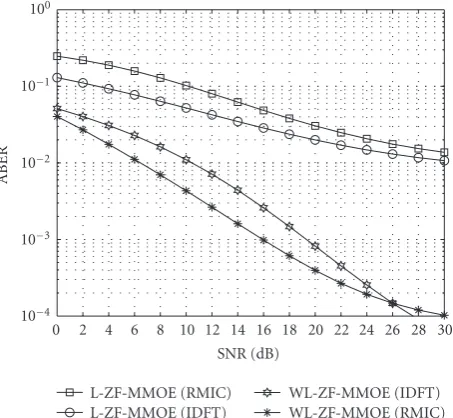
Figure 2: ABER versus SNR (Environment 1, CP-based system, SIR=10 dB).
10−4 10−3 10−2 10−1 100
0 2 4 6 8 10 12 14 16 18 20 22 24 26 28 30 SNR (dB)
ABER
L-ZF-MMOE (RMIC) L-ZF-MMOE (IDFT)
WL-ZF-MMOE (IDFT) WL-ZF-MMOE (RMIC)
Figure 3: ABER versus SNR (Environment 1, ZP-based system, SIR=10 dB).
NBI, assuring in particular a huge performance gain with re-spect to the “WL-ZF-MMOE (IDFT)” receiver.
The results ofFigure 3were obtained instead by consid-ering a ZP-based system. In this scenario, both IDFT and RMIC precoding assure the existence of L- and WL-ZF so-lutions for any FIR channel of order less than or equal to L. It can be seen that, notwithstanding their channel-irrespective ICI suppression capabilities, the “L-ZF-MMOE (RMIC)” and “L-ZF-MMOE (IDFT)” equalizers are not able to achieve satisfactory NBI rejection, achieving ABER of only about 10−2 for SNR = 30 dB. In contrast, both the “WL-ZF-MMOE (IDFT)” and “WL-“WL-ZF-MMOE (RMIC)”
equal-10−4 10−3 10−2 10−1 100
0 2 4 6 8 10 12 14 16 18 20 22 24 26 28 30 SIR (dB)
ABER
L-ZF (RMIC) L-ZF (IDFT)
WL-ZF-MMOE (IDFT) WL-ZF-MMOE (RMIC)
Figure 4: ABER versus SIR (Environment 1, CP-based system, SNR=20 dB).
izers not only assure perfect ICI suppression, but also ex-hibit a remarkable robustness against the NBI. In particu-lar, note that, except for very high values of the SNR, the ZF-MMOE (RMIC)” equalizer outperforms the “WL-ZF-MMOE (IDFT)” one.
5.1.2. ABER versus SIR
In this experiment, we evaluated the performances of the considered equalizers as a function of the SIR ranging from 0 to 30 dB. With reference to a CP-based system, results of
Figure 4further corroborate the good NBI suppression ca-pabilities of the “WL-ZF-MMOE (RMIC)” equalizer, which largely outperforms the “L-ZF (IDFT),” “L-ZF (RMIC),” and “WL-ZF-MMOE (IDFT)” equalizers, for all the considered values of the SIR. On the other hand, it can be seen from
Figure 5that, for a ZP-based system, both WL equalizers al-low one to achieve a significant performance gain with re-spect to their linear counterparts, by working well even in the presence of strong NBI signal. Specifically, with respect to the “WL-ZF-MMOE (IDFT)” receiver, the “WL-ZF-MMOE (RMIC)” equalizer remarkably saves about 14 dB in trans-mitter power, for a target ABER of 2·10−4. This evidences that adoption of the RMIC precoder is important not only for perfect WL symbol recovery in the absence of distur-bance, but also for improved NBI suppression.
5.2. Environment 2: MC system employingM=256
subcarriers with ZP/CP lengthLr=16
In this environment, the CP- and ZP-based MC systems em-ployM = 256 subcarriers, withLr = 16. Observe that, in this case, it results thatWnbi≈0.4/M, that is, the NBI band-width is about 40% of the subcarrier spacing. The baseband discrete-time multipath channel{h(m)}L
10−4 10−3 10−2 10−1
0 2 4 6 8 10 12 14 16 18 20 22 24 26 28 30 SIR (dB)
ABER
L-ZF-MMOE (RMIC) L-ZF-MMOE (IDFT)
WL-ZF-MMOE (IDFT) WL-ZF-MMOE (RMIC)
Figure 5: ABER versus SIR (Environment 1, ZP-based system, SNR=20 dB).
filter of orderL=16, whose taps are modeled as i.i.d. zero-mean unit-variance complex proper Gaussian random vari-ables, independently varying over 103Monte Carlo runs.
5.2.1. ABER versus SNR
In this experiment, we evaluated the performances of the equalizers compared in the Environment 1, as a function of the SNR ranging from 0 to 30 dB.Figure 6reports the results for a CP-based, whereasFigure 7refers to a ZP-based system. Basically, Figures6and7show the same performance trends of Figures2and3, by further corroborating the effectiveness
of the proposed RMIC precoding strategy. It is interesting to observe that, in general, the full-column rank property of the channel matrixHdoes not necessarily mean that the inver-sion of the matrixHHH, which is needed to calculateH†in
(6), is nicely conditioned. In particular, it might happen that, for a large number of subcarriers, the condition number of HHHmay be too large and, consequently, the ZF constraint GH = IM might not be satisfied exactly.8Interestingly, re-sults of Figures6and7show that this problem does not occur for the RMIC precoder, which not only guarantees thatHis full-column rank for any FIR channel of orderL≤Lr, but ad-ditionally assures that channel inversion is well-conditioned even when a large number of subcarriers is used.
6. CONCLUSIONS
We considered the problem of deriving mathematical con-ditions guaranteeing WL-FIR perfect symbol recovery in
8IfHHH is near to be singular, matrixH†is the minimal norm least-squaresolution of the ZF constraintGH=IM.
10−6 10−5 10−4 10−3 10−2 10−1
0 2 4 6 8 10 12 14 16 18 20 22 24 26 28 30 SNR (dB)
ABER
L-ZF (RMIC) L-ZF (IDFT)
WL-ZF-MMOE (IDFT) WL-ZF-MMOE (RMIC)
Figure 6: ABER versus SNR (Environment 2, CP-based system, SIR=10 dB).
10−6 10−5 10−4 10−3 10−2 10−1
0 2 4 6 8 10 12 14 16 18 20 22 24 26 28 30 SNR (dB)
ABER
L-ZF-MMOE (RMIC) L-ZF-MMOE (IDFT)
WL-ZF-MMOE (IDFT) WL-ZF-MMOE (RMIC)
Figure 7: ABER versus SNR (Environment 2, ZP-based system, SIR=10 dB).
were not optimized and the channel impulse response was assumed to be exactly known at the receiving side; the inter-esting extensions of jointly optimal transceiver optimization and blind subspace-based channel estimation are the topic of our current research and will be addressed in a forthcoming paper.
APPENDICES
A. PROOF OF THEOREM1
Let us consider the case where the channel transfer func-tion H(z) has 0 ≤ Mz ≤ Ldistinct zeros on the
subcarri-thus, the diagonal matrixAcpis singular with rank(Acp)=
2(M−Mz). SinceBcpandJare nonsingular, the matrixBcpis full-column rank by construction. Thus, the matrixAcpBcp is full-column rank if and only if [31]N(Acp)∩R(Bcp)= {02M}. The null space ofAcp can be readily characterized: an arbitrary vectorμ=[μT longs to the subspace R(Bcp) if and only if there exists a vectorα ∈ CM such that S
zβ = Bcpα. As a consequence, condition N(Acp)∩R(Bcp) = {02M} holds if and only if the system of equations Bcpα−Szβ = 02M admits the unique solution α = 0M and β = 02Mz. It can be seen
[32] that this happens if and only if and only if the matrix [Bcp,Sz]∈ C2M×(M+2Mz)turns out to be full-column rank. Furthermore, since it results [40] that rank([Bcp,Sz]) = rank(Sz) + rank[(I2M−SzSz−)Bcp], with rank(Sz) = 2Mz andSz− =SzT [31], it follows that rank[Bcp,Sz]=M+ 2Mz holds if and only if rank[(I2M−SzSzT)Bcp]=M.
B. PROOF OF THEOREM2
Whenσ2
v→0, evaluation ofPd,minis complicated by the fact thatRddbecomes singular and, thus, the inverse (ΠRddΠH)−
1
does not exist. Accounting for (24) and resorting to the limit formula for the Moore-Penrose inverse [38], one has
lim the orthogonal projector on the subspaceN(ΠL). Under condition (C3), the matrix ΠL ∈ C(2Q−M)×2Rnbi turns out to be tall and, thus, the dimension of its null space is equal to the number 2Rnbi of columns minus rank(ΠL). Due to the fact thatΠH =O(2Q−M)×M, the columns ofH belong to N(Π), that is,R(H) ⊆ N(Π); however, if condition (C4) holds, the subspaceR(H) has the same dimensionM ofN(Π), thus obtainingR(H)= N(Π) which, together
This work is in part supported by Italian National project Wireless 8O2.16 Multi-antenna mEsh Networks (WOMEN) under Grant no. 2005093248 and in part by the Centro Re-gionale di Competenze sulle Tecnologie dell’Informazione e della Comunicazione (CRdC ICT).
REFERENCES
[1] Z. Wang and G. B. Giannakis, “Wireless multicarrier commu-nications: where Fourier meets Shannon,”IEEE Signal Process-ing Magazine, vol. 17, no. 3, pp. 29–48, 2000.
[2] T. Starr, J. M. Cioffi, and P. J. Silvermann, Understanding Digital Subscriber Line Technology, Prentice-Hall, Englewood Cliffs, NJ, USA, 1999.
[3] http://www.homeplug.org/.
[4] “IEEE 802.11 working group for wireless local area networks,” http://grouper.ieee.org/groups/802/11/.
[5] ETSI Normalization Committee, “High performance radio lo-cal area networks (HIPERLAN) type 2,”http://www.etsi.org/. [6] ETSI Normalization Committee, “Radio broadcasting
sys-tems, digital audio broadcasting (DAB) to mobile, portable, and fixed receivers,”http://www.etsi.org/.
[7] ETSI Normalization Committee, “Digital video broadcasting (DVB): framing structure, channel coding and modulation for digital terrestrial television,”http://www.etsi.org/.
[8] A. Scaglione, G. B. Giannakis, and S. Barbarossa, “Redundant filterbank precoders and equalizers. I. Unification and optimal designs,”IEEE Transactions on Signal Processing, vol. 47, no. 7, pp. 1988–2006, 1999.
[9] A. Scaglione, G. B. Giannakis, and S. Barbarossa, “Redundant filterbank precoders and equalizers. II. Blind channel estima-tion, synchronizaestima-tion, and direct equalizaestima-tion,”IEEE Transac-tions on Signal Processing, vol. 47, no. 7, pp. 2007–2022, 1999. [10] B. Muquet, Z. Wang, G. B. Giannakis, M. de Courville, and P.
Duhamel, “Cyclic prefixing or zero padding for wireless multi-carrier transmissions?”IEEE Transactions on Communications, vol. 50, no. 12, pp. 2136–2148, 2002.
[11] A. Scaglione, S. Barbarossa, and G. B. Giannakis, “Filterbank transceivers optimizing information rate in block transmis-sions over dispersive channels,”IEEE Transactions on Informa-tion Theory, vol. 45, no. 3, pp. 1019–1032, 1999.
[13] D. Darsena, G. Gelli, L. Paura, and F. Verde, “A constrained maximum-SINR NBI-resistant receiver for OFDM systems,”
IEEE Transactions on Signal Processing, vol. 55, no. 6, pp. 3032– 3047, 2007.
[14] D. Darsena, G. Gelli, L. Paura, and F. Verde, “Joint equalisation and interference suppression in OFDM systems,”Electronics Letters, vol. 39, no. 11, pp. 873–874, 2003.
[15] D. Darsena, G. Gelli, L. Paura, and F. Verde, “NBI-resistant zero-forcing equalizers for OFDM systems,”IEEE Communi-cations Letters, vol. 9, no. 8, pp. 744–746, 2005.
[16] P. J. Schreier and L. L. Scharf, “Second-order analysis of im-proper complex random vectors and processes,”IEEE Trans-actions on Signal Processing, vol. 51, no. 3, pp. 714–725, 2003. [17] J. Eriksson and V. Koivunen, “Complex random vectors
and ICA models: identifiability, uniqueness, and separability,”
IEEE Transactions on Information Theory, vol. 52, no. 3, pp. 1017–1029, 2006.
[18] B. Picinbono and P. Chevalier, “Widely linear estimation with complex data,”IEEE Transactions on Signal Processing, vol. 43, no. 8, pp. 2030–2033, 1995.
[19] H. L. Van Trees,Optmimum Array Processing, John Wiley & Sons, New York, NY, USA, 2002.
[20] G. Gelli, L. Paura, and F. Verde, “On the existence of FIR zero-forcing equalizers for nonredundantly precoded transmissions through FIR channels,”IEEE Signal Processing Letters, vol. 12, no. 3, pp. 202–205, 2005.
[21] Z. Ding and G. Li, “Single-channel blind equalization for GSM cellular systems,”IEEE Journal on Selected Areas in Communi-cations, vol. 16, no. 8, pp. 1493–1505, 1998.
[22] D. Darsena, G. Gelli, L. Paura, and F. Verde, “Subspace-based blind channel identification of SISO-FIR systems with im-proper random inputs,”Signal Processing, vol. 84, no. 11, pp. 2021–2039, 2004, special issue on Signal Processing in Com-munications.
[23] W. H. Gerstacker, R. Schober, and A. Lampe, “Receivers with widely linear processing for frequency-selective channels,”
IEEE Transactions on Communications, vol. 51, no. 9, pp. 1512– 1523, 2003.
[24] S. Benedetto and E. Biglieri,Principles of Digital Communi-cations with Wireless AppliCommuni-cations, Kluwer Academic/Plenum, New York, NY, USA, 1999.
[25] International Telecommunication Union (ITU) and Radio-communication Study Groups, “Study of the required geo-graphic coordination distance between a HAPS TDMA sys-tem and adjacent syssys-tem IMT-2000 terrestrial mobile stations operating in the same frequency band,” document 8-1/368-E, May 1988.
[26] J. A. C. Bingham,The Theory and Practice of Modem Design, John Wiley & Sons, New York, NY, USA, 1988.
[27] P. Siohan, C. Siclet, and N. Lacaille, “Analysis and design of OFDM/OQAM systems based on filterbank theory,”IEEE Transactions on Signal Processing, vol. 50, no. 5, pp. 1170–1183, 2002.
[28] G. Gelli and F. Verde, “Blind subspace-based channel identifi-cation for quasi-synchronous MC-CDMA systems employing improper data symbols,” inProceedings of the 14th European Signal Processing Conference (EUSIPCO ’06), Florence, Italy, September 2006.
[29] P. Ciblat and E. Serpedin, “A fine blind frequency offset esti-mator for OFDM/OQAM systems,”IEEE Transactions on Sig-nal Processing, vol. 52, no. 1, pp. 291–296, 2004.
[30] T. Fusco and M. Tanda, “Blind frequency-offset estimation for OFDM/OQAM systems,”IEEE Transactions on Signal Process-ing, vol. 55, no. 5, pp. 1828–1838, 2007.
[31] R. Penrose, “A generalized inverse for matrices,”Proceedings of the Cambridge Philosophical Society, vol. 51, pp. 406–413, 1955.
[32] R. A. Horn and C. R. Johnson,Matrix Analysis, Cambridge University Press, New York, NY, USA, 1990.
[33] F. D. Neeser and J. L. Massey, “Proper complex random pro-cesses with applications to information theory,”IEEE Trans-actions on Information Theory, vol. 39, no. 4, pp. 1293–1302, 1993.
[34] S. V. Schell, “A separability theorem for 2M conjugate-symmetric signals impinging on an M sensor array,”IEEE Transactions on Signal Processing, vol. 45, no. 3, pp. 789–792, 1997.
[35] A. Chevreuil and P. Loubaton, “Blind second-order identifica-tion of FIR channels: forced cyclostaidentifica-tionarity and structured subspace method,”IEEE Signal Processing Letters, vol. 4, no. 7, pp. 204–206, 1997.
[36] E. Serpedin and G. B. Giannakis, “Blind channel identification and equalization with modulation-induced cyclostationarity,”
IEEE Transactions on Signal Processing, vol. 46, no. 7, pp. 1930– 1944, 1998.
[37] D. Slepian, “Prolate spheroidal wave functions, Fourier analy-sis, and uncertainty. V. The discrete case,”Bell System Technical Journal, vol. 57, no. 5, pp. 1371–1430, 1978.
[38] A. Ben-Israel and T. N. E. Greville, Generalized Inverses, Springer, Berlin, Germany, 2002.
[39] R. T. Behrens and L. L. Scharf, “Signal processing applications of oblique projection operators,”IEEE Transactions on Signal Processing, vol. 42, no. 6, pp. 1413–1424, 1994.