Proposed Vector-Controlled Two-Phase Induction
Motor as A Replacement for Single Phase Induction
Motor
Mr. Eeram Krishna Murthy &
Mr. S Chandra Kiran
1
B.Tech degree in Electrical and Electronics Engineering in the year of 2011 from BITIT,
Hindupur, Ananthapuramu, Andhra Pradesh
Dr.KVSRIT, Kurnool, Andhra Pradesh State, India.
[email protected]
2
Asst. Professor at Dr. KVSRIT, Kurnool Sree Vidyanikethan Engineering College, Tirupati,
Andhra Pradesh, India
[email protected]
ABSTRACT :
This paper presents vector controlled of single phase induction motor. some problems are with vector
controlled SPIM.As SPIM’s are typically to maintain speed and also about the complex
implementation of vector controlled SPIM.the implemantion of the proposed vector controlled TPIM
compared to the vector controlled SPIM. The general modal sutable for vector control of the
unsymmentrical two phase induction motor and also stator flux oriented controlled strategies are
analized. the comparative performance of both has been presented in this work with help of a
practical three phase motor.
I.
INTRODUCTION:
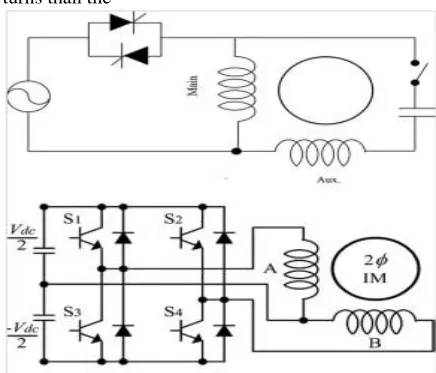
SPIMs normally require auxiliary winding and main winding as well as a capacitor to produce the starting torque. SPIMs are typically classified ac- cording to their starting technique. SINGLE-phase induction motors (SPIMs) are employed widely in the fractional power range, particularly in house-holds where a three-phase ac electrical supply is not available. The unsymmetrical two-phase induction machines are widely used in high volume commercial applications due to their relative low cost and high reliability. Conventionally, these machines are fed from a single-phase ac mains supply. To achieve variable speed operation a power electronics inverter can be used. Although in this case a configuration with a single phase input / three phase output inverter driving a three phase induction motor seams to be economically preferable, it is believed that for certain applications the true potential of the unsymmetrical two-phase induction motor drive is not yet exhausted.The fig1 are represents single phase induction motor &two phase induction motor. This paper presents several problems encountered in conventional vector-controlled SPIMs and proposes a vector control strategy for a symmetrical two-phase induction motor (TPIM) drive (as vector-controlled TPIM) as a viable replacement for the vector controlled SPIM. The implementation of the vector- controlled TPIM is simpler and more accurate than a vector-controlled SPIM. Because self inductances and the rotor self-inductances in the d-q axis, respectively.
II.
CONVENTIONALVECTOR-
CONTROLLED SPIM MODEL
:
SPIMs are classified as unsymmetrical TPIMs. Fig. 2 shows the dq-axis equivalent circuit of an unsymmetrical TPIM in terms of the stationary reference frame. This equivalent circuit is more complicated than that of three-phase induction motors because the auxiliary winding has more turns than the
Fig2:Three Phase Power Device circuit.
main winding. The dynamic SPIM model neglecting core saturation and iron losses can be described using a stationary reference frame
+p = +
+p = + (1)
0= +p + , = +
0= +p - , = + (2)
where p is the derivation operator and ωr is the rotor angular speed , ,& , are the stator
voltages and the stator currents in the d-q axis in terms of the stationary reference frame(superscripts).
= + ;
speed. The currents supplied to the machine need to be oriented in phase and in quadrature to the rotor Flux. This can be accomplished by choosing ωe so that the rotor flux is entirely in the d-axis, resulting in λeqr = 0 , λedr constant.
This expresses the field orientation concept in the dq-variables. Therefore, is reduced to below expression.
Te = P/2.Ldm/Lr.λedr ieqs1 (10)
e e
= + ;
=stator fulx in the dq axies; = stator fulx in the dq axies;
, are are the stator self-inductances in the
dq-axis and the rotor self-inductance, respectively. , are theleakage stator inductances in the dq-axis and leakage rotor inductance,respectively. , are are the magnetizing inductances in the
d-q axis. The constant k is defined as the winding turn ratio and is given by the following:
ωe − ωr = ωsl = Ldm/τr.i qs1/λ dr (11) The rotor position angle θe can be
obtained indirectly by Summing the rotor position angle θr and slip position angle θsl . The SPIM models to compensate for the unbalanced operation In terms of the stationary reference frame can be derived from (1)–(2) and are given by the following:
vsds = (rds + L2dm/τrLr)isds + σdsLdspisds + esds(12) vsqs = (rqs +L2qm/τrLr)isqs + σqsLqspisqs + esqs(13) Where
esds = −Ldm/Lr (ωrλsqr + λsdr/τr) (14)
s s s
= ≈
The instantaneous electromagnetic torque Te can be expressed in terms of the flux linkages and currents
e qs = Lqm/Lr (ωrλ dr –λ qr/τr) (15) Where σds(= 1 − L2dm/LrLds) and
σqs(= 1 − L2qm/LrLqs)
Are the leakage factors in the dqaxis. esds
s
= ) (3)
Te and the load torque TL are related by the following equation:
)=J +F (4)
and e qs are the counter electromotive forces in the dq-axis. The compensated stator voltage
equations in terms of the synchronous reference frame can be rewritten considering (4) and (5) as [6]
e 2 e e
where P, J, and F are the number of machine poles, inertia, and viscous friction coefficient, respectively.
v ds =(rds + L dm/τrLr)i ds1+ σdsLdsdi ds1/dt +
eeds1 + ceds1 (16)
Many studies have concentrated on modified SPIM e 2 e e
models to eliminate the unbalanced operation. This section examines one of the SPIM models, which was presented by Correa The mutual inductances are not identical in the torque The ac term of the
v qs1 =(rqs +L qm/τrLr)i ds1+σqsLqsdi qs1/dt +
eeqs1 + ceqs1 (17)
Where the modified counter electromotive forces are given by
e e
electromagnetic torque can be eliminated by adjusting the stator currents. The phase currents, stator voltages, and counter electromotive forces in the d-q- axis must be redefined to characterize the modified
e ds1 = −Ldm λr/(τrLr) − ωeσdsLdsi qs1 (18) eeqs1 = Ldmωrλr/Lr + ωeσdsLdsieds1 (19) Where the compensated electromotive forces are given by
e 2 e
SPIM models due to the adjustment of a(or)k. c ds1 = − (a Lqs − Lds) i qs1 e (20)
2 e
; (5)
= ; ;
= ( - ) (6)
dλsdr / dt= −λsdr/τr− ωrλsqr +1/τr.Ldm is
ds1 (7) c qs1 = (a rqs − rds) i qs1 (21)
2.1SPIM DRIVE SYSTEM
:
Conventional vector-controlled SPIM methods have concentrated mostly on eliminating unbalanced operation because vector control strategies are based on a balanced drive system involving symmetrical motors. Modified stator voltage equations are needed to compensate for the unbalanced SPIM operation,
e e
With τr = Lr /rr . The rotor-flux model in terms of the synchronous
dλedr/dt = −λedr/τr + ωslλeqr +1/τrLdm ieds1 (8)
dλeqr/dt = −λedr/τr− ωslλedr +1/τrLdm ieqs1 (9)
Where ωsl (= ωe − ωr ) is the slip angular speed and ωe I theSynchronous angular
that a vector controlled symmetrical motor.
2.2DIFFICULTY IN MEASURING THE
SPIM PARAMETERS
:
The parameters for ac machines need to be preciselytooperateavector-controlled ac machine without error. The parameters for symmetrical machines can be calculated precisely using the no- load test and locked-rotor test. On the other hand, unsymmetrical motors produce negative and positive torque during operation. This makes measuring the parametersmorecomplicatedInaddition,modelling,re newing,andoptimizing Single-phase capacitor motors are difficult compared to symmetrical motors. Therefore, many calculations and iterations of measuring tests are needed to determine theSPIM parameters.Innumerouscomputercalculationswerepr oposedtoobtainprecisemeasurementsoftheSPIMpara meters.Therefore,unsymmetrical machines as SPIM is not proper to control the speed motor by using a vector control strategies, and symmetrical motors should be used as a replacement.
III.
VECTOR CONTROL STRATEGY
FOR TPIM DRIVE:
This section proposes a vector control strategy for symmetrical TPIMs (as “vector- controlled TPIM“) as a replacement for the vector- controlled SPIM. Historically, the vector control strategies have concentrated on three-phase ac machines and have not been attempted in symmetrical TPIM until now. The vector-controlled TPIM can solve several of the problems that plague the v of the TPIM precisely.ector-controlled SPIM, and can control the speed of the TPIM precisely. until now. The vector-controlled TPIM can solve several of the problems that plague the vector-controlled SPIM, and can control the speed of the TPIM precisely. Before going to analyze any motor or generator, it is very much important to obtain the machine in terms of equivalent mathematical equations. Traditional per phase equivalent circuit has been widely used in steady state analysis and design of induction motor. As the per phase equivalent circuit of the machine is only valid in steady state condition, in an adjustable-speed drive the machine normally constitutes an element within a feedback loop, and therefore its transient behavior has to be taken into consideration. The dynamic model considers the instantaneous effects of varying voltages/currents, stator frequency, and torque disturbances. A dynamic model of the machine subjected to control must be known in order to understand and design of vector controlled drives
.
Due to the fact that every good control has to face any possible change of the plant, it could be said thatthe dynamic model of the machine is the approximation of the real plant. Nevertheless, should incorporate all the important dynamic effects occurring during both steady-state and transient operations. Furthermore it should be valid for any changes in inverter’s supply such as voltages and or currents the dynamic model of the induction motor is derived by using a two-phase motor in direct and quadrature axes.
IV.
REFERENCE FRAMES:
The required transformation in voltages, currents, or flux linkages is derived in a generalized way. The reference frames are chosen to be arbitrary and particular cases, such as stationary, rotor and synchronous reference frames are simple instances of the general case. R.H. Park in the 1920s, proposed a new theory of electrical machine analysis to represent the d-q model. He transformed the stator variables to a synchronously rotating reference frame fixed in the rotor, which is called Park’s transformation. He showed that all the time varying inductances that occur due to an electric circuit in relative motion and electric circuits with varying magnetic reluctances could be eliminated. In 1930s, H.C Stanley showed that time varying inductances in the voltage equations of an induction machine due to electric circuits in relative motion can be eliminated by transforming the rotor variables to a stationary reference frame fixed on the stator. Later G. Kron proposed a transformation of both stator and rotor variables to a synchronously rotating reference that moves with the rotating magnetic field.
4.1AXIS TRANSFORMATION (3Φ TO 2Φ):
NEED FOR TRANSFORMATION
:
The dynamic performance of an induction machine is somewhat complex because the three phase rotor windings move with respect to the three phase stator windings. The machine model can be described by differential equations with time varying mutual inductances, (between the three phases of the stator and the three phases of the rotor) but such a model tends to be very complex. Hence to reduce the complexity it is necessary to transform the three phase windings into equivalent two-phase machine.
V.
THREE PHASE MODEL
:
Available online:http://internationaljournalofresearch.org/ P a g e | 359
s s
design studies, it is important to liberalize the machine equations around a steady state operating point to obtain smallsignal equations.Thedynamic performance of an induction machine is somewhat complex because the three phase rotor windings move with respect to the three phase stator windings. Hence to reduce the complexity it is necessary to transform the three phase windings into equivalent two-phase machine. This approach is desirable because of the conceptual simplicity obtained with two sets of windings, one on the stator and the other in the rotor. The equivalence between the three phase and two phase machine models is derived from simple observation, and this approach is suitable for extending it to model an n-phase machine by means of a two phase machine
.
Fig 5 fid-q axies phase conversion
It is convenient to set θ = 0, so that the qS axis is aligned with the as axis by ignoring the zero sequence component the transformation relations cam be simplified as
(22)
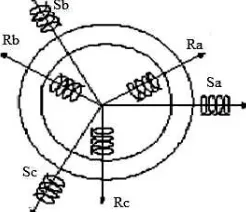
Fig. 3 Representation of three phase stator and rotor.
coupling effect in three-phase stator and rotor windings of motor. Consider a symmetrical three phase induction machine with stationary stator winding axes
as-bs
-
cs at 2Π/3 angle apart as shownin Fig.2.4 Our goal is to transform the 3-φ stationary
And inversel
(23)
(24)
(26)
(27)
reference frame (as-bs-cs) variables into 2-φ stationary
reference frame (ds-qs) variable sand then transform
these to synchronously rotating reference frame (de
-qe) and vice versa.
For example assume that the 3-φ stator voltages are sinusoidal and balanced, and are given by
(28)
(29)
(30)
(26) &(27) By substituting the above equations we obtain
(31)
(32)
show that Vqs and Vds are balanced, 2-φ voltages of equal peak values and the latter is at Π/2 angle phase lead with respect to the other component
Fig 4 Stationary frame a-b-c to ds-qs axes transformation
VI.
MODELLING OF INDUCTION MOTOR
ALONG STATIONARY
REFERENCE FRAME:
(33) (34)
(35)
(36)
Differences Between the Vector-Controlled TPIM and the Vector-Controlled Three-Phase AC Motor The vector control strategy for symmetrical TPIM is derived from the vector-controlled three-phase ac machine. Three-phase ac motors are operated by a rotating mmf. The rotating mmf vector Fss
is determined by the addition of the stationary threephase mmfs vectors
Fss= Fas + aFbs + a2Fcs = Fds + jFqs (37) where a = ej2π/3 = cos 23π + j sin 23π .(38) The abc→dq transformation for the phase currents in terms of the stationary reference frame is needed for vector-controlled three-phase ac motors
isabc =2/3ias – 1/2(ibs + ics) + j√3/2(ibs − ics ) (39)
VII.
SINUSOIDALPULSEWIDTHMODU
LATION(PWM)TECHNIQUEFORT HETWO
LEG INVERTER
:
Although many PWM techniques for voltage source invertershave been proposed, the sinusoidal PWM technique is the simplest method for an inverter [20]. In this paper, the sinusoidal PWM technique was used for the two-leg inverter-fed TPIM, as shown in Fig. 1(b). The offset voltage specified by Vsn exists between the phase voltages Vds and Vqs across the loads, and the output voltages Vdn and Vqn exist in the two-leg inverter. Therefore, the determined output voltages Vdn and Vqn can be expressed as follows: Vdn = Vds + Vsn (40)
Vqn = Vqs + Vsn . (41)
VIII.
TRANSIENT RESPONSE FOR THE MOTOR
SPEED, REFERENCE Q-
AXIS STATOR CURRENT:
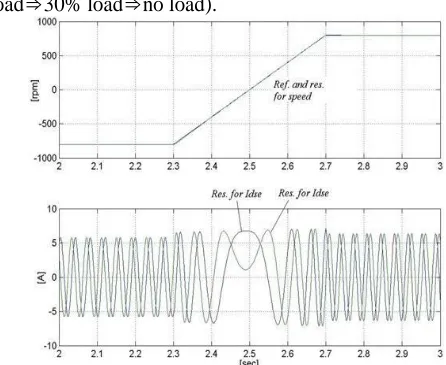
Response for the q-axis stator current, and rotating q-axis stator current due to the variation of speed under 30% load torque (400 r/min⇒800 r/min). speed: 1760 r/min, and the number of poles: 4), which can be calculated using the no-load test and locked-rotor test. Fig. 12 shows the transient response for the motor speed, reference q-axis stator current Iqs its response Ie qs for the qaxis stator current, and the rotating q-axis stator current Is qs when the reference speed is changed suddenly from 400 to 800 r/min under a 30% load torque. The q-axis stator current Ie qs is in proportion to the load torque except during the transient response period; its magnitude is
Fig:6 Single Phase Induction Motor Simulation Circuit
approximately 2.5 A. The actual frequency of Isqs is in proportion to the reference speed. Fig. 13 shows the transient response for the
motor speed, Ie. qs , Ie qs,
and Is qs, in the q-axis when the load torque is
changed suddenly from no load to a 30% load
torque and returned to a no load at a fixed speed
of 800 r/min. The motor speed maintains a
constant 800 r/min regardless of the magnitude of
the load torque. The magnitude of the rotating
stator current Is qs increases but its frequency
is
fixed due to the motor speed. Fig. 14 shows the reference motor speed, transient response for the motor speed, and reference q-axis stator current Ie. qs , along with its response for Ieqs when the reference speed changes suddenly in the opposite direction from.400 to 400 r/min under.Transient response for the motor
speed, reference q-axis stator current, response for
the q-axis stator current, and rotating q-axis stator
current under a fixed 800 r/min due to a variation
of theload (no
load
⇒
30% load
⇒
no load).
Available online:http://internationaljournalofresearch.org/ P a g e | 361
Fig:8 Transient response for themotor speed, reference q-axis stator current,and rotating q-axis stator current under no load due to the quick variation in the opposite direction of the reference speed (−400 r/min ⇒ 400 r/min ⇒ −400 r/min).
Fig:9 Transient response for the motor speed,reference Q- axies stator current,response for the q-axies stator current ,and roratind q-axies stator current under a fixed 800r/m due variation of the load(no load=30%load=no load).
Fig:12 Vector controlled Two Phase Induction motor Simulation circuit
Fig:13 Implementation of vector controlled three phase induction motor simulation circuit.
Fig:10 Two reference voltages,triangular carrier wave,and two output voltages in a two leg inverter
0
0.5
1
1.5
2
2.5
3
Fig:14 Three phase O/p currents Iabc
Fig:11 Experimental waveforms for the steady-state two-phase
0
0.5
1
1.5
2
2.5
3
currents and their locus.
0
0.5
1
1.5
2
2.5
3
Fig:16 Fulx,torque & speed wave forms
0
0.5
1
1.5
2
2.5
3
Fig:17 idqs wave forms.
0
0.5
1
1.5
2
2.5
3
Fig;18 fdqs wave forms
0 0.5
1 1.5
2 2.5
3
Fig;19 Two phase induction motor reference speed
IX.
CONCULSION
:
work where three phase power is not available easily,in those areas these single phase to three phase converters are use full.
REFERENCES:
[1] D.Wang, ―Hybrid fuzzy vector control for single phase induction motor,‖ in Proc. Int.Conf. Comput. Control Ind. Eng., 2010, pp. 122–125.
[2] A. Nied, J.Oliveira, F. R. L. Sa, R. Campos, and L. H. R. C. Stival, ―Singlephase induction motor indirect field oriented control under nominal load,‖ in Proc. Power Electron. Drive Syst., 2010, pp. 789– 793.
[3] C. Mdemlis, I. Kioskeridis, and T. Thodoulidis, ―Optimization of singlephase induction motors— Part I: Maximum energy efficiency control,‖ IEEE Trans. Energy Convers., vol. 20, no. 1, pp. 187–195, Mar.2005.
[4] M. F. Rahman and L. Zhong, ―A current- forced reversible rectifier fed single-phase variable speed induction motor drive,‖ in Proc. 27th Annu. IEEE Power Electron. Spec. Conf., Jun., 1996, pp. 114– 119.
[5] C. Schauder, ―Adaptive speed identificacin for vector control of induction motors without rotational transducers,‖ IEEE Trans. Industry Applications, vol. 28, no. 5, pp. 1054–1061, Sept./Oct.1992.
[6] M. E. Elbuluk, L. Tong, and I. Husain,―Neural network based model reference adaptive systems for high-performance motor drives and motion controls,‖ IEEE Trans. Ind. Appl., vol. 38, no. 3, pp. 879–886,May/Jun. 2002.
[7] S. Bolognani and M. Zigliotto, ―Fuzzy logic control of a switched reluctance motor drive,‖ IEEE Trans. Ind. Appl., vol. 32, no. 5, pp. 1063–1068, Sep./Oct. 1996.
[8] Jang, D.H. - Yoon, D.Y.: Space-vector PWM technique for two-thase inverter-fed two phase induction motors, IEEE Transactions on Industry Applications, vol. 39, no. 2, Mar./Apr. 2003, pp.542– 549.
[9] Blaabjerg, F. - Lungeanu, F. - Skaug, K. - Tonnes, M.: Two-phase induction motor drives, IEEE
Transactions on
Industry Applications, vol. 10, no. 4, Jul./Aug. 2004,pp. 24–32.
[10] P.C. Krause, O. Waszynchuk and S.D. Sudhoff, Analysis of Electrical Machinery, IEEE Press, New York, 1995.
[11] P. Vas, Parameter Estimation, Condition Monitoring, and Diagnosis of Electrical Machines, Clarendon Press, Oxford, 1993.
[12 ] P. N. Enjeti et al., ―Economic single phase to three phase converter topologies for fixed frequency output,‖ IEEE APEC Con$ Rec., pp. 88-94, 1991.
[13] C. Chen et ab, ―A single phase to three phase power converter for motor drive applications,‖ IEEE IAS Con$ Rec., pp. 639- 646, 1992.
[14] P. N. Enjeti and A. Rahman, ―A new single- phase to three-phase converter with active input current shaping for low cost ac motor drives,‖IEEE Trans.
[15] C. Attaianese, A. Del Pizzo, E. Pagano, and A. Perfetto, “Modelling, renewing and optimizing single-phase capacitor motors for home applications,” in Proc. IEEE Ind. Appl. Soc. Conf. Rec, 1986, pp. 831–839.
[16] E. F. Fuchs, A. J. Vandenput, J. Holl, and J. C. White, “Design analysis of capacitor-run single-phase induction motors,” IEEE Trans. Energy Convers., vol. 5, no. 2, pp. 327–336, Jun. 1990.
[17] Y. H. Cho, K. Y. Cho, H. S. Mok, K. H. Kim, and J. S. Lai, “Phase current reconstruction techniques for two-phase inverters using a single current sensor,” J. Power Electron., vol. 11, no. 6, pp. 837–845, 2011.
[18] D.-H. Jang, “PWM methods for two-phase inverters,” IEEE Ind. Appl. Mag., vol. 13, no. 2, pp. 50–61, Mar./Apr. 2007.
[19] Paul C. Krause, Analysis of Electric Machinery. New York: McGraw- Hill, 1987.
Mr. EERAM KRISHNA MURTHY was born in India. He received B.Tech degree in Electrical and Electronics Engineering in the year of 2011 from BITIT, Hindupur, Ananthapuramu, Andhra Pradesh State and pursuing M.Tech degree in Power Electronics and Electrical drives in EEE Department in Dr.KVSRIT, Kurnool, Andhra Pradesh State, India.
mail id: [email protected]
Mr. S CHANDRA KIRAN was born in India. He is presently working as an Asst. Professor at Dr. KVSRIT,
Kurnool. He received M.Tech degree in the
specialization of Electrical Power systems in the year of 2012 from Sree Vidyanikethan Engineering College, Tirupati, Andhra Pradesh, India. His area of interests are Neural Networks, Fuzzy logics and Power Quality. He has published three International Journals and has attended one National Conference on Power Quality.