Proficient Valuation and Estimation of
Human Performance in Collective Learning
Environments using Machine Learning
B. Monisharani, D. Janani, Kaliappan,
IV B.E (CSE), Dept. of Computer Science and Engineering, P. A. College of Engineering and Technology, Pollachi, Coimbatore, Tamil Nadu, India
IV B.E (CSE), Dept. of Computer Science and Engineering, P. A. College of Engineering and Technology, Pollachi, Coimbatore, Tamil Nadu, India
Assistant Professor, Dept. of Computer Science and Engineering, P. A. College of Engineering and Technology, Pollachi, Coimbatore, Tamil Nadu, India
ABSTRACT: Machine learning has attracted more andmore attention in the past few decades. In this paper, we have proposed a machine learning-based system architecture and algorithms to find patterns of learning, interaction, and relationship and effective valuation for a complex system involving massive data that could be obtained from a proposed collective learning environment (CLE). Collective learning may take place among larger team members to find solutions for real-time events or problems, and to discuss concepts or interactions during situational judgment tasks (SJT). Modeling a collective, networked system that involves multimodal data presents many challenges. This paper focuses on proposing a Machine Learning - (ML)-based system architecture to promote understanding of the behaviors, group dynamics, and interactions in the CLE. The designed framework integrates techniques from computational psychometrics (CP) and deep learning models that include the utilization of convolutional neural networks (CNNs) for feature extraction, skill identification, and pattern recognition. The proposed framework also identifies the behavioral components at a micro level, and can help us model behaviors of a group involved in learning.
KEYWORDS: Collective Learning, Deep Learning, Computational Psychometrics, Machine Learning, Human Behavior, Skills.
I. INTRODUCTION
Collective learning methods have been implemented broadly by organizations at all stages, as research recommends that active human involvement in cohesive and micro group communications is critical for effective learning [1]. In current research, an important line of inquiry focuses on finding accurate evidence and valid valuation of these micro-level interactions which supports collective learning. Even though there is a long practice of using mathematical models for modeling human behavior, Cipresso (2015) [2] introduced a computational sychometrics-based method for modeling characteristics of real behavior. Cipresso’s [2] article provides us with a way to extract dynamic interaction features from multimodal data for modeling and analyzing actual situations.
and visualization of group dynamics such as correctly assessing the increase in the groups’ level of shared understanding of different perspectives, and ability to clarify misconceptions.
This proposed paper is an extension of our ongoing work [3], [4] and here we present details regarding the ML architecture for data-intensive computing and efficient valuation. Our paper is organized as follows: in Section II we briefly discuss our related work on ML for multi-modal human interaction analytics. In Section III we discuss a three-stage architecture for large-scale CLE and the layout of the functional components. Based on the
architecture discussed in section III, preliminary experimentation analysis is discussed in Section IV. In Section V we discuss scalable applications of our framework for next-generation collective learning and valuation systems, as well as for the Department of Homeland Security (DHS) and the Department of Defense (DoD). Section VI concludes with directions for future work.
In this paper, we extend the foundation laid out in our recent work to implement CP, AI, and ML for effective valuation of teamwork skills. The next sections discuss in detail, the three-stage architecture for data-intensive computing and efficient valuation.
II. DESIGN AND ARCHITECTURE
Considerable data-intensive, high-performance, scalable computing is transforming our capabilities to gather and analyze data in different forms. This may lead to new inventions and discoveries in education, science, and technology. This may also impact learning and valuation (LAS) platforms. Data-intensive computing changes our thinking about education, science, and technology, by accelerating an ability to perform advanced data collection and computing [10]. Data-intensive scalable computing has a high potential for unique applications. This will be more challenging when we need to scale up the platform to handle large-scale datasets (Terabyte, Petabyte, Zettabyte scale). Recent improvements in computing have led to substantial progress towards the visualization capabilities of such data. Data analytics and visualization will serve as a vital tool for the validation of expected results by accurately identifying patterns and relationships in data. Visualization may play an essential role in understanding the big picture in group interactions within the CLE and may assist in detecting hidden factors. Convolutional Neural Network (CNN) and one of its approaches – deep learning (DL) may require the use of a highly efficient Graphical Processing Unit (GPU) implementation or for training on multiple GPUs [11], [12], [13] or for applications of this architecture to substantial learning populations.
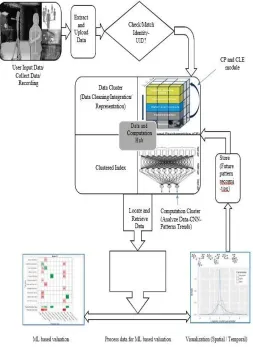
Fig. 1 illustrates a possible arrangement of components for machine learning (ML) based data-intensive computing and efficient valuation. Some of the components are listed here:
A. Data Integration and Processing
B. Massive data intensive CNN (deep learning) based cloud computing and Computational Psychometrics (CP)
C. Effective Valuation (EA)
A. Data Integration and Processing
A data cluster would enable massive data integration, processing, and performing of such tasks as data collection, information extraction, and storing large-size distributed datasets for long-term access. Data collection is an essential phase of acquiring data from multiple sources, categorizing it, and passing it to the next stage in the process as shown in Fig. 1. Data on humans, machines, and other entities can be categorized as structured or unstructured and incorporated into a distributed Hadoop infrastructure.
Fig. 1. Framework for ML based data intensive computing and proficient valuation.
B. Massive data intensive CNN (deep learning) based cloud computing and Computational Psychometrics (CP)
Once data has been categorized (as described in part ‘A’), we can use a computation cluster to analyze the data on a cloud platform to understand individual and group abilities. We plan to use Python/R to run deep learning in the cloud using ACT’s enterprise learning analytics platform (LEAP). We plan to deploy a feature extraction algorithm including CNN based deep learning for skill, pattern, trend identification, and for achieving state-of-the-art accuracy in feature classification. We plan to update this network structure over time to make this a dynamic system.
computing platform consists of 3 layers, i.e., map/reduce on top of Hadoop, HPC (high-performance computing) infrastructure for massive data processing and CNN deep learning-based cloud computing. For HPC, we use a method for dynamic partitioning of processes. Network updater adds new network specific data entries under the situation of any real-time events such as changes in the team and their activities.
Computational Psychometrics (CP): Collective problem solving (CPS) is identified as cross-cutting capabilities
which is part of ACT’s Holistic Framework [9]- a comprehensive description of the knowledge and 21st-century skills individuals need to know and be able to succeed at school and work [9],
[17]. Advanced development in computational techniques and analytical tools has produced new pathways in CPS research
Simultaneously, psychometrics researchers started developing valuations using advanced computational techniques and analytical tools which have emerged as a novel interdisciplinary field of prominent research called, “Computational Psychometrics (CP)” [19], [20], [21]. CP is a new area of learning and valuation (LAS) research, which consist of data-driven machine learning and information querying computer science methods, theory-data-driven psychometrics, and stochastic theory – all used in order to measure learner’s latent abilities in real time [7], [19], [20], [22]. As shown in Fig. 1, computation cluster integrates CP and CLE components.
C. Effective Valuation (EA)
The effective valuation (EA) module locates and retrieves data after the computation is finished using the CNN and CP modules illustrated in section II-B. The CNN and CP modules carry out feature extraction, model training, and pattern identification from two player dyadic gameplay logs and behavioral data. Through effective valuation, we aim to analyze human behavior as it relates to specific situations in the game, to detect the dynamics of group behavior, such as shared understanding and engagement at the micro level.
For achieving our objectives, the EA module identifies/detects clusters of interactions, and abilities based on degree, connected components, and it performs collective learning skill analysis i.e., whether there is any change (increase) in group understanding for a given problem or situation. For example, it carries out real-time regular and critical event/person analyses such as situational data processing and real-time data correlation (correlation of skills, attainment level between groups). Using machine learning, we analyze collective learning network attributes such as users (nodes), interactions (links, weighted flow), knowledge (skills/abilities), local and global system parameters (engagement, shared understanding), behaviors, group density, and cluster formation and centrality.
The EA module also performs predictive decision-making based on group behaviors. This module stores future patterns which can be used for any exploratory analytics and effective visualization of past and present group interactions and relative performance. Biometric data is analyzed for biometric database matching and for biometric image processing. Biometric data are unique physical characteristics such as face, eye tracking/ iris, and fingerprints, which can be used for automated recognition [2], [6], [23].
Based on the three-stage architecture discussed in this section, section-IV demonstrates preliminary experimentation analysis.
III. EXPERIMENTATION ANALYSIS
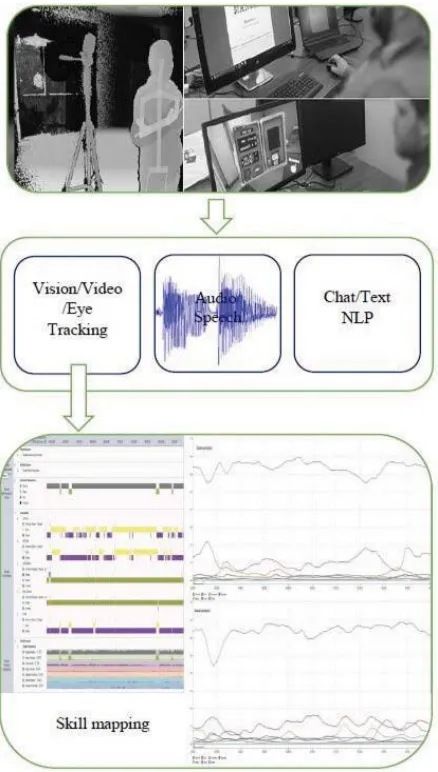
installed, an external monitor with the Tobii eye tracking [25] unit mounted below the screen, with a webcam (with internal microphone) mounted above the screen. A wireless keyboard and mouse will also be connected to the laptop. As shown in Fig. 2, this study focused on collecting the following: game log data, user eye tracking, and user portrait video/audio, chat logs (conversation flow), behavioral expressions, object clicks, time in-game & between games. Our objective is to use this CPS human-human game log-data for team interaction analysis and for finding teamwork skill evidence based on the CPS construction.
Fig. 2. CLE multi-modal data analytics and skill mapping process.
IV. MOUNTABLE APPLICATIONS
The proposed ML-based data-intensive computing framework has wide-ranging scalable applications including next-generation collective learning and valuation systems, DHS, Defense-Army, Airforce, Navy soldiers/Team training, and development. U.S. Army is considering learner and team-centric training, which will allow the development of mission-capable militaries, and organized teams to handle (win) in complex situations [29], [30], [31], [32].
V. CONCLUSIONS AND FUTURE WORK
In this proposed paper, we have presented a machine learning (ML)-based system architecture to identify evidence about teamwork skills from the behavior, group dynamics, and interactions in the CLE. We developed a three-stage robust architecture for data-intensive computing and efficient valuation of teamwork CPS skills.
In our future work, we will attempt to build text-based Natural Language Processing (NLP) / Machine Learning (ML) models to identify or classify various performances of CPS subskills from the chat logs, audio/video interactions data collected throughout the study. Additional feature extraction that may be used during this phase will be implemented for CNN based pattern identification. The knowledge gained in developing this baseline model will represent significant guidance for proceeding phases and potential studies to follow.
REFERENCES
[1] L. Lei, J. Hao, A. von Davier, P. Kyllonen, and J-D. Zapata-Rivera. “A tough nut to crack:
Measuring collective problem solving.” Handbook of Research on Technology Tools for Real-World Skill Development. IGI Global, 2016. 344-359. Web. 28 Aug. 2018. doi:10.4018/978-1-4666-9441-5.ch013
[2] P. Cipresso, “Modeling behavior dynamics using computational psychometrics within virtual worlds,” Frontiers in Psychology, vol. 6, no.
1725, p.22, 6 November 2015.
[3] P. Chopade, K. Stoeffler, S. M. Khan, Y. Rosen, S. Swartz, and A. von Davier, “Human-Agent valuation: Interaction and sub-skills
scoring for collective problem solving,” in: Penstein Rosé C. et al.(eds) Artificial Intelligence in Education. AIED 2018. Lecture Notes in Computer Science, vol 10948, pp 52-57, June 2018 Springer, Cham, DOI https://doi.org/10.1007/978-3-319-93846-2_10
[4] P. Chopade, S. M. Khan, K. Stoeffler, D.Edward, Y. Rosen, and A. von Davier, “Framework for effective teamwork valuation in
collective learning and problem solving,” in 19th International Conference on Artificial Intelligence in Education (AIED), LAS, The Festival of learning, ARL workshop “Valuation and Intervention during Team Tutoring” AIED-2018, vol-2153, pp-48-59, July 2018. CEUR-WS.org/Vol-2153/paper6.pdf
[5] P. Chopade, M. Yudelson, B. Deonovic, and A. von Davier, Modeling Dynamic Team Interactions for Intelligent Tutoring, in Joan
Johnston, Robert Sottilare, Anne M. Sinatra, C. Shawn Burke (ed.) Building Intelligent Tutoring Systems for Teams (Research on Managing Groups and Teams, vol. 19) Emerald Publishing Limited, pp.131 - 151, ISBN: 978-1-78754-474-1, September 2018.
https://www.emeraldinsight.com/doi/abs/10.1108/S1 534-085620180000019010
https://books.emeraldinsight.com/page/detail/Buildin g-Intelligent-Tutoring-Systems-for-Teams/?k=9781787544741
[6] S. Khan, “Multimodal behavioral analytics in intelligent learning and valuation systems,” in Innovative Valuation of Collaboration.
Methodology of Educational Measurement and Valuation, A. von Davier, Z. M. and K. P., Eds., Springer, Cham, 2017, pp. 173-184.
[7] S. Polyak, A. von Davier and K. Peterschmidt, “Computational Psychometrics for the measurement of collective problem-solving
skills,” in Proceedings of ACM KDD conference, Halifax, Nova Scotia CANADA, August 2017 (KDD2017), Halifax, Nova Scotia CANADA, 2017.
[8] S. Polyak, A. von Davier, and K. Peterschmidt, “Computational Psychometrics for the measurement of collective problem solving
skills,”Frontiers in Psychology, 8, pp.20-29, 2017. http://doi.org/10.3389/fpsyg.2017.02029
[9] W. Camara, R. O’Connor, K. Mattern, and M.Hanson, “Beyond academics: A Holistic Framework for enhancing education and
workplace success.” ACT Research Report Series, 2015 (4).ACT, Inc. 2015.
[10] C. Chen and C. Zhang, “Data-intensive applications, challenges, techniques and technologies:A survey on Big Data,” Information
Sciences, vol.275, pp. 314-347, 2014.
[11] A. Krizhevsky, I. Sutskever, and G. Hinton,“ImageNet classification with deep convolutional neural networks,” in NIPS: Advances in
Neural Information Processing Systems 25, 2012.
[12] C. Piech, J. Bassen, J. Huang, S. Ganguli, M. Sahami, L. Guibas and J. Sohl-Dickstein, “Deep knowledge tracing,” in NIPS, In Advances
in Neural Information Processing Systems, 2015.
[13] “CNN Convolutional neural network,”Wikipedia, https://en.wikipedia.org/wiki/Convolutional_neural_n etwork
[14] DOE, “Synergistic challenges in data-intensive science and exascale computing,”Department of Energy, ASCAC Data Subcommittee
[15] R. Moore, B. C., R. Marciano, A. Rajasekar, and M. Wan, “Data-Intensive computing,” in The Grid: Blueprint for a New Computing Infrastructure, I. Foster and C. Kesselman, Eds., New York, Morgan Kaufmann Publishers Inc, ELSEVIER, pp. 105-128, 1998
[16] S. Creese, T. Gibson-Robinson, M. Goldsmith, D. Hodges, Dee Kim, O. Love, J. Nurse, B. Pike, and J. Scholtz, “Tools for understanding
identity,” in Technologies for Homeland Security (HST), 2013 IEEE International Conference, Nov 2013.
[17] “Organization for Economic Cooperation and Development (OECD),” PISA 2015 draft collective problem-solving framework., 2015.
[18] G. Grover, M. Bienkowsk, A. Tamrakar, B. Siddiquie, D. Salter, and A. Divakaran, “Multimodal analytics to study collective problem
solving in pair programming,” in LAK '16 Proceedings of the Sixth International Conference on Learning Analytics & Knowledge, 2016.
[19] A.vonDavier,“Computational Psychometrics in support of collective educational valuations,” Journal of Educational Measurement, vol.
54, pp. 3-11, 2017.
[20] A. von Davier, “Virtual and collective valuations: Examples, implications, and challenges for educational measurement.,” in Invited Talk
at the Workshop on Machine Learning for Education at International Conference of Machine Learning, Lille, France, 2015.
[21] A. von Davier, Ed., Measurement issues in collective learning and valuation, vol. 54, Journal of Educational Measurement, [Special
Issue], pp. 3-11, 2017.
[22] A. von Davier, M. Zhu, and P. Kyllonen, Eds., Innovative valuation of collaboration, Springer International Publishing, 2017.
[23] Y. Huang and S. Khan, “DyadGAN: Generating facial expressions in dyadic interactions,” in 2017 IEEE Conference on Computer Vision
and Pattern Recognition Workshops (CVPRW), Honolulu, HI, 2017.
[24] GlassLab,Inc.https://www.glasslabgames.org/
[25] Tobii Eye Tracking https://www.tobii.com/
[26] Noldus https://www.noldus.com/
[27] S. Moulder, T. Sheridan, A. Dulai, and G. Rossini, “Deep Learning in the Cloud with MATLAB R2016b,” Mathworks, 2016.
[28] “Mathworks Inc. MATLAB- Statistics and Machine Learning Toolbox,” 2017.
[29] “The U.S. Army learning concept for training and education 2020-2040, TRADOC Pamphlet 525-8-
2,” U.S. Army, April 2017.
[30] I. Magnisalis, S. Demetriadis, and A. Karakostas, “Adaptive and intelligent systems for collective learning support: A review of the Field,”IEEE Transactions on Learning Technologies, vol. 4, no. 1, pp. 5-20, 28 January 2011.
[31] G. Goodwin, J. Johnston, and R. Sottilare,
“Individual learner and team modeling for adaptive training and education in support of the US Army learning model: Research Outline,” US Army Research Laboratory, September 2015.