International Journal of Emerging Technology and Advanced Engineering
Website: www.ijetae.com (ISSN 2250-2459,ISO 9001:2008 Certified Journal, Volume 4, Issue 10, October 2014)
609
A Writer Identification System of Greek Historical
Documents using MATLAB
M. K. Konstantakis
1, E. J. Yannakoudakis
21
School of Social Sciences and Psychology, Department of Sociology, Panteion University, L.Syggrou 136, GR-17671 Athens, Greece
2Department of Informatics, Athens University of Economics & Business, Patission 76, GR-10434 Athens, Greece
Abstract--In this paper we present a system for writer
identification from historical lines of text, where features are extracted and used to recognize individuals. The main goal is to analyze documents of different writing styles in order to identify the writers. We consider a complete 2D probability distribution that takes into account all possible combinations of angle pairs, outperforming original code. The images included are taken from the Greek digital
library Hellinomnimon available at
http://www.lib.uoa.gr/hellinomnimon/. The experiments are based on 7 pages of text written by 43 different writers.
Keywords-- Writer identification, Handwriting analysis,
Feature extraction, Edge-hinge distribution, Historical documents.
I. INTRODUCTION
The growth of artificial intelligence and pattern recognition fields owes greatly to one of the highly challenged problem of handwriting identification. Identifying the handwriting of a writer is highly essential today due to the immense growth in technology and its applications in wide areas. The application of writer identification is in wide areas, such as, digital rights management in the financial sphere, to solve the expert problems in criminology by forensic expert decision-making systems, where a narrowed-down list of identified writers provided by the writer identification system. By combining with the writer verification as an authentication system this can be used to monitor and regulate the access to certain confidential sites or data where large amounts of documents, forms, notes and meeting minutes are constantly being processed and managed, knowing the identity of the writer would provide an additional value. It can also be used for historical document analysis [1], handwriting recognition system enhancement [2] and hand held and mobile devices [3].
To a certain extent its recent development and performance consider as a strong physiologic modalities of identification, such as DNA and fingerprints [4]. It is evident that the importance of writer identification has become more significant in these days. Obviously, the number of researchers involved in this challenging problem is going high as a result of these opportunities.
There are numerous languages throughout the world. Each language poses a different threat to the writer identification problem depending on the characteristics of the language. So it is very clear that the identification
problem varies across multiple languages. The
handwriting-based writer identification is an active research arena.
As it is one of the most difficult problems encountered in the field of computer vision and pattern recognition, the handwriting-based writer identification problem faces with a number of sub problems like :
designing algorithms to identify handwritings of
different individuals,
identifying relevant features of the handwriting,
basic methods for representing the features,
identifying complex features from the basic
features developed and,
evaluating the performance of automatic
methods.
The main goal of this paper is to analyze documents of different writing styles in order to identify the writers. In the end of the experimental procedure we insert to the database model some texts of unknown writers in order to recognize the writer and confirm the functionality of the system.
The rest of the paper is organized as follows. Section 2 describes the theoretical part of the historical documents. Section 3 describes the research about the writer identification procedure and the previous works in that field. In the following, the proposed method and statistical approach (feature extraction stage and classification stage) is detailed in section 4, while in section 5 the experimental results aredemonstrated. Finally, conclusions are drawn in section 6 and references in section 7.
II. HISTORICAL DOCUMENTS
International Journal of Emerging Technology and Advanced Engineering
Website: www.ijetae.com (ISSN 2250-2459,ISO 9001:2008 Certified Journal, Volume 4, Issue 10, October 2014)
610
Especially the latter task, handwriting recognition, is challenging for a number of reasons, including training sets of small size, unusual writing styles, crossed out or overwritten words, and other artifacts.Previous research on the recognition of handwriting in historical documents has been described in [9], where a hidden Markov model recognizer for holistic handwritten words has been applied to manuscripts of George Wash-ington, and in [7] where HMMs as well as conditional ran-dom field models have been used for handwriting recog¬nition on the same manuscript. In [6] the attention has been on speeding up a the recognition task for indexing historical documents, and in [15] it has been focused on character recognition in historical Greek documents.
The system described in this paper is being developed for the recognition of historic manuscripts from Greek authors in the context of research in literature, physics, mathematics and geography (see Figure 1 for example image).
Fig.1 Example of Greek historical document
III. WRITER IDENTIFICATION
Research in writer identification has received renewed interest in the recent years. A wide variety of features, local or global and structural or statistical, have been proposed that serve to distinguish the writing of an individual from another.
Consequently the approaches proposed in the last several years renewed the interests in this scientific community for the research topic. Figure 2 presents the standard framework of writer identification [11].
The necessary features from the handwritten documents are extracted as the first step. Later the features extracted are used to classify to which writer the document belongs using similarity score method. The document is classified as belonging to a writer with high similarity score:
Fig.2 Example of historical Greek handwritten document
Based on the input method of writing, automated writer identification has classifieds into on-line and off-line. The on¬line writer identification task is considered to be less difficult than the offline one as it contains more information about the writing style of a person, such as speed, angle or pressure, which is not available in the off-line one [12, 13]. Based on the different features associated with the writing, such as character, word, line, paragraph and the document, this has classified.
Text-dependent & text-independent are the other
classification of automated writer identification.
Dependent on the text content, text-dependent methods only matches the same characters and requires the writer to write the same text consequently. The text-independent methods are able to identify writers independent of the text content and it does not require comparison of same characters. Thus it is very similar to signature verification techniques and uses the comparison between individual characters or words of known semantic (ASCII) content. This method considers as the global style of hand writing text as the metric for comparison, and also got better identification results. As it requires the same writing content this method is not apt for many practical situations. Even though it got a wider applicability, text-independent methods do not obtain the same high accuracy as text-dependent methods do.
Previous Works
International Journal of Emerging Technology and Advanced Engineering
Website: www.ijetae.com (ISSN 2250-2459,ISO 9001:2008 Certified Journal, Volume 4, Issue 10, October 2014)
611
These features can be broadly classified in two families: features extracting from texture: the document image is simply seen in this case as an image and not as a handwriting. For example, application of Gabor filters and co-occurrence matrices were considered in [14].
structural features: in this case the extracted features attempt to describe some structural properties of the handwriting. One can quote for example the average height, the average width, the average slope and the average legibility of characters [16].
Note that it is also possible to combine the two families of features [18]. The nature of these statistical features, extracted from a block of text, has allowed to reach interesting performance, which are however always difficult to compare due to a lack of common references.
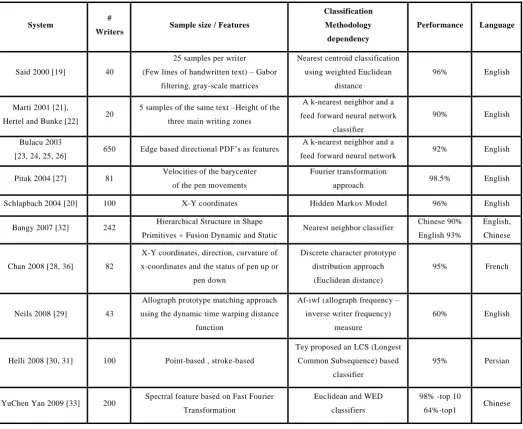
One can also categorize the previous works according to the number of writers and the nature of training samples used by the system (see table 1).
[image:3.595.40.564.312.741.2]On the one hand the system is required to deal with as much writers as possible while on the other hand, training samples of each handwriting may represent several lines of text or on the contrary a few words.
Table 1.
Comparison of performance and test conditions for writer identification in most r ecent studies.
System #
Writers Sample size / Features
Classification
Methodology
dependency
Performance Language
Said 2000 [19] 40
25 samples per writer
(Few lines of handwritten text) – Gabor
filtering, gray-scale matrices
Nearest centroid classification
using weighted Euclidean
distance
96% English
Marti 2001 [21],
Hertel and Bunke [22] 20
5 samples of the same text –Height of the
three main writing zones
A k-nearest neighbor and a
feed forward neural network
classifier
90% English
Bulacu 2003
[23, 24, 25, 26] 650 Edge based directional PDF’s as features
A k-nearest neighbor and a
feed forward neural network
classifier
92% English
Pitak 2004 [27] 81 Velocities of the barycenter of the pen movements
Fourier transformation
approach 98.5% English
Schlapbach 2004 [20] 100 X-Y coordinates Hidden Markov Model 96% English
Bangy 2007 [32] 242 Hierarchical Structure in Shape Primitives + Fusion Dynamic and Static
Features
Nearest neighbor classifier Chinese 90% English 93%
English,
Chinese
Chan 2008 [28, 36] 82
X-Y coordinates, direction, curvature of
x-coordinates and the status of pen up or
pen down
Discrete character prototype
distribution approach
(Euclidean distance)
95% French
Neils 2008 [29] 43
Allograph prototype matching approach
using the dynamic time warping distance
function
Af-iwf (allograph frequency –
inverse writer frequency)
measure
60% English
Helli 2008 [30, 31] 100 Point-based , stroke-based
Tey proposed an LCS (Longest
Common Subsequence) based
classifier
95% Persian
YuChen Yan 2009 [33] 200 Spectral feature based on Fast Fourier Transformation
Euclidean and WED
classifiers
98% -top 10
International Journal of Emerging Technology and Advanced Engineering
Website: www.ijetae.com (ISSN 2250-2459,ISO 9001:2008 Certified Journal, Volume 4, Issue 10, October 2014)
612
IV. THE PROPOSED METHOD –STATISTICAL APPROACHResearch in automatic writer identification has mainly focused on the statistical approach. This has led to the specification and extraction of statistical features such as run-length distributions, slant distribution, entropy, and edge-hinge distribution [23]. The edge-hinge distribution feature outperforms all other statistical features.
We have improved and used Luigi Rosa and Laurens van der Maaten's excellent package for writer identification [34, 37]. Luigi Rosa consider a complete 2D probability distribution that takes into account all possible combinations of angles pairs, outperforming original code.
The statistical approach consist of two stages: a feature-extraction stage and a classification stage. In the feature-extraction stage, features are extracted from handwriting and are stored in feature vectors. In the classification stage, the feature vectors are mapped onto classes representing the writers.
IV.I Feature Extraction Stage
EDGE Distribution
Feature extraction starts with conventional edge detection (we used Sobel, followed by thresholding) that generates a binary image in which only the edge pixels are "on".[23]
We then consider each edge pixel in the middle of a square neighborhood and we check in all directions emerging from the central pixel and ending on the periphery of the neighborhood for the presence of an entire edge fragment:
Fig.3 Extraction of edge direction distribution
All the verified instances are counted into a histogram that is finally normalized to a probability distribution which gives the probability of finding in the image an edge fragment oriented at the angle measured from the horizontal.
In order to avoid redundancy, the algorithm only checks the upper two quadrants in the neighborhood because, without on-line information, we do not know which way the writer "traveled" along the found oriented edge fragment.
EDGE-HINGE Distribution
A method of feature extraction that is similar to the one previously described, but it has added complexity. Edge-hinge distribution is mainly focused in the neighborhood, not one, but two edges fragments emerging from the central pixel and, subsequently, compute the joint probability distribution of the orientations of the two fragments.
Fig.4 Extraction of edge-hinge distribution
Edge-hinge distribution is a feature that
characterizes the changes in direction of a writing stroke in handwritten text. The edge-hinge distribution is extracted by means of a window that is slid over an edge-detected binary handwriting image. Whenever the central pixel of the window is on, the two edge fragments (i.e. connected sequences of pixels) emerging from this central pixel are considered. Their directions are measured and stored as pairs. A joint probability distribution is obtained from a large sample of such pairs. ( p(x,y) = P(X = x and Y = y) ).
Run-Length Distribution
Run lengths, first proposed for writer identification by Arazi [35], are determined on the binarized image taking into con-sideration either the black pixels corresponding to the ink trace or, more beneficially, the white pixels corresponding to the back¬ground. Whereas the statistical properties of the black runs mainly pertain to the ink width and some limited trace shape characteris¬tics, the properties of the white runs are indicative of character placement statistics. There are two basic scanning methods: hori¬zontal along the rows of the image and vertical along the columns of the image. Similarly to the edge-based directional features pre¬sented above, the histogram of run lengths is normalized and inter¬preted as a probability distribution.
IV.II Classification Stage
International Journal of Emerging Technology and Advanced Engineering
Website: www.ijetae.com (ISSN 2250-2459,ISO 9001:2008 Certified Journal, Volume 4, Issue 10, October 2014)
613
D= pdist(X) computes the Euclidean distance (set as default) between pairs of objects in m-by-n data matrix X. Rows of X correspond to observations, and columns correspond to variables. D is a row vector of length m(m–1)/2, corresponding to pairs of observations in X. The distances are arranged in the order (2,1), (3,1), ..., (m,1), (3,2), ..., (m,2), ..., (m,m–1)). D is commonly usedas a dissimilarity matrix in clustering or
multidimensional scaling.
To save space and computation time, D is formatted as a vector. However, we can convert this vector into a square matrix using the squareform function so that element i, j in the matrix, where i < j, corresponds to the distance between objects i and j in the original data set.
Given an m-by-n data matrix X, which is treated as m (1-by-n) row vectors x1, x2, ..., xm, the various distances between the vector xs and xt are defined as follows:
Euclidean distance
Notice that the Euclidean distance is a special case of the Minkowski metric, where p = 2.
Standardized Euclidean distance
Where V is the n-by-n diagonal matrix whose jth diagonal element is S(j)2, where S is the vector of standard deviations.
Minkowski metric
√∑
Notice that for the special case of p = 1, the Minkowski metric gives the city block metric, for the special case of p= 2, the Minkowski metric gives the Euclidean distance, and for the special case of p = ∞, the Minkowski metric gives the Chebychev distance.
V. EXPERIMENTS AND RESULTS
We consider a complete 2D probability distribution that takes into account all possible combinations of angles pairs, outperforming original code.
We used a Matlab implementation and some of the main functions of the platform are:
Select image: read the input image
Add selected image to database: the input
image is added to database and will be used for training
Database Info: show informations about the
images present in database.
Writer Recognition: writer identification. The
selected input image is processed.
Delete Database: remove database from the
current directory.
Remove a specified image: we can remove a
specified image from the database.
Exit: quit program.
In the experiments, 7 pages of text written by 43 different writers are used, Greek authors in the context of research in literature, physics, mathematics and geography.
From the Matlab menu of our program we inserted the images (7x43=301 images) to the database and categorized them by ID and author name. (43 ID’s of 43 different writers).
For testing the program we used test images of known writers ( in example Vardalaxos_test and Velestinlis_test) and test images of unknown writers taken from the Greek digital library Hellinomnimon (at the bottom of the Hellinomnimon page):
Γηδαζθαιία Eληειήο ζπζηεκαηηθή απάζεο ηεο
Eκπνξηθήο Eπηζηήκεο (Ηάζην, 1817) – ID: agnostos1.
Επγφκεηξνλ ήηνη ηα δχγηα θαη κέηξα δηαθφξσλ
εκπνξίσλ (Βελεηία, 1803) – ID: agnostos2.
Πηλαθίδηνλ Aξηζκεηηθφλ (Βηέλλε, 1791) – ID:
agnostos3.
By using Vardalaxos_test we received the above results after the feature extraction and the writer recognition process:
The program analyzed that the Vardalaxos_test image matches exactly with the Vardalaxos as a writer.
International Journal of Emerging Technology and Advanced Engineering
Website: www.ijetae.com (ISSN 2250-2459,ISO 9001:2008 Certified Journal, Volume 4, Issue 10, October 2014)
614
The program analyzed that the agnostos1_2 image matches exactly with the Karantinos (ID) as a writer.
In the table below we can see the authors, the Id’s of each author, the context or research and the Identification name. We can see the authors and the context of research in the table below:
Author ID Context of research Id name
Αιεμαλδξίδεο Γεκήηξηνο (1784 - 1851;) 1 Ηζηνξία ηεο Διιάδνο : Απφ ηεο πξψηεο θαηαβνιήο ησλ Διιεληθψλ πξαγκάησλ άρξη ηεο αιψζεσο ηεο Κσλζηαληηλνχπνιεο χπν ησλ Οζσκαλψλ
Alexandridis
Βαξδαιάρνο Kσλζηαληίλνο (1775 - 1830) 2 Μαζήκαηα δηα ηνπο Παίδαο. Τφκνο Τξίηνο (Οδεζζφο 1830) Vardalaxos
Βάξθνζεο Νηθφιανο ( ; - πεξ. 1782) 3 Λνγηθή Βαυκατζηέξνπ (Βηέλλε, 1795) Varkosis
Βεληακίλ Λέζβηνο (1759/1762 - 1824) 4 Γεσκεηξίαο Eπθιείδνπ Σηνηρεία [Τφκνο Β'] (Βηέλλε, 1820) - Σηνηρεία Aξηζκεηηθήο [Τφκνο Α'] (Βηέλλε, 1818)
Veniamin
Βιεκκίδεο Νηθεθφξνο (1197-1272) 5 Δπηηνκή Λνγηθήο (Λεηςία, 1784) Vlemmidis
Βνχιγαξηο Eπγέληνο (1716 - 1806) 6 A. Tαθνπεηίνπ, Σηνηρεία Γεσκεηξίαο (Βηέλλε, 1805) - Σηνηρεία ηεο Μεηαθπζηθήο,(Βελεηία, 1805)
Voulgaris
Γιπηδνχλεο Mαλνπήι (1530/1540 - 1596) 7 Bηβιίνλ πξφρεηξνλ ηνηο πάζη πεξηέρνλ ηελ ηε πξαθηηθήλ αξηζκεηηθήλ... (Βελεηία, 1568)
Glytzounis
Γνβδειάο Γεκήηξηνο (1780 - 1831) 8 Σηνηρεία Aιγέβξαο (Χάιιε, 1806) - Σηνηρεία Aξηζκεηηθήο (Ηάζην, 1818)
GovdelasD
Γνβδειάο Μηραήι (ηέιε 18νπ αη. - κέζα 19νπ αη.)
9 Aη ηεο Φχζεσο Eπνραί (Βελεηία, 1816) GovdelasM
Γακαζθελφο ν Σηνπδίηεο (αξρέο 16νπ αη.- 1577) 10 Mεξηθή δηάγλσζηο εθ ησλ παιαηψλ θηινζφθσλ πεξί Φχζεσο (Βελεηία, 1682)
Damaskinos
Γεκεηξίνπ Θσκάο (κέζα 18νπ αη. - αξρέο 19νπ αη.)
11 Χεηξαγσγφο Έκπεηξνο ηεο Πξαγκαηείαο (Βηέλλε, 1809) Dimitriou
Εαθαξάλαο Σππξίδσλ (πεξ. 1770 - πεξ. 1830) 12 Tνπ λαπθιήξνπ Eθεκεξηλή εηο ην πέιαγνο πξάμηο (Κσλζηαληηλνχπνιε, 1803)
Zafaranas
Θενηφθεο Nηθεθφξνο (1731 - 1800) 13 Σηνηρείσλ Mαζεκαηηθψλ εθ παιαηψλ θαη λεσηέξσλ ζπλεξαληζζέλησλ, (Μφζρα, 1798)
Theotokis
Ησαλλίδεο Παλαγηψηεο (ηέιε 18νπ αη. - κέζα 19νπ αη.)
14 Βεδνχη Λέσλ, Ζ ζχληνκνο έθζεζηο ηνπ πιαλεηηθνχ ζπζηήκαηνο (Παξίζη, 1825)
Ioannidis
Κάβξαο Zήζεο (πεξ. 1760 - 1844;) 15 Σηνηρεία ηεο Aξηζκεηηθήο θαη Aιγέβξεο (Ηέλα, 1800) Kavras
Καλέινο Σηέθαλνο (1792 - 1823) 16 Φπζηθή δεκψδεο εηο παχζηλ ηεο δεηζηδαηκνλίαο (Βελεηία, 1810)
Kanelos
Καξαθηνπιάθεο Aλαζηάζηνο (πεξ. 1780 - πεξ. 1840)
17 Αξηζηνηέινπο θπζηνγλσκνληθά (Κσλζηαληηλνχπνιε, 1819) Karakioulafis
Καξαληελφο Ησάλλεο (1784 - 1834) 18 Γηαζάθεζηο εηο ηελ επίηνκνλ ζεσξίαλ... ηνπ θπξίνπ Λαθξνπά (Κέξθπξα, 1826) - Σεηξά ζηνηρεηψδνπο Μαζεκαηηθήο, ηφκνο Α': Σηνηρεία Αξηζκεηηθήο (Βηέλλε, 1828)
Karantinos
International Journal of Emerging Technology and Advanced Engineering
Website: www.ijetae.com (ISSN 2250-2459,ISO 9001:2008 Certified Journal, Volume 4, Issue 10, October 2014)
615
VI. CONCLUSIONSThe recognition of handwritten manuscripts has gained increasing attention in recent years. In this paper we have presented an effective method for writer identification for Greek historical documents using Matlab. Our particular focus of attention is on the Greek digital library
Hellinomnimon available at
http://www.lib.uoa.gr/hellinomnimon/.
The experiments are based on 7 pages of text written by 43 different writers.
We have improved and used Luigi Rosa and Laurens van der Maaten's excellent package for writer identification [34]. Luigi Rosa consider a complete 2D probability distribution that takes into account all possible combinations of angles pairs, outperforming original code.
The statistical approach consist of two stages: a feature-extraction stage and a classification stage.
The achieved identification rates are very promising: For the Vardalaxos_test image the nearest ID is
number 2 and the distance from Database is equal to 0.0600 and
Κνθθηλάθεο Kσλζηαληίλνο (1781 - 1831) 20 Ηζηνξίαο ηνπ Δκπνξίνπ επηηνκή (Βηέλλε, 1809) Kokkinakis
Κνκκεηάο Σηέθαλνο (πεξ. 1770 - 1830;) 21 Παηδαγσγηθά Μαζήκαηα Γεσγξαθίαο (Πέζηε, 1828) Kommitas
Κνξπδαιεχο Θεφθηινο (1563/1574 - 1646) 22 Eίζνδνο Φπζηθήο Aθξνάζεσο θαη' Aξηζηνηέιελ (Βελεηία, 1779) - Δηο άπαζαλ ηελ Λνγηθήλ ηνπ Αξηζηνηέινπο (Βελεηία, 1729)
Koridalevs
Κνχκαο Kσλζηαληίλνο (1777 - 1836) 23 Σχλνςηο Φπζηθήο (Βηέλλε, 1812) Koumas
Κσλζηαληίλνπ Γεψξγηνο (1710/1730 - πεξ. 1790) 24 Παγθφζκηνο Iζηνξία ηεο Oηθνπκέλεο (Βελεηία, 1759) Konstantinou
Κψπαο Γεξάζηκνο (1778 - 1832) 25 Πίλαμ ηεο θιίζεσο ηνπ Hιίνπ (Κσλζηαληηλνχπνιε, 1816) Kopas
Λαζζάλεο Γεψξγηνο (1793 - 1870) 26 Ζ δηά θσλήο Aξηζκεηηθή (Μφζρα, 1820) Lassanis
Μαθξαίνο Σέξγηνο (1734/1740 - 1819) 27 Eπηηνκή Φπζηθήο αθξνάζεσο (Βελεηία, 1816) Makraios
Μαξκαξνηνχξεο Iσάλλεο (κέζα 18νπ αη. - αξρέο 19νπ αη.)
28 Ο αληαπνθξηηήο Tεξγεζηίνπ (Τεξγέζηε, 1800) Marmarotouris
Μειέηηνο, Μεηξνπνιίηεο Αζελψλ (Μηραήι) (1661 - 1714)
29 Δπηηνκή Γεσγξαθίαο (Βελεηία, 1728) Meletios
Μνηζηφδαθαο Iψζεπνο (1725/1730 - 1800;) 30 Θεσξία ηεο Γεσγξαθίαο (Βηέλλε, 1781) Misiodakas
Μπαιάλνο Bαζηιφπνπινο (1694 - πεξ. 1760) 31 Έθζεζηο αθξηβεζηάηε ηεο Aξηζκεηηθήο (Βελεηία, 1803)- Μέζνδνο Γεσκεηξηθψο ρσξνχζα πεξί επξέζεσο ησλ δχν κέζσλ... (Βελεηία, 1756)
MpalanosB
Μπαιάλνο Kνζκάο (1731 - 1807/1808) 32 Αληηπειάξγεζηο (Βηέλλε, 1816) MpalanosK Παιαηνιφγνο Γξεγφξηνο (ηέιε 18νπ αη. - πξψην
κηζφ 19νπ αη.)
33 Δξκελεία ηεο θαιιηέξγεηαο ηνπ γεσκήινπ (Παξίζη, 1828) Palaiologos
Πακπιέθεο Χξηζηφδνπινο (1733 - 1793) 34 Πεξί Φηινζφθνπ, Φηινζνθίαο... (Βηέλλε, 1786) Pamplekis
Σπαλφπνπιινο Παλαγηψηεο (κέζα 18νπ αη. - αξρέο 19νπ αη.)
38 Αξηζκεηηθή Eκπνξηθή (Τεξγέζηε, 1803) Spanopoulos
Σπαξκηψηεο Ησλάο (πεξ. 1770 - πεξ. 1830) 39 Σχλνςηο ησλ θσληθψλ ηνκψλ (Βηέλλε, 1802) Sparmiotis
Σηαγεηξίηεο Aζαλάζηνο (πεξ. 1780 - πεξ. 1840) 40 Δπηηνκή Aξηζκεηηθήο (Βηέλλε, 1810) - Ζπεηξσηηθά, ήηνη Iζηνξία θαη Γεσγξαθία ηεο Hπείξνπ (Βηέλλε, 1819)
Stagiritis
Φαηδέαο Γεψξγηνο (πεξ. 1722 - 1768) 41 Γξακκαηηθή Γεσγξαθηθή (Βελεηία, 1760) Fatzeas
Φηιηππίδεο Γαληήι (1750/1755 - 1832) 42 Γεσγξαθία λεσηεξηθή (Βηέλλε, 1791) - Ζ Λνγηθή παξά ηνπ Κνλδηιιηάθ (Βηέλλε, 1801)
Filippidis
International Journal of Emerging Technology and Advanced Engineering
Website: www.ijetae.com (ISSN 2250-2459,ISO 9001:2008 Certified Journal, Volume 4, Issue 10, October 2014)
616
For the agnostos1_2 image the nearest ID is number
18 and the distance from Database is equal to 0.1064.
It is well known fact that the more training data is available for a writer the higher it is expected recognition performance.
Our future research will address the exploration of handwritten historical documents and the upgrade of the system to include more writers.
REFERENCES
[1] Fornes, A., Llados, J., Sanchez, G., Bunke, H. ―Writer Identification in Old Handwritten Music Scores‖. 8th IAPR Workshop on Document Analysis Systems, 347—353, 2008. [2] Sas, J. ―Handwriting Recognition Accuracy Improvement by
Author Identification‖. L. Rutkowski et al. (eds.), ICAISC, LNAI 4029, 682--691.Springer, Heidelberg, 2006.
[3] Chaudhry, R., Pant, S. K. ―Identification of authorship using lateral palm print - a new concept‖. Journal ForensicScience International, volume (141), 49-57, 2004.
[4] Schomaker, L. ―Advances in Writer Identification and Verification‖. 9th International Conference on Document Analysis and Recognition(ICDAR), volume 2, 1268—1273, 2007. [5] Antonacopoulos, A., Downton, A. ―Special issue on the Analysis of Historical Documents‖. International Journal Document Analysis Recognition, 9(2):75–77, 2007.
[6] Govindaraju, V., Xue H. ―Fast handwriting recognition for indexing historical documents‖. 1st International Workshop on Document Image Analysis for Libraries, pages 314–320, 2004. [7] Feng, S., Manmatha R., McCallum, A. ―Exploring the use of
conditional random field models and HMMs for historical handwritten document recognition‖. 2nd International Conference on Document Image Analysis for Libraries, pages 30–37, 2006. [8] Kornfield, E., Manmatha, R., Allan, J. ―Text alignment with
handwritten documents‖. 1st International Workshop on Document Image Analysis for Libraries, pages 195–205, 2004. [9] Lavrenko, V., Rath, T., Manmatha, R. ―Holistic word recognition
for handwritten historical documents‖. International Workshop on Document Image Analysis for Libraries, pages 278–287, 2004. [10] Feldbach, M., Tonnies, K. ―Line detection and segmentation in
historical church registers‖. 6th International Conference on Document Analysis and Recognition, pages 743–747, 2001. [11] Gupta, S. ―Automatic Person Identification and Verification using
Online Handwriting‖. Master Thesis, International Institute of Information Technology Hyderabad, India, 2008.
[12] Schlapbach, A., Marcus, L. Bunke, H. ―A writer identification system for on-line whiteboard data‖. Pattern Recognition Journal 41 23821–23897, 2008.
[13] Schomaker, L. ―Advances in Writer identification and verification‖. 9th International Conference on Document Analysis and Recognition (ICDAR), 2007.
[14] Said, H., Tan, T., Baker, K. ―Personal Identification Based on Handwriting‖. Pattern Recognition Journal, vol. 33; pp 149-160, 2000.
[15] Ntzios, K., Gatos, B., Pratikakis, I., Konidaris, T., Perantonis, S. ―An old Greek handwritten OCR system based on an efficient segmentation-free approach‖. International Journal Document Analysis Recognition, 9(2):179–192, 2007.
[16] Marti, U., Messerli, R., Bunke, H. ―Writer Identification Using Text Line Based Features‖. 6th International Conference on Document Analysis and Recognition (ICDAR), Seattle (USA), pp 101-105, 2001.
[17] Rath, T., Manmatha, R. ―Word spotting for historical documents‖. International Journal Document Analysis Recognition, 9(2):139– 152, 2007.
[18] Srihari, S., Cha, S., Arora,H., Lee, S. ―Individuality of Handwriting : A Validity Study‖, 6th International Conference on Document Analysis and Recognition (ICDAR), Seattle (USA), pp 106-109, 2001.
[19] Said, H., Peake, G., Tan, T., Baker, K. ―Writer Identification from Non-Uniformly Skewed Handwriting Images‖. 9th British Machine Vision Conference, pp. 478-487, 1998. 172, 2004 [20] Schlapbach, A., Bunke, H. ―Using HMM based recognizers
for writer identification and verification‖. International Workshop on Frontiers in Handwriting Recognition, IWFHR, Tokyo, pp. 167–
[21] Marti, U.V., Messerli, R., Bunke, H. ―Writer Identification Using Text Line Based Features‖. 6th International Conference Document Analysis and Recognition (ICDAR), pp. 101-105, 2001.
[22] Hertel, C., Bunke, H. ―A Set of Novel Features for Writer Identification‖. Fourth International Conference Audio and Video-Based Biometric Person Authentication, pp. 679-687, 2003.
[23] Bulacu, M., Schomaker, L., Vuurpijl, L. ―Writer identification using edge-based directional features‖. 7th International Conference on Document Analysis and Recognition (ICDAR), 2003.
[24] Bulacu, M. Schomaker, L. ―Writer Style from Oriented Edge Fragments‖. 10th International Conference Computer Analysis of Images and Patterns, pp. 460-469, 2003.
[25] Schomaker, L., Bulacu, M., Franke, K. ―Automatic Writer Identification Using Fragmented Connected - Component Contours‖. 9th International Workshop Frontiers in Handwriting Recognition (IWFHR), pp. 185-190, 2004. [26] Bulacu, M., Schomaker, L. ―A Comparison of Clustering
Methods for Writer Identification and Verification‖. 8th International Conference Document Analysis and Recognition, vol. II, pp. 1275-1279, 2005.
[27] Pitak, T., Matsuura, T. ―On-line writer recognition for Thai based on velocity of barycenter of pen-point movement‖. International Conference on Image Processing, ICIP `04, vol. 2, pp. 889–892, 2004.
[28] Chan, S. K., Viard-Gaudin, C., Tay, Y. H. ―Online writer identification using character prototypes distributions‖. inProceedings of SPIE - The International Society for Optical Engineering, 2008.
[29] Niels, R., Gootjen, F. Vuurpijl, L. ―Writer Identification through Information Retrieval: The Allograph Weight Vector‖. International Conference on Frontiers in Handwriting Recognition, pp. 481-486, 2008.
[30] Helli, B., Moghaddam, M.E. ―A text-independent Persian writer identification system using LCS based classifier‖. IEEE International Symposium on Signal Processing and Information Technology, ISSPIT, 2008.
[31] Helli, B., Moghaddam, M.E. ―A writer identification method based on XGabor and LCS‖. IEICE Electronics Express 6, 2009.
[32] Li, B., Sun, Z., Tan, T.N. ―Hierarchical Shape Primitive Features for Online Text-independent Writer Identification‖. Proc. of 2th ICB Conference, pages 201–210, 2007.
International Journal of Emerging Technology and Advanced Engineering
Website: www.ijetae.com (ISSN 2250-2459,ISO 9001:2008 Certified Journal, Volume 4, Issue 10, October 2014)
617
[34] Laurens van der Maaten, Eric Postma ―Improving AutomaticWriter Identification‖. Proceedings of the 17th BNAIC Conference, 2005.
[35] Arazi, B. ―Handwriting identification by means of run-length measurements‖. IEEE Trans. Syst. Journal, Man and Cybernetics, SMC-7(12):878-881, 1977.
[36] Tan, X., Viard-Gaudin, C., Kot, A. ―Automatic writer identification framework for online handwritten documents using character prototypes‖. Pattern Recognition Journal 42 pages 3313–3323, 2009.