Bagadi Siddarth
11 Lecturer in CSE Dept, JNTU-Hyderabad ,Telangana, India.
A b stract:Basic alterations in network topology due to mobility and constrained the battery power of the mobile devices are the key challenges within the mobile ad-hoc networks. The depletion of the power supply may rationale early unavailability of nodes and therefore links in the network. The mobility of nodes factors, general route breaks and adversely
impacts the specified performance of the
applications. We've got to proposea cross-layer design for power control and link availability prediction (DPCPLP) in mobilead-hoc networks that provide a mixed solution for energy conservation as well as link availability. The simulation results show that the proposed cross-layer design improves the throughput, packet delivery ratio by means of prior prediction of link breaks and initiating the route restore. It also reduces usual communication interruption time, routing overheads, end-to-end delay, and energy consumption. For that reason, this suggests that the proposed cross-layer design raises network and nodes’ lifetime and ability.
Key wo rd s -cross-layer, routing, AODV, MANET
I. INTRODUCTION
A mobile ad-hoc network (MANET) is a self-configuringinfrastructure-much less network of cellular devices linkedby means of wireless hyperlinks. Ad-hoc is Latin and method "for thispurpose". Mobile ad Hoc Networks (MANETs) hasmerged as one of the vital everyday areas of study in therecent years on the grounds that of the challenges it poses to theassociated protocols. MANET is the new emerging technology, which makes it possible for customers to keep up a correspondence withoutany bodily infrastructure in
spite of their geographicalplace, that’s why it's oftentimes referred to as an“infrastructure much less” community.
In mobile adhoc networks the nodes in addition contribute in routing distribution belong to other nodes of thenetwork. These two-way environments of the network have many merits in addition to demerits also. The on themobility of the nodes, not approximating other networks in a way which is exposed between any dispatcher andreceiver may or possibly will not be existing after positive occasion which causes an association crash among anytwo nodes. Because of the association of any node, the particular node will not be in attendance in the reporting of a forward node which causes link failure.
The attendance of connection collapse will not be known to the sender node and the sender will decide the path and forward the communication.At one stage there will be association failure and the forward node tries todiscover a few other ways. Otherwise, it will be acknowledged to the dispatcher as not available; at this timethe foundations have to procedure route particular again and process the similar again and again. Severaldirection-finding protocol studies are based on node lifetime and link lifetime.
II. BA CKGROUND W ORK
With the intention beingmobile, untethered
connectivity using wireless interfaces needs to be a present with each node within the network. In general, mobile nodes are determined by battery energy for their operations. It is fascinating to cut back the energy consumption in these nodes. Further, this difficulty is foremost as-as soon as the battery of the node is exhausted, it cannot transmit as well as
acquire any information. It has died to outcome in an influence on network connectivity considering that in ad-hoc networks, even intermediate nodes are important to maintain connectivity. As quickly as some of the intermediate nodes die, the entire link must be formed again. This leads to a large quantity of delay, waste of uncommon node resources like battery power, thereby obstructing the throughput of the whole approach. Extra, mobility grants the challenges in the form of always variable topology and as a result requiring an intricate and energy efficient routing mechanism. Wireless networks might be used typically via personal conversation instruments which humans can lift with them. These small, at all times linked personal devices will result in new functions. For jogging a lot of these applications on resource-constrained instruments, one wishes efficient networking stack in the mobile devices. Conventionally, to simplify the complex mission of handling community connectivity, layered architecture had been used. To further strengthen the performance, the inspiration of layered software, accessories is now being broken through also enabling lawyers to entry data constructions of non-instantaneous layers. This method is popularly referred to as move-layer optimization. Exceptions of service in MANETs will indicate assured the supply of packets similar to the distinct flows at the greater precedence to be able to satisfy loss and delay performance necessities. In MANETs, node capabilities utilizing ultimate battery energy, availability of which can range broadly throughout the nodes. The nodes may be mobile, for that reason the links in the most fulfilling courses from the source to the destination could wreck either due to mobility or much less battery power. Therefore delivering QoS guarantees with highly unreliable links, want speedy and even proactive routing recovery, along with transport and application layer optimization, which can even earlier than the cross link failure in the end happens. For this reason, the measurements at the data link layer and MAC layer have got to be used on the network, transport and application layers to restrict wastage of transmitting
power as a result of transmission of data frames which are no need due to link failure.
III. M ETHDOLOGY OF DESIGN FOR
POW ER CONTROL A NDLINK
A VA ILA BILITY
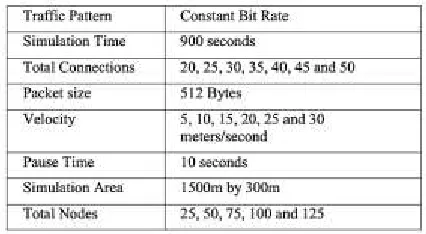
We simulated an AODV routing protocol, AODV with link prediction (AODVLP) anddynamic power control protocol with link prediction (DPCPLP) using NS-2. In thesimulations, There is a variation in the 3 parameters – node velocity, network load (rate ofgeneration of packets) and number of nodes in a given area. The complete simulationparameters are mentioned in Table.1. Numerous simulations were run with the same parameters and average of observed values was taken to decrease the estimation error.The DPCPLP algorithm is the set of power levels used for the transmission,where L is an integer varies from 1 to 7. The transmit power is the maximum powerlevel and the number of power levels in the set is 7.
Figure.1 shows cross layer relations used in DPCPLP are between physicaland network layers. The received signal strength is used by the network layer to recreatethe process to find the new route.
Figure.1: Cross layer interactions at node
transmitting RTS, CTS, knowledge and ACK packets and estimation of the hyperlinkavailability time and additional, formation of the trail prior to the hyperlink ruin to support the quality of service (QoS) standards of functions
A . Tran s mitter:
1. Let,
2. Check the optimum power table at the transmitter node for the receiver node addressand its stored optimum transmit power value ,
3. If node entry is available, then else ,
4. Add this power value in RTS header and send RTS with this power level,
5. Receive a CTS packet, observe its received power and extract transmit power. Thenode calculates optimum transmit power for a DATA packet,
6. Update optimum power table,
7. Add the power level in the DATA packet header and send the DATA packet atoptimum transmit power level,
8. Receive ACK, 9. End
1. For each neighbor, 2. On receipt of a packet,
3. Update record of (received power, time) for last three packets,
4. If and then Prediction (),
5. Prediction () 6. {
7. Estimate and update the and update the, when a node enters into a critical state,prior to link break 8. }
9. If (current time >=) 10. {
11. Sent a warning message to the upstream node, 12. Sleep for fixed duration.
13. }
14. On receipt of repair message,
15. Set the route, and link status as soon-to-be-broken,
16. Local route repair(). 17. Local route repair() 18. {
19. Find path to next node nj;
20. If (found a path in k hops within time) 21. Use this path for rerouting.
22. Else
23. Find path to destination D; 24. If (path is found)
25. {
26. Route the packet through new path,
27.Send message to sources to find the shortest path. 29. }
30. }
1. A t s o u rce: 2. {
3. New path discovers message received, 4. Discover new path,
5. Redirect traffic through new path. 6. }
Table .1 Simulation parameters for DPCPLP
Simu latio n Parameters : Two-ray radio propagation model is used. We have used seven transmit powerlevels. Three parameters viz. node velocity, network load and node dens ity were varied inthe simulations. Network load is the rate of generation of packets in the network.
Constantbit rate (CBR)sources are assumed in the simulation.
A verage interruption time is the time during which
ongoing communications areinterrupted.
Routing overhead is the number of routing overhead
packets that are generated inthe network to transfer the data packets.
Throughput is the number of kilobytes transferred
successfully from the sender tothe receiver successfully.
The packet delivery ratio is the ratio of the data
packets delivered to the destination tothose generated by the CBR sources. The higher the value better is the performance.
A verage end-to-end delay of data packets includes all
possible delays caused bybuffering during route discovery, queuing at interface queue, retransmission delays at the MAC layer, propagation and transfer time.
Figure.2 Average interruption time vs node velocity
Figure.2 shows the contrast of the average interruption time in DPCPLP, AODVLP and AODVschemes. It displays that DPCPLP displays least average interruption time as compared toAODVLP and AODV. This is for the reas on that DPCPLP uses a smaller transmission range, thus concurrent transmission of packets as well as uses backup path in case of route failures forrenovation of paths, thus results in lowest interruption time as
compared to AODVLP andAODV. However, AODV, AODVLP and DPCPLP give increasing average interruptiontime to increase in node velocity because faster mobility of nodes causes more routeunapproachability. Additional, more route unreachability result in higher interruption time.
Figure.3 Routing overhead vs node velocity
Figure.4 Delivery of packets vs no. of nodes
Figure.4 shows the variation of the packet delivery ratio with increasing node density.Results show that packet delivery ratio is best DPCPLP as compared to AODVLP andAODV. It happens because in DPCPLP, concurrent transmission takes place due to the spatial reuse of the channel, resulting from lower transmit power of the packets, in addition toDPCPLP and AODVLP schemes discovers alternative routes before the route failures, andmore data is successfully delivered to the destination. However, DPCPLP, AODVLP andAODV give decreasing delivery ratio as node density increases, since it causes morecontentions and collision due to more
neighboring nodes in the vicinity and
therefore,decreases delivery ratio by retransmitting the packets more than once.
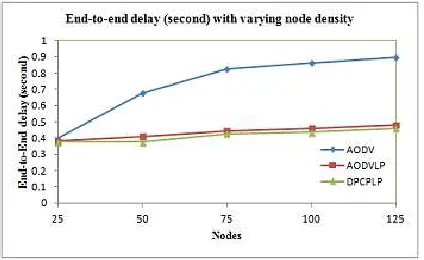
Figure .5 End-to-end delay vs no. of nodes
The end-to-end delay is an average of the difference between the time a data packet isoriginated by an application and the time the data packet is received at its destination.Figure 5.12 shows lowest end-to-end delay in DPCPLP as compared to AODVLP andAODV because DPCPLP takes care of concurrent transmission of packets due to lowertransmit power for RTS, CTS, DATA and ACK in addition to prior route discovery in caseof route failures. The end-to-end delay is lower in AODVLP as compared to AODV due to the prior route discovery in case of route failures. At low density, the delay is low in all.
IV. CONCLUSION
In this paper, we have proposed cross layer design to provide a combined solutionfor link availability management and power conservation (DPCPLP) in ad-hoc networks.This extension is the addition of power control at MAC layer that minimizes powerconsumption, thus yields longer battery life alongwith the prediction function predicts linkbreaks and proactively repairs, it before breaks at the network layer, based on received signalpower of the three consecutive received packets and threshold signal power strength. Usingthe MAC layer RTS, CTS, DATA and ACK packet exchange, the
optimum transmitpower can be dynamically
estimated based on ongoing transmission and accordingly thesender and receiver can adjust its transmitting power in sending RTS, CTS, DATA andACK packets at optimum power, which is lower than maximum transmit power to conserve its energy sources.
REFERENCES
[1] N. Abramson, “The ALOHA - another alternative for computer communications”,Proceedings of the fall joint conference”, NJ, Vol. 37, pp. 281−285, 1970.
[2] S. Chakravarti, A. Mishra, “QoS issues in adhoc wireless networks”, IEEECommunication Magazine, Vol. 39, pp. 142−148, February 2001.
[3] C. K. Toh, Adhoc Mobile Wireless Networks: Protocols and Systems, Prentice-HallPTR, NJ, 2002.
[4] E.M. Royer, C. K Toh, “A review of current
routing protocols for adhoc mobilewireless
networks”, IEEE Personal Communications, Vol.6, pp. 46−55, April1999.
[5] Charles E. Perkins, Adhoc Networking, Addition Wesley, Reading, MA 2001.
[7] D.B. Jonhson, D.A. Maltz, “Dynamic Source Routing in Adhoc wireless networks,Mobile Computing”, T. ImieLinski and H. Korth, Eds. Kluwer AcademicPublishers, Vol. 353, pp. 153−181, 1996.
[8] C.E. Perkins, E.M. Royer, S. Das, “Adhoc on Demand Distance Vector Routing”,Proceedings of Second IEEE workshop on Mobile Computing Systems andapplications, pp. 90−100, 1999.
[9] V. Park. S. Corson, “Temporally Ordered Routing Algorithm (TORA) version 1”,IETF Internet Draft (draft-ietf-manet-tora-spec-04.txt), July 2001.
[10] N. Poojary, S. V. Krishnamurthy, S. Dao., “Medium access control in a network ofadhoc
mobiles nodes with heterogeneous power
capabilities”, Proceedings IEEEInternational
Conference on Communications ICC (2001), Vol. 3, pp. 872−877,2001.
[11] L. Kleinrock, F. A. Tobagi, “Packet switching in radio channels: Part II-the hiddenterminal problem in carrier sense multiple access and busy tone solution”, IEEETransaction Communications, Vol.23, no. 12, pp. 1417−1433, 23rd December1975.
[12] P. Karn, “MACA: a new channel access method for packet radio”, Proceedings ofthe ARRL/CRRL
Amateur Radio 9th Computer Networking
Conference, September22, 1990.
[13] V. Bhargavan, A. darners, S. Shenker, L. Zhang, “MACAW - A Wireless MediaAccess protocol for Wireless Lans”, Proceedings of ACM SIGCOMM, pp.212−225,1994.