Feature Vector Selection for Automatic
Classification of ECG Arrhythmias
Ch.Venkanna1, B. Raja Ganapathi2
Assistant Professor, Dept. of ECE, G.V.P. College of Engineering (A), Madhurawada, A.P., India1
PG Student [CSP], Dept. of ECE, G.V.P. College of Engineering (A), Madhurawada, A.P., India2
ABSTRACT: The processing of ECG signal plays a significant role in diagnosing most of the cardiac diseases. One cardiac cycle in an ECG signal consists of the P-QRS-T waves. The feature extraction scheme determines the amplitudes and intervals in the ECG signal for subsequent analysis. The shape of ECG waveform can reveal the current state of functionality of the heart. For all these observation of anomalies and selection of feature vector is important. Based on the selected feature vector classification is done. The classification is done by using RBF neural network for the analysis and evaluation of Feature Vector Selection of ECG Arrhythmias.
KEYWORDS: ECG, baseline wander, zero phase filter, Atrial Fibrillation (AF), Cardiac Ischemia (CI), Sudden Cariac Arrest (SCA), RBFNN.
I. INTRODUCTION
Cardio-vascular disease is one of leading causes of death. Any disturbance in normal rhythm of heart is called cardiac arrhythmia. Electrocardiogram (ECG) is one of the most important noninvasive tools for the diagnosis of cardiac arrhythmia. The electrocardiogram (ECG) signal represents the changes in electrical potential during the cardiac cycle recorded using surface electrodes on the body [1].
The characteristics of an ECG signal helps to distinguish various arrhythmias. Manual approach of ECG analysis is time taking process and also requires expert. ECG analysis is difficult in a small setup like clinics, health centers etc. Hence, method for automatic classification with high accuracy is needed. Also, automatic classification will be helpful to paramedical and emergency medical staff in cases where immediate action is to be taken.
In this paper, automatic classification of 4 different types of ECG beats- normal sinus rhythm, atrial fibrillation, cardiac ischemia, sudden cardiac arrest is implemented. The R- peak detection is done using Pan Tompkins’ algorithm. The other characteristic waves are detected by taking the R-peak as reference. The anomalies in the shape of arrhythmic ECG are observed. The mean and standard deviation of the anomalies are taken as the features.
Database: MIT-BIH arrhythmia database [2] is used for testing the proposed algorithm.
II. LITERATURE SURVEY
Pan, Tompkins [3] developed a real-time algorithm for detection of the QRS complexes of ECG signals. It reliably recognizes QRS complexes based upon digital analyses of slope, amplitude, and width. The algorithm automatically adjusts thresholds and parameters periodically to adapt to such ECG changes as QRS morphology and heart rate.
George B. Moody et al [4] studied on the factors that are involved in the automatic detection of Atrial Fibrillation. They stated that R-R interval difference can be taken as the measure for the automatic detection of Atrial Fibrillation.
Recent studies suggest that Tpeak-end interval /QT interval (Tp-e/QT) may be more meaningful to predict sudden cardiac arrest. SU Xianming et al [5] found that Tp-e/QT ratio can be as an index in predicting sudden cardiac death .
III. CARDIAC DISORDERS
Atrial fibrillation: Atrial fibrillation occurs when the electric current in the heart is generated from all over the atria at a very high speed, between 300 and 500 impulses a minute. This does not allow the atria to contract in a synchronized fashion. Because of the high number of impulses generated by the heart, and their location, the atria begin to quiver. This is known in medical terms as fibrillation [7].
Cardiac Ischemia: If a coronary artery is occluded, the transport of oxygen to the cardiac muscle is decreased, causing an oxygen debt in the muscle, which is called ischemia. Ischemia causes changes in the resting potential and in the repolarisation of the muscle cells, which is seen as changes in the T-wave [8]. If the oxygen transport is terminated in a certain area, the heart muscle dies in that region. This is called an infarction. An infarct area is electrically silent since it has lost its excitability.
Sudden Cardiac Arrest: The immediate cause of sudden cardiac arrest is usually an abnormality in the heart rhythm
(arrhythmia), the result of a problem with your heart's electrical system. Unlike other muscles in the body, which rely on nerve connections to receive the electrical stimulation they need to function, the heart has its own electrical stimulator - a specialized group of cells called the sinus node located in the upper right chamber (right atrium) of the heart. The sinus node generates electrical impulses that flow in an orderly manner through heart to synchronize the heart rate and coordinate the pumping of blood from heart to the rest of the body. If something goes wrong with the sinus node or the flow of electric impulses through the heart, an arrhythmia can result, causing heart to beat too fast, too slow or in an irregular fashion. Often these interruptions in rhythm are momentary and harmless. But some types of arrhythmia can be serious and lead to a sudden stop in heart function (sudden cardiac arrest).
IV. PROPOSED METHOD
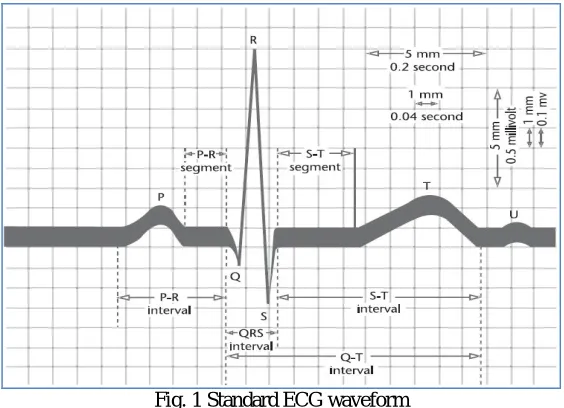
The standard ECG waveform [9] is taken as a reference for the algorithm. The wave intervals are estimated based on this standard waveform. The standard waveform that is considered is shown in fig 1.
Fig. 1 Standard ECG waveform
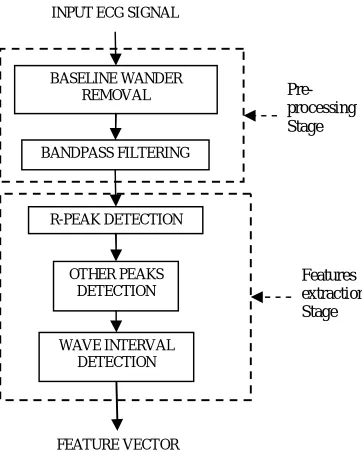
Fig. 2 Flow diagram of Feature vector generation
Pre-processing: In this pre-processing stage first baseline wander is removed and then filtering is done to remove the noise. First baseline wander is estimated by using first order zero phase low pass filter with cut-off frequency 0.5 Hz. Then the baseline wander is removed from the applied ECG signal. The output signal is the applied to the band pass filter with lower cutoff frequency 5Hz and upper cutoff frequency 40Hz. Since power line interference has the frequency at 50Hz, this can also be removed using the above band pass filter.
Feature Extraction: In the feature extraction stage, all the ECG characteristic waves are identified and their intervals are calculated. Identification of the R-peak is most important in the ECG diagnosis. First the R-peak is identified using the PanTompkins’ algorithm [3]. By taking the R-peak as reference, the other characteristic waves are identified. The onset and offset points of each wave are also pointed simultaneously in the above process. So that wave intervals can be calculated.
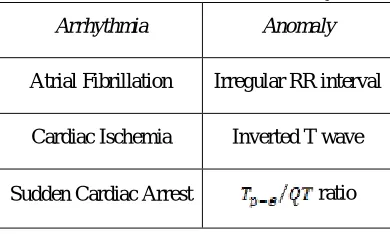
Features are selected based on the anomalies observed in the arrhythmias. The anomaly characteristics observed in each arrhythmia are discussed below.
a) For the AF case, the atria quiver irregularly due to their irregular excitation. But the ventricles quiver regularly. So the synchronism between atria and ventricles will be disturbed. This result the irregular RR intervals.
b) For the CI case, some area of the heart behaves electrically silent. Instead of propagating the electrical pulses this part reflects them. Generally this effect is in ventricle myocardium. As an effect the T wave will be inverted.
c) For the SCA case, recent studies suggest that Tpeak-end interval /QT interval (Tp-e/QT) may be more meaningful to predict sudden cardiac arrest. SU Xianming et al [5] found that Tp-e/QT ratio can be as an index in predicting sudden cardiac death.
Based on the above anomaly characteristics observed the feature vector is selected. From the above analysis, the features selected for the classification are: mean and standard deviation of RR interval difference, mean and standard deviation of T-peak, mean and standard deviation of ratio. The arrhythmias and their anomalies are listed in table 1.
INPUT ECG SIGNAL
Table 1: Anomalies observed in the arrhythmias
Arrhythmia Anomaly
Atrial Fibrillation Irregular RR interval
Cardiac Ischemia Inverted T wave
Sudden Cardiac Arrest ratio
The selected feature vector is based on the anomalies observed is shown in table 2.
Table 2: Feature Vector
Mean of T-peak
Std of T-peak
Mean of difference in RR interval
Std of difference in RR interval
Mean of Tp-e/QT ratio
Std of Tp-e/QT ratio
Each ECG signal is applied to the algorithm shown in fig 2 for the feature vector generation. Based on the features extracted the classification is done using RBF (Radial Basis Function) neural network.
RBF neural network:
Fig. 3 Basic structure of RBF neural network
The output equation can be written as
where is a set of basis functions that are assume to be linearly independent.
For radial basis functions, the basis functions are
Fig 4. Training algorithm
V. RESULT AND DISCUSSION
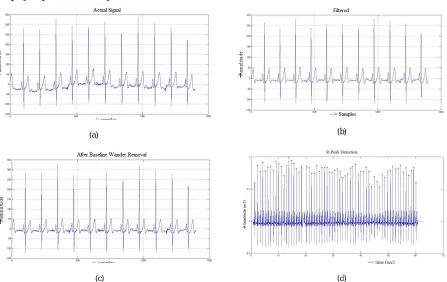
The step by step result of NSR person ECG of record number ‘nsrdb 16272m’ is shown below.
Fig 5. (a) Original applied ECG signal of NSR person (b) Output of the baseline wander removal step (c) Output of Band pass filter (d) Output of R-peak Detection stage after indicating the R-peaks as red colour star.
(a) (b)
(c) (d)
Start with One Neuron, select its center from data
point with lowest cost
Update the weights and calculate the error E Add new hidden neuron,
select its center from the remaining data points with
lowest cost
E<Egoal
In the fig 5, first original applied ECG signal is shown and then outputs of baseline wander removal step and output of band pass filter step are shown. Finally the identified R-peaks are indicated as red colour star mark. After the detection of R-peak the other characteristic waves i.e. P, Q, S and T peaks and their intervals are identified by taking R-peak as reference. This process is carried out for all the ECG records. The output of one for each class of ECG signals is shown in fig 6.
(a)
(b)
(d)
Fig 6. (a) Result for NSR (b) Result for AF (c) Result for CI (d) Result for SCA
In the fig 6, different peaks are indicated with different symbols. * indicates R-peak
o indicates P-peak ^ indicates T-peak
+ indicates Q and S –peaks
The figure 6(a) shows the result for a typical signal of NSR person. The figure 6(b) shows the result for a typical signal of AF person. The figure 6(c) shows the result for a typical signal of CI person. The figure 6(d) shows the result for a typical signal of SCA person.
After identifying all the characteristic waves and their intervals, feature vector is calculated for each record. Here some records are used for training the neural network and some are used for testing.
Table 3. Classification confusion matrix
Input Class
Output Class
NSR AF CI SCA
NSR 10 0 0 0
AF 0 11 1 0
CI 0 1 9 1
SCA 0 0 0 10
VI. CONCLUSION
The anomalies of arrhythmias are observed. The feature vector is selected based on the anomalies. The neural network is trained with the some of the collected ECG arrhythmia database and is tested with the remaining records. The results are observed experimentally in accurate. The feature vector selected assures the requirement for the classification. With this observation of anomalies of arrhythmias, feature vector size can be reduced compared to previous methods, so that the time required for the feature vector extraction is reduced.
REFERENCES
[1] D. 1. Rowlands, "Understanding the electrocardiogram" (Section 2: Morphological abnormalities). Imperial Chemical Industries PLC, England, 1982.
[2] MIT/BIH arrhythmia database: http://www.physionet.org/cgi-bin/atm/ATM
[3] Jiapu Pan, Willis J. Tompkins “A Real-Time QRS Detection Algorithm”, IEEE Transactions On Biomedical Engineering, VOL. BME-32, NO. 3, MARCH 1985.
[4] George B. Moody, Roger G. Mark “ A new method for detection Atrial Fibrillation using R-R intervals.” IEEE Transactions on Computers in Cardiology, pp. 227-230, 1983.
[5] SU Xianming PhD MD, Zhi Xiaowen “Tpeak-end interval /QT interval ratio of ECG predicts sudden cardiac death and malignant Ventricular arrhythmias”, IEEE, pp. 57-60, 2011.
[6] Shameer Faziludeen, Sabiq P.V “ECG Beat Classification Using Wavelets and SVM”, Proceedings of IEEE Conference on Information and Communication Technologies, pp. 815-818, 2013.
[7] Atrial fibrillation description, http://www.nhlbi.nih.gov/health/health-topics/topics/af/ [8] Cardiac Ischemia Theory, http://www.cardiacischemia.com/