Study on Use of Waste Polythene in Bituminous
Paving Mix Design
Gayatri Narayan
M.Tech. Transportation
Engineering,
(Civil Engineering)
Mallareddy Institute of
Technology,
Maisammaguda, Dhulapally,
Sec-500100.
BH. Nagendra Rao
ME WRD
Professor
(Civil Engineering)
Retd. Exe Engineer in
Irrigation & CAD Dept.
[email protected]
M. Visweswara Rao
M.Tech. (Structures)
Professor & HOD
(Civil Engineering)
mukkamalavisweswararao
@gmail.com
Abstract:
Bituminous streets since its origin in 1920 has been an exceptionally well known technique for street development. In this strategy for street development bitumen is utilized as a cover in the wearing course. This has the upsides of - minimal effort of materials utilized, moderately low level of commotion generation by the movement, bring down upkeep and repair cost. Notwithstanding, it is less solid than different techniques for street development accessible and isn't the best earth safe alternative. With a specific end goal to counter these disadvantages different investigations have been embraced. In our examination with the expanded utilization of plastic which is non-biodegradable in our everyday experience the quantum of deny entering our landfills and filling our rubbish dumps is expanded marvelously. This has expanded the waste administration challenge. So as to address this abuse, reuse and reuse strategy is the way. This task takes up this case and uses plastic in bituminous blend. The bitumen in the bituminous blend has been supplanted by plastic to some degree. For this examination bituminous cement (BC) has been taken up as the layer of study.
This examination is isolated into two parts. The primary half was to decide the Optimum Bitumen Content (OBC) utilizing the Marshall technique. The second half was to supplant some portion of the bitumen with plastic and the strength, stream, Void loaded with Bitumen (VFB), Voids loaded with air (VFA) and Voids in mineral totals (VMA) and touch base at the ideal plastic substance (OPC) to accomplish most extreme solidness and stream according to the MORTH (update 5) determinations. It has been watched that adding plastic up to an ideal level improves the steadiness and stream yet past an utmost it doesn't add to the quality of the bituminous blend. In our investigation the Optimum Bitumen Content (OBC) was observed to be 5.8%
and ideal plastic substance (OPC) was closed to be 8.75% of the OBC.
Keywords
Waste Plastic, Bituminous Concrete (BC), Optimum Bitumen Content (OBC), Optimum Plastic Content (OPC), Marshall Method...
1. Introduction
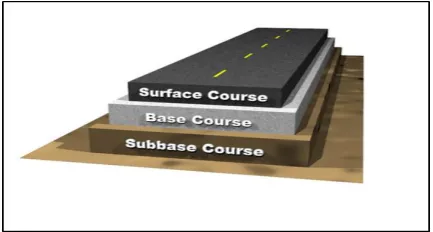
A highway pavement is a structure comprising of layers of treated materials over the common soil known as sub-level or over the fill, whose essential capacity is to apportion the connected vehicle burdens to the sub-level. The last conclusion is to guarantee that the transmitted worries because of wheel stack are diminished adequately, with the goal that they won't surpass bearing limit of the sub-review.
There are mainly two types of pavements i) Flexible pavements.
ii) Rigid pavements.
Flexible0pavements: Customary adaptable pavements are layered frameworks with better materials on top where the force of stresses is high and materials with less quality are utilized at the base where the power is low. They have low or immaterial flexural quality and are adaptable in their basic activity under burdens.
Available online:
http://edupediapublications.org/journals/index.php/IJR/
Page | 2741Rigid pavements: These pavements have essential flexural unbending nature. These are by and large developed utilizing bond concrete. Subsequently are usually alluded to as CC pavements. These are broke down by the plate hypothesis.
Fig 1.2 - Basic Rigid Pavement Structure. The principle reason for bituminous blend configuration is to decide the prudent mix and degree of totals and bitumen which yields a blend having adequate workability, sturdiness, soundness and adaptability to oppose activity loads.
Desirable Properties of Mix Design:
• Adequate dependability of blend to withstand the burdens and disfigurement because of rehashed use of wheel loads.
• Adequate adaptability of the blend to oppose weariness impacts and advancement of breaks amid benefit life of the pavement.
• Adequate workability of the blend at blending, laying and compacting temperatures. • Possess adequate air voids to avert 'seeping' of the fastener because of further compaction under wheel loads and furthermore lessening of slide protection under wet conditions.
• Adequate sturdiness to support the joined impact of unfriendly climate and rehashed activity loads.
• Adequate protection from perpetual miss-happening, for example, rutting because of development of overwhelming wheel loads amid sweltering climate.
• Adequate slip protection even after proceeded with activity developments.
Requirements of Design Mix:
• The strength of the blend comparing to the plan fastener substance to be more than least determined esteem.
• Flexibility or disfigurement at inability to be inside the predefined go.
• Voids substance of the planned blend to be inside indicated go.
• Durability of the blend under dormant water to evaluate water affectability.
Gradation:
Reviewing alludes to the assurance of the molecule measure appropriation for total.
• Uniformly reviewed total: - just a couple of sizes command the mass material. With this reviewing, the totals are not being not effectively stuffed
• Open reviewed total contains an excessive number of little grain measured totals and is anything but difficult to be bothered by a gap.
• Gap reviewing is the sort of evaluating where at least one size of totals of a halfway size are deficient.
Sorts of Bituminous Mixes:
1) Hot-blend black-top (HMA)
Hot-blend black-top (HMA) is delivered in a hot-blend plant by hot-blending a foreordained measure of total with a settled measure of black-top at high temperature. The blending temperature must be high with the goal that black-top is thick for appropriately covering the total. A HMA blend must be spread and compacted when the blend is as yet hot in order to have a workable blend. The most generally utilized blends are HMA.
2) Cold-laid plant blend
Frosty laid plant blend is created in a black-top blending plant by blending a controlled measure of total with a controlled measure of fluid black-top without the utilization of warmth. It is laid and compacted at encompassing temperature.
3) Mixed set up or street blend
4) Penetration macadam
Entrance macadam is delivered by a development methodology in which layers of coarse and uniform size total are spread out and about and rolled, and showered with suitable measures of black-top to enter the total. The black-top material utilized might be hot black-top concrete or a quick setting (RS) black-top emulsion.
2. Literature Review
1. Denning and Carswell (1981) they proposed that higher temperature decreases the recuperation even on including plastic.
2. Punith and Veeraragavan revealed enhanced dynamic crawl and aberrant rigidity on adding plastic to bitumen.
3. Mazumdar and Panda found that 5% plastic expands the infiltration, Ductility and softening of bitumen. Thus including plastic builds the properties of bituminous blend outline.
4. Muphy (2001) inspected the likelihood of fusing waste plastic into bitumen as a modifier, assessed the execution of reused changed bitumen and contrast their properties and those of standard bitumen and polymer adjusted bitumen. They finished up polypropylenes are not valuable in enhancing the properties of bitumen and showed useful troubles amid blending and testing, proposing poor attachment with bitumen.
5. Panda and Mazumdar (2002) their investigations demonstrate that including 2.5% polythene enhances the Marshall quality and different variables and furthermore enhances the water protection of the blend.
6. Reinke and Glidden (2002) report that including of polythene enhances the recuperation factor of the bituminous blend and diminishes the crawl.
7. Karim concentrated the execution of bituminous blend submerged and found the execution expanded with expansion of polythene.
8. Vasudevan (2004) included polythene as a level of bitumen and laid arteril streets and found a lessening in development of pot gaps.
9. Shbeeb (2007) Polythene option lessened the rutting by adding of polythene to the bituminous blend.
10. Casey (2008) found that 4% of waste plastic to SMA yielded best outcomes when contrasted with unmodified fastener.
11. Science Tech Entrepreneur (2008) Suggests that platic expands the lifeof the pavement
12. Verma (2008) Adding of plastic expands quality of pavement in winter.
13. Aslam and Rahman (2009) said the dry procedure is more temperate and advantageous for development of adaptable pavements. As wet process has the danger of isolation
14. Sabina et al. (2009) the bituminous blend quality increments by 1.2 to 1.5 by expansion of 10 to 15% of polythene.
15. Herndon (2009) showed the two procedures Wet Process and the Dry Process.
16. Sui and Chen (2011) adding polythene to total diminishes their stripping quality and grip of bitumen.
17. Sangita et al. (2011) utilizing plastic in bitumen builds the life of the pavement by 2 to 3 times.
18. Gawande et al. (2012) Plastic of around 5-10% by weight of bitumen helps in enhancing the life span and investment funds in bitumen happen.
19. Prusty (2012) considering the marshall esteems the creator watched that a steadier pavement can be utilized by utilizing polymer adjustments.
20. Swami (2012) by change of bitumen the issues like seeping in hot temperature areas and sound contamination because of overwhelming movement are lessened and it at last enhances the quality and execution of street.
21. Pareek (2012) they inferred that Polymer changed bitumen demonstrate a superior flexible recuperation (79%) and age protection
22. Moghaddam and Karim (2012) their examination demonstrates that Polyethylene Terephthalate (PET) strengthened blends indicate higher dependability esteem,
23. The Indian Roads Congress Specifications Special Publication: 53 (2002) investigated the day and age of handing-off the pavement surface might be expanded by half on utilization of plastic in bitumen.
24. Habib PP indicates preferable quality over HDPE or LDPE
25. Ahmadinia et al. (2012) The aftereffects of rheological tests completed in their investigation demonstrate that the greater part of bitumen mixes show better execution at higher temperature with polyethylene - enhanced rutting protection,
Available online:
http://edupediapublications.org/journals/index.php/IJR/
Page | 2743contrasted with the regular black-top as far as changeless disfigurement.
3. Components of Bituminous Mix and
Materials Used
Evaluated total and bitumen are the organizations of bituminous material. There is a little extent of air show in the same, which make the bituminous material a three-stage material.
The entire property of the bituminous material is very subject to the individual properties of each stage and their particular blend extents. The two strong stages i.e. the bitumen and the total are diverse in nature.
1) Bitumen Binder 2) Aggregates 3) Filler 4) Waste Plastic
Keeping in mind the end goal to decide the properties of bitumen the accompanying tests were led
a) Penetration test b) Ductility test c) Softening point test d) Specific gravity test
4. Experimental Results
After the materials have been tried in the wake of leading every significant test according to the MORTH (fifth correction) and every single relevant code the following stage is extent the totals. To start with the plan reviewing is landed at in light of different factors, for example, the development sort, thickness of the layer and the accessibility of totals. In our investigation the degree proposed by morth has been considered as the outline degree.
Proportioning in Gradation is completed in three strategies
• Analytical Method
• Graphical Method
• Trial and Error Method
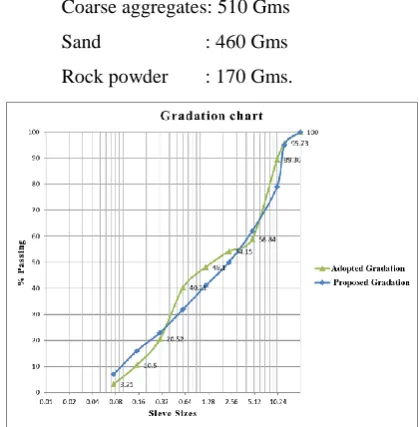
For the most part, the mid-purpose of the range in degree table is gone for. Here we utilized the experimentation Method for proportioning and to work out the activity blend equation. After various unsuccessful trials, the accompanying degree was landed at.
Keeping in mind the end goal to accomplish this degree, the parts were blended in the accompanying extents:
Coarse aggregates: 510 Gms Sand : 460 Gms Rock powder : 170 Gms.
Fig 3 – Gradation Chart for Aggregate Mix Marshall Stability Test:
Marshall Method of blend configuration was embraced for plan of the outline of bituminous blend. The whole plan of the blend was separated into two sections.
Part I - Where the OBC (Optimum Bitumen Content) was resolved.
Part II – Where the OPC (Optimum Plastic Content) was resolved.
Assurance Of Optimum Bitumen Content: As an initial step to assurance of BC the Marshall examples were set up according to the method indicated in Highway material and pavement testing by SK Khanna, CEG Justo and A. Veeraraghavan, fifth version (2013).
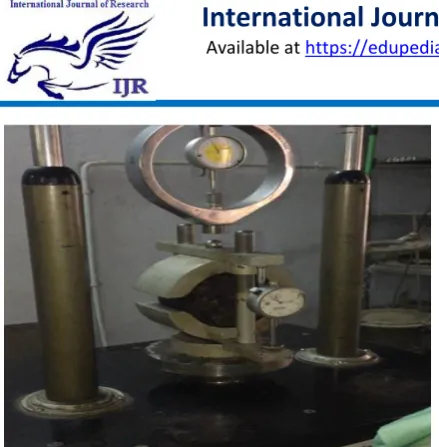
Fig 5 – Marshall Testing Machine
The examples were tried in the Marshall Machine for security and stream esteems. The Marshall strength of the blend is characterized as the most extreme load bourn by the blend at the standard test temperature of 60⸰C when load0is connected under standard test conditions. Its unit of estimation is KN. The Flow esteem is the aggregate distortion of the test example at the most extreme load, communicated in mm units.
In view of the soundness and stream readings got from the Marshall test and the Values of voids, thickness and VFB ascertained utilizing the recipes from the Lecture notes in Transportation Systems Engineering on Marshall Mix plan by Prof. Tom V Mathew from IITB (Civil). The accompanying charts were plotted in view of the qualities got:
Table 1 – OBC Calculations
Fig 6 - OBC – Stability Graph
Fig 7 - OBC – Flow Graph
Fig 8 - OBC –Density Graph
Available online:
http://edupediapublications.org/journals/index.php/IJR/
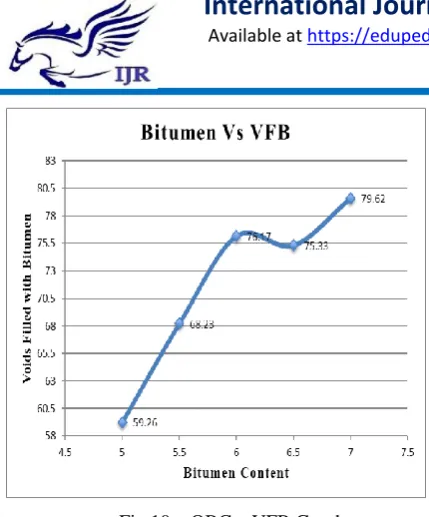
Page | 2745Fig 10 – OBC – VFB Graph Hence OBC of the design mix is 5.8%. Determination of Optimum Plastic Content:
After the ideal bitumen content was touched base at the second piece of the blend configuration was to decide the ideal plastic substance. For this reason, drain bundles which are disposed of as waste were utilized. The Specific gravity and softening point were received from the maker report as 0.92 and 115oC separately. The plastic parcels were prepared into little 2.36 mm and underneath pieces. These could be added to the blend I) To the totals while cooking them for the bituminous blend. (Dry Process) ii) Add the plastic to the bitumen while warming it to add to the warmed totals (wet Process).
We embraced the main technique (Dry Process) where the plastic was added to the totals while warming them before including the bitumen and blended altogether till all the plastic pieces broke up and the totals looked slick. After this progression the system stays unaltered from the means for deciding the OBC.
1. Plastic substance relating to greatest soundness = 10 %
2. Binder substance relating to greatest mass particular gravity (Gm) = 7.5 %
3. Average of the above qualities = 8.75 %. Subsequent to leading different tests first on the different parts of the bituminous blend with a specific end goal to determine their appropriateness for use in the blend, from there on the degree procedure the Marshall briquettes were made and tried to discover the OBC. The OBC of our examination was 5.8%
As a moment part to our investigation a piece of the bitumen was supplanted by squander plastic
which had been cleaned and granulated into suitable size. After Marshall Test on the second arrangement of Marshall Briquettes utilizing waste plastic and bitumen the OPC was finished up to be 8.75%. The security of the briquettes was observed to be no less than two times with the additional preferred standpoint of reserve funds in bitumen.
5. Problems of Waste Plastic
• Among others squander plastic is likewise a genuine ecological issue.
• It is a non‐biodegradable material subsequently does not rot over drawn out stretches of time.
• It can gag the channels and seepage channels, is being eaten by brushing creature causing disease and even passing.
• It can pollute development fills.
• If consumed in the open it can cause genuine natural contamination.
Ways to Use Reuse and Recycle Plastic:
As an initial move towards reusing of plastic is squander administration in which the waste is isolated into plastics and non-plastics. As an initial step to reusing the recyclers need to isolate the piece which can be reused. After choice and isolation of the production line squander might be straightforwardly reused. The utilized plastic waste must be washed, destroyed, and handled suitably. This plastic would then be able to be utilized as a part of
1) Polymer Coated Bitumen Road: Under this test a few associations have proposed research to discover the handiness utilization of reused plastic. Service of street transport and highways have supported an exploration conspire R-85 entitled Investigation on field execution of Bituminous blends with changed folios to IIT Madras. Likewise The CPCB has taken up an activity by bringing up a task with Thiagarajar College of Engineering Madurai to appraise the execution of plastic covered fabricated streets laid amid 2002-2006 in various urban communities. The perceptions in both these examinations have been comparative. They are as specified underneath.
• "The plastic covered totals would be advised to Impact, LA Abrasion and pulverizing esteem.
• The harshness list estimations of these streets have been observed to be 3000 mm/Km which demonstrate great riding surface.
• Polymer covered total bitumen blend performs all around contrasted with polymer altered bitumen blends and have not built up any potholes, rutting, raveling or edge blemish, despite the fact that these streets are over four years old.
• Plastic covered bituminous blend diminish the life cycle cost of pavement when contrasted with plain bitumen.
• The water incited harms are lessened to roadway.
2) Plastic Waste Disposal through Plasma Pyrolysis: Plasma Pyrolysis is a cutting edge innovation, which joins the properties of plasma with the pyrolysis procedure. The exceptional warmth age of PPT enable it to discard a wide range of plastic squanders including polymeric, risky waste in a protected way.
3) Conversion of Plastics Waste into Liquid Fuel: An exhibition plant was set up at Nagpur, Maharashtra for utilization of waste plastics into fluid fuel. The procedure embraced depends on de-polymerization of waste plastics into fluid fuel in nearness of an impetus.
Restrictions being used of Waste Plastic:
• The material might comprise of just low thickness polyethylene (LDPE) or high thickness polyethylene (HDPE), PU and PET. • Black hued plastic waste is a consequence of
rehashed reusing and ought not be utilized. • PVC might not be utilized since they
discharge deadly levels of dioxins. • Points of interest of Use of Plastic:
• Eco-accommodating method for transfer of waste plastic.
• Reduce ecological contamination.
• Increase business e.g. Utilize labor in isolation, cleaning and granulation of waste plastic.
• Add to the national economy by decreasing lifecycle cost of bituminous streets.
• Ease in Municipal Solid Waste Management.
6. Conclusion
In Conclusion with the quick increment in plastic waste age as a result to its expanded utilization in all kinds of different backgrounds even the
administration of India has started ventures for look into in reusing, reusing and transfer of this waste material. The Ministry of Environment Forest and Climate Change, Ministry of Road Transport and Highways to give some examples have taken up different examinations for compelling and feasible strategies for the utilization of plastic in non-conventional ways. IRC too has amended its code books and IRC:SP:98-2013 GUIDELINES FOR THE USE OF WASTE PLASTIC IN HOT BITUMINOUS MIXES (DRY PROCESS) IN WEARING COURSES has been started.
7. References
1. Denning and Carswell (1981) they proposed that higher temperature decreases the recuperation even on including plastic.
2. Punith and Veeraragavan revealed enhanced dynamic crawl and aberrant rigidity on adding plastic to bitumen.
3. Mazumdar and Panda found that 5% plastic expands the infiltration, Ductility and softening of bitumen. Thus including plastic builds the properties of bituminous blend outline.
4. Muphy (2001) inspected the likelihood of fusing waste plastic into bitumen as a modifier, assessed the execution of reused changed bitumen and contrast their properties and those of standard bitumen and polymer adjusted bitumen. They finished up polypropylenes are not valuable in enhancing the properties of bitumen and showed useful troubles amid blending and testing, proposing poor attachment with bitumen.
5. Panda and Mazumdar (2002) their investigations demonstrate that including 2.5% polythene enhances the Marshall quality and different variables and furthermore enhances the water protection of the blend.
6. Reinke and Glidden (2002) report that including of polythene enhances the recuperation factor of the bituminous blend and diminishes the crawl.
7. Karim concentrated the execution of bituminous blend submerged and found the execution expanded with expansion of polythene.
8. Vasudevan (2004) included polythene as a level of bitumen and laid arteril streets and found a lessening in development of pot gaps.
Available online:
http://edupediapublications.org/journals/index.php/IJR/
Page | 274710. Casey (2008) found that 4% of waste plastic to SMA yielded best outcomes when contrasted with unmodified fastener.
11. Science Tech Entrepreneur (2008) Suggests that platic expands the lifeof the pavement
12. Verma (2008) Adding of plastic expands quality of pavement in winter.
13. Aslam and Rahman (2009) said the dry procedure is more temperate and advantageous for development of adaptable pavements. As wet process has the danger of isolation
14. Sabina et al. (2009) the bituminous blend quality increments by 1.2 to 1.5 by expansion of 10 to 15% of polythene.
15. Herndon (2009) showed the two procedures Wet Process and the Dry Process.
16. Sui and Chen (2011) adding polythene to total diminishes their stripping quality and grip of bitumen.
17. Sangita et al. (2011) utilizing plastic in bitumen builds the life of the pavement by 2 to 3 times.
18. Gawande et al. (2012) Plastic of around 5-10% by weight of bitumen helps in enhancing the life span and investment funds in bitumen happen.
19. Prusty (2012) considering the marshall esteems the creator watched that a steadier pavement can be utilized by utilizing polymer adjustments.
20. Swami (2012) by change of bitumen the issues like seeping in hot temperature areas and sound contamination because of overwhelming movement are lessened and it at last enhances the quality and execution of street.
21. Pareek (2012) they inferred that Polymer changed bitumen demonstrate a superior flexible recuperation (79%) and age protection
22. Moghaddam and Karim (2012) their examination demonstrates that Polyethylene Terephthalate (PET) strengthened blends indicate higher dependability esteem,
23. The Indian Roads Congress Specifications Special Publication: 53 (2002) investigated the day and age of handing-off the pavement surface might be expanded by half on utilization of plastic in bitumen.
24. Habib PP indicates preferable quality over HDPE or LDPE
25. Ahmadinia et al. (2012) The aftereffects of rheological tests completed in their investigation demonstrate that the greater part of bitumen mixes
show better execution at higher temperature with polyethylene - enhanced rutting protection,
26. Rahman and Wahab (2013) finished up from their investigation that the use of reused PET altered black-top gives more favorable circumstances contrasted with the regular black-top as far as changeless disfigurement.