DEVELOPMENT OF HEURISTIC METHODS
BASED ON GENETIC ALGORITHM (GA)
FOR SOLVING VEHICLE ROUTING PROBLEM
(PEMBANGUNAN KAEDAH HEURISTIK BERASASKAN
ALGORITMA GENETIK UNTUK MENYELESAIKAN
MASALAH PENJALANAN KENDERAAN)
ZUHAIMY BIN ISMAIL
RESEARCH VOTE NO :
74285
JABATAN MATEMATIK
FAKULTI SAINS
UNIVERSITI TEKNOLOGI MLAYSIA
DEVELOPMENT OF HEURISTICS METHODS BASED ON GENETIC
ALGORITHM FOR VEHICLE ROUTING PROBLEM (VRP)
The Vehicle Routing Problem (VRP) is an important area and has been studied as
combinatorial optimization problems. VRP calls for the determination of the optimal set
of routes to be performed by a fleet of vehicle to serve a given set of customers. VRP in
which demand at each location is unknown at the time when the route is designed but is
follow a known probability distribution, is known as VRP with Stochastic Demands
(VRPSD). VRPSD finds its application on wide-range of distribution and
logistics-transportation sector with the objective is to serve a set of customers at minimum total
expected cost. One of the applications of VRPSD is in the case of picking up garbage
done by solid waste collection company.
The computational complexity of most vehicle routing problem and moreover the
intricate of stochastic VRP algorithm has made them an important candidate for solution
using metaheuristics. This research proposes the enhanced metaheuristic algorithms that
exploit the power of Tabu Search, Genetic Algorithm, and Simulated Annealing for
solving VRPSD. Genetic Algorithm as population-based methods are better identifying
promising areas in the search space, while Tabu Search and Simulated Annealing as
trajectory methods are better in exploring promising areas in search space.
Simulated Annealing is a global optimization technique which traverses the
search space by generating neighboring solutions of the current solution. A superior
neighbor is always accepted and an inferior neighbor is accepted with some probability.
Tabu Search is similar to Simulated Annealing, in that both traverse the solution space
by testing mutations of an individual solution. However, simulated annealing generates
only one mutated solution but Tabu Search generates many mutated solutions and moves
to the solution with the lowest fitness of those generated. Genetic Algorithm gives a pool
of solutions rather than just one. The process of finding superior solutions mimics the
VRPSD.
New algorithms, journal papers and computerized system were also
developed. Future, area that may be explored include the used of Ant Colony
Optimization (ACO) which exploits the nature phenomenon of ants. Based on the
proposed heuristic method, we developed a program to optimize the routing problem
using the Visual Studio C++ 6.0 programming language.
Key researchers :
Assoc. Prof. Dr. Zuhaimy bin Haji Ismail
Irhamah Nurhadi
Dr Zaitul Marlizawati Zainuddin
E-mail :
[email protected]
Tel. No :
07-5534224
PEMBANGUNAN KAEDAH HEURISTIK BERASASKAN KAEDAH
GENETIC ALGORITMA (GA) UNTUK MASALAH PERJALANAN
KENDERAAN (VRP).
Masalah Perjalanan Kenderaan (VRP) adalah satu ruang yang penting untuk dikaji sebagai salah satu daripada gabungan masalah pengoptimaan. VRP juga dikenali sebagai pencarian suatu set optimum kepada perjalaan kenderaan untuk mewakili atau di anggap sebagai satu set pelanggan. VRP untuk setiap permintaan dan disetiap lokasi adalah satu anu yang tidak diketahui ketika perjalanan dibentuk, akan tetapi ianya akan mengikut setiap taburan kebarangkalian yang diketahuinya, dan ini juga dikenali sebagai VRP bersama permintaan Stokastik (VRPSD). Aplikasi VRPSD ditemui dalam suatu ruang kebarangkalian yang luas dan sektor pengangkutan logistik bersama objektifnya yang tersendiri iaitu untuk menghasilkan set pelanggan pada kadar minimum. Salah satu daripada aplikasi VRPSD adalah daripada kes untuk mengangkut bahan buangan pepejal yang telah dilakukan oleh syarikat pengangkutan bahan buangan pepejal.
Kompleks Pengkomputeran adalah masalah system pengangkutan kenderaan yang lebih kompleks kepada algoritma stokastik. VRP telah membuatkan ianya sebagai satu cara yang penting untuk penyelesaian masalah menggunakan kaedah metaheuristik. Kajian ini bertujuan untuk memberi penekanan yang lebih mendalam kepada kaedah metaheuristik yang membentuk kaedah lain, seperti Tabu Search, Genetic Algorithm, dan Simulated Annealing untuk menyelesaikan masalah VRPSD. Algoritma Genetic adalah kaedah populasi asalan sebagai suatu kaedah yang baik dalam mencari identiti di ruang carian, akan tetapi Tabu Search dan Simulated Annealing adalah kesinambungan yang lebih baik di ruang carian.
Search mempunyai ciri-ciri yang sama seperti Simulated Annealing, kedua-duanya menguasai penyelesaian ruang untuk pencubaan mutasi daripada masalah individu. Walaubagaimanapun, simulated annealing menghasilkan hanya satu penyelesaian mutasi, manakala tabu search menghasilkan lebih daripada satu masalah mutasi, dan membentuk penyelessaian tersebut kepada bentuk penghasilan yang terbaik. Genetic Algorithm memberi lebih daripada satu penyelesain, malah satu koleksi kumpulan penyelesaian. Evolusi proses, iaitu suatu proses mencari ajukan kepada superior solutions bersama penyelesaiannya, telah dikombinasikan atau dimutasikan, untuk mencari satu kumpulan penyelesaian. Kajian ini diselidik dan telah membentuk satu kaedah baru untuk heuristics yang berasaskan GA bagi menyelesaikan masalah VRPSD. Algoritma-algoritma baru, akhbar jurnal dan sistem perkomputeran juga telah dihasilkan. Tambahan lagi, bahagian yang dikaji juga bersangkutan dengan kaedah yang digunkan untuk Ant Colony Optimization (ACO) yang telah dibentuk mengikut fenomena semut. Merujuk kepada tujuan kaedah heuristic, dengan ini kami membentuk suatu program untuk mengoptimumkan masalah perjalanan dengan menggunakan Visual Studio C++ 6.0 programming.
Key researchers :
Assoc. Prof. Dr. Zuhaimy bin Haji Ismail Irhamah Nurhadi
Dr Zaitul Marlizawati Zainuddin
E-mail : [email protected]
Tel. No : 07-5534224
CATATAN : * Jika Laporan Akhir Penyelidikan ini SULIT atau TERHAD, sila lampirkan surat daripada pihak
berkuasa/organisasi berkenaan dengan menyatakan sekali sebab dan tempoh laporan ini perlu dikelaskan sebagai SULIT dan TERHAD.
Lampiran 20
UNIVERSITI TEKNOLOGI MALAYSIA
BORANG PENGESAHAN LAPORAN AKHIR PENYELIDIKAN
TAJUK PROJEK : DEVELOPMENT OF HEURISTIC METHODS BASED ON GENETIC ALGORITHM FOR SOLVING VEHICLE ROUTING PROBLEM
Saya ZUHAIMY BIN ISMAIL
(HURUF BESAR)
Mengaku membenarkan Laporan Akhir Penyelidikan ini disimpan di Perpustakaan Universiti
Teknologi Malaysia dengan syarat-syarat kegunaan seperti berikut :
1. Laporan Akhir Penyelidikan ini adalah hakmilik Universiti Teknologi Malaysia.
2. Perpustakaan Universiti Teknologi Malaysia dibenarkan membuat salinan untuk tujuan rujukan sahaja.
3. Perpustakaan dibenarkan membuat penjualan salinan Laporan Akhir Penyelidikan ini bagi kategori TIDAK TERHAD.
4. * Sila tandakan ( / )
SULIT (Mengandungi maklumat yang berdarjah keselamatan atau Kepentingan Malaysia seperti yang termaktub di dalam AKTA RAHSIA RASMI 1972).
TERHAD (Mengandungi maklumat TERHAD yang telah ditentukan oleh Organisasi/badan di mana penyelidikan dijalankan).
TIDAK TERHAD
___________________________________ TANDATANGAN KETUA PENYELIDIK
PROF. MADYA. DR. ZUHAIMY ISMAIL Nama & Cop Ketua Penyelidik
i
PREFACE
This research report entitled “The development of heuristic methods based on Genetic Algorithm (GA) for solving Vehicle Routing Rroblem (VRP)” as been prepared by Assoc. professor Dr. Zuhaimy Hj. Ismail during the period January 2006 to February 2008 at the Department of Mathematics, University Technology Malaysia, Skudai Johor.
This report is submitted as the requirement for the completion of e-science research project which is fully supported by The Ministry of Science, Technology and Innovation (MOSTI). The subject of this report is to develop heuristic methods for solving variant of VRP basing the heuristics on GA. One such variant is the VRP with stochastic demand (VRPSD). I would like to express my gratitude to MOSTI for their trust in our expertise and interest in this project.
Next, I would like to thank The Research management Centre (RMC), Universiti Teknologi Malaysia for all the support and services provided in making this research a success. I would like to thank The Department of Mathematics and Faculty of Science for making this research a success.
I would like to thank Mr. Ahmad Kamel Ismail from The SWM Environment Sdn Bhd (formerly known as Southern Waste Management Sdn Bhd) and the management of Perniagaan Zawiyah Sdn. Bhd for our collaboration on the data collection and for providing the guidelines on the processes in solid waste collection and distribution practices.
I also wish to thank my students and colleagues Irhamah, Khairil Asmani, Dr Zaitul Marlizawati for their contribution and devotion in this work. Also. The staff – the academic as well as the administrative – at The Department of Mathematics, Faculty of Science, UTM
Assoc. Prof. Dr. Zuhaimy Ismail
ii
The Vehicle Routing Problem (VRP) is an important area and has been studied as combinatorial optimization problems. VRP calls for the determination of the optimal set of routes to be performed by a fleet of vehicle to serve a given set of customers. VRP in which demand at each location is unknown at the time when the route is designed but is follow a known probability distribution, is known as VRP with Stochastic Demands (VRPSD). VRPSD finds its application on wide-range of distribution and logistics-transportation sector with the objective is to serve a set of customers at minimum total expected cost. One of the applications of VRPSD is in the case of picking up garbage done by solid waste collection company.
The computational complexity of most vehicle routing problem and moreover the intricate of stochastic VRP algorithm has made them an important candidate for solution using metaheuristics. This research proposes the enhanced metaheuristic algorithms that exploit the power of Tabu Search, Genetic Algorithm, and Simulated Annealing for solving VRPSD. Genetic Algorithm as population-based methods are better identifying promising areas in the search space, while Tabu Search and Simulated Annealing as trajectory methods are better in exploring promising areas in search space.
iii
CHAPTER TITLE PAGE
TITLE PAGE
PREFACE i
SUMMARY ii
TABLE OF CONTENTS iii
LIST OF TABLES viii
LIST OF FIGURES ix
LIST OF APPENDICES xi
1 INTRODUCTION 1
1.1 Introduction 1
1.2 Background of the Problem 3
1.3 Problem Statement of Research 6
1.4 Objectives of the Study 7
1.5 Scope of the Study 7
1.6 Significance of the Study 8
1.7 Thesis Proposal Layout 9
2 REVIEW OF THE LITERATURE 10
2.1 Introduction 10
2.2 The Vehicle Routing Problem with Stochastic Demands
(VRPSD) 11
2.2.1 Real World Applications
2.2.2 Solution Frameworks for VRPSD 2.2.2.1 Stochastic Programming
2.2.2.2 A Markov Decision Process Model 2.2.3 Mathematical Formulation of Single VRPSD 2.2.4 Threshold and Expected Cost Evaluation 2.2.5 Multiple Homogeneous VRPSD
iv
2.2.7 Overview of Genetic Algorithm and Tabu Search on VRPSD
20 20 2.3 Heuristic Methods
2.3.1 Why Use a Heuristic Methods 2.3.2 Measuring the Quality of a Heuristic 2.3.3 Types of Heuristic Methods
22 22 23 24
2.4 Metaheuristics 25
2.4.1 Classification of Metaheuristics 2.4.2 Trajectory Methods
2.4.2.1 Basic Local Search: Iterative Improvement
2.4.2.2 Simulated Annealing 2.4.2.3 Tabu Search
2.4.2.4 Explorative Local Search Methods 2.4.3 Population-based Methods
2.4.3.1 Evolutionary Computation 2.4.3.2 Ant Colony Optimization
27 28 28
29 29 31 31 31 33
2.5 Hybrid Metaheuristics 34
2.5.1 Design Issues
2.5.1.1 Hierarchical Classification 2.5.1.2 Flat Classification
2.5.2 Implementation Issues
34 35 36 37
2.6 Critical Reviews 39
2.7 Summary 42
3 RESEARCH METHODOLOGY 43
3.1 Introduction 43
3.2 Research Framework 43
3.3 Data Source 44
3.4 Data Testing
3.4.1 The Chi Square Goodness of Fit Test 3.4.2 The Kolmogorov Smirnov Test
v 3.4.1 Single Vehicle
3.4.2 Multiple homogeneous vehicles 3.4.3 Multiple heterogeneous vehicles
49 49 49
3.6 Genetic Algorithm 51
3.6.1 Selection Methods 3.6.2 Recombination 3.6.3 Mutation
52 54 56
3.7 Tabu Search 57
3.8 The Ant Colony Algorithm 62
3.8.1 Behavior of Real Ants 3.8.2 Double Bridge Experiments 3.8.3 Artificial Ants
3.8.4 Ant System
3.8.5 Types of Ant Algorithm
3.8.5.1 Ant-Density Algorithm 3.8.5.2 Ant-Quantity Algorithm 3.8.5.3 Ant-Cycle Algorithm 3.8.6 Our ACS Model for VRPSD
3.8.7 Components of Ant Colony System 3.8.7.1 Ant Colony System Transition Rule 3.8.7.2 Ant Colony System Local Updating
Rule
3.8.7.3 Ant Colony System Global Updating Rule
3.8.8 Ant Colony System Parameter Settings 3.8.9 Pheromone Behavior and Its Relationship to
Performance
3.8.10 Ant Colony System with Local Search
62 62 66 67 70 70 70 71 72 73 73
74
75 75
76 76 3.9 Simulated Annealing
3.10Illustration of Ant Colony Algorithm
3.11Illustration of the Calculation of VRPSD Objective Function
79 81
vi
4 TABU SEARCH FOR SINGLE VRPSD 91
4.1 Introduction
4.2 Tabu Search for Single VRPSD 4.2.1 Initial Solution
4.2.2 Neighbourhood Exploration 4.2.3 Tabu Moves
4.2.4 Aspiration Criterion 4.2.5 Stopping Criteria
4.3 Illustration of the Tabu Search for Single VRPSD 4.4 Discussion
91 91 91 92 94 95 95 97 103
5 GENETIC ALGORITHM FOR SOLVING SINGLE
VRPSD 107
5.1 Introduction
5.2 Genetic Algorithm for Single VRPSD 5.2.1 Chromosome Representation 5.2.2 Initialization
5.2.3 Evaluation
5.2.4 Roulette Wheel Selection with elitism 5.2.5 Order Crossover (OX)
5.2.6 Mutation
5.2.7 Stopping criterion 5.3Illustration of Genetic Algorithm 5.4Comparison between GA and TS
107 107 107 108 108 109 109 111 111 113 116
6 SOFTWARE DEVELOPMENT FOR SOLVING
SINGLE VRPSD
117
6.1 Introduction
6.2 Scope and Parameter Setting of the Designed Program 6.3 Operation of the Designed Program
6.4 Programming with Microsoft Visual C++ 6.0 6.4.1 Introduction
vii
6.4.3 Main Functions in ACS Code 6.5 Summary
124 126
7 THE EMULATION OF ANT COLONY SYSTEM AND
SIMULATED ANNEALING FOR SINGLE VRPSD 127
7.1 Introduction 7.2 The Data
7.3 Comparison of Algorithms over Problem Sizes 7.4 Comparison of Algorithms over Demand Ranges 7.5 Summary
127 127 130 132 134
8 CONCLUSIONS AND RECOMMENDATIONS 135
8.1 Introduction 8.2 Conclusions
8.3 Recommendations for Future Work 8.4 Suggestions for Program Improvement
135 135 136 137
REFERENCES 138
viii
TABLE TITLE PAGE
2.1 Previous works on VRPSD 21
3.1 Data for heterogeneous vehicles instances 50
3.2 Data set for the numerical example 81
3.3 Parameter settings for numerical example 82
5.1 Population in the initial Generation (Generation = 0) 113 5.2 Evaluation and Selection in the 1st generation 114 5.3 Crossover and Swap Mutation Process in the 1st generation 115
5.4 GA Results from Swap Mutation 116
5.5 GA and TS Results 116
6.1 Scope of program 118
6.2 Parameter setting for program 118
6.3 Main functions in ACS code 125
7.1 Data from Elion et al. (1971) 128
7.2 Parameter setting of ACS algorithm 130
7.3 Parameter setting of SA algorithm 130
7.4 Comparison of algorithm ACS and SA for different problem sizes
131
7.5 Comparison of algorithm ACS and SA for different demand ranges
ix
FIGURE TITLE PAGE
2.1 Function of q 18
2.2 Algorithm for the computation of the VRPSD objective
function f0(Q) 19
2.3 Classification of hybrid metaheuristics (design issues) 35 2.4 Classification of hybrid metaheuristics (implementation
issues) 37
2.5 Genetic Algorithm for the VRPSD 40
3.1 Research Framework 44
3.2 Procedure of Genetic Algorithm 52
3.3 Illustration of Roulette Wheel Selection 53
3.4 Situation before ranking (graph of fitnesses) 53 3.5 Situation after ranking (graph of order numbers) 54
3.6 One point crossover 55
3.7 Two point crossover 55
3.8 Uniform crossover 55
3.9 Basic Tabu Search Algorithm 61
3.10 Experimental setup for the double bridge experiment 64 3.11 Results obtained with Iridomyrmex humilis ants in the
double bridge experiment 64
3.12 The initial experimental setup and the new situation after 30
minutes, when the short branch is added 65
3.13 Results obtained with Iridomyrmex humilis ants in additional experiment
65
FIGURE TITLE PAGE
x
3.16 Ant Colony System’s algorithm 73
3.17 ACS with local search Descent Method algorithm 77
3.18 Flow chart of ACS implemented 78
3.19 Roulette wheel for selecting next customer to move to 83
3.20 5 customers network (depot excluded) 86
3.21 Illustration of hj determination 89
4.1 Illustration of LK algorithm 93
4.2 Tabu Search Algorithm for Single VRPSD 96
4.3 Initial Solution 97
4.4 2-opt Move Process at Iteration 1 to 3 98
4.5 2-opt Move Process at Iteration 4 to 10 99
4.6 Modified LK Move Process at iteration 1 to 5 101 4.7 Modified LK Move Process at iteration 6 to 10 102
4.8 Aspiration Cost versus Iteration 103
4.9 Cost versus Iteration 104
4.10 The comparison between static and dynamic tabu list size 105
5.1 The Order Crossover 110
5.2 Structure of Genetic Algorithm 112
6.1 Main GUI (Graphical User Interface) of designed program 119 6.2 Pull-down menus and its items in menu bar 119
6.3 Message box in Instruction item 120
6.4 Components for data and result displaying 121
6.5 Third part of the designed program 122
xi
APPENDIX TITLE PAGE
A Computational results for numerical example 143
B Computational result for different problem sizes 146
CHAPTER 1
INTRODUCTION
1.1 Introduction
Optimization is a part of life. In our day to day lives, we make decisions that we believe can maximize or minimize our objectives, such as taking a shortcut to minimize the time or distance required to reach a particular destination, or finding a lowest priced items in the supermarket. Most of these decisions are based on our years of experience and knowledge about the system without resorting to any systematic mathematical formulation. However, as the system becomes more complicated, further it is needed to formulate it into specific mathematical model, and with the advent of computer it is possible to exploit optimization theories to their maximum extent.
The Vehicle Routing Problems (VRP), Traveling Salesman Problem (TSP), minimum spanning tree problem and knapsack problem are example problems of combinatorial optimization.
Since late fifties, the Vehicle Routing Problem (VRP) has been and remains a rich topic for researchers and practitioners. It becomes an area of importance to operations research as well as its use for real world applications. An integral component of logistics is transportation, and a frequently arising situation in the transportation and distribution of commodities has usually been modeled as a Vehicle Routing Problem (VRP). Usually real world VRP arises with many site constraints. VRP is a generalized problem of the Traveling Salesman Problem (TSP) in that the VRP consists in determining m vehicle, where a route is tour that begins at the depot. The task is to visit a set of customer in a given order and returns to the depot. All customers must be visited exactly once and the total customer demand of a route must not exceed the vehicle capacity. Given a set of geographically dispersed customers, each showing a positive demand for a given commodity, the VRP consists of finding a set of tours of minimum length (or cost) for a fleet of vehicles.
The majority of these researches conducted on operations research are focus on static and deterministic cases of vehicle routing in which all information is determined before the time of planning of the routes. Whereas in this ICT age, information is gathered in real time and in many cases they are changing. The complexity of the problem increases as more information is unavailable at the time of the planning or when the service has begun such as the time to begin service, the location, actual demand. In some service industries, it allow for customers to request for service within a short period of time and such request has increase the dynamism and complexity of the problem.
proposed and or developed. In this thesis, we interest in studying variables as stochastic part. This chapter presents the flow of the research proposal and it begins with the background and problem statement of the research. It is important that an extensive work has been carried out in order to present a case for this work and this is given in Chapter 2. Research objectives, the scope of this study and discussion on the research contribution are also given. Finally, the brief of each chapter is outlined.
1.2 Background of the problem
The classical VRP models usually do not capture an important aspect of real life transportation and distribution-logistic problems, namely fact that several of the problem parameters (demand, time, distance, city location, etc) are often stochastic. Most existing VRP models oversimplify the actual system by assuming system parameter (e.g. customer demands) as deterministic value, although in real application, it may not be possible to know all information about customers before designing routes. Stochastic information occurs and has major impact on how the problem is formulated and how the solution is implemented. As compared to the development in deterministic case, research in Stochastic VRP is rather undeveloped.
This study considers an important variation of VRP that is VRP with Stochastic Demands (VRPSD) in which demand at each location is unknown at the time when the route is designed, but is follow a known probability distribution. This situation arises in practice when whenever a company, on any given day, is faced with the problem of collection/ deliveries from or to a set of customers, each has a random demand. In this study, we deal with specific case at solid waste collection. It is hoped that optimization can take into account the stochasticity of the problem in obtaining better routes or reducing cost.
replenish its load, and then resume service at the point where failure occurred. Therefore the vehicle will always be able to satisfy all demands, and the length of the corresponding tour becomes a random quantity. The recourse action could be the
vehicle resumes service along the planned route, namely a priori approach
(Bertsimas et al., 1990), or visiting the remaining customers possibly in an order that differs from the planned sequence that is called re-optimization approach (Dror et al, 1989).
Tillman (1969) was the first to propose algorithm for the VRPSD in the case where there were multiple terminal deliveries and multiple vehicles. Since then, many researchers have studied this problem in two frameworks, namely the chance constrained and stochastic with recourse. In the chance constrained VRPSD, the problem is to design a number of vehicle routes of least distance traveled, subject to constraint that the probability of route failure on any route is within an allowable limit. In contrast, VRPSD with recourse try to minimize the total expected cost (or distance), including the cost of travel as well as the cost of recourse action when a route failure occurs. The VRPSD with recourse is considerably more difficult than chance constrained VRPSD (Yang et al., 2000).
Various formulations and algorithms have been proposed and investigated,
including the properties and solution frameworks of VRPSD studied by Dror et al. (1989), Bertsimas (1992) who proposed cyclic heuristic and found a priori
solution for single vehicle and Dror et al. (1993) who have examined a priori VRPSD in the context of Stochastic Programming where there is only one vehicle and the number of potential failures is small. Yang’s thesis (1996) developed optimal restocking policy in conjunction with routing decisions for a priori VRPSD for single and multiple vehicles. Secomandi (2001) considered re-optimization-type routing policy by means of rollout policy for single vehicle. Chepuri and Homem-de-Mello (2005) proposed a new heuristic method based on the Cross-Entropy method for single vehicle.
better solution quality in respect to cyclic heuristic. Instead of the work of Bianchi et al. (2005) and Gendreau et al. (1995), the work on the application of GA, TS and ACO for VRPSD are lacking in the literature, although it is widely known that GA has been proven effective and successful in a wide variety of combinatorial optimization problems, including certain types of VRP, especially where time windows are included and in TSP, and as known also that Tabu Search, the approach that dominates the list of successful algorithms that is a robust, efficient and effective approach to the general VRP family of problem (Laporte 1992, Osman 1993) and Tabu Search often outperforms other heuristic techniques in terms of computational speed and solution quality (Osman, 1993).
The number of published work on the application of GA for solving basic VRP, TSP, VRPTW, VRPB, and multi depot VRP has been growing. Different approaches were also proposed based on different crossover operator, different mutation operator, or replacement methods. In 2005, the work of Bianchi et al. results that the performance of GA and TS seem to be not significantly different, due to the fact that these algorithms find solutions values which are not very different to each other. Based on previous research on algorithm developed for VRPSD and the knowledge of the basic structure of GA and TS, in this study we develop a TS and GA for single VRPSD in the next chapter.
of Blanton and Wainwright (1993), Thangiah (1995a and 1995b), Berger et al. (1998) and Braysy et al. (2000).
In this study, several metaheuristics were developed for solving VRPSD, including GA, TS and ACS. As known, GA and ACS as population-based methods are better in identifying promising areas in the search space, whereas TS as trajectory methods are better in exploring promising areas in search space.
1.3 Problem Statement of Research
The VRPSD is defined on a complete graph G = (V, A, C), where
V = {0, 1,…, n} is a set of nodes with node 0 denotes the depot and nodes 1, 2, …,
n correspond to the customers,
A = {(i, j):i,j∈V,i≠ j} is the set of arcs joining the nodes,
and a non-negative matrix
C = (cij :i,j∈V,i≠ j}) denotes the travel cost (distance) between node i and j.
The cost matrix C is symmetric and satisfies the triangular inequality. Customers have stochastic demandsξi, i = 1,…, n, which are a non-negative discrete random
variable with known probability distribution Pr ( k)
i
ik ob
p = ξ =ξ , k = 0, 1,…, K ≤
Q. Assume further that customers’ demands are independent and identical. Actual demand is only known after the vehicle arrives at customer’s location. If there is a route failure at any node, the recourse action has to be made, the recourse action is travels back to the depot for replenish and then to resume its journey as planned at the node where failure occurred.
requests should be served. These have made them an important candidate for solution using metaheuristics.
This research tries to propose new metaheuristic algorithm based on hybrid Genetic Algorithm with Tabu Search to solve VRPSD. In this work, we initially consider a single-vehicle model and later expand our analysis to incorporate multiple homogeneous and heterogeneous vehicles. In the hybrid GA, Tabu Search is used as mutation operator. The performance of this algorithm will be compared with other heuristics/ metaheuristics and implementation of this algorithm also will be done to solve real problem in optimizing solid waste collection.
1.4 Objectives of the Study
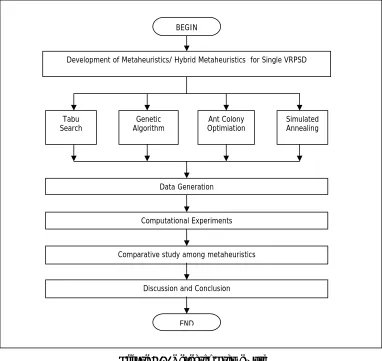
The aim of this study is to develop various approaches to optimize VRPSD solution, particularly in the use of metaheuristics approach. The objectives of this study are to:
a. develop metaheuristics for solving single VRPSD that include: 1. Tabu Search
2. Genetic Algorithm
3. Ant Colony Optimization
4. Simulated Annealing
b. conduct comparative evaluation on the performance of the above
metaheuristics.
c. implement the VRPSD models for solving real problem data in optimizing
solid waste collection.
1.5 Scope of the Study
performance testing, and also implementing the algorithm to solve real problem data in optimizing solid waste collection.
The scope of this study can be summarized as follows:
1. It is assumed that vehicles are start and end at a single depot.
2. It is also assumed that a customer demand can not be split between vehicles, and that the demand is to be fully satisfied.
3. The recourse action to be taken is a priori approach.
4. The problem data were generated and tested using Minitab 14 and SPSS 13,
while the implementation of metaheuristics was done using Delphi 7.0.
1.6 Significance of the Study
From the view point of VRP, our algorithm is the first implementation of hybrid GA (especially hybrid GA with Tabu Search) approach to the VRPSD appeared in the literature. From application aspect, in addition to solve real problem in optimizing waste collection using the proposed algorithm, we also develop software package for solving VRPSD. And the result of this study will be presented and published at the international publications/ journal.
1.7 Thesis Proposal Layout
This thesis proposal contains eight chapters. The first chapter is the introduction. This chapter gives an introduction to the background of the problem, the statement of the problem, objectives and scope of the study, and significance of the study. Chapter two is the Literature Review. This chapter presents a literature review about the Vehicle Routing Problem with Stochastic Demands, solution techniques appeared in literature and also techniques which may be applied for solving VRPSD. Chapter three, the Research Methodology, presents the direction of the study and an overview of the methods used.
Chapter four explores the development of heuristic method based on Tabu Search for solving single VRPSD. The discussion of this chapter begins with the detail development of TS for single VRPSD, followed by the experimental results and discussion. Chapter five explores the dynamism of Genetic Algorithm in solving the VRPSD. Chapter six provides the introduction and applications of Programming with Microsoft Visual Studio C++ 6.0 using Ant Colony System (ACS) and Simulated Annealing (SA). Chapter seven discusses the comparison between ACS and SA. The last chapter, Chapter eight, is Conclusion and Recommendations for further research.
CHAPTER 2
REVIEW OF THE LITERATURE
2.1 Introduction
2.2 Vehicle Routing Problem with Stochastic Demands (VRPSD)
VRP and its variants are at the core of many industrial applications in transportation logistics. In this study a variant of VRP is studied, where customer demands are not deterministically known but unknown until the time when the vehicle arrives at the customer location. To deal with this problem, the VRP is extended to cover the more realistic case of uncertainty in customer demands by using VRP with Stochastic Demands model. The customer demands are unknown but assumed to follow specific probability distribution according to the past experience about customer demands.
2.2.1 Real World Applications
The VRPSD finds its applications in all those cases where it is impossible to know the demand of the customers before the vehicles arrive at customer’s location. The pick up of garbage is one of them. It is of course impossible to know a priori how much garbage has to be collected at each customer location. It is possible that the total quantity of garbage could exceed the vehicle capacity. In such situation, the vehicle needs to go to the depot to replenish and then resume its route.
The delivery of petrol stations is another case subject to the stochasticity of demand. When customer issues the order, it is still unknown how much he will sell in the time between the order and the new delivery. Another related application is in the cash replenishment of automatic teller machines of a bank. The daily demand for cash at a specific machine is a random variable, while the maximum amount of cash that might be carried by a vehicle at any time is specified by a security policy. Not all machines may be able to be supplied on a route from its designated vehicle, forcing a decision to be made as to how to supply the machines when restocking demand may exceed vehicle capacity.
anticipate can be sold on the route. Visits are made to predetermined customer sites with the intent of replacing depleted stock. Because there is no advanced reporting of the current inventory level or the size of a replenishment order, the amount to be sold is not known until the site is visited. Examples of such peddle routes are (1) beer distribution to retail outlets, (2) supply of baked goods at food stores, (3) replenishment of liquid gas at research laboratories, and (4) stocking of vending machines.
2.2.2 Solution Frameworks for VRPSD
Dror et al. (1989) mentioned that there are two solution frameworks for Stochastic VRP (including VRPSD), namely stochastic programming and Markov decision process.
2.2.2.1Stochastic Programming
By a mathematical programming problem, we usually understand a problem of the type
Minimize ZMP = f(x)
subject to: gi(x)≤0, (i = 0, 1, …, m),
n R S
x∈ ⊆ ,
0 ≥ x
where the real functions f, gi(i = 0, 1, …, m) are assumed to be deterministic and
known.
In general, the stochastic programming is mathematical programming where one or more parameters are random variables. Such cases seem typical of real-life problems, where it may be difficult to determine the values of the parameters with certainty. The stochastic programming can be described as
subject to: gi(x,ξ)≤0, (i = 0, 1, …, m)
n R S
x∈ ⊆ ,
0 ≥
x .
where ξ is a vector of random variables defined on a probability space (Ω,Σ,Ρ),
hence ( f(x,
ξ
),gi(x,ξ), i = 0, 1, …, m) is a random vector.Stochastic programming terminology distinguishes between “wait and see” and “here and now” situations. The SVRP more naturally belongs to the “here and now” category since usually routes have to be planned in anticipation of customer demands which become only known only in the process of executing the planned routing sequence. Again, the problems in this category are usually modeled in two ways: so-called chance constrained stochastic programming and stochastic programming with recourse. (Dror et al., 1989)
(i) Chance constrained programming
Minimize )]ZCPP = Ei[f(x,ξ
subject to: x∈S
α ξ
ξ ( , )≤0)≥1−
( g x
P i , i = 0, 1, …, m
or P(ξ gi(x,ξ)≤0)≥1−αi, i = 0, 1, …, m
The name “chance constrained” follows from the fact that each constraint is realized with a minimum probability of 1−αi, 0<αi <1 (Taha, 2003). Laporte et
al. (1989) in Dror et al. (1989) define two-index variables xij instead of three-index
variables xijk, but their model cannot take into account heterogeneous vehicle
capacities. Let xij be a binary variable equal to 1 if and only if a vehicle travels on
arc (i,j). Also let m be the number of vehicles available, Tm is the set of all feasible
solutions to the m-TSP and α is the maximum allowable probability of route failure. Then the Laporte et al. model (called CCP1), adapted to the case of general distance matrices, can be written as
Minimize =
∑
j i
ij ij
CCP c x
Z
subject to
∑
∉ ∈
≥
S j S i
ij V S
x
,
) (
α , (S ⊆{1,...,n};S ≥2)
m
ij T
x x=( )∈
Here )Vα(S is the minimum number of vehicles required to serve all
customers of S so that the probability of route failure in S does not exceedα, i.e., )
(S
Vα is the smallest integer such that
∑
∈
≤ >
S i
i QV S
P( ξ α( )) α). The value of Vα(S)
is easily determined provided the probability distribution of
∑
∈S
i i
ξ is known or even
approximated for any non-empty subset S of {1, …, n}.
(ii) Stochastic Programming with Recourse
Minimize )]ZSPR =Ei[f(x,ξ)+φ(x,ξ
subject to: x∈S
where )φ(x,ξ is some non-negative real function H(gi(x,ξ)) taking the value 0 if
(gi(x,ξ)≤ 0). This expresses the fact that if all the constraints are satisfied, then we
are concerned with the value of the objective function f only, but when a constraints violation occurs, we have to add a penalty to the objective function. In the SVRP,
) ,
( ξ
φ x correspond to the cost of corrective or recourse actions. (Dror et al., 1989)
Laporte and Loveaux (1989) in Dror et al. (1989) propose a stochastic models with recourse with full service (i.e., no split deliveries) is assumed and two cases are considered:
1. The SVRP with early information: all customer demands are known after the route is constructed but before the vehicle leaves the depot and route breaks are planned in advance so as to minimize their expected cost; 2. The SVRP with late information: breaks and failures coincide.
In both cases, it is assumed that the planned routing sequence is unaltered by failures or breaks. The two models differ only in their recourse function. The general model (called SPR1) given as
Minimize ZSPR1 =cx+Ei[φ(x,ξ)]
where )φ(x,ξ is the recourse function.
For a more detailed analysis we refer to the original paper since the explicit recourse representation is quite complicated.
2.2.2.2A Markov Decision Process Model
Consider a SVRP with a single vehicle of fixed capacity Q located at the depot with the assumption that no customer demand exceeds Q. In addition, assume that the exact demand becomes known immediately upon arrival at the customer location (i.e., before replenishment begins). Upon the arrival at a customer location, two possible actions can be taken prior to the start of service:
(i) not to replenish the customer and then move to another location (which could be another customer or the depot),
(ii) to replenish the customer and then move to another location.
Dror et al. (1989) assumed a non preemptive service policy which implies that if customer service (replenishment) has started, it is not interrupt until either the customer is fully replenished or the vehicle is empty, in which case the only option is to return to the depot. When there are no more customers to be replenished, then again the only option is to return to the depot. This is the final state of the system. The initial state is condition that there is a full vehicle at the depot with all n
customers to be serviced.
The system is observed each time the vehicle arrives at one of the locations of {0, 1, …, n}. Let τ0 =0,τ1,τ2,...(τi ≤τi+1; i = 0, 1, …) be the times (cumulative
distance traveled by the vehicle) at which these events occur. Note that τi
corresponds to the time of the ith arrival which is not necessarily an arrival time at location i. These are called transition times and correspond to the times at which decisions are taken. The state of the system at a transition time τk is described by a
vector s=(r,l,x1,...,xn), where r ∈ {0, 1, …, n} denotes the position of the vehicle
vehicle is full). If customer i has been visited, then the exact demand is known and xi
represents the remaining demand (xi ≥0). If customer I has not yet been visited, then
the demand is unknown and is denoted by xi = -1. The state space is a subset S of
{0, 1, …, n} × [0, Q] × ({−1}∪[0,Q])n which satisfies the above conditions.
At each transition time, a decision d is selected from the decision space }
,..., 1 , 0 { } ,
{d1 d2 n
D= × where d =(d1,i) means that the vehicle goes to the
customer i from its present location, say j, without servicing j and d =(d2,i)
corresponds to the case where the vehicle first replenishes j before going to i. The decision d =(⋅,i),(i≠0) is admissible even if l = 0, which represents the value of collecting the information on the demand at i without being able to satisfy any part of that demand. If xi = 0 for all I, then the only admissible action is d =(d1,0) i.e.,
returning to the depot. For each s∈S, let D(s)⊂Ddenote the set of admissible
decisions when the system is in state s, and τ ={(s,d)d∈D(s)} the set of
admissible state-decision pairs.
At transition time τk, the system is in some state sk ∈S and a decision
) ( k
k D s
d ∈ is taken. The time τk+1 of the next transition is deterministic (specified
by the distance matrix C), and the next state sk+1 is generated according to the
probability distribution which governs the demand variables. Suppose
S x x l r
sk =(τk, , 1,..., n)∈ is the observed state at the current transition time τk, and
) ( ) ,
(d* i D s
d = ∈ is the decision taken, where d*∈{d1,d2}. Then the time
(distance) until the next event is simply the difference k k r i
k
c ,
1 τ τ
τ + − = where
k
rτ is
the location of the vehicle at transition time τk (we implicitly assume that service
time is zero). Let p(⋅s,d) be the transition law, i.e., for every Borel subset S of S,
) , (Ss d
p is the probability that the next state belongs to S, given s and d.
A control policy is a function µ which associates with each state s∈S a decisiond =µ(s)∈D(s). The aim of the decision maker is to find a policy which
and terminating at s* =(0,Q,0,...,0). More precisely, one seeks a policy µ* which
minimizes
∑
= +
T
k r rk k c E 0 , ] [ 1 τ τ
µ where T is the random number of transitions.
(Dror et al., 1989)
2.2.3 Mathematical Formulation of Single VRPSD
VRPSD is a variant of VRP with the goal is to find a vehicle route and a restocking policy at each node (a threshold) that minimizes the total expected cost. The costs under consideration are:
- Cost of traveling from one customer to another as planned.
- Restocking cost: the cost of traveling back to the depot for restocking.
- The cost of returning to depot for restocking caused by the remaining stock in the vehicle being insufficient to satisfy demand upon arrival at a customer location. This route-failure cost is a fixed nonnegative cost b plus a cost of traveling to the depot and back to the route.
Let 0 → 1 → 2 … j→ j+1 … → n be a particular vehicle route. Upon the service completion at customer j, suppose the vehicle has a remaining load q (or the residual capacity of the vehicle after having serviced customer j), and let fj(q)
denote the total expected cost from node j onward. If Sj represents the set of all
possible loads that a vehicle can have after service completion at customer j, then, )
(q
fj for q∈Sj satisfies
, ) ( ) ( min ) ( ⎪⎩ ⎪ ⎨ ⎧ = q f q f imum q f r j p j
j (2.1)
where
∑
≤ + + + + − = q k k j k j j j p j k p q f c q f ξ ξ : , 1 1 1 , ( ) ) (∑
> + + + + + − + + q k k j k j j k p Q q f c b ξ ξ : , 1 1 0 ,1 ( )]
2
[ (2.2)
∑
= + +
+ + −
+
= K
k
k j k j
j j r
j q c c f Q p
f
1
, 1 1
1 , 0 0
, ( )
)
( ξ (2.3)
with the boundary condition
n n
n q c q S
f ( )= ,0, ∈ (2.4)
In equations (2.2-2.4), f p(q)
j represents the expected cost of going directly to the
next node, whereas fr(q)
j represents the expected cost of the restocking action.
These equations are used to recursively determine the objective value of the planned vehicle route and the optimal sequence of decisions after customers are served. (Bianchi et al., 2005) In principle, this procedure leads to a dynamic programming since each time a customer demand is revealed, a decision has to be taken as to where the vehicle should proceed.
2.2.4 Threshold and Expected Cost Evaluation
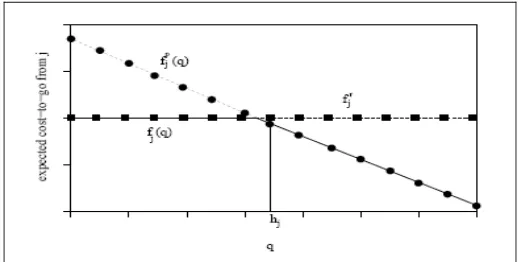
The expected cost-to-go in case of restocking, is constant in q, since in case of restocking the vehicle will have full capacity Q before serving the next customer,
whatever the current capacity q is. On the other hand, f p(q)
j is a monotonically
non-increasing function in q, for every fixed customer j. Therefore there is a capacity threshold value hjsuch that, if the vehicle has more than this value of residual goods,
then the best policy is to proceed to the next planned customer, otherwise it is better to go back to the depot for replenish, as seen in Figure 2.1. (Yang et al., 2000)
The algorithm in Figure 2.2 is an implementation of the above dynamic programming recursion for the calculation of f0(Q)and of the thresholds (Bianchi et
al., 2005).
Figure 2.2. Algorithm for the computation of the VRPSD objective function f0(Q)
2.2.5 Multiple homogeneous VRPSD
Given a fleet of vehicles indexed by m ∈ M, is based at a depot with each capacities Q, the problem is to find a set of a priori routes (and the associated optimal restocking policies), each to be served by a vehicle, such that customer demands on the route are fully satisfied and the total expected cost is minimized. The total demand of customers assigned to each route does not exceed the vehicle capacity of the vehicle assigned to it, and the total cost is minimized.
In deterministic vehicle routing problems, a single route will always be optimal if the vehicle has enough capacity to carry all customer demand. However, multiple vehicles (routes) are needed when the total customer demand exceeds the vehicle capacity. It is assumed that there are m vehicles for n customer nodes. Let
{
r r rm}
r= 1, 2,..., be a particular solution in which ri is the sub tour dedicated to ith
vehicle. The function to be minimized is the sum of expected cost for all vehicles
for (q = Q, Q-1,…,0) do
) (q fn =cn,0
for (j = n-1, n-2, …, 1) do
compute fjr using fj+1(.) for (q = Q, Q-1, …, 0) do
compute fjp(q)
compare fjr and fjp(q) for finding the threshold hj compute fj(q) using fj+1(.)
end for end for
end for
compute f0(Q)
whereas the function of each vehicle is similar with the single vehicle. (Yang et al., 2000)
2.2.6 Previous Works on the VRPSD
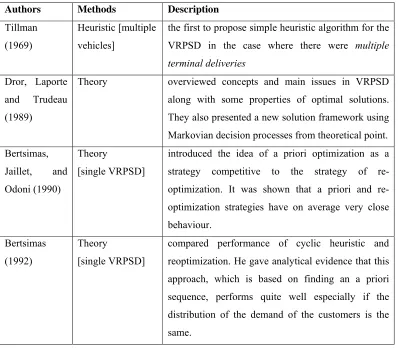
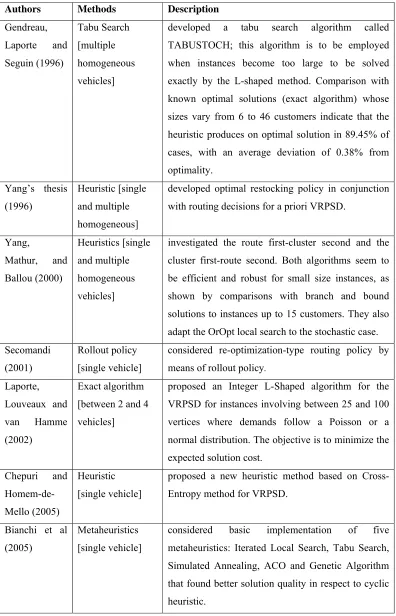
The summary of main contributions to solve VRPSD and similar problems is given in Table 2.1.
Table 2.1. Previous works on VRPSD
Authors Methods Description
Tillman (1969)
Heuristic [multiple vehicles]
the first to propose simple heuristic algorithm for the VRPSD in the case where there were multiple terminal deliveries
Dror, Laporte and Trudeau (1989)
Theory overviewed concepts and main issues in VRPSD along with some properties of optimal solutions. They also presented a new solution framework using Markovian decision processes from theoretical point. Bertsimas,
Jaillet, and Odoni (1990)
Theory
[single VRPSD]
introduced the idea of a priori optimization as a strategy competitive to the strategy of optimization. It was shown that a priori and re-optimization strategies have on average very close behaviour.
Bertsimas (1992)
Theory
[single VRPSD]
Table 2.1. Previous works on VRPSD (continued1)
Authors Methods Description
Gendreau, Laporte and Seguin (1996) Tabu Search [multiple homogeneous vehicles]
developed a tabu search algorithm called TABUSTOCH; this algorithm is to be employed when instances become too large to be solved exactly by the L-shaped method. Comparison with known optimal solutions (exact algorithm) whose sizes vary from 6 to 46 customers indicate that the heuristic produces on optimal solution in 89.45% of cases, with an average deviation of 0.38% from optimality. Yang’s thesis (1996) Heuristic [single and multiple homogeneous]
developed optimal restocking policy in conjunction with routing decisions for a priori VRPSD.
Yang, Mathur, and Ballou (2000) Heuristics [single and multiple homogeneous vehicles]
investigated the route first-cluster second and the cluster first-route second. Both algorithms seem to be efficient and robust for small size instances, as shown by comparisons with branch and bound solutions to instances up to 15 customers. They also adapt the OrOpt local search to the stochastic case. Secomandi
(2001)
Rollout policy [single vehicle]
considered re-optimization-type routing policy by means of rollout policy.
Laporte, Louveaux and van Hamme (2002)
Exact algorithm [between 2 and 4 vehicles]
proposed an Integer L-Shaped algorithm for the VRPSD for instances involving between 25 and 100 vertices where demands follow a Poisson or a normal distribution. The objective is to minimize the expected solution cost.
Chepuri and Homem-de-Mello (2005)
Heuristic [single vehicle]
proposed a new heuristic method based on Cross-Entropy method for VRPSD.
Bianchi et al (2005)
Metaheuristics [single vehicle]
Table 2.1. Previous works on VRPSD (continued2)
Authors Methods Description
Irhamah (2006)
Metaheuristics [single,
homogeneous and heterogeneous vehicles]
-based on Hybrid Genetic Algorithm with Tabu Search where TS as a mutation operator
-management of initial population: the inclusion of constructive and insertion heuristic and the implementation of the concept of statistical control -first considering heterogeneous VRPSD
2.3 Heuristic Methods
Silver et al. (1980) define a heuristic method as a procedure for solving well-defined mathematical problem by intuitive approach in which the structure of the problem can be interpreted and exploited intelligently to obtain a reasonable solution.
2.3.1 Why Use a Heuristic Method?
According to Silver et al. (1980), there are several possible reasons for using heuristic methods of solution. These include:
a. The mathematical problem is of such a nature that an analytic (closed form) or iterative solution procedure is unknown.
b. Although an exact analytic or iterative solution procedure may exist, it may be computationally prohibitive to use or perhaps unrealistic in its data requirements.
c. The heuristic method, by design, may be simpler for the decision maker to understand, hence markedly increasing the chances of implementation.
e. A heuristic may be used as part of an iterative procedure that guarantees the finding of an optimal solution. Two distinct possibilities exist:
i. To easily obtain an initial feasible solution.
ii. To make a decision at an intermediate step of an exact solution
procedure.
f. Heuristics can be used to give such ‘good’ starting solutions. In implicit enumeration approaches to problem solving a good starting solution can give a bound that drastically reduces the computational effort.
2.3.2 Measuring the Quality of a Heuristic
Silver et al. (1980) stated that a good heuristic should possess the following four properties:
1. Realistic computational effort to obtain solution.
2. The solution should be close to the optimum on the average, i.e., we want
good performance on the average.
3. The chance of a very poor solution (i.e., far from the optimum) should be
law.
4. The heuristic should be as simple as possible for the user to understand,
preferably explainable in intuitive terms, particularly if it is to be used manually.
Here are several ways for measuring the quality of heuristics:
1. Comparison with the optimum solution.
2. Problem relaxation – bounding.
3. Extreme value statistical methods.
4. Other comparisons.
i. Comparison with an enumerative method, requiring much more
computational effort that is terminated after a large amount of computation, but likely without having found the optimal solution.
ii. Comparison with performance of the decision maker, either during an
for this type of comparison. Identification of significant improvement over existing procedures is probably much more important for encouraging implementation than any proof of optimality, or nearness to optimality.
iii. Comparison with other heuristic procedures – where other heuristic
solution methods have been proposed and/or used, one certainly can compare ‘our’ heuristic against the others.
iv. Comparison with a ‘random’ decision rule – an extreme type of heuristic is where one makes a decision completely at random.
5. Worst-case behaviour.
2.3.3 Types of heuristic methods
It should be emphasized that the categories are not meant to be mutually exclusive.
1. Decomposition methods
Here the problem under consideration is broken into smaller parts that are solved separately, but taking account, at least in a crude way, of possible interactions among the parts.
2. Inductive methods.
The idea here is to generalize from smaller (or somewhat simpler) versions of the same problem.
3. Feature extraction (or reduction) methods.
The general approach here is to first obtain the optimal solutions to several numerical cases under consideration. Common features of these solutions are extracted and are assumed to hold in general.
4. Methods involving model manipulation:
- modification of the objective function.
- relaxation of certain constraints, some of which may be flexible in any event.
- Aggregation of variables, the idea being to reduce the number of decision variables.
5. Constructive methods.
6. Local improvement methods.
In contrast with the constructive procedures, local improvement starts with a feasible solution and improve upon it iteratively.
2.4 Metaheuristics
The term metaheuristic is firstly introduced by Fred Glover, derives from the composition of two Greek words. Heuristic derives from the verb heuriskein which means “to find”, while the suffix meta means “beyond, in an upper level”. Before this term was widely adopted, metaheuristics were often called modern heuristics (Reeves, 1993). Examples of metaheuristics include-but not limited to- Ant Colony Optimization, Evolutionary Computation including Genetic Algorithm, Iterated Local Search, Simulated Annealing and Tabu Search. Nowadays metaheuristics are widely used to solve important practical combinatorial optimization problems. However, due to the variety of techniques and concepts comprised by metaheuristics, there is still no commonly agreed definition for metaheuristics.
descent bias (based on the objective function), memory bias (based on previously made decisions) or experience bias (based on prior performance). Many of the metaheuristic approaches rely on probabilistic decision made during the search. But, the main difference to pure random search is that in metaheuristic algorithm randomness is not used blindly but in an intelligent biased form.
The definition used in the Metaheuristics Network (2000) is as follows. A metaheuristic is a set of concepts that can be used to define heuristic methods that can be applied to a wide set of different problems. In other words, a metaheuristic can be seen as a general algorithmic framework which can be applied to different optimization problems with relatively few modifications to make them adapted to a specific problem. Blum and Roli (2003) summarized metaheuristics as high-level strategies for exploring search spaces by using different methods. Of great importance hereby is that a dynamic balance is given between diversification and intensification. The term diversification generally refers to the exploration of the search space, whereas the term intensification refers to the exploitation of the accumulated search experience. These terms stem from the tabu search field and it is important to clarify that the terms exploration and exploitation are sometimes used instead, for example in the Evolutionary Computation field, with a more restricted meaning. In fact the notions of exploration and exploitation often refer to rather short term strategies tied to randomness, whereas intensification and diversification also refer to medium and long term strategies based on the usage of memory. The use of the terms diversification and intensification in heir initial meaning becomes more and more accepted by the whole field of metaheuristics.
2.4.1 Classification of Metaheuristics
There are several ways to classify and describe metaheuristic algorithms. Blum and Roli (2003) summarized the most important way to classify metaheuristics as below.
• Nature-inspired vs. non-nature inspired.
Perhaps, the most intuitive way of classifying metaheuristics is based on the origins of the algorithm. There are nature-inspired algorithms, like Genetic Algorithms and Ant Algorithms, and non nature-inspired ones such as Tabu Search and Iterated Local Search. In our opinion this classification is not very meaningful for the following two reasons. First, many recent hybrid algorithms do not fit either class (or, in a sense, they fit both at the same time). Second, it is sometimes difficult to clearly attribute an algorithm to one of the two classes. So, for example, one might ask the question if the use of memory in Tabu Search is not nature-inspired as well.
• Population-based vs. single point search.
Another characteristic that can be used for the classification of metaheuristics is the number of solutions used at the same time: Does the algorithm work on a population or on a single solution at any time? Algorithms working on single solutions are called trajectory methods and encompass local search-based metaheuristics. They all share the property of describing a trajectory in the search space during the search process. Population-based metaheuristics, on the contrary, perform search processes which describe the evolution of a set of points in the search space.
• Dynamic vs. static objective function.
• One vs. various neighborhood structures.
Most metaheuristic algorithms work on one single neighborhood structure. In other words, the fitness landscape topology does not change in the course of the algorithm. Other metaheuristics, such as Variable Neighborhood Search (VNS), use a set of neighborhood structures which gives the possibility to diversify the search by swapping between different fitness landscapes.
• Memory usage vs. memory-less methods.
A very important feature to classify metaheuristics is the use they make of the search history, that is, whether they use memory or not. Memory-less algorithms perform a Markov process, as the information they exclusively use to determine the next action is the current state of the search process. There are several different ways of making use of memory. Usually we differentiate between the use of short term and long term memory. The first usually keeps track of recently performed moves, visited solutions or, in general, decisions taken. The second is usually an accumulation of synthetic parameters about the search. The use of memory is nowadays recognized as one of the fundamental elements of a powerful metaheuristic.
In the rest of this study, we use the way to classify metaheuristics according to the single point vs. population-based search classification, which divides metaheuristics into trajectory methods and population-based methods. This choice is motivated by the fact that this categorization permits a clearer description of the algorithms. Moreover, a current trend is the hybridization of methods in the direction of the integration of single point search algorithms in population-based ones.
2.4.2 Trajectory Methods
2.4.2.1Basic Local Search: Iterative Improvement
2.4.2.2Simulated Annealing
Simulated Annealing (SA) is commonly said to be the oldest among the metaheuristics and surely one of the first algorithms that has an explicit strategy to escape from local minima. The origins of the algorithm are in statistical mechanics (Metropolis algorithm) and it was first presented as a search algorithm for CO problem in Kirkpatrick et al. (1983) (given some assumptions on the cooling schedule of the temperature, etc.) that could be shown to converge to an optimal solution. The fundamental idea is to allow moves resulting in solutions of worse quality than the current solution (uphill moves) in order to escape from local minima. The probability of doing such a move is decreased during the search.
Simulated Annealing comes from the annealing process of solids. A solid is heated until its melts, and then the temperature of the solid is slowly decreased (according to annealing schedule) until the solid reaches the lowest energy state or the ground state. If the initial temperature is decreased rapidly, the solid at the ground state will have many defects or imperfections. An easy implementation of the algorithm makes it very easy to adapt a local search method (e.g. best improvement local search) to a simulated annealing algorithm, usually rendering the local search with much better results. But although it is proven to converge to the optimum, it converges in infinite time. Not only for this reason, but also since we have to cool down slowly, the algorithm is usually not faster than its contemporaries.
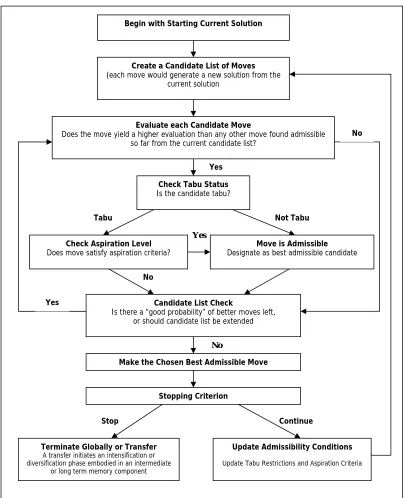
2.4.2.3Tabu Search
heuristic, but rather as a metaheuristic, i.e., a general strategy for guiding and controlling “inner” heuristics specifically tailored to the problems at hand (Gendreau, 2002). Tabu Search (TS) is among the most cited and used metaheuristics for combinatorial problems. Many computational experiments have shown that TS has now become an established optimization technique which can compete with almost all known techniques and which – by its flexibility – can beat many classical procedures.
The word tabu (or taboo) comes from Tongan, a language of Polynesia, where it was used by the aborigines of Tonga Island to indicate things that can not be touched because they are sacred. According to Webster’s Dictionary, the word now also means “a prohibition imposed by social custom as a protective measure: or of something “banned as constituting a risk”. These current more pragmatic senses of the word accord well with the theme of tabu search. The risk to be avoided in this case is that of following a counter-productive course, including one which may lead to entrapment without hope of escape. On the other hand, as in the broader social context where “protective prohibitions” are capable of being superseded when the occasion demands, the “tabus” of tabu search are to be overruled when evidence of a preferred alternative becomes compelling.
2.4.2.4Explorative Local Search Methods
These are the Greedy Randomized Adaptive Search Procedure (GRASP), Variable Neighbourhood Search (VNS), Guided Local Search (GLS) and Iterated Local Search (ILS).
2.4.3 Population-based Methods
Population-based methods deal in every iteration of the algorithm with a set (i.e., a population) of solutions rather than with a single solution. As they deal with a population of solutions, population-based algorithms provide a natural, intrinsic way for the exploration of the search space. Yet the final performance depends strongly on the way the population is manipulated.
2.4.3.1Evolutionary Computation