OPTIMIZED BURST ASSEMBLY ALGORITHM FOR MULTI-RANKED TRAFFIC OVER OPTICAL BURST SWITCHING NETWORK
OLA MAALI MOUSTAFA AHMED SAIFELDEEN
A dissertation submitted in partial fulfillment of the requirements for the award of the degree of
Master of Science (Computer Science)
Faculty of Computing Universiti Teknologi Malaysia
This dissertation is dedicated to my mother, Fatooma, the one of the kind, for all the love and care she has always provided me, to the soul of my father, Maali, for all the
virtues he planted in me, and to all members of my beloved family: Mohamed, Shaimaa, Moustafa and Asmaa for their endless support. Last but not the least to my
iv
ACKNOWLEDGEMENT
First and foremost, I would like to express heartfelt gratitude to my supervisor Prof. Dr. Abdul Samad Ismail for his constant support during my study at UTM. He inspired me greatly to work in this project. His willingness to motivate me contributed tremendously to our project. I have learned a lot from him and I am fortunate to have him as my mentor and supervisor
ABSTRACT
vi
ABSTRAK
TABLE OF CONTENTS
CHAPTER TITLE PAGE
DECLARATION ii
DEDICATION iii
ACKNOWLEDGMENT iv
ABSTRACT v
ABSTRAK vi
TABLE OF CONTENTS vii
LIST OF TABLES xi
LIST OF FIGURES xii
1 INTRODUCTION
1.1 Introduction 1
1.2 Research Motivations 5
1.3 Problem Statement 7
1.4 Research Objectives 8
1.5 Significance of The Study 9
1.6 Scope of the Study 10
1.7 Dissertation Organization 11
2 LITERATURE REVIEW
2.1 Introduction 12
2.2 Types of Internet Traffic 13
2.2.1 Constant Bit Rate Traffic 13
viii
2.2.3 Available Bit Rate Traffic 15
2.2.4 Unspecified Bit Rate Traffic 15
2.2.5 Traffic Contract 15
2.2.5.1 Traffic Parameters 16
2.3 OBS Networks 16
2.3.1 Burst Assembly Schemes 19
2.3.1.1 Time-based Scheme 20 2.3.1.2 Threshold-based Scheme 21 2.3.1.3 Hybrid Time-and-Threshold-based 21 Scheme
2.3.1.4 Learning-based Burst Assembly 22 Scheme (LBA)
2.3.1.5 Average-Delay-based Burst Assembly 22 Scheme
2.3.1.6 Burst-assembly Algorithm with 23 Service Differentiation
2.3.1.7 Real Time Adaptive Burst Assembly 24 Scheme RT-ABA
2.3.1.8 A Novel Fuzzy-Based Adaptive 25 Timer Burst Assembly Algorithm For
Optical Burst Switching Networks
2.3.1.9 A New Burst Assembly and 25 Scheduling Technique For Optical
Burst Switching Networks
2.3.1.10 An Evaluation of a Burst Aggregation 26 Method in an Optical Burst Switched
Agile All-Phonetic Network
2.3.2 Signaling Technologies 27
IV.Just-In-Time (JIT) 30 2.3.2.3 Initiated Signaling Scheme 31 2.3.2.4 Resource Signaling Scheme 31 2.3.2.5 Reservation Signaling Scheme 31 2.3.2.6 Release Signaling Scheme 32 2.3.2.7 Computation Signaling Scheme 32
2.3.3 Contention Resolution 32
2.3.3.1 Optical Buffering 33 2.3.3.2 Wavelength Conversion 34 2.3.3.3 Routing Deflection 34 2.3.3.4 Burst Segmentation 35 2.3.3.5 Burst Dropping 35 2.3.3.6 Load Balancing (Rerouting) 35 2.3.3.7 Admission Control 36 2.3.3.8 Traffic Routing 36
2.4 Quality of Service in OBS 36
2.5 Chapter Summary 38
3 RESEARCH METHODOLOGY
3.1 Introduction 40
3.2 Research Framework 41
3.3 Problem Formulation 42
3.3.1 Literature Review 42
3.3.2 RT-ABA Analysis 43
3.4 MC-ABA Design and Implementation 44
3.4.1 The Research Design Phases 45
3.4.1.1 Phase I: Ensuring Efficient Burst 46 Assembly Upon various Internet
loads
3.4.1.2 Phase II: Enhancing Assembly 46 Service Among ranked multi-classes
of Traffic
x
performance via preventing high priority data packet losses
3.4.1.4 Phase IV:Measuring and Analysis 48 to the achieved enhanced performance
for the scheme offered by mean of simulation and Implementation
3.4.2 National Chiao Tung University network 49 Network simulator (NCTUns)
3.4.3 Simulation Scenarios 50
3.5 Results and Analysis 53
3.6 Documentation 53
3.7 Summary 53
4 DESIGN AND IMPLEMENTATION 55
4.1 Introduction 55
4.2 General Design 55
4.3 Optimizing the real time adaptive Burst Assembly 56 Scheme
4.4 A Multi-class real-time Adaptive Burst Assembly 57 Scheme MC-ABA
4.5 Summary 62
5 RESULTS AND DISCUSSION 63
5.1 Introduction 63
5.2 Simulation Results 63
5.2.1 Simulation Results for Average Packet Loss 64 of RT-ABA and MC-ABA
5.2.2 A Multi-class real-time Adaptive Burst 66 Assembly Scheme MC-ABA
5.3 Analysis and Discussion 66
5.4 Summary and Conclusion 68
6.1 Summary 69
6.2 Achievements of the Study 70
CHAPTER 1
INTRODUCTION
1.1 Introduction
The vital role of communications in our everyday life has become indispensable in all fields. The Internet as a cardinal form of modern means of communication facilitates exchanging information, online conversations, business transactions, etc., giving rise to a whale of a wide spread usage of the Internet all over the world.
Finally the fiber optics was offered as a novel and trustworthy Internet transmission media for the well-known speed it has as well as the massive bandwidth it can provide when compared to the old traditional types of cables used for the Internet backbone infrastructure (Chatterjee and Pawlowski, 1999). The peerless conspicuous high speed nature of light can guarantee high transmission rate where the data is carried over electromagnetic waves by the mean of optical fibres.
Various multiplexing techniques are proposed to provide best transmission media utilization, Wavelength Division Multiplexing (WDM) is one technology that provides high performance and quality rate (Heron et al., 2008; Ishio et al., 1984). It offers two different patterns, first is the Conventional Wavelength Division Multiplexing (CWDM), while the second is called Dense Wavelength Division Multiplexing (DWDM) (Brackett, 1990; Chih-Lung et al., 2008).
Many studies consider the DWDM as a promising technology as it serves various types of data e.g. IP, ATM, SONET/SDH, and Ethernet (Qiao and Yoo, 1999; Laude, 2003. In addition to being protocol independent and also capable of manipulating bit rates between 100Mb/s up to 10Gb/s.
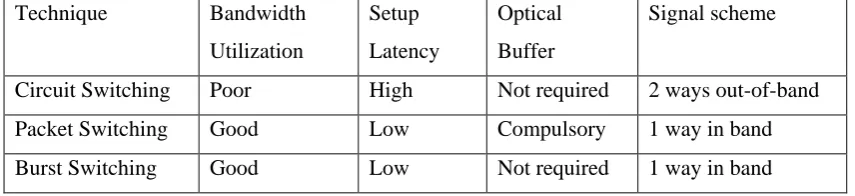
The DWDM is associated with different switching techniques e.g. circuit switching, packet switching, and burst switching. This dissertation is concerned with the Optical Burst Switching (OBS) (Qiao and Yoo, 1999; Jonathan, 1999; Laude, 2003) which is considered as the best concomitant technique when compared to other existing techniques like Al-shargabi (2011). Brief comparison is done between the three techniques in Table 1.1. The OBS amalgamates all merits and benefits of both circuit and packet switching, the out-of-band fashion is applied for signaling scheme where a burst control packet is detached from data burst for them to travel on separate channels as a mean of maintaining optimum resource utilization plus a diminished setup delay.
from data analysis in SMS method most user think it’s easy to use and they
3
Table 1.1 Comparison between 3 switching techniques in the fiber optical Networks.
Technique Bandwidth Utilization
Setup Latency
Optical Buffer
Signal scheme
Circuit Switching Poor High Not required 2 ways out-of-band Packet Switching Good Low Compulsory 1 way in band Burst Switching Good Low Not required 1 way in band
Data aggregation and buffering processes are done at the edge nodes of the OBS networks where a burst control packet (burst header; holding all burst data e.g. length, offset time, etc.) is sent first for resource allocation over intermediate OBS nodes, then the data burst follows on a devoted channel, after being held for fixed offset time.
The OBS, as a foreseen sophisticated technology, serves various types of traffic, assists miscellaneous applications, manages different data burst lengths, besides encompassing multifarious techniques for contention resolution and signalling, and therefore it can guarantee best Quality of Service (QoS) providence for the upcoming networking generation (Farahmand et al., 2007; Yoo, 2006; Youngseok and Mukherjee, 2004).
The OBS network is composed of edge and core routers plus Wavelength Division Multiplexing WDM links. Burst aggregation and corresponding burst control packets are the edge routers responsibility, while data burst switching/routing is held at the Core routers. In the core nodes the Just-Enough-Time (JET) protocol applies the “out-of-band” transmission fashion, where the control packet is detached from dara burst before it travels on a separate channel, for a uni-directional resource allocation. In case of having more than one output-port leading to the same destination, it is most probably that the shortest path is chosen in the unequal Probabilities Outputting Scheme (UPOS) analyzed by Ho (2009). The UPOS does not use a fixed probability for all output-ports which makes it more suitable for the actual Internet traffic environment as it reserve the short path for high priority traffic via prioritizing the multi-class traffic of OBS networks. This technique resulted in a concrete enhancement in QoS through giving high priority classes a pre-emptive chance to allocate Short-Path-Ports (SPPs) and also occupy the idle ports over those classes of low priority level.
A Successive minimal Incremental Routing algorithm (SMIR) offered by Ni et al., (2009) was proposed to provide a class-wise routing paradigm that can be extended from a 2-class to an N-classes OBS network. It periodically updates each path(i) between source-destination (s-d) for delivering N-class burst using link costs calculations. SMIR can also perform path re-optimization in case of changes in Internet traffic requirements.
5
transmitting and switching over WDM nodes have been emphasized for handling an omnifarious application/priority WDM network.
Real Time traffic-Adaptive Burst Assembly (RT-ABA) scheme (Al-Shargabi, 2011), is a bright technique for burst composition in an adaptive fashion via avoiding the risk of losing a burst formed only of high priority data, the technique offered enhanced the traditional composite burst assembly schemes by the mean of using a membership value to get two traffic types aggregated in one burst to guarantee fairness among traffic classes and optimize the Quality of Service (QoS) provided. The Internet traffic is exposed to continuous changes in traffic loads, scenarios, etc. Although the RT-ABA could successfully manage to aggregate data bursts accordingly but it classified traffic classes into two classes only: high and low priority.
1.2 Research Motivations
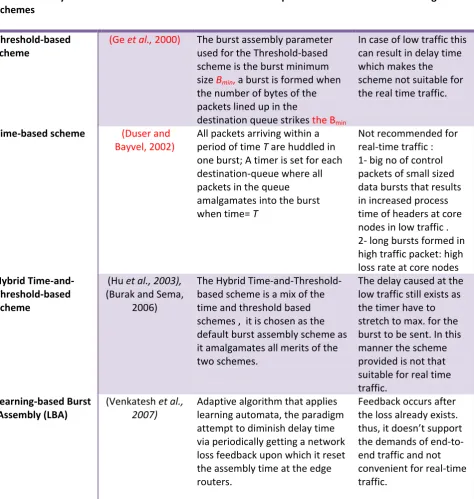
Table 1.2 A brief comparison between some of the burst assembly schemes.
Burst Assembly Schemes
Year Technique Disadvantages
Threshold-based scheme
(Ge et al., 2000) The burst assembly parameter
used for the Threshold-based scheme is the burst minimum size Bmin, a burst is formed when the number of bytes of the packets lined up in the
destination queue strikes the Bmin
In case of low traffic this can result in delay time which makes the scheme not suitable for the real time traffic.
Time-based scheme (Duser and Bayvel, 2002)
All packets arriving within a period of time T are huddled in one burst; A timer is set for each destination-queue where all packets in the queue amalgamates into the burst when time= T
Not recommended for real-time traffic : 1- big no of control packets of small sized data bursts that results in increased process time of headers at core nodes in low traffic . 2- long bursts formed in high traffic packet: high loss rate at core nodes Hybrid Time-and-
Threshold-based Scheme
(Hu et al., 2003), (Burak and Sema,
2006)
The Hybrid Time-and-Threshold-based scheme is a mix of the time and threshold based schemes , it is chosen as the default burst assembly scheme as it amalgamates all merits of the two schemes.
The delay caused at the low traffic still exists as the timer have to stretch to max. for the burst to be sent. In this manner the scheme provided is not that suitable for real time traffic.
Learning-based Burst Assembly (LBA)
(Venkatesh et al., 2007)
Adaptive algorithm that applies learning automata, the paradigm attempt to diminish delay time via periodically getting a network loss feedback upon which it reset the assembly time at the edge routers.
Feedback occurs after the loss already exists. thus, it doesn’t support the demands of end-to-end traffic and not convenient for real-time traffic.
7
transcendence in service provided, besides limiting burst-blocking, packet-loss and end-to-end delay.
1.3 Problem Statement
The standard OBS technique has undergone some efficient enhancement through recent studies have achieved a recognisable improvement in the QoS in terms of delay and packet loss for real time traffic. However, the existing schemes do not function over all types of Internet traffic.
The RT-ABA scheme is a promising solution, using a membership value (MV), to offer an optimised scheme that fulfils a concrete enhancement over QoS via providing high performance level among real time and non-real time Internet traffic classes. However, the scheme dealt with the Internet traffic as categorised into only two classes; real and non-real time traffic. Besides, all aggregated data bursts are treated in the same way along core nodes without considering the amount of real-time data within each burst which does not maintain the suitable service for real real-time systems which consequently affected the QoS.
The burst for this Multi-Class ranked scheme for real time and non-real time traffic, named MC-ABA, is assembled in an adaptive technique with different traffic classes referring to their addressed priority level while considering the instantaneously detected Internet state of traffic load. The data burst is then given a calculated factor indicating the amount of real time traffic within the aggregated burst, the factor is saved to the burst header travelling ahead for resource allocation. The higher the factor that the burst header indicates, the bigger the chance for the data burst to gets over the core nodes first i.e. with minimal delay and therefore contention and packet lost are avoided. The MC-ABA guarantees suitable service for each class over OBS network, especially for those burst holding high priorities i.e. holding real time data and prevent burst blocking and high end-to-end delay for data belonging to real time systems and governmental organizations having vital type of traffic.
1.4 Research Objectives
This study endeavors to improve the QoS for Internet traffic bursts served over the OBS network through carrying out some upgrades to the already existing scheme RT-ABA via:
(i) To run the chosen burst assembly scheme for performance evaluation in terms of end-to-end delay and packet loss.
(ii) To enhance the chosen scheme to be able to serve N ranks of data traffic, where the traffic is ranked on economic basis where class 0, of highest priority, is given the most costly subscription fee. This paid type of service ensures a suitable service over OBS network for ranked classes of traffic belonging to different users.
9
(iv) To test and evaluate the performance of the proposed MC-ABA Algorithm against the chosen scheme on OBS networks, in terms of packet loss and end-to-end delay.
1.5 Significance of the study
The study presented here offers an optimized form for the RT-ABA as it offers a Multi-Class ranked scheme for real time and non-real time traffic, named MC-ABA after the multi-class RT-ABA, which begets a pre-eminence in QoS provided via offering an n-class traffic scheme. The MC-ABA can handle all categories of traffic by assigning them to ranked category levels (0-N) and manage burst aggregation process with respect to their priority in an adaptive fashion referring to the continuously changing Internet traffic loads.
1.6 Scope of the Study
The scope of the offered study can be stated as follows:
i. This approach is to be applied over OBS network for data burst aggregation.
ii. The research focuses on applying all types of traffic (0 to N-type) and allows them to be served and assembled accordingly in an adaptive technique.
iii. The scheme calculates the ratio of high priority traffic besides it avoids contention along core nodes and mitigates latency for real time data. iv. Analysis and comparison with the existing scheme RT-ABA over OBS
network is reviewed to guarantee the enhancement in Service and concrete optimization achieved, by the mean of simulation over NCTUns networks simulation code.
1.7Dissertation Organization
11
REFERENCES
Ahmadi, H., Chimento, P. F., Guerin, R. A., Gun, L., Lin, B., Onvural, R. O. and Tedijanto, T. E. (1995). NBBS traffic management overview. IBM Systems Journal, 34, 604-628.
Akar, N., Karasan, E., Muretto, G. and Raffaelli, C. (2007). Performance Analysis of an Optical Packet Switch Employing Full/Limited Range Share Per Node Wavelength Conversion. In: Global Telecommunications Conference, 2007. GLOBECOM '07. IEEE, 26-30 Nov. 2007. 2369-2373.
Akar, N., Karasan, E., Vlachos, K. G., Varvarigos, E. A., Careglio, D., Klinkowski, M. and Sole-Pareta, J. (2010). A survey of quality of service differentiation mechanisms for optical burst switching networks. Optical Switching and Networking, 7, 1-11.
Al-Shargabi, M. A. and Ismail, A. S. (2008). Utilizing Optical Burst Switching Networks for the Internet Real-Time Traffic. 2008 International Symposium on High Capacity Optical Networks and Enabling Technologies, 49-54263. Amit Kumar Garg, a. K., R. S (2007). Performance Analysis of Optical Burst Switching High-Speed Network Architecture. IJCSNS International Journal of Computer Science and Network Security, 7.
Amstutz, S. (1983). Burst switching--An introduction. Communications Magazine, IEEE, 21, 36-42.
Amstutz, S. R. (1989). Burst switching-an update. Communications Magazine, IEEE, 27, 50-57.
Andrikopoulos, I., Liakopoulos, A., Pavlou, G. and Sun, Z. (1999). Providing rate guarantees for internet application traffic across ATM networks.
Aracil, J., Akar, N., Bjornstad, S., Casoni, M., Christodoulopoulos, K., Careglio, D., Fdez-Palacios, J., Gauger, C., Gonzalez, Hu, G., Karasan, E., Klinkowski, M., Morato, D., Nejabati, R., Overby, H., Raffaelli, C., Simeonidou, D., Stol, N.,
Tosi-Beleffi, G. and Vlachos, K. (2007). Research in optical burst switching within the e-Photon/ONe network of excellence. Optical Switching and Networking, 4, 1-19. 157 ATMForum (1996). UNI Signaling 4.0
Ahmad, K 2002; “ATM Traffic Control”, Sourcebook of ATM and IP Networking,
Wiley-IEEE Press, 2002; ISBN 978047172861
Abdelouahab, A.; Abbou, F. M.; Ewe, H. T., "Parallel Optical Burst Switching (POBS) for Ultra-Dense WDM (U-DWDM) systems," Information Technology and Multimedia (ICIM), 2011 International Conference on , vol., no., pp.1,6, 14-16,Nov.,2011,doi: 10.1109/ICIMU.2011.6122751
Abubakar muhammad umaru, Muhammad shafie abd latiff, and Yahaya coulibaly. (2014). A novel fuzzy-based adaptive timer burst Assembly algorithm for optical burst Switching networks. Journal of Theoretical and Applied Information Technology
Baldine, I., Rouskas, G. N., Perros, H. G. and Stevenson, D. (2002). JumpStart: a just-in-time signaling architecture for WDM burst-switched networks. Communications Magazine, IEEE, 40, 82-89.
Barakat, N. and Sargent, E. H. (2006). Separating resource reservations from service requests to improve the performance of optical burst-switching networks. Ieee Journal on Selected Areas in Communications, 24, 95-107.
Belbekkouche, A., Hafid, A., Tagmouti, M. and Gendreau, M. (2009). An Absolute and Fair QoS Differentiation Scheme for DWDM OBS Networks. In: Global Telecommunications Conference, 2009. GLOBECOM 2009. IEEE, Nov. 30 2009-Dec. 4 2009. 1-7.
Beran, J., Sherman, R., Taqqu, M. S. and Willinger, W. (1995). Long-range dependence in variable-bit-rate video traffic. Communications, IEEE Transactions on, 43, 1566-1579.
Bertsekas, D. and Gallager, R. (1992). Data networks (2nd ed.), Prentice-Hall, Inc. Bjornstad, S. and Overby, H. (2005). Quality of service differentiation in Optical
Packet/Burst Switching: A performance and reliability perspective. 2005 7th International Conference on Transparent Optical Networks, Vol 1,
1650-1667.
Bonald, T., Indre, R. M., Oueslati, S. and Rolland, C. (2010). On virtual optical bursts for QoS support in OBS networks. In: Optical Network Design and Modeling (ONDM), 2010 14th Conference on, 1-3 Feb. 2010. 1-6.
Bonald, T., Massoulie, L., Proutiere, A. and Virtamo, J. (2006). A queueing analysis of max-min fairness, proportional fairness and balanced fairness. Queueing Systems, 53, 65-84.
Bonomi, F. and Fendick, K. W. (1995). The rate-based flow control framework for the available bit rate ATM service. Network, IEEE, 9, 25-39.
Boyer, P. E. and Tranchier, D. P. (1992). A reservation principle with applications to the ATM traffic control. Computer Networks and ISDN Systems, 24, 321-334. Brackett, C. A. (1990). Dense wavelength division multiplexing networks: principles
and applications. Selected Areas in Communications, IEEE Journal on, 8, 948-964.
Buchta, H., Gauger, C. M. and Patzak, E. (2008). Maximum Size and Throughput of SOA-Based Optical Burst Switching Nodes With Limited Tuning-Range Wavelength Converters and FDL Buffers. Lightwave Technology, Journal of, 26, 2919-2927.
Burak, K. and Sema, O. (2006). Adaptive Threshold based Burst Assembly in OBS Networks. In: Electrical and Computer Engineering, 2006. CCECE '06. Canadian Conference on, May 2006. 1419-1422.
Byongkwon, M., Jeonghoon, M., Jeongdong, R., Song, C. and Hoyoung, S. (2006). A Flow Control Algorithm Achieving Application Level Fairness. In:
Communications and Electronics, 2006. ICCE '06. First International Conference on, 10-11 Oct. 2006. 13-18.
Campanella, M. (2002). Implementation Architecture Specification for the Premium IP Service deliverable d9.7-addendum 1. GN1(GEANT).
Casoni, M. and Raffaelli, C. (2009). TCP Performance Over Optical Burst-Switched Networks With Different Access Technologies. Optical Communications and Networking, IEEE/OSA Journal of, 1, 103-112.
Chan, S. and Zukerman, M. (2000). A new max-min fairness definition to neutralize malicious users. In: Communications, 2000. ICC 2000. 2000 IEEE
International Conference on, 2000. 1310-1314 vol.3.
Chatterjee, S. and Pawlowski, S. (1999). All-optical networks. Commun. ACM, 42, 74-83.
Chih-Lung, T., Cheng-Kuang, L., Jau-Ji, J., Wei-Yang, L., Chih-Wei, S., Shu-Chuan, L., San-Liang, L. and Keiser, G. (2008). Bidirectional Transmission Using Tunable Fiber Lasers and Injection-Locked Fabry–PÉrot Laser Diodes for WDM Access Networks. Photonics Technology Letters, IEEE, 20, 794-796.
Ching-Fang, H., Te-Lung, L. and Nen-Fu, H. (2002). Performance analysis of deflection routing in optical burst-switched networks. In: INFOCOM 2002. Twenty-First Annual Joint Conference of the IEEE Computer and
Communications Societies. Proceedings. IEEE, 2002. 66-73 vol.1. Chlamatac, I., Ganz, A., Karmi and G. (1992). Lightpath communications : an
approach to high bandwith optical WAN's, New York, NY, ETATS-UNIS, Institute of Electrical and Electronics Engineers.
Christodoulopoulos, K., Sourlas, V., Mpakolas, I. and Varvarigos, E. (2009). A comparison of centralized and distributed meta-scheduling architectures for computation and communication tasks in Grid networks. Computer
Communications, 32, 1172-1184.
Christodoulopoulos, K., Varvarigos, E. and Vlachos, K. (2007). A new burst assembly scheme based on the average packet delay and its performance for TCP traffic. Optical Switching and Networking, 4, 200-212.
Choudhury, P.; Prasanna Kumar, K.R.; Athithan, G.; Nandi, S., "Analysis of VBR coded VoIP for traffic classification," Advances in Computing, Communications and Informatics (ICACCI), 2013 International Conference on ,vol.,no.,pp.90,95,22-25,Aug.,2013
doi: 10.1109/ICACCI.2013.6637152
Danielsen, S. L., Hansen, P. B. and Stubkjaer, K. E. (1998). Wavelength conversion in optical packet switching. Lightwave Technology, Journal of, 16, 2095- 2108.
(eds.) Quality of Future Internet Services. Springer Berlin / Heidelberg.
Detti, A., Eramo, V. and Listanti, M. (2002). Optical burst switching with burst drop (OBS/BD): an easy OBS improvement. In: Communications, 2002. ICC
2002. IEEE International Conference on, 2002. 2687-2691 vol.5.
Duser, M. and Bayvel, P. (2002). Performance of a dynamically wavelength-routed optical burst switched network. Ieee Photonics Technology Letters, 14, 239- Fabrice Poppe, K. L., Herman Michiel and Serge Molenaar (2002). Quality-ofservice
differentiation and fairness in optical burst-switched networks. Proc. SPIE 4874, 118
Farahmand, F., Vokkarane, V. M., Jue, J. P., Rodrigues, J. J. P. C. and Freire, M. M. (2007). Optical burst switching network: A multi-layered approach. Journal of High Speed Networks, 16, 105-122.
Gao, X. and Bassiouni, M. (2009). Improving Fairness With Novel Adaptive Routing in Optical Burst-Switched Networks. J. Lightwave Technol., 27, 4480-4492. Gauger, C. M., Kohn, M. and Scharf, J. (2004). Comparison of contention resolution
strategies in OBS network scenarios. In: Transparent Optical Networks, 2004. Proceedings of 2004 6th International Conference on, 4-8 July 2004. 18-21 vol.1.
Ge, A., Callegati, F. and Tamil, L. S. (2000). On optical burst switching and self- similar traffic. Ieee Communications Letters, 4, 98-100.
Ghiassi-Farrokhfal, Y. and Liebeherr, J. (2009). Output characterization of constant bit rate traffic in FIFO networks. Communications Letters, IEEE, 13, 618-620. Guerreiro, M., Correia, N. S. and Medeiros, M. C. R. (2007). Evaluation and
comparison of signaling reservation protocols for grid over OBS networks employing active routers. ICTON 2007: Proceedings of the 9th International Conference on Transparent Optical Networks, Vol 3, 105-108324.
Hahne, E. L. (1991). Round-robin scheduling for max-min fairness in data networks. Selected Areas in Communications, IEEE Journal on, 9, 1024-1039.
Hosaagrahara, M. (2006). A Generalized Framework for Achieving Max-Min Fairness: Theory and Applications. PhD, Submitted to the Faculty of Drexel University.
Hsu-Feng, H. and Jenq-Neng, H. (2004). A max-min fairness congestion control for streaming layered video. In: Acoustics, Speech, and Signal Processing, 2004. Proceedings. (ICASSP '04). IEEE International Conference on, 17-21 May 2004. V-981-4 vol.5.
Hsu-Feng, H. and Jenq-Neng, H. (2006). A Max-Min Fairness Congestion Control for Layered Streaming of Scalable Video. Circuits and Systems for Video Technology, IEEE Transactions on, 16, 1074-1085.
Hu, G., Dolzer, K. and Gauger, C. (2003). Does burst assembly really reduce the self-similarity? In: Optical Fiber Communications Conference, 2003. OFC 2003, 23-28 March 2003. 124-126 vol.1.
Hudek, G. C. and Muder, D. J. (1995). Signaling analysis for a multi-switch Globalization', 1995 IEEE International Conference on, 18-22 Jun 1995. 1206-1210 vol.2.
Hunter, D. K., Chia, M. C. and Andonovic, I. (1998). Buffering in optical packet switches. Lightwave Technology, Journal of, 16, 2081-2094.
Ishii, D., Fujii, T., Arakawa, Y. and Sasase, I. (2003). Fair burst dropping technique for optical composite burst switched multi-hop network. In: Communications, Computers and signal Processing, 2003. PACRIM. 2003 IEEE Pacific Rim Conference on, 28-30 Aug. 2003. 405-408 vol.1.
Heron, Ronald W.; Pfeiffer, Thomas; van Veen, Doutje T.; Smith, Joe; Patel, Sanjay S., "Technology innovations and architecture solutions for the next-generation optical access network," Bell Labs Technical Journal , vol.13, no.1,
pp.163,181, Spring 2008 doi: 10.1002/bltj.20289
URL: http://ieeexplore.ieee.org/stamp/stamp.jsp?tp=&arnumber=6768780&isn umber=6768768
Huan-lin Liu , Shang Jiang. (2012). A mixed-length and time threshold burst assembly algorithm Based on traffic prediction in obs network. Int. J. Sensing, Computing & Control Vol. 2, No. 2, pp. 87-93.
Ishio, H., Minowa, J. and Nosu, K. (1984). Review and status of wavelengthdivision- multiplexing technology and its application. Lightwave Technology,
Journal of, 2, 448-463.
Jaffe, J. (1981). Bottleneck Flow Control. Communications, IEEE Transactions on, 29, 954-962
Jain, R. (1996). Congestion control and traffic management in ATM networks: Recent advances and a survey. Computer Networks and ISDN Systems, 28, 1723-1738.
Jain, R., Chiu, D.-M., and Hawe, W. (1984). A Quantitative Measure of Fairness and Discrimination for Resource Allocation in Shared Computer System. Technical Report 301, Digital Equipment Corporation.
Jeong, H., Choi, J. and Kang, M. (2009). An adaptive load-aware burst assembly scheme to achieve optimal performance of FDL buffers in OBS networks. Photonic Network Communications, 17, 238-244.
Jian, Z., Danni, S., Qiang, Z. and Jintao, M. (2008). A New Distributed Optimal Utility Max-Min Fair Resource Allocation. In: Networking, Sensing and Control, 2008. ICNSC 2008. IEEE International Conference on, 6-8 April 2008. 482-487.
Jing, T. and Rouskas, G. N. (2005). Routing path optimization in optical burst switched networks. In: Optical Network Design and Modeling, 2005. Conference on, Feb. 7-9, 2005. 1-10.
Jonathan, S. T. (1999). Terabit burst switching. Journal of High Speed Networks, 8, 3-16.
José, H., Javier, A., Víctor, L., Jorge V. (2007). On the analysis of burst-assembly delay in OBS networks and applications in delay-based service differentiation. Photonic Network Communications, 14, 49-62.
Kejie, L., Jue, J. P., Gaoxi, X., Chlamtac, I. and Ozugur, T. (2003). Intermediatenode initiated reservation (IIR): a new signaling scheme for wavelengthrouted
networks. Selected Areas in Communications, IEEE Journal on, 21, 1285-1294.
Kleinrock, L. (1967). Time-shared Systems: a theoretical treatment. J. ACM, 14, 242-261.
Kleinrock, L. (1975). Queueing systems, volume 1: theory, John Wiley & Sons. Kleinrock, L. (1976). Queueing Systems: Volume 2: Computer Applications, John
Wiley & Sons New York.
Korkakakis, N. and Vlachos, K. (2008). An adaptive burst assembly scheme for OBS-GRID networks. Csndsp 08: Proceedings of the Sixth International Symposium on Communication Systems, Networks and Digital Signal Processing, 414-417743.
Kushner, H. J. and Whiting, P. A. (2004). Convergence of proportional-fair sharing algorithms under general conditions. Wireless Communications, IEEE
Transactions on, 3, 1250-1259.
Li, H., Tan Wei Liak, M. and Thng Li-Jin, I. (2004). A distributed monitoring-based fairness algorithm in optical burst switching networks. In: Communications, 2004 IEEE International Conference on, 20-24 June 2004. 1564-1568 Vol.3. Li, J., Mohan, G. and Chua, K. C. (2005). Dynamic load balancing in IP-over-WDM
optical burst switching networks. Computer Networks, 47, 393-408.
Laude, J.-P., "New cyclic wavelength routers using diffraction grating for CWDM or DWDM networks," Optical Fiber Communications Conference, 2003. OFC 2003 ,vol.,no.,pp.55,56vol.1,23-28,March,2003
doi: 10.1109/OFC.2003.1247484
Maier, M. and Reisslein, M. (2008). Trends in Optical Switching Techniques: A Short Survey. Network, IEEE, 22, 42-47.
Mao, G. Q. and Liu, H. B. (2007). Real time variable bit rate video traffic prediction. International Journal of Communication Systems, 20, 491-505.
Mei, Y., Zheng, S. Q. and Verchere, D. (2001). A QoS supporting scheduling algorithm for optical burst switching DWDM networks. In: Global
Telecommunications Conference, 2001. GLOBECOM '01. IEEE, 2001. 86- 91 vol.1.
Mills, D. L. and Braun, H. (1987). The NSFNET backbone network. SIGCOMM Comput. Commun. Rev., 17, 191-196.
MiniwattsMarketingGroup. (2010). WORLD INTERNET USAGE AND POPULATION STATISTICS [Online]. Available:
Communications, 28, 754-764.
Nace, D., Doan, N. L., Gourdin, E. and Liau, B. (2006). Computing Optimal Max- Min Fair Resource Allocation for Elastic Flows. Networking, IEEE/ACM Transactions on, 14, 1272-1281.
Nandi, M.; Turuk, A.K.; Sahoo, B.D.; Puthal, D.K.; Dutta, S., "A new contention avoidance scheme in optical burst switch network," Networks, 2008. ICON 2008. 16th IEEE International Conference on , vol., no., pp.1,5, 12-14 Dec. 2008
doi: 10.1109/ICON.2008.4772591
Ogryczak, W., Wierzbicki, A. and Milewski, M. (2008). A multi-criteria approach to fair and efficient bandwidth allocation. Omega, 36, 451-463.
Orawiwattanakul, T., Ji, Y., Zhang, Y. and Li, J. (2009). Fair Bandwidth Allocation in Optical Burst Switching Networks. J. Lightwave Technol., 27, 3370-3380. Ozsarac, S. and Karasan, E. (2010). Congestion window-based adaptive burst
assembly for TCP traffic in OBS networks. Photonic Network Communications, 20, 138-150.
Pantaleo, A., Tornatore, M., Pattavina, A., Raffaelli, C. and Callegati, F. (2007). Considerations on In-Band and Out-of-Band Signalling Constraints in OBS Networks. In: Transparent Optical Networks, 2007. ICTON '07. 9th
International Conference on, 1-5 July 2007. 113-116.
Po-Kai, H., Cheng-Shang, C., Jay, C. and Duan-Shin, L. (2007). Recursive
Constructions of Parallel FIFO and LIFO Queues With Switched Delay Lines. Information Theory, IEEE Transactions on, 53, 1778-1798.
Pavon-Marino,P.;Neri,F.,"On-the-Myths-of-Optical-Burst
Switching," Communications, IEEE Transactions on , vol.59, no.9, pp.2574,2584,September,2011
doi: 10.1109/TCOMM.2011.063011.100192
Pedro, Joao; Monteiro, P.; Pires, Joao, "Performance comparison of Optical Burst-Switched Networks with flexible burst scheduling at the ingress edge
Qiao, C. and Yoo, M. (2000). Choices, features and issues in optical burst switching. 1, 36 - 44
Qiao, C. M. and Yoo, M. S. (1999). Optical burst switching (OBS) - a new paradigm for an optical Internet. Journal of High Speed Networks, 8, 69-84.
Quaglio, J. V., Gunji, T. and Hirata, C. M. 2009. Extending NCTUns simulator to support mobile networks. Proceedings of the 2nd International Conference on Simulation Tools and Techniques. Rome, Italy: ICST (Institute for Computer Sciences, Social-Informatics and Telecommunications Engineering).
Qin, Y.; Siew, C. -K, "Framework for dynamic optical virtual private networks (VPNs): architecture and analysis," Communications, IEE Proceedings- , vol.151,no.1,pp.71,76,Feb,2004
doi: 10.1049/ip-com:20040326
Roberts, J. W. (1991). Variable-bit-rate traffic control in B-ISDN. Communications Magazine, IEEE, 29, 50-56.
Roberts, J. W. (2004). Internet traffic, QoS, and pricing. Proceedings of the IEEE, 92, 1389-1399.
Rostami, A. and Wolisz, A. (2007). Impact of Edge Traffic Aggregation on the Performance of FDL-Assisted Optical Core Switching Nodes. In:
Communications, 2007. ICC '07. IEEE International Conference on, 24-28 June 2007. 2275-2282.
Sarwar, S., Wallentin, L., Franzl, G. and van As, H. R. (2008). Composite Burst Assembly with High-Priority Packets in the Middle of Burst. 2008 5th International Conference on Broadband Communications, Networks and Systems (Broadnets 2008), 140-145672.
Siu, K.-Y. and Jain, R. (1995). A brief overview of ATM: protocol layers, LAN emulation, and traffic management. SIGCOMM Comput. Commun. Rev., 25, 6-20.
Soares, V. N. G., Veiga, I. D. C. and Rodrigues, J. J. P. (2008). OBS Simulation Tools: A Comparative Study. In: Communications Workshops, 2008. ICC Workshops '08. IEEE International Conference on, 19-23 May 2008. 256-260. Shete, V.; Yiyong Zha; Lei Wang; Yuhua Chen, "Cost analysis of DWDM
Sonia Parveen, Robert Radziwilowicz, Sofia A. Paredes, Trevor J. Hall. (2011). Evaluation of a burst aggregation method in an Optical burst switched agile all-photonic network. In SPIE Digital Library
McDysan, D., Spohn, D. (1998). ATM Theory and Applications McGraw-Hill Professional.
Tan, S. K., Mohan, G. and Chua, K. C. (2004). Link scheduling state information based offset management for fairness improvement in WDM optical burst switching networks. Computer Networks, 45, 819-834.
Tanida, H., Ohmae, K., Young-Bok, C. and Okada, H. (2003). An effective BECN /CRN typed deflection routing for QoS guaranteed optical burst switching. In: Global Telecommunications Conference, 2003. GLOBECOM '03. IEEE, 1-5 Dec. 2003. 2601-2606 vol.5.
Tien-Dzung, N. and Youngnam, H. (2006). A Proportional Fairness Algorithm with QoS Provision in Downlink OFDMA Systems. Communications Letters, IEEE, 10, 760-762.
Tanwir, S.; Perros, H., "A Survey of VBR Video Traffic Models," Communications Surveys & Tutorials, IEEE , vol.15, no.4, pp.1778,1802, Fourth Quarter 2013 doi: 10.1109/SURV.2013.010413.00071
Tao Ren; Dimirovski, G.M.; Yuan-Wei Jing "ABR traffic control over ATM network
using fuzzy immune-PID controller", American Control Conference, 2006, On
page(s): 6 pp.
Taheri M; Ansari N “A feasible solution to provide cloud computing over optical networks”, IEEE Network, vol 27, issue 6, pp: 31-35
Toksoz, M. A. and Akar, N. (2010). Dynamic threshold-based assembly algorithms for optical burst switching networks subject to burst rate constraints. Photonic Network Communications, 20, 120-130.
Um, T. W., Choi, J. K., Guo, J., Ryu, W. and Lee, B. S. (2008). Soft-state bandwidth reservation mechanism for slotted optical burst switching networks. Etri
Journal, 30, 216-226.
H.264/AVC variable bit rate video. Communications Magazine, IEEE, 46, 164-174.
Van Do, T. and Chakka, R. (2010). A new performability model for queueing and FDL-related burst loss in optical switching nodes. Computer Communications, 33, S146-S151.
Vargas, T. R., Guerri, J. C. and Sales, S. (2008). Effect and Optimization of Burst Assembly Algorithms for Video Traffic Transmissions over OBS Networks. 2008 5th International Conference on Broadband Communications, Networks and Systems (Broadnets 2008), 105-112672.
Veiro, B. (1990). Traffic Measurement on Variable Bit Rate (Vbr) Sources with Application to Charging Principles. Computer Networks and Isdn Systems, 20, 435-445.
Venkatesh, T., Sujatha, T. L. and Murthy, C. S. R. (2007). A novel burst assembly algorithm for optical burst switched networks based on learning automata. Optical Network Design and Modeling, Proceedings, 4534, 368-377460. Verma, S., Chaskar, H. and Ravikanth, R. (2000). Optical burst switching: a viable
solution for terabit IP backbone. Network, IEEE, 14, 48-53.
Vokkarane, V. M. (2004). Design and Analysis of Architectures and Protocols for Optical Burst-Switched Networks. Ph.D., ePublish@UTD.
Vokkarane, V. M. (2007). Intermediate-node-initiation (INI): A generalized signaling framework for optical burst-switched networks. Optical Switching and Networking, 4, 20-32.
Vokkarane, V. M. and Jue, J. P. (2003). Prioritized burst segmentation and composite burst-assembly techniques for QoS support in optical burst-switched
networks. Ieee Journal on Selected Areas in Communications, 21, 1198-1209. Vokkarane, V. M., Jue, J. P. and Sitaraman, S. (2002). Burst segmentation: an
approach for reducing packet loss in optical burst switched networks.
In:Communications, 2002. ICC 2002. IEEE International Conference on, 2-2 May. 2673-2677 vol.5.
V. Kavitha and V. Palanisamy(2013). New burst assembly and Scheduling technique for Optical burst switching networks. Journal of Computer Science 9 (8): 1030-1040.ISSN: 1549-3636
International Conference on, 14-18 June 2009. 1-5.
Widjaja, I. (1995). Performance analysis of burst admission-control protocols. Communications, IEE Proceedings-, 142, 7-14.
Wu, B., Qin, Y., Xie, F. and Feng, G. (2008). Providing absolute QoS in an OBS/WR architecture. J. Opt. Netw., 7, 796-813.
Xiaomin, L. and Mark, B. L. (2004). Performance modeling of optical-burst switching with fiber delay lines. Communications, IEEE Transactions on, 52, 2175-2183.
Xiaoyuan, C., Jian, W., Xiaobin, H. and Jintong, L. (2008). An adaptive offset time scheme in OBS network. In: Optical Internet, 2008. COIN 2008. 7th
International Conference on, 14-16 Oct. 2008. 1-2.
Xu, Y. and Fan, G. (2009). Reservation signalling mechanism for reducing blocking probability in optical burst switching networks with limited wavelength
conversion capabilities. Iet Communications, 3, 402-417.
Yang, C., Hamdi, M. and Tsang, D. H. K. (2001). Proportional QoS over OBS networks. In: Global Telecommunications Conference, 2001. GLOBECOM '01. IEEE, 2001. 1510-1514 vol.3.
Yang, L. H., Jiang, Y. M. and Jiang, S. M. (2003). A probabilistic preemptive scheme for providing service differentiation in OBS networks. Globecom'03: Ieee Global Telecommunications Conference, Vols 1-7, 2689-26934209. Yinghui, Q. (2009). Performance analysis of a selective burst discarding scheme for
routing in OBS networks. In: Communications and Photonics Conference and Exhibition (ACP), 2009 Asia, 2-6 Nov. 2009. 1-7. Yiqun, H., Yuefeng, J. and Zehua, G. (2004). A new wavelength scheduling
algorithm for achieving fairness in OBS networks. In: IP Operations and Management, 2004. Proceedings IEEE Workshop on, 11-13 Oct. 2004. 157- Yong, L., Kee Chaing, C. and Mohan, G. (2005). Achieving max-min fairness in
WDM optical burst switching networks. In: High Performance Switching and Routing, 2005. HPSR. 2005 Workshop on, 12-14 May 2005. 187-191. Yoo, M. and Qiao, C. (1997). Just-Enough-Time (JET): a high speed protocol for
Advanced Semiconductor Lasers and Applications, Gallium Nitride Materials, Processing, and Devi, 11-15 Aug 1997. 26-27.
Yoo, M., Qiao, C. and Dixit, S. (2000). QoS performance of optical burst switching in IP-over-WDM networks. Selected Areas in Communications, IEEE
Journal on, 18, 2062-2071.
Yoo, S. J. B. (1996). Wavelength conversion technologies for WDM network applications. Lightwave Technology, Journal of, 14, 955-966.
Yoo, S. J. B. (2006). Optical Packet and Burst Switching Technologies for the Future Photonic Internet. J. Lightwave Technol., 24, 4468-4492.
Youngseok, L. and Mukherjee, B. (2004). Traffic engineering in next-generation optical Networks. Communications Surveys & Tutorials, IEEE, 6, 16-33. Yu, D., Chunlei, Z., Xiaoping, Z., Yili, G. and Hanyi, Z. (2007). A Novel Load
Balancing Deflection Routing Strategy in Optical Burst Switching Networks. In: Optical Fiber Communication and the National Fiber Optic Engineers Conference, 2007. OFC/NFOEC 2007. Conference on, 25-29 March 2007. 1- 3
Yu, D., Tao, P., Hanyi, Z. and YiIi, Q. (2006). Adaptive load balancing routing algorithm for optical burst-switching networks. In: Optical Fiber
Communication Conference, 2006 and the 2006 National Fiber Optic Engineers Conference. OFC 2006, 5-10 March 2006. 3 pp.
Zalesky, A., Vu, H. L., Rosberg, Z., Wong, E. W. M. and Zukerman, M. (2007). OBS contention resolution performance. Performance Evaluation, 64, 357- 373.
Zalesky, A., Vu, H. L., Rosberg, Z., Wong, E. W. M. and Zukerman, M. (2007). Stabilizing deflection routing in optical burst switched networks. Selected Areas in Communications, IEEE Journal on, 25, 3-19.
Zhang, Z., Liu, L. and Yang, Y. (2007). Slotted Optical Burst Switching (SOBS) networks. Computer Communications, 30, 3471-3479.
Zhao, Y., Zeng, L.-k., Xie, G., Liu, Y.-a. and Xiong, F. (2008). Fairness based resource allocation for uplink OFDMA systems. The Journal of China Universities of Posts and Telecommunications, 15, 50-55.
Zhou, B., Bassiouni, M. and Li, G. (2004). Improving fairness in optical-burst switching networks. J. Opt. Netw., 3, 214-228.