STEGANOGRAPHY BASED ON UTILIZING MORE SURROUNDING PIXELS
MASOUD AFRAKHTEH
STEGANOGRAPHY BASED ON UTILIZING MORE SURROUNDING PIXELS
MASOUD AFRAKHTEH
A project report submitted in partial fulfillment of the requirements for the award of the degree of
Master of Science (Computer Science)
Faculty of Computer Science and Information Systems Universiti Teknologi Malaysia
v
ABSTRACT
vi
ABSTRAK
vii
TABLE OF CONTENTS
CHAPTER TITLE PAGE
DECLARATION ii
DEDICATION iii
ACKNOWLEDGMENT iv
ABSTRACT v
ABSTRAK vi
TABLE OF CONTENTS vii
LIST OF TABLES xi
LIST OF FIGURES xii
LIST OF ABBREVIATION xv
LIST OF APPENDICES xvi
INTRODUCTION 1
1.1 Overview 1
1.2 Problem Background 2
1.2.1 Image’s Distortion Problem 3
1.2.2 Pair of Values Problem (PoVs) 5
1.2.3 Summary 6
1.3 Problem Statement 6
1.4 Objectives 8
1.5 Project Scope 9
1.6 Importance of the Research 9
viii
LITERATURE REVIEW 11
2.1 Introduction 11
2.2 Watermarking 12
2.2.1 Digital Watermarking 12
2.2.2 Visible Watermarking 13
2.2.3 Imperceptible Watermarking 13
2.3 Fingerprinting 14
2.4 Cryptography 14
2.5 Steganography 15
2.5.1 Cover Media Selection 17
2.5.1.1 Concealment in Digital Images 17 2.5.1.2 Gray-Scale File Format 19
2.6 Conventional LSB Insertion Method 20
2.6.1 LSB Insertion in Gray-Scale Images 20
2.7 Enhanced LSB Algorithms 22
2.7.1 The Optimal LSB Insertion Method 22
2.7.2 The PVD Method 24
2.7.3 The Multiple-Based Notational System 26
2.7.4 The A-MELSBR Method 28
2.7.5 An Advanced LSB Embedding Scheme 30
2.8 Evaluation of the Algorithm 31
2.8.1 Imperceptibility 32
2.8.1.1 Image’s Distortion 32
2.8.1.2 Quality Metrics 33
2.8.1.2.1 PSNR Metric 34
2.8.1.2.2 Universal Quality 34
2.8.1.2.3 Watson Metric 35
2.8.2 Capacity 36
2.8.2.1 Image Embedding Rate 36
2.8.3 Robustness 37
2.8.3.1 No Existence of Pair of Values 38
2.9 Robustness against Visual Attacks 39
2.9.1 Filtering 39
ix
2.9.3 RS Steganalysis 44
2.10 Summary 47
RESEARCH METHODOLOGY 48
3.1 Introduction 48
3.2 Framework of Research Planning 48
3.2.1 Literature Review 50
3.2.2 Designing the Algorithm 51
3.2.3 Implementation 51
3.2.4 Analysis of the Results 52
3.3 Summary 52
DESIGN OF THE METHOD 53
4.1 Introduction 53
4.2 Design of the Algorithm 53
4.2.1 Adjustment Technique 55
4.2.2 Embedding Phase 56
4.2.3 Extracting Phase 63
4.3 The Flowchart of the Algorithm 64
RESULTS AND DISCUSSION 65
5.1 Introduction 65
5.2 Comparisons 66
5.2.1 Capacity 68
5.2.1.1 Simple LSB vs. Optimal Method 68 5.2.1.2 Proposed Methods vs. MBNS 73
5.2.2 Imperceptibility 80
5.2.2.1 Number of LSBs 80
5.2.2.2 Error Images 83
5.2.3 Security 87
5.2.3.1 Chi-Squared Attack 87
5.3 Conclusion 91
3
4
x
CONCLUSION AND FUTURE WORK 92
6.1 Introduction 92
6.2 Findings 93
6.2 Future work 93
REFERENCES 95
Appendices A-Y 98-104
xi
LIST OF TABLES
TABLE TITLE PAGE
5. 1 Results for Optimal and simple LSB methods
(For Man). 70
5. 2 Results for Optimal and simple LSB methods
(For Lena). 71
5. 3 Results for Optimal and simple LSB methods
(For Finstones). 72
5. 4 Results respective values for each payload together with different values of achieved image quality metrics such as the PSNR, Watson and
Universal Q – All tested on Man. 74
5. 5 Respective values for each payload together with different values of achieved image quality metrics such as the PSNR, Watson and Universal
Q – All tested on Lena. 76
5. 6 Respective values for each payload together with different values of achieved image quality metrics such as the PSNR, Watson and Universal
Q – All tested on Finstone. 78
5. 7 Respective quality values for the same payloads
xii
LIST OF FIGURES
FIGURE TITLE PAGE
1. 1 Windmill as original image (Left), and embedded image. 4 1. 2 EZ-Stego; Filtered images of Figure 1.1: Nothing
embedded (Left), 50% capacity of the carrier image used
for embedding (Right). 4
1. 3 Gif image of a flooring tile as carrier medium (l.) and its
filtered image(r.) 4
1. 4 PoVs artifact exists in the histogram after applying LSB
embedding. 5
1. 5 The process of message encoding and message extracting 7 2. 1 A classification of information hiding techniques
(Pfitzmann, 1996) 11
2. 2 There is a visible water mark in the middle of the image. 13
2. 3 Typical fingerprint functions. 14
2. 4 The block diagram of a secure steganographic system. 16 2. 5 Available Categories of the steganography media. 18
2. 6 Pixel values before embedding 21
2. 7 Pixel values once embedding process is done. 21 2. 8 All difference values quantized into six ranges 24
2. 9 Two steps of MELSBR method 28
2. 10 A Spatial mask to evaluate the gray level variation in
neighbors of pixel 29
2. 11 Comparison between the basic model and LSB
xiii
2. 12 Embedding function of EzStego in a reduced pallet from 8
to 3 bits (Westfeld and Pfitzmann, 2000) 40
2. 13 Colors with even index in the sorted palette become black,
the rest become white (Westfeld and Pfitzmann, 2000). 40 2. 14 Windmill as carrier medium on the left, and stego-image
on the right (Westfeld and Pfitzmann, 2000). 40 2. 15 Filtered images of Figure 2.14: nothing embedded (l.), 50
% of the image capacity is used for embedding (r.)
(Westfeld and Pfitzmann, 2000). 41
2. 16 Filtered Flooring tile shows the failure in distinguishing
any embedding (Westfeld and Pfitzmann, 2000). 41 2. 17 Probability of embedding in the flooring tile image (Lee,
2009). 43
2. 18 RS-diagram of an image with an embedding rate p Using
M = [0110] (Fridrich et al., 2001) 46
3. 1 Framework of research planning 49
3. 2 The work flow of Literature review (doted boxes represent
the scope of this research) 50
4. 1 The initial design diagrams related to embedding and
extracting procedures. 54
4. 2 An example of how target pixels are chosen in order, by help of a PRNG and comparing its values with Probability
number. 58
4. 3 The table shows how the surrounding neighbors of the current pixel are chosen for estimating the maximum
capacity (in bits) that is tolerated. 59
4. 4 Supposing that the current pixel capacity equals to 3 bits, so the current three bits of the message bits stream are
embedded in the LSBs of the current pixel. 60 4. 5 The desired flowchart of the proposed algorithm. 64 5. 1 Optimal and simple methods performance compared in
terms of PSNR (Man). 70
5. 2 Optimal and simple methods performance compared in
xiv
5. 3 Optimal and simple methods performance compared in
terms of PSNR (Finestones). 72
5. 4 Test images: Lena, Man and Finstone (512*512 - 8 bit gray-scale images). These images can be downloaded
from USC-SIPI Image Database. 73
5. 5 Quality performance attained for Man. 75
5. 6 Quality performance attained for Lena. 77
5. 7 Quality performance attained for Finstones. 79 5. 8 Quality performance attained for the same number of
LSBs for Man. 82
5. 9 Error images represent how well the edges are used rather
than smooth edges by using Lena via Adaptive method. 85 5. 10 Error images represent how well the edges are used rather
than smooth edges y using Lena via Non-Adaptive (Fixed)
method. 86
5. 11 Results for Chi-squared attack on Man image been embedded by simple LSB method and tested on 50, 100 and over 100 percent of the image (Used more than one bit
to embed message bits). 89
5. 12 Results for Chi-squared attack on Man image been embedded by the new adaptive method and tested on 50, 100 and over 100 percent of the image (Used more than
one bit to embed message bits). 90
6. 1 The average diagram shows how well adaptive mode does
CHAPTER 1
INTRODUCTION
1.1 Overview
2
letters of each word to find another sentence. The secret message was the statement: “Pershing sails from NY June 1”. Here is the long cover message sent: “Apparently neutral’s protest is thoroughly discounted and ignored. Isman hard hit. Blockade issue affects pretext for embargo on by-products, ejecting suets and vegetable oils.” (Kahn, 1967)
In comparison with today’s technologies, lots of new interesting methods are appeared and computers play the most important role in this section. It is worth mentioning that a great deal of information hiding systems deal with media files such as video, sound and different types of images formats. So, digital media can be transmitted over networks. A secured transmission is mostly wanted in such an area in order to protect secret messages. There is an art called Steganography that is in relation with hiding the secret data in a media like an image so that it does not attract any attention and looks like an innocent medium.
1.2 Problem Background
3
effort is done to get a better imperceptibility by removing PoVs and decreasing image’s distortion.
1.2.1 Image’s Distortion Problem
The conventional LSB insertion method just embeds an amount of message bits inside a pre-defined number of LSBs of the cover-image regardless of the variation of colors around the target pixel. It means that it does not consider human vision system and the very first goal is how to embed more in the image. That is why conventional LSB method embeds the biggest amount of secret bits. Another method which is identical to LSB method is called Optimal method that uses an adjustment technique to decrease the error made after embedment. This is one kind of creating distortion by changing pixels LSBs by random bit values.
4
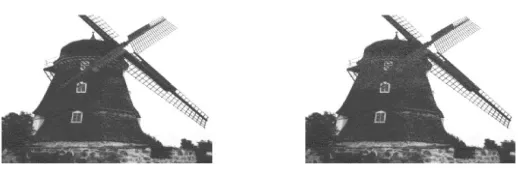
Another method named EZ-stego uses a color pallet to find the closest color (two adjacent colors) in the predefined pallet. Although it uses adjacent colors, it is easily attacked by a visual attack like substituting all even pallet colors’ values with black and odd numbers with white or vice versa. Therefore, the distortion is shown by a filtering method (Figures 1.1, 1.2). The usefulness of this attack is limited to the texture of the original image, and it does not work out on a kind of flooring tile image (Figure 1.3).
Figure 1. 1 Windmill as original image on the left, and embedded image on the right (Westfeld and Pfitzmann, 2000).
Figure 1. 2 Filtered image of Figure 1.1, nothing embedded (Left) and 50% capacity is embedded on the right image (Westfeld and Pfitzmann, 2000).
5
1.2.2 Pair of Values Problem (PoVs)
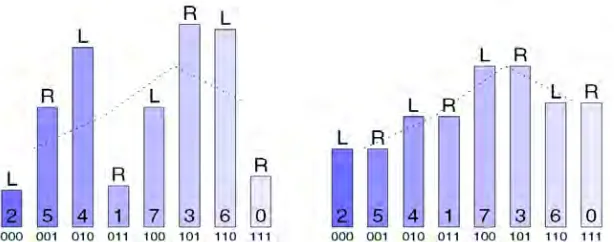
Another method (Zhang and Wang, 2005) also presented an adaptive steganographic scheme with the multiple-based notational system (MBNS) based on human vision sensitivity (HVS). The hiding capacity of each image pixel is determined by its local variation. The formula for computing the local variation takes the human visual sensitivity into account. A great local variation value indicates that the area to where the pixel belongs is either a busy or edge area. It means more secret data is hidden. This way, the stego-image’s quality degradation is so much invisible to the human eye. However, the sequential processing mode of the pixel values increases the cumulative distortion and it also leads to see some pair of values created in the histogram of the stego-image (Figure 1.4). Pair of values are made as the algorithm fits random bits in LSBs of pixels (the same frequency of gray-scale values in image’s histogram for all 2k and 2k+1 values). Therefore, assuming that number of 0s and 1s are approximately identical, when the algorithm embeds some bit(s) inside each pixel, with the probability of 50 percent, the least significant bit value is either zero or one. The idea of the existence of PoVs is similar to the theoretic analysis of PoVs (Lee et al., 2009). In both methods, just LSB causes PoVs. If all k-bits are substituted, the LSB is again changed by chance of 50 percent and makes a pair of value. Ultimately, this is useable for steganalyzers in order to detect the existence of the message (such as chi-squared attack).
6
1.2.3 Summary
Often steganographic schemes create regular statistical evidence that is used to detect the secret message with respect to image quality properties (Avcibas et al., 2003). One example is the detection of secret message existence in the LSB of natural continuous-tone images (Dumitrescu et al., 2002). The key to this success is based on finding a group of pixels that their corresponding cardinalities are changed with LSB method as the message bits are scattered randomly not sequentially. All steganalysis methods take advantage of the measures such as existence of image’s distortion, and PoVs that give consistent scores across an image class. From this point of view, it results in a visual attack that uses multivariate regression on the selected quality metrics (Avcibas et al., 2001). Ultimately, once the natural LSBs are changed with random bits in smooth areas, then it is easily detected by means of evidences left.
There is just one important factor which makes steganalysis harder and that is when imperceptibility rises. If a new method proposes some way that guarantees achieving an acceptable imperceptibility as well as removing PoVs, it is regarded as a robust algorithm to such visual attacks as chi-squared attack.
1.3 Problem Statement
7
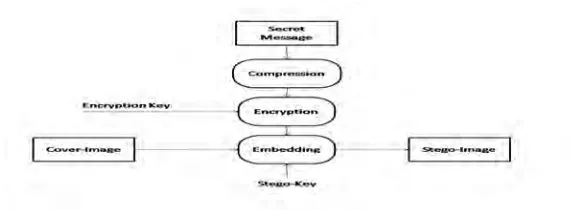
method chooses its proper pixels having the least likely risk of being attacked and detected by Steganalyzers (Provos, 2001). In other words, there is a need to choose the best pixels unlike the conventional LSB insertion method that chooses the target bits sequentially. Furthermore, in order to add more security, the message can be compressed and then encoded by a secret key to be embedded in the cover image (Figure 1.5). The reverse mode is not recommended since number of compression methods are limited so that the probability of being attacked goes higher. Because some content-dependent patterns in the original message exposes the message existence. Thus the way these characteristics are concealed is so much important (Lee, 1999). But, in this study the focus is more on the algorithm such that these issues are ignored however they are needed for guaranteeing more security. In this study, an algorithm is proposed based on the following ideas:
Choosing some pixels of a typical gray-scale image with more capacity, considering a probability value for each target pixel. The idea is based on the algorithm offered by Lee et al. (1999). This is just due to scattering message bits, in order not to be detected easily.
Removing the statistical regular patterns (PoVs) with help of an advanced technique which is incrementing or decrementing the pixel value instead of just flipping LSBs with desired message bits (Lee et al. ,2009).
Using local variation formula (considering human vision sensitivity-HVS) to determine the best capacity of each pixel with respect to each pixel’s adjacent neighbors (Zhang and Wang, 2005).
Choosing more adjacent neighbors so as to decrease the cumulative distortion (more than 3 neighbors and perhaps all eight neighbors).
8
A hybrid method of all named methods assures that there will be no existence of any PoVs. Therefore, the following questions are answered in this study:
1. How to choose the desired pixels non-sequentially?
2. Which policy will perform better so as to get the maximum image’s imperceptibility and provide lesser cumulative image’s distortion rather than maximum capacity?
3. How to remove regular patterns (PoVs)?
1.4 Objectives
The major goals in this study are as follows:
1. To design a steganography algorithm that increases imperceptibility. 2. To get the same acceptable payload or capacity as MBNS method does. 3. To add and analyze the security against chi-squared attack.
These goals are fulfilled as follows:
1. The more surrounding pixels, the more imperceptibility. These pixels are considered in local variation formula. In this way more accurate number is estimated for each target pixel. Image’s distortion decreases a great deal when other surrounding pixels’ values are used and vice versa. 2. Several payloads are checked under the same conditions for either of the
methods.
9
technique named as adjustment technique is utilized that makes chi-squared attack unable to find any PoVs.
1.5 Project Scope
In this study, the scope of the proposed algorithm is mainly based on below items:
1. The desired file expected to be embedded (secret data) is the ordinary text file format.
2. The desired media for hiding the text file (cover media) is an 8-bits gray-scale image file format.
3. The proposed method uses the basic concept of LSB insertion method. 4. There are two keys used in the proposed algorithm (stego-key and seed
number) but finding the best key is ignored in this study.
5. Chi-squared attack is the desired visual attack in order to prove the effectiveness of the proposed algorithm.
6. The visual language used for coding is MATLAB.
7. The standard images for testing purposes are Lena, Man and Finstones .
1.6 Importance of the Research
95
REFERENCES
Anderson, R.J. and Petitcolas, F.A.P. (May 1998). On the limits of Steganography. IEEE Journal of selected Areas in Communications.
Aura, T. (1995). Invisible Communication. EET technical report. Finland: Helsinki Univ. of Technology.
Avcibas, I., Avcıbas, I., Sankur, B., Akarun, L., Anarim, E., Memon, N. and Yemez, Y. (2001). Image Quality Statistics and Their Use in Steganalysis and Compression. Doctor of Philosophy. Institute for Graduate Studies in Science and Engineering.
Avcibas, I., Memon, N. and Sankur B. (2003). Steganalysis Using Image Quality Metrics. IEEE transactions on Image Processing. IEEE, 12, 221-229.
Brin, S., Davis, J. and Garcia-Molina, H. (1995). Copy Detection Mechanisms for Digital Documents. Proceedings of the ACM SIGMOD Annual Conference. San Jose.
Broder, A.Z. (1993). Some applications of Rabin's fingerprinting method. Methods in Communications, Security, and Computer Science. London: Springer-Verlag, 143-152.
Broder, A.Z. (1998). On the Resemblance and Containment of Documents. Proceedings of Compression and Complexity of Sequences 1997. IEEE Computer Society, 21-27.
Chan, C.K. and Cheng, L.M. (2004). Hiding data in images by simple LSB substitution. Pattern Recognition. Vol. 37 (No. 3), 469–474.
Clair, B. (2001). Steganography: How to Send a Secret Message. Saint Louis University.
96
Dumitrescu, S., Wu, X. and Memon, N. (2002). Steganalysis of Random lsb Embedding in Continuous-tone Images. IEEE International Conference on Image Processing.
Fan, L., Cao, P., Almeida, J. and Broder, A. (2000). Summary Cache: A Scalable Wide-Area Web Cache Sharing Protocol. IEEE/ACM Transactions on Networking. Vol. 8 (No. 3).
Fridrich, J., Goljan, M. and Du, R. (2001). Reliable Detection of LSB Steganography in Color and Grayscale Images. IEEE Multimedia. 8, 22-28.
Fridrich, J. and Goljan, M. (2002). Practical Steganalysis of Digital Images-State of the Art. In Proceedings of SPIE. 1-13.
Fridrich, J., Goljan, M. and Soukal, D. (2003). Higher-order statistical steganalysis of palette images. Security and Watermarking of Multimedia Contents. Proc. SPIE 5020,178–190.
Isbell, R.A. (2002). Steganography: Hidden Menace or Hidden Savoir. Steganography White Paper.
Johnson, N. F, Jajodia, S. and Mason, G. (1998). Exploring Steganography: Seeing the Unseen. IEEE Computer. 31, 26-34.
Kahn, D. (1967). The Code breakers. ISBN 0-684-83130-9. New York: Macmillan. Lee, Y.K. and Chen, L. h. (1999). An Adaptive Image Steganographic Model Based
on Minimum-Error LSB Replacement. In Proceedings of the Ninth National Conference on Information Security. 14-15. Taichung, Taiwan, 8-15.
Lee, K., Westfeld, A., Lee, S. and Technische Universität esden (2006). Category Attack for LSB Steganalysis of JPEG images. Digital Watermarking (5th International Workshop). London: Springer-Verlag, 35-48.
Lee, Y.K., Bell, G., Huang, S.Y., Wang, R.Z. and Shyu, S.J. (2009). An Advanced Least-Significant-Bit Embedding Scheme for Steganographic Encoding. Advances in Image and Video Technology. Berlin / Heidelberg: Springer, 349-360.
Manber, U. (1994). Finding Similar Files in a Large File System. Proceedings of the USENIX Winter Technical Conf.