CLASSIFICATION USING A MULTI-OBJECTIVE STRATEGY
Mohd Saberi Mohamad
1,2,Sigeru Omatu
I,Safaai Deris
2and Michifuci Yoshioka
IIDepartment of Computer Science and Intelligent Systems,
Graduate School of Engineering, Osaka Prefecture University, Sakai, Osaka 599-8531, Japan
2Department of Software Engineering, Faculty of Computer Science and Infonnation System, Universiti Teknologi Malaysia, 81310 Skudai, Johor, Malaysia
Email: [email protected].{sigeru.yoshioka}@.cs.osakafu-u.ac.jp: [email protected]
Abstract: A microarray machine offers the ability to measure the expression levels of
thousands of genes simultaneously. Itis used to collect the infonnation from tissue and cell
samples regarding gene expression differences that could be useful for cancer classification.
However, the urgent problems in the use of gene expression data are the availability of a huge
number of genes relative to the small number of available samples, and many of the genes are
not relevant to the classification. Ithas been shown that selecting a small subset of genes can
lead to improved classification accuracy. Hence, this paper proposes a solution to the
problems by using a multi-objective strategy in genetic algorithms. This approach is
experimented on one gene expression data set, namely the lung cancer.Itobtains encouraging
result on the
~
set as compared with an approach that uses single-objective strategy ingenetic algorithms.
Keywords: Cancer Classification, Genetic Algorithm, Gene Expression Data, Gene Selection,
Multi-objective.
1. INTRODUCTION
Gene expression is a process by which mRNA and eventually protein are synthesised from
the DNA template of each gene. Recent advances in microarray technology allow scientists to
measure the expression levels of thousands of genes simultaneously and determine whether
those genes are active, hyperactive, or silent in nonnal or cancerous tissues. This technology
finally produces gene expression data. Current studies on the molecular level classification of
tissue have produced remarkable results and indicated that gene expression data could
134
significantly aid in the development of an efficient cancel' classification [3]. However,
classification based on the data confronts with more challenges. One of the major challenges
is the overwhelming number of genes relative to the number of samples in a data set. Many of
the genes are also not relevant to "the classification process. Hence, the selection of genes is
the key of molecular classification, and should be taken with more attention.
The task of cancer classification using gene expression data is to classifY tissue
samples into related classes of phenotypes, e.g., cancer versus normal [4]. A gene selection
process is used to reduce the number of genes used in classification while maintaining an
acceptable classification accuracy. Gene selection methods can be classified into two
categories. If gene selection is carried out independently from the classification procedure, the
methods belong to the filter approach. Otherwise, it is said to follow a wrapper (hybrid)
approach. Most previous works have used the filter approach to select genes since it is
computationally more efficient than the hybrid approach. However, the hybrid approach
usually provides greater accuracy than the filter approach [3]. The application of hybrid
approaches using genetic algorithm (GA) with a classifier has grown in recent years. From the
previous works, the GA performed well but only on data that have a number offeatures that is
less than 1,000.
Multi-objective optimisation (MOO) is an optimisation problem that involves
multiple objectives or goals. Generally, the objectives may estimate very different aspects of
solutions. Being aware that gene selection is a MOO problem in the sense of classification
accuracymaximisation, and gene subset size minimisation.
Xn
X,the decision space
Zm
Z, the objective space
Figure I.The n-dimensional decision space maps to the rn-dimensional objective space.
Therefore, this research proposes a multi-objective strategy in a hybrid of GA and
support vector machine classifier (GASVM) for genes selection and classification of gene
expression data.Itis known as MOGASVM,
2. A MULTI-OBJECTIVE STRATEGY IN GA
MOGASVM is developed to improve the perfonnance of GASVM that uses single-objective
[3]. All infonnation of GASVM such as flowchart, algorithm, chromosome representation,
fitness function, and parameter values are available in Mohamadet al. [3].
In the sense of classification accuracy maximisation and gene subset size
minimisation, a gene selection can be viewed as a MOO problem. Fonnally, each gene subset
(a solution) is represented by x (n-dimensional decision vector). Itis associated with a vector
objective function f(x):
f(x) ==
U;
(x)'/2(x),···'/m (x» (I)with x==(xpx 2,... ,Xn)EX, where X is the decision space, i.e., the set of all expressible
solutions. The vector objective function f(x) maps X into 9{m, where 9{ is the objective
space and m~2 is a number of objectives. /; is the ith objective. The vector z
=
f(x) is an"'Objective vector. The image ofX in the objective space is the set of all attainable points, z
(see Fig. 1). If all objective functions are for maximisation, a subset x is said to dominate
than another x (x·)if and only if:
x>x·
iff
ViEl..m,/;(x)~/;(x·)A3}El..m,f/x )>fix·)
A solution (gene subset) is said to be Pareto optimal if it is not dominated by any
other solutions in the decision space. A Pareto optimal solution cannot be improved with
respect to any objective without worsening at least one other objectives. The set of all fea,sible
non-dominated solutions in X is referred to as the Pareto optimal set, and for a given Pareto
optimal set, the corresponding objective function values in the objective space are called as
the Pareto front [2].
Pareto front in this research is defined as the set of non-dominated gene subsets.
MOGASVM is one of promising approaches to find or approximate the Pareto front. The role
of this approach is guided with the search towards the Pareto front and preserving the
non-dominated solutions as diverse as possible. Therefore, original GASVM is customised to
accommodate multi-objective problems by using a specialised fitness function. The ultimate
goal of MOGASVM is to identifY a non-dominated gene subset Pareto front. This subset
(individual) is evaluated by its accuracy on the training data and the number of genes selected
in it. These criteria are denoted as
J;
and/2
separately, and used in the fitness function.Therefore, the fitness of an individual is calculated such equation (4):
136
f.. =
Wj xA(x)/2
=
W2X
«M - R(x» 1M)(2)
(3)
fitness(x)=
f..
+
J;
(4)where A(x)E[0,
I]
is the leave-one-out-cross-validation (LOOCY) accuracy on the training data using the only expression values of the selected genes in a subset x, R(x) is the numberof selected genes in x. M is the total number of genes. WI and
w
2 are two priority weightscorresponding to the importance of accuracy and the number of selected genes, respectively,
where WI E[0.1,0.9] and w2=1-WI' /2 is calculated such above in order to support the
maximisation function of minimisation of gene subset size. In this paper, the accuracy is more
important than the number of selected genes (gene subset size).
Ambroise and Mclachlan (2002) have indicated that testing results could be
overoptimistic, caused by the "selection bias", if the test samples were not excluded from the
classifier building processina hybrid approach [I].Therefore, the proposed MOGASVM is
totally excluded the test samples from the classifier building process in order to avoid the
influence of bias.
3. EXPERIMENTAL RESULTS
3.] Data Sets
One gene expression data set is used to evaluate the proposed approach, namely the lung
cancer. The lung cancer data set has two classes: malignant pleural mesothelioma (MPM) and
adenocarcinoma (ADCA). There are 181 samples (31 MPM and 150 ADCA). The training set
contains 32 (16 MPM and 16 ADCA) of them. The rest 149 samples are used for the test set.
Each sample IS described by 12,533 genes. It can be obtained at
http://chestsurg. orglpublicationsl2002-microarray.aspx.
3.2 Experimental setup
Three criteria following its important are used to evaluate MOGASVM performances: the test
accuracy, the LOOCV accuracy, and the number of selected genes.
The experimental results presented in this section pursue two objectives. The first
objective is to show that gene selection using MOGASVM is needed for reducing the number
of genes and achieving better classification of gene expression data. The second objective is
to show that MOGASYM is better than the original version of GASVM [3] that use a
objective approach. To achieve these objectives, several experiments are conducted 10 times
using different values of WI and W2 (wI E[0.1,0.9] and W2 =1-wI)' The subset that produces
the highest LOOCY accuracy with the lowest number of selected genes is chosen as the best
subset. SYM, GASYM (single-objective), and GASYM-II [3] are also experimented in this
research as a comparison with MOGASYM.
3.3 Result analysis and discussion
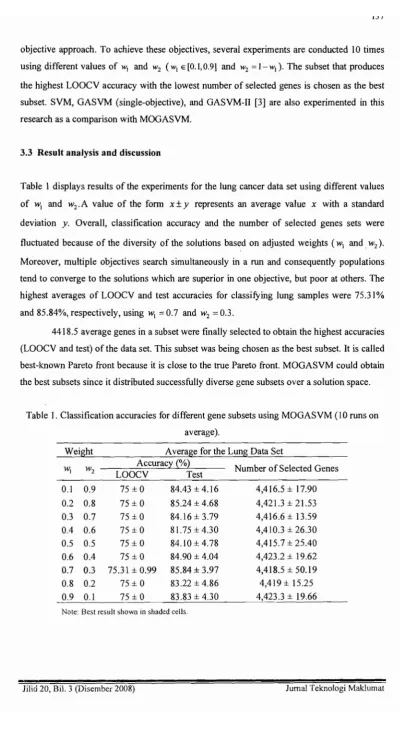
Table 1 displays results of the experiments for the lung cancer data set using different values
of WI and w2 •A value of the fonn x±y represents an average value x with a standard
deviation y. Overall, classification accuracy and the number of selected genes sets were
fluctuated because of the diversity of the solutions based on adjusted weights (WI and.w2 ).
Moreover, multiple objectives search simultaneously in a run and consequently populations
tend to converge to the solutions which are superior in one objective, but poor at others. The
highest averages of LOOCY and test accuracies for classifying lung samples were 75.31 %
and 85.84%, respectively, using WI
=
0.7 and w2=
OJ.44 I8.5 average genes in a subset were finally selected to obtain the highest accuracies
(LOOCY and test) of the data set. This subset was being chosen as the best subset. Itis called
best-known Pareto front because it is close to the true Pareto front. MOGASYM could obtain
the best subsets since it distributed successfully diverse gene subsets over a solution space.
Table I. Classification accuracies for different gene subsets using MOGASYM (10 runs on
average).
Weight Average for the Lung Data Set
WI
w
2Accuracy (%)
Number of Selected Genes
LOOCY Test
0.1 0.9 75 ± 0 84.43 ± 4.16 4,416.5± 17.90
0.2 0.8 75 ± 0 85.24 ± 4.68 4,421.3 ± 21.53
OJ 0.7 75 ±O 84.16 ± 3.79 4,416.6 ± 13.59
0.4 0.6 75 ± 0 81.75±4.30 4,410.3 ± 26.30
0.5 0.5 75 ± 0 84.10±4.78 4,415.7 ± 25.40
0.6 0.4 75 ± 0 84.90 ± 4.04 4,423.2 ± 19.62
0.7 0.3 75.31 ± 0.99 85.84± 3.97 4,4J8.5 ± 50.19
0.8 0.2 75 ± 0 83.22 ± 4.86 4,419± 15.25
0.9 0.1 75 ± 0 83.83 ± 4.30 4,423.3 ± 19.66
Note: Best result shown in shaded cells.
138
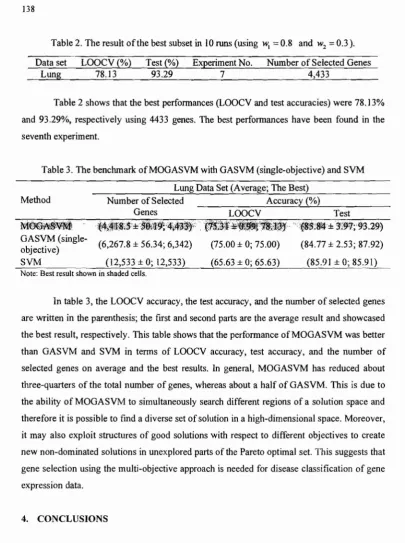
Table 2. The result ofthe best subset in 10 runs (using WI
=
0.8 and w2=
0.3).Data set Lung
LOOCV(%) 78.13
Test (%) 93.29
Experiment No. 7
Number of Selected Genes 4,433
Table 2 shows that the best performances (LOOCV and test accuracies) were 78.13%
and 93.29%, respectively using 4433 genes. The best performances have been found in the
seventh experiment.
Table 3. The benchmark ofMOGASVM with GASVM (single-objective) and SVM
Lung Data Set (Average; The Best)
Method Number of Selected Accuracy (%)
Genes LOOCV Test
Nt~~"
.
·~4.#1~~"$~~·:5~ll\t)';'4~~~~~'· ·:{rr$;~il.*1~f(~!f8:{.1i~J" '·:jG8'St~±9';;9<1;'~3.b9~
GASVM
(single-b· t' ) (6,267.8±56.34; 6,342) (75.00±0; 75.00) (84.77±2.53; 87.92) o ~ecIve
SVM (I2,533±0; 12,533) (65.63±0; 65.63) (85.91±0; 85.91)
Note: Best result shown in shaded cells.
In table 3, the LOOCV accuracy, the test accuracy, and the number of selected genes
are written in the parenthesis; the first and second parts are the average result and showcased
the best result, respectively. This table shows that the performance of MOGASVM was better
than GASVM and SVM in terms of LOOCV accuracy, test accuracy, and the number of
selected genes on average and the best results. In general, MOGASVM has reduced about
three-quarters of the total number of genes, whereas about a half of GASVM. This is due to
the ability of MOGASVM to simultaneously search different regions of a solution space and
therefore it is possible to find a diverse set of solution in a high-dimensional space. Moreover,
it may also exploit structures of good solutions with respect to different objectives to create
new non-dominated solutions in unexplored parts of the Pareto optimal set. This suggests that
gene selection using the multi-objective approach is needed for disease classification of gene
expression data.
4. CONCLUSIONS
MOGASVM has been proposed, developed, and analysed to solve the gene selection
problems. By performing experiments, this research found that classification accuracy and the
number of selected genes were more fluctuating and not equal when using different values of
WI and w2. This result concludes that there are many irrelevant genes in gene expression data
and some of them act negatively on the acquired accuracy by the relevant genes.
Generally. MOGASVM achieved significant the LOOCV accuracy, the test accuracy,
and the number of selected genes. and were better than GASVM (single-objective) and SVM
since the multi-objective strategy in it can find a diverse solution in Pareto optimal set.
However, MOGASYM did not achieve the higher accuracy, and the number of selected genes
was still higher. MOGASVM can also be extended to other applications such as pattern
recognitions, computer visions, and cognitive sciences.
ACKNOWLEDGEMENTS
This study was supported and approved by Universiti Teknologi Malaysia, Osaka Prefecture
University, and Malaysian Ministry of Higher Education. The authors gratefully thank the
referees for the helpful suggestions.
REFERENCES
[I] Ambroise, C. and McLachlan, G. 1., "Selection bias in gene extraction on the basis of
microarray gene-expression data", Proceedings of the National Academy of Scienye of
the USA, Washington, USA, Volume 99, Issue 10, pp 6562-6566, 2002.
[2] Handl, 1., Kell, D. B. and Knowles, J, "Multi-objective optimisation in bioinformatics and
computational biology", IEEE/ACM Transaction on Computational Biology &
Bioinformatics, Volume4, Issue 2, pp. 279-292,2007.
[3] Mohamad, M. S., Deris, S. and lilias, R. M., "A hybrid of genetic algorithm and support
vector machine for features selection and classification of gene expression microarray",
International Journal of Computational Intelligence and Applications, Volume 5,
pp.91-107,2005.
[4] Mohamad, M. S., Omatu, S., Deris, S. and Hashim, S. Z. M., "A model for gene selection
and classification of gene expression data", International Journal of Artificial Life &
Robotics, Volume 11,Issue 2, pp.2I9-222, 2007.