639 | P a g e
MULTI-MODAL EVENT TOPIC MODEL FOR EVENT
TRACKING
Prajakta N. Sonone
1, Prof. A.V.Deorankar
2 1P.G. Scholar, Department of Computer Science and Engineering,
Government College of Engineering, Amravati, Maharashtra (India)
2
Associate Professor, Department of Information Technology,
Government College of Engineering, Amravati, Maharashtra (India)
ABSTRACT
In Social media documents or any document collected from Google contains certain events having long text.
Due to variety of uploaded information over internet it is required to model them with appropriate images
associated with story of particular event. Variety of text is considered to be different but the images are same for
those events. Because may they have different textual information but the visual modalities are always same.
Multimodal event topic model is proposed in this paper. Which can effectively model these events having so
many images and text and find correlation between them. For evaluating the results we have prepared our own
dataset which contains almost 5000 records related to stocks. For event tracking in case of multiple events,
similarity computing identification method is used. For various documents rather multiple documents this
method can be used to distribute topics in the document. For feature extraction Affinity Proportion Algorithm is
suggested in this paper. For dataset parsing instead of XML parsing JSON parsing is used which can parse the
entries for data efficiently. And in fast manner it can parse the dataset values. So Multi-modal topic model can
effectively track the bunch of events over the time.
Keywords: CrossSpot, Event detection, Event tracking, multi-modal, Social media, Topic model.
I. INTRODUCTION
640 | P a g e
evolutionary trend of Rio Olympics then with help of this incremental framework we can find the evolutionary theme of the whole event in details. This event tracking mechanism is used to track the event happened in previous years. The events and their overall summary can be obtained with the help of event tracking mechanism.
II. LITERATURE SURVEY
641 | P a g e
III.
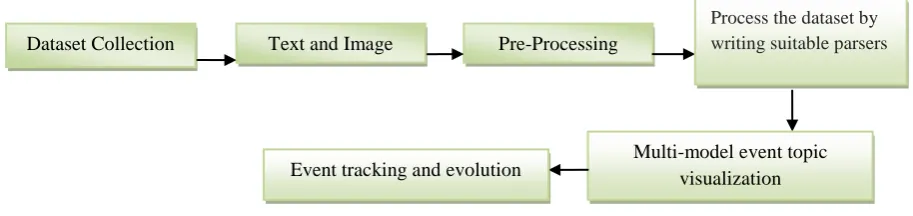
MULTI-MODAL EVENT TOPIC MODEL 3.1 Architecture of Multi-Modal Event Topic ModelThe multi-modal event topic model (mm-ETM) is suggested in this paper which is used for finding the correlations between visual and textual modalities. This model can also used to track and detect the events according to time when the event is happened. The dependency relationships between textual and visual modalities are different for different semantic concepts. The event may contain text as well as images corresponding to particular topic. Some topics are represented using textual information and some using visual descriptors. For modelling such text corpora and multimedia contents, the multi-model topic is well suited. The system architecture of multi-model event topic model is given in following figure.
Fig 1.Workflow diagram for Multi-Modal Event Topic Model
3.2 Topic Assignments in Multi-Modal Event Topic Model:
According to the generative process of mmETM with visual words and textual words having document d can be described as follows.
For Visual representative Topics, textual topic is denoted as Zw and visual topics are denoted as Zv. Here the
Multinomial distribution over words is described using notation is, and .
For each document d , In case of Non- Visual representative Topics Zw , the Multinomial distribution over
words is described using notation is, .
Binomial distribution of Visual representative Topics and Non- Visual representative can be written as
d .
Multinomial distribution over is Visual representative Topics Θd Dir( ),Multinomial distribution over is
Non- Visual representative Topics Ψd .
For each word wn in document d Xdn d), For each visual word vn individual topic assignment is
In the above assignments Zw textual topic and visual topic is Zv. Ψd and Θd are document-topic
distributions. are set of K-visual representative topic and H non-visual representative topic .
3.3 Event Tracking
With the help of incremental mmETM model learning, topic distributions related with each document can be obtained. Means For each document topic distribution can be done with this model over times. For tracking more than one event at a time similarity computing identification is applied. By using similarity computing
Pre-Processing Text and Image
Multi-model event topic visualization Event tracking and evolution
Dataset Collection
642 | P a g e
identification method based on the learned mmETM model at epoch, multiple event documents can be classified into their corresponding events at epoch . In this way multiple events can be tracked over time.
3.4 SIMILARITY COMPUTING IDENTIFICATION
This method is used for tracking the events in the model. It can also be used in incremental mmETM model. One critical step in the item-based collaborative filtering algorithm is to compute the similarity between items and then to select the most similar items. The basic idea in similarity computation between two items i and j is to first isolate the users who have rated both of these items and then to apply a similarity computation technique to determine the similarity.
3.5 DATASET COLLECTION
As of now data sets are not available for processing multi-modal information we have collected events related stock company named as NASDAQ. Which have near about 5000 records of various stock related information. For processing this data set JSON parsing is used which have some advantages as compare to XML parsing as follows.
3.5.1 Advantages of JSON parsing With respect to XML parsing:
JSON is extended from JavaScript. JSON syntax is lighter than XML as JSON has serialized format of data having less redundancy. JSON does not contain start and end tags. JSON is light – weighted in compare to XML as it has serialized format and so faster also. JSON supports data type including integer and strings, JSON also supports array. It does not need any additional code for parsing. JSON syntax is lighter than XML as JSON has serialized format of data having less redundancy. JSON does not contain start and end tags. JSON is light – weighted in compare to XML as it has serialized format and so faster also. JSON is data oriented and can be mapped more easily.
3.6 Affinity Proportion Algorithm for feature Extraction:
In statistics and data mining, affinity propagation (AP) is a clustering algorithm based on the concept of "message passing" between data points. Unlike clustering algorithms such as k-means or k-medoids, affinity propagation does not require the number of clusters to be determined or estimated before running the algorithm. Similar to k-medoids, affinity propagation finds "exemplars", members of the input set that are representative of clusters. The inventors of affinity propagation showed it is better for certain computer vision and computational biology tasks, e.g. clustering of pictures of human faces and identifying regulated transcripts, than k -means, even when k-means was allowed many random restarts and initialized using PCA. A study comparing affinity propagation and Markov clustering on protein interaction graph partitioning found Markov clustering to work better for that problem. A semi-supervised variant has been proposed for text mining applications.
IV. CONCLUSIONS
643 | P a g e
performance can be improved by using the different domains like Flickr, Youtube and Google News for dataset collection of social media event for its detailed analysis.
REFERENCE
[1] Shengsheng Qian, Tianzhu Zhang, Changsheng Xu, and Jie Shao, “Multi-modal event topic model For social event analysis” IEEE Trans. multimedia, vol. 18, no. 2, Feb. 2016
[2] M. Merler, B. Huang, L. Xie, G. Hua, and A. Natsev, “Semantic model vectors for complex video event recognition,” IEEE Trans. Multimedia, vol. 14, no. 1, pp. 88–101, Feb. 2012.
[3] T. Zhang and C. Xu, “Cross-domain multi-event tracking via CO-PMHT,” ACM Trans. Multimedia Comput. Commun. Appl., vol. 10, no. 4, pp. 31:1–31:19, 2014.
[4] X. Yang, T. Zhang, C. Xu, and M. S. Hossain, “Automatic visual concept learning for social event understanding,” IEEE Trans.Multimedia, vol. 17, no. 3, pp. 346–358, Mar. 2015. N.
[5] X. Wu, C.-W. Ngo, and A. G. Hauptmann, “Multimodal news story clustering with pairwise visual near-duplicate constraint,” IEEE Trans.Multimedia, vol. 10, no. 2, pp. 188–199, Feb. 2008.
[6] I. Kalamaras, A. Drosou, and D. Tzovaras, “Multi-objective optimization for multimodal visualization,”
IEEE Trans. Multimedia, vol. 16, no. 5, pp. 1460–1472, Aug. 2014.
[7] Meng Jiang, Alex Beutel, Peng Cui, Bryan Hooi, Shiqiang Yang Senior Member, IEEE, Christos Faloutsos,IEEE Trans. knowledge and Data Engineering, Manuscropt ID “Spotting Suspicious Behaviors in Multimodal Data: A General Metric and Algorithms”.
[8] C. Kang, S. Xiang, S. Liao, C. Xu, and C. Pan, “Learning consistent feature representation for cross-modal multimedia retrieval,” IEEE Trans. Multimedia, vol. 17, no. 3, pp. 370–381, Mar. 2015.
[9] S. Qian, T. Zhang, R. Hong, and C. Xu, “Cross-domain collaborative learning in social multimedia,” in
Proc. ACM MM, 2015, pp. 99–108.
[10]T. Zhang, C. Xu, G. Zhu, S. Liu, and H. Lu, “A generic framework for video annotation via semi-supervised learning,” IEEE Trans. Multimedia, vol. 14, no. 4, pp. 1206–1219, Aug. 2012.
[11]X. Yang, T. Zhang, and C. Xu, “Cross-domain feature learning in multimedia,” IEEE Trans.Multimedia, vol. 17, no. 1, pp. 64–78, Jan. 2015.
[12]X. Yang, T. Zhang, and C. Xu, “Cross-domain feature learning in multimedia,” IEEE Trans.Multimedia, vol. 17, no. 1, pp. 64–78, Jan. 2015.
[13]A. Mukherjee, B. Liu, and N. Glance, “Spotting fake reviewer groups in consumer reviews,” in WWW, pp. 191-200, 2012.
[14] L. Akoglu, R. Chandy, and C. Faloutsos, “Opinion fraud detection in online reviews by network effects,” in ICWSM, 2013
[15] J. Pei, D. Jiang, and A. Zhang, “On mining cross-graph quasicliques,” in ACM SIGKDD, pp. 228-238, 2005.
644 | P a g e
[17]A. Sun and S. S. Bhowmick, “Quantifying visual-representativeness of social image tags using image tag clarity,” in Proc. Social Media Modeling Comput., 2011, pp. 3–23.
[18]C. S. Firan, M. Georgescu, W. Nejdl, and R. Paiu, “Bringing order to your photos: Event-driven classification of Flickr images based on social knowledge,” in Proc. CIKM, 2010, pp. 189–198.
[19]T. Zhang, C. Xu, G. Zhu, S. Liu, and H. Lu, “A generic framework for video annotation via semi-supervised learning,” IEEE Trans. Multimedia, vol. 14, no. 4, pp. 1206–1219, Aug. 2012.
[20]X. Yang, T. Zhang, and C. Xu, “Cross-domain feature learning in multimedia,” IEEE Trans.Multimedia, vol. 17, no. 1, pp. 64–78, Jan. 2015.
[21]X. Yang, T. Zhang, C. Xu, and M. Yang, “Boosted multifeature learning for cross-domain transfer,”
TOMCCAP, vol. 11, no. 3, pp. 35:1–35:18, 2015.