Zone Routing Protocol
P
[1]
P
A. Nirosha., M.C.A, M.E CSE, P [2]
P
. G. Priyadharshini., M.SC., M.PHIL,
P
[1] [2]
PAssistant Professor, Department Of Computer Science,
P
[1] [2]
PDhanalakshmi Srinivasan College Of Arts And Science For Women,
Perambalur, Tamilnadu, India.
ABSTRACT:
In this article, Introduce a routing protocol for a
special class of ad-hoc networks, termed by us the
Reconfigurable Wireless Networks (RWNs). The main
features of RWNs are: increased mobility of the network
nodes, larger number of nodes, and a large network span.
To argue that the current routing protocols do not provide
a satisfactory solution for routing in this type of an
environment. To propose a scheme, called the Zone
Routing Protocol (ZRP), which dynamically adjusts itself
to the operational conditions by sizing a single network
parameter – the Zone Radius. More specifically, ZRP
reduces the cost of frequent updates of the constantly
changing network topology by limiting the scope of the
updates to the immediate neighborhood of the change. To
study the performance of the scheme, evaluating the
average number of control messages required to discover a
route within the network.
Key Words: Hybrid Routing, Proactive Routing, Query
Control, Reactive Routing, Routing Protocol and Routing
Zone.
I. INTRODUCTION:
1.1 THE NOTION OF THE AD HOC
WIRELESS NETWORKS:
An ad hoc network is defined as “An autonomous
system of routers (and associated hosts) connected by
wireless links the union of which forms an arbitrary graph.
The routers are free to move randomly and organize
themselves arbitrarily; thus, the network's wireless topology
may change rapidly and unpredictably. Such a network may
operate in a standalone fashion, or may be connected to the
larger Internet operating as a hybrid fixed/ad hoc network.”
The areas of application range from school classes over
well-known services like chartrooms to online shopping, but
they are also used in places that do not come to mind
immediately, like in the military. Furthermore, it is not even
necessary to have a human interaction factor: ad hoc
networks can also be used to link together research
computers or moving vehicles that exchange information
“on the road”, unbeknownst to the driver.
II.RECONFIGURABLE WIRELESS
NETWORKS (RWNS):
RWN is a type of ad hoc network with rapidly
changing topology. These networks typically have a large
span and connect hundreds to thousands of nodes that can
be rapidly deployed without infrastructure and where the
nodes are highly portable. Thus rapidly changing the node
constellation and the presence or absence of links. In this
article, I concentrate on routing in large RWN networks
with high mobility.
2.1 EXAMPLES OF THE USE OF THE RWN’S
ARE:
Tactical Operation - for fast establishment of military
communication during the deployment of forces in
unknown and hostile terrain;
Rescue Missions - for communication in areas without
adequate wireless coverage;
National Security - for communication in times of
national crisis, where the existing communication
infrastructure is non-operational due to a natural
disaster or a global war;
2.2 COMMUNICATION ENVIRONMENT AND
The main challenges in the design and operation
of the RWNs, compared to more traditional wireless
networks, stem from the lack of a centralized entity, the
potential for rapid node movement, and the fact that all
communication is carried over the wire-less medium. In
standard cellular wireless networks, there are a number of
centralized entities. In ad-hoc networks, there is no
preexisting infrastructure, and these centralized entities do
not exist. The centralized entities in the cellular networks
perform the function of coordination. The lack of these
entities in the RWNs requires distributed algorithms to
perform these functions. In particular, the traditional
algorithms for mobility management, which rely on a
centralized HLR/VLR, and the medium access control
schemes, which rely on the base-station/MSC support,
become inappropriate.
The following are a number of assumptions about
the communication parameters, the network architecture,
and the network traffic in a RWN.
Nodes are equipped with portable communication
devices. These may be powered by lightweight
batteries. Limited battery life can impose
restrictions on the transmission range,
communication activity (both transmitting and
receiving) and computational power of these
devices.
Connectivity between nodes is not a transitive
relation; i.e., if node A can communicate directly
with node B and node B can communicate directly
with node C, then node A may not, necessarily, be
able to communicate directly with node C. This
leads to as the hidden terminal problem.
A hierarchy in the network routing and mobility
management procedures could improve network
performance measures, such as the latency in
locating a mobile. However, a physical hierarchy
may lead to areas of congestion and is very
vulnerable to frequent topological
reconfigurations.
Assume that nodes are identified by fixed IDs
(based on IP addresses, for example).
All the network nodes have equal capabilities.
This means that all nodes are equipped with
identical communication devices and are capable
of performing functions from a common set of
networking services. However, all nodes do not
necessarily perform the same functions at the
same time. In particular, nodes may be assigned
specific functions in the network, and these roles
may change over time.
Although the network should allow
communication between any two nodes, it is
envisioned that a large portion of the traffic will
be between geographically close nodes. This
assumption is clearly justified in a hierarchical
organization. For example, it is much more likely
that communication will take place between two
vehicles in the same unit, rather than between two
vehicles in two different zones.
2.3 FEATURES FOR THE RWNS:
Robust routing and mobility management
algorithms to increase the network’s reliability
and availability; e.g., to reduce the chances that
any network component is isolated from the rest
of the network.
Adaptive algorithms and protocols to adjust to
frequently changing radio propagation, network,
and traffic conditions
Low-overhead algorithms and protocols to
preserve the radio communication resource
multiple (distinct) routes between a source and a
destination - to reduce congestion in the vicinity
of certain nodes, and to increase reliability and
survivability.
III. PROACTIVE VS REACTIVE
PROTOCOLS:
The protocols used in Ad Hoc networks generally
are categorized into two groups: pro-active and reactive
protocols. Pro-active protocols follow an approach similar
to the one used in wired routing protocols. By continuously
evaluating the known and attempting to discover new
routes, they try to maintain the most up-to-date map of the
network. This allows them to efficiently forward packets, as
the route is known at the time when the packet arrives at the
node. Pro-active or table-driven protocols, in order to
moving or failing nodes, require continuous updates, which
may consume large amounts of bandwidth clearly a
disadvantage in the wireless world, where bandwidth is
often sparse. Even worse so, much of the accumulated
routing information is never used, since routes may exist
only for very limited periods of time. In contrast, reactive
protocols determine the proper route only when required,
that is, when a packet needs to be for-warded. In this
instance, the node floods the network with a route request
and builds the route on demand from the responses it
receives. This technique does not require constant
broadcasts and discovery, but on the other hand causes
delays since the routes are not already available.
Additionally, the flooding of the network may lead to
additional control traffic, again putting strain on the limited
bandwidth.
3.1. ZONE ROUTING PROTOCOL:
ZRP is a framework by using it we can take
advantage of both proactive and on reactive protocol
according to the application. In this separation of nodes,
local neighborhood from the global topology of the entire
network allows for applying different approaches and thus
taking advantage of each technique’s features for a given
situation. These local neighborhoods are called zones (hence
the name) each node may be within multiple overlapping
zones, and each zone may be of a different size. The “size”
of a zone is not determined by geographical measurement,
as one might expect, but is given by a radius of length P
where P is the number of hops to the perimeter of the zone.
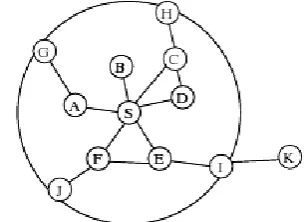
Figure 3 1.1: Example Routing Zone with P=2
In the above diagram ZRP, protocol having Zone
radius 2 in this inside the zone communication done in
proactive way and outside it between such zones in reactive
way. A, E, F, H, J, C are interior node and D, G, I, k are
border nodes communication between B and K is done
through proactive way and L is located outside the
zone.ZRP consist of three parts IARP proactive art, IERP
reactive part of it and BRP used with IERP to reduce the
query traffic.
3.2 ARCHITECTURE:
The Zone Routing Protocol, as its name implies, is
based on the concept of zones. A routing zone is defined for
each node separately, and the zones of neighboring nodes overlap. The routing zone has a radius ρ expressed in hops. The zone thus includes the nodes, whose distance from the node in question is at most ρ hops. An example routing zone is shown in Figure 1, where the routing zone of S includes
the nodes A–I, but not K. In the illustrations, the radius is
marked as a circle around the node in question. It should
however be noted that the zone is defined in hops, not as a
physical distance. The nodes of a zone are divided into
peripheral nodes and interior nodes. Peripheral nodes are
nodes whose mini-mum distance to the central node is
exactly equal to the zone radius ρ. The nodes whose
minimum distance is less than ρ are interior nodes. In Figure
1, the nodes A–F are interior nodes; the nodes G–J are
peripheral nodes and the node K is outside the routing zone.
Note that node H can be reached by two paths, one with
length 2 and one with length 3 hops. The node is however
within the zone, since the shortest path is less than or equal
to the zone radius.
The number of nodes in the routing zone can be
regulated by adjusting the transmission power of the nodes.
Lowering the power reduces the number of nodes within
direct reach and vice versa. The number of neighboring
nodes should be sufficient to provide adequate reach ability
and redundancy. On the other hand, a too large coverage
results in many zone members and the update traffic
becomes excessive. Further, large transmission coverage
adds to the probability of local contention.
3.3 ZRP IMPLEMENTS IARP, IERP AND BRP:
ZRP refers to the locally proactive routing
component as the Intra-zone Routing Protocol (IARP). The
globally reactive routing component is named Inter-zone
Routing Protocol (IERP). IERP and IARP are not specific
routing protocols. Instead, IARP is a family of
maintains routing information for nodes that are within the
routing zone of the node. Correspondingly, IERP is a family
of reactive routing protocols that offer enhanced route
discovery and route maintenance services based on local
connectivity monitored by IARP.
The fact that the topology of the local zone of
each node is known can be used to reduce traffic when
global route discovery is needed. Instead of broadcasting
packets, ZRP uses a concept called border casting. Border
casting utilizes the topology information provided by IARP
to direct query request to the border of the zone. The border
cast packet delivery service is provided by the Border-cast
Resolution Protocol (BRP). BRP uses a map of an extended
routing zone to construct border-cast trees for the query
packets. lternatively, it uses source routing based on the
normal routing zone. By employing query control
mechanisms, route requests can be directed away from areas
of the network that already have been covered.
In order to detect new neighbor nodes and link
failures, the ZRP relies on a Neighbor Discovery Protocol
(NDP) provided by the Media Access Control (MAC)
layer.NDP transmits “HELLO” beacons at regular intervals.
Upon receiving a beacon, the neighbor table is updated.
Neighbors, for which no beacon has been received within a
specified time, are removed from the table. If the MAC
layer does not include a NDP, the functionality must be
provided by IARP.
Figure 3.3.1: ZRP Architecture
The relationship between the components is
illustrated in Figure 3.3.1. Route updates are triggered by
NDP, which notifies IARP when the neighbor table is
updated. IERP uses the routing table of IARP to respond to
route queries. IERP forwards queries with BRP. BRP uses
the routing table of IARP to guide route queries away from
the query source.
IV. PERFORMANCE
:
In order to maximize performance of the RNW’s,
we need to minimize the amount of control traffic that is
sent. Thus, we wish to maintain an overview of the
networks topology that is as accurate as possible (at any
given time thus minimizing delays caused by route
discovery requests), while at the same time requiring
sending as little packages as possible. Given the hybrid
nature of the RNW’s , the goal can be reduced to finding the
correct - i.e. optimal size of the routing zone radius ρ for the
given network which may vary from case to case, depending
on the circumstances.
The cost of maintaining the ever-changing local
routes in RNW’s is too high, particularly since most of the
routes are so short-lived that they are never used. Instead, a
zone radius of0T0Tρ≤30T0Twould be beneficial, to ensure that the
zones overlap enough to allow for route redundancy. Note,
however, that reducing0T 0Tρ→00T 0Teffectively turns the ZRP into
a completely reactive protocol, obsoleting the advantages
gained from its hybrid nature: all routing is done on-demand
(using IERP), as no node is able to contact another node
using IARP.
0T
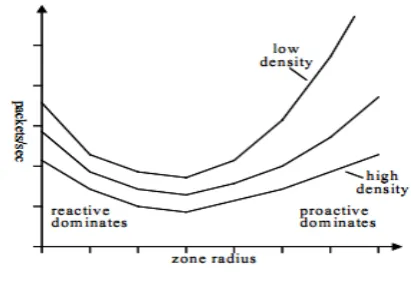
Figure 4.1: ZRP Traffic per Node (Schematic)
The results of shows that the IARP traffic grows
with the number of nodes in a given zone, while increased
mobility of a nodes increases IERP traffic: as nodes move,
the routes between zones break and need to be
``re-discovered''. Increasing the number 0TN 0Tof nodes in the global
network has only limited effect on the amount of pro-active
general, it can be stated that ``larger zones provide more
efficient queries, which compensates for the IARP
maintenance cost''.0T
4.1 PERFORMANCE GAIN ON THE EXAMPLE
OF BORDERCASTING:
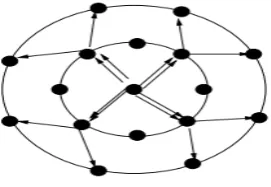
In this section, we will show how BRP can minimize the number of broadcasts significantly. First let us consider a network as shown in Figure 4.1.1.The first 8
nodes connected to the node in the middle should be seen as
that node’s peripheral nodes (that is, interior nodes are not
shown in this example), the 8 nodes on the outside as the
peripheral nodes of the extended zone. As we can see, the
total number of queries if no BRP would be used would sum
up to be 40!
Figure 4.1.1: Query Flooding
Now we introduce selective border-casting. A large number
of broadcasts can be avoided, since many of the zones
overlap and peripheral nodes connect to the same nodes in
the extended zone. As Figure 5 shows, the number has been
brought down to 16, a decrease of over 50%!
Figure 4.1.2: Selective Border Casting
The tremendous advantage of using Selective
Broadcasting in the IERP is visualized in Figure 4.1.2, as
adopted from other research papers.
It is important to note that all of the components of the ZRP provide the necessary flexibility optimal for nodes in a MANET:
• Each node may choose a different zone radius,
according to its signal strength, transmission
power, velocity etc.
• ZRP provides support for unidirectional links,
which frequently occur in MANETs
• Local neighbors are detected using NDP, which
can be implemented on the link-layer. Even
though this requires periodic messages to maintain
an accurate overview of the interior nodes, there is
not much of an overhead since this is performed
within the (comparably) small local zone. since
only link-layer uncast are presumed to be reliable
and in sequence, these properties are no
requirements for other traffic
• The protocols that make up the ZRP are
implementation specific. That is, one RNW with
certain requirements may adjust AOD for use as
the IERP and OLSR as the IARP, while in another
situation it might be favorable to use TBRPF as
the IARP and DSR as the IERP.
• By basing all components on the IP, ZRP can
provide all the services customers are used to
from wired networks. Another advantage is the
possibility of implementing security aspects on
the IP layer (for example through the use of
IPSec), thus removing costly overhead from the
wireless protocol vast performance gain through
the use of link-optimization, selective border
casting, Query Detection (1 and 2), Early
Termination and Loopback Termination (see
Figure 4.1.1)
• The ZRP can determine the appropriate zone
radius dynamically on-demand ; propagation of
the new routing zone is conceivable but would
need to be implemented)
The Zone Routing Protocol (ZRP) provides a hybrid routing framework, in which each node maintains
local routes within its zone in a pro-active manner, while
inter-zone communication is performed in a reactive
manner. In order to improve performance of the reactive IERP and avoid having to rely on flooding all neighboring nodes, thus risking exhaust-ting the available bandwidth, it
makes use of a border casting protocol.
In contrast to other MANET routing protocols,
RNW’s, as mentioned above, provides a hybrid approach, a framework of protocols. Thus, it does not directly conflict or compete with any of the classical protocols, but is able to
take advantage of each of those protocols strengths,
depending on the situation, requirements and
implementation. Also, ZRP is more suitable than other
protocols for large networks spanning diverse mobility patterns by providing the benefits of both reactive and pro-active routing in a flat network that takes advantage of a near hierarchical approach and its components IARP, IERP
and BRP
VI. REFERENCES
:[1] 16TBroad casting Resolution Protocol (BRP)0T16T0THaas, Z.J.,
Pearlman, M.R. and Samar, P., IETF Internet Draft,
draft-ietf-manet-brp-02.txt, July 2002.
[2] 16TMobile Ad-Hoc Networks (MANET) Charter0T16T0TIETF,
http://www.ietf.org/html.charters/manet-charter.html
[3] 16TMobile Ad hoc Networking (MANET): Routing Protocol
Performance Issues and Evaluation Considerations0T16T0TCorson,
S., Macker, J., Network Working Group, January 1999,
RFC2501
[4] 16TAd Hoc on Demand Distance Vector (AODV)
Routing0T16T0TPerkins, C.E., Belding-Royer, E.M., Das, S.R.,
IETF Internet Draft, 33T
http://www.ietf.org/internet-drafts/draft-ietf-manet-aodv-12.txt33T.
ABOUT AUTHOR
PRIYADHARSHINI.G- Received M.Sc., M.Phil Degree in Computer
Science. She is currently working as
Assistant Professor in Department of
Computer Science in
Tamil Nadu, India. Presented a
paper
Networking, and
Dot Net.
NIROSHA.A- Received M.C.A, M.E
Degree in and
Engineering. Currently working as
TamilNadu.
Presented a paper
Networking, Web