Effect of Copper Slag as a Partial Replacement of Fine
Aggregate on the Properties of Cement Concrete
Jayapal Naganur1, Chethan B. A.2
1PG Student, Dept. of Civil Engineering, GEC, HASSAN, India VTU, Belgaum. Karnataka, India, 1E-mail:[email protected] 2Assistant Professor. Dept. of Civil Engineering, GEC, HASSAN, India
Abstract:
Utilization of industrial waste or
secondary materials has encouraged in
construction industry for the production of
concrete because it contribute to reducing
the consumption of natural resources.
Copper slag is one of the materials that is
considered as a industrial waste which can
be used in construction Industry. This paper
presents the results of an experimental
investigation on the properties of concrete
using copper slag as partial replacement of
fine aggregate. For this research work,
M20 grade concrete was used and tests were
conducted. Various concrete mixtures were
prepared with different proportions of
copper slag as fine aggregates replacement.
Concrete mixtures were evaluated for
workability, compressive strength, splitting
tensile strength, corrosion, acid resistivity
and microstructural analysis. The results for
concrete indicated that workability
increased significantly as copper slag
percentage increase compared with the
control mixture. A substitution of up to 40 to
50% copper slag as a fine aggregate yielded
comparable strength to that of the control
mixture. However addition of copper slag
more than 50% resulted in strength
reduction compared to conventional
concrete.
Keywords:
Copper slag, compressive strength, tensile strength, accelerated corrosion test, acid resistivity and SEM analysis.
Introduction
worldwide while at the same time the generated wastes from the industry are increasing substantially. The sustainable development for construction involves the use of nonconventional and innovative materials, and recycling of waste materials in order to compensate the lack of natural resources and to find alternative ways conserving the environment.
The rapid increase in the natural aggregates consumption every year due to the increase in the construction industry worldwide means that the aggregates reserves are being depleted rapidly, particularly in desert countries such as Arebian Gulf region. It has been reported that, without proper alternative aggregates being utilized in the near future, the concrete industry globally consume 8-10 billion tones of natural aggregates after some years [3].
Many industrial wastes such as stone dust, silica fume, blast furnace slag and copper slag is pollutive; hence require proper collection, disposal and storage. Application of these materials in concrete is environmentally friendly and economically beneficial [5]. The most common type of slag produced in metallurgical is blast furnace slag. Long term performance records in manufacturing blended cement, light weight aggregates and Pozzolans for Portland cement have demonstrated blast furnace iron and steel slag to be economical and durable. Copper slag has been used in Canada approximately 45% in base
construction, rail road ballast and engineered fill [7].
Copper slag is one of the materials that is considered as a waste material which could have a promising future in construction industry as partial or full substitute of either cement or aggregates. It is a by- product obtained during the matte smelting and refining of copper. To produce every ton of copper, approximately 2.2–3.0 tons copper slag is generated as a by-product material. In India copper slag is producing by Sterlite Industries Ltd (SIL), Tuticorin Tamil Nadu. It is producing Copper slag during the manufacture of copper metal. Currently, about 2600 tons of Copper slag is produced per day and a total accumulation of around 1.5 million tons [6].
If we are able to use the copper slag in place of natural sand then we can successively obtain a material to replace the sand, which is eco-friendly and cost effective. Hence there is a growing need to find the alternative solution for the slag management. In the present study, it is proposed to study the effect of addition of copper slag mixed with natural sand in concrete.
Materials and Methods
Cement
requirements of Indian Standard Specification IS: 4031- 1988. The test results are listed in the Table 1.
Table 1.0 Properties of OPC
Characteristics Unit Value
Specific gravity - 3.15 Fineness % 2.5 Standard consistency % 32 Initial setting time Minutes 167
Final setting time Minutes 254 Compressive strength N/mm2 46.27
Fine and Coarse Aggregates
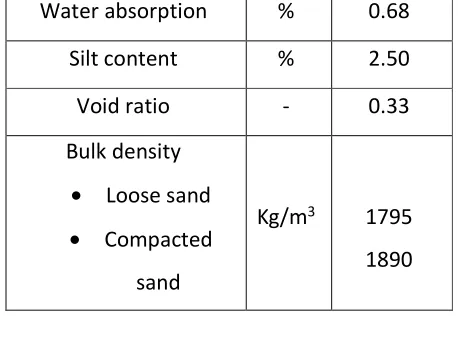
Coarse aggregates of 20mm down size and fine aggregates of Zone II were used from Hassan area of Karnataka. The test results on fine and coarse aggregate are presented in the following table 2.0 and 3.0.
Table 2.0 Physical Properties of Fine
Aggregate
Properties Unit Values
Fineness modulus - 2.78
Specific gravity - 2.65
Water absorption % 0.68
Silt content % 2.50 Void ratio - 0.33 Bulk density
• Loose sand
• Compacted
sand
Kg/m3 1795
1890
Table 3.0 Physical Properties of Coarse
Aggregate
Properties Unit Values
Specific Gravity - 2.73 Fineness Modulus - 8.01 Crushing Value % 26.37
Impact Value % 30.75 Water absorption % 2.60
Copper Slag
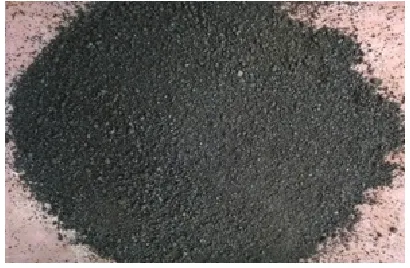
Copper slag collected from the Sterlite Industries Ltd (SIL), Tuticorin Tamil Nadu. The physical and chemical properties of copper slag are mentioned in the table 4.0 and 5.0 respectively.
Table 4.0 Physical Properties of Copper
Properties Unit Values
Specific Gravity - 2.73 Fineness Modulus - 8.01 Crushing Value % 26.37
Impact Value % 30.75 Water absorption % 2.60
Table 5.0 Chemical Composition of Copper Slag
Chemical
Component
Chemical
Component (%)
SiO2 25.85
Fe2O3 68.29
Al2O3 0.22
CaO 0.15
Na2O 0.58
K2O 0.23
LoI 6.59
Mn2O3 0.22
TiO2 0.41
TiO2 0.41
Figure 1.0 Copper Slag
PREPARATION AND CASTING OF
TEST SPECIMENS
Concrete cubes of size 150 × 150 × 150mm were casted for all the concrete mixes for compressive strength, 150 × 300mm size cylinders were casted for tensile strength, for Galvano Static weight loss method(GSWLM) cylinders of size 150 × 300mm were casted by immersing HYSD bar and for acid resistivity test cubes of size 150 × 150 × 150mm were casted. After 24 hours of casting the specimens were demoulded and put into water curing tank until 7, 14 and 28 days of testing for compression and tensile strength, for GSWLM the cylinders were demoulded after 24 hours and immersed in Nacl solution and for acid resistivity test the cubes were kept in normal water curing for 7 days and later immersed in H2SO4 solution for 30 days
time.
The experiment is conducted by sand is replaced with copper slag in steps of 10% till the strength decreases and the optimum value of the replaced percentage is noted down. The concrete is designed for M20 grade and water cement ratio used for the experimental work is 0.5.
RESULTS AND DISCUSSION
A. Compressive Strength Test
Figure 2.0 Cube Specimen Failure under Compressive Load
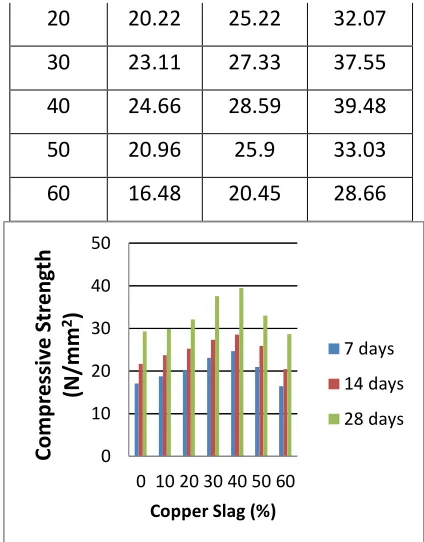
The compressive strength of concrete cubes is determined at ages 7, 14 and 28 days and Table 6.0 shows the strength variation of the mix having conventional concrete and partial replacement of sand by copper slag. The test is conducted as per IS: 516-1999
Table 6.0 Compressive Strength Variation
Replace
(%)
Compressive Strength
(N/mm2)
7 days 14 days 28 days
0 17.03 21.66 29.25 10 18.74 23.70 29.85
20 20.22 25.22 32.07 30 23.11 27.33 37.55 40 24.66 28.59 39.48 50 20.96 25.9 33.03 60 16.48 20.45 28.66
Figure 3.0 Compressive Strengths for 7, 14 and 28 Days.
From the figure 3.0 it is clear that with the increase in the percentage of copper slag compressive strength of the mixes 10, 20, 30, 40 and 50 has been increased gradually. 28 days strength of the mix 10, 20, 30, 40 and 50 has increased by 1.9%, 8.7%, 22.0%, 26.0% and 11.4% w.r.t the 28 days strength of the conventional mix. The 14 days strength of the mix 10, 20, 30, 40 and 50 has increased by 12.7%, 21.1%, 24.3%, 27.7% and 16.37% w.r.t the 14 days strength of the conventional mix. The 7 days strength of the mix 10, 20, 30, 40 and 50 has increased by 9.0%, 15.72%, 26.2%, 30.9% and 18.7% w.r.t the 7 days strength of the conventional mix. The 40% replacement shows the highest strength on
0 10 20 30 40 50
0 10 20 30 40 50 60
C
o
m
p
re
ss
iv
e
S
tr
e
n
g
th
(N
/m
m
2 )
Copper Slag (%)
7 days
14 days
the other hand compressive strength has started decreasing for the mixes 60. From this it can be concluded that with the increase in the percentage of the copper slag, compressive strength of the concrete increases up to 50% and decreases for more than 50% replacement of sand by copper slag.
B. Tensile Test
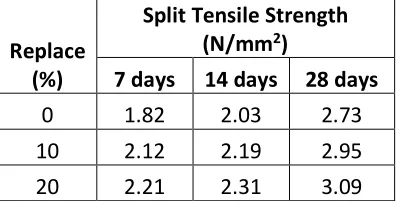
The procedure of mix is as same as that of the compressive strength test. Figure 4.0 shows the tensile strength of cylinder specimen having sand replaced by copper slag. The test is conducted as per IS: 516-1999
Figure 4.0 Cylinder Failure under Tensile Loading
Table 7.0 Tensile Strength Variation
Replace (%)
Split Tensile Strength (N/mm2)
7 days 14 days 28 days
0 1.82 2.03 2.73 10 2.12 2.19 2.95 20 2.21 2.31 3.09
30 2.22 2.38 3.42 40 2.38 2.5 3.49 50 2.05 2.26 2.48 60 1.98 2.12 2.33
Figure 5.0 Tensile Strength for 7, 14 and 28 Days
From the figure 5.0 it is observed that with the increase in the percentage of copper slag the 7days tensile strength of the replacements 10%, 20%, 30% and 40% increases by 14.1%, 17.6%, 18% and 23.5% w.r.t the 7 days tensile strength of the conventional mix. The 14days tensile strength of the replacements 10%, 20%, 30% and 40% increases by 7.3%, 12.1%, 14.7 and 18.8% w.r.t the 14 days tensile strength of the conventional mix. The 28 days tensile strength of the replacements 10%, 20%, 30% and 40% increases by 7.4%, 11.6%, 20.1 and 21.7% w.r.t the 28 days tensile strength of the conventional mix, on the other hand tensile strength has started
0 0.5 1 1.5 2 2.5 3 3.5 4
0 10 20 30 40 50 60
S
p
li
t
te
n
si
le
S
tr
e
n
g
th
(
N
/m
m
2)
Copper Slag (%)
7 days
14 days
decreasing for the replacements 50% and 60%. From this it can be concluded that with the increase in the percentage of the copper slag, tensile strength of the concrete increases up to 40% and decreases for more than 40% replacement of sand by copper slag.
C. Correlation between Compressive And Split Tensile Strength
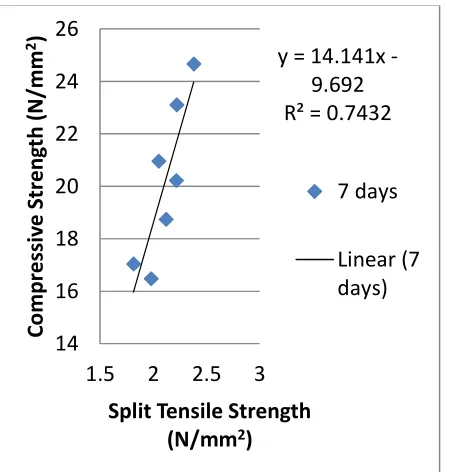
Correlation between compressive and split tensile strength is shown in the following figures 6.0, 7.0 and 8.0.
Figure 6.0 Correlation for 7 Days Strength
Figure 7.0 Correlation for 14 Days Strength
Figure 8.0 Correlation for 28 Days Strength
From the above figures it has been shown that the compressive and split tensile strength have good correlation between each other.
y = 14.141x -9.692 R² = 0.7432
14 16 18 20 22 24 26
1.5 2 2.5 3
C o m p re ss iv e S tr e n g th ( N /m m 2)
Split Tensile Strength (N/mm2)
7 days
Linear (7 days)
y = 17.209x -14.141 R² = 0.8796
18 20 22 24 26 28 30
1.5 2 2.5 3
C o m p re ss iv e S tr e n g th ( N /m m 2)
Split Tensile Strength (N/mm2)
14 days
Linear (14 days)
y = 17.209x -14.141 R² = 0.8796
18 20 22 24 26 28 30
1.5 2 2.5 3
C o m p re ss iv e S tr e n g th ( N /m m 2)
Split Tensile Strength (N/mm2)
14 days
D. Accelerated Corrosion Process:
(Galvano Static Weight Loss Method)
Figure 9.0 GSWLM Setup
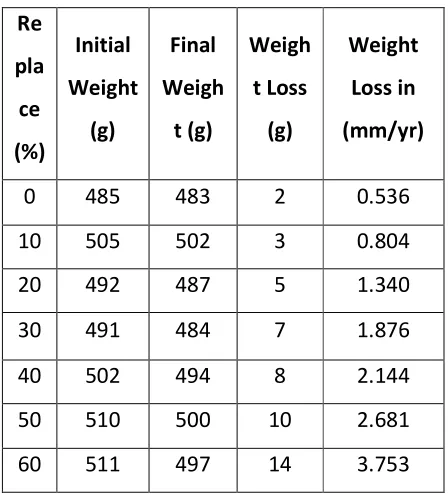
Since copper slag contains more than 50% of ferrous content, it is necessary to find corrosion properties of copper slag admixed concrete. To do so, the weighed TMT steel specimens were embedded in concrete cylinder of size 150mm diameter and 300 mm height. The concrete samples were subjected to alternate wetting and drying exposure in 3.5% NaCl solution. Regular D.C power supply of 12V is supplied continuously throughout the corrosion period of 15 days. Anode of voltmeter is connected with soldered wires and cathode is connected with copper plate. After the process of accelerated corrosion was over, all the specimens were disconnected and removed from solution. After the period of 15 days, the rod was taken out and weighed. The loss in weight was calculated. Corrosion test was conducted for uncoated rebar. From the weight loss values, (ASTM G-1) the corrosion rates were obtained from the following relationship.
/
Where K is a constant, K = 87.6 in case of expressing corrosion rate in mm/yr
T = Exposure time expressed in hours,
A = Surface area in cm2,
W = Mass loss in milli gram, and
D = Density of the corroding metal (7.85g/cm3)
Table 8.0 Corrosion for Different Mixes
Re
pla
ce
(%)
Initial
Weight
(g)
Final
Weigh
t (g)
Weigh
t Loss
(g)
Weight
Loss in
(mm/yr)
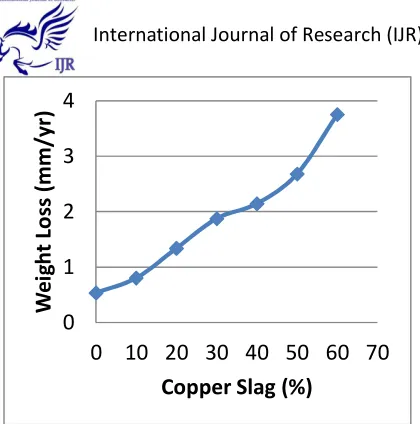
Figure 10.0Weight of Bars in Different
Mixes
From figure 10, it was observed that the slag admixed concrete showed higher corrosion rates than control concrete in all replacements. The loss in weight of the rods in the replacements 10%, 20%, 30%, 40%, 50% and 60% increases by 33.3%, 66%, 71.4%, 75%, 80% and 85.7% w.r.t the loss in weight of rod in the conventional mix. This enormous rate of increase in the
corrosion may be due to the presence of high percentage (68.29%) of Fe2O3 present
in the copper slag. The increase in the rate of corrosion of slag admixed concrete is maximum for 60% replacement of copper slag of sand.
E. Acid Resistivity Test
This test is conducted in order to find out the resistance of concrete to acid. In this case cubes of size 150mm×150mm×150mm is prepared and kept for curing in normal
water for 7 days. After 7 days the cubes are dried and the weight of each cube is noted down. Solution is prepared by adding 50gm of H2SO4 for each litre of water. The dried
cubes are immersed in the solution and left for 30 days. After 30 days the cubes are taken out and dried. After drying each cube is again weighed. The loss in weight between the cubes weighed after 7 days of normal curing and 30 days of placing in solution gives the amount of resistance that concrete may show towards acid. This is one of the test that is done in order to find the resistance ability of concrete towards acid.
Table 9.0 Weight of Different Cubes
Replac
e
(%)
Initial
Weigh
t (g)
Final
Weigh
t (g)
Weigh
t loss
(g)
Weigh
t loss
(%)
0 8.155 7.870 0.285 3.495 10 8.204 7.665 0.536 6.527 20 8.418 7.856 0.562 6.677 30 8.495 7.812 0.683 8.040 40 8.638 7.880 0.758 8.775 50 8.700 7.902 0.798 9.172 0
1 2 3 4
0 10 20 30 40 50 60 70
W
e
ig
h
t
Lo
ss
(
m
m
/y
r)
60 8.775 7.890 0.885 10.09
Figure 11.0 Acid Resistivity Results for 30 Days
From the figure 11.0 it is revealed that with the increase in the percentage of copper slag the loss in the weight of cubes of replacement 10%, 20%, 30%, 40%, 50% and 60% increases by 46.8%, 49.2%, 58.2%, 62.4%, 64.2 and 67.7% w.r.t the loss in weight of cubes of conventional mix. The dimension of cube specimens were reduced 3mm for all sides at 30days. From the above test results, the concrete containing copper slag was found to be slightly decrease resistant to the H2So4 solution
than the conventional concrete.
F. Scanning Electron Microscope (SEM)
Microstructural analysis is carried on concrete specimens of conventional
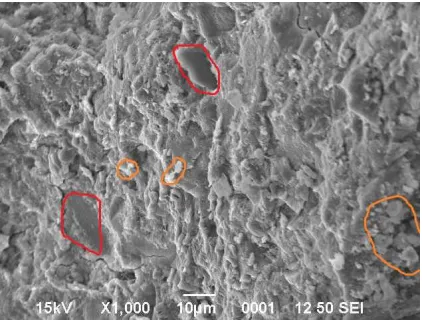
concrete and for optimum concrete i.e. 40% replacement of sand by copper slag using scanning electron microscopy (SEM). The specimens of size 10 mm has been used for the test.The following figures 12 and 13 shows the images for SEM analysis.
Figure 12 Conventional Concrete
Fig 13 SEM of Concrete 40% Sand
Replacement by Copper Slag
From the above figures 12 and 13 it can be observed that the concrete containing 40% copper slag has more dense texture when compared with conventional 0
1 2 3 4 5 6 7 8 9 10 11
0 10 20 30 40 50 60 70
Lo
ss
i
n
W
e
ig
h
t (
%
)
concrete. Due to the more dense texture, the strength of copper replaced concrete is increased when compared to conventional concrete.
CONCLUSION
• The compressive strength increased with increase in copper slag content up to a replacement level of 50%. The maximum increase in compressive strength was observed at a replacement level of 40%.
• Beyond the replacement level of 50% of sand with copper slag in concrete, a decrease in strength was observed. Hence, the properties of concrete were evaluated up to a replacement level of 60%.
• The density of concrete increased with increase in percentage of copper slag.
• The splitting tensile strength of
concrete has increased up to a replacement percentage of 40%. Beyond the replacement percentage of 40%, the splitting tensile strength has been found to
be lesser than that of concrete made with control mix.
• An increase in corrosion of reinforcement has been observed with increase in the percentage of copper slag in concrete.
• With increase in the percentage of copper slag, the concrete has been found to be more vulnerable to acid attack. The loss of weight, after 30 days of immersion in H2SO4 solution, has increased with
increase in copper slag percentage in concrete.
References
[1] D. Brindha and s. Nagan (2010) “Utilization of Copper Slag as a Partial Replacement of Fine Aggregate in Concrete”. International Journal of Earth Sciences and Engineering ISSN 0974-5904, Vol. 03, No. 04, August 2010, pp. 579-585.
[3] K.S. Al-Jabri, R.A. Taha, A. Al-Hashmi and A.s. Al-Harthy (2006) “Effect of copper slag and cement by-pass dust addition on mechanical properties of concrete”. Construction and Building Materials 20(2006)322-331.
[4] Khalifa S. Al- Jabri, Mackoto Hisada, Abdullah H. Al-Saidy and S.K.Al-Oraimi (2009) “Performance of high strength concrete made with copper slag as a fine aggregate” Construction and Building Materials 23(2009)2132-2140.
[5] Kalifa S. Al-Jabri, Abdullah H. Al-Saidy and Ramzi Taha (2011) “Effect of copper slag as a fine aggregate on the properties of cement mortar and concrete”. Construction and Building Materials 25(2011)933-938.
[6] M. Najimi, J. Sobhani and A.R. Pourkhorshidi (2011) “Durability of copper slag contained concrete exposed to sulphate attack”. Construction and Building Materials 25(2011)1895-1905.
[7] R. Tixier, R. Devaguptapu and B.
Mobasher (1997) “The effect of copper
slag on the hydration and mechanical
properties of cementitious mixtures”.
Cement and concrete Research, Vol.
27. No. 10. pp 1569-1580. 1997.
[8] P. Shanmuganathan, P. Laxmipathiraj, S. Shrikanth, A. L. Nachiappan and A. Sumathi (2008) “Toxicity characterization and long-term stability studies on copper slag from the ISASMELT process”. Resources, Construction Recycling 52(2008)601-611.
[9] A. M. Kalinkin, Sanjay Kumar, B. I. Gurevich, T. C. Alex, E. V. Kalinkina, V. V. Tyukavinkina, V. T. Kalinnikov and
Rakesh Kumar (2012)
“Geopolymerization behavior of Cu-Ni slag mechanically activated in air and in Co2 atmosphere”. International
Journal of Mineral processing 112-113 (2012) 101-106.
[10] Antonio M. Ariño and Barzin Mobasher “Effect of Ground Copper Slag on Strength and Toughness of Cementitious Mixes”. aci materials journal.