PIC Microcontroller based Efficient Baby
Incubator
Harshad Joshi1, Dattu Shinde2
BE Student, Dept. of E&TC, SMSMPITR, Akluj,Maharashtra, India1
TE Student, Dept. of E&TC, SMSMPITR, Akluj,Maharashtra, India2
ABSTRACT:There are four million babies worldwide who die in the first month of life, one million die on their first day. Preterm birth is attributed, either directly or indirectly, to at least 25% of neonatal deaths, and low birth weight (LBW) new-borns are at the greatest risk. About half of the worldwide total, or 1.8 million babies each year, die for lack of a consistent heat until they have the body fat and metabolic rate to stay warm.
This paper helps to prevent the death of such babies. The microcontroller based baby incubator helps to all peoples, the cost this project is very less than today’s baby incubator which are used in big hospital. So, everyone which belongs to economical backward also use of it.
This project not only used for monitoring and controlling the temperature but also provide number of advantages such as controlling humidity, monitoring heartbeat, voice of baby, oxygen level, weight, etc.
KEYWORDS: Humidity module, heartbeat, oxygen, temperature, voice module, GSM module.
I.INTRODUCTION
Thermoregulation is a critical physiological function that is closely associated with the baby’s survival. Extremely low birth weight baby have inefficient thermoregulation due to immaturity, baby may exhibit cold body temperatures after birth and during their first 12 hours of life. Thermoregulation plays a unique and crucial role in the nurturing and development of baby. The temperature inside the mother's womb is 38°C (100.4°F). Leaving the warmth of the womb at birth, the wet new born finds itself in much colder environment and immediately starts losing heat thus the thermal protection of newborns is very important but not difficult. Heat loss can occur in infants with extremely low birth weight in following ways:
a) Conduction:-The transfer of energy from the molecules of a body to the molecules of a solid object in contact with the body, resulting in heat loss.
b) Convection:- The similar loss of thermal energy to an adjacent gas.
c) Evaporation:- Evaporative heat loss is the total heat transfer by energy carrying water molecules from the skin and respiratory tract to the drier environment.
d) Radiation:- Radiant loss is the net rate of heat loss from the body to environmental surfaces not in contact with body.
Thermal stability improves gradually as the baby increases in weight. The table below shows relation between age, weight and corresponding range of temperatures.
The proposed incubator looks like as given below
Figure: - Incubation chamber
Age and weight Starting
temperature (0c)
Range of temperature (0c)
0-6 hours
Under 1200g 35.0 34.0-35.4
1200-1500g 34.1 33.9-34.4
1501-2500g 33.4 32.8-33.8
Over2500(>36weeks) 32.9 32.0-33.8
6-12hours
Under 1200g 35.0 34.0-35.4
1200-1500g 34.0 33.5-34.4
1501-2500g 33.1 32.8-33.8
Over2500(>36weeks) 32.8 31.4-33.8
12-24hours
Under 1200g 34.0 34.0-35.4
1200-1500g 33.8 33.3-34.3
1501-2500g 32.8 31.8-33.8
Over2500(>36weeks) 32.2 31.0-33.7
24-36hours
Under 1200g 34.0 34.0-35.0
1200-1500g 33.6 33.0-34.1
1501-2500g 32.6 31.4-33.5
Fig: -block diagram
II
.
MATERIAL USEDACRYLIC SHEET:- Cast acrylic sheet is a material with unique physical properties and performance characteristics. It weighs half as much as the finest optical glass, yet is equal to it inclarity and is up to 17 times more impact resistant. Cast acrylic sheet is made in over 250 colors, in thicknesses from .030" to 4.25'' and can transmit ultraviolet light or filter it out as required.
Temperature Sensor: Two temperature sensors are used for the premature infant and for the Incubator. The type of temperature sensor we are using here is LM35. The specifications of temperature sensor are coded such that if the sensor detects that the temperature is 34°Celsius or greater, the fan will get switched on automatically, in order to reduce the temperature to an optimum of 22-27°Celsius. Likewise, if the sensor detects that the temperature has reduced to 20° Celsius or less, the heater will automatically get switched on (which, in our case, is a bulb) to increase the temperature up to the desired value.
Pulse Counter: The idea is to use a heartbeat sensor which detects the heart beat when a finger is placed in it, by determining the Blood volume at the finger tip. The sensor calculates the average value of the heart beat and displays it for every five seconds. This process is repeated twelve times, every five seconds. Thus, at the end of a minute the average value of the heart beat for twelve readings is determined and displayed on the LCD. If the heart beat exceeds the normal rate, a message will be sent to the LCD Display as well as the monitor, which displays that the heartbeat is above or below normal and the required corrective measures are undertaken
Heater: The heater is used to increase the temperature if it has exceeded the specified value and bring it up to the normal value, hence protecting the baby. The heater used in our project is demonstrated in the form of a bulb. A relay circuit is used for the switching mechanism of the heater.
Fan: The fan is used to decrease the temperature if it has exceeded the specified value and brings it down to the normal value, hence protecting the baby. A relay circuit is used for the switching the voltage from 5V to 12V, which is the Voltage required to run the Fan.
Motor Driver: L293D is a bipolar motor driver IC. This is a high voltage, high current push-pull four channel driver compatible to TTL logic levels and drive inductive loads. It has 600 mA output current capability per channel and internal clamp diodes.
Above table gives us the detailed characteristics of this project.
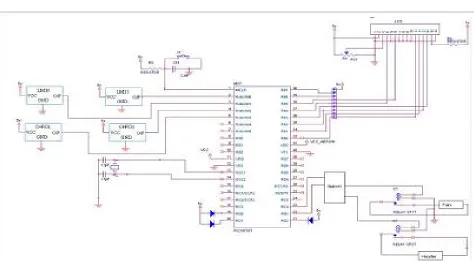
Above circuit diagram shows interfacing between all components of this project. Here microcontroller is used to control all operations of the baby incubator. There are many functions are involved such as cooling, heating, pulse rating, display all readings, etc.
GSM INTERFACE: -
GSM interface is the additional feature provided for this system. It is used as a enhancement. In this the present readings taken through the sensors are given to the GSM modem for further manipulations and calculations.
III.CONCLUSION
The project is designed keeping in mind the medical conditions available in rural areas. This Equipment can be effectively used by technicians in a small health care centre. It can be a life saving machine for low birth weight infants. The components can be easily fixed. The chamber is sufficient enough to accommodate the baby comfortably. As the electronic part is separated from the Baby’s compartment baby can be assured safe. The temperature of the system can be understood. This project is simple and efficient in maintaining the temperature of the chamber irrespective of the outside temperature and is designed at a low cost.
Above figure shows the Simulation results of completecircuit carried out using Proteus software. The results obtained from the PIC16F877A microcontroller interfaced with two temperature sensors, two potentiometers as humidity sensors, an LCD and LED’s. The LCD is used to monitor the sensor readings. The LED’s are also connected for identification of the sensor working properly.
If the tempraure in incubator increased above 370c then cooling unit take part in operation, simillarly if temprature
decreases then heating unit take part in operation. Also pulse ratigs are continuously disply on LCD.
IV.FUTURE SCOPE
REFERENCES
1. Joshi, N S, Kamat, R K, Gaikwad, P K, “Development of Wireless Monitoring System for Neonatal Intensive Care Unit”, International Journal of Advanced Computer Research (ISSN-print): 2249-7277, ISSN (online: 2277-7970) Volume-3 Number-3 Issue-11 September-2013 2. Med A.Z., Elyes F., Abdelkader M, “Application of Adaptive Predictive Control to a Newborn Incubator”, American Journal of Engineering
and Applied Sciences 4 (2): 235-243, ISSN 1941-7020, 2011
3. R. Paradiso, G. Loriga, and N. Taccini, "A wearable health care system based on knitted integrated sensors," Information Technology in Biomedicine, IEEE Transactions on, vol. 9, pp. 337-344, 2005.
4. Olson K.R. , Caldwell A.C. , “Designing an early stage prototype using readily available material for a neonatal incubator for poor settings”, Engineering in Medicine and Biology Society (EMBC), 2010 Annual International Conference of the IEEE , pp. 1100 – 1103, Year: 2010 5. Richard F, Guillermo G, William J, Danny M, Gabriel R, “Low-Cost, Neonatal Incubator”, Senior Design Project Report, Santa Clara
University, California June 13, 2013
6. Ruddy, N.P., G. Mathur and S.I. Hariharan, “Toward a fuzzy logic control of the infant incubator” Annals Biomed. Eng., 37: 21462152, 2009. 7. Shin, D.I. ,Shin, K.H., Kim, I.K., Park, K.S., Lee, T.S., Kim, S.I., Lim, K.S., Huh, “Low-power hybrid wireless network for monitoring infant
incubators” ,S.J. Medical Engineering and Physics, vol. 27 issue 8 October, pp. 713-716, 2005