Available online: http://internationaljournalofresearch.org/ P a g e | 1037
Deface Resistant Routing Scheme for Broadcasting
Trade in Wireless Multihop Networks
Y. Venkateswara Reddy #1, D. Kumar*2
# M. Tech student in CSE, Dr. Samuel George Institute of Engineering & Technology, Darimadugu, Markapuram,
Andhrapradesh, India * Associate Professor, Dept. of CSE
Dr. Samuel George Institute of Engineering & Technology, Darimadugu, Markapuram, Andhrapradesh, India
ABSTRACT: An Application flow it contains
broadcast trade is taken into account. Reducing the level of video distortion is essential per user perspective. Real-time wireless communications are the emerging theory in the field of wireless networks. The routing metrics depicted for wireless networks are application is new model concentrates on the area of wireless network. The application changes consist of video congestion. The dynamic modify network models causes’ periodic connectivity which results in large packet loss. Video data in real time requires special algorithms that can overcome the losses of packets in the insufficient networks. In order to preserve data leakage and prevent piracy, conventional system addressed. The proposing method is observation of streamed traffic throughout the network .Also security hindered the use of open peer to peer networks for commercial data delivery. The basic idea is to propose to change dynamic data leakage detection model is robust to the variation of the video lengths. It changes the detection results in the environment subjected to variation in size of videos. A routing protocol for reducing distortion in videos is designed based on the framework’s routing model. The protocol designed is efficient in minimizing video distortion end-to-end by distributing the frames in the paths through priority based. We evaluate via tested experiments that our protocol is efficient in reducing the video distortion and minimizing the user experience degradation.
Index Terms: Routing, Protocol Design, wireless network, video distortion, distortion minimization, information leakage and content delivery.
I.
INTRODUCTION
As of late, the eminency of real-time video and streaming application; these administrations over the web have been expanded. The real time video application such as: YouTube, Microsoft Network Videos. The vast majority don't perused as much as they used to, and when they do read, they tend to skim-read, which implies the significance of
composed duplicate can be lost or misinterpreted [2].With a plenitude of content pushed to the purchasers and representatives consistently, so a well- designed video depicts a brand new innovation to the business requirements. The intrigued demand on the video is due to three reasons: Cost effectiveness, increased productivity and consistency. The primary employments of videos [3] incorporate Training and Tutorial, where corporate video first picked up with training and keeps on being one of the best employments of video servicing. Online Video is a savvy substitute for the training classes. It can likewise effectively coordinate video into online management tools. The decision of the flow made by such typical routing protocol depends upon the network parameters. Here we are mainly considered with the improvement of the user perceived video quality by accounting the application requirements. Here the schemes which are used to encode the video clips can accommodate a certain number of packet losses per frame by considering some threshold for packet loss per frame in the Group of Pictures (GOP).
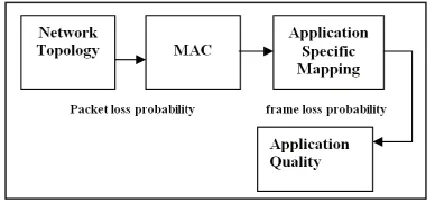
Fig. 1: System Architecture of an Analytical Model with Multilayer Approach
Available online: http://internationaljournalofresearch.org/ P a g e | 1038 model as it is built based on a multilayer approach. In
Subsequent to WMSNs have some unmistakable contrasts from the customary data sensor organization, the sensor system must be reexamined, so we can convey mixed media content with a specific level of Quality of Service (QoS). The information era rate of a video sensor is entirely high, bringing about much higher system data transfer capacity prerequisites and power utilization. This issue is particularly bothered when no proficient compression scheme is utilized. Accordingly, the transmission of immense measures of mixed media information, especially video information, over data transmission obliged sensor systems is a major challenge. Subsequent to the need to minimize the energy utilization has driven the vast majority of the examination in the sensor node organization, systems to productively convey application-level QoS, and to delineate prerequisites to the network-layer measurements. As WMSNs are imagined to have no extra assets other than the incorporation of interactive media sensors, new methodologies should be proposed.
Our contributions during this paper are as follows: • Developing an analytical framework to find the effect of routing on video distortion:
The framework facilitates the computation of routes that are optimum in terms of achieving the minimum distortion.
• Design of a sensible routing protocol for distortion resilient video delivery
II.
RELATED WORK
Standards just like the MPEG-4 [6] and also the H.264/AVC [7] give tips on how a video clip should be encoded for a transmission over a communication system supported layered cryptography. H.264/AVC is newest video cryptography commonplace of the ITU-T Video cryptography experts group and the ISO/IEC picture consultants group. The main goals of the H.264/AVC standardization effort have been increased compression performance and provision of a "network-friendly" video representation addressing "conversational" and "non-conversational" applications. H.264/AVC has achieved a significant improvement in rate distortion efficiency relative to existing standards. This article provides a summary of the technical features of H.264/AVC, describes profiles and applications for the quality, and descriptions the history of the standardization method. The videos with tricky theft are the principle
Available online: http://internationaljournalofresearch.org/ P a g e | 1039 nodes in the model are given the equal importance
and perform the same set of tasks.
III.
PROPOSED SYSTEM
We discuss how video distortion experienced by the end user can be significantly reduced and the quality of video is improved by computing the application requirements. Certain number of packet losses per frame can be handled by different schemes used to encode a video clip. Any frame cannot be decoded if the lost packets in a frame exceed a certain threshold value. Distortion increases in a video stream with every loss of frame. At each hop along the path from source to destination the value of distortion depends on the positions of the unrecoverable video frames in the GOP. Multilayer design approach is used in our model as shown in Fig1. Evolution of frame losses in GOP are designed in an analytical model which used to outline the dynamic behavior of the process instead of just focusing on a single network quality metric such as packet-loss probability. The probability of frame loss in GOP is matched with probability of packet loss on a link. Video distortion metric is then directly related to probability of frame loss. Routing can be posed as an optimization problem by using the above mapping from packet loss probability to video distortion where the objective is to minimize the end to end distortion by finding the path from source to destination [4]. Because of the prominence of spilling conveyance of motion pictures, improvement of P2P streaming programming has grabbed much attention. These advances improve the dispersion of any kind of data over the Internet. Initial, a normal client in a protected system gets streaming content from a content server. At that point, with the utilization of a P2P spilling programming, the normal yet vindictive client redistributes the spilling content to non standard clients Content spillage is not really recognized or blocked by watermarking and DRM-based strategies
Figure 2 - Flowchart for application-aware routing (Source Node)
3.1. Leakage Detection Criterion
The cross-relationship coordinating estimation is performed on both the activity designs produced through time space based calculation and those created through parcel size based calculation. The comparability information received from the coordinating of time space based created traffic pattern are extensively smaller and their appropriation is thought to be typically circulated around zero, subsequent to the dispersion of cross-relationship coefficient estimations of two arbitrary waveforms is approximated to the normal distribution. Then again, the DP coordinating estimation is performed on activity designs produced through parcel size based estimation. Accordingly, a predefined quality is utilized as the choice limit. Regardless, a fixed choice limit is chosen by contrasting the separation registered through DP coordinating with the choice limit, the separation not exactly the edge demonstrates that the thought about the similar traffic patterns. If we need to retransmit the parcel that is lost, we need to proceed with the yes alternative, and then the chart begins representation of video streaming. If we say no, the spilling gets ceased there by itself.
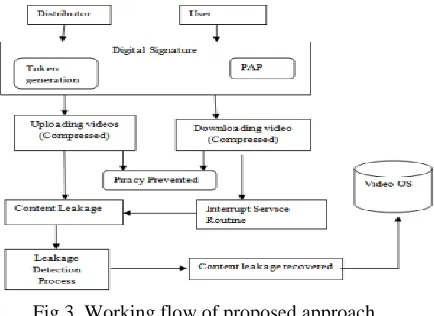
The proposed architecture is given below:
Fig.3. Working flow of proposed approach
3.2. Multichip-Induced Challenges
Available online: http://internationaljournalofresearch.org/ P a g e | 1040 for video conferencing, images in their test-bed are
bad. Other findings indicate that more than three hops cause delay above 250 ms, which is not acceptable in case of live streaming End-to end packet loss rates are also significantly increased in multi hop wireless networks, where each error prone wireless link adds to the overall packet loss probability.
IV.
PROTOCOL DESIGN
The solution to the MDR problem described in the previous section, awareness about the complete network the nodes that are present in the network and the quality of the links between the nodes is necessary. But the network nature is dynamic and distributed operations so to have the complete knowledge of the global state is not always available to the nodes. Here the solution to MDR problem can be computed with the partially gathered source node information. During the path discovery process in order to collect information regarding the state of the network, the source node has to be sampled. For each wireless link in the network the sampling process includes the estimation of the ETX metric [15]. These estimates provide a measure of the quality of the links. To implement the estimation process, keep tracking the successful broadcasting of probe messages in periodic time intervals. The ETX estimates computed locally in the neighborhood of a node are then appended in the Route Request messages during the Route Discovery phase. As an acknowledgement at destination side a Route Reply message is acknowledged to the source that contains the computed ETX estimates, which are usable to compute. The information from the sampling process can be used to solve the optimization problem. Algorithm: Path discovery
Input: source node s , destination node d Input: Frame size F
Output: route R from s to d
1: \* DSR Route Discovery phase*\S 2: send Route Request
3: receive Route Reply (ni , ETXi ) messages 4: N =∆ {node-ids ni from route reply messages} 5: 6: /*Path Discovery Initialization Phase*/ 7: n ←s
8: c← F
9: B =∆ {(d,c) | 0 ≤ c ≤ F} 10: R←[]
11: x←(n,c) 12: append x to R
13: 14:/ * Path computation*/
15: repeat
16: u *← next_node_in_optimal path (x,B ,N ) 17: ĉ=E[Cnew| Ccur=c]
18: n ←u * 19: c ←ĉ 20: x←(n,c) 21: append x to R 22: N ←N -{ u* } 23: until x B
This source routing is an open-loop control problem where all the decisions are made at the beginning itself. A decision at a stage corresponds to the choice of the next node and the decisions are sequential one. The selection process is not known by the source node priory because of the randomness of the second component of the state. It has to estimate at each stage and use this estimate to make a decision for that stage.
V.
RESULTS
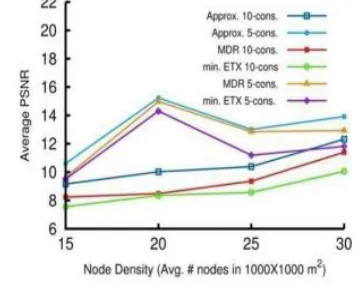
Available online: http://internationaljournalofresearch.org/ P a g e | 1041 Fig. 4 Average PSNR for five and ten video
connections
The pair of nodes that represent the source and destination in every case are selected at random. If they happen to be neighbors, we discard that pair and repeat the method till we tend to select a source and destination that are over one hop apart. Every set of experiments is repeated 10 times, and therefore the average value is reported in every case.
Tested Experiments
The experiment setup consists of an initial raw video processed using the H.264 encoder with a most GOP size of thirty frames. The traffic load ranges from two to twelve synchronous video flows, where the sender and receiver pairs are randomly selected. Each situation is repeated five times. To capture the effect of the ETX-based and MDR routing schemes on the user expertise, we tend to measure the average MOS because the number of synchronous video flows in the network will increase.
VI.
CONCLUSION
The content leakage of video is being detected and piracy prevention has been proposed for the compressed videos. Enhance streaming performance and protect illegal redistribution is based on the fact that each streaming content has a unique traffic pattern is an innovative solution to protect illegal redistribution of data by a regular user, yet malicious user. It concentrates on network which primarily carries the video flow. And also seek to understand the impact of video distortion on the end-to-end flow. Towards this, an analytical model is constructed which attach the video distortion to the underlying packet loss probabilities. By using dynamic programming approach, an optimal path (in case of distortion) between the source and destination is found. Unlike the traditional ETX metrics, this approach takes into account the correlation among
packet loss. The framework permits to formulate a routing policy for minimizing distortion, based on that we tend to design a practical routing theme that's evaluated via extensive simulations and tested experiments. The user experience regarding the degradation is kept to minimum by using this analytical framework.
VII.
FUTURE WORK
Multiple videos can be sent to destination node at a time. The Text message sent along with video can be encrypted using cypher text methods. Frequent path and transmission errors are handled by adding redundancy by utilizing redundant network routes. To select most advantageous transmission parameters, it seems extensively accepted that cross-layer parameter exchanges are essential. The future work of this paper is to minimize the users experienced degradation and to decrease the distortion more than 20%.
8. REFERENCES
[1] ISO/IEC JTC1/SC29/WG11, ―ISO/IEC 14496— Coding of audio-visual objects,‖ standards/mpeg-4/mpeg-4.htm
[2] S. K. Das, A. Mukherjee, S. Bandyopadhyay, K. Paul, and D. Saha, "Improving quality-of-service in ad hoc wireless networks
[3] Y. M. Lu and V. W. S. Wong, "An energy-efficient multipath routing protocol for wireless sensor networks," International Journal of Communication Systems, vol. 20, no. 7, pp. 747-766, 2007
[4] D. S. J. D. Couto, D. Aguayo, J.Bicket, R. Morris,―A high throughput path metric for multi-hop wireless routing,‖ In Proc. 9th MobiCom, San Diego, CA, USA, Sep., 2003, pp. 134-146.
[5] M. T. Ivrlac, L. U. Choi, E. Steinbach, J. A. Nossek, ―Models and analysis of streaming video transmission over wireless fading channels,‖ Signal Process., Image Commun., Vol. 24, No. 8, pp. 651-665, Sep. 2009.
[6] T.Wiegand,G.J. Sullivan, G. Bjontegaard, and A. ,―Overview of the H.264/AVC video coding standard, vol. 13, no. 7, pp. 560– 576, Jul. 2003. [7] D.S.J.D.Couto, D.Aguayo, J.Bicket, and R.Morris, A high-throughput path metric for multi-hop wireless routing,‖ in Proc. 9 εobiCom, San Diego, CA, USA, Sep. 2003, pp. 134–146.
Available online: http://internationaljournalofresearch.org/ P a g e | 1042 on Advanced Radio Technologies, Boulder, CO,
2004.
[9] Y. M. Lu and V. W. S. Wong, "An energy-efficient multipath routing protocol for wireless sensor networks," International Journal of Communication Systems, vol. 20, no. 7, pp. 747-766, 2007
[10] W. Wei and A. Zakhor, ―Robust multipath source routing protocol (RMPSR) for video communication over wireless ad hoc networks,‖ in Proc. IEEE ICME, Taipei, Taiwan, Jun. 2004, pp. 1379–1382.
[11] J. Chen, S.-H. G. Chan, and V. O. Li, ―Multipath routing for video delivery over bandwidth-limited networks,‖ IEEE J. Sel. Areas Commun., vol. 22, no. 10, pp. 1920–1932, Dec. 2010.
[12] S. Mao, Y. T. Hou, X. Cheng, H. D. Sherali, S. F. Midkiff, and Y.- Q. Zhang, ―On routing for multiple description video over wireless ad hoc networks,‖ IEEE Trans. Multimedia, vol. 8, no. 5, pp. 1063– 1074, Oct. 2006
[13] M. T. Ivrlac, L. U. Choi, E. Steinbach, J. A. Nossek, ―Models and analysis of streaming video transmission over wireless fading channels,‖ Signal Process., Image Commun., Vol. 24, No. 8, pp. 651-665, Sep. 2009.
[14] Hortelano, J., Cano, J.C., Calafate, C.T., Manzoni, P.: Evaluating the performance of real time videoconferencing in ad hoc networks through emulation. In: PADS ’08: Proceedings of the 22nd Workshop on Principles of Advanced and Distributed Simulation, Washington, DC, USA, pp. 119–126. IEEE Computer Society (2008)
[15] D. S. J. D. Couto, D. Aguayo, J. Bicket, and R. Morris, ―A high throughput path metric for multi-hop wireless routing,‖ in Proc. 9th MobiCom, San Diego, CA, USA, Sep. 2003, pp. 134–146
Y.VENKATESWRA REDDY
received B. Tech (CSE) Degree from JNT University in 2013 and pursuing M. Tech (CSE) Degree from JNTU
Kakinada (14-16).He is doing
Project from JNTU, Kakinada in Computer Science Engineering. His interested research areas are cloud computing, networking and mobile computing.
D. Kumar received B. Tech (CSIT) Degree from JNT University in 2006 and M. Tech (CSE) Degree from JNTUK Kakinada in 2011. He has 10 years of teaching experience. He joined as Assistant Professor in Dr.
Samuel George Institute of Engineering &