Adaptive Fuzzy Control Approach for Automatic Generation
Control of Two-Area Interconnected Hydro-thermal System
Ch.Pratyusha 1 , Prof. k.Chandra Sekhar 2
1
Department of Electrical Engineering, Andhra University college of engineering, Visakhapatnam , Andhra Pradesh, India.
2
Associate Professor, Dept. of Electrical Engineering , Andhra University college of engineering, Visakhapatnam , Andhra Pradesh, India.
Abstract: In this paper, an adaptive fuzzy logic control for automatic generation control of interconnected two area Hydro-Thermal System using This paper deals with a novel approach of artificial intelligence (AI) technique called Hybrid Neuro-Fuzzy (HNF) approach for an (AGC). The advantage of this controller is that it can handle the non linearities at the same time it is faster than other conventional controllers. The effectiveness of the proposed controller in increasing the damping of local and inter area modes of oscillation is demonstrated in a two area interconnected power system. The result shows that intelligent controller is having improved dynamic response and at the same time faster than conventional controller. The study was designed for a two area interconnected power system.
Keywords: Two area power system, Automatic
generation control, load frequency control, fuzzy logic controller. Neural Network, Hybrid Neuro-Fuzzy(HNF).
1. Introduction
The main requirement of an interconnected AGC is to ensure that: (i) frequency of various bus voltages and currents are maintained at near specified nominal values, (ii) tie-line power flowing among the interconnected areas are maintained at specified levels, and (iii) total power requirement on the system as a whole is shared by individual generators economically in optimum fashion. The first two functions are ensured by designing an efficient AGC regulator. The third function involves another set of control called active power dispatch. In this paper, an attempt has been made to apply hybrid neuro-fuzzy (HNF) controller for the automatic load frequency control for the two area interconnected system. With the help of MATLAB we have proposed a class of adaptive
networks that are functionally equivalent to fuzzy inference systems.
The proposed architecture referred to as ANFIS .The performance of the hybrid neuro-fuzzy (HNF) controller is compared with the conventional PI controller to show its
superiority.
The proposed controllers are tested for a two area hydrothermal system. Simulation results show that the limitations of conventional controller can beovercome by including Neural concept and thereby the dynamic response of the system with respect to peak time, overshoot and settling time can be improved drastically
2. SYSTEM MODELING
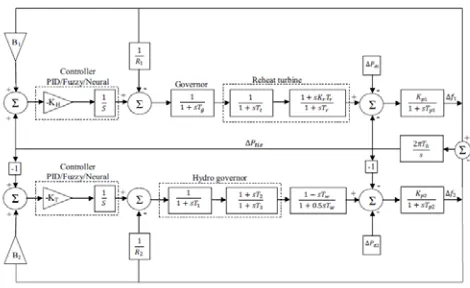
The two-area interconnected power system taken as a test system in this study consists of reheat turbine type thermal unit as area-1and hydro unit as area-2 [2]. The model of the power system is as shown in Fig. 1, where symbols have their usual meanings. The control task is to minimize the system frequency deviation Δf1 in area 1,
Δf2 in area 2 and the deviation in the tie-line power flow
ΔPtie between the two areas under the load disturbances
ΔPd1 and ΔPd2 in the two areas. This is achieved
conventionally with the help of integral control which acts on ACEi, given by (1), which is an input signal to the
controller.
ACE
i=
Σ
n
j
=
1ΔP
tie,i,j+B
iΔf
i (1)where ACEi is the area control error of the ith area
Δ fi = frequency error of ith area
Δ Ptie, i j = tie-line power flow error between ith and jth area
Figure.1.Two area Hydro-Thermal power system
3. Hybrid Neuro Fuzzy modeling
The general algorithm for a fuzzy system designer can be synthesized as follows:
Fuzzyfication: 1. Normalize of the universes of discourses for the fuzzy input and output vectors. 2. Choose heuristically the number and shape of the membership functions for the fuzzy input and output vectors.
3. Calculate of the membership grades for every crisp value of the fuzzy inputs. Fuzzy Inference: 1. Complete the rule base by heuristics from the conventional control results.
2. Identify the valid (active) rules stored in the rule base. 3. Calculate the membership grades contributed by each rule and the final membership grade of the inference, according to the chosen fuzzification method.
Defuzzyfication:
1. Calculate the fuzzy output vector, using an adequate defuzzification method.
2. Simulation results are obtained.
From the beginning, a fuzzy-style inference must be accepted and the most popular are:
• Mamdani-style inference, based on Lotfi Zadeh’s 1973 paper on fuzzy algorithms for complex systems and decision processes that expects all output membership functions to be fuzzy sets. It is intuitive, has widespread acceptance, is better suited to human input, but it’s main limitation is that the computation for the defuzzification process lasts longer;
• Sugeno-style inference, based on Takagi-Sugeno- Kang method of fuzzy inference, in their common effort to formalize a systematic approach in
generating fuzzy rules from an input-output data set, that expects all membership functions to be a singleton. It has computational efficiency, works well with linear techniques (e.g. PID control, etc.), works
well with optimization and adaptive techniques,
guaranties continuity of the output surface, is better suited to mathematical analysis. The results are very much similar to Mamdani - style inference. A simple fuzzy inference system has limited learning (or adaptation) possibilities. If learning capabilities are required, it is convenient to put the fuzzy model into the framework of supervised neural networks that can compute gradient vectors systematically. Sugeno– style inference is preferred and the typical fuzzy rule is:
If x is A and y is B then z=f(x,y)
where A and B are fuzzy sets in the antecedent and z = f(x, y is a crisp function in the consequent. Usually, function z is a first-order or a zero-order.
Fig. 2 Architecture of a Two-Input Sugeno Fuzzy Model with Nine Rules
Fig. 2 shows a Sugeno Fuzzy model of five layers. Each layer of the model represents a specific part as:
Layer 1:
Each adaptive node in this layer generates the membership grades the input vectors i (Ai = 1,2,3). For instance, the node function of the i-th node may be a generalized bell membership function
Where Ai are the input vectors associated with the i-th node and {ai,bi,ci} are their parameter set that changes the shapes of the membership function; x is the input to the node i, . Parameters in this layer are referred to as the premise parameters.
Layer 2:
Layer 3:Fixed node i in this layer calculate the ratio of the i-th rule’s firing strength to the total of all firing strength:
For convenience, outputs of this layer will be called normalized firing strength.
Layer 4:Adaptive node i in this layer compute the contribution of ith rule toward the overall output, with the following node function:
where wi is the output of layer 3, and {pi, qi, ri} is
the parameter set. Parameters in this layer are
referred to as the consequent parameters.
Layer 5:The single fixed node in this layer
computes the overall output as the summation of
contribution from each rule:
The basic learning rule is the ack propagation gradient descendent, which calculates error signals (the derivative of the squared error with respect to each node’s output) recursively from the output layer backward to the input nodes. This learning rule is exactly the same as the back propagation learning rule used in the common feed forward neural networks. The overall output f can be expressed as a linear combinations of the consequent parameters:
3.1 Sugeno type Neuro-Fuzzy Controller::Adaptive Neuro Fuzzy Inference System (ANFIS) is more complex than Fuzzy Inference System (FIS), but users have some limitations: only zero-order or first-order Sugeno fuzzy
models, And Method: prod, Or Method : max, Implication Method : prod, Aggregation Method : max, Defuzzification Method : wtaver (weighted average). On the other hand, users can provide to ANFIS their own number of MFs (numMFs) both for inputs and outputs of the fuzzy controller, the number of training and checking data sets (numPts), the MF’s type (mfType), the optimization criterion for reducing the error measure (usually defined by the sum of the squared difference between actual and linearized N curve). Membership function type (mfType): Gbell MFs are preferred by ANFIS in most cases. For other types of MFs preferred by the user for a certain application (pimf, gaussmf, trimf, trapmf, gauss2mf dsigmf and psigmf) there is no rule in choosing them. The general rule is to obtain the best smallest error measure with minimum training parameters. MFs type such as sigmf and zmf are not accepted. Number of Membership function (numMFs): The great advantage of neuro-fuzzy design method comparing with fuzzy design method consists in the small number of input and output MFs (usually 2...4 !), which implies the same maximum number of rules. Thus, the rule base and the occupied memory become very small Number of Epochs (numEpochs): The number of epochs is determined according to the above parameters and to the accepted error measure, fixed by the user. In the present study 10 epochs have been taken. Based on the training data set, (Derived from PI controller results) ANFIS automatically generates a first-order Sugeno fuzzy type, using only 3 gbell MFs and 9 rules.
4. FUZZY CONTROLLER DESIGN
RULE BASE USED FOR THE FUZZY CONTROLLER
5. ARTIFICIAL NEURAL NETWORK
CONTROLLER DESIGN:
Artificial Neural Networks (ANNs) are relatively crude electronic models based on the neural structure of the brain. Artificial neural networks try to mimic the functioning of brain. In this study feedforward model is used, which contains three layers; input, hidden and output layer. The ANN controller takes two real valued inputs; ACE and change in ACE, and gives a real valued output. Figure. 3 shows the structure of the controller. The controller is designed with one input layer of two neuron, hidden layer with three neurons and output layer with one neuron
INPUT HIDDEN OUTPUT LAYER LAYER LAYER
Figure.3. Architecture of ANN Controller
6. SIMULATION RESULTS AND DISCUSSION
Fig. 4 Frequency deviation of area-1
Fig. 5 Frequency deviation of area-2
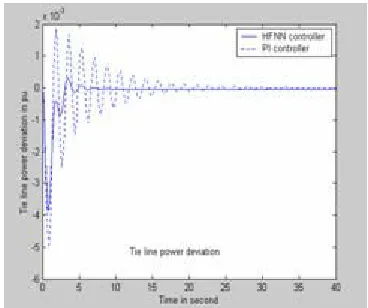
Fig. 6 Tie-line power deviation
Fig. 8 Frequency deviation of area-2
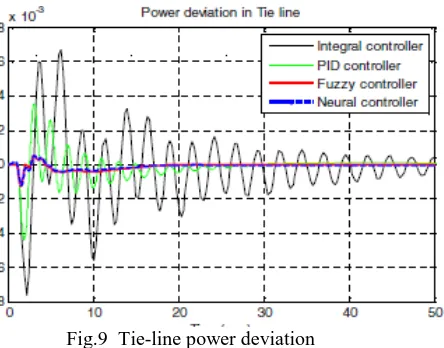
Fig.9 Tie-line power deviation
Simulations were performed using Matlab®Simulink Fuzzy Logic Toolbox and Neural Network Toolbox. The parameters of the power system are given in appendix. The step load disturbance of 0.01 p.u. was applied in area-1 for all the cases and the deviations in frequency and tie-line power flows were investigated. The AGC performance with conventional optimized integral and Ziegler-Nichols tuned PID controller is compared with that of proposed fuzzy tuned PID the ANN controllers. The change in frequency deviation
f1, f2 and the deviation in the tie-line power flow
Ptie under the load disturbances of 0.01 p.u. in area
-1, are shown in Figures.4,5 and 6. It is observed that the performance is superior in case of ANN and Fuzzy controllers as compared to conventional controller.
Table 1:
THERMAL UNIT ANN CONTROLLER PARAMETERTable 2:
HYDRO UNIT ANN CONTROLLER PARAMETER7. Conclusions
A hybrid neuro-fuzzy automatic generation controller is designed following the procedure presented above. The
proposed scheme utilizes sugeno-type fuzzy inference system controller, with the parameters inside the fuzzy inference system decided by the neural-network back propagation method. The ANFIS is designed by taking ACE and rate of change of ACE as inputs. This network consists of five layers with, each layer representing a specific part in ANFIS controller.
Appendix
PARAMETER
DESCRIPTION
VALUE UNIT
B1 , B2 Tie Line Frequency Bias in Areas 1& 2
0.425
Pu MW/Hz
R1 , R2 Regulations of Governors in Areas 1 &2 2.4 Hz/pu MW Tg Governor Time Constants for Thermal Areas 1
0.08 Second
Tt Turbine Time Constants for Thermal Areas 1
0.4 Second
Kr
Reheater Constants
(Gains) for Thermal
(Reheat) Areas 1 0.33 Thermal Unit Tr Reheater Time Constants for Thermal (Reheat) Areas
10 Second
Kp1,Kp2 Power System
Constants in Areas 1&2
120 Hz/pu MW
Tp1,Tp2
Power System Time Constants in Area 1 &
2
20 Second
To
Synchronizing Coefficient for Tie Line
for Two Area Systems
0.0707 MW/radian
T1
Hydro
Governor(Stage 1) Time Constant for
Hydro Area
48.7 Second
T2
Hydro Governor (Stage
2) Time Constant for
Hydro Area
0.513 Second
The nominal system parameters are: f = 60 Hz, Rk = 2.4 Hz / Unit, Tg = 0.08 Sec, Tr = 10.0 Sec, Hk = 5 .0 Sec, Kr= 0.5, Tf = 0.3 Sec, 2πTki = 0.05 Mw, Dk= 0.00833 pu Mw/Hz
Acknowledgments
This work is supported by Electrical & Electronics Engineering Dept, Andhra university college of engineering,Andhra Pradesh, India.
References
[1] Hadi Saadat, Power System Analysis, 2nd ed., McGraw-Hill, 2004, pp. 527-554.
[2] Olle I. Elgard, Electric Energy System Introduction,McGraw Hill, New Delhi, 2005, pp. 219–361.
[3] Ibraheem, Prabhat Kumar, and Dwarka P. Kothari, “Recent philosophies of automatic generation control strategies in power systems,” IEEE Transl. On Power Systems, vol. 20, pp. 346357,February 2005.
[4] K. C. Divya, P.S. Nagendra Rao, “A simulation model for AGC studies of hydro-hydro systems,” Int. J. Electrical Power & Energy Systems, vol. 27, pp. 335-342, Jun.-Jul. 2005.
[5] LEE, CC, “Fuzzy logic in control systems: Fuzzy logic controller Part-I&II,” IEEE Trans. Syst., Man, Cybern., vol. 20, no. 2, pp. 404-435, March-April 1992.
[6] B. Franoise, Y. Magid, and W. Bernard, “Application of neural networks to load-frequency control in power systems,” Neural Network ,vol. 7, no. 1, pp.1 83–194, 1994.
[7] S. Mishra, A.K. Pradhan and P.K. Hota, “Development and Implementation of a Fuzzy logic based constant speed DC Drive”, Journal of Electrical Division of Institution of Engineers (India), Vol. 79, Dec. 1998, pp. 146-149.
[8] J.Lee, “On methods for improving performance of PI-type fuzzy logic
controllers”, IEEE Trans. On Fuzzy Systems, Vol. 1, No. 4, Nov. 1993, pp. 298.
[9] J.R. Jang, “ANFIS: Adaptive-network-Based Fuzzy Inference System”, IEEE Trans. On Systems, Man and Cybernetics, Vol. 23, No.3, May. 1993, pp.665-685.
[10] S.P. Ghoshal, “Multi-Area Frequency and Tie-Line Power Flow Control with Fuzzy Logic Based Integral Gain Scheduling”, IE (I)
Journal EL, Vol. 84, December 2003, pp. 135-141.
[11] “Fuzzy Logic Toolbox ”, Available: www.mathworks.com