ISSN 2348 – 7968
A Review on Routing Protocol for Wireless Sensor Network
Shilpa S Patharwalkar
Electronics & Telecommunication/SP Pune University/PGMCOE,Pune Pune,Maharashtra Pune ,India
Abstract
The recent advancement with integration of micro electro-mechanical systems technology, integrated circuit technologies, microprocessor hardware and nano technology, wireless communications, Ad-hoc networking routing protocols, distributed signal processing, and embedded systems have developed the concept of Wireless Sensor Networks (WSNs) . In WSN, the sensor nodes have a limited transmission range, and their processing and storage capabilities as well as their energy resources are also limited. Routing protocols for wireless sensor networks are responsible for maintaining the routes in the network and have to ensure reliable multi-hop communication under these conditions. To prolong the lifetime of the sensor nodes, designing efficient routing protocols is critical. Even though sensor networks are primarily designed for monitoring and reporting events, since they are application dependent, a single routing protocol cannot be efficient for sensor networks across all applications. In this paper, we give a survey of routing protocols for Wireless Sensor Network and compare their strengths and limitations.
Keywords: 27TWireless Sensor Networks, Routing Protocols,
Cluster Head.
1. Introduction
A Wireless Sensor Network is a special kind of wireless network consisting of small and spatially distributed autonomous devices (nodes) which can cooperatively sense physical phenomena around them.
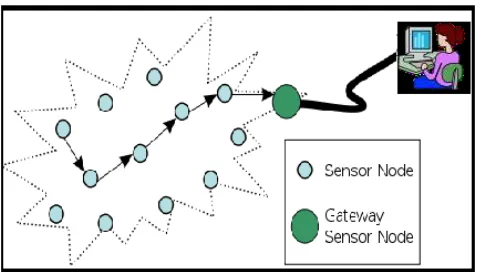
It also processes the collected data and effectively route them to the nearest sinks or gateway node. It consists of a large number of densely deployed sensor nodes. Each node in the sensor network may consist of one or more sensors, a low power radio, portable power supply, and possibly localization hardware, such as a GPS (Global Positioning System) unit or a ranging device. These nodes incorporate wireless transceivers so that communication and networking are enabled. Additionally, the network possesses self-organizing capability. The important requirements of WSN are: Use large number of sensors, energy consumption is low, Self organization capability, and Querying ability. (ii) slower than wired networks (ii) Configuration is very complex when compared with wired networks. Following fig 1 shows Wireless Sensor Network
Fig 1.Wireless Sensor Networks
Routing is a process of determining a path between source and destination for data transmission. In Wireless Sensor Networks, the network layer is mostly used to implement the routing of the incoming data and Routing protocol is an important factor in design of a communication stack. In multi-hop networks the intermediate sensor nodes have to relay their packets towards Base Station. Routing protocols, designed for sensor networks, must accomplish high reliability. In this paper, we analyze the current routing protocols and classify them into three categories on the basis of network structure. Very nearly the majority of the routing protocols can be delegated Flat-based, hierarchical or location-based[3].Flat -based protocols are query based and depend with respect to the naming of desired information, which helps in disposing of numerous excess transmissions. Hierarchical-based protocols focus on clustering the nodes so cluster heads can do some collection and reduction of data in order to save energy. Location-based protocols uses the positioning of data to relay the information to the desired regions instead of the entire system.
ISSN 2348 – 7968
Wireless Sensor Network. Then, we will classify different routing protocols for wireless sensor network based on the architecture of network and their operation. At last we conclude this paper.
2. Routing Challenges /Design Issues In WSN
The main design goal of WSNs is to carry out data communication while trying to prolong the lifetime of the network. There are numerous design and communication challenges in WSNs because of its application domain and their network structures. Besides, it also constraints resources nature makes it more difficult to cope with these challenges. The deployment of WSNs can vary both by its network structure and application type therefore it is required to consider both the design and communication challenges for efficient communication. Furthermore, these challenges have a greater influence on routing protocols design and degrade its performance. Both sensor nodes and base station have the influence on the performance of routing protocols of WSNs as shown in fig 2
Fig 2.Routing Protocol Challenges
Scalability
A system is said to be scalable if its effectiveness can be increased by putting extra hardware proportional to the added capacity. Wireless sensor network should be such that it should be able to accept new node and co-ordinate them with existing nodes.
Quality of Service
Quality of service is determined by different applications differently. In some application the data transmission in
time efficient manner is considered to be quality of service while in others low energyconsumption or energy conservation is regarded as quality of service. In the later case the emphasis is on energy-aware routing protocols.
Fault Tolerance
Some sensor nodes may fail or be blocked due to lack of
power, have physical damage or environmental
interference. The failure of sensor nodes should not affect the overall task of the sensor network. This is the reliability or fault tolerance issue. Fault tolerance is the ability to sustain sensor network functionalities without any interruption due to sensor node failures.
Localization
As in the wireless network the sensor nodes are deployed in ad-hoc manner so they do not have knowledge about their position. The problem of determining the position of nodes is called localization. The problem can be solved by: GPS, Beacon nodes, Proximity based localization. Other techniques such as Moore’s algorithm [6], Radio interfermetric positioning system [7], and mobile assisted localization [8] can be used.
Energy Conservation
Transmission Media
Sensor nodes communicating with each others in a multi-hop network are linked together by wireless medium hence the operation of this network is affected by some traditional problems that are usuallyattached with a wireless channel [7].Generally, Transmission Media is wireless (RF or Infrared), which is affected by fading and high error rate and affect the operation of WSNs.
Data Aggregation/Fusion
Since sensor nodes might generate significant redundant data, similar packets from multiple nodes can be aggregated so that the number of transmissions would be reduced. Data aggregation isthe combination of data from different sources by using functions such as suppression (eliminating duplicates), min, max and average [30]. As computation would be less energy consuming than communication, substantial energy savings can be obtained through data aggregation. This technique has been used to achieve energy efficiency and traffic optimization in a number of routing protocols
Energy Conservation Quality of Service Scalability
Node Deployment
Fault Tolerance Transmission Media Routing Challenges
ISSN 2348 – 7968
Production Cost:
The cost of single node is enough to justify the overall cost of the sensor network. So the cost of each sensor node must be kept low. When the cost of traditional sensors is less than cost of network then Wireless sensor network is not justified
Node Deployment
Node deployment in WSNs is application dependent and affects the performance of the routing protocol. In a sensor network, the deployment is either deterministic (manual) or self-organizing (random).In deterministic situations, the sensors are manually placed and data is routed through pre-determined paths. But in self-organizing systems, the sensor nodes are randomly distributed creating an infrastructure in an ad hoc manner.When the distribution of nodes is not uniform, optimal clustering becomes a necessity to enable energy efficient network operation. In some applications like battle field and wildlife monitoring, sensor nodes are randomly deployed like being dropped from an airplane.
Fault Tolerance
Due to the uncertain deployment nature of WSN, the failure of sensor nodes can be seen due to harsh environmental conditions, physical damage or due to running out of power. But to achieve better performance, the networks should be fault tolerant. If a node failure occurs, the network should have the capabilities to maintain its functionalities and its performance should not be affected or the effect should be minimal [6].In case of failure of any sensor nodes, MAC and routing protocols must accommodate formation of new links so that sensor node failure should not affect the overall task of the sensor network.
Security
It should achieve all security goals which are confidentiality, Availability, Integrity, Authentication, Authorization, Non-repudiation and Freshness [1]. 1) Physical Layer: It is transmission medium can be suffered from denial of service, node capture etc. 2) Data link layer: It suffers from dos and jamming attacks. In this layer perform error detection and correction. 3) Network layer: This layer is affected by routing related attacks such as dropping entire packet, global broadcast. 4) Application layer: Data collection and management is done at this layer. This layer ensures that when sink collects from sensor node no malicious node is allowed to interfere.
3. Classification of Routing Protocol for WSN
Different routing protocols for wireless sensor network based on the architecture of network and their operation have been classified as depicted in table 1 as follows
Category Type Examples
Architecture Based
Location Based Protocols
Sequential assignment routing (SAR)
Ad-hoc positioning system (APS)
Geographic adaptive fidelity (GAP)
Greedy other adaptive face routing (GOAFR)
Geographic and energy aware routing (GEAR)
Geographic distance routing (GEDIR) Hierarchi cal Protocols Hierarchical Power-Active Routing (HPAR)
Threshold sensitive energy efficient sensor network protocol (TEEN)
Power efficient gathering in sensor information systems
Minimum energy communication network (MECN) Flat Based Protocol
E nergy Aware Routing (EAR)
Directed Diffusion (DD)
Sequential Assignment Routing (SAR)
Minimum Cost Forwarding Algorithm (MCFA)
Sensor Protocols for Information via Negotiation (SPIN)
Active Query forwarding In sensor network (ACQUIRE)
Operation Based
Negotiati on Based Protocol
Sensor Protocols for Information via Negotiation (SPAN)
Sequential assignment routing (SAR)
Directed Diffusion (DD) Multi
path based Protocol
Multi path and Multi SPEED (MMSPEED)
Sensor Protocols for Information via Negotiation (SPIN)
Query Based Protocol
Sensor Protocols for Information via Negotiation (SPIN)
Directed Diffusion (DD) COUGAR
QoS Based
ISSN 2348 – 7968
SPEED
Multi path and Multi SPEED (MMSPEED) Coherent
Based Protocol
---
Architecture based Routing Protocols
Protocols are divided according to the structure of network which is very crucial for the required operation.
Flat-based Routing Protocols
Flat-based Routing Protocols follows Data- centric Routing Approach which is Best suited for large amount of sensor nodes.
Hierarchical-based Routing Protocols
The protocol follows Cluster based routing approach which is Energy efficient method and increases network scalability and lifetime
Location Based Protocols
For above protocol nodes are located by means of GPS based routing which reduce energy consumption and optimizes the whole network.
Operation Based Routing Protocols
WSNs applications are categorized according to their functionalities. Hence, classification of routing protocols is done according to their operations to meet these functionalities. The main aim behind this classification is to achieve optimal performance and to save the scarce resources of the network.
Multipath-based Multiple path selection
These protocols use routing algorithm which decreases delay , increases network performance.
Query based Protocol
This class of protocols works on sending and receiving queries for data. The destination node sends query of interest from a node through network and node with this interest matches the query and send back to the node which initiated the query.The query generally uses high level languages.
Negotiation-based
This protocol eliminates redundant data Transmission by using efficient computation method which also provides scope of optimization
QoS based
In this type of routing, network needs to have a balance approach for the QoS of applications. In this case the application can delay sensitive so to achieve this quality of service, metric network have to look also for its energy consumption which is another metric when communicating to the base station. So to achieve better QoS, the cost function for the desired QoS also needs to be considered.
Coherent Based Protocol
Coherent data processing routing is used when energy-efficient routing is required. In this routing scheme, nodes perform minimum processing (typically, time-stamping, suppression etc) on the raw data locally before sending for further processing to other nodes.
4. Conclusions
Routing in WSNs is challenging due to distinguish from other wireless networks like mobile ad hoc networks or cellular networks. Sensor nodes are tightly constrained in terms of energy, processing, and storage capacities. Thus, they require carefully resource management.In recent years, the routing protocols in WSN has become one of the most important research areas. The design of routing protocols in WSNs is influenced by many challenging factors e.g. Node deployment, Energy considerations, Data delivery model Node/link heterogeneity, Fault tolerance, Scalability and Quality of service etc .The concept behind the routing protocol design is to prolong the lifetime of individual sensors and network whereas maintaining the energy efficient network.
ISSN 2348 – 7968
References
[1] A. A. Name, and B. B. Name, Book Title, Place: Press, Year. [2] A. Name, and B. Name, "Journal Paper Title", Journal Name,
Vol. X, No. X, Year, pp. xxx-xxx.
[3] A. Name, "Dissertation Title", M.S.(or Ph.D.) thesis, Department, University, City, Country, Year.
[4] A. A. Name, "Conference Paper Title", in Conference Name, Year, Vol. x, pp. xxx-xxx.
First Author Biographies should be limited to one paragraph consisting of the following: sequentially ordered list of degrees, including years achieved; sequentially ordered places of employ concluding with current employment; association with any official journals or conferences; major professional and/or academic achievements, i.e., best paper awards, research grants, etc.; any publication information (number of papers and titles of books published); current research interests; association with any professional associations. Do not specify email address here.
Second Author biography appears here. Degrees achieved followed by current employment are listed, plus any major academic achievements. Do not specify email address here.