Study on Effect of Injection Opening Pressure
on the Performance and Emissions of C I
Engine Running on Neem Methyl Ester Blend
as a Fuel
1
Ramesha D.K.,
2Vidyasagar H.N,
3Hemanth Kumar.P.
1,2Associate Professor, Department of Mechanical Engineering, University Visvesvaraya College of Engineering,
Bangalore University, Bangalore-560001, India
3M.E.Scholar, Department of Mechanical Engineering, University Visvesvaraya College of Engineering,
Bangalore University, Bangalore-560001, India
Abstract: The present day internal combustion engines are operating essentially on petroleum based fuels, which are non- renewable in nature and lead to depletion in short period due to its indiscriminate use in different fuels. Renewable agriculture based, non- edible oils like pongamia, mahua (Maduca Indica), neem, jatropha oils etc. can be used as an alternative fuel in CI engines. In this investigation, neem oil methyl ester was prepared by transesterification using NaOH as catalyst and tested in 4 stroke direct injection natural aspirated diesel engine. Tests are carried out at constant speed of 1500 rpm at different brake power and at three different injection pressures. Results showed that methyl ester Blend (B-20) performs well in running a diesel engine at 200 bar injection pressure, which is higher than the rated injection pressure of diesel operation 180 bar. The UBHC, and smoke level emissions are reduced and NOx is slightly increased in case of neem methyl ester blend with diesel (B20), compared to diesel mode of operation. The results reveal that brake thermal efficiency and fuel properties of methyl esters are comparable with diesel. Based on this study, methyl esters of neem oil can be used as a substitute for diesel in compression ignition engine.
Keywords: Neem oil, Transesterification, Methyl esters, Emissions, Performance, Injection pressure.
I .INTRODUCTION
Vegetable oils are easily available in rural areas which are renewable in nature, have a reasonably high cetane number to be used in C.I engines with simple modifications and can be used easily blended with diesel in the neat and esterified (bio diesel) forms. Jatropha, karanja, mahua, neem, coconut oil, rapeseed oil etc. are some of the vegetable oils that have been tried as fuels in C.I engines. As mentioned above, several vegetable oils have been tested in engines. Among above mentioned vegetable oils, neem oil is one of promising oil as substitute to diesel fuel. It is non- edible and has a calorific value and cetane number is close to diesel fuel. Viscosity and density are higher compared to diesel fuel. Agriculture of neem oil is not a monoculture and it has well established collection and storage techniques. Neem (Azadircachata Indica juss) grows wild in dry forest adopting all kinds of soil the tree starts producing seed from 5-6 years old. The flowering spreads over January to April in various parts of the country depending on climatic conditions. The seed contain 35- 50% oil with dark colour.
ISSN: 2319-8753
I
nternational
J
ournal of
I
nnovative
R
esearch in
S
cience,
E
ngineering and
T
echnology
(An ISO 3297: 2007 Certified Organization)
Vol. 2, Issue 9, September 2013
catalyst such as sodium hydroxide is used to convert the glycerol based tri- esters which make up fats and oils to methanol based mono-ester (methyl esters) yielding free glycerol as a by-product. A Stoichiometric material balance yields the following simplified equation [4, 5]. The basic scheme involved in this process is as shown in Fig. 1.
Figure1: Basic Scheme for Bio diesel production
III. ENGINE TEST
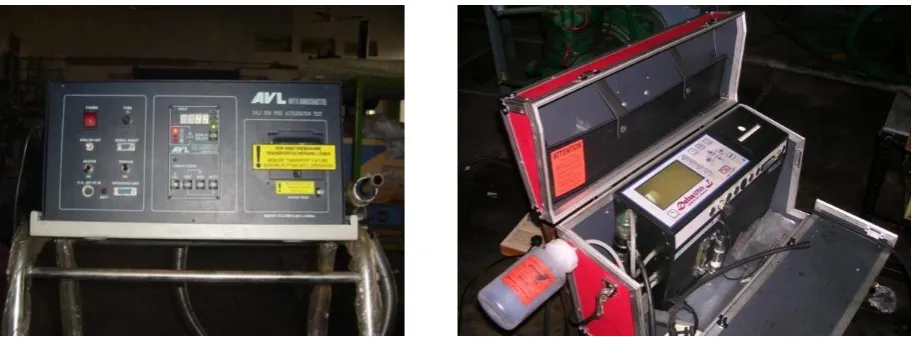
The engine used for the study is Kirloskar AVI make single cylinder four stroke constant speed (1500rpm), vertical cylinder, compression ignition, water cooled, direct injection, 5HP diesel engine. The engine has 80mm bore, 110 mm stroke, 16.5:1 compression ratio, injection pressure of 180bar, and fuel injection timing of 27o bTDC. The computer assisted experimental set up of engine shown in Fig. 2. The eddy current dynamometer was used for load measurement. The engine speed was sensed and indicated by an inductive pick up sensor with digital meter output. Fig. 3 shows AVL make smoke meter used for smoke measurement. The carbon-di-oxide (CO2), carbon monoxide (CO), unburnt hydro
carbons (UBHC), nitrous oxide (NOx) and oxygen (O2) content was measured by MRU air fair emission monitoring
systems shown in Fig. 4.The experiments were conducted at three different injection pressures (180, 200, 220 bar) for studying effect of injection pressure on the performance and emission of diesel engine with conventional diesel and neem methyl ester – diesel blends (B-20) as fuels.
Figure 2: Experimental Set up
.
Figure 3: AVL Smoke Meter Figure 4: MRU Emission Monitoring System
IV. RESULTS AND DISCUSSION
A. Fuel properties
ISSN: 2319-8753
I
nternational
J
ournal of
I
nnovative
R
esearch in
S
cience,
E
ngineering and
T
echnology
(An ISO 3297: 2007 Certified Organization)
Vol. 2, Issue 9, September 2013
Table 1 Table 3
Fatty acid composition of Neem oil Comparison of properties of Neem Methyl Ester with Diesel.
Table 2
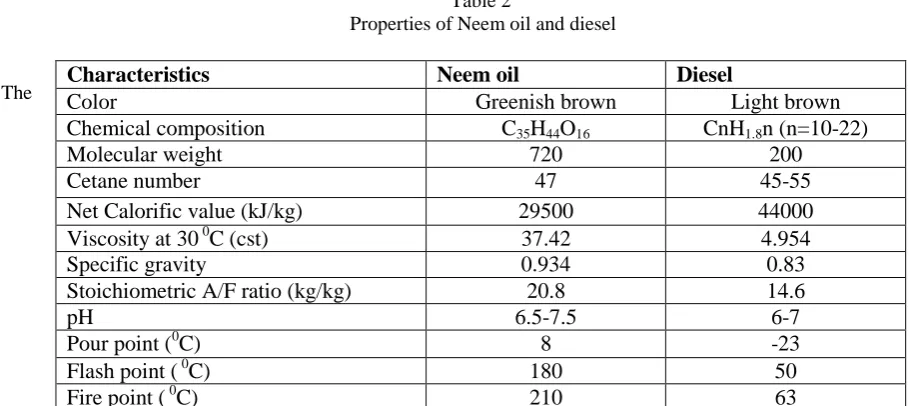
Properties of Neem oil and diesel
The
kinematic viscosity of neem oil is 37.42 centistokes and transesterified oil of 6.3 centi-stokes (cst), which is closer to diesel value. Methyl ester has a cetane number almost equal to diesel value. The calorific value of crude neem oil is 29500 kJ/kg whereas the calorific value of neem methyl ester oil is 31142 kJ/kg as shown in Table 2 and Table 3, but it is less than the calorific value of conventional diesel (44000 kJ/kg). From this the properties of methyl esters of neem oil are compatible and acceptable as fuel oil.
B. Engine Performance
Brake Thermal Efficiency:
Variation of BTE with load at three injection pressure for B-20 oil is shown in Fig. 5 and compared with diesel mode of operation. It is observed from figure that maximum efficiency (28.34%) for B-20 oil obtained at 200 bar. The high injection pressure means that the injection always takes place at high pressure and hence atomization is better and mixing with oil is good [6, 7]. This will enhance combustion and intern improves efficiency. High injection pressures will lead to delayed injection and too fine spray leads less momentum.
Properties
Diesel Neem
Methyl
Ester
Cetane No
45-55
48
Viscosity (cst)
4.954
6.3
Calorific value
(MJ/Kg)
44
31.142
Flash point
0C
47
80
Carbon residue %
86
83
Sl no
Fatty acid composition
Value (%)
1
Palmatic acid
13-18%
2
Stearic acid
12-15%
3
Arachidic acid
2-4%
4
Oleic acid
55-62%
5
Linoleic acid
6-10%
Characteristics
Neem oil
Diesel
Color
Greenish brown
Light brown
Chemical composition
C
35H
44O
16CnH
1.8n (n=10-22)
Molecular weight
720
200
Cetane number
47
45-55
Net Calorific value (kJ/kg)
29500
44000
Viscosity at 30
0C (cst)
37.42
4.954
Specific gravity
0.934
0.83
Stoichiometric A/F ratio (kg/kg)
20.8
14.6
pH
6.5-7.5
6-7
Pour point (
0C)
8
-23
Flash point (
0C)
180
50
Figure 5: Variation of BTE with BMEP
C. Engine Emissions
(i). Unburnt Hydrocarbons:
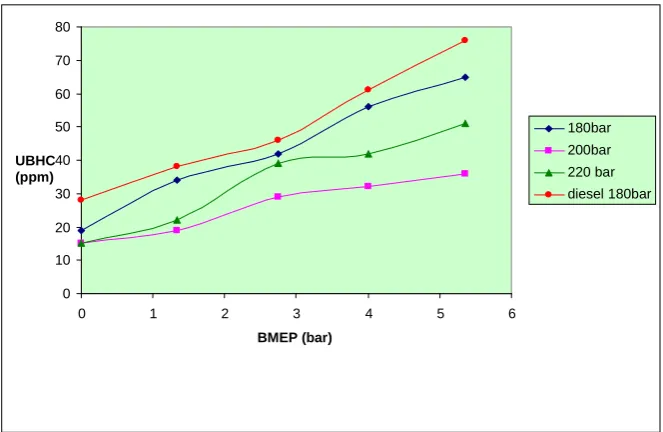
Fig. 6 shows the hydrocarbon emissions with load at three different injection pressure considered. From the figure it is clear that significant drop in hydrocarbon emissions levels as injection pressure increases. Because of better combustion, enhanced atomization also led to lower ignition delay, which in turn enhances performance with vegetable oils, which have high ignition delay to account of their high viscosity [6-8].
10 15 20 25 30 35
0 1 2 3 4 5 6
BMEP (bar)
B
TE
(
%
) 180bar
200bar
220 bar
diesel 180bar
0 10 20 30 40 50 60 70 80
0 1 2 3 4 5 6
BMEP (bar) UBHC
(ppm)
ISSN: 2319-8753
I
nternational
J
ournal of
I
nnovative
R
esearch in
S
cience,
E
ngineering and
T
echnology
(An ISO 3297: 2007 Certified Organization)
Vol. 2, Issue 9, September 2013
(ii). NOx emission:
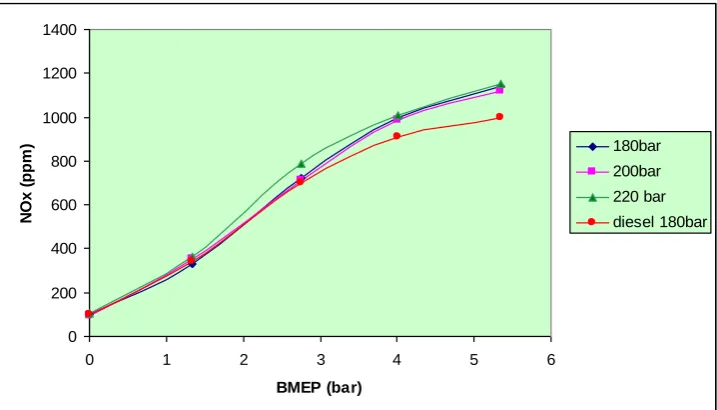
The variation of NOx emission with BMEP shows in the Fig. 7. The NOx level marginally increases with increasing
injection pressure due to faster combustion and higher temperature reached in the cycle [5 - 7].
Figure 7: Variation of NOx with BMEP
(iii). Smoke Opacity:
Fig. 8 indicates the smoke level variation with BMEP. There is no significant variation in smoke level emissions, however slight decrease with increase in the injection pressure, this is due to improved mixture formation and well atomized spray
Figure 8: Smoke opacity with BMEP 0 10 20 30 40 50 60 70
0 1 2 3 4 5 6
BMEP (bar) S m ok e O pa c it y ( % ) 180bar 200bar 220 bar diesel 180bar 0 200 400 600 800 1000 1200 1400
0 1 2 3 4 5 6
V. CONCLUSIONS
The following conclusions were drawn from the work:
1. Neem oil is a renewable source of energy; it can be used in conventional compression Ignition engine as a substitute fuel.
2. After transesterification of Neem oil, Kinematic Viscosity, Specific gravity has reduced and calorific Value is increased.
3. The injection of 200 bar is formed to optimum injection pressure for better results.
4. The emission such as hydro Carbon, NOx and Smoke density are reduced and Comparable BTE with B 20 fuel when compared to diesel fuel
REFERENCES
1. Pringi N V., (1987), Non Traditional oil seeds of India, Oxford and IBH publishing company Pvt Ltd..
2. Ramesha D.K, B.J. Ranganath, N. Ranapratap Reddy, (2007), “Characteristics of Ethanol Esterified Pongamia Pinnata and Madhuca Indica oils for compression ignition engine applications”, Journal of middle European construction and design of cars, pp31-36.
3. A.S.Ramdas, S.Jayaraj, C. Muraleedharan, (2004), Use of vegetables oils as IC engine Fuels-A review, Renewable Energy, 29pp 727-742. 4. Gerhard Knothe, (2000), “Monitoring a Progressing Transesterification Reaction by Fiber-Optic near Infrared Spectroscopy with
Correlation to 1H Nuclear Magnetic Resonance Spectroscopy”,JAOCS 77, , paper no. J9483.
5. Agarawal.A.K. & Das.L.M,( 2001), “Biodiesel development and characterization for use as a fuel in compression ignition engines”, Transactions of ASME, Vol.123), pp 440-447.
6. Narayana Reddy, A Ramesh, (2004), “Parametric studies fir improving the performance of Jatropa oil-fuelled compression ignition engine”, Journal of Renewable Energy, vol 31, pp 1994-2016.
7. Sukumar Puhan, N. Vedaraman, G. Sankaranarayanan and Boppana V Bharat Ram, (2005), “Performance and emission study of Mahua oil (madhuca indica oil) ethyl ester in a 4-stroke natural aspirated direct injection diesel engine”, Journal of Renewable Energy, Volume 30, Issue 8, pp. 1269-1278.
8. Shashikant Vilas Ghadge and Hifjur Raheman, (2005), “Biodiesel production from mahua (Madhuca indica) oil having high free fatty acids,” Journal of Biomass and Bio-energy, Volume 28, Issue 6 , pp 601-605.
9. Sukumar Puhan, N. Vedaraman, Boppana V.B. Ram, G. Sankarnarayanan and K. Jeychandran., (2005), “Mahua oil (Madhuca Indica seed oil) methyl ester as biodiesel-preparation and emission characteristics”. Journal of Biomass and Bio-energy, Volume 28., Issue 1, pp. 87-93. 10. Ramesha D.K , G.Premakumara, ,Rashmi H.V, (2009), “Effect of Blend and Injection Pressure on improving the performance of Pongamia
Methyl Ester Oil Fueled C.I. Engine.”International Journal on Mechanical and Automobile Engineering (IJMAE), Volume 4, No. 5,. pp 54-63. 11. Mrityunjaya Swamy K M, Ramesha D.K, G.Premakumara, (2009), “Effects on Performance and Emission using Jatropha Curcus and its
Methyl Esters as fuel in C I engines.” Journal of Energy and fuel users (ENFUSE), Vol LIX, , pp 12-17.