
Generic Security of NMAC and HMAC with Input Whitening
Peter Gaˇzi1, Krzysztof Pietrzak1, and Stefano Tessaro2 1
IST Austria
{peter.gazi,pietrzak}@ist.ac.at
2
UC Santa Barbara
Abstract. HMAC and its variant NMAC are the most popular approaches to deriving a MAC (and more generally, a PRF) from a cryptographic hash function. Despite nearly two decades of research, their exact security still remains far from understood in many different contexts. Indeed, recent works have re-surfaced interest forgeneric attacks, i.e., attacks that treat the compression function of the underlying hash function as a black box.
Generic security can be proved in a model where the underlying compression function is modeled as a random function – yet, to date, the question of proving tight, non-trivial bounds on the generic security of HMAC/NMAC even as a PRF remains a challenging open question.
In this paper, we ask the question of whether a small modification to HMAC and NMAC can allow us to exactly characterize the security of the resulting constructions, while only incurring little penalty with respect to efficiency. To this end, we present simple variants of NMAC and HMAC, for which we prove tight bounds on the generic PRF security, expressed in terms of numbers of construction and compression function queries necessary to break the construction. All of our constructions are obtained via a (near)black-boxmodification of NMAC and HMAC, which can be interpreted as an initial step of key-dependent message pre-processing.
While our focus is on PRF security, a further attractive feature of our new constructions is that they clearly defeat all recent generic attacks against properties such as state recovery and universal forgery. These exploit properties of the so-called “functional graph” which are not directly accessible in our new constructions.
Keywords.message authentication codes, HMAC, generic attacks, provable security
1
Introduction
This paper presents new variants of the HMAC/NMAC constructions of message authentication codes which enjoyprovablesecurity as a pseudorandom function (PRF) against generic distinguishing attacks, i.e., attacks which treat the compression function of the underlying hash function as a black-box. In particular, we prove concrete tightbounds in terms of the number of queries to the construction and to the compression function necessary to distinguishing our construction from a random function. Our constructions are the first HMAC/NMAC variants to enjoy such a tight analysis, and we see this as an important stepping stone towards the understanding of the generic security of hash-based message authentication codes.
Hash-Based MACs.HMAC[3] is the most widely used approach to key a hash functionH to obtain a PRF or a MAC. It computes the output on messageM and a keyK as
HMAC(K, M) =H(K⊕opadkH(K⊕ipadkM)),
whereopad6=ipadare constants.3Usually,H is a hash function like SHA-1, SHA-256 or MD5, in particular following the Merkle-Damg˚ard paradigm [17,5]. That is, it extends a compression function f : {0,1}c×
{0,1}b→ {0,1}c into a hash function MDf
IV by first padding M into b-bit blocks M[1], . . . , M[`], and then producing the outputH(M) =S`, where
S0←IV, Si←f(Si−1kM[i]) for alli= 1, . . . , ` . (1) 3
starting with thec-bit initialization valueIV. A cleaner yet slightly less practical variant ofHMACisNMAC, which instead outputs
NMACKin,Kout(M) =MD f
Kout(MD f
Kin(M)), whereKin, Kout ∈ {0,1}c are key values.
Security of HMAC/NMAC.The security of both constructions has been studied extensively, both by obtaining security proofs and proposing attacks. On the former side, NMACand HMACwere proven to be secure pseudorandom functions (PRFs) in the standard model [3], later also using weaker assumptions [2] and via a tight bound in the uniform setting [8]. However, as argued in [8], this standard-model bound might be overly pessimistic, covering also very unnatural constructions of the underlying compression functionf (for example the one used in their tightness proof). The authors hence argue for the need of an analysis of the PRF security ofHMACin the so-calledideal compression function model where the compression function is modelled as an ideal random function and the adversary is allowed to query it. This model was previously used by Dodiset al.[7] to studyindifferentiabilityofHMAC, which however only holds for certain key lengths. This is also the model implicitly underlying many of the recently proposed attacks on hash-based MACs [20,18,16,21,11,6,23]. These attacks are termed generic, meaning they can be mounted for any un-derlying hash function as long as it follows the Merkle-Damg˚ard (MD) paradigm. The complexity of such a generic attack is then expressed in the number of key-dependent queries to the construction (denoted qC) as well as the number of queries to the underlying compression function (denoted qf). These two classes of queries are also often referred to asonline andoffline, respectively.
All iterated MACs are subject to the long-known Preneel and van Oorschot’s attack [22] which implies a forgery (and hence also distinguishing) attack againstHMAC/NMACmakingqC= 2c/2construction queries (consisting of constant-length messages) and no direct compression function queries (i.e, qf = 0). This immediately raises two questions:
How does the security of HMACandNMAC degrade (in terms of tolerableqC) by increasing (1) the length` of the messages and (2) the numberqf of compression-function evaluations?
The first question has been partially addressed in [8]. Their result4can be interpreted as giving tight bounds on the PRF security ofNMACagainst an attacker makingqCkey-dependent construction queries (of length at most` <2c/3b-bit blocks) butnoqueries to the compression function. They show that both constructions can only be distinguished from random function with advantage roughly(qC, `)≈`1+o(1)qC2/2c, improving significantly on the bound(qC, `) ≈`2qC2/2c provable using standard folklore techniques. From our per-spective, this bound can be read as a smooth trade-off: with increasing maximum allowed query length`it tells us how many queriesqCcan be tolerated for any acceptable upper bound on advantage.
Still, it is not clear how this trade-off changes when allowing extremely long messages (` >2c/3) and/or some queries to the compression function (qf >0). Note that while huge`can be prevented by standards, in practical settingsqfis very likely to be much higher thanqC, as it represents cheap local (offline) computation of the attacker. We therefore focus on capturing the trade-off between qC and qf for values of qC that do not allow to mount the attack from [22]. However, as we argue below, getting such a tight trade-off for NMAC/HMAC seems to be out of reach for now, we hence relax the problem by allowing for slight modifications to the vanillaNMAC/HMACconstruction.
Our Contributions.We ask the following question here, and answer it positively:
Can we devise variants ofHMAC/NMACwhose security provably degrades gracefully with an increas-ing number of compression function queries qf, possibly retaining security for qf being much larger than2c?
The main contribution of this paper is the introduction and analysis of a variant of NMAC (which we then adapt to the HMAC setting, as described below) which uses additional key material to “whiten”
4
message blocks before being processed by the compression function. Concretely, our construction – termed WNMAC(for “whitened NMAC”) uses an additional extrab-bit keyKw, and given a messageM padded as M[1], . . . , M[`], operates asNMACon input padded to blocksM0[i] =M[i]⊕K
b, i.e., every message block
is whitened with thesamekey (see also Fig.1).
The rationale behindWNMACis two-fold. First, from the security viewpoint, the justification comes from the rich line of research on generic attacks on hash-based MACs. Most recent attacks [20,16,21,11] exploit the so-called “functional graph” of the compression function f, i.e., the graph capturing the structure off when repeatedly invoked with its b-bit input fixed to some constant (say 0b). Since our whitening denies
the adversary the knowledge ofb-bit inputs on whichfis invoked during construction queries, intuitively it seems to be the right way to foil such attacks. Moreover, a recent work by Sasaki and Wang [23] suggests that keyingevery invocation off is necessary in order to prevent suboptimal security against generic state recovery attacks. WNMACarguably provides the simplest and most natural such keying. Second, from the practical perspective,WNMACcan be implemented on top of an existing implementation ofNMAC, using it as a black-box.
PRF-Security of WNMAC.Our main result shows that WNMAC is a secure PRF; more precisely, no attacker making at mostqCconstruction queries (for messages padded into at most`blocks) andqf primitive queries can distinguishWNMACfrom a random function, except with distinguishing advantage
WNMAC(qC, qf, `)≤ qfqC
22c + 2·
`qCqf 2b+c +
`qC2 2c ·
d0(`) +64` 3 2c + 1
.
Here, d0(`) is the maximum, over all positive integers `0 ≤`, of the number of positive divisors of`0, and grows very slowly, i.e.,d0(`)≈`1/ln ln`. We also prove that this bound is essentially tight. Namely, we give an
attack that achieves advantage roughlyqCqf/22c, showing the first term above to be necessary. Additionally, we know from [8] that the third term is tight for`≤2c/3.
Note that in the case of qf = 0, the bound matches exactly the bound from [8]. Moreover, observe that under the realistic assumption that` <min{2c/3,2b−c}, the bound simplifies to
WNMAC(qC, qf, `)≤3 qfqC
22c + (d
0(`) + 2)· `qC2 2c .
Ignoring d0(`) for simplicity, we see that we can tolerate up to qC ≈ 2c/2/
√
` construction queries and up to qf ≈ 21.5c primitive queries. This corresponds to the security threshold ranging from 2192 f-queries for MD5 up to 2768 f-queries for SHA-512. The first term also clearly characterizes the complete trade-off curve betweenqC<2c/2/
√
`and qf for any reasonable upper bound on the message length and acceptable distinguishing advantage.
Other security properties.Additionally, we also analyze the security levelWNMACachieves with respect to other security notions frequently considered in the attacks literature. By a series of reductions, we show that, roughly speaking,WNMAC also upper-bounds the adversary’s advantage fordistinguishing-H andstate recovery. We believe that addressing these cryptanalytic notions also using the traditional toolbox of provable security is important and see this paper as taking the first step on that path.
Lifting to HMAC.We then move our attention fromNMACtoHMACand propose two analogous modi-fications to it. The first one, calledWHMAC, is obtained fromHMACin the same wayWNMACis obtained from NMAC: by whitening the padded message blocks with an independent key (see Fig. 5). The second one, termed WHMAC+, additionally processes a fresh keyK+ instead of the first block of the message (see Fig.6). Both variants can be implemented given only black-box access to HMAC, and we prove that they maintain the same security level asWNMACas long as the parametersb, coffsatisfyb2c(forWHMAC) or b c (for WHMAC+). Note that for existing hash functions, the former condition is satisfied for both MD5 and SHA-1, while the latter holds also for SHA-256 and SHA-512.
call in DWNMACcomputesf(s, K2) for a longer, b-bit key. As expected, we prove that this tweak removes the need for the qCqf/22c term and replaces it by the strictly favourable term qCqf/2b+c, proving that the zero-padding in the outer call ofWNMACwas actually responsible for the “bottle-neck” term in its security bound.
Our Techniques.In our information-theoretic analysis ofWNMACwe employ the H-coefficient technique by Patarin [19] as recently revisited by Chen and Steinberger [4], partially inheriting the notational framework from the recent analysis of keyed sponges by Gaˇzi, Pietrzak, and Tessaro [9]. On a high level, the heart of our proof is a careful analysis of the probability that two sets intersect in the ideal experiment: (1) the set of adversarial queries to f, and (2) the set of inputs on which f is invoked when answering the adversary’s queries toWNMAC. Obtaining a bound on the probability of this event then allows us to exclude it and use the result from [8] that considersqf = 0, properly adapted to theWNMACsetting.
Related Work.As mentioned above, the motivation for our work partially stems from the recent line of work on generic attacks against iterated hash-based MACs [20,18,16,21,11,6,23]. While our security bound forWNMACdoes not exclude attacks of the complexity (in terms of numbers of queries and message lengths) considered in these papers, the design ofWNMACwas partially guided by the structure of these attacks and seems to prevent them. We find in particular the work [23] to be a good justification for investigating the security of WNMAC and related constructions. Iterated MAC that uses keying in every f-invocation was already considered by An and Bellare [1], their construction NI was later subject to analysis [8] that we adapt and reuse. One can seeWNMACas a conceptual simplification ofNIwhere the key is simply used to whiten theb-bit input to the compression function. Finally, our dual construction considered in Section 5
bears resemblance to the Sandwich MAC analyzed by Yasuda [24], we believe that our methods could be easily adapted to cover this construction as well.
Perspective and open problems.We stress that the reader should not conclude from this work that NMAC and HMAC are necessarily less secure than the constructions proposed in this paper, specifically with respect to PRF security. In fact, we are not aware of any attacks showing a separation between the PRF security of our constructions and that of the original NMAC/HMAC constructions, finding one is an interesting open problem.
While obtaining a non-tight birthday-type bound for NMAC/HMAC is feasible (for most key-length values, a bound follow directly from the indifferentiability analysis of [7]), proving tight bounds in terms of compression function and construction queries on the generic PRF security ofNMAC/HMACis a challenging open problem, on which little progress has been made. The main challenge is to understand how partial information in form off-queries can help the attacker to break security (i.e., distinguish) in settings with qC2c/2/
√
`, when the attack from [8] does not apply. This will require in particular developing a better understanding of the functional graph defined by queries to the function f. Some of its properties have been indeed exploited in existing generic attacks, but proving security appears to require a much deeper understanding: Most of the recent attacks, which are probably still not tight, do not come with rigorous proofs but instead rely on conjectures on the structure of these graphs [11]. The difficulty of this question for NMAC/HMACis also well documented by the fact that even proving security of the whitened constructions presented in this paper required some novel tricks and considerable effort.
Similarly, it remains equally challenging to prove that for the properties considered by the recent attacks againstHMAC/NMAC(such as distinguishing-H, state recovery or various types of forgeries), the security of WNMAC/WHMACis provably superior. Yet, we note that our construction invalidates direct application of all existing attacks, and hence we feel confident conjecturing that its security is much higher.
SHA-functions,d= 65). Note that sincedb−c, this will not affect the tightness of the bounds for concrete parameters.
2
Preliminaries
Basic notation.We denote [n] := {1, . . . , n}. Moreover, for a finite set S (e.g., S = {0,1}), we let Sn,
S+ andS∗ be the sets of sequences of elements ofS of lengthn, of arbitrary (but non-zero) length, and of arbitrary length, respectively (withεdenoting the empty sequence, as opposed towhich is a small quantity). As a shorthand, let{0,1}b∗ denote {0,1}b∗
. We denote byS[i] thei-th element ofS ∈ Sn for alli∈[n].
Similarly, we denote byS[i . . . j], for every 1≤i≤j≤n, the sub-sequence consisting ofS[i], S[i+1], . . . , S[j], with the convention thatS[i . . . i] =S[i]. Moreover, we denote bySkS0 the concatenation of two sequences inS∗, and also, we letS |T be the usual prefix-of relation:S|T :⇔(∃S0∈ S∗:SkS0 =T).
For an integern, d(n) =|{i∈N:i|n}|is the number of its positive divisors and
d0(n) := max
n0∈{1,...,n}|{d∈N:d|n
0}| ≈n1/ln lnn
is the maximum, over all positive integers n0 ≤n, of the number of positive divisors of n0. More precisely, we have∀ε >0∃n0 ∀n > n0:d(n)< n(1+ε)/ln lnn [12].
We also let F(D,R) be the set of all functions from D to R; and with a slight abuse of notation we sometimes writeF(m, n) (resp.F(∗, n)) to denote the set of functions mappingm-bit strings ton-bit strings (resp. from {0,1}∗ to {0,1}n). We denote by x $
← X the act of sampling xuniformly at random from X. Finally, we denote the event that an adversaryA, given access to an oracleO, outputs a valuey, asAO⇒y. To emphasize the random experiment considered, we sometimes denote the probability of an event Ain a random experiment Eby PE[A]. Finally, the min-entropyH
∞(X) of a random variableX with range X is defined as−log (maxx∈XPX(x)).
Pseudorandom functions.We consider keyed functions F: K × D → R taking a κ-bit key (i.e., K =
{0,1}κ), a messageM ∈ D as input, and returning an output from R. For a keyed function Funder a key
k∈ Kwe often writeFk(·) instead ofF(k,·). One often considers the security ofFas apseudorandom function
(or PRF, for short) [10]. This is defined via the following advantage measure, involving an adversaryA:
AdvprfF (A) :=
P
h
K← {$ 0,1}κ: AFK ⇒1i−Phf ← F$ (D,R) : Af⇒1i .
Informally, we say thatFis a PRF if this advantage is “negligible” for all “efficient” adversariesA.
PRFs in the ideal compression function model.For our analysis below, we are going to consider keyed constructions C[f] :{0,1}κ× D → Rwhich make queries to a randomly chosen compression function
f ← F$ (c+b, c) which can also be evaluated by the adversary (we sometimes writeCf instead of C[f]). For this case, we use the following notation to express the PRF advantage ofA:
AdvprfC[f](A) :=
P
h
K← {$ 0,1}κ,f← F$ (c+b, c) : ACfK,f ⇒1
i
−PhR← F$ (D,R),f← F$ (c+b, c) : AR,f ⇒1i .
We callA’s queries to its first oracleconstruction queries (or C-queries) and its queries to the second oracle asprimitive queries (orf-queries).
Note that the notion of PRF-security is identical to the notion of distinguishing-R, first defined in [14] and often used in the cryptanalytic literature on hash-based MACs.
Distinguishing-H.A further security notion defined in [14] is the so-calleddistinguishing-H security. Here, the goal of the adversary is to distinguish the hash-based MAC construction CK[f] using its underlying
compression functionf(say SHA-1) and a random keyK, from the same constructionCK[g] built on top of
already the initial compression functionfas ideal, this corresponds to distinguishing a pair of oracles (CK[f],f)
from (CK[f],g). Formally,
Advdist-HC (A) := P
h
K← {$ 0,1}κ,f← F$ (c+b, c) : ACfK,f ⇒1
i
−PhK← {$ 0,1}κ,f,g← F$ (c+b, c) : ACfK,g⇒1
i .
State recovery.An additional notion considered in the literature is security againststate recovery. Since the definition of this notion needs to be tailored for the concrete construction it is applied to, we postpone the formal definition of security against state recovery to Section3.10.
MACs and unpredictability.It is well known that a good PRF also yields a good message-authentication code (MAC). A concrete security bound for unforgeability can be obtained from the PRF bound via a standard argument.
Iterated MACs.For a keyed function f : {0,1}c× {0,1}b → {0,1}c we denote with Cascf : {0,1}c×
{0,1}b∗→ {0,1}c the cascade construction (also known as Merkle-Damg˚ard) built fromf as
Cascf(K, m1k. . .km`) :=y`wherey0:=Kand fori≥1 : yi:=f(yi−1, mi),
in particularCascf(K, ε) :=K.
The constructionNMACf: ({0,1}c)2× {0,1}b∗ → {0,1}c is derived from Cascf
by adding an additional, independently keyed application offat the end. It assumes that the domain sizes of fsatisfyb≥cand the output of the cascade is padded with zeroes before the lastf-call. Formally,
NMACf((K1, K2), M) :=f(K2,Cascf(K1, M)k0b−c).
Note that practical MD-based hash functions take as input arbitrary-length bitstrings and then pad them to a multiple of the block length, often including the message length in the so-called MD-strengthening. This padding then also appears in NMAC(and HMAC) but here we take the customary shortcut and our definition ofNMACabove (resp.HMACbelow) actually corresponds to the generalized constructions denoted asGNMAC(resp.GHMAC) in [2] where this step is also justified in detail.
HMACf is a practice-oriented version of NMACf, where the two keys (K1, K2) are derived from a single keyK∈ {0,1}b by xor-ing it with two fixedb-bit stringsipadandopad. In addition, the keys are not given
through the key-input of the compression functionf, but are prepended to the message instead. This allows for the usage of existing implementations of hash functions that contain a hard-coded initialization vector IV. Formally:
HMACf(K, m) :=Cascf(IV, K2kCascf(IV, K1km)kfpad) where (K1, K2) := (K⊕ipad, K⊕opad)
andfpadis a fixed (b−c)-bit padding not affecting the security analysis. (Technically, [15] allows for arbitrary length of the keyK: a key shorter thanbbits is padded with zeroes before applying the xor transformations, a longer key is first hashed.)
3
The Whitened NMAC Construction
We now present our main construction called Whitened NMAC(or WNMACfor short). To that end, let us first consider a modification of the cascade constructionCasccalledwhitened cascade and denotedWCasc. For a keyed functionf:{0,1}c× {0,1}b → {0,1}cwe denote withWCascf
: ({0,1}c× {0,1}b)× {0,1}b∗→ {0,1}c
the whitened cascade construction built fromf as
WCascf((K1, Kw), m1k. . .km`) :=y`
f f f
K1 f
⊕
m1
Kw ⊕
m2
Kw ⊕
m3
Kw ⊕
m`
Kw
f
K2 WNMAC[f]K1,K2,Kw(m1k · · · km`)
Fig. 1.The constructionWNMAC[f]K1,K2,Kw.
in particularWCascf((K1, Kw), ε) :=K1.
The construction WNMACis derived fromNMAC, the only difference being that the inner cascadeCasc is replaced by the whitened cascadeWCasc. More precisely,
WNMACf((K1, K2, Kw), M) :=f(K2,WCascf((K1, Kw), M)k0b−c).
For a graphical depiction of WNMAC, see Figure 1. We devote most of this section to the proof of the following theorem that quantifies the PRF-security ofWNMAC.
Theorem 1 (PRF-Security of WNMAC). Let A be an adversary making at mostqf queries to the com-pression function f and at most qC construction queries, each of length at most ` b-bit blocks. Let K = (K1, K2, Kw)∈ {0,1}c× {0,1}c× {0,1}b be a tuple of random keys. Then we have
AdvprfWNMACf K
(A)≤ qfqC
22c + 2·
`qCqf 2b+c +
`qC2 2c ·
d0(`) +64` 3 2c + 1
. (2)
Note that as observed in Section 2, this also covers the so-called distinguishing-R security ofWNMAC. Moreover, our analysis also implies security bounds for distinguishing-H and state recovery, as we discuss later.
3.1 Basic Notation, Message Trees and Repetition Patterns
Let us fix an adversary A. We assume that A is deterministic, it makes exactly qf queries to f and qC construction queries, and it never repeats the same query twice. All these assumptions are without loss of generality for an information-theoretic indistinguishability analysis, since an arbitrary (possibly randomized) adversary making at most this many queries can be transformed into one satisfying the above constraints and achieving advantage which is at least as large.
Let QC ⊆ {0,1}b ∗
be any non-empty set of messages (later this will represent the set of A’s C-queries). Based on it, we now introduce themessage treeand its labeled version, which capture the inherent combinatorial structure of the messagesQC, as well as the internal values computed while these messages
are processed byWCascf inside ofWNMACf. The message treeT(QC) = (V, E) forQC is defined as follows:
– The vertex set isV :=nM0∈ {0,1}b∗
: ∃M ∈ QC:M0|M o
, where|is the prefix-of partial ordering of strings. In particular, note that the empty stringεis a vertex and thatQC⊆V.
– The setE⊆V ×V of (directed) edges is
E:=
(M, M0) : ∃m∈ {0,1}b:M0 =Mkm .
To simplify our exposition, we also define the following two mappings based onT(QC).
ε K1
0
f(K1,0⊕Kw)
0k0
f(λ(0),0⊕Kw)
0
0k1 f(λ(0),1⊕Kw)
0k1k1
f(λ(0k1),1⊕Kw)
1 1
0
1
f(K1,1⊕Kw)
1
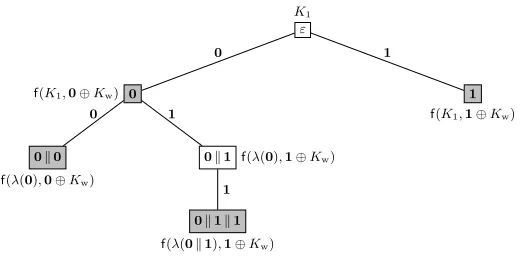
Fig. 2. Labeled message tree. Example of a labeled message tree Tf
K(QC) for four messages QC =
{0,0k0,0k1k1,1}, where r = rb forr ∈ {0,1}. The gray vertices correspond to these four messages. Next to each vertexvand edge (u, v), we give the labelλ(v) and the valueµ(v), respectively.
– The mappingµ(v) :V\{ε} → {0,1}breturns the unique message blockm∈ {0,1}bsuch thatπ(v)kµ(v) =
v (intuitively, this will be the message block that is processed when “arriving” in vertexv).
Alternatively, with a slight abuse of notation we will also refer to the vertices in V asv1, . . . , v|V|which is an arbitrary ordering of them such that for all 1≤i, j ≤ |V| it satisfiesvi |vj ⇒i ≤j. Note that one
obtains such an ordering for example if one, intuitively speaking, processes the messages inQC block-wise
and labels the vertices by their “first appearance”: in particularv1=εis the tree root. Additionally, for a mapping f:{0,1}c× {0,1}b → {0,1}c and a key tupleK= (K
1, K2, Kw)∈ {0,1}c×
{0,1}c× {0,1}b we also consider an extended version ofT(Q
C) which we call thelabeled message tree and
denoteTf
K(QC) = (V, E, λ), and which is defined as follows:
– The set of vertices V and edgesEare defined exactly as for T(QC) above.
– The vertex-labeling function λ: V → {0,1}c is defined iteratively: λ(ε) := K
1 and for each non-root vertex v∈V \ {ε} we putλ(v) :=f(λ(π(v)), µ(v)⊕Kw).
An example of a labeled message tree is given in Figure 2. Note that each vertex label λ(v) is exactly the output of the inner, whitened cascadeWCascfK1,Kw(v) inWNMACfK (recall thatv is actually a message from{0,1}b∗).
For any message tree T(QC) = (V, E), a repetition pattern is any equivalence relation ρ on V. For a
labeled message treeTf
K(QC) = (V, E, λ) we say that a repetition patternρisinduced by it if it satisfies
∀u, v∈V :λ(u) =λ(v)⇔ρ(u, v).
3.2 Interactions and Transcripts
LetQRC denote the set ofqCpairs (x, r) such thatx∈ {0,1}b∗ is a construction query and r∈ {0,1}c is a potential response to it (what we mean by “potential” will be clear from below). Similarly let QRf denote the set ofqf pairs (x, r) such thatx∈ {0,1}c× {0,1}b is anf-query andr∈ {0,1}c is a potential response to it. LetQC ⊆ {0,1}b∗ andQf ⊆ {0,1}c× {0,1}b denote the sets of first coordinates (i.e., the queries) in
QRC andQRf, respectively; we have|QC|=qCand|Qf|=qf.
We call the pair of sets (QRC,QRf)validif the adversaryAwould indeed ask these queries throughout the experiment, assuming that each of her queries would be replied by the respective response inQRC or
QRf (note that once a deterministicAis fixed, this determines whether a given pair (QRC,QRf) is valid). We then define a valid transcriptto be of the form
τ= QRC,QRf, K= (K1, K2, Kw), TKf (QC)
where (QRC,QRf) is valid, f: {0,1}c× {0,1}b → {0,1}c is a function and K = (K1, K2, Kw)∈ {0,1}c×
{0,1}c× {0,1}b is a key tuple.
We differentiate between the ways in which such valid transcripts are generated in the real and in the ideal worlds (or experiments), respectively, by defining corresponding distributions Treal andTideal over the set of valid transcripts:
Real world. The transcript Treal for the adversary A is obtained by sampling f
$
← F(c+b, c) and K = (K1, K2, Kw)← {0,1}c× {0,1}c× {0,1}b, and lettingTreal denote
QRC={(Mi, Yi)} qC
i=1,QRf ={(Xi, Ri)} qf
i=1, K= (K1, K2, Kw), TKf (QC)
,
where we executeA, which asks construction queriesM1, . . . , MqC answered withYi:=WNMAC[f]K(Mi)
for all i ∈[qC]; and f-queries X1, . . . , Xqf answered with Ri :=f(Xi) for all i ∈[qf] (note that the C-queries andf-queries may in general be interleaved adaptively, depending onA). Finally, we letTf
K(QC)
be the labeled message tree corresponding toQC, fandK.
Ideal world. The transcriptTidealfor the adversaryAis obtained similarly to the above, but here, together with the random functionf← F$ (c+b, c) and the key tupleK= (K1, K2, Kw)← {0,1}c×{0,1}c×{0,1}b, we also sampleqCindependent random valuesY1, . . . , YqC ∈ {0,1}
r. Then we letT
ideal denote
QRC={(Mi, Yi)}iqC=1,QRf ={(Xi, Ri)}qi=1f , K= (K1, K2, Kw), TKf (QC),
where we execute A, answer each its C-query Mi with Yi for all i ∈[qC] and each its f-queryXi with
Ri:=f(Xi) for alli∈[qf]. Then we letTKf (QC) be the labeled message tree corresponding toQC,fand
K.
Later we refer to the above two random experiments as real andideal, respectively. Note that the range of Treal is included in the range ofTideal by definition, and that the range of Tideal is easily seen to contain all valid transcripts.
3.3 The H-Coefficient Method
We upper-bound the advantageAin distinguishingWNMAC[f]K forf $
← F(c+b, c) from a random function in terms of the statistical distance of the transcripts, i.e.,
AdvprfWNMAC(A)≤SD(Treal,Tideal) = 1 2
X
τ
|P[Treal=τ]−P[Tideal=τ]| , (3)
where the sum is over all valid transcripts. This is because an adversary forTreal andTideal, whose optimal advantage is exactly SD(Treal,Tideal), can always output the same decision bit as A, ignoring any extra information provided by the transcript.
We are going to use Patarin’s H-coefficient method [19], as recently revisited in [4]. This means that we need to partition the set of valid transcripts intogoodtranscriptsGTandbadtranscriptsBTand then apply the following lemma, whose proof is given for completeness in AppendixA.
Lemma 1 (The H-Coefficient Method [19]). Let δ, ∈[0,1]be such that:
(a) P[Tideal∈BT]≤δ.
(b) For all τ∈GT,
P[Treal=τ] P[Tideal=τ]
≥1− .
Then,
AdvprfWNMAC(A)≤SD(Treal,Tideal)≤+δ .
3.4 Good and Bad Transcripts
Given a valid transcriptτ we define the setsLin,Lout⊆ {0,1}c× {0,1}b as
Lin:={(λ(π(v)), µ(v)⊕Kw) : v∈V \ {ε}}
Lout:= K2, λ(v)k0b−c : v∈ QC ,
and let L=Lin∪ Lout. Intuitively, L represents the set of inputs on whichf is evaluated while processing A’s construction queries in the real experiment. This set is also well-defined in the ideal experiment by the above equations, and in both experiments it is determined by the transcript. We refer toLin as the set of inner f-invocations, i.e., those invocations of f that were required to evaluate the inner, whitened cascade WCascf inWNMAC; and similarly,Lout denotes theouter invocations.
If there is an intersection between the adversary’s f-queries and the inputs inLin (resp. Lout), we call this aninner (resp., outer) C-f-collision. We then denote byC-f-collin (resp.,C-f-collout) the event that any inner (resp., outer) C-f-collision occurs. Formally,
C-f-collin:⇔(Qf∩ Lin6=∅) and C-f-collout:⇔(Qf ∩ Lout6=∅)
and let C-f-coll := C-f-collin∪C-f-collout. Furthermore, if the vertex labels λ(M) collide for two messages M, M0∈ QC, we call this a C-collision and denote such an event by
C-coll:⇔(∃M, M0∈ QC: λ(M) =λ(M0)) .
Definition 1 (Good Transcripts). Let
τ = QRC,QRf, K= (K1, K2, Kw), TKf (QC) = (V, E, λ)
be a valid transcript. We say that the transcript is good (and thusτ ∈GT) if the following properties are true:
(1) The eventC-f-collout has not occurred.
(2) The eventC-coll has not occurred.
(3) For any v∈V we have λ(v)6=K2.
We denote asGTthe set of all good transcripts, andBTthe set of allbadtranscripts, i.e., transcripts which can possibly occur (i.e., they are in the range of Tideal) and are not good. More specifically, we denote by BTi the set of all bad transcripts that do not satisfy thei-th property in the definition of a good transcript
above, hence we haveBT=S3 i=1BTi.
3.5 Probability of a C-f-collision
In this section we upper-bound the probability of C-f-coll by considering inner and outer C-f-collisions separately.
Lemma 2. We havePideal[C-f-coll
in]≤`qCqf/2b+c.
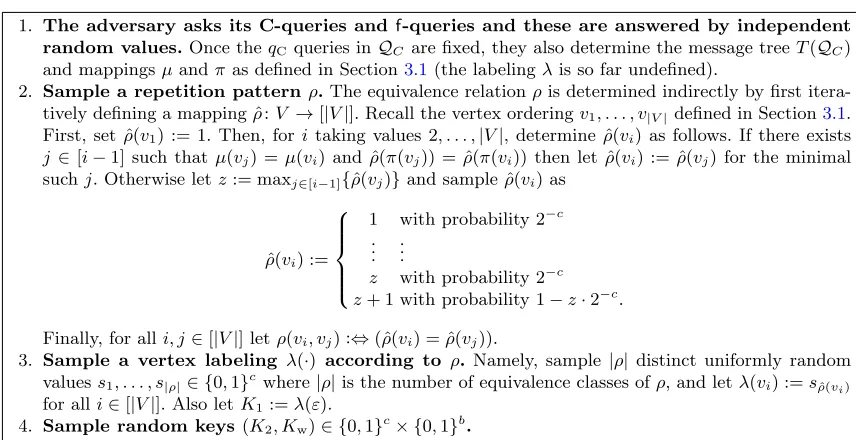
Proof. We start by modifying the ideal experiment to obtain an experiment denoted ideal0 and the corre-sponding transcript distributionTideal0. The experimentideal0 is given in Figure3. Clearly,ideal0 differs from the ideal experiment only in the way the vertex labeling functionλ(·) is determined.
We now argue that Pideal[C-f-collin] =Pideal0[C-f-collin]. To see this, consider an intermediate experiment ideal00that is defined exactly asidealexcept that it uses a separate ideal compression function gto generate the vertex labels of the tree contained in the transcript, whereg is completely independent off queried by the adversary (i.e., the adversary queries f and the transcript containsQRf and TKg(QC)). It is now clear
1. The adversary asks its C-queries and f-queries and these are answered by independent random values.Once theqCqueries inQC are fixed, they also determine the message treeT(QC)
and mappingsµandπas defined in Section3.1(the labelingλis so far undefined).
2. Sample a repetition pattern ρ.The equivalence relationρis determined indirectly by first itera-tively defining a mapping ˆρ:V →[|V|]. Recall the vertex orderingv1, . . . , v|V|defined in Section3.1. First, set ˆρ(v1) := 1. Then, for itaking values 2, . . . ,|V|, determine ˆρ(vi) as follows. If there exists
j ∈[i−1] such that µ(vj) =µ(vi) and ˆρ(π(vj)) = ˆρ(π(vi)) then let ˆρ(vi) := ˆρ(vj) for the minimal
suchj. Otherwise letz:= maxj∈[i−1]{ˆρ(vj)}and sample ˆρ(vi) as
ˆ
ρ(vi) :=
1 with probability 2−c
. . . ...
z with probability 2−c
z+ 1 with probability 1−z·2−c.
Finally, for all i, j∈[|V|] letρ(vi, vj) :⇔( ˆρ(vi) = ˆρ(vj)).
3. Sample a vertex labeling λ(·) according to ρ. Namely, sample |ρ| distinct uniformly random valuess1, . . . , s|ρ|∈ {0,1}c where|ρ|is the number of equivalence classes ofρ, and letλ(vi) :=sρˆ(vi) for alli∈[|V|]. Also letK1:=λ(ε).
4. Sample random keys (K2, Kw)∈ {0,1}c× {0,1}b.
Fig. 3.The random experimentideal0for the proofs of Lemmas2and3.
The remaining equality Pideal00[C-f-coll
in] =Pideal 0
[C-f-collin] follows from the definition ofideal0. It is easy to see that the distribution of vertex labels sampled in steps2and3ofideal0 and by labeling the treeTKg(QC)
inideal00are the same. In both cases, repeated inputs to the compression function lead to consistent outputs, while fresh inputs lead to independent random outputs. The two experiments only differ in the order of sampling:ideal00first samplesgand then performs the labeling, whileideal0starts by sampling the repetition pattern, and then chooses the actual labels correspondingly. The same distribution of vertex labels in these two experiments then implies the same probability ofC-f-collin occurring.
Finally, we upper-bound the probabilityPideal0[C-f-collin]. Conditioned on the repetition patternρtaking some fixed valuerp, in step2, we have
Pideal0[C-f-collin |ρ=rp]≤
X
v∈V\{ε}
Pideal0[(λ(π(v)), µ(v)⊕Kw)∈ Qf |ρ=rp]
= X
v∈V\{ε} Pideal0
(sρˆ(π(v)), µ(v)⊕Kw)∈ Qf |ρ=rp
= X
v∈V\{ε}
qf/2b+c≤`qCqf/2b+c
because the random variablessi andKwsampled in steps3and4are uniformly distributed and independent of Qf. Since this bound holds conditioned onρbeing any fixed repetition pattern rp, it remains valid also
without conditioning on it, hence concluding the proof. ut
We proceed by upper-bounding the probability of an outer C-f-collision.
Lemma 3. We have
Pideal[C-f-collout]≤ `qCqf
2b+c +
qCqf 22c .
Proof. Let us again consider the experimentsideal0 andideal00defined in the proof of Lemma2. We start by the simple observation that for any eventAwe have
Pideal[A] =Pideal[A∧C-f-collin] +Pideal[A∧ ¬C-f-collin]
≤ `qCqf
2b+c +P
ideal00
[A∧ ¬C-f-collin]≤`qCqf
2b+c +P
ideal00
which follows from Lemma2 and the observation thatidealandideal00 only differ ifC-f-collin occurs. Applying (4) to the eventC-f-colloutas A, it remains to bound the probabilityPideal
00
[C-f-collout]; for this we observe that Pideal00[C-f-coll
out] =Pideal 0
[C-f-collout] similarly as before: the repetition patternρ sampled in step2ofideal0 has the same distribution as the repetition pattern induced by the treeTKg(QC) in ideal00,
and this together with the sampling performed in step3 results in the same distribution of vertex labels in ideal00andideal0 and hence also in the same probability ofC-f-collout in both experiments.
Finally, to upper-bound the probabilityPideal0[C-f-coll
out], again conditioned on the repetition patternρ sampled in step2 taking some fixed valuerp, we have
Pideal0[C-f-collout |ρ=rp]≤
X
v∈QC Pideal0
(K2, λ(v)k0b−c)∈ Qf |ρ=rp
≤ X
v∈QC Pideal0
(K2, sρˆ(v)k0b−c)∈ Qf |ρ=rp
= X
v∈QC
qf/22c≤qCqf/22c
because the random variablessiandK2sampled in steps3and4are uniformly distributed and independent of Qf. Since this bound holds conditioned onρbeing any fixed repetition pattern rp, it remains valid also
without conditioning on it. ut
3.6 Probability of Repeated Outer Invocations
In this section we analyze the probability that any of the outer f-invocations in the ideal experiment will not be fresh, in particular we upper-bound bothP[Tideal∈BT2] andP[Tideal∈BT3].
Lemma 4. We have
Pideal[C-coll]≤`qCqf
2b+c +
`qC2 2c ·
d0(`) +64` 3 2c
.
Proof. Applying (4) to the eventC-coll, we havePideal[C-coll]≤`q
Cqf/2b+c+Pideal 00
[C-coll]. Since the queries
QC in the experimentideal00 are chosen non-adaptively (with respect to the keys K1,Kw and the function g used to later compute the tree labeling), we can obtain via a union bound that
Pideal00[C-coll]≤qC2· max
M16=M2
|M1|,|M2|≤`b
Pg,K1,KwhWCascg
K1,Kw(M1) =WCasc
g
K1,Kw(M2) i
.
Moreover, we have max
M16=M2
|M1|,|M2|≤`b
Pg,K1,KwhWCascgK
1,Kw(M1) =WCasc
g
K1,Kw(M2) i
= max
M16=M2
|M1|,|M2|≤`b X
K1∈{0,1}c Kw∈{0,1}b
1 2c+b ·P
ghWCascg
K1,Kw(M1) =WCasc
g
K1,Kw(M2) i
≤ X
K1∈{0,1}c
Kw∈{0,1}b
1
2c+b · M1max6=M2
|M1,|M2|≤`b
PghWCascgK
1,Kw(M1) =WCasc
g
K1,Kw(M2) i
= X
K1∈{0,1}c
Kw∈{0,1}b 1
2c+b · Mmax 16=M2
|M1,|M2|≤`b
Pg
CascgK1(M1⊕Kw) =CascgK1(M2⊕Kw)
= X
K1∈{0,1}c Kw∈{0,1}b
1
2c+b · Mmax 16=M2
|M1,|M2|≤`b
Pg
CascgK1(M1) =Casc g
K1(M2)
| {z }
CascColl(`)
where the notationMi⊕Kw denotes XOR-ing the keyKw to each of the blocks ofMi.
The last maximization term above was already studied in the context of the construction NI2 in [8], where it was denoted as CColl(`), but we will refer to it as CascColl(`) to avoid confusion with the event C-collconsidered here. It was shown in [8] that
CascColl(`)≤`·d
0(`) 2c +
64`4
22c . (5)
We give an overview of the approach used in [8] to obtain this bound in AppendixB.
Putting all the above bounds together concludes the proof of Lemma 4. ut
Lemma 5. We have
Pideal[∃v∈V:λ(v) =K2]≤ `qC
2c .
Proof. As is clear from the description of the ideal experiment, the keyK2 is chosen uniformly at random and independently of the rest of the experiment, in particular of the labels λ(v). The lemma hence follows
by a simple union bound over all`qCverticesv∈V. ut
3.7 Good Transcripts and Putting Pieces Together
Let us consider a good transcriptτ. First, sinceτ6∈BT1, there is no overlap between the outerf-invocations and thef-queries issued by the adversary. Second, sinceτ 6∈BT2, there is also no repetition between the outer f-invocations themselves. Finally, since τ 6∈ BT3, there is also no overlap between the outer f-invocations and the innerf-invocations (all the outer invocations containK2 as their first component). Altogether, this means that each outerf-invocation in real is fresh and hence its outcome can be seen as freshly uniformly sampled (sincefis an ideal random function). Therefore, the distribution of these outcomes will be the same as inideal, where they correspond to the independent random values Yi. Hence, for all τ∈GT, we have
P[Treal=τ] P[Tideal=τ]
= 1.
Plugging this into Lemma 1, together with the bounds from Lemmas 3,4 and5, we obtain
AdvprfWNMAC(A)≤
3
X
i=1
P[Tideal∈BTi]
≤qfqC
22c + 2·
`qCqf 2b+c +
`qC2 2c ·
d0(`) +64` 3 2c
+`qC 2c
≤qfqC
22c + 2·
`qCqf 2b+c +
`qC2 2c ·
d0(`) +64` 3 2c + 1
,
which concludes the proof of Theorem1. ut
3.8 Tightness
TheqC=Θ(c)case.We must define an adversaryAO,f who can distinguish the case where the first oracleO implements a random functionRfrom the case where it implementsWNMACf((K1, K2, Kw),·) with random keysK1, K2, Kwusing the random functionf:{0,1}b+c → {0,1}c which is given as the second oracle.
AO,f first pickst :=q
f/2c keysKe1, . . . ,Ketarbitrarily, and then uses itsqf function queries to learn the outputs
Zi={f(Kei, xk0b−c) : x∈ {0,1}c}
for all the keys. When throwing 2c balls randomly into 2c bins, we expect a 1−1/e ≈ 0.63 fraction of
the bins to be non-empty (and the value is strongly concentrated around this expectation). We can think of evaluating the random function f(Kei,·k0b−c) : {0,1}c → {0,1}c as throwing 2c balls (the inputs) to
random bins (the outputs), and thus have |Zi| ≈ 0.63·2c. Then AO,f queries O on Θ(c) random inputs,
letQc denote the corresponding outputs. Now AO,f outputs 1 if and only if for some i we have Qc ⊂ Zi.
IfO(·) =WNMACf((K1, K2, Kw),·) =f(K2,WCascf((K1, Kw),·)k0b−c) and moreoverK2=Kei for somei –
which happens with probabilityt/2c – then all the outputs ofO(·) are in the range off( e
Ki, .k0b−c) and thus
AO,f outputs 1.
On the other hand, ifO(·) is a random function, then every single query will miss the setZiwith constant
probability 0.37. Using this, we get by a Chernoff bound (and the union bound over alltkeys) that
P[∃i : Qc ⊂ Zi]≤
t 2Θ(qC) .
Summing up we get forqC=Θ(c) andt=qf/2c AdvprfWNMAC(AqC,t)≥
t 2c −
t 2Θ(qC)
≥ t
2c−1 ≥ qf 22c−1 =
qfqC 22c·Θ(c)
which matches our termqfqC/22c from the lower bound up to aΘ(c) factor.
3.9 Distinguishing-H Security of WNMAC
The above results also imply a bound on the distinguishing-H security ofWNMAC. To capture this, we first introduce the notion of distinguishing-C, which corresponds to PRF-security with the restriction that the distinguisher only uses construction queries.
Definition 2 (Distinguishing-C). LetC[f] :{0,1}κ× D → Rbe a keyed construction making queries to a
randomly chosen compression function f ← F$ (c+b, c). The distinguishing-C advantage of an adversary A is defined as
Advdist-CC[f] (A) :=
P
h
K← {$ 0,1}κ,f $
← F(c+b, c) : ACfK⇒1
i
−PhR← F$ (D,R) : AR⇒1i .
The notion of distinguishing-C is useful for bridging distinguishing-H and PRF-security, as the following simple lemma shows.
Lemma 6. For every adversary A asking qC and qf construction and primitive queries, respectively, there exists an adversaryA0 asking qC queries to its single oracle such that
Advdist-HC (A)≤AdvprfC[f](A) +Advdist-CC[f] (A0) and
AdvprfC[f](A)≤Advdist-HC (A) +Advdist-CC[f] (A0).
1. The adversary asks its C-queries. For each of them, only the repetition pattern for the state values belonging to this query is sampled (as in the experiment ideal0 in Figure 3) and the query is answered with a fresh random value, unless the outer f-invocation happens on a repeated value, in which case the query is answered consistently. After answering all queries, we have a complete repetition patternρfor all state values.
2. Let Aoutput its guess (M, s).
3. Sample a vertex labeling λ(·) according toρ, letK1:=λ(ε). 4. Sample random keys (K2, Kw)∈ {0,1}c× {0,1}b.
Fig. 4.The random experimentE0
for the proof of Theorem3.
One can readily obtain a bound on the distinguishing-C security ofWNMACusing Theorem1withqf = 0.
Lemma 7 (Distinguishing-C Security ofWNMAC).LetAbe an adversary making at mostqC construc-tion queries, each of length at most ` b-bit blocks. Let K = (K1, K2, Kw)∈ {0,1}c× {0,1}c× {0,1}b be a tuple of random keys. Then we have
Advdist-CWNMACK(A)≤ `qC
2 2c ·
d0(`) +64` 3 2c + 1
.
By combining Theorem 1and Lemmas 6and7, we get the following theorem.
Theorem 2 (Distinguishing-H Security ofWNMAC). LetAbe an adversary making at mostqf queries to the compression function and at mostqC construction queries, each of length at most ` b-bit blocks. Let K= (K1, K2, Kw)∈ {0,1}c× {0,1}c× {0,1}b be a tuple of random keys. Then we have
Advdist-HWNMAC K(A)≤
qfqC 22c + 2·
`qCqf 2b+c + 2·
`qC2 2c ·
d0(`) +64` 3 2c + 1
.
3.10 State Recovery for WNMAC
We now formally define the notion of security against state recovery for WNMAC. We consider the strong notion where the goal of the adversary is to output a pair (M, s) such that the states occursat any point during the evaluation ofWCasconM. Formally, we defineAdvsrWNMAC[f](A) to be
PhK← K$ ,f← F$ ,AWNMACfK,f ⇒(M, s) : ∃M0∈ {0,1}b∗ s.t.M0|M∧WCascf
K1,Kw(M
0) =si
whereK={0,1}c× {0,1}c× {0,1}b,K= (K
1, K2, Kw) andF:=F(c+b, c).
Theorem 3 (State-Recovery Security of WNMAC). Let A be an adversary making at most qf queries to the compression function and at mostqC construction queries, each of length at most ` b-bit blocks. Let K= (K1, K2, Kw)∈ {0,1}c× {0,1}c× {0,1}b be a tuple of random keys. Then we have
AdvsrWNMACf K(A)≤
qfqC 22c + 2·
`qCqf 2b+c + 2·
`qC2 2c ·
d0(`) +64` 3 2c + 2
.
Proof (sketch). First, we replace the compression function oraclef by an independent random function g completely unrelated to WNMACf. The error introduced by this is upper-bounded by Theorem2and now, compression-function queries are useless to the adversary, hence we can disregard them.
Let us denote byEthe experiment whereAinteracts withWNMACf (without direct access tof). Consider an alternative experimentE0 given in Figure4. As long as the key K
2 chosen in step4 does not hit any of the internal states that occurred during the query evaluation, the experimentE0 is identical toE. Moreover, since K2 is chosen independently at random, such a hit can only occur with probability at most `qC/2c. Since the vertex labels are only sampled after the adversary makes its guess for the state, the probability
f f f
f(IV, K⊕ipad) f
⊕
m1
Kw ⊕
m2
Kw ⊕
m3
Kw ⊕
m`
Kw
f
f(IV, K⊕opad) WHMAC[f]K,Kw(m1k · · · km`)
Fig. 5.The constructionWHMAC[f]K,Kw.
f f f
f(IV, K⊕ipad) f
K+
⊕
m2
Kw ⊕
m3
Kw ⊕
m`
Kw
f
f(IV, K⊕opad) WHMAC+[f]K,Kw,K+(m1k · · · km`)
Fig. 6.The constructionWHMAC+[f]
K,Kw,K+.
4
Whitening HMAC
HMACis a “practice-oriented” variant ofNMAC, see Section2 for its definition. In this section we consider a “whitened” variant WHMAC of HMAC which is derived from HMAC in the same way as WNMAC was derived fromNMAC, i.e., by XORing a random keyKw to every message block. We also consider a variant WHMAC+ where the first message block is a fresh keyK+∈ {0,1}b. More precisely,
WHMACK,Kw[f](m) :=f
K20,WCascfK0
1,Kw(m)kfpad
where
K10 :=f(IV, K⊕ipad) and K20 :=f(IV, K⊕opad) (6) andfpadis some fixed padding; and
WHMAC+K,K
w,K+[f](m) :=f
K20,WCascfK0
1,Kw(m)kfpad
,
where this time
Z :=f(IV, K⊕ipad) and K10 :=f(Z, K+) and K20 :=f(IV, K⊕opad)
and fpad is again some padding. For graphical representations of WHMAC and WHMAC+ see Figures 5
and6, respectively. Note that both variants,WHMACandWHMAC+, can be implemented given just black-box access to an implementation ofHMAC.
The theorem below relates the security of WHMACandWHMAC+ to the security ofWNMAC.
Theorem 4 (Relating Security of WHMAC to WNMAC). Consider any xxx∈ {prf,dist-H,sr}. Assume that for every adversaryAmaking at mostqf queries to the compression functionf and at mostqC construc-tion queries, each of length at most ` b-bit blocks, we have
AdvxxxWNMACK
where here and below,K1, K2∈ {0,1}c andK, Kw, K+∈ {0,1}b are uniformly random keys. Then for every such adversaryAwe have
AdvxxxWHMACK,K
w[f](A)≤+ 2
−b−2c
2 (7)
and
AdvxxxWHMAC+
K,Kw,K+[f](A)≤+ 2·2 −b−c
2 + 2−c . (8)
Proof. Intuitively, forWHMACone can think off as an extractor which extracts keys K10, K20 from K, and the bound then readily follows by the leftover hash lemma. ForWNMAC+ one can roughly think ofK10 and K0
2as being extracted from independent keysK+ andK, respectively. For the latter it is thus sufficient that b(which is the length, and thus also the entropy of the uniformK andK+) is sufficiently larger thanc(the length of K10, K20), whereas for the former we need b to be sufficiently larger than 2c. The details of both proofs follow.
In order to prove the bound (7) it is sufficient to show that the statistical distance between the transcripts (as seen by the adversary) when interacting with WNMAC or WHMAC is at most 2−b−22c. As the only
difference between WNMAC and WHMAC is that we replace the uniform keys K1, K2 with keys K10, K20 derived according to (6), to bound the distance between the transcripts, it is sufficient to bound the distance between the random and derived keys. As K0
1, K20 are not independent of f, it is important to bound the distance when givenf, concretely, we must show that
SD((K10, K20,f),(K1, K2,f))≤2− b−2c
2 .
We will use the leftover hash lemma [13] which states that for any random variableX ∈ {0,1}m with
min-entropy at least H∞(X) ≥k and a hash function h: {0,1}m → {0,1}` chosen from a family of pairwise
independent hash functions we have (withU`being uniform over {0,1}`)
SD((h(X), h),(U`, h))≤2
`−H∞(X)
2 ≤2
`−k
2 .
Sincef:{0,1}b+c→ {0,1}c is uniformly random, also the function
f0(K) = (f(IV, K⊕ipad),f(IV, K⊕opad))
is uniformly random, and thus also pairwise independent. UsingH∞(K) =H∞(K⊕ipad) =band (K10, K20) = f0(K) we thus get
SD((K10, K20,f0),(K1, K2,f0)) =SD((K10, K 0
2,f),(K1, K2,f))≤2− b−2c
2
as required. The first equality above holds asf defines all off0 and vice versa.
To establish the bound (8), consider now the keysK10, K20 derived according to (4). We will again upper bound the statistical distance of the derived and the random keys, proving
SD((K10, K20,f),(K1, K2,f))≤2·2− b−c
2 + 2−c .
Instead ofK10, consider a keyK100which is computed asK100=f(z, K+) for some fixedz6=IV. By the leftover hash lemma we get
SD((K100,f(z, .)),(K1,f(z, .)))≤2− b−c
2
SD((K20,f(IV, .)),(K2,f(IV, .)))≤2− b−c
2 .
Noting thatf(z, .) andf(IV, .) are independent random functions, andK and K+ are also independent, we can apply the triangle inequality for statistical distance to obtain
SD( (K100, K20,f), (K1, K2,f) )≤2·2− b−c
2 .
If we replace K100 =f(z, K+) withK0
1 =f(Z, K+) above we get an extra 2−c term which accounts for the
f f f
K1 f
⊕
m1
Kw ⊕
m2
Kw ⊕
m3
Kw ⊕
m`
Kw
f K2
DWNMAC[f]K1,K2,Kw(m1k · · · km`)
Fig. 7.The constructionDWNMAC[f]K1,K2,Kw.
5
The Dual WNMAC Construction
Looking at the security bounds forWNMACgiven in Section3from a distance, it seems that under reasonable assumptions the most restrictive term in the bounds is qfqC/22c. Intuitively speaking, the reason for this term is the outerf-call inWNMACthat only takes 2cbits of actual inputs and addsb−cpadding zeroes.
In an attempt to overcome this limitation, we propose a variant of the WNMAC construction that we call Dual WNMAC (DWNMAC). We prove the PRF-security ofDWNMAC that goes beyond the restrictive term qfqC/22c and our proof again extends also to distinguishing-H and state-recovery security. The price we pay for this improvement is a slight increase in the key length and the fact that DWNMAC cannot be implemented using only black-box access toNMAC. Similarly, if we apply the same modification toWHMAC, the resulting construction can no longer be implemented using black-box access toHMAC.
The construction DWNMAC is derived from WNMAC, the only difference being that the outer f-call is performed on thec-bit state and ab-bit key K2. More precisely, for a key tuple (K1, K2, Kw)∈ {0,1}c×
{0,1}b× {0,1}b and a messageM ∈ {0,1}b∗, we define
DWNMACf((K1, K2, Kw), M) :=f(WCascfK1,Kw(M), K2).
For a graphical depiction of DWNMAC, see Figure 7. Note that DWNMAC is slightly similar to what we would obtain by whitening from the Sandwich MAC construction [24].
We now summarize the security of DWNMAC.
Theorem 5 (Security ofDWNMAC). LetAbe an adversary making at mostqf queries to the compression functionfand at mostqCconstruction queries, each of length at most` b-bit blocks. LetK= (K1, K2, Kw)∈
{0,1}c× {0,1}b× {0,1}b be a tuple of random keys. Then we have
AdvxxxDWNMACf
K(A)≤3· `qCqf
2b+c + 2·
`qC2 2c ·
d0(`) +64` 3 2c + 2
for allxxx∈ {prf,dist-H,sr}.
Proof (sketch). The proofs are analogous to the proofs for WNMAC given in Section 3, with the main modification needed in Lemma3 where the probability of an outer C-f-collision can be upper-bounded by qCqf/2b+c. Roughly speaking, this is because the outer call inDWNMACdoes not contain the 0b−c padding and instead processesb+cbits of input that are hard to predict for the attacker. ut
References
1. Jee Hea An and Mihir Bellare. Constructing VIL-MACs from FIL-MACs: Message authentication under weakened assumptions. In Michael J. Wiener, editor,CRYPTO’99, volume 1666 ofLNCS, pages 252–269, Santa Barbara, CA, USA, August 15–19, 1999. Springer, Heidelberg, Germany.
2. Mihir Bellare. New proofs for NMAC and HMAC: Security without collision-resistance. In Cynthia Dwork, editor, CRYPTO 2006, volume 4117 ofLNCS, pages 602–619, Santa Barbara, CA, USA, August 20–24, 2006. Springer, Heidelberg, Germany.
3. Mihir Bellare, Ran Canetti, and Hugo Krawczyk. Keying hash functions for message authentication. In Neal Koblitz, editor,CRYPTO’96, volume 1109 ofLNCS, pages 1–15, Santa Barbara, CA, USA, August 18–22, 1996. Springer, Heidelberg, Germany.
4. Shan Chen and John P. Steinberger. Tight security bounds for key-alternating ciphers. In Phong Q. Nguyen and Elisabeth Oswald, editors,EUROCRYPT 2014, volume 8441 ofLNCS, pages 327–350, Copenhagen, Denmark, May 11–15, 2014. Springer, Heidelberg, Germany.
5. Ivan Damg˚ard. A design principle for hash functions. In Gilles Brassard, editor,CRYPTO’89, volume 435 of
LNCS, pages 416–427, Santa Barbara, CA, USA, August 20–24, 1990. Springer, Heidelberg, Germany.
6. Itai Dinur and Ga¨etan Leurent. Improved generic attacks against hash-based MACs and HAIFA. In Juan A. Garay and Rosario Gennaro, editors,CRYPTO 2014, Part I, volume 8616 ofLNCS, pages 149–168, Santa Barbara, CA, USA, August 17–21, 2014. Springer, Heidelberg, Germany.
7. Yevgeniy Dodis, Thomas Ristenpart, John P. Steinberger, and Stefano Tessaro. To hash or not to hash again? (in)differentiability results forh2and HMAC. In Reihaneh Safavi-Naini and Ran Canetti, editors,CRYPTO 2012, volume 7417 of LNCS, pages 348–366, Santa Barbara, CA, USA, August 19–23, 2012. Springer, Heidelberg, Germany.
8. Peter Gaˇzi, Krzysztof Pietrzak, and Michal Ryb´ar. The exact PRF-security of NMAC and HMAC. In Juan A. Garay and Rosario Gennaro, editors, CRYPTO 2014, Part I, volume 8616 of LNCS, pages 113–130, Santa Barbara, CA, USA, August 17–21, 2014. Springer, Heidelberg, Germany.
9. Peter Gaˇzi, Krzysztof Pietrzak, and Stefano Tessaro. The exact PRF security of truncation: Tight bounds for keyed sponges and truncated CBC. In Rosario Gennaro and Matthew J. B. Robshaw, editors,CRYPTO 2015, Part I, volume 9215 ofLNCS, pages 368–387, Santa Barbara, CA, USA, August 16–20, 2015. Springer, Heidelberg, Germany.
10. Oded Goldreich, Shafi Goldwasser, and Silvio Micali. On the cryptographic applications of random functions. In G. R. Blakley and David Chaum, editors,CRYPTO’84, volume 196 ofLNCS, pages 276–288, Santa Barbara, CA, USA, August 19–23, 1984. Springer, Heidelberg, Germany.
11. Jian Guo, Thomas Peyrin, Yu Sasaki, and Lei Wang. Updates on generic attacks against HMAC and NMAC. In Juan A. Garay and Rosario Gennaro, editors,CRYPTO 2014, Part I, volume 8616 ofLNCS, pages 131–148, Santa Barbara, CA, USA, August 17–21, 2014. Springer, Heidelberg, Germany.
12. G. H. Hardy and Edward M. Wright.An Introduction to the Theory of Numbers (sixth edition). Oxford University Press, USA, 2008.
13. Johan H˚astad, Russell Impagliazzo, Leonid A. Levin, and Michael Luby. A pseudorandom generator from any one-way function. SIAM Journal on Computing, 28(4):1364–1396, 1999.
14. Jongsung Kim, Alex Biryukov, Bart Preneel, and Seokhie Hong. On the security of HMAC and NMAC based on HAVAL, MD4, MD5, SHA-0 and SHA-1 (extended abstract). In Roberto De Prisco and Moti Yung, editors,SCN 06, volume 4116 ofLNCS, pages 242–256, Maiori, Italy, September 6–8, 2006. Springer, Heidelberg, Germany. 15. Hugo Krawczyk, Mihir Bellare, and Ran Canetti. HMAC: Keyed-hashing for message authentication. IETF
Internet Request for Comments 2104, February 1997.
16. Ga¨etan Leurent, Thomas Peyrin, and Lei Wang. New generic attacks against hash-based MACs. In Kazue Sako and Palash Sarkar, editors,ASIACRYPT 2013, Part II, volume 8270 of LNCS, pages 1–20, Bengalore, India, December 1–5, 2013. Springer, Heidelberg, Germany.
17. Ralph C. Merkle. One way hash functions and DES. In Gilles Brassard, editor, CRYPTO’89, volume 435 of
LNCS, pages 428–446, Santa Barbara, CA, USA, August 20–24, 1990. Springer, Heidelberg, Germany.
18. Yusuke Naito, Yu Sasaki, Lei Wang, and Kan Yasuda. Generic state-recovery and forgery attacks on ChopMD-MAC and on NChopMD-MAC/HChopMD-MAC. In Kazuo Sakiyama and Masayuki Terada, editors, IWSEC 13, volume 8231 of
LNCS, pages 83–98, Okinawa, Japan, 2013. Springer, Heidelberg, Germany.
20. Thomas Peyrin, Yu Sasaki, and Lei Wang. Generic related-key attacks for HMAC. In Xiaoyun Wang and Kazue Sako, editors, ASIACRYPT 2012, volume 7658 ofLNCS, pages 580–597, Beijing, China, December 2–6, 2012. Springer, Heidelberg, Germany.
21. Thomas Peyrin and Lei Wang. Generic universal forgery attack on iterative hash-based MACs. In Phong Q. Nguyen and Elisabeth Oswald, editors,EUROCRYPT 2014, volume 8441 ofLNCS, pages 147–164, Copenhagen, Denmark, May 11–15, 2014. Springer, Heidelberg, Germany.
22. Bart Preneel and Paul C. van Oorschot. MDx-MAC and building fast MACs from hash functions. In Don Coppersmith, editor,CRYPTO’95, volume 963 ofLNCS, pages 1–14, Santa Barbara, CA, USA, August 27–31, 1995. Springer, Heidelberg, Germany.
23. Yu Sasaki and Lei Wang. Generic attacks on strengthened HMAC: n-bit secure HMAC requires key in all blocks. In Michel Abdalla and Roberto De Prisco, editors,SCN 14, volume 8642 ofLNCS, pages 324–339, Amalfi, Italy, September 3–5, 2014. Springer, Heidelberg, Germany.
24. Kan Yasuda. “sandwich” is indeed secure: How to authenticate a message with just one hashing. In Josef Pieprzyk, Hossein Ghodosi, and Ed Dawson, editors,ACISP 07, volume 4586 ofLNCS, pages 355–369, Townsville, Australia, July 2–4, 2007. Springer, Heidelberg, Germany.
A
The
H
-Coefficient Method
In this section we prove the basic lemma underlying Patarin’sH-Coefficient method [19].
Lemma 1 (restated). Let δ, ∈[0,1]be such that:
(a) P[Tideal∈BT]≤δ.
(b) For all τ∈GT,
P[Treal=τ] P[Tideal=τ]
≥1− .
Then,
AdvprfWNMAC(A)≤SD(Treal,Tideal)≤+δ .
Proof. LetT be the set of valid transcripts such thatP[Tideal =τ]≥P[Treal=τ]. Then,
SD(Treal,Tideal) =X
τ∈T
(P[Tideal=τ]−P[Treal=τ])
by the fundamental properties of the statistical distance. Then, note that T can be partitioned into two blocksT ∩BTandT ∩GT. On the one hand, we can use(a)to upper bound
X
τ∈T ∩BT
(P[Tideal =τ]−P[Treal=τ])≤
X
τ∈T ∩BT
P[Tideal=τ]≤
X
τ∈BT
P[Tideal=τ]≤δ .
On the other hand,(b)implies
X
τ∈T ∩GT
(P[Tideal=τ]−P[Treal=τ])≤·
X
τ∈T ∩GT
P[Tideal =τ]≤ .
Therefore, SD(Treal,Tideal) ≤+δ. Moreover, every adversary A can be turned into a distinguisherA0 for Treal andTideal, which looks at the first part of the transcript (i.e., the one containing theq message-output pairs (M1, Y1), . . . ,(Mq, Yq)), and outputs the corresponding decision bitAwould output (this bit is uniquely
defined by the fact thatAis deterministic). Then, we clearly have
AdvprfWNMAC(A) =P[A0(Treal)⇒1]−P[A0(Tideal)⇒1]≤SD(Treal,Tideal)≤+δ ,
B
Probability of a Cascade Collision
Here we briefly summarize the technique used in [8] to upper-bound the quantityCascCollconsidered in the proof of Lemma4. For further details, we refer the reader to [8].
Intuitively, the problem of upper-bounding the probability P[CascColl] is reduced to a combinatorial counting problem. The objects counted are so-called “structure graphs” that represent the structure of inter-mediate values obtained when labeling the message tree corresponding toQC using a random compression
function f.5 On a high level, these structure graphs differ from our labeled message trees by merging the vertices that end up having the same label (and hence resulting in a directed acyclic graph that does not necessarily have to be a tree). It is shown in [8, Lemma 2] that the probability (over the randomness of f) of a fixed structure graph occurring can be upper-bounded using the number of so-calledf-collisions in this graph. Then, loosely speaking, [8, Lemma 3] shows that structure graphs containing two or more such f-collisions are too unlikely to matter, while [8, Lemma 4] performs the actual counting and gives an upper bound on the number of distinct structure graphs that contain at most one such f-collision. Overall, this results in the desired bound (5).
C
Description of the General Attack
Here we describe how to generalize the attack from Section3.8to the case whenqCis large, concretely, for a givenqCwe let 0≤α≤1 be such that
qC= 2α·c·Θ(c) and further we set
t=qf/2c(1−α)
Note that forα= 0 we get the parameters of the previous attack.AO,f first picks some (arbitrary) subset
X ⊂ {0,1}c of size|X |= 2c(1−α), andt (arbitrary) keys
e
K1, . . . ,Ket, and then uses its qf function queries to
learn the outputs off on those keys:
Zi={f(Kei, xk0b−c) : x∈ X }
We now let AO,f queryO on q
C random inputs and letQc denote the outputs. In the previous attack we
simply let AO,f output 1 if Q
c ⊂ Zi for some i, as this could only happen (except with extremely tiny
probability) ifOimplemented WNMACwhere the keyK2 for the outer invocation wasKei.
Now we have to be a bit more careful, asZicontains just a (possibly very small) fraction of the outputs
off(Kei,·k0b−c), and thusQc will not be a subset ofZi even ifKc=Kei. Instead we will look at the size of
the intersection
Ii=Qc∩ Zi .
If O(·) implements a random function, then Qc is a set of qc = 2α·c·Θ(c) random values from {0,1}c,
and and Zi is a random subset of size 2(1−α)c.6 Let Us denote a random subset of {0,1}c of size s. As
|Qc| · |Zi|= 2c·Θ(c) we have for some constant γi (this constant is small, and its exact value depends on
|Qc| and|Zi|)
E[|Qc| · |Zi|] =E[|U|Qc|| · U|Zi||] =γi·c Now consider the case where the first oracle is
O(·) =WNMACf((K1, K2, Kw),·) =f(K2,WCascf((K1, Kw),·)k0b−c) 5
We note that in [8] the initial state is fixed to ac-bit all-zero string0instead of the value K1 considered in our Lemma4, but it is easy to verify that sinceK1is already fixed at that point, this does not introduce any difference. 6 The setsQ
candZican be slightly smaller than 2(1−α)c and 2α·cΘ(c), respectively, due to collisions. But this can
andK2=Kei for somei. We claim that in this case the intersection will be roughly twice as large:
E[|Qc| · |Zi|] =E[|U|Qc||U|Zi||]≈2·γi·c . (9)
The reason is that now we can have collisions on either the inputs tof(K2=Kei,·), or on the outputs, thus
doubling our chances to see a collision.
The strategy of AO,f is now to check, for all i = 1, . . . , t, if|Qc∩ Zi| is much bigger than it should be
assumingOis a random function, say
|Qc∩ Zi| ≥1.5·γi
and output 1 if this is the case. In the case where O(.) is WNMACand K2 =Kei for some i, we’ll almost
certainly output 1. If O(.) is a random function, we expect to pass the above check (and thus get a false positive) with probability only 2−Θ(c)for every key (this again follows by the Chernoff bound), and thus by a union bound with probabilityt/2Θ(c)overall. If the hidden constant in the previousΘ too small to make t/2Θ(c)small (<1/2 is sufficient), we can let the adversary save up some of itsqf queries (at the prize of a slightly smallert) for extra queries used to get additional outputs for keysKei where the above check passes,
in order to make the probability of a false positive extremely small.
Summing up we get an advantage of roughly (recall thatqC= 2α·c·Θ(c) andt=qf/2c(1−α)) AdvprfWNMAC(AqC,t)≈
t 2c =
qf 2c(1−α)2c =
qf 2−cα22c =
qfqC 22c·Θ(c)
![Fig. 1. The construction WNMAC[f]K1,K2,Kw.](https://thumb-us.123doks.com/thumbv2/123dok_us/7926050.1316000/7.612.133.481.73.154/fig-the-construction-wnmac-f-k-k-kw.webp)
![Fig. 5. The construction WHMAC[f]K,Kw.](https://thumb-us.123doks.com/thumbv2/123dok_us/7926050.1316000/16.612.109.501.70.292/fig-the-construction-whmac-f-k-kw.webp)
![Fig. 7. The construction DWNMAC[f]K1,K2,Kw.](https://thumb-us.123doks.com/thumbv2/123dok_us/7926050.1316000/18.612.127.480.72.144/fig-the-construction-dwnmac-f-k-k-kw.webp)
