Complete Characterization of Fairness in Secure
Two-Party Computation of Boolean Functions
Gilad Asharov∗ Amos Beimel† Nikolaos Makriyannis‡ Eran Omri§ December 16, 2014
Abstract
Fairness is a desirable property in secure computation; informally it means that if one party gets the output of the function, then all parties get the output. Alas, an implication of Cleve’s result (STOC 86) is that when there is no honest majority, in particular in the important case of the two-party setting, there exist functions that cannot be computed with fairness. In a surprising result, Gordon et al. (JACM 2011) showed that some interesting functions can be computed with fairness in the two-party setting, and re-opened the question of understanding which Boolean functions can be computed with fairness, and which cannot.
Our main result in this work is a complete characterization of the (symmetric) Boolean functions that can be computed with fairness in the two-party setting; this settles an open problem of Gordon et al. The characterization is quite simple: A function can be computed with fairnessif and only if the all one-vector or the all-zero vector are in the affine span of either the rows or the columns of the matrix describing the function. This is true for both deterministic and randomized functions. To prove the possibility result, we modify the protocol of Gordon et al. (JACM 2011); the resulting protocol computes with full security (and in particular with fairness) all functions that are computable with fairness.
We extend the above result in two directions. First, we completely characterize the Boolean functions that can be computed with fairness in the multiparty case, when the number of parties is constant and at most half of the parties can be malicious. Second, we consider the two-party setting with asymmetric Boolean functionalities, that is, when the output of each party is one bit, but the outputs are not necessarily the same. We generalize our aforementioned protocol for symmetric functions to handle asymmetric functions, and obtain a sufficient condition for computing such functions with fairness. In addition, we provide a necessary condition for fairness; however, a gap is left between these two conditions. We then consider a specific asymmetric function in this gap area, and by designing a new protocol, we show that it is computable with fairness. However, we do not give a complete characterization for all functions that lie in this gap, and their classification remains open.
Keywords: Fairness, secure two-party computation, foundations, malicious adversaries
∗
School of Computer Science and Engineering, Hebrew University of Jerusalem, Jerusalem, Israel. Supported by the Israeli Centers of Research Excellence (I-CORE) Program (Center No. 4/11).
†
Department of Computer Science, Ben Gurion University, Be’er Sheva, Israel. Partially supported by ISF grant 544/13 and by the Frankel Center for Computer Science.
‡
Departament de Tecnologies de la Informaci´o i les Comunicacions, Universitat Pompeu Fabra, Barcelona, Spain. §
1
Introduction
Secure multiparty computation is one of the gems of modern cryptography. It enables a set of mutually distrusting parties to securely compute some joint function of their inputs in the presence of an adversarial behaviour. The security requirements of such a computation include privacy, correctness, independence of inputs, andfairness. Informally, fairness means that if one party gets the output of the function, then all parties get the output. For example, when two parties are signing a contract, it is reasonable to expect that one party signs the contract if and only if the second party signs the contract.
The study of secure multiparty protocols (MPC) started with the works of Yao [13] for the two-party setting and Goldreich, Micali, and Wigderson [9] for the multiparty setting. When a strict majority of honest parties can be guaranteed, protocols for secure computation provide full security, i.e., they provide all the security properties mentioned above including fairness. How-ever, this is no longer the case when there is no honest majority, and in particular in the case of two-party computation where one of parties may be corrupted. In these settings, protocols for secure computation provide a weaker notion of security, which is known as “security with abort”. Specifically, these protocols still provide important security requirements such as correctness and privacy, but can not guarantee fairness – and the adversary can get its output while preventing the honest parties from getting their output. Relaxing the security requirement when there is no honest majority is unavoidable as was shown by Cleve [7].
To elaborate further, Cleve [7] proved that there exist two-party functions that cannot be com-puted with fairness when there is no honest majority. In particular, he showed that the coin-tossing functionality, where two parties toss an unbiased fair coin, cannot be computed with complete fair-ness. He proved that in any two-party coin-tossing protocol there exists an adversary that can bias the output of the honest party. A ramification of Cleve’s impossibility is that any function that implies coin-tossing cannot be computed with full security without an honest majority. An example for such a function is the exclusive-or (XOR) function; a fully secure coin-tossing protocol can be easily constructed assuming the existence of a fair protocol for XOR.
For years, the common interpretation of Cleve’s impossibility was that no interesting functions can be computed with full security without an honest majority. In a recent surprising result, Gordon et al. [10] showed that this interpretation is inaccurate, and there exist interesting functions can indeed be computed with full security in the two-party setting, e.g., the millionaires’ problem with polynomial size domain. This result re-opened the question of understanding which Boolean functions can be computed with fairness and which cannot.
In more detail, Gordon et al. [10] showed that all functions with polynomial size domain that do not contain an embedded XOR can be computed with full security in the two-party setting; this class of functions contains the AND function and Yao’s millionaires’ problem. They also presented a protocol, later referred to as the GHKL protocol, which computes with full security a large class of Boolean functions containing embedded XORs. However, the analysis of this protocol is rather involved, and the exact class of function that can be computed using this protocol was unclear.
In this paper, we focus on the characterization of fairness for Boolean functions, and provide a
1.1 Previous Works
As mentioned above, Cleve [7] proved that coin-tossing cannot be computed with full security without an honest majority, and in particular, in the two-party setting. A generalization of Cleve’s result was given recently by Agrawal and Prabhakaran [1]. They showed that any non-trivial sampling functionality cannot be computed with fairness and correctness in the two-party setting, where a non-trivial sampling functionality is a randomized functionality in which two parties, with no inputs, sample two correlated bits.
Gordon et al. [10] re-opened the question of characterizing fairness in secure two-party and multiparty computation. This question was studied in a sequence of works [2, 3, 12]. Asharov, Lindell, and Rabin [3] focused on the work of Cleve [7] and fully identified the class of functions that imply fair coin-tossing, and are thus ruled out by Cleve’s impossibility. Later, Asharov [2] studied the functions that can be computed with full security using the GHKL protocol. He identified three classes of functions: Functions that can be computed using the GHKL protocol, functions that cannot be computed with full security using this specific protocol, and a third class of functions that remained unresolved. Intuitively, [2] showed that if a function is somewhat asymmetric, in the sense that, in the ideal model, one party exerts more influence on the output compared to the other party, then the function can be computed with full security.
Makriyannis [12] has recently shown that the class of functions that by [2] cannot be compute fairly using the GHKL protocol is inherently unfair. He showed a beautiful reduction from sampling functionalities, for which fair computation had already been ruled out in [1], to any function in this class. Indeed, in this class of functions, the influence that each party exerts over the output in the ideal world is somewhat the same. However, the works of [2, 12] left the aforementioned third class of functions unresolved. Specifically, this class of functions is significantly different than the class of functions that was shown to be fair, and it contains functions where the parties exert the same amount of influence over the output in the ideal model and yet do not imply sampling, at least not by the construction of [12].
The characterization of fairness was studied in scenarios other than symmetric two-party Boolean functions where the output of the parties is the same. In particular, Gordon and Katz [11] consid-ered fully-secure computation in the multiparty setting without an honest majority and constructed a fully-secure three-party protocol for the majority function and anm-party protocol for the AND ofm bits. Asharov [2] also studied asymmetric functions where the parties’ outputs are not neces-sarily the same, as well as functions with non-Boolean outputs, and showed some initial possibility results for these classes of functions.
1.2 Our Results
In this work, we study when functions can be computed with full security without an honest majority. Our main result in this work is a complete characterization of the Boolean function that can be computed with full security in the two-party setting. This solves an open problem of [10]. We focus on the third class of functions that was left unresolved by [2, 12], and show that
all functions in this class can be computed with full security (thus, with fairness). This includes functions where the parties’ influences on the output in the ideal world are completely equalized, showing that the classification is more subtle than one might have expected.
there exist functions in this class that cannot be computed using the GHKL protocol for any set of parameters, but can be computed using our modified protocol (see Example 1.2). In addition, this protocol computes with full security all functions that were already known to be fair. Combining the result with the impossibility result of [12], we obtain a quite simple characterization for fairness:
Theorem 1.1 (informal). A Boolean function f : X ×Y → {0,1} can be computed with full security if and only if the all one-vector or the all-zero vector are in the affine span of either the rows or the columns of the matrix describing the function.
The above informally stated theorem is true for both deterministic and randomized functions. Alternatively, our characterization can be stated as follows: either a function implies non-trivial sampling, thus cannot be computed with fairness, or the function can be computed with full security (and, in particular, with complete fairness), assuming the existence of an oblivious transfer protocol.
y1 y2 y3 y4
x1 0 0 0 1
x2 0 0 1 1
x3 0 1 1 0
x4 1 1 0 1
Figure 1: A function that can be computed with our protocol, and cannot be computed using [10]
Example 1.2. The function whose matrix is described in Figure 1 is a concrete example of a function that was left as unresolved in [2, 12]. The all-one vector is an affine combination of the rows of the matrix described in Figure 1 (taking the first row with coefficient -1, the second and the forth with coefficient 1, and the third row with coefficient 0; the sum of the coefficients is 1, as required by an affine combination). Thus, this function can be computed with full security by our protocol. However, we show that the GHKL protocol is susceptible to an attack for this particular function.
2
Preliminaries
In this paper all vectors are column vectors over R. Vectors are denoted by bold letters, e.g.,vor
1 (the all-one vector). LetV ⊆R` be a set of vectors. A vectorw∈
R` is anaffine combinationof
the vectors in V if there exist scalars {av∈R}v∈V such that w=
P
v∈Vav·v and Pv∈Vav = 1. Let M be a `×k real matrix. A vector w ∈ R` is in the image of M, denoted w ∈ im(M), if
there exists a vectoru ∈Rk such that Mu=w. A vector v∈
Rk is in the kernel ofM, denoted
v∈ker(M), ifMv=0`.
The affine hull of a set V ∈ R`, denoted affine-hull(V), is the smallest affine set containing V,
or equivalently, the intersection of all affine sets containing V. This is equivalent to the set of all affine combinations of elements in V, that is, affine-hull(V) ={P
v∈Vav·v:Pv∈Vav= 1}. Proposition 2.1. 1` is not a linear combination of the columns of M iff (0k)T is an affine com-bination of the rows ofM.
Proof. 1` is not a linear combination of the columns of M iff rank( M|1
) = rank(M) + 1 (where
M|1
is the matrix M with the extra all-one column) iff dim(ker( M|1T
)) = dim(ker(MT))−1
iff there exists a vectoru∈R` such thatMTu=0
kand 1·u= 1 iff (0k)T is an affine combination
of the rows ofM.
Definition 2.2. Given two `×k matrices matrices A and B, we say that C =A∗B if C is the entry-wise (Hadamard) product of the matrices, that is, Ci,j =Ai,j·Bi,j.
2.1 Secure Multiparty Computation
In this section we define secure multiparty computation, where the definitions are the standard and based on [6, 8]. Letn∈Ndenote the security parameter. A functionµ(·) is negligible if it vanishes
faster than any (positive) inverse-polynomial. A distribution ensembleX ={X(a, n)}a∈∆,n∈Nis an
infinite sequence of random variables indexed by ∆ and N. Two distribution ensembles,X andY,
arecomputationally indistinguishable if for every non-uniform polynomial-time algorithm D, there exists a negligible function µsuch that for every aand n
|Pr [D(X(a, n)) = 1]−Pr [D(Y(a, n)) = 1]| ≤µ(n).
Furthermore, we say that X and Y are statistically close if for all a and n, the following sum is upper-bounded by a negligible function inn:
1 2 ·
X
s
|Pr [X(a, n) =s]−Pr [Y(a, n) =s]|,
wheresranges over the support of eitherX(a, n) orY(a, n). We writeX≡c Y when the ensembles are computationally indistinguishable andX ≡s Y when they are statistically close.
Let P1, P2, . . . , Pm denote the parties. Anm-party functionality f = (f1, . . . , fm) is a random
process such thatf maps m-tuples of inputs (one for each party) to m-tuples of random variables called outputs (one output for each party). The domain of f is denoted by X =X1× · · · ×Xm.
When the functionality is deterministic we refer to it as a function. Whenf1 =· · ·=fm, we refer
An m-party protocol Π, for computing a functionality f, is a polynomial-time protocol such that on a global input 1n– the security parameter – and on private inputs x
1 ∈X1, . . . , xm∈Xm,
the joint distribution of the outputs of honest executions of{Π(1n, x1,· · ·, xm)}n∈N is statistically
close to f(x1,· · · , xm) = (f1(x1, . . . , xm), . . . , fm(x1,· · · , xm)). The parties in the protocol run in
polynomial time in the security parametern (we considerf as a fixed, finite function).
The Adversary. Following the usual convention, we introduce an adversaryA, which is given an auxiliary inputzand corrupts a subset of the parties. The adversary is static, that is, it chooses the subset it corrupts prior to the execution of the protocol. The adversary is assumed to be malicious and computationally bounded. For a protocol Π computingf, let
(OutRealA(z),Π,ViewRealA(z),Π)(1n, x1, . . . , xm)
denote the joint distribution of the honest parties’ outputs and the adversary’s view during an execution of Π, wherex1, . . . , xm are the prescribed inputs, 1nis the security parameter (in unary
representation), and the view of the adversary contains its auxiliary input, the inputs of the parties it controls, their random inputs, and the messages they get during the execution of the protocol.
2.1.1 The Ideal Model Paradigm
Letf = (f1, . . . , fm) be anm-party functionality and let Π be a protocol for computingf. Further,
assume that an adversary corrupts a fixed subset B ⊆ {P1, . . . , Pm} of the parties. Security in
multiparty computation is defined via anideal model. Namely, we assume that parties have access to a trusted party T that performs the computation of the functionality for them, and we attempt to show that protocol Πemulates this ideal scenario. In Figure 2, we describe the ideal model with full security.
Inputs: Each partyPi holds 1n andxi ∈Xi. The adversary is given an auxiliary input z∈ {0,1}∗. The
trusted partyT has no input.
Parties send inputs: Each honest party sends its input toT, each corrupted party sends a value of the adversary’s choice. Write (x0
1, . . . , x0m) for the tuple of inputs received byT.
The trusted party performs computation: If anyx0iis not in the appropriate domain (or was not sent at all), thenT reassigns the aberrant input to some default value. Write (x01, . . . , x0m) for the tuple of inputs after (possible) reassignment. The trusted party then chooses a random stringrand computes
f(x01, . . . , x0m;r).
Trusted party sends outputs: Each partyPi receivesfi(x01, . . . , x0m;r).
Outputs: Each honest party outputs whateverT sent him, the corrupted parties output nothing, and the adversary outputs a probabilistic polynomial-time function of its view.
Figure 2: The Ideal model with full security.
Let S be an adversary in the ideal world, which is given auxiliary input z and corrupts a subset B of the parties. Denote the honest parties’ outputs and the adversary’s view by (OutIdealS(z),f,ViewIdealS(z),f)(1n, x1, . . . , xm), where x1, . . . , xm are the prescribed inputs and 1n is the
Definition 2.3. Let Π be a protocol for computingf. We say thatΠ computes f with full security
tolerating coalitions of size at most t if for every non-uniform polynomial time adversary A con-trolling a set B of at most t parties in the real model, there exists a non-uniform polynomial time adversaryS (called the simulator) controlling B in the ideal model such that
(
OutRealA(z),Π,ViewRealA(z),Π
1n, x1, . . . , xm)
)
(x1,...,xm)∈X,z∈{0,1}∗,n∈N c
≡
(
OutIdealS(z),f,ViewIdealS(z),f
1n, x1, . . . , xm
)
(x1,...,xm)∈X,z∈{0,1}∗,n∈N
.
3
Characterization of Fairness for Boolean Two-Party Functions
In this section we provide a complete characterization of the Boolean functions that can be com-puted with full security. Letf :X×Y → {0,1}be a finite Boolean function with the associated`×k
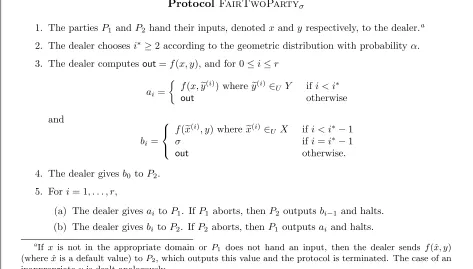
matrixM. Without loss of generality, X={1, . . . , `}and Y ={1, . . . , k}. In Figure 3 we describe ProtocolFairTwoPartyσ, a modification of the GHKL protocol [10]. ProtocolFairTwoPartyσ
is described using an on-line dealer.
Remark 3.1. ProtocolFairTwoPartyσ has a special structure that can be used to transform it
to a protocol without a dealer. That is, the protocol is composed of a fixed number r of rounds (which depends on the security parameter and the function computed by the protocol), the dealer prepares 2r values a1, . . . , ar and b1, . . . , br and in round i it first gives ai to P1, if P1 does not abort it gives bi to P2. The values ai and bi are called backup outputs and the respective value
is outputted by a party if the other party aborts. If one of the parties aborts in round i, then the dealer aborts; otherwise it continues to round i+ 1. Using, by now, standard techniques, and assuming that a secure protocol for OT exists,1 one can transform this protocol to a protocol without a dealer. This transformation includes executing a two-party protocol, guaranteeing only security with abort, computing authenticated 2-out-of-2 shares of a1, . . . , ar and b1, . . . , br, and
then in roundi, partyP2 sends toP1 its authenticated share of ai and then party P1 sends toP2 its authenticated share of bi. A standard proof shows that if the protocol with the on-line dealer
guarantees full security, then the resulting protocol guarantees full security. See further discussion in Section 5.
The main difference in ProtocolFairTwoPartyσ compared to the GHKL protocol is in Step 3,
where bi∗−1 =σ (compared to bi∗−1 = f(x,
e
y) for a random ey in the GHKL protocol). For some functions f we choose σ = 0 and for some we choose σ = 1; the choice ofσ depends only on the function and is independent of the inputs. This seemingly small change enables to compute with full security a larger class of functions, i.e., all Boolean functions that can be computed with full security. We note that this change is somewhat counter intuitive as we achieve security against a malicious P1 by giving P2 less information. The reason why this change works is that it enables the simulator for P1 to choose its input to the trusted party in a clever way.
Remark 3.2. There are two parameters in Protocol FairTwoPartyσ that are unspecified – the
parameterα of the geometric distribution and the number of rounds r. We show that there exists
1
Protocol FairTwoPartyσ
1. The partiesP1andP2 hand their inputs, denotedxandy respectively, to the dealer.a
2. The dealer choosesi∗≥2 according to the geometric distribution with probabilityα.
3. The dealer computes out=f(x, y), and for 0≤i≤r
ai=
f(x,ey(i)) where e
y(i)∈
U Y ifi < i∗
out otherwise
and
bi=
f(xe(i), y) where e
x(i)∈
U X ifi < i∗−1
σ ifi=i∗−1
out otherwise.
4. The dealer gives b0 toP2.
5. Fori= 1, . . . , r,
(a) The dealer givesaito P1. IfP1 aborts, thenP2 outputsbi−1and halts.
(b) The dealer gives bi toP2. IfP2 aborts, thenP1outputsai and halts.
a
If x is not in the appropriate domain or P1 does not hand an input, then the dealer sends f(ˆx, y)
(where ˆxis a default value) toP2, which outputs this value and the protocol is terminated. The case of an
inappropriateyis dealt analogously.
Figure 3: ProtocolFairTwoPartyσ for securely computing a functionf, whereσ is either 0 or
1.
a constantα0 (which depends onf) such that taking anyα≤α0 guarantees full security (provided that f satisfies some conditions). As for the number of rounds r, even if both parties are honest the protocol fails if i∗ > r (where i∗ is chosen with geometric distribution). The probability that
i∗ > r is (1−α)r. So, if r =α−1·ω(logn) (wheren is the security parameter), the probability of not reachingi∗ is negligible.
Theorem 3.3. Let M be the associated matrix of a Boolean function f. If (0k)T is an affine combination of the rows ofM, then there is a constantα0>0 such that ProtocolFairTwoParty0
with α≤α0 is a fully-secure protocol for f.
Proof. It is easy to see that the protocol is secure against a corruptedP2, using a simulator similar to [10]. Intuitively, this follows directly from the fact that P2 always gets the output afterP1.
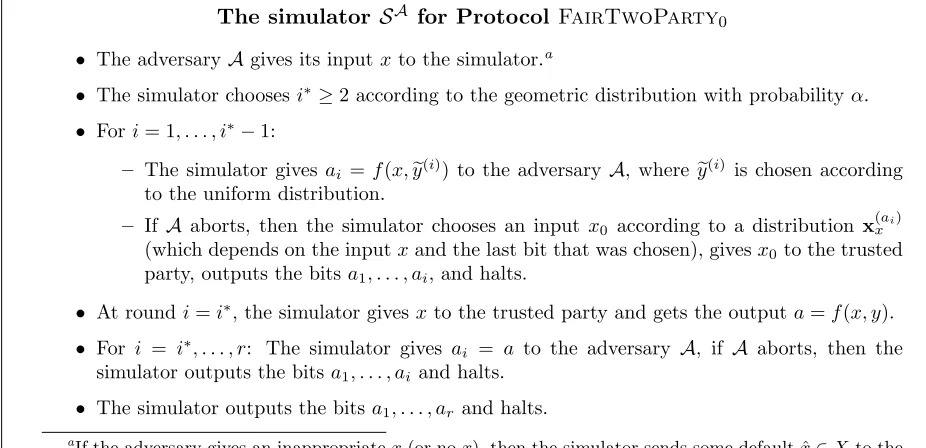
We next prove that the protocol is secure against a corruptedP1 by constructing a simulator for every adversaryAin the real world controllingP1. The simulator we construct has only black-box access toAand we denote it by SA. The simulation is described in Figure 4. It operates along the
same lines as in the proof of [10]. The main difference is in the analysis of the simulator, where we prove that there exist distributions (x(xa))x∈X,a∈{0,1}, which are used by the simulator to choose the
input thatP1 gives to the trusted party.
We next prove the correctness of the simulator, that is, if (0k)T is an affine combination of
The simulatorSA for Protocol FairTwoParty0
• The adversaryAgives its inputxto the simulator.a
• The simulator choosesi∗≥2 according to the geometric distribution with probabilityα.
• Fori= 1, . . . , i∗−1:
– The simulator gives ai =f(x,ye(i)) to the adversary A, where ey(i) is chosen according
to the uniform distribution.
– If A aborts, then the simulator chooses an input x0 according to a distribution x (ai) x
(which depends on the inputxand the last bit that was chosen), givesx0to the trusted
party, outputs the bitsa1, . . . , ai, and halts.
• At roundi=i∗, the simulator givesxto the trusted party and gets the outputa=f(x, y).
• For i = i∗, . . . , r: The simulator gives ai = a to the adversary A, if A aborts, then the
simulator outputs the bitsa1, . . . , ai and halts.
• The simulator outputs the bitsa1, . . . , arand halts.
aIf the adversary gives an inappropriatex(or nox), then the simulator sends some default ˆx∈Xto the
trusted party, outputs the empty string, and halts.
Figure 4: The simulatorSA for Protocol
FairTwoParty0.
generates its output as the view of P1 in the execution of the protocol in the real world. First, it chooses i∗ as in Protocol FairTwoParty0, i.e., with geometric distribution. Up to roundi∗−1,
the backup outputs are uncorrelated to the input of the honest party. That is, for all i < i∗ the output ai =f(x,ye) is chosen with a uniformly randomye. Starting with round i=i
∗, the backup
outputs are correlated to the true input of the honest party, and are set asai=f(x, y), exactly as
in the real execution.
As a result the adversary seeing the same view, A aborts in the simulation if and only if it aborts in the protocol. Furthermore, if the adversary aborts after round i∗, the output of P2 in the protocol and in the simulator is identical –f(x, y). The only difference between the simulation and the protocol is the way that the output of P2 is generated when the adversary aborts in a roundi≤i∗. If the adversary aborts in roundi∗, the output ofP2 in ProtocolFairTwoParty0 is
bi∗−1= 0, while the the output ofP2 in the simulation isf(x, y). To compensate for this difference,
in the simulation the output of P2 if the adversary aborts in a round 1 ≤ i ≤i∗ −1 is f(x0, y), wherex0 is chosen according to a distribution x(xai) to be carefully defined later in the proof.
To conclude, we only have to compare the distributions (ViewA,OutP2) in the real and ideal worlds given that the adversary aborts in a round 1≤i≤i∗. Thus, in the rest of the proof we leti
be the round in which the adversary aborts and assume that 1≤i≤i∗. The view of the adversary in both worlds isa1, . . . , ai. Notice that in both worldsa1, . . . , ai−1 are equally distributed and are independent of (ai,OutP2). Thus, we only compare the distribution of (ai,OutP2) in both worlds.
First, we introduce the following notation
(1/`, . . . ,1/`)M = (s1, . . . , sk), M
1/k .. .
1/k
=
p1
.. . p`
For example, sy is the probability that f(x, ye ) = 1, whenxeis uniformly distributed. Furthermore, for every x ∈ X, y ∈ Y, and a ∈ {0,1}, define qx(a)(y) , Pr [f(x0, y) = 1], where x0 is chosen according to the distribution x(xa). That is, qx(a)(y) is the probability that the output ofP2 in the simulation is 1 when the the adversary aborts in roundi < i∗, the input of P1 isx, the input ofP2 isy, and ai=a. Finally, define the column vector qx(a),(qx(a)(y))y∈Y. Using this notation,
MTx(xa)=q(xa), (2)
where we represent the distribution x(xa) = (xx(a)(x0))x0∈X by a column vector. Next, we analyze the four options for the values of (ai,OutP2).
First case: (ai,OutP2) = (0,0). In the real world (ai,OutP2) = (0,0) if one of the following two events occurs:
• i < i∗, ai = f(x,ey) = 0, and OutP2 = bi−1 = f(x, ye ) = 0. The probability of this event is (1−α)(1−px)(1−sy).
• i=i∗, ai∗ =f(x, y) = 0, and OutP
2 =bi∗−1 = 0. Recall that in Protocol FairTwoParty0
bi∗−1= 0 with probability 1. The probability of this event isα·(1−f(x, y))·1 (that is, it is
0 if f(x, y) = 1 and it isα otherwise).
Therefore, in the real world Pr [(ai,OutP2) = (0,0)] = (1−α)(1−px)(1−sy) +α(1−f(x, y)).On the other hand, in the ideal world (ai,OutP2) = (0,0) if one of the following two events occurs:
• i < i∗, ai = f(x,ye) = 0, and OutP2 = f(x0, y) = 0. The probability of this event is (1−α)(1−px)(1−qx(0)(y)).
• i = i∗, ai∗ = f(x, y) = 0, and OutP
2 = f(x, y) = 0. The probability of this event is
α·(1−f(x, y)).
Therefore, in the ideal world Pr [(ai,OutP2) = (0,0)] = (1−α)(1−px)(1−q (0)
x (y)) +α(1−f(x, y)).
To get full security we need that these two probabilities in the two worlds are the same, that is,
(1−α)(1−px)(1−sy) +α(1−f(x, y)) = (1−α)(1−px)(1−qx(0)(y)) +α(1−f(x, y)),
i.e.,
qx(0)(y) =sy. (3)
As this is true for everyy, we deduce, using Equation (1) and Equation (2), that
MTx(0)x =q(0)x =MT 1/`,· · ·,1/`T . (4)
Thus, taking the uniform distribution, i.e., for everyx0 ∈X
x(0)x (x0) = 1/`, (5)
Second case: (ai,OutP2) = (0,1). In the real world Pr [(ai,OutP2) = (0,1)] = (1−α)(1−
px)sy (in the real world OutP2 = 0 when i = i
∗). On the other hand, in the ideal world
Pr [(ai,OutP2) = (0,1)] = (1−α)(1−px)q (0)
x (y) (in the ideal world ai∗ = OutP
2 =f(x, y)). The probabilities in the two worlds are equal if Equation (3) holds (i.e., Equation (5) holds) for every
x.
Third case: (ai,OutP2) = (1,0). In the real world Pr [(ai,OutP2) = (1,0)] = (1−α)px(1−sy) +
α·f(x, y)·1.On the other hand, in the ideal world Pr [(ai,OutP2) = (1,0)] = (1−α)px(1−q (1)
x (y)).
The probabilities in the two worlds are equal when
(1−α)px(1−sy) +αf(x, y) = (1−α)px(1−q(1)x (y)).
Ifpx= 0, then f(x, y) = 0 and we are done. Otherwise, this equality holds iff
q(1)x (y) =sy−
αf(x, y) (1−α)px
. (6)
As this is true for everyy, we deduce, using Equation (1) and Equation (2), that
MTx(1)x =q(1)x =MT 1/`,· · · ,1/`T
− α
(1−α)px
(rowx)T =MT
1/`,· · · ,1/`T
− α
(1−α)px ex
, (7)
whererowx is the row ofM labeled by the inputx, andexis thex-th unit vector. Before analyzing when there exists a probability vector x(1)x solving Equation (7), we remark that if the equalities
hold for the first 3 cases of the values for (ai,OutP2), the equality of the probabilities must also hold for the case (ai,OutP2) = (1,1). In the rest of the proof we show that there exist probability vectors x(1)x for everyx∈X solving Equation (7).
Claim 3.4. Fixx∈X and let α be a sufficiently small constant. If (0k)T is an affine combination of the rows ofM, then there exists a probability vector x(1)x solving Equation (7).
Proof. By the conditions of the claim, there exists a vector u ∈ R` such that MTu = 0 k and
1,· · · ,1u = 1. Consider the vector y = 1/`,· · ·,1/`T + (1−αα)px(u−ex). The vector y is a solution to Equation (7) sinceMTu=0k. We need to show that it is a probability vector. First,
1,· · · ,1
y= 1,· · · ,1
1/`,· · · ,1/`T
+ 1,· · ·,1 α (1−α)px
(u−ex) = 1 +
α
(1−α)px
(1−1) = 1.
Second,yi ≥1/`−(1−αα)px(1 +|ui|)≥1/`−2kα(1 + max{|ui|}) (recall thatpx≥1/kaspx>0 and
px is a multiple of 1/k). Thus, by takingα≤1/(2k`(1 + max{|ui|})), the vectoryis non-negative,
and, therefore, it is a probability vector solving Equation (7).2
To conclude, we have showed that if (0k)T is an affine combination of the rows of M, then
there are probability vectors solving Equation (7). Furthermore, these probability vectors can be efficiently found. Using this probability distributions in the simulator we constructed proves that
protocolFairTwoParty0 is fully secure forf.
We provide an alternative proof of Claim 3.4 in the appendix. Furthermore, in the appendix we prove the converse of Claim 3.4. This converse claim shows that the condition that (0k)T is an
affine combination of the rows of M, which is sufficient for our protocol to securely compute f, is necessary for our simulation of protocolFairTwoParty0.
Changing the Constant. In the above proof, we have fixed bi∗−1 (i.e., P2’s backup output at
roundi∗−1) to be 0. By changing this constant and setting it to 1 (that is, by executing Protocol
FairTwoParty1), we can securely compute additional functions.
Corollary 3.5. Let M be the associated matrix of a Boolean function f. If (1k)T is an affine combination of the rows ofM, then there is a constantα0>0 such that ProtocolFairTwoParty1
with α≤α0 is a fully-secure protocol for f.
Proof. Let M = 1−M. Executing Protocol FairTwoParty1 on f is equivalent to executing ProtocolFairTwoParty0 with the function ¯f(x, y) = 1−f(x, y) (whose associated matrix isM), and flipping the output. Thus, ProtocolFairTwoParty1 is fully secure forf if (0k)T is an affine
combination of the rows ofM. By the conditions of the corollary, there is an affine combination of the rows ofM that equals (1k)T and the same affine combination applied to the rows ofM equals
(0k)T, thus, ProtocolFairTwoParty0 is a fully secure protocol for ¯f.
Corollary 3.6. Assume that there is a secure protocol for OT. A Boolean two-party function f
with an associated matrix M is computable with full security if:
• either 0` or 1` is an affine combination of the columns of M, or
• either (0k)T or (1k)T is an affine combination of the rows of M.
Proof. By Theorem 3.3, a function can be computed with full security by protocolFairTwoParty0 if (0k)T is an affine combination of the rows of M. Likewise, by Corollary 3.5, a function can be
computed with protocolFairTwoParty1 if (1k)T is an affine combination of the rows of M. By
changing the roles of the parties in the protocol (in particular, P2 gets the correct output before
P1), we obtain the other two possibilities in the corollary.
Assuming that there exists a secure protocol for OT, we can transform protocolFairTwoPartyσ
to a protocol without a dealer providing full security.
3.1 Limits of the GHKL Protocol
We consider the function that was given in Example 1.2 and show that it cannot be computed using the GHKL protocol. In fact, we show a concrete attack on the protocol, and construct an adversary that succeeds to influent the output of the honest party. We then explain how the modified protocol is not susceptible to this attack.
Assume thatP2 chooses its input from{y1, y2, y4}uniformly at random (each with probability 1/3), and in case inputy1 was chosen it flips the output that was received. If the protocol computes
f with full security, thenP2 receives a bit that equals 1 with probability 2/3, no matter what input distribution (malicious) P1 may use.
We now compute the probability that P2 outputs 1 when it runs the GHKL protocol withA. We have the following cases:
1. Ifi∗ 6= 1, then bothb0 and b1 are random values chosen by the online-dealer, and thus both possible values ofa1 yield the same result. In this case, the output ofP2 is 1 with probability 2/3.
2. Ifi∗ = 1, then the valuea1is the correct output (i.e.,f(x, y) wherey ∈ {y1, y2, y4}). Moreover, the output of P2 depends ona1: Ifa1= 1, then it outputs b0, which is random value chosen by the online-dealer. In case a1 = 0, it outputs b1, which is the correct output.
Since A uses input x1, the case of a1 = 1 may occur only if the input ofP2 is y4, and thus
b0 = 1 with probability 3/4. On the other hand, if a1 = 0 then P2’s input is either y1 ory2, and it receives correct output b1. It outputs 1 only in the case where its input wasy1.
We therefore conclude:
Pr [Out2 = 1] = Pr [i∗6= 1]·Pr [Out2 = 1|i∗6= 1] + Pr [i∗= 1]·Pr [Out2 = 1|i∗ = 1] = (1−α)·2
3 +α·
Pr [Out2 = 1∧a1 = 0|i∗ = 1] + Pr [Out2 = 1∧a1 = 1|i∗ = 1]
= (1−α)·2
3 +α·
2 3 ·
1 2 +
1 3·
3 4
= 2
3 − 1 12α6=
2 3 .
Protocol FairTwoParty1. Since 1Tk is an affine combination of the rows of M, we use the
protocol FairTwoParty1, that is, use the backup output at round i∗−1 to be 1. Assume that the adversary corrupts P1 and instructs him to conduct the same attack in some round i≥2 (as
i∗ ≥ 2 such attack in round 1 is meaningless in our protocol) . Now, if i=i∗, the value of bi∗−1
is always 1, and the value of bi∗ is correct. If i < i∗, then bi is some random value chosen by the
dealer. In the former case (i∗ = i), since P2 flips its output in case its input was y1, its output is 1 with probability 2/3. In the latter case, P2 outputs 1 with probability 2/3. We get that the final output of P2 is 1 with probability 2/3, and conclude that the protocol is not susceptible to the attack described above.
The intuition why the GHKL protocol is susceptible to this attack whereas our protocol is immune to it, is the following. In the GHKL protocol, for each input y the distributions of bi∗−1
is different. At round i∗, the valueai∗ is “correct”, and leaks information about the distribution
of bi∗−1. This gives the adversary the ability to bias the output of P2 once it guesses correctly the
round i∗. In contrary, in our protocol, we detach the correlation betweenai∗ and bi∗−1; although
ai∗ leaks information about the input of P2, all distributions of bi∗−1 are exactly the same for all
possible inputs y, and this attack is bypassed.
3.2 Characterization of Fairness via Non Semi-Balanced Functions
Recall the definition of semi-balanced functions given in [12]:
Definition 3.7. A function f : X ×Y → {0,1} with an associated ` ×k matrix M is right semi-balanced if ∃p ∈ Rk such that Mp =1
` and
Pk
i=1pi 6= 1. Similarly, f is left semi-balanced
if ∃q ∈ R` such that MTq = 1 k and
P`
i=1qi 6= 1. A function f is semi-balanced if it is right
Makriyannis [12] proved that semi-unbalanced functions are inherently unfair, by showing that a fully-secure protocol for a semi-balanced function implies fair-sampling. We claim that iff is not semi-balanced then f is computable with full security by Protocol FairTwoPartyσ.
Lemma 3.8. Iff is notright semi-balanced, then either(0k)T is an affine combination of the rows of M or 1` is an affine combination of the columns of M.
If f is not left semi-balanced, then either (1k)T is an affine combination of the rows of M or
0` is an affine combination of the columns of M.
Proof. We show only the case where f is not right semi-balanced, the case of left semi-balanced is proven analogously. If f is not right semi-balanced, then one of the following is implied: Either 1` 6∈ im(M), which, by Proposition 2.1, implies that (0k)T is an affine combination of the rows
of M. Alternatively, it can be that 1` ∈ im(M). In this case the vector p for which M ·p = 1`
satisfies P`
i=1pi = 1 (since f is not right semi-balanced). This in particular implies that 1` is an
affine combination of the columns ofM.
Theorem 3.9. Assume an that there is a secure protocol for OT. Let f be a Boolean two-party functionf with an associated matrix M. The function f can be computed with full-security if and only iff is not semi-balanced if and only if at least one of the following conditions holds
I. (0k)T is an affine combination of the rows ofM or1` is an affine combination of the columns of M,
II. (1k)T is an affine combination of the rows ofM or0` is an affine combination of the columns of M.
Proof. If f is semi-balanced, then by [12] it cannot be computed with complete fairness, hence, it cannot be computed with full security.
If f is not semi-balanced, then, by Lemma 3.8, at least one of the conditions (I) or (II) holds. By Corollary 3.6, conditions (I) or (II) imply (assuming that there is a secure protocol for OT)
thatf can be computed with full security.
3.3 A Geometric Interpretation of the Characterization
We review the geometric representation of our characterization, which may shed some light on on our understanding of full security. We start by linking between semi-balanced functions and linear hyperplanes.
Alinear hyperplane inRm is an (m−1)-dimensional affine subspace ofRm, and is defined as all
the pointsX= (x1, . . . , xm)∈Rmthat are a solution of some linear equationa1x1+. . .+amxm=b,
for some constants a = (a1, . . . , am) ∈ Rm and b ∈ R. We denote this hyperplane by H(a, b) ,
{X ∈Rm| hX,ai=b}. We show alternative representations for the semi-balanced property:
Claim 3.10. Let f be a Boolean function, let X1, . . . , X` ∈Rk denote the rows of the matrix M,
and let Y1, . . . , Yk∈R` denote the columns ofM. The following are equivalent:
1. The function is semi-balanced.
3. There exists an hyperplane H(q,1)that contains all the rowsX1, . . . , X`, and there exists yet another hyperplane H(p,1) that contains all the columns Y1, . . . , Yk. In addition, 1k,0k 6∈ H(q,1) and 1`,0`6∈ H(p,1).
Proof. 3 ⇒2: Recall that the affine hull of set S of vectors is the smallest affine set containing
S, or, equivalently, the intersection of all affine sets containing S. Since hyperplanes are affine sets, and since all the rows lie on the same hyperplane H(p,1), then affine-hull{X1, . . . , X`} ⊆ H(p,1). Since 1k,0k 6∈ H(p,1), it holds that1k,0k6∈affine-hull{X1, . . . , X`}. The case of1`,0` 6∈
affine-hull{Y1, . . . , Yk} is shown analougesly.
2 ⇒1: This case is implied by Lemma 3.8.
1 ⇒3: Clearly, if there exists a vector p ∈ Rk such that M ·p =1
` and Pki=1pi 6= 1, then for
each row it holds that hXi,pi = 1, and so all the rows lie on the hyperplane H(p,1). In addition, h0,pi = 0 6= 1 and h1,pi = Pk
i=1pi 6= 1 and so both 1`,0` 6∈ H(p,1). The case of left
semi-balanced is equivalent.
The following theorem divides the Boolean functions to three categories. Each category has some different properties which we will discuss
Theorem 3.11. Let f be a Boolean function. Then:
1. The function is balanced:
There exists an hyperplaneH(q,1)that contains all the rowsX1, . . . , X`, and there exists yet another hyperplane H(p,1)that contains all the columns Y1, . . . , Yk. Then:
(a) If 0`,1` 6∈ H(p,1) and 0k,1k 6∈ H(q,1), then the function is semi-balanced and cannot be computed fairly.
(b) If eitherH(p,1),H(q,1)contains one of the vectors1k,0k,1`,0`, thenf can be computed with full-security.
2. The function is unbalanced (full-dimensional):
If the rows do not lie on a single hyperplane, or the columns do no lie on a single hyperplane, then the function is unbalanced and can be computed with full-security.
Case 2 was proven as possible in [2, 12]. Case 1a was proven as impossible to be computed with the GHKL protocol in [2] (with respected to a specific simulation strategy), and later was proven to be inherently unfair, and was reduced to fair sampling [12]. Finally, case 1b was left unresolved in [2, 12], and is finally proven to be possible here.
Intuition. Intuitively, fairness is possible to achieve in functions which are more “unbalanced” and is impossible in functions that are “balanced”. In our context, the term “balanced” relates to the question whether each party can influence and bias the output of the other party in a single (and fair) invocation of the function. In functions that are “balanced”, both parties cannot bias the output of the other, and thus these functions can be used as a reliable source for sampling correlated coins. In contrast , functions that are unbalanced, one party has significantly more ability to bias the output than the other, and thus they are not reducible to sampling.
the possibility, the simulator uses the ability that the function enables it, to bias the output of the honest party in the ideal execution (where, an ideal execution is close in its nature to a single fair invocation of the function). Thus, the exact same property that enables or disables reducible to sampling, is the property that enables or disables simulation.
The intuition above is demonstrated in the above classes. Consider the class of functions 1a. In this class, every function is very balanced; From the fact that all the rows lie on a single hyperplane, any affine combination of them, and in particular, any convex combination of them is also in the hyperplane. This implies that in any single invocation of the function, no matter out input distribution P1 uses (what convex combination it uses), the possible outputs of P2 satisfy the exact same constraint. We have precisely the same guarantee for the case of malicious P2 and honest P1. These are the key properties that enable reducing these functions to sampling, since each party has some guarantee regarding its output no matter what input distribution the other party uses. Two other properties that show that these functions are balanced are the following. First, the dimensions of the affine hulls of the rows and the columns are exactly the same, and both equal min{k, `} −1. Second, as pointed out in [2, 12], almost all functions in this class satisfy
|X|=|Y|.
The other extreme case is the class 2. In this class of functions, one party has significant more power over the other. In particular, assume that the rows do not lie on a single hyperplane. As a result, any convex combination of the rows may result in some different hyperplane, and thus no constraint is guaranteed on the outputs of P2, and in particular a maliciousP1 can influent them. We use this ability to influence the output in the proof of possibility, where the simulator chooses the input distributionx(xb)to influent the output of the honest party, so that the simulation will be
identical to the real. In addition, for this class of function it holds that the dimension of the affine hulls of the rows and columns are always distinct, where one of the dimensions is full (min{`, k}), and the other is strictly lower. Moreover, all functions in this class satisfy |X| 6=|Y|.
The third class of functions 1b is where the things become less clearer. This class contains functions where the affine dimensions of the rows and columns are exactly the same. Moreover, this class contains also functions that are even symmetric and satisfyMfT =Mf (see, for instance,
Example 1.2). Still, fairness is possible. Overall, since all the rows and columns lie on hyperplanes, all the functions in this class can be reduced to sampling; however, the sampling is a trivial one (where the resulting coins of the parties are uncorrelated). In addition, although the influent that a party may have on the output of the other is significantly less than the case of class 2, it turns out that simulation is still possible, and the simulator can “smudge” the exact advantage that the real world adversary has in the real execution.
Randomized Functions. Letf :X×Y → ∆({0,1}) be a randomized finite Boolean function and define associated `×k matrix M such that Mi,j = Pr [f(xi, yj) = 1]. By modifying Protocol FairTwoPartyσ such that the dealer now computes randomized outputs, we note that the analysis
above still holds. In particular, the following theorem is true.
4
On the Characterization of Fairness for Asymmetric Functions
In this section, we study asymmetric Boolean functions. Namely, we consider functionsf = (f1, f2), where fi : X×Y → {0,1} for each i ∈ {1,2}. As two-party functionalities, P1 and P2’s input domains correspond to setsX andY respectively, like the symmetric case, however, their outputs now are computed according to f1 and f2 respectively. In other words, the parties are computing different functions on the same inputs.
Our goal is to extend the characterization of full security to this class of functions. In particular, we show how the feasibility result (Theorem 3.3) and the impossibility result (reduction from non-trivial sampling) translate to the asymmetric case. Unfortunately, while these two results provide a tight characterization for symmetric functionalities, the same cannot be said about asymmetric ones. As a first step toward the characterization the latter functions, we consider a particular function that lies in the gap and describe a new protocol that computes this function with full security. While this protocol may be considered as another variant of the GHKL-protocol, we believe that it departs considerably from the protocols we have considered thus far. Consequently, it seems that the characterization for asymmetric functionalities is more involved than the symmetric case.
4.1 Sufficient Condition for Fairness of Two-Party Asymmetric Functionalities
We analyze when Protocol FairTwoPartyσ, described in Figure 3, provides full security for
Boolean asymmetric functionalitiesf = (f1, f2). We modify Protocol FairTwoPartyσ such that the backup values ofPiare computed withfi; we call the resulting protocolFairTwoPartyAsymmσ.
Theorem 4.1. Let f1, f2 be functions with associated matrices M1 and M2 respectively. If 0k is an affine combination of the rows of M2, and all the rows of M1∗M2 are linear combinations of
the rows of M2, then there is a constant α0 >0 such that ProtocolFairTwoPartyAsymm0 with
α≤α0 is a fully-secure protocol for(f1, f2).
In Theorem 4.1, we require that all the rows of the matrix M1∗M2 are in the row-span ofM2, and that the vector 0k is an affine combination of the rows ofM2. Note that when the function is symmetric, and thus,M1 =M2, the first requirement always holds and the only requirement is the second, exactly as in Theorem 3.3.
Proof of Theorem 4.1. We only discuss the required changes in the proof of ProtocolFairTwoPartyAsymm0 compared to the proof of Protocol FairTwoParty0. We use the same simulator for P1. The
dif-ference are in its proof. As in the proof of Theorem 3.3, we only need to compare the distribution of (ai,OutP2) in both worlds given that the adversary aborts in round i≤i
∗.
First, we introduce the following notation
(1/`, . . . ,1/`)M2 = (s1, . . . , sk), M1
1/k .. .
1/k
=
p1
.. . p`
. (8)
x, the input of P2 isy, andai =a, that isqx(a)(y),Pr [f(x0, y) = 1], wherex0 is chosen according to the distributionx(xa). Finally, define the column vectorq(xa),(q(xa)(y))y∈Y. Using this notation,
M2Tx(xa)=q(xa), (9)
where we represent the distributionx(xa)= (xx(a)(x0))x0∈X by a column vector. We next analyze the four options for the values of (ai,OutP2).
First case: (ai,OutP2) = (0,0). In the real world Pr [(ai,OutP2) = (0,0)] = (1−α)(1−px)(1−
sy) +α(1−f1(x, y)).On the other hand, in the ideal world Pr [(ai,OutP2) = (0,0)] = (1−α)(1−
px)(1−q(0)x (y))+α(1−f1(x, y))(1−f2(x, y)).To get full security we need that these two probabilities in the two worlds are the same, that is,
(1−α)(1−px)(1−sy)+α(1−f1(x, y)) = (1−α)(1−px)(1−qx(0)(y))+α(1−f1(x, y))(1−f2(x, y)). (10)
Ifpx= 1, then f1(x, y) = 1 and (10) holds. Otherwise, (10) is equivalent to
qx(0)(y) =sy−
α·(1−f1(x, y))f2(x, y) (1−α)(1−px)
. (11)
As this is true for everyy, we deduce, using Equations (2) and (1), that
M2Tx(0)x =q(0)x =M2T 1/`,· · ·,1/`T − α
(1−α)(1−px)
(M1∗M2)Tex. (12)
Claim 4.2. Fixx∈X and let α be a sufficiently small constant. If (0k)T is an affine combination of the rows of M2 and all the rows of M1 ∗M2 are linear combinations of the rows of M2, then
there exists a probability vector x(0)x solving Equation (12).
Proof. Let1denote the`×kall-one matrix, and letλα = (1−α)(1α−px). We get that (M1∗M2)Tex= ((1−M1)∗M2)Tex= (M2−M1∗M2)Tex=M2Tex−(M1∗M2)Tex. Literally, this is the subtraction of some rowx in matrixM2, and the row x in the matrixM1∗M2. However, from the conditions in the statement, this is just a vector in the linear-span of the rows ofM2, and can be represented asMT ·v for some constantsv∈R`. We therefore are looking for a probability vectorx(0)
x solving:
M2Tx(0)x =M2T 1/`,· · ·,1/`T −λα·M2Tv. (13)
Letβ =h1,vi, and recall that0kis in the affine hull of the rows ofM2, and thus there exists a vector u∈R`such thatMT·u=0kandh1,ui= 1. Consider the vectory= (1/`, . . . ,1/`)T−λαv+λαβu.
This vector is a solution for Eq. (13) sinceM2T ·u=0k. Moreover, it sums-up to 1 since:
h1,yi=h1,(1/`, . . . ,1/`)Ti −λαh1,vi+λαβh1,ui= 1−λαβ+λαβ·1 = 1
Finally, for appropriate choice of α, all the coordinates of y are non-negative, and thus y is a
probability vector solving Eq. (13).
Second case: (ai,OutP2) = (0,1). In the real world Pr [(ai,OutP2) = (0,1)] = (1−α)(1−px)sy (in the real world OutP2 = bi∗−1 = 0 when i = i
∗). On the other hand, in the ideal world
Pr [(ai,OutP2) = (0,1)] = (1−α)(1−px)q (0)
x (y) + α·(1−f1(x, y))f2(x, y) (in the ideal world
ai∗ =f1(x, y) and OutP
Third case: (ai,OutP2) = (1,0). In the real world Pr [(ai,OutP2) = (1,0)] = (1−α)px(1−sy) +
α·f1(x, y)·1.On the other hand, in the ideal world Pr [(ai,OutP2) = (1,0)] = (1−α)px(1−q (1)
x (y))+
α·f1(x, y)(1−f2(x, y)).The probabilities in the two worlds are equal when
(1−α)px(1−sy) +αf1(x, y) = (1−α)px(1−q(1)x (y)) +αf1(x, y)(1−f2(x, y)).
Ifpx= 0, then f1(x, y) = 0 and we are done. Otherwise, this equality holds iff
qx(1)(y) =sy−
αf1(x, y)f2(x, y) (1−α)px
. (14)
As this is true for everyy, we deuce, using Equations (9) and (8), that
M2Tx(1)x =q(1)x =MT 1/`,· · · ,1/`T − α
(1−α)px
(M1∗M2)Tex, (15)
Analogically to case (0,0), there exists a probability vectorx(1)x solving Equation (15) if each row
of M1∗M2 is in the row span of M2, and0k is in the affine hull of the rows ofM2.
If the equalities hold for the first 3 cases of the values for (ai,OutP2), the equality of the probabilities must also hold for the case (ai,OutP2) = (1,1).
To conclude, the conditions of the theorem imply that there are probability vectors solving Equations (12) and (15) for every x. Using these probability distributions in the simulator we constructed, we conclude that protocol FairTwoPartyAsymm0 is fully secure forf = (f1, f2).
Changing the Matrices. In the symmetric setting, we have showed that by flipping the matrix
M associated with the function (i.e., by taking the matrixM = 1
−M) we can construct protocols with full security for a richer class of functions. In the asymmetric setting we can go even further:
P1 and P2 can flip some of the rows of M1 and obtain a matrix ˆM1 and flip some of the columns of M2 and obtain a matrix ˆM2. The parties now executeFairTwoPartyAsymm0 on the flipped matrices and the parties obtain outputs a and b respectively. If the input of P1 corresponds to a row that was flipped, then P1 outputs 1−a, otherwise, it outputs a. Similarly, if the input of P2 corresponds to a column that was flipped, then P2 outputs 1−b, otherwise, it outputs b. Call the resulting protocol FairTwoPartyAsymm’. Thus, we obtain the following corollary.
Corollary 4.3. Let M1, M2 be the associated matrices of f1 and f2 respectively. Assume that Mˆ1
is computed from M1 by flipping some of its rows and Mˆ2 is computed from M2 by flipping some
of its columns. If 0k is an affine-combination of the rows of Mˆ2, and all the rows of Mˆ1 ∗Mˆ2
are in the linear span of the rows of Mˆ2, then then there is a constant α0 > 0 such that Protocol
FairTwoPartyAsymm’ with α≤α0 is a fully-secure protocol forf = (f1, f2).
4.2 Necessary Condition
Theorem 4.4. Let f1, f2 be functions with associated matrices M1 and M2 respectively. If there
exist p∈R`, q∈
Rk such that pTM1 =δ1·1Tk, M2q=δ2·1` andpT(M1∗M2)q6=δ1δ2, then the
functionality f(x, y) = (f1(x, y), f2(x, y)) implies (non-private) non-trivial sampling.
Proof. Suppose there exist p∈R`, q∈Rk such that pTM1 =δ1·1Tk, M2q=δ2·1` and pT(M1∗
M2)q6=δ1δ2. Further assume thatPi|pi|=Pi|qj|= 1, and defineδ1,2 =pT(M1∗M2)q. Consider the following protocol Π in the hybrid model with ideal access to f (with full security/complete fairness).
• Inputs: Empty for both parties.
• Invoke trusted party: Parties choose xi, yj according to probability vectors |p| and |q|
respectively, and invoke the trusted party, writeaand bfor the bits received by the first and second party.
• Outputs: P1 outputs a if pi ≥ 0 and 1−a otherwise. P2 outputs b if qj ≥ 0 and 1−b
otherwise.
Claim 4.5. Write Out1, Out2 for the outputs of P1 and P2 in the above protocol. In an honest
execution of Π, the parties’ outputs satisfy Pr [Out1 = 1] = δ1+p−, Pr [Out2 = 1] = δ2+q− and Pr [Out1 = 1∧Out2 = 1] =δ1,2+p−δ2+q−δ1+p−q−, wherep−=Ppi<0|pi|andq−=Pqj<0|qj|. Proof. We begin the proof by introducing some notation. Let row1,i,row2,i denote thei-th row of
M1 and M2 respectively, and let col1,j, col2,j denote the j-th column of M1 and M2 respectively. Construct matrices ˆM1 and ˆM2 such that
• thei-th row of ˆM1 is equal torow1,i ifpi≥0 and 1Tk −row1,i otherwise,
• thej-th column of ˆM2 is equal to col2,j ifqj ≥0 and 1`−col2,j otherwise.
Let rowˆ 1,i, ˆcol1,j and rowˆ 2,i, ˆcol2,j denote the rows and columns of ˆM1 and ˆM2 respectively. The proof consists of a straightforward computation of each probability.
Pr [Out1 = 1|y=yj] =|pT|Mˆ1eyj
=
X
pi<0
|pi|rowˆ 1,i+
X
pi≥0
pirowˆ 1,i
eyj
=
X
pi<0
|pi|(1Tk −row1,i) +
X
pi≥0
pirow1,i
eyj.
=
X
pi<0
|pi|1Tk +pTM1
The output of P2 is obtained in a similar fashion. Next,
Pr [(Out1,Out2) = (1,1)] =|pT|( ˆM1∗Mˆ2)|q|
=|pT|
X
j
( ˆcol1,j∗colˆ 2,j)|qj|
=|pT|
X
qj≥0
( ˆcol1,j∗col2,j)qj +
X
qj<0 ˆ
col1,j∗(1`−col2,j)
|qj|
=|pT|
( ˆM1∗M2)q+ X
qj<0 ˆ
col1,j|qj|
. (17)
Now, since by (16), |pT|colˆ 1,j =|pT|Mˆ1eyj =δ1+p−, we deduce that (17) is equal to
X
pi≥0
pi(row1,i∗row2,i) +
X
pi<0
|pi| (1−row1,i)∗row2,i
q+ (δ1+p−)q−
=pT(M1∗M2)q+ X
pi<0
|pi|(row2,iq) + (δ1+p−)q−
=δ1,2+p−δ2+q−δ1+p−q−.
It remains to show that protocol Π is a secure realization of (non-private) non-trivial sampling. First, we note that the parties’ outputs above are statistically dependent. This follows from the fact that two bits are independent if and only if Pr [Out1 = 1]·Pr [Out2 = 1] = Pr [Out1 = 1∧Out2= 1]. Since, by assumption, δ1,2 6=δ1δ2, we deduce that in an honest execution the parties’ outputs are statistically dependent. To conclude, note that no matter how the adversary (say controlling P2) chooses his input – or doesn’t send one at all, by (16), the probability that the output of P1 is 1 is
equal toδ1+p−. Hence, by [1], we get a contradiction.
4.3 Special Round Protocol with a Twist
Define an asymmetric functionality fsp(x, y) = (f1(x, y), f2(x, y)), where f1, f2 are given by the following matrices
M1 =
1 1 1 0
0 0 0 1
1 0 0 1
0 1 0 1
, M2 =
1 0 1 0
1 0 0 1
1 0 0 0
0 1 1 1
.
4.3.1 On the limits of the known protocols for the function fsp
Suppose that parties execute protocol FairTwoPartyAsymm0 for computing fsp. In addition, suppose that P2 chose his input uniformly at random from {y1, y2}. If the protocol computes f with full security, then this particular choice of inputs should result in P2 obtaining an unbiased random bit as an output, regardless of the actions of P1. We claim that a corrupt P1 can bias
P2’s output toward zero and thus protocolFairTwoPartyAsymm0 does not compute f with full security. Consider an adversary A that quits immediately upon receiving a2. Let’s compute the probability thatP2’s output is equal to 1 under the action ofA, and assuming that y∈U {y1, y2}:
Pr [out2 = 1] = Pr [b1 = 1]
= Pr [b1 = 1∧i∗ = 2] + Pr [b1= 1∧i∗6= 2] = 0 + 1
2·(1−α).
In summary, knowing that bi∗−1 = 0 and thatAcan guess i∗ with non-negligible probability (Ais
betting that i∗ = 2) we deduce that the above attack will result in P2 outputting a bit that does not satisfy the prescribed probability distribution. If we revert to the original GHKL protocol, i.e.,
i∗≥1, andbi∗−1 =f2(
e
x(i∗−1), y) where ex(i∗−1) is chosen uniformly at random, then a very similar attack will produce the same result:
• The adversary instructsP1 to use x3 and execute the protocol.
• At the first round, ifa1 = 1 quit. Otherwise, quit upon receivinga2.
Again, let’s compute the probability that P2’s output is equal to 1 under the action ofAassuming thaty ∈U {y1, y2}:
Pr [out2 = 1] = Pr [out2 = 1∧i∗ 6= 1] + Pr [out2 = 1∧i∗ = 1] = (1−α)1
2 +α·
Pr [a1= 1∧b0 = 1|i∗= 1] + Pr [a1= 0∧b1 = 1|i∗ = 1]
= (1−α)1 2 +α·
1 4 + 0
= 1
2 −α 1 4.
Once again, A can guess i∗ with non-negligible probability (A is betting that i∗ = 1), and since
P1 obtains ai∗ prior toP2 obtaining bi∗, the adversary can successfully bias P2’s output. We note
that an adversary corrupting P1 can biasP2’s output regardless of how we choose to describe the function. In other words, flipping some of the rows of M1 and/or some of the columns of M2 does not offer any solution, since the attacks above can be easily modified to successfully biasP2’s output. Nor is switching the players’ roles helpful, i.e., considering (M2T, M1T), since M1=M2T.
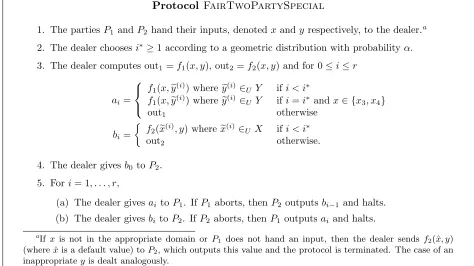
To remedy this, we propose a new protocol, named FairTwoPartySpecial (described in
Figure 5), which foils the attacks described above and provides full security forfsp. Our protocol is indistinguishable from the original GHKL protocol for every round, except special roundi∗. Recall that in the GHKL protocol (as well as all other protocols we have considered), at roundi∗, partyP1 obtainsai∗ =f1(x, y) followed by P2 who obtains bi∗ =f2(x, y). We can reverse the player’s roles,
however, there is a party that always gets the correct output before the other party. We now make the following modification for the protocol computingfsp : ai∗ =f1(x, y) only ifx∈ {x1, x2}, and
ai∗ = f1(x,
e
y(i∗)) otherwise, where e
Protocol FairTwoPartySpecial
1. The partiesP1andP2 hand their inputs, denotedxandy respectively, to the dealer.a
2. The dealer choosesi∗≥1 according to a geometric distribution with probabilityα.
3. The dealer computes out1=f1(x, y), out2=f2(x, y) and for 0≤i≤r
ai=
f1(x,ye
(i)) where e
y(i)∈
U Y ifi < i∗
f1(x,ye(i)) whereye(i)∈U Y ifi=i∗ andx∈ {x3, x4}
out1 otherwise
bi=
f2(xe
(i), y) where e
x(i)∈
U X ifi < i∗
out2 otherwise.
4. The dealer gives b0 toP2.
5. Fori= 1, . . . , r,
(a) The dealer givesaito P1. IfP1 aborts, thenP2 outputsbi−1and halts.
(b) The dealer gives bi toP2. IfP2 aborts, thenP1outputsai and halts.
aIf x is not in the appropriate domain or P
1 does not hand an input, then the dealer sendsf2(ˆx, y)
(where ˆxis a default value) toP2, which outputs this value and the protocol is terminated. The case of an
inappropriateyis dealt analogously.
Figure 5: ProtocolFairTwoPartySpecialfor securely computing a functionfsp.
Theorem 4.6. For everyα ≤1/9, protocol FairTwoPartySpecial is fully secure forfsp.
Proof. The proof follows the ideas of symmetric case (and ProtocolFairTwoPartyAsymm0) with two significant modifications. First, we need two distinct simulations forP1depending on the choice of inputs. In particular, ifA hands x1 or x2 to SA, then the simulation is exactly the same as in the symmetric case (or ProtocolFairTwoPartyAsymm0). If not, i.e., if Ahands x3 orx4, then we simulate P1 as if he were P2 in the symmetric case. On the other hand, regarding the second player, we note that a difficulty arises due to the fact thatP2 obtains the output first depending on
P1’s choice of input. Nevertheless, we claim that by simulatingP2as if he wereP1in the symmetric case (or ProtocolFairTwoPartyAsymm0), i.e., as if healways gets the output first, results in the correct simulator. Thus, we will first consider the case of a corruptP1 when the adversary hands eitherx1 orx2 to the simulator, followed by the security analysis of a corrupt P2.
We only discuss the required changes in the security proof of ProtocolFairTwoPartySpecial
compared to the security proof of Protocol FairTwoPartyAsymm0. As in the proofs of
Theo-rem 3.3 and TheoTheo-rem 4.1, we only need to compare the distribution of (ai,OutP2) in both worlds given that the adversary aborts in round i ≤ i∗. Similarly to the previous proofs, we compute vectorsq(0)x andq(1)x whereqx(a)(y) is the desired probability that the output ofP2 in the simulation (given that the adversary has aborted in roundi < i∗) is 1 when the input ofP1 is x, the input of
P2 is y and ai = a. In contrast to the proofs of Theorem 3.3 and Theorem 4.1, we only need to
considering the four possible values of (ai,OutP2), we deduce that
q(0)x (y) =sy+
α
(1−α)(1−px)
(1−f1(x, y))(sy−f2(x, y))
q(1)x (y) =sy+
α
(1−α)px
f1(x, y)(sy−f2(x, y))
and thus,
q(0)x1 =
3/4 1/4 1/2 1/2
+ α
(1−α)(1−px1) 0 0 0 1/2
, q(1)x1 =
3/4 1/4 1/2 1/2
+ α
(1−α)px1
−1/4 1/4
−1/2 0 ,
q(0)x2 =
3/4 1/4 1/2 1/2
+ α
(1−α)(1−px2)
−1/4 1/4 1/2 0
, q(1)x2 =
3/4 1/4 1/2 1/2
+ α
(1−α)px2 0 0 0
−1/2
.
We conclude that M2Tx(xa)=qx(a) for the following vectors x(xa):
x(0)x1 = 1/4·(1,1,1,1)T + α
(1−α)(1−px1)
1/2·(0,1,−1,0)T
x(1)x1 = 1/4·(1,1,1,1)T + α (1−α)px1
1/4·(−3,−1,3,1)T
x(0)x2 = 1/4·(1,1,1,1)T + α
(1−α)(1−px2)
1/4·(1,−1,−1,1)T
x(1)x2 = 1/4·(1,1,1,1)T + α (1−α)px2
1/2·(0,−1,1,0)T.
It remains to show that for some α ∈ (0,1) the above vectors become probability vectors - they already sum to 1, we just need them to be positive. A straightforward computation yields that any
α≤1/9 will do.
CorruptP2. We now consider the case of an adversaryAcorruptingP2. As mentioned above, we construct a simulator SA given a black-box toAthat is completely analogous toP1’s simulator in protocol FairTwoPartyAsymmσ. Namely, say that A hands y ∈Y toSA for the computation
of f. The simulator chooses i∗ according to a geometric distribution with parameter αand,
• fori= 0, . . . , i∗−1, the simulator hands bi =f(ex
(i), y) toA, where e
x(i) ∈U X. If A decides to quit,SA sendsy0 according to distribution yy(bi) (to be defined below), outputs (b0, . . . , bi)
and halts.
• fori=i∗, the simulator sends y to the trusted party, receivesb=f2(x, y) and handsbi∗ =b
toA. IfA decides to quit,SA outputs (b0, . . . , bi∗) and halts.
• for i = i∗+ 1, . . . , r, the simulator hands bi = b to A. If A decides to quit, SA outputs
![Figure 1: A function that can be computed with our protocol, and cannot be computed using [10]](https://thumb-us.123doks.com/thumbv2/123dok_us/7902542.1311924/4.612.255.359.260.331/figure-function-computed-protocol-computed-using.webp)