Efficient and Low-complexity Hardware Architecture of Gaussian Normal
Basis Multiplication over GF(2
m) for Elliptic Curve Cryptosystems
Bahram Rashidi1, Sayed Masoud Sayedi2, Reza Rezaeian Farashahi3
1,2Dept. of Elec. & Comp. Eng., Isfahan University of Technology, Isfahan 84156-83111, Iran 3Dept. of Mathematical Sciences, Isfahan University of Technology, Isfahan 84156-83111, Iran
1[email protected], 2[email protected], 3[email protected]
Abstract—In this paper an efficient high-speed architecture of Gaussian normal basis multiplier over binary finite
field GF(2m) is presented. The structure is constructed by using regular modules for computation of exponentiation
by powers of 2 and low-cost blocks for multiplication by normal elements of the binary field. Since the exponents are powers of 2, the modules are implemented by some simple cyclic shifts in the normal basis representation. As a result, the multiplier has a simple structure with a low critical path delay. The efficiency of the proposed structure is studied in terms of area and time complexity by using its implementation on Vertix-4 FPGA family and also its ASIC design in 180nm CMOS technology. Comparison results with other structures of the Gaussian normal basis multiplier verify that the proposed architecture has better performance in terms of speed and hardware utilization.
Keywords: Finite Fields, Elliptic Curve Cryptosystems, Multiplication, Gaussian normal basis, FPGA, ASIC.
1. Introduction
Finite fields are applied in a variety of applications such as cryptography. The efficient implementations of finite fields are important in public key cryptosystems such as elliptic curve cryptosystem (ECC). In such cryptosystems, the multiplier is a key operator in group law and point multiplication [1]. Furthermore, the time and hardware complexity of multiplication are important factors in evaluating the efficiency of the related cryptosystems. The binary finite fields of order 2𝑚, denoted by GF(2𝑚), are attractive fields for implementation of ECC. In these fields, the addition operation is implemented by a simple bit-wise XOR. Moreover, the basis of a binary field is a critical factor in the hardware implementation. There are two popular and applicable basis called polynomial basis (PB) and normal basis (NB). In the normal basis representation, the squaring operation and every exponentiation by powers of 2 are implemented only by cyclic shift operations. This feature can be useful in the design of the field operations such as multiplier. Therefore, hardware implementation by normal basis representation is a notable issue in the cryptographic applications.
There are several presented architectures of the normal basis and Gaussian normal basis (GNB) multiplication in recent years [2]-[24]. For example, in [4] a novel scalable multiplication algorithm is presented for a Gaussian normal basis using Hankel Matrix-Vector representation. In [5] a modified digit-level GNB multiplier over GF(2𝑚) is proposed. Also for GNB of types greater than 2, a complexity reduction algorithm is proposed to reduce the number of XOR gates without increasing the gate delay of the digit-level multiplier. In [7] three structures for GNB multiplier are presented. The first structure is a low-complexity digit-level serial input parallel output (SIPO) GNB multiplier. Second structure is an improved digit-level parallel input serial output (PISO) multiplier architecture. And the third structure is a new hybrid architecture by connecting the output of the digit-level PISO multiplier to the input of the digit-level SIPO multiplier. In [8] a new normal basis multiplication algorithm based on divide-and-conquer and uniform shift method is used to implement an efficient multiplexer-based architecture. A bit-parallel GNB multiplier using one pipelined XOR tree is also designed in [15]. A novel algorithm for GNB binary finite field multiplication using Toeplitz matrix-vector representation is proposed in [19]. It is also shown that the GNB multiplication can be realized through block Toeplitz matrix-vector-products. The multipliers with systolic and semi-systolic architecture are presented in [3], [12], [14], [16], [17], [18] and [20]. A main problem in the systolic structure is its very high hardware consumption and high number of clock cycles; see for example [20] where the number of clock cycles is reduced. In [24] Dickson polynomial representation is proposed as an alternative way to represent the GNB of characteristic 2. A novel recursive Dickson–Karatsuba decomposition to achieve a subquadratic space-complexity parallel GNB multiplier is presented.
The rest of this paper is organized as follows. In section 2, we briefly recall the notion of Gaussian normal basis for binary finite fields and propose the structure of digit-serial GNB multiplier. In section 3, we provide a comparison between this work and other previously related works. Finally, we conclude the paper in section 4.
2. Proposed structure of the Digit-serial Gaussian normal basis multiplieroverGF(2m)
A binary finite field of order 2𝑚 denoted by GF(2m) is isomorphic a vector space of dimension 𝑚 over GF(2).
So, the elements of GF(2m) can be represented by a basis. Two important types of this representation in the finite
field arithmetic are polynomial basis (PB) and normal basis (NB). For an efficient hardware implementation, the normal basis representation is a suitable choice. The element 𝛽 in GF(2m) is called a normal element if the set
𝑩 = {𝛽20 , 𝛽21
, 𝛽22
, … , 𝛽2𝑚−2 , 𝛽2𝑚−1
} is a basis for GF(2m) over GF(2). For every binary finite field such a
normal element exists and the corresponding set𝑩 is called a normal basis. Then, every element 𝐴 of GF(2m) is
written by
𝐴 = ∑𝑚−1𝑖=0 𝑎𝑖𝛽2𝑖 = (𝑎0𝛽20+ 𝑎1𝛽21+ 𝑎2𝛽22+ ⋯ + 𝑎𝑚−2𝛽2𝑚−2+ 𝑎𝑚−1𝛽2𝑚−1),
where 𝑎𝑖∈ GF(2). For simplicity, the element 𝐴 is represented by the 𝑚-bit number [𝑎𝑚−1, 𝑎𝑚−2, … , 𝑎2, 𝑎1, 𝑎0]. The addition of elements 𝐴, 𝐵 given by 𝐴 = [𝑎𝑚−1, 𝑎𝑚−2, … , 𝑎2, 𝑎1, 𝑎0] and 𝐵 = [𝑏𝑚−1, 𝑏𝑚−2, … , 𝑏2, 𝑏1, 𝑏0] is
𝐶 = 𝐴 + 𝐵 = [𝑎𝑚−1+ 𝑏𝑚−1, 𝑎𝑚−2+ 𝑏𝑚−2, … , 𝑎2+ 𝑏2, 𝑎1+ 𝑏1, 𝑎0+ 𝑏0].
So, the addition of the elements of GF(2m) is performed using bit-wise XOR logic gates. The squaring of the
element 𝐴is
𝐴2= ( ∑ 𝑎 𝑖𝛽2𝑖 𝑚−1
𝑖=0
)
2
= ∑ 𝑎𝑖2(𝛽2
𝑖 )2
𝑚−1
𝑖=0
= ∑ 𝑎𝑖𝛽2𝑖+1 𝑚−1
𝑖=0
= 𝑎𝑚−1𝛽 + ∑ 𝑎𝑖−1𝛽2𝑖 𝑚−1
𝑖=1
,
This means 𝐴2is represented by [𝑎𝑚−2, 𝑎𝑚−3, … , 𝑎2, 𝑎1, 𝑎0, 𝑎𝑚−1]. So, one important property of using normal basis representation is performing the squaring operation very efficiently by a simple one-bit rotation to the left. Also, this operation is performed recursively for exponentiation of a power of two. Thus, for the positive integer 𝑛, the computation of 𝐴2𝑛 is performed via 𝑛-bit cyclic shift to left, i.e.,
𝐴2𝑛= [𝑎
𝑚−𝑛−1, 𝑎𝑚−𝑛−2, … , 𝑎1, 𝑎0, 𝑎𝑚−1, … , 𝑎𝑚−𝑛+1, 𝑎𝑚−𝑛].
And similarly 𝐴2−𝑛is computed by 𝑛-bit cyclic shift to right, as we have
𝐴2−𝑛= [𝑎
𝑛−1, 𝑎𝑛−2, … , 𝑎1, 𝑎0, 𝑎𝑚−1, 𝑎𝑚−2, … , 𝑎𝑛+1, 𝑎𝑛].
The multiplication of elements 𝐴, 𝐵 in GF(2m) is written by
𝐶 = 𝐴𝐵 = ∑ 𝑎𝑖𝛽2
𝑖
𝑚−1
𝑖=0
∑ 𝑏𝑗𝛽2
𝑗
= ∑ ∑ 𝑎𝑖𝑏𝑗𝛽2
𝑖+2𝑗
𝑚−1
𝑗=0 𝑚−1
𝑖=0 𝑚−1
𝑗=0
The element 𝛽2𝑖+2𝑗 is represented by
𝛽2𝑖+2𝑗
= ∑ 𝜆𝑖𝑗(𝑘)𝛽2𝑘
𝑚−1
𝑘=0
, 𝜆𝑖𝑗(𝑘)∈ GF(2).
Thus,
𝐶 = ∑ ∑ 𝑎𝑖𝑏𝑗∑ 𝜆𝑖𝑗(𝑘)𝛽2
𝑘
𝑚−1
𝑘=0 𝑚−1
𝑗=0
= ∑ 𝑐𝑘𝛽2
𝑘
𝑚−1
𝑘=0 𝑚−1
𝑖=0
, 𝑐𝑘= ∑ ∑ 𝑎𝑖𝑏𝑗𝜆𝑖𝑗(𝑘) 𝑚−1
𝑗−0 𝑚−1
𝑖=0
.
Here 𝜆(𝑘) is an 𝑚 by 𝑚 symmetric matrix with entries 𝜆(𝑘)𝑖𝑗 in GF(2). The 𝜆(𝑘)matrices can be computed by a k -cyclic diagonal shift to 𝜆(0) matrix; i.e., for the indices 𝑖, 𝑗, 𝑘 = 0, … , 𝑚 − 1, computed modulo 𝑚, we have
The complexity of the hardware implementation of a normal basis multiplication is related to the number of nonzero entries of the matrices 𝑀 that is a crucial parameter for the speed of the system.
The Gaussian normal basis, GNB for short, is a special class of normal basis that by which the multiplication is simpler and more efficient [25] and [26]. The complexity of the multiplication of a GNB is measured by its type that is a positive integer related to the number of nonzero entries of the multiplication matrix. The time and area complexity of the multiplication operation over GF(2m) is depend on the type of the normal basis with respect to
that basis. Therefore, a more efficient multiplier has a smaller type. The optimal normal basis (ONB) is a GNB of type 1 or 2 providing the most efficient multiplication algorithm among all normal bases. The GNB is considered in several standards such as IEEE P1363 [26] and NIST [27]. For example even types 𝑇={4,2,6,4, and 10} corresponded to fields {GF(2163), GF(2233), GF(2283), GF(2409) and GF(2571)}, are recommended by
these two standards.
For each binary finite field GF(2m), where 𝑚 is not divisible by 8, a GNB exists of some type, also for each
positive integer 𝑇 at most one GNB of type 𝑇 exists. More precisely, for given positive integers 𝑚 and 𝑇, let
𝑝 = 𝑚𝑇 + 1 be a prime number such that gcd(𝑚𝑇/𝑘, 𝑚) = 1, where 𝑘 is the multiplicative order of 2 module
𝑝. Then a GNB over GF(2m) of type 𝑇 exists. In this work, we consider the GNBs with odd values of 𝑚 which
are applicable for cryptography applications and implies that 𝑇 is an even number.
The GNB multiplication can also be computed via the following approach; see e.g. [26]. Let GF(2m) has a
Gaussian normal basis 𝑩 of type 𝑇, where 𝑝 = 𝑚𝑇 + 1 is a prime number. Let 𝑢 be an integer of order 𝑇 mod
𝑝. Then, the set
𝑍 = {𝑧𝑖,𝑗∶ 𝑧𝑖,𝑗= 2𝑖𝑢𝑗 | 𝑖 ∈ {0,1, … , 𝑚 − 1}, 𝑗 ∈ {0,1, … , 𝑇 − 1}}
is a reduced residue system modulo 𝑝, i.e., each positive integer 𝑥 less than 𝑝 can be uniquely represented as
𝑥 = 𝑧𝑖,𝑗 mod 𝑝. Let 𝐹 be a function given by
𝐹 ∶ {1,2, … , 𝑝 − 1} → {0,1, … , 𝑚 − 1}
𝐹(𝑥) = 𝑖, 𝑥 = 𝑧𝑖,𝑗 mod 𝑝 (1)
For even type 𝑇 the first coordinate 𝑐0of 𝐶, the multiplication 𝐴 and 𝐵, is computed by
𝑐0= ∑ 𝑎𝐹(𝑘+1)𝑏𝐹(𝑝−𝑘) 𝑝−2
𝑘=1
. (2)
Also, other coordinates 𝑐𝑖
, 1 ≤ 𝑖 ≤ 𝑚 − 1
, are computed similarly by one bit right cyclic shift of inputs.A bit serial implementation of normal basis multiplication of two elements 𝐴 and 𝐵 is performed in [21] as follows.
𝐶 = 𝐴𝐵 = 𝐴(𝑏𝑚−1𝛽2𝑚−1+ 𝑏𝑚−2𝛽2𝑚−2+ ⋯ + 𝑏0𝛽)
= 𝑏𝑚−1(𝐴𝛽2𝑚−1) + 𝑏𝑚−2(𝐴𝛽2𝑚−2) + ⋯ + 𝑏0(𝐴𝛽)
= 𝑏𝑚−1(𝐴2
−(𝑚−1)
𝛽)2𝑚−1+ 𝑏𝑚−2(𝐴2
−(𝑚−2)
𝛽)2𝑚−2+ ⋯ + 𝑏0(𝐴𝛽)
= (… ((𝑏𝑚−1𝐴2−(𝑚−1)𝛽) 2
+ 𝑏𝑚−2𝐴2−(𝑚−2)𝛽) 2
… )
2
+ 𝑏0(𝐴𝛽).
Also the digit-serial GNB multiplication is implemented as below, where 𝐵 is divided into 𝑑 words of 𝑤 bits with 𝑑 = ⌈𝑚
𝑤⌉.
𝐶 = (… ((𝑏𝑚−1𝐴2−(𝑤−1)𝛽2𝑚−𝑤) 2
+ 𝑏𝑚−2𝐴2−(𝑤−2)𝛽2𝑚−𝑤) 2
+ ⋯ )
2
+ 𝑏𝑚−𝑤𝐴𝛽2𝑚−𝑤
+ (… ((𝑏𝑚−𝑤−1𝐴2−(𝑤−1)𝛽2𝑚−2𝑤) 2
+ 𝑏𝑚−𝑤−2𝐴2−(𝑤−2)𝛽2𝑚−2𝑤) 2
+ ⋯ )
2
+ 𝑏𝑚−2𝑤𝐴𝛽2𝑚−2𝑤
+ ⋯
+ (… ((𝑏𝑚−(𝑑−1)𝑤−1𝐴2−(𝑤−1)𝛽2𝑚−𝑑𝑤) 2
+ 𝑏𝑚−(𝑑−1)𝑤−2𝐴2−(𝑤−2)𝛽2𝑚−𝑑𝑤) 2
+ ⋯ )
2
+ 𝑏0𝐴𝛽.
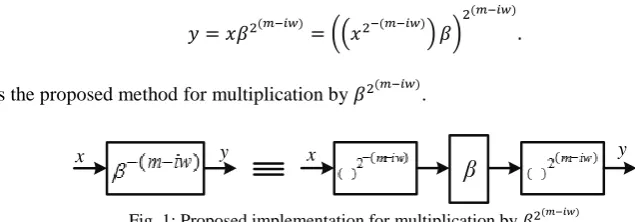
In this method multiplications by some powers of 𝛽 are required which cause complex and irregular structure in hardware implementation [21]. To have a low-complexity and regular architecture of multiplication by
𝛽2(𝑚−𝑖𝑤)
exponentiation of the input 𝑥 by 2−(𝑚−𝑖𝑤) is done, then multiplication by 𝛽 is performed, and finally the exponentiation of the result by 2(𝑚−𝑖𝑤) is completed. These operations result in:
𝑦 = 𝑥𝛽2(𝑚−𝑖𝑤)= ((𝑥2−(𝑚−𝑖𝑤)) 𝛽)2
(𝑚−𝑖𝑤) .
Fig. 1 shows the proposed method for multiplication by 𝛽2(𝑚−𝑖𝑤).
β
x y x y
Fig. 1: Proposed implementation for multiplication by 𝛽2(𝑚−𝑖𝑤)
In the proposed method two steps of exponentiation by 2−(𝑚−𝑖𝑤) and 2(𝑚−𝑖𝑤) are free hardware implemented only by cyclic shift; therefore, only multiplication by 𝛽 is the main part to be implemented.
Here, we explain the structure of the proposed digit-serial multiplier. Let 𝐴, 𝐵 be two elements in GF(2m) and let
𝐵 = [𝑏𝑚−1, 𝑏𝑚−2, … , 𝑏2, 𝑏1, 𝑏0]. We consider 𝐵 as the following 𝑤 × 𝑑 array and divide it into its columns.
(
𝑏𝑚−1
𝑏𝑚−𝑤−1
𝑏𝑚−2
𝑏𝑚−𝑤−2 ⋯
𝑏𝑚−𝑤
𝑏𝑚−2𝑤
⋮ ⋱ ⋮
𝑏𝑚−(𝑑−1)𝑤−1 𝑏𝑚−(𝑑−1)𝑤−2 ⋯ 𝑏𝑚−𝑑𝑤
)
We let 𝑏𝑖= 0 if 𝑖 ≤ 0. More precisely,
𝐵 = 𝐵1+ 𝐵2+ 𝐵3+ ⋯ + 𝐵𝑤, where, for 𝑖 = 1, … , 𝑤,
𝐵𝑖= ∑ 𝑏𝑚−(𝑘−1)𝑤−𝑖 𝛽2𝑚−(𝑘−1)𝑤−𝑖 𝑑
𝑘=1
.
The multiplication of elements 𝐴, 𝐵 in GF(2m) is written by
𝐶 = 𝐴𝐵 = 𝐴 ∑ 𝐵𝑖 𝑤
𝑖=1
= 𝐴 ∑ ∑ 𝑏𝑚−(𝑘−1)𝑤−𝑖 𝛽2𝑚−(𝑘−1)𝑤−𝑖 𝑑
𝑘=1 𝑤
𝑖=1
= ∑ ∑ 𝑏𝑚−(𝑘−1)𝑤−𝑖 𝐴𝛽2𝑚−(𝑘−1)𝑤−𝑖 𝑑
𝑘=1 𝑤
𝑖=1
= ∑ (∑ 𝑏𝑚−(𝑘−1)𝑤−𝑖 𝐴2−(𝑤−𝑖)𝛽2𝑚−𝑘𝑤 𝑑
𝑘=1
)
2𝑤−𝑖 𝑤
𝑖=1
.
In other words, we have
𝐶 = ∑ 𝐶𝑖2
𝑤−𝑖 =
𝑤
𝑖=1
((… ((𝐶12+ 𝐶2) 2
+ 𝐶3) 2
+ ⋯ )
2
+ 𝐶𝑤),
where for 𝑖 = 1, … , 𝑤,
𝐶𝑖= ∑ 𝑏𝑚−(𝑘−1)𝑤−𝑖 𝐴2
−(𝑤−𝑖) 𝛽2𝑚−𝑘𝑤 𝑑
𝑘=1
= ∑ 𝑏𝑚−(𝑘−1)𝑤−𝑖(((𝐴2
−(𝑤−1) )2(𝑖−1))
2−(𝑚−𝑘𝑤) 𝛽)
2𝑚−𝑘𝑤
.
𝑑
𝑘=1
To calculate exponentiation by 2−(𝑚−𝑘𝑤) before multiplication by 𝛽 block in regular form, we write
((𝐴2−(𝑤−1))2(𝑖−1)) 2−(𝑚−𝑘𝑤)
= (… (((𝐴2−(𝑤−1))2(𝑖−1)) 2−(𝑚−𝑤)
)
2𝑤
… )
2𝑤
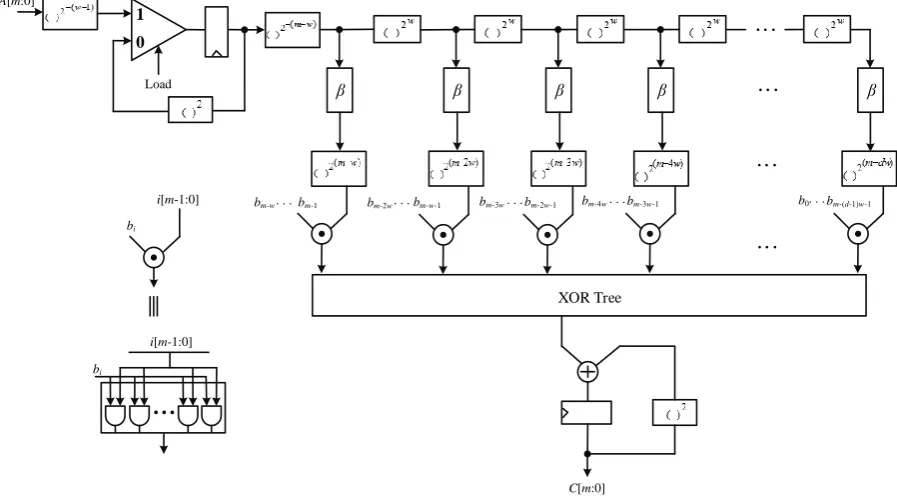
So, first exponentiation by 2−(𝑚−𝑤) is computed, and then for 𝑘 = 2,3, … , 𝑑, exponentiation by 2−(𝑚−𝑘𝑤) are generated by a sequence of exponentiation by 2𝑤 with length 𝑑-1. Fig.2 shows the proposed structure for the digit-serial GNB multiplier over GF(2m).
1
0
Load β β β β β
bi
i[m-1:0]
i[m-1:0]
bm-1
bm-w. . . bm-2w. . .bm-w-1 bm-3w. . .bm-2w-1 bm-4w. . .bm-3w-1 bm-(d-1)w-1
XOR Tree
b0. . .
C[m:0]
. . .
. . .
. . .
. . .
A[m:0]
bi
Fig. 2: Proposed structure for the digit-serial GNB multiplier over GF(2m)
As seen in the Fig. 2, a regular architecture for hardware implementation is provided. In proposed structure different exponentiation by power of 2 blocks are implemented by wired cyclic shift in the normal basis. This property is an important factor for improvement of efficiency in the structure.
For implementation of multiplication by 𝛽 in GF(2m) of type 𝑇, a method presented in [6] is employed. In this
method, the entries of the multiplication matrix 𝑀 are encoded to an (𝑚 − 1) × 𝑇 matrix 𝑅 with entries 𝑟𝑖,𝑗 ∈
{0, 1, 2, … , 𝑚 − 1}, where 𝑖 = 0,1, … , 𝑚 − 2 and 𝑗 = 0,1, … , 𝑇 − 1. Notice that the multiplication matrix 𝑀 is symmetric and for GNB of even type 𝑇, we have 𝜆𝑖,0(𝑘)= 𝜆𝑖,𝑘(0), where 𝑖, 𝑘 are in {0, 1, 2, … , 𝑚 − 1} (see [6]). So,
𝛽2𝑖
𝛽 = ∑ 𝜆𝑖,0(𝑘)𝛽2𝑘
𝑚−1
𝑘=0
= ∑ 𝜆(0)𝑖,𝑘𝛽2𝑘
𝑚−1
𝑘=0
.
This means, the 𝑖th row of matrix 𝑀 is the 𝑚-bit number representation of 𝛽2𝑖𝛽. Thus, the number of entries ‘1’
in the first row is one and in other rows is even and less or equal to 𝑇. Now, the entries of 𝑖th row of matrix 𝑅 are
identified based on the column numbers of entries 1 in (𝑖 + 1)th row of matrix 𝑀. If the number of ones in row (𝑖 + 1) of 𝑀 matrix is 𝑇, then all entries of row 𝑖 of matrix 𝑅 are specified. If it is not the case, the remaining entries of 𝑅, whose number is even, is initialized with a constant value. There is also another method to determine matrix 𝑅 which is based on the function 𝐹 in Eq.(1). In this method, for all 𝑘 = 1,2, … , 𝑝 − 2, where
𝑝 = 𝑚𝑇 + 1, the pairs (𝐹(𝑘 + 1), 𝐹(𝑝 − 𝑘)) are calculated, that for each calculated pair its second coordinate, the value 𝐹(𝑝 − 𝑘), is an entry of matrix R in row 𝐹(𝑘 + 1) − 1 if 𝐹(𝑘 + 1) ≥ 1. Multiplication by 𝛽 based on matrix 𝑅 is as follows
𝛽𝐵 = 𝛽 ∑ 𝑏𝑖𝛽2𝑖 𝑚−1
𝑖=0
= ∑ 𝑏𝑖𝛽𝛽2𝑖= ∑ 𝑏𝑖 𝑚−1
𝑖=0 𝑚−1
𝑖=0
∑ 𝜆(𝑘)𝑖,0𝛽2𝑘
𝑚−1
𝑘=0
= ∑ ∑ 𝑏𝑖𝜆𝑖,𝑘 (0)
𝛽2𝑘 =
𝑚−1
𝑘=0 𝑚−1
𝑖=0
∑ ∑ 𝑏𝑖
𝑚−1
𝑖=0
𝜆(0)𝑖,𝑘𝛽2𝑘
𝑚−1
𝑘=0
= ∑ ( ∑ 𝑏𝑖 𝑚−1
𝑖=0
𝜆𝑘,𝑖(0)) 𝛽2𝑘= ∑ ∑ 𝑏 𝑟𝑘,𝑗 𝑇−1
𝑗=0
𝛽2𝑘= ∑ 𝑠(𝑘, 𝐵)𝛽2𝑘 𝑚−1
𝑘=0 𝑚−1
𝑘=0 𝑚−1
𝑘=0
,
where, 𝑠(𝑘, 𝐵) = ∑𝑇−1𝑗=0𝑏𝑟𝑘,𝑗, 0 ≤ 𝑘 ≤ 𝑚 − 2. Briefly, we have
In the following an example of GF(27), with type 𝑇=4 GNB is presented. For the following multiplication
matrix 𝑀,
𝑀 =
[
0 1 0 0 0 0 0 1 0 1 0 0 1 1 0
0 0 0 0
1 0 0 1 1
0 1 1 1 0
1 0 0 1 0
1 0 0 0 1
1 0 1 0 0 1 0 1 1 1]
,
by using the first method the matrix 𝑅 is calculated as follows:
𝑅 =
[
0 2 5 6 1 3 4 5 2
2 1 1
5 6 2 4
3 0 3 5
3 0 6 6]
.
Also based on the second method, first values of 𝐹(𝑘) are calculated, as shown in Table 2. Table2: Sequence of 𝐹 for 𝑇=4 over GF(27)
𝑘 1 2 3 4 5 6 7 8 9 10 11 12 13 14
𝐹(𝑘) 0 1 5 2 1 6 5 3 3 2 4 0 4 6
𝑘 15 16 17 18 19 20 21 22 23 24 25 26 27 28
𝐹(𝑘) 6 4 0 4 2 3 3 5 6 1 2 5 1 0
Then the pairs of (𝐹(𝑘 + 1), 𝐹(𝑝 − 𝑘)) are listed as shown in Table 3, and based on that matrix 𝑅 can be constructed.
Table3: Pairs of (𝐹(𝑘 + 1), 𝐹(𝑝 − 𝑘)) for 𝑇=4 over GF(27)
(1,0) (4,2) (3,2) (5,1) (0,4) (3,3) (2,5) (4,0) (5,3) (1,2) (6,4) (6,5) (6,1) (6,6) (1,6) (5,6) (4,6) (2,1) (3,5) (0,4) (5,2) (3,3) (4,0) (1,5) (2,3) (2,4) (0,1)
If we show output bits of multiplication 𝛽𝐵 by 𝑡𝑘 = 𝑠(𝑘, 𝐵) then for above matrix 𝑅 we have,
𝑡0= 𝑏1
𝑡1= 𝑠(1, 𝐵) = 𝑏0⊕ 𝑏2⊕ 𝑏6⊕ 𝑏5
𝑡2= 𝑠(2, 𝐵) = 𝑏5⊕ 𝑏3⊕ 𝑏4⊕ 𝑏1
𝑡3= 𝑠(3, 𝐵) = 𝑏5⊕ 𝑏3⊕ 𝑏2⊕ 𝑏3= 𝑏5⊕ 𝑏2
𝑡4= 𝑠(4, 𝐵) = 𝑏2⊕ 𝑏0⊕ 𝑏6⊕ 𝑏0= 𝑏2⊕ 𝑏6
𝑡5= 𝑠(5, 𝐵) = 𝑏1⊕ 𝑏6⊕ 𝑏3⊕ 𝑏2
𝑡6= 𝑠(6, 𝐵) = 𝑏1⊕ 𝑏4⊕ 𝑏6⊕ 𝑏5
b1
t0 t1 b5b3
t2 b2b5
t3 t4 b2b6 b1b3
t5
b5b6 b4b1
t6 b2b0
Fig. 3: Hardware implementation of the multiplication by 𝛽 over GF(27)
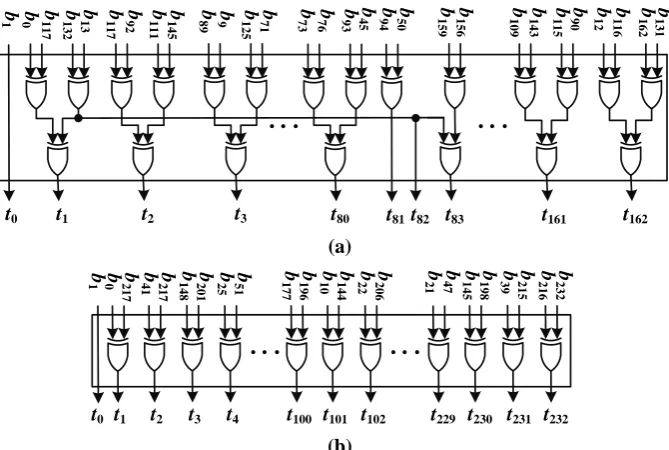
Fig.4 (a) and Fig.4 (b) show the hardware implementation of the multiplication by 𝛽 over two applicable fields GF(2163) and GF(2233) respectively.
b
1
t0 t1
b
132
b
117
b
0 13b
t2 t3
b
117 92b 111b 145b 89b 9b 125b 71b 109b 143b 115b 90b 12b 116b 162b 131b
. . .
. . .
t80
b
73 76b 93b 45b 159b 156b
t1
b
94 50b
t81t82 t83 t161 t162
b
1 0b 217b
t2
b
41 217b
t3
b
148 201b
t4
b
25 51b
t100
b
177 196b
t101
b
10 144b
t102
b
22 206b 21b 47b 145b 198b 39b 215b 216b 232b
t0 t229 t230 t231 t232
. . .
. . .
(a)
(b)
Fig.4: Hardware implementation of the multiplication by 𝛽 for fields GF(2163) (a) and GF(2233) (b).
Type of the Gaussian normal basis in the field GF(2163) is 𝑇=4. In this field, after resource sharing of the XOR
common terms 24% of XOR gates are reduced in the implementation.
In the following, the proposed structure of digit-serial GNB multiplier is presented for two cases of 𝑤=3, 𝑑 =
⌈73⌉=3 and 𝑤=4, 𝑑 = ⌈7
4⌉=2 over GF(2
7). For the first case, 𝐵 is represented by three words 𝐵
1 to 𝐵3:
𝐵1= 𝑏6𝛽26+ 𝑏5𝛽25+ 𝑏4𝛽24
𝐵2= 𝑏3𝛽23+ 𝑏2𝛽22+ 𝑏1𝛽21
𝐵3 = 𝑏0𝛽 And for 𝑖 = 1,2,3, 𝐶𝑖 are:
𝐶1= ((𝐴2−2) 2−4
𝛽)2 4
𝑏6+ (((𝐴2−2) 2−4
)2 3
𝛽)
2
𝑏3+ ((((𝐴2−2) 2−4
)2 3
)
23
𝛽)
2−2
𝑏0
𝐶2= (((𝐴2
−2 )2)2
−4 𝛽)
24
𝑏5+ ((((𝐴2
−2 )2)2
−4 )
23 𝛽)
2
𝑏2+ (((((𝐴2
−2 )2)2
−4 )
23 )
23
𝛽)
2−2
𝑏−1
𝐶3= (((𝐴2
−2 )22)
2−4 𝛽)
24
𝑏4+ ((((𝐴2
−2 )22)
2−4 )
23 𝛽)
2
𝑏1+ (((((𝐴2
−2 )22)
2−4 )
23 )
23
𝛽)
2−2
𝑏−2.
The bits 𝑏−1 and 𝑏−2 are set to zero, and product 𝐶 of the Gaussian normal basis multiplication based on 𝐶1, 𝐶2 and 𝐶3 is presented as follows:
𝐶 = ((𝐶12+ 𝐶2) 2
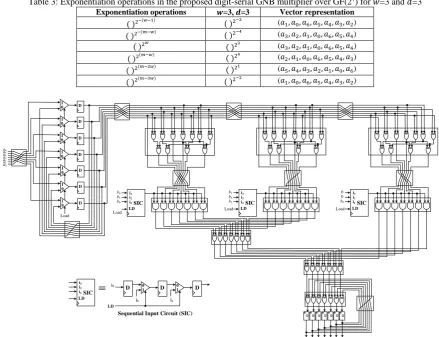
Table 3 shows required exponentiation operations in the proposed digit-serial GNB multiplier over GF(27) for 𝑤=3 and 𝑑=3, and Fig. 5 shows the proposed structure of the digit-serial GNB multiplier over GF(27) with 𝑇=4
for case 𝑤=3 and 𝑑=3.
Table 3: Exponentiation operations in the proposed digit-serial GNB multiplier over GF(27) for 𝑤=3 and 𝑑=3
Exponentiation operations 𝒘=3, 𝒅=3 Vector representation
( )2−(𝑤−1)
( )2−2
(𝑎1, 𝑎0, 𝑎6, 𝑎5, 𝑎4, 𝑎3, 𝑎2) ( )2−(𝑚−𝑤)
( )2−4 (𝑎
3, 𝑎2, 𝑎1, 𝑎0, 𝑎6, 𝑎5, 𝑎4) ( )2𝑤
( )23
(𝑎3, 𝑎2, 𝑎1, 𝑎0, 𝑎6, 𝑎5, 𝑎4) ( )2(𝑚−𝑤)
( )24
(𝑎2, 𝑎1, 𝑎0, 𝑎6, 𝑎5, 𝑎4, 𝑎3) ( )2(𝑚−2𝑤)
( )21
(𝑎5, 𝑎4, 𝑎3, 𝑎2, 𝑎1, 𝑎0, 𝑎6) ( )2(𝑚−3𝑤)
( )2−2
(𝑎1, 𝑎0, 𝑎6, 𝑎5, 𝑎4, 𝑎3, 𝑎2)
1 0 D 1 0 D 1 0 D 1 0 D 1 0 D 1 0 D 1
0 D b6 i1SIC
i2 i3 LD b5 b4 Load
b3 i1SIC
i2 i3 LD b2 b1 Load
b0 i1SIC
i2 i3 LD 0 0 Load D D D D D D D Load a6 a5 a4 a3 a2 a1 a0 c6 c5 c4 c3 c2 c1 c0 0 1 i2
i3 0
1
i1 D
Sequential Input Circuit (SIC)
LD SIC i1 i2 i3 LD D D
Fig. 5: Proposed structure ofthe digit-serial GNB multiplier over GF(27) with 𝑤=3 and 𝑑=3
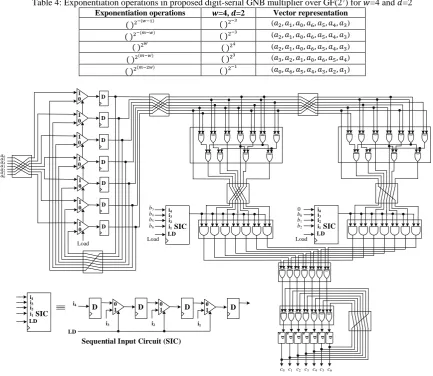
For the case of 𝑤=4 and 𝑑=2 the words representation of the 𝐵 is
𝐵1= 𝑏6𝛽26+ 𝑏5𝛽25+ 𝑏4𝛽24+ 𝑏3𝛽23
𝐵2= 𝑏2𝛽22+ 𝑏1𝛽21+ 𝑏0𝛽
and multiplication result is 𝐶 = (((𝐶12+ 𝐶2) 2
+ 𝐶3) 2
+ 𝐶4) where 𝐶1 and 𝐶4 are:
𝐶1= ((𝐴2−3) 2−3
𝛽)
23
𝑏6+ (((𝐴2−3) 2−3 ) 24 𝛽) 2−1 𝑏2
𝐶2= (((𝐴2−3) 2
)2 −3
𝛽)
23
𝑏5+ ((((𝐴2−3) 22 ) 2−3 ) 24 𝛽) 2−1 𝑏1
𝐶3= (((𝐴2−3) 22
)
2−3
𝛽)
23
𝑏4+ ((((𝐴2−3) 22 ) 2−3 ) 24 𝛽) 2−1 𝑏0
𝐶4= (((𝐴2−3) 23
)
2−3
𝛽)
23
𝑏3+ ((((𝐴2−3) 23 ) 2−3 ) 24 𝛽) 2−1
𝑏−1.
Required exponentiation operations in the proposed digit-serial GNB multiplier over GF(27) for 𝑤=4 and 𝑑=2
Table 4: Exponentiation operations in proposed digit-serial GNB multiplier over GF(27) for 𝑤=4 and 𝑑=2
Exponentiation operations 𝒘=4, 𝒅=2 Vector representation
( )2−(𝑤−1)
( )2−3
(𝑎2, 𝑎1, 𝑎0, 𝑎6, 𝑎5, 𝑎4, 𝑎3) ( )2−(𝑚−𝑤)
( )2−3
(𝑎2, 𝑎1, 𝑎0, 𝑎6, 𝑎5, 𝑎4, 𝑎3) ( )2𝑤
( )24
(𝑎2, 𝑎1, 𝑎0, 𝑎6, 𝑎5, 𝑎4, 𝑎3) ( )2(𝑚−𝑤)
( )23
(𝑎3, 𝑎2, 𝑎1, 𝑎0, 𝑎6, 𝑎5, 𝑎4) ( )2(𝑚−2𝑤)
( )2−1
(𝑎0, 𝑎6, 𝑎5, 𝑎4, 𝑎3, 𝑎2, 𝑎1)
1
0 D
1
0 D
1
0 D
1
0 D
1
0 D
1
0 D
1
0 D b6
b5 b4
Load
b2 b1 b0
Load
D
D
D
D
D
D
D
Load
a6 a5 a4 a3 a2 a1 a0
c6 c5 c4 c3 c2 c1 c0 0
1
i3
i4 0
1
i2
D
Sequential Input Circuit (SIC) LD
SIC i1 i2 i3
LD
D
D 01
i1
D i4
SIC i1 i2 i3
LD i4
b3
SIC i1 i2 i3
LD i4
0
Fig. 6: Proposed structure of the digit-serial GNB multiplier over GF(27) with 𝑤=4 and 𝑑=2
The critical data path of the proposed structure of digit-serial GNB multiplier over GF(2m) with type 𝑇 is T
A+ (⌈𝑙𝑜𝑔2𝑇⌉+⌈𝑙𝑜𝑔2(𝑑+1)⌉)TX, where TA and TX denote the time delay of a 2-input AND gate and 2-input XOR gate respectively. For above two examples the critical data path of structures in Fig.5 and Fig.6 are
TA+(⌈𝑙𝑜𝑔24⌉+⌈𝑙𝑜𝑔2 (3+1)
⌉)TX =TA+5TX and TA+ (⌈𝑙𝑜𝑔24⌉+⌈𝑙𝑜𝑔2 (2+1)
⌉)TX =TA+4TX respectively. Also, the number of clock cycles for the case (𝑤=3, 𝑑=3) is 4 and for case (𝑤=4, 𝑑=2) is 5. The proposed digit-serial GNB multiplier requires 𝑑. 𝑚 AND gates and ≤ 𝑑. 𝑚+(𝑇-1)(𝑚-1) XOR gates. The number of XOR gates is lower than those of other digit-serial structures. More details of the hardware and time complexity of this work and other related works are presented in the next section.
3. Comparison Results
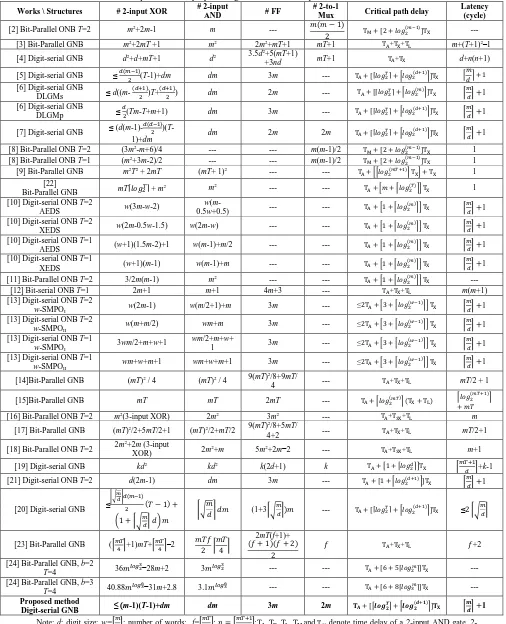
Comparison with other structures of the GNB and ONB multipliers based on different parameters like hardware resources, critical path delay and number of clock cycles are presented here. The hardware implementation of the proposed architecture is based on two fields of GF(2163) and GF(2233) recommended by NIST for ECC
Table 5: Comparison of the proposed digit-serial GNB multiplier and other related works
Works \ Structures # 2-input XOR # 2-input
AND # FF
# 2-to-1
Mux Critical path delay
Latency (cycle)
[2] Bit-Parallel ONB T=2 m2+2m-1 m --- 𝑚(𝑚 − 1)
2 TM+ [2 + 𝑙𝑜𝑔2(𝑚−1)]TX ---
[3] Bit-Parallel GNB m2+2mT +1 m2 2m2+mT+1 mT+1 T
A+TX+TL m+(T+1)2–1
[4] Digit-serial GNB d2+d+mT+1 d2 3.5d2+5(mT+1)
+3nd mT+1 TA+TX d+n(n+1)
[5] Digit-serial GNB ≤ 𝑑(𝑚−1)
2 (T-1)+dm dm 3m --- TA+ [⌈𝑙𝑜𝑔2 𝑇⌉ + ⌈𝑙𝑜𝑔
2 (𝑑+1)⌉]T
X ⌈
𝑚 𝑑⌉ + 1
[6] Digit-serial GNB
DLGMs ≤ d((m-
(𝑑+1)
2 )T+
(𝑑+1)
2 ) dm 2m --- TA+ [⌈𝑙𝑜𝑔2
𝑇⌉ + ⌈𝑙𝑜𝑔 2 (𝑚)⌉]T
X ⌈𝑚𝑑⌉ +1
[6] Digit-serial GNB
DLGMp ≤
𝑑
2(Tm-T+m+1) dm 3m --- TA+ [⌈𝑙𝑜𝑔2 𝑇⌉ + ⌈𝑙𝑜𝑔
2 (𝑑+1)⌉]T
X ⌈𝑚𝑑⌉ +1
[7] Digit-serial GNB ≤ (d(m
-1)-𝑑(𝑑−1)
2 )(T
-1)+dm dm 2m 2m TA+ [⌈𝑙𝑜𝑔2
𝑇⌉ + ⌈𝑙𝑜𝑔 2 (𝑑+1)⌉]T
X ⌈𝑚𝑑⌉ +1
[8] Bit-Parallel ONB T=2 (3m2-m+6)/4 --- --- m(m-1)/2 T
M+ [2 + 𝑙𝑜𝑔2(𝑚−1)]TX 1 [8] Bit-Parallel ONB T=1 (m2+3m-2)/2 --- --- m(m-1)/2 T
M+ [2 + 𝑙𝑜𝑔2(𝑚−1)]TX 1
[9] Bit-Parallel GNB m2T2 + 2mT (mT+ 1)2 --- --- T
A+ [⌈𝑙𝑜𝑔2(𝑚𝑇+1)⌉ TX] + TX 1 [22]
Bit-Parallel GNB mT⌈𝑙𝑜𝑔2
𝑇⌉ + m2 m2 --- --- T
A+ [𝑚 + ⌈𝑙𝑜𝑔2(𝑇)⌉] TX 1
[10] Digit-serial ONB T=2
AEDS w(3m-w-2)
w(m
-0.5w+0.5) --- --- TA+ [1 + ⌈𝑙𝑜𝑔2
(𝑚)⌉] T
X ⌈𝑚𝑑⌉ +1
[10] Digit-serial ONB T=2
XEDS w(2m-0.5w-1.5) w(2m-w) --- --- TA+ [1 + ⌈𝑙𝑜𝑔2
(𝑚)⌉] T
X ⌈𝑚𝑑⌉ +1
[10] Digit-serial ONB T=1
AEDS (w+1)(1.5m-2)+1 w(m-1)+m/2 --- --- TA+ [1 + ⌈𝑙𝑜𝑔2
(𝑚)⌉] T
X ⌈𝑚𝑑⌉ +1
[10] Digit-serial ONB T=1
XEDS (w+1)(m-1) w(m-1)+m --- --- TA+ [1 + ⌈𝑙𝑜𝑔2
(𝑚)⌉] T
X ⌈𝑚𝑑⌉ +1
[11] Bit-Parallel ONB T=2 3/2m(m-1) m2 --- --- T
A+ [1 + ⌈𝑙𝑜𝑔2(𝑚)⌉] TX ---
[12] Bit-serial ONB T=1 2m+1 m+1 4m+3 --- TA+TX+TL m(m+1)
[13] Digit-serial ONB T=2
w-SMPOI w(2m-1) w(m/2+1)+m 3m ---
≤2TA+ [3 + ⌈𝑙𝑜𝑔2(𝑤−1)⌉] TX ⌈𝑚𝑑⌉ +1
[13] Digit-serial ONB T=2
w-SMPOII
w(m+m/2) wm+m 3m --- ≤2TA+ [3 + ⌈𝑙𝑜𝑔2(𝑤−1)⌉] TX ⌈𝑚𝑑⌉ +1
[13] Digit-serial ONB T=1
w-SMPOI 3wm/2+m+w+1
wm/2+m+w+
1 3m --- ≤2TA+ [3 + ⌈𝑙𝑜𝑔2 (𝑤−1)⌉] T
X ⌈𝑚𝑑⌉ +1
[13] Digit-serial ONB T=1
w-SMPOII wm+w+m+1 wm+w+m+1 3m --- ≤
2TA+ [3 + ⌈𝑙𝑜𝑔2(𝑤−1)⌉] TX ⌈𝑚𝑑⌉ +1
[14]Bit-Parallel GNB (mT)2 / 4 (mT)2 / 4 9(mT)2/8+9mT/
4 --- TA+TX+TL mT/2 + 1
[15]Bit-Parallel GNB mT mT 2mT --- TA+ ⌈𝑙𝑜𝑔2(𝑚𝑇)⌉ (TX+ TL) ⌈𝑙𝑜𝑔2
(𝑚𝑇+1)⌉
+ 𝑚𝑇
[16] Bit-Parallel ONB T=2 m2(3-input XOR) 2m2 3m2 --- T
A+T3X+TL m
[17] Bit-Parallel GNB (mT)2/2+5mT/2+1 (mT)2/2+mT/2 9(mT)2/8+5mT/
4+2 --- TA+TX+TL mT/2+1
[18] Bit-Parallel ONB T=2 2m
2+2m (3-input
XOR) 2m
2+m 5m2+2m−2 --- T
A+T3X+TL m+1
[19] Digit-serial GNB kd2 kd2 k(2d+1) k T
A+ [1 + ⌈𝑙𝑜𝑔2𝑑⌉]TX ⌈𝑚𝑇+1𝑑 ⌉+k-1
[21] Digit-serial ONB T=2 d(2m-1) dm 3m --- TA+ [1 + ⌈𝑙𝑜𝑔2(𝑑+1)⌉]TX ⌈𝑚𝑑⌉ +1
[20] Digit-serial GNB ≤
⌈√𝑚𝑑⌉𝑑(𝑚−1)
2 (𝑇 − 1) +
(1 + ⌈√𝑚𝑑⌉ 𝑑) 𝑚
⌈√𝑚𝑑⌉ 𝑑𝑚 (1+3⌈√𝑚𝑑⌉)𝑚 --- TA+ [⌈𝑙𝑜𝑔2𝑇⌉ + ⌈𝑙𝑜𝑔2(𝑑+1)⌉]TX ≤2 ⌈√𝑚𝑑⌉
[23] Bit-Parallel GNB (⌈𝑚𝑇4⌉+1)mT+⌈𝑚𝑇4⌉–2 𝑚𝑇𝑓
2 ⌈
𝑚𝑇
4⌉
2mT(f+1)+ (𝑓 + 1)(𝑓 + 2)
2
𝑓 TA+TX+TL 𝑓+2
[24] Bit-Parallel GNB, b=2
T=4 36𝑚𝑙𝑜𝑔2
3
−28m+2 3𝑚𝑙𝑜𝑔23 --- --- TA+ [6 + 5⌈𝑙𝑜𝑔2𝑚⌉]TX ---
[24] Bit-Parallel GNB, b=3
T=4 40.88𝑚𝑙𝑜𝑔3
6
−31m+2.8 3.1𝑚𝑙𝑜𝑔36 --- --- TA+ [6 + 8⌈𝑙𝑜𝑔3𝑚⌉]TX ---
Proposed method
Digit-serial GNB ≤ (m-1)(T-1)+dm dm 3m 2m 𝐓𝐀+ [⌈𝒍𝒐𝒈𝟐
𝑻⌉ + ⌈𝒍𝒐𝒈 𝟐 (𝒅+𝟏)⌉]𝐓
𝐗 ⌈𝒎𝒅⌉ +1
Note: d: digit size; w=⌈𝑚𝑑⌉: number of words; f=⌈𝑚𝑇4⌉; 𝑛 = ⌈𝑚𝑇+1𝑑 ⌉;TA, TX, TL, TM and T3Xdenote time delay of a input AND gate, 2-input XOR gate, one bit Latch, and 2 to 1 multiplexer and 3-2-input XOR gate respectively; q = dk is consecutive coordinate to satisfy the corresponding normal basis representation, where q ≥ mT/2 if m is even, and q ≥ (mT−T+2)/2 if m is odd; b: m = bi (i>1).
The number of XOR gates is the lowest compared to other digit-serial structures. Hardware resources in recent work [20] are more than that of present design; however, the latency in [20] is better. Table 6 shows FPGA implementation results of the proposed architecture and work [7] on Virtex-4 XC4VLX100-ff1148for GF(2233)
and GF(2163). In the table hardware utilization, maximum frequency and execution time for different digit sizes
are reported.
Table 6: FPGA implementation results of the proposed architectures for GF(2233) and GF(2163)on Virtex-4
XC4VLX100-ff1148
Works and Fields Digit size Area Fmax(MHz) Time (ns)
[7] DL-SIPO GF(2163)
41 7229 Slices (12783 LUTs, 326 FFs) 153.846 26 11 1691 Slices (3365 LUTs, 326 FFs) 208.33 72 [7] DL- PISO
GF(2163)
41 7385 Slices (13218 LUTs, 378 FFs) 144.927 27.6 11 1899 Slices (3912 LUTs, 444 FFs) 175.438 85.5
Proposed method
GF(2163)
82 12075 Slices (23370 LUTs, 490 FFs) 207.108 14.484
41 6331 Slices (12265 LUTs, 490 FFs) 241.061 20.74
21 3432 Slices (6640 LUTs, 494 FFs) 269.879 33.345
11 1960 Slices (3800 LUTs, 502 FFs) 316.051 53.788
6 1184 Slices (2287 LUTs, 518 FFs) 355.075 78.856
Proposed method
GF(2233)
117 16782 Slices (32866 LUTs, 699 FFs) 207.751 14.439
59 8536 Slices (16743 LUTs, 699 FFs) 262.504 19.045
30 4394 Slices (8593 LUTs, 699 FFs) 318.210 28.287
15 2407 Slices (4657 LUTs, 699 FFs) 329.545 51.578
8 1458 Slices (2811 LUTs, 699 FFs) 394.594 83.622
It should be noted that in [7] number of D flip flops for output register in DL-PISO structure and for serial input (A input) in the DL-SIPO structure have not been considered in the implementation. According to the Table 6, the proposed work has better timing results than [7] on similar FPGA family Virtex-4 XC4VLX100-ff1148. For example in field GF(2163) execution times of the proposed structures are 20.74ns and 53.788ns for two digit
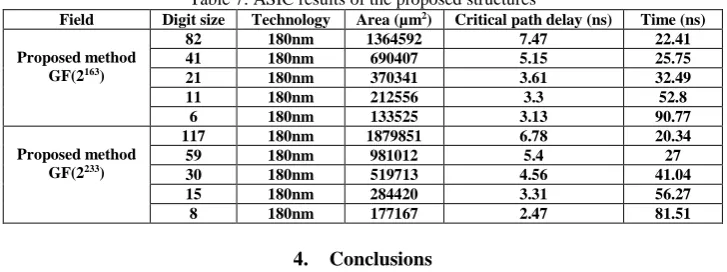
sizes 41 and 11, respectively, which are better than execution time in [7] for similar digit sizes. Table 7 shows area, critical path delay, and execution time of the proposed structure in 180nm CMOS technology by Synopsys Design Vision tool. Results show a suitable trade-off between area and execution time, applicable for elliptic curve cryptography systems.
Table 7: ASIC results of the proposed structures
Field Digit size Technology Area (µm2) Critical path delay (ns) Time (ns)
Proposed method
GF(2163)
82 180nm 1364592 7.47 22.41
41 180nm 690407 5.15 25.75
21 180nm 370341 3.61 32.49
11 180nm 212556 3.3 52.8
6 180nm 133525 3.13 90.77
Proposed method
GF(2233)
117 180nm 1879851 6.78 20.34
59 180nm 981012 5.4 27
30 180nm 519713 4.56 41.04
15 180nm 284420 3.31 56.27
8 180nm 177167 2.47 81.51
4. Conclusions
This paper presents an FPGA and ASIC implementation of an efficient hardware structure of the digit-serial Gaussian normal basis multiplier over GF(2m). In the proposed structure by reviewing the multiplication
equation in normal basis, a regular structure for Gaussian normal basis multiplier is presented. The structure of multiplier is based on exponentiation by powers of 2 and multiplication by normal element of GF(2m).
Therefore, the proposed architecture has low hardware complexity and low critical path delay. It is suitable for high-speed hardware implementation of the finite field multiplication and inversion operations over GF(2m) for
elliptic curve cryptography.
References
[1] D. Hankerson, A. Menezes, S. Vanstone, “Guide to Elliptic Curve Cryptography”, Springer-Verlag, New York, 1st edn., 2004. [2] Jenn-Shyong Horng, I-Chang Jou and Chiou-Yng Lee, “On complexity of normal basis multiplier using modified Booth’s
algorithm”, Proc. of the 7th WSEAS International Conference on Applied Informatics and Communications, Athens, Greece, August 24-26, 2007, pp.12-17.
[3] C.W. Chiou, H.W. Chang, W.-Y.Liang, C.-Y.Lee, J.-M.Lin, Y.-C.Yeh, “Low-complexity Gaussian normal basis multiplieroverGF(2m)”, IET Inf. Secur., 6(4), 2012, pp. 310-317.
[4] Chiou-Yng Lee,CheWunChiou, “Scalable Gaussian Normal Basis Multipliers over GF(2m) Using Hankel Matrix-Vector
Representation”, J Sign Process Syst (69), 2012, pp. 197-211.
[6] A. Reyhani-Masoleh, “Efficient Algorithms and Architectures for Field Multiplication Using Gaussian Normal Bases”, IEEE Trans. Computers, 55(1), Jan. 2006, pp. 34-47.
[7] R. Azarderakhsh and A. Reyhani-Masoleh, “Low-Complexity Multiplier Architectures for Single and Hybrid-Double Multiplications in Gaussian Normal Bases”, IEEE Trans. Comput., 62(4), Apr. 2013, pp. 744-757.
[8] Jenn-Shyong HORNG, I-Chang JOU, Chiou-Yng LEE, “Low-complexity multiplexer-based normal basis multiplier over GF(2m)”, J
Zhejiang UnivSci A 2009 10(6), pp. 834-842.
[9] T.-P. Chuang, C. WunChiou, S.-S.Lin, C.-Y. Lee, “Fault-tolerant Gaussian normal basis multiplier over GF(2m)”, IET Inf. Secur.,
2012, 6(3), pp. 157-170.
[10] A. Reyhani-Masoleh and M.A. Hasan, “Efficient Digit-serial Normal Basis Multipliers over Binary Extension Fields”, ACM Trans.Embedded Computing Systems, vol. 3, no. 3, pp. 575-592, Aug.2004.
[11] C¸. K. Koc¸ and B. Sunar, “An Efficient Optimal Normal Basis Type II Multiplier over GF(2m)” IEEE Trans. Computers, 50(1), Jan.
2001,pp. 83-87.
[12] CheWunChiou, Chiou-Yng Lee and Yun-Chi Yeh, “Sequential Type-I Optimal Normal Basis Multiplier and Multiplicative Inverse in GF(2m)”, Tamkang Journal of Science and Engineering, 13(4), 2010,pp. 423-432.
[13] A. Reyhani-Masoleh and M.A. Hasan, “Low Complexity Word-Level Sequential Normal Basis Multipliers,” IEEE Trans. Comput., 54(2), Feb. 2005, pp. 98-110.
[14] Zhen Wang, Xiaozhe Wang, and Shuqin Fan, “Concurrent Error Detection Architectures for Field Multiplication Using Gaussian Normal Basis”, Proc. of Information Security, Practice and Experience (ISPEC), LNCS 6047, 2010, pp. 96-109.
[15] CheWunChiou, Jim-Min Lin, Yu-Ku Li, Chiou-Yng Lee, Tai-Pao Chuang, and Yun-Chi Yeh, “Pipeline Design of Bit-Parallel Gaussian Normal Basis Multiplier over GF(2m)”, Advances in Intelligent Systems and Computing, Springer, 238, 2014, pp. 369-377.
[16] Bayat-Sarmadi, S., Hasan, M.A.: Concurrent Error Detection in Finite-Filed Arithmetic Operations Using Pipelined and Systolic Architectures. IEEE Trans. Comput., 58, 2009, pp. 1553-1567.
[17] Chiou, C. W., Chang, C. C., Lee, C. Y., Lin, J. M., & Hou, T. W., “Concurrent error detection and correction in Gaussian normal basis multiplier over GF(2m)”, IEEE Trans Comput., 58 (6), 2009, pp. 851-857.
[18] Kwon, S., “A low complexity and a low latency bit parallel systolic multiplier over GF(2m) using an optimal normal basis of type
II”, Proc. of 16th IEEE Symp. Computer Arithmetic, June 2003, pp. 196-202.
[19] C. Lee and P. Chang, “Digit-Serial Gaussian Normal Basis Multiplier over GF(2m) Using Toeplitz Matrix-Approach”, Proc. Int’l
Conf. Computational Intelligence and Software Eng. (CiSE), 2009, pp. 1-4.
[20] Reza Azarderakhsh, Mehran Mozaffari Kermani, Siavash Bayat-Sarmadi, and Chiou-Yng Lee, “Systolic Gaussian Normal Basis Multiplier Architectures Suitable for High-Performance Applications”, IEEE Trans on Very Large Scale Integration (VLSI) Systems, (99), 2014, pp.1-4.
[21] Yong sukcho, Jae Yeon Choi, “A new Word-parallel bit-serial Normal basis multiplier over GF(2m)”, International Journal of control
and Automation, 6(3), June 2013, pp. 209-216.
[22] Chiou-Yng Lee, “Concurrent error detection architectures for Gaussian normal basis multiplication over GF(2m)”, Integration, the
VLSI journal, 43, 2010, pp. 113-123.
[23] Wang, Z., Fan, S., “Efficient montgomery-based semi-systolic multiplier for even-type GNB of GF(2m)”, IEEE Trans. Comput., 61(3),
2012, pp. 415-419.
[24] Jeng-Shyang Pan, Chiou-Yng Lee, Yao Li, “Subquadratic space complexity Gaussian normal basis multipliers over GF(2m) based on
Dickson–Karatsuba decomposition”, IET Circuits Devices Syst., 2015, 9(5), pp. 336–342.
[25] D.W. Ash, I.F. Blake, and S.A. Vanstone, “Low Complexity Normal Bases”, Discrete Applied Math., 25, 1989, pp. 191-210.
[26]IEEE P1363: Editorial Contribution to standard for Public Key Cryptography, 2003.