Computer Simulation of SPWM-VSI for minimize the starting torque and current in Asynchronous Motor Drive Page 292
Computer Simulation of SPWM-VSI for Minimizing the
starting torque and current in Asynchronous Motor Drive
Neha Thakur
1, Rakesh Singh Lodhi
2Abstract
The paper involves the speed control of three phase induction motor by using the PWM fed VSI. Speed can regulate by varying the external resistance in series with rotor circuit but this method is not so efficient. Therefore this paper is focused on frequency control method for which a three phase induction motor drive fed by Pulse width modulation Voltage source inverter. PWM is most reliable and efficient way to regulate the output voltage of VSI. There are several ways to modulate the pulse width but this paper deals with sinusoidal pulse width modulation technique. By varying the modulation index of SPWM then vary the voltage of VSI. This technique minimizes the lower order harmonics and improves the response of VSI. The transient rotor current, electromagnetic torque and rotor speed of the Induction Motor will improve. Proposed model of open loop PWM Inverter fed induction motor drives in MATLAB/Simulink software.
Keywords:
PWM Inverter, MATLAB/Simulink, Induction motor.
1,2
Department of Electrical & Electronic Engineering, Vindhya Institute of Technology & Science Indore (M.P), India
Computer Simulation of SPWM-VSI for minimize the starting torque and current in Asynchronous Motor Drive Page 293
I. Introduction
Induction Motor is very popular and extensively used in industry. It is simply excited ac machine which have a very good speed regulation and high starting torque [1]. To maintain the speed of the Induction motor there is need an electrical drive system [2]. In the past, the application of Induction motor was limited with constant speed because conventional method was used, but due to the evolution in inverter we can regulate the speed of Induction motor very easily[1,2]. There are various ways to control the speed of 3-ϕ Induction Motor. For this purpose PWM fed VSI electrical drive system is taken because the harmonic content is very low and it improves the performance of 3-ϕ Induction motor. In inverter six switches of bridge network is made of IGBT instead of SCR because of high switching frequency of VSI. The gate terminal of IGBT is fixed with pulses of PWM generator are the function of reference sine wave which has lower order harmonics are eliminated from the PWM fed VSI which makes the operation of 3-ϕ Induction motor smooth and noiseless[3].
II. 3-ϕ AC Drive System
3-ϕ electrical drive system plays an important role in speed control of 3-ϕ Induction Motor. The speed of 3-ϕ Induction Motor can be given as:-
s) (1 ω
ωr s
S) (1 P f 4Π ω s
r
Where,
r = Rotor speed in radian/second
s
f = Supply frequency in Hertz
S = Slip
P = no. of poles/phase
Mathematical expression shows by varying frequency, slip or number of poles/phase. Speed of 3-ϕ Induction Motor can be controlled. The main function of the drive system is to maintain constant v/f ratio at the input of 3-ϕ Induction Motor when frequency is varied [4].
III Pulse Width Modulation Inverter
3-ϕ inverter consists of a bridge network in which six IGBT’s but each IGBT is gated for 180˚ [5]. The output of VSI is non-sinusoidal and consists of harmonics. These harmonics raises the current harmonic due to machine impedance. The harmonic in the output voltage of VSI causes losses in the m/c winding. The quality of inverter depends upon the amount of harmonics [6].
Figure 3.1 Block diagram of VSI fed Induction motor
Drive .
There are several techniques are available for eliminating or minimizing the harmonics such as:–
(a)External control of sinusoidal voltage (b) External control of dc voltage (c) Internal control of inverter.
Computer Simulation of SPWM-VSI for minimize the starting torque and current in Asynchronous Motor Drive Page 294 SPWM technique is adopted because of variation
in modulation index & it can vary the output
voltage. Modulating index is
c r
V
V and it controls
the harmonic content. The magnitude of fundamental component of output voltage is proportional to the Modulation Index (MI) and it cannot be more than 1[9].
Figure. 3.2: Phase voltage and Total harmonic
distortion graph.
Figure. 3.3: Line voltage and Total harmonic
distortion graph
IV. Implemented VSI Fed Induction
Motor Drives
The MATLAB Simulink based three phases VSI fed induction motor drive system shown in figure. 4.1. In this 180˚ conduction mode is applied. It consists of six IGBT switches S1 to S6 are used to operate in six different modes. Main purpose of
this topology is to provide three phase voltage source so that we can easily control the magnitude, phase, voltage and frequency [7].
Figure. 4.1: Implemented VSI fed induction motor
drive
V. Simulation Results:
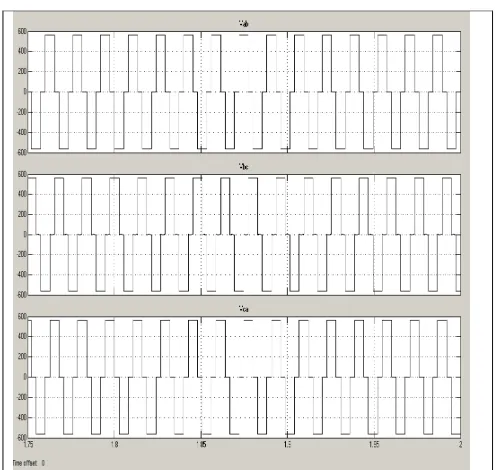
Computer Simulation of SPWM-VSI for minimize the starting torque and current in Asynchronous Motor Drive Page 295 In figure 5.1 shows the output voltage Vab, Vbc &
Vca.
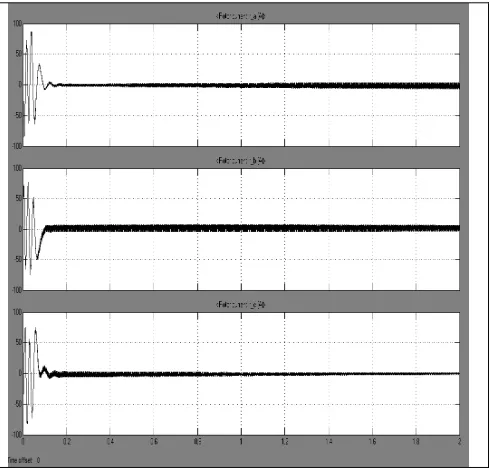
Figure. 5.2: Rotor Current waveform
In figure 5.2 shows the magnitude of rotor current is initially high and after 0.1 Sec it settles down.
Figure .5.3 Electromagnetic torque and Rotor speed of
induction motor
Torque is inversely proportional to slip at the time of starting and after the breakdown torque it becomes proportional to the Slip.
In figure 5.3 shows Rotor speed of the induction motor rises initially and then after 0.1 sec it becomes constant.
In figure 5.4 shows the proposed pulse width modulation inverter fed induction motor model in MATLAB/Simulink.
Figure .5.4 Simulink model of Proposed PWM inverter
fed Induction motor
Computer Simulation of SPWM-VSI for minimize the starting torque and current in Asynchronous Motor Drive Page 296
Figure.6.1 Output voltage of PWM fed VSI
In figure 6.1 shows the elimination of lower order harmonic the output voltage becomes smooth (behaves like sine wave).
Figure.6.2 Rotor Current waveform
The rotor current fluctuates between 0 to 0.1 sec and after 0.1 sec its magnitude becomes 5 amps. In VSI fed induction motor drive the starting current magnitude is high (approximately 80 amps), as compared to PWM fed inverter
modeling where current magnitude is
approximately 60 A.
It can easily observe by using the PWM fed inverter; the starting current value goes to minimize.
Figure.6.3 Electromagnetic Torque and Rotor Speed
Here magnitude of starting torque rises as compared to inbuilt VSI model. Due to elimination of lower order harmonic the pulsation in torque also minimizes.
VII. Conclusion
The modeling, analysis and control of 3-Φ induction motor with performance analysis of VSI fed 3-ΦInduction Motor drive and PWM fed VSI AC Motor drive. For this purpose the proposed drive system is designed in MATLAB/Simulink. The two test results are implemented VSI fed and PWM fed asynchronous motor drive is shown. Control process of machine can be improved by
PWM inverter. The Rotor current and
electromagnetic torque is reduced by using PWM inverter in induction machine and speed will also be reduced in motoring mode.
Computer Simulation of SPWM-VSI for minimize the starting torque and current in Asynchronous Motor Drive Page 297 modulation index it can vary the frequency of
output voltage of VSI in such a way that v/f ratio remains same.
The effect of modulation index on line voltage and phase voltage has been carried out which shows the Total Harmonic Distortion decreases with increase in modulation index.
VIII. Acknowledgment
We are thankful to the administrative authority of Vindhya institute of technology and science, college Indore for their support and in
completion of my research. I am also thankful to all the staff of electrical department for their support in preparing the research model.
REFERENCES
[01] G.K.Dubey,’ Fundamental of electrical drives’ Narosa Publication, Second Edition, 2011. [02] Bimal k Bose,‘Modern power electronics & AC drives’ Pearson Education, Third Edition,2007. [03] Bimal k Bose,’Power electronics & variable frequency drives’ IEEE Press, 1997.
[04] P. S. Bimbhra, ‘Electrical Machine’ Khanna Publication.
[05] M. H. Rashid, ‘Power Electronics devices Circuits and applications’ PHI publication, Third Edition. [06] P. S. Bimbhra, ‘Power Electronics’ Khanna Publication.
[07] Dr. Shailendra Jain, ‘Modeling and simulation using MATLAB Simulink’,Wiley India,2012.
[08] C. S. Sharma, Tali Nagwani, ‘ Simulation and analysis of pwm inverter fed induction motor drives’ IJSETR Volume-2, Feb, 2013.
[09] B. Basavaraja, D. V. S. S Siva Sarma, ‘Modelling, simulation and experimental analysis of transient terminal overvoltage in pwm- inverter fed induction motor’ IEEE, 2007.
[10] Veera Chary, Digital Simulation of Sinusoidal PWM Inverter Fed Induction Motor Drive’ IEEE International Conference on PEDS-99,July 1999, Hong Kong.
[11] Puja Talukder, Prashant Kumar Soori, and Benetta Aranjo, ‘Speed Control of Induction Motor Drive Using Universal Controller’ IEEE International Conference (PEOCO2012),6-7 June 2012 Melaka, Malaysia.
[12] Mohd Fakhizan bin Romlie, Mohammad Fadhil Pesol and Khairul Nisak Md Hasan, “PWM Technique to Control Speed of Induction Motor using Matlab/xPCTarget Box” 2nd IEEE International Conference on Power and Energy (PECon 08), December 1-3, 2008, Johor Baharu, Malaysia.
[13] Pradeep Ranjan Tripathy and Bibhu Prasad Panigrahi “Simulation Study on DTC Based Induction Motor Drives using MATLAB” IEEE 978-1-4244-2746-8/08©2008
[14] Mohamed M. M. Negm, “Torque Optimized Speed Control of a 3-Phase Induction Motor” IEEE 0-7803- 6338-8/00.
[15] M. Harsha Vardhan Reddy, V.Jegathesan “Open Loop V/f Control of Induction Motor based on Hybrid PWM With reduced torque ripples” IEEE 978-1-4244-7926-9/11
[16] Dr. M.V. Aware, Dr. S. G. Tarnekar, Jagdish G. Chaudhari “Improved Direct Torque Control Induction motor drive” IEEE 1-4244-0549- 1/06
Computer Simulation of SPWM-VSI for minimize the starting torque and current in Asynchronous Motor Drive Page 298 [18] S. Yuvarajan, Bellamkonda Ram swami, And V. Subramanian “Analysis of a Current- Controlled Inverter-Fed
Induction Motor Drive using digital Simulation ”IEEE Transactions On Industrial Electronics and Control Instrumentation, Vol. Ieci-27 No. 2, May 1980.High Power Application” Proceedings of India International Conference on Power Electronics 2006.
[19] J. F. Bangura “Simulation of Inverter-Fed Induction Motor Drives with Pulse-Width Modulation by a time-stepping coupled finite Element-flux linkage-based state space model” IEEE Transactions on Energy Conversion, Vol 14, No. 3, September 1999.
[20] Sunil M. Chhaya and Bimal K. Bose “Expert System based automated simulation and design Motor’s optimization of a voltage-fed Inverter for induction” IEEE 0-7803-089 1 – 3/93.
[21] Tolga Sürgevil “Modeling and Simulation of a Boost DC/AC Inverter fed Induction Motor Drive” 978-1-4673-5003-7/11IEEE Acemp – Electro motion 2011, 8 - 10 September2011 Istanbul – Turkey.
[22] J.Klima, M.Chomat and L Schreier “Analytical Investigation of Voltage Source Inverter Ped Induction Motor Drive under Fault Conditions” IEEE ICIT'02, Bangkok, Thailand
[23] M. Depenbrock, “Pulse width control of a phase inverter with non sinusoidal phase voltage of a three-phase PWM inverter”, Proc. IEEE Int. Semiconductor Power Conversion Conf., Orlando, Florida, USA, pp. 399-403, 1977.
[24] D. G. Holmes and T. A. Lipo, “Pulse Width Modulation for Power Converters” Principles and Practices, IEE Press, Wiley Publications, New York, USA. 2000
[25] J. Holtz, “Pulse width modulation- a survey”, IEEE Trans. On Industrial Electronics, Vol. 39, No. 5, pp. 410-420, Oct.1992.
[26] J. Holtz, “Pulse width modulation for electronic Power conversion”, Proc. IEEE vol. 8., pp. 1194- 1214 Aug. 1994.
[27] www.mathwork.com
AUTHOR’S PROFILE :
Rakesh Singh Lodhi has been teaching and research from last five years & working as an Assistant Professor in Department of Electrical & Electronics Engineering at Vindhya Institute of Technology & Science, Indore (M.P.) India. He guided research project in vector control of ac motor drives in post graduate level. He is working in new research areas include Electric vehicles, Brushless DC Motor drives, PWM Inverter, Control and electrical drives.