PERCEPTIONS OF SCHOOL HEADS ON PARENTS’ INVOLVEMENT ON THE
ZIMBABWEAN PRIMARY SCHOOLS
THEMBINKOSI TSHABALALA
Senior Lecturer and National Programme Leader for the Master of Education in Educational Management in the Faculty of Arts and Education at the Zimbabwe Open University
ABSTRACT
The involvement of parents in Zimbabwean schools is governed by Statutory Instrument 87 of 1992
(SI87) for non-government schools and Statutory Instrument 379 of 1998 (SI379) (Bowora and Mpofu, 1998) for government schools. Non-government schools are run by School Development
Committees (SDCs) and government schools are run by School Development Associations (SDAs). It is argued that comprehensive parent involvement is a pre-requisite for improving the culture of teaching and learning in schools. Against the background of a literature review which examines
legislation affecting parents, this article draws on a qualitative inquiry of parent involvement in a small sample of primary schools in Matabeleland North selected by means of purposeful sampling.
The research adopted a qualitative methodology using a case study design. Data were gathered by means of semi-structured interviews using an interview guide. Views of the research respondents were audio-taped, transcribed and became the primary data for analysis. The findings indicated
that the schools were doing more to involve parents than is legally required. Strong leadership from heads of schools together with formal organisation of parent involvement has established
parent-friendly schools, regular home-school communication and innovative parent volunteering. However, certain reservations to parental involvement were detected in school heads’ attitudes. The study recommends that together with enabling legislation, schools can develop valuable
initiatives to make parents more active and equal partners in the governance of schools.
Keywords:
School Development Committee
School Development Association
Parent involvement
School heads
Parent-friendly schools
International Journal of Asian Social Science
INTRODUCTION
The benefits of collaboration between parents and teachers are widely supported by research
(Henderson and Berla, 1994; Booth. and Dunn., 1996; Cairney, 2000), and such collaboration is currently included in the policy of most education systems throughout the world. In Great Britain,
government support home-school and parent education programmes gained particular attention in
the Government‟s Education White Paper Excellence in schools in July 1997 (National Children‟s
Bureau., 2000) and the contribution of parents has been linked to school effectiveness (Munn, 1993; Bastiani and Wolfendale, 1996; Wolfendale and Bastiani, 2000; Wolfendale, 2002). The importance of parent involvement is also evident in Australia (Angus, 1995) and New Zealand
(Renwick, 1989). Parent involvement and school improvement have been linked in Hong Kong
(Ng, 1999), the Netherlands (Smit et al., 1993) and Indonesia (Van der Werf et al., 2000). Additionally, the concept of parents as partners with schools has been well established in federal
and state policy and legislation in the United States (United States Department of Education, 1996)
and the rights of parents have been given considerable attention in the education systems of the
European Union (European Information Network on Education., 1998).
In spite of this positive trend, it is difficult to understand why there is not more actual parent
involvement in schools. This paper, therefore, explores the challenges that make it difficult for
schools and legislators to translate the intention to increase parent involvement into practice.
Merely to invite parents into schools is easier than overcoming subtle and powerful barriers to
effective parent involvement on the part of teachers and parents. Most of the time, attitudes of
schools towards active parent involvement are ambiguous. Although the official rhetoric claims
that the parent-teacher relationship should be collaborative, equal and reflect an even distribution of
power, this is often absent in schools. Investigations into parent involvement in Zimbabwean
communities from the perspectives of teachers, parents and learners confirm the need for a broader
conceptualisation of parent involvement which includes, but transcends, parent participation in
school governance. Against the background of current policy and legislation, this paper reports on
the implementation of comprehensive parent involvement in a small sample of primary schools in
Zimbabwe based on the findings of a qualitative inquiry.
Statement of the Problem
The study sought to investigate the perceptions of heads of primary schools towards parents
involvement in school developments.
Purpose of the Study
The study‟s aim was to expose the challenges encountered by parents in the governance issues of primary schools in Zimbabwe through interrogating the heads‟ experiences in their capacities as
Research Objectives
The study intended to:To use heads‟ experiences in coordinating activities of SDCs/SDAs to unmask the operational challenges that they experience.
To explore strategies that the Ministry of Education, Sport, Arts and Culture can adopt to
improve the functioning of SDCs/SDAs.
Research Questions
The study was guided by the following research questions:
Basing on the experiences of heads of schools, what are the challenges and limitations
being experienced by SDCs/SDAs?
How can the challenges experienced by SDCs/SDAs be addressed?
LITERATURE REVIEW
Conceptualisation of Parent Involvement in School Governance
Before independence, parents in Zimbabwean schools operated in an ethos of authoritarianism
(Moyo, 2000). The state regarded parent involvement (particularly in schools for blacks) primarily as a means of financing schools. At best, parents were seen as clients who had little say in school
management and functioning. Parent responsibilities were perceived in terms of payment of school
fees, attendance of school events and fundraising. In many communities, parent involvement has
been virtually non-existent due to political turbulence, poor socio-economic conditions, teacher
reluctance and parent apathy (Chindova, 1999). Eipsten and Dauber (1993) recommended a comprehensive strategic model of parent involvement which includes diverse types of parent
activity. Various approaches to home-school partnerships that combine effective family practices
with positive school programmes exist (Corner, 1984; Coleman, 1987; Swap, 1993; Epstein, 1995)
(Gordon, 1977). Various authors advocate a broad approach to parent involvement which extends beyond school governance to incorporate as many and as diverse a representation of parents in a
variety of tasks in and outside the school (Bastiani, 1989; Swap, 1993; Epstein, 1995). Currently, the most comprehensive model of partnership in the literature appears to be Epstein (1995)
framework of six major types of parent-school involvement: parenting; communication,
volunteering, learning at home; decision-making and community collaboration. Each type of
involvement poses specific challenges for its successful design and implementation and each leads
to different outcomes for learners, parents and teachers (Epistein et al., 1997). Integral to the model is an organisational structure that coordinates schools, family and community partnerships
(Epistein et al., 1997). The latter should comprise parents and teachers and be part of, but not synonymous with the school governing body. Epstein in (Nardine and Morris, 1991) also maintains that rhetoric about the importance of parent involvement is meaningless without financial and
Parents are called upon to assume their responsibilities as citizens of a democratic state through the
fulfilment of basic responsibilities. Furthermore, the broad definition of parents implies that
schools should acknowledge a variety of family types and develop a range of home-school linkages
accordingly. Thus, teachers should co-operate with non-traditional caregivers; for example, grant
parents, other relatives and older siblings. Many children in disadvantaged communities in
Zimbabwe are cared for by grandparents or other relatives. However, it is exceptional for schools to engage a learner‟s relatives actively and purposefully in parent involvement practices (Angus, 1995). Laudably, the extensive powers of the school governing bodies accommodate the parents‟
role in vital matters of school governance. However, the contribution of parents in governing
bodies is limited. The empowerment of the larger parent body depends on the efficacy of the liaison
between them and the school governing body as well as the capacity of elected parent
representatives to function effectively as governors. Many working-class and rural parents face
constraints in terms of participation in school governing bodies as a result of poor skills, distance
from schools and lack of time. Provincial and district education departments tasked with
developing the skills of these bodies‟ members provide brief and uneven training for new
governing bodies (Epstein, 1995).
Establishment of School Development Committees
A School Development Committee is a body corporate which is a stand-alone committee of the
school that can sue or can be sued like any other business enterprise. The committee members are
elected by parents/guardians of children in each of the schools in Zimbabwe (secondary and
primary) government or non-government. The establishment of School Development Committees
is governed by the Education Act of 2006 (Chapter 25:04).
Roles of School Development Committees/Associations
School Development Committees/Associations in Zimbabwe are supposed to provide resources and
assist in the operation and development of the school. They are expected to advance the moral,
cultural, physical and intellectual welfare of the pupils in the schools and to promote the welfare of
the school for the benefit of its present and future pupils, their parents, teachers and the community
at large. SDC/SDAs preserve and maintain the property and facilities of the school, employ, pay
and fire support staff and at times, employ additional teachers to serve the needs of the school
conditions and terms approved by the Minister (through the Provincial Education Director). They
are also expected to see and take professional advice on matters affecting the committee and the
school.
Significance of the Study
The importance of this study lies in that if heads of schools‟ experiences illuminate the challenges and limitations being experienced by SDCs/SDAs, measures can be put in place to ensure that
improve the monitoring of SDC/SDA activities by the Ministry of Education, Sport, Arts and
Culture officials to make sure that parents are accorded the full rights in the affairs of their schools.
Limitations of the Study
The study is limited to the absence of the parents‟ voice on their involvement in school affairs. The study is also limited to a detailed account of parent involvement and is thus no more than a snap
shot of practice in specific settings. Clearly, the findings cannot be generalised but they alert one to
both the possibilities of parent involvement and difficulties encountered in a small sample of
Zimbabwean schools.
Delimitations of the Study
The researcher delimited the investigation to establishing challenges faced and limitations
displayed by parents as they participate in School Development Committees or Associations.
Views of principals from ten primary school head teachers were used in the research. Perceptions
from other stakeholders like parents themselves, school children among others, were not sought by
the study.
Research Methodology
The study adopted a qualitative methodology and made use of case study and document analysis,
research designs. The methodology and the designs were selected because they afforded the heads
the opportunity to relive their experiences in their daily interactions with parents. The population
consisted of ten heads of schools from one cluster in Nkayi District in Matabeleland North Province of Zimbabwe. The inquiry explored heads‟ accounts of parent involvement in the governance of primary schools. Griffith (2000) emphasises the key role of the school heads, who as school leaders, are well positioned to drive parent involvement. She found that the definitive role of
the principal in parent involvement is cardinal in schools with non-involved parents and
disadvantaged school populations. Moreover, Chapman and Birchfield (1994) argue that principals in developing countries play a particularly striking role in implementing all school polities
including parent involvement.
Data Collection and Analysis
Data were gathered by means of semi-structured interviews lasting forty-five minutes using an
interview guide. All interviews were audio-taped, transcribed and became the primary data source
for analysis conducted by the researcher. The aim was to understand experiences from the participants‟ point of view. No attempt was made to generalise the findings or prove hypotheses. A transparent disclosure of the role of the researcher and his or her relationship with the participants, the „volunteering‟ of participants and description of school settings was done to contextualise the research and allow for the impact of the researcher role and participant selection on findings. The
Findings and Discussion
The study sought to investigate the perceptions of school heads on the involvement of parents in
Zimbabwean primary schools. This section is presented in two parts namely, demographic data and
actual findings.
Demographic Data
Table-1. Distribution of research participants by sex (N=10)
Sex Frequency Percentage
Male 7 70
Female 3 30
Total 10 100
As Table 1 shows, 70% of the heads of schools were male and 30% of them were female. This
datum was considered statistically significant to the extent that it tended to confirm the gender gap
(in favour of males) with senior management in rural primary schools which has always been
pointed out by many a gender activist on educational publications. For example, Bowora and Mpofu (1998) clearly acknowledge the existence of disparities in senior management positions between males and females in Zimbabwean rural schools and described them as a cause for
concern.
Table-2. Composition of respondents by approximate age (N=10)
Age in years Frequency Percentage
30-39 years 2 20
40-49 years 4 40
50+ years 4 40
Total 10 100
Table 2 shows the age range for principals and teachers. As the table demonstrates the majority of
the school heads were aged at least 40.
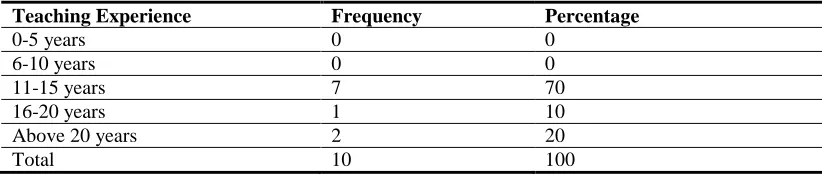
Table-3. Composition of respondents by experience as heads of schools (N=10)
Teaching Experience Frequency Percentage
0-5 years 0 0
6-10 years 0 0
11-15 years 7 70
16-20 years 1 10
Above 20 years 2 20
Total 10 100
Information on Table 3 indicates that the vast majority of heads of schools in this study have been
in their posts for more than 10 years, since the categories of 0-5 years and 6-10 years passed by the
Table-4. Composition of respondents by highest qualification (N=10)
Highest Professional Qualification Frequency Percentage
Primary Teachers‟ Lower (PTL) 0 0
Primary Teachers‟ Higher (PTH) 0 0
Certificate in Education (CE) 3 30
Diploma in Education (DipEd) 2 20
Bachelor of Education (BEd) 5 50
Master of Education (MEd) 0 0
Total 10 100
The demographic characteristics of respondents are shown in Table 4. Half of them have acquired
the Bachelor of Education in Education Degree (50%) and 30% of them are Certificate of
Education holders, while 20% of them are Diploma of Education holders. This information is
significant in that it demonstrates that all heads have acceptable qualifications.
Actual Research Findings
According to international literature, there is a link between school effectiveness and improvement
and school-based parent involvement programmes (Chrispeels, 1992). This inquiry suggests that strong parent involvement was linked to sound management and a strong culture of teaching and
learning in these schools. The absence of the culture of teaching and learning is a grave concern in
most rural schools in Zimbabwe. Most of the heads in this study agreed that most members of
SDCs/SDAs were very keen to participate in school governance issues but were discouraged by
lack of time and expertise in understanding some of the technical issues in the running of schools.
For example, issues to do with the curriculum finance and employment contracts of teachers
usually gave them challenges. It was the duty of the heads to guide the parents on these issues. To
promote effective home-school communication, schools should establish regular two-way communication with all families about school programmes and children‟s progress (Epistein et al., 1997). All the heads regularly communicated with parents sometimes directly through children or through parents‟ meetings and indirectly through community leaders like chiefs, councillors and others.
A common tendency among schools is to communicate with the home only when a behavioural or
learning problem arises and to neglect to communicate good news about learners‟ achievements
(Dietz, 1997). Most heads acknowledged that problem-orientated communication was the norm. Where achievements were acknowledged, this was done by sending a child‟s work home for a parents‟ signature. All heads of schools found that attendance of large, general parent meetings, including the crucial school governing body elections, was extremely poor. “We really have to work hard to get parents to come to meetings.‟‟ Some schools even struggled to obtain the mandatory quorum to elect numbers of the School Development Committees or School
Development Associations. In contrast, individual parent-teacher meetings where parents obtained
Cullingford and Morrison (1999) agree that parents who are hard pressed for time are less concerned about policy issues and are primarily interested in their own child‟s progress. All head teachers claimed an open-door policy. One described this saying: „I always invite parents to come to my office any time they feel like.‟ However, many parents are intimidated by contacting a school and especially the head. Moreover, heads of schools are inundated by parental demands on their time. One head resorted that, „Unfortunately, having an open-door policy can backfire on you because your door is always closed because you always have people with you.‟ Another head of school did home visits in cases of repeated absenteeism or suspected child neglect. But the data
showed that both written communication and parent-teacher meetings focused on the teachers‟
telling parents about activities and how children were progressing. To realise an equal partnership, parents‟ voices must be heard. Some of the schools found that a suggestion box functioned well. Parents could bring in their suggestions, comments or complaints which were referred daily to a
senior teacher for immediate follow-up. But these strategies tended to provide parents with an
anonymous and limited voice in the school.
Schools must become places where families feel wanted and recognised for their strengths and
potential. Frequently, families, particularly poor families, do not feel welcome in school. In a sound
partnership, this can be partly overcome by creating more family-like schools (Epistein et al., 1997), which recognise each child‟s individuality and approach all families, not just those who are
easy to reach. But, in spite of an open-door policy espoused by all schools, the data suggest that
going beyond the hard core of interested parents and reaching larger numbers remains more of an ideal than reality, as one heard remarked: „Disempowered parents are not going to come knocking at the door and say, “Here I am.” They have to be invited and the school is in the position to invite someone into its domain.‟ The endeavour to create an invitational environment was an ongoing concern for all heads that recognised that the responsibility lay with the school in what is often an
unequal partnership. Another head observed „My response to parent apathy is “How good is the school environment for parents?” Are they seen as the source of challenge or the source of complaint? I believe we‟ve got to make parents welcome.‟
A welcoming atmosphere requires more than just the rhetoric of policy. Activities to involve
parents should consider the pressures of contemporary family life, should be feasible to impellent
and equitable to all types of families (Epistein et al., 1997). These schools made concrete efforts to accommodate working parents on their terms. Parent meetings were held on Saturday mornings,
Sundays or even public holidays so that parents could attend. Teachers were expected to work these
unconventional hours without special compensation. Parents were given a tour of the school,
visited classrooms, sat with their children at their desks and observed school activities.
Epistein et al. (1997) maintain that an individual cannot create a lasting compressive programme of parent involvement but, along with clear policies and strong support from education authorities, a
had a written policy on parent involvement, although heads mentioned advice given to teachers at
staff meetings regarding how to deal with parents.
In all cases, head teachers enjoyed harmonious relations with the governing body the SDCs/SDAs.
Heads spoke warmly of their relationship with the chairperson or members whom they singled out for special mention. But a few linked this appreciation to the SDCs/SDA‟s allowing them to retain what they viewed as their legitimate autonomy as head. Some SDCs/SDAs want to poke their nose
in certain things, which is not really their sphere. Especially, the academic things which definitely do not fall into the area of the SDC‟s jurisdiction. One head was outspoken in this regard: “They leave me to run the school. Yes we will discuss things but I am the one who makes the decision.” Most heads indicated that finding members willing to stand for the posts in the SDC is not easy. It
is a great commitment to work as an SDC member. Members had to meet at least monthly and that
is just the main committee. Meetings are usually long and members are also co-opted to
sub-committees. Another head repeatedly mentioned that parents feared that election to the school
committee would mean sacrificing their home duties to spend time in the school mostly for no
benefit.
At some time in all the interviews, the heads referred to the ambiguous relationship with parents.
Parents involvement undoubtedly added value to the school, yet dealing with parents was seen as a
delicate and time-consuming task. Parents could be a source of trouble as one had summed it up: „A parent can really be a tricky thing. Sometimes you just have to handle them with kid gloves because you get some who will easily say, “I‟ll take my child out of your school.” In spite of good practice in their schools, the heads typified the view that the curriculum is the province of
professional educators and that parental input in curriculum and instruction was unwelcome
(Thomas, 1998). One head mirrored this viewpoint: “I don‟t really want parents to interfere in the
classroom. One is very sensitive to that.‟‟ All heads showed a need to „control‟ parents, to maintain a balance of power with regard to parents who might interfere. One head remarked: „We have our few that need to be sorted out and we sort them out‟. Another head was very emphatic: „I don‟t take any nonsense from the parents; I don‟t take nonsense from the School Development Committee.‟
CONCLUSIONS
The heads of schools revealed that in spite of the legislation promoting the existence and operations
of SDCs, these committees experienced challenges during their activities in schools.
Most members of SDCs/SDAs were very keen to participate in school governance issues but
were discouraged by lack of time and expertise in understanding some of the technical issues
in the running of schools.
There are challenges related to communication gaps between schools and parents especially on
positive developments.
Many heads admitted that many parents were intimidated by contacting a school and especially
the head, in spite of the pronounced open-door policy.
Most heads indicated that they enjoyed harmonised relations with the governing SDC/SDA
body. However, this was linked to the legitimate autonomy that SDCs/SDAs allowed heads.
Most heads also indicated that most parents were very reluctant to take up posts as members of
the SDC/SDAs.
RECOMMENDATIONS
Having the above findings and conclusions, the research puts forth the following recommendations:
Schools should involve parents in setting goals of the school and consult them for their views
so that they could cooperate and participate freely in school affairs.
Schools should increase the frequency of holding parents meetings and educate parents on
school policies and financial management so that they can be fully conversant with technical
issues in running of schools.
Heads should allow parents to partake in decisions concerning the academic issues which
heads regard as their sole preserve.
Schools can also come up with mechanisms that would help them identify potential parents
with skills to include in the SCDs/SDAs.
There is need for schools to constantly and consistently communicate with parents about their
children on both positive and negative issues; the tendency is to communicate mainly the
negative things like the misbehaviour of pupils or poor academic performance.
Schools should hold meetings at convenient times for parents and committee members to
participate without affecting negatively their other commitments. Meetings should not be held
too early during the day or late during the day. They should not take long hours as this
discourages parents from attending.
REFERENCES
Angus, M., 1995. Devolution of school governance in an australian state school system: In
case studies in educational change: An international perspective. London: Falmer.
Bastiani, J., 1989. Listening to parents: An approach to the improvement of home/school
relations London: David Fulton.
Bastiani, J. and S. Wolfendale, 1996. Home-school work in britain: Review, reflection and
development. London: David Fulton.
Booth. and Dunn., 1996. Family-school links: How do they effect educational outcomes?
. New Jersey: Lawrence Erlbaum.
Cairney, T.H., 2000. Beyond the classroom walls: The rediscovery of the family and
community as partners in education. Educational Review 25(2): 163 – 174.
Chapman, W. and S.A. Birchfield, 1994. How headmasters perceive their role. A case
study in botswana. International Review of Education 49(6): 163-174.
Chindova, M., 1999. The principals‟ role in the management of parent involvement in
rural schools. Harare: ZPH.
Chrispeels, D., 1992. Using an effective schools framework to build home-school
partnerships for student success. Paper prepared for the national centre for
effective schools. Wisconsin Centre for Education Research. University of
Wisconsin – Madison.
Coleman, J.S., 1987. Families and schools. . Educational Researcher: 32-38.
Corner, J.P., 1984. Home/school relationships as they affect the academic success of
children. Educational Review SI(3): 253-262.
Cullingford, C. and M. Morrison, 1999. Relationships between parents and schools: A
case study. Educational Review 51(3): 253-262.
Dietz, J., 1997. School, family and community. Techniques and models for successful
collaboration. Gaithesburg, Maryland: Aspen.
Eipsten, J.L. and S.L. Dauber, 1993. Parents‟ attitudes and practices of involvement in
schools. New York: New York State University.
Epistein, J.L., L. Coates, K.C. Salinas, M.G. Sanders and B.S. Simon, 1997. School,
family and community partnerships: Your handbook for action. Corwin:
Thousand Oakes.
Epstein, J.L., 1995. School/family/community partnership: Caring for the children we
share. Phi Delta Kappa May.
European Information Network on Education., 1998. The role of parents in the education
system of the european union. Brussels: Eurydice.
Gordon, I.J., 1977. Parent education and parent involvement. Retrospect and prospect.
Childhood Education November.
Griffith, J., 2000. Principal leadership of parent involvement. Journal of Educational
Administration, 39(2): 162-186.
Henderson, A.T. and N. Berla, 1994. A new generation of evidence: The family is critical
to student achievement. Columbia: National Committee for citizens in Education.
Moyo, S.V., 2000. Parents and schools: Customers, managers or partners? . Harare: ZPH.
Munn, P., 1993. Parents and schools: Customers, managers or partners? . London:
Routledge.
Nardine, F.E. and R.D. Morris, 1991. Parent involvement in the states: How firm is
commitment? Phi Delta Kappa January: 363 – 366.
Ng, S., 1999. Home-school relations in hong kong: Separation or partnership. School
Effectiveness and School Improvement, 19(4): 551 – 560.
Renwick, M., 1989. Keeping in touch: Teachers and parents in kindergartens. Wellington:
New Zealand Council for Educational Research.
Smit, F., W. van Esch and H.J. Walberg, 1993. Parental involvement in education.
Nijmejen: The Netherlands:ITS.
Swap, S.M., 1993. Developing home-school partnerships: From concepts to practice. New
York: Teachers College Press.
Thomas, G.J., 1998. Education, law and practical rights. In home school relations:
Working successfully with parents and families. Needham Heights, Naine: Allyn
and Bacon.
United States Department of Education, 1996. Reaching all families: Creating family-
friendly schools. Washington: US Department of Education.
Van der Werf, G., B. Creemers and H. Guldemond, 2000. Improving parental
involvement in primary education in indonesia: Implementation, effects and costs.
School Effectiveness and School Improvement 12 (4): 447-466.
Wolfendale, S., 2002. Parent partnership services for special educational needs:
Celebrations and challenges. London: David Fulton.
Wolfendale, S. and J. Bastiani, 2000. The contributions of parents to school effectiveness.
London: David Fulton.
AUTHOR’S BIO-DATA
1. Dr. Thembinkosi Tshabalala is a Senior Lecturer and National Programme Leader for
the Master of Education in Educational Management in the Faculty of Arts and Education
at the Zimbabwe Open University. To date, he has published more than 3 research articles
international peer reviewed journals. He has presented 8 papers at international
conferences and 10 papers at local conferences. He can be contacted by business address:
Zimbabwe Open University P.O.Box MP1119 Mount Pleasant Harare, Zimbabwe OR by