Review
1
Protein 0
th
-Order Structure: The Key for Creating
2
Entirely New Gene/Protein
3
Kenji Ikehara1,2,3,*
4
1 G&L Kyosei Institute, Koharu Bld. 202, Hokkeji 153-4, Nara 630-8001, Japan
5
2 The International Institute for Advanced Studies of Japan, Kizugawadai 9-3, Kizugawa, Kyoto 619-0225, Japan
6
3 Professor emeritus of Nara Women’s University, Japan
7
* Correspondence: [email protected]; Tel.: +81-774-73-4478
8
Abstract: Understanding the mechanism, how entirely new (EntNew) gene/protein or the first
9
ancestral gene/protein of a family was created, should be one of the most important issues in the
10
biological sciences. However, the mechanism is totally unknown still now. On the other hand, it is
11
well known that mature protein is generally rigid and one catalytic center exists on the protein.
12
Creation of such a mature EntNew gene/protein should be, of course, carried out through random
13
process, because it cannot be designed in advance. However, the EntNew gene/protein never be
14
created by random polymerization of the respective monomeric units, because of the extraordinary
15
large sequence diversities of ~10180 and ~10130, respectively. Protein 0th-order structure or a specific
16
amino acid composition, in which immature but water-soluble protein can be produced even
17
through random process, holds the key for solving the difficult problem. As it was fragmentally
18
described in the previous papers how and where EntNew gene/protein was created, I describe in
19
detail in this review three processes generating EntNew gene/protein with some flexibility under
20
three genetic codes, the universal genetic code, SNS primitive code and GNC primeval code, and
21
discuss why the mature gene/protein could be created through the processes.
22
Keywords: protein 0th-order structure; origin of gene; origin of protein; origin of genetic code; GNC
23
primeval genetic code hypothesis; SNS primitive genetic code hypothesis
24
25
1. Introduction
26
In every textbook of “Biochemistry” or “Molecular biology”, formation of water-soluble
27
globular protein always starts from amino acid sequence of a protein or protein primary structure,
28
which is specified by gene expression, or transcription and translation of a gene. Polypeptide chain
29
produced by the gene expression is, first, folded into the respective secondary structures (-helix,
30
-sheet and turn/coil structures) and, further, the secondary structures are assembled to tertiary
31
structure (Figure 1) [1].
32
On the other hand, S. Ohno was proposed “gene duplication theory” for new gene formation
33
about 50 years ago. The theory suggests that new gene is produced from one of duplicated genes [2].
34
Thereafter, it has been confirmed that the theory can well explain the way, how new homologous
35
genes in a family gene have been created. However, the gene duplication theory has a fatal weakness
36
that a previously existing gene is always required to create a new homologous gene. Therefore, the
37
theory cannot show the way, how entirely new gene/protein (EntNew gene/protein) or the first
38
family gene/protein was created. The word, gene/protein, is used to indicate gene and/or protein in
39
this article, because both are always intimately related to each other after the first gene/protein was
40
created.
41
It would be obvious that both base sequence and amino acid sequence of mature gene/protein
42
cannot be designed in advance, and, therefore, EntNew gene/protein must be produced by random
43
polymerization of nucleotides and amino acids. However, EntNew gene/protein could not be
44
produced by random joining of the respective monomeric units, because diversities of base sequence
45
and amino acid sequence for a small protein composed of 100 amino acids are extraordinary large as
46
(43)100 = ~10180 and 20100 = ~10130, respectively (Figure 1) [3]. Furthermore, the genetic information
47
could not be generated without a target of protein. Therefore, it is totally unknown how EntNew
48
gene/protein is created, regardless of significance of the creation of EntNew gene/protein in
49
biological sciences (Figure 1). Those would be the reason, why formation process of protein starts
50
from amino acid sequence in every textbook still now.
51
I previously described in several papers that a special amino acid composition or protein
52
0th-order structure is essential to understand the creation of EntNew gene/protein through random
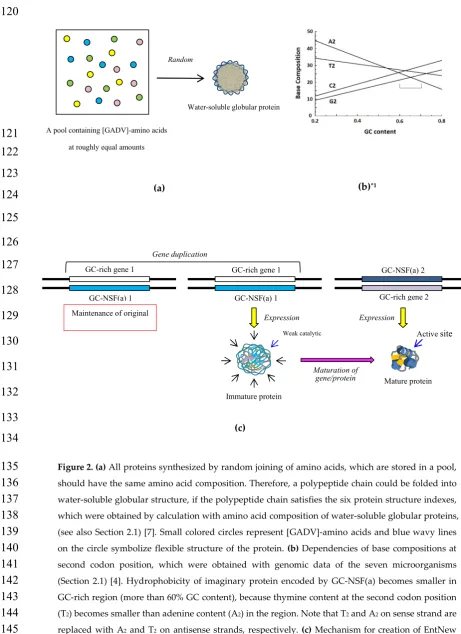
53
polymerization of the respective monomeric units [4-9]. However, the descriptions in the previous
54
papers were rather fragmentary. Then, I describe the characteristics and significance of protein
55
0th-order structure through the creation mechanism of EntNew gene/protein in this review article.
56
The reason, why the number of references in this article is not many, is because almost no
57
investigation about the creation of EntNew gene/protein has been reported except our studies so far.
58
59
60
61
62
Figure 1. Gene expression (transcription and translation) and protein structure formation. After
63
polypeptide chain was synthesized by the gene expression, the chain (primary structure) is folded
64
into secondary and tertiary structures However, both mature gene and mature protein could not be
65
created directly through random processes. On the other hand, understanding the process of
66
EntNew gene/protein should be one of the most important issues in the field of biological sciences.
67
Nevertheless, it is totally unknown still now, how and from what mature gene/protein was created.
68
Asterisk (*) indicates the result calculated under the genetic code without degeneracy.
69
2. Creation of EntNew gene/protein under protein 0th-order Structure
70
2.1. Properties of modern water-soluble globular protein and protein 0th-order structure
71
It would be unquestionable that six properties (hydrophobicity/hydrophilicity (hydropathy),
72
-helix, -sheet, turn/coil formabilities, acidic amino acid (Acidic-AA) content and basic amino acid
73
(Basic-AA) content) are important for protein structure formation. Hence, the six protein structure
74
indexes of water-soluble globular proteins encoded by genomes of seven microorganisms with
75
different GC content (Mycobacterium tuberculosis (GC=65.6%), Aeropyrum pernix (56.3%), Escherichia
76
coli (50.8%), Bacillus subtilis (43.5%), Haemophilus influenzae (38.1%), Methanococcus genitarium (31.3%)
77
Protein structure formation
mature
Gene mRNA
mature
Protein (Primary Secondary Tertiary structure) transcrption translation
Random process
Impossible! (~1/10180)*
Random process
Impossible! (~1/10130)
from What ? How ?
and Borrelia burgdorferi (28.2%)) were calculated with amino acid composition in a protein and
78
hydropathy and secondary structure indexes of amino acid given in Stryer’s text book [1],
79
according to the following equation for the former four protein indexes [10]. I(x)t = I(x)a na/nt,
80
where I(x)t, I(x)a, na and nt are total index of a protein, index for each amino acid, each amino acid
81
number and total amino acid number in a protein, respectively. Acidic-AA (aspartic and glutamic
82
acids) and basic-AA (histidine, lysine and arginine) contents were arithmetically obtained. The six
83
average protein structure indexes, which were obtained with water-soluble globular proteins
84
encoded by the seven genomes, were as follows: Hydropathy (-1.51 ± 0.38), -helix (1.03 ± 0.03),
85
-sheet (1.00 ± 0.02), turn/coil (0.96 ± 0.05) formabilities, Acidic-AA content (12.0 ± 3.2%) and
86
Basic-AA content (14.1 ± 3.1%) [10]. Therefore, it is expected that if all the six protein structure
87
indexes of an imaginary protein fall within the respective ranges of the six indexes, polypeptide
88
chain of the imaginary protein should be folded into water-soluble globular structure.
89
There exist three protein 0th-order structures corresponding the respective evolutionary stages
90
of the genetic code. Those are; (1) amino acid composition (actually, amino acid sequence) of
91
imaginary protein encoded by nonstop frame on antisense strand of GC-rich gene (GC-NSF(a))
92
under the modern genetic code. The amino acid composition is similar to SNS-encoding 10 amino
93
acids [11]. (2) 10 amino acids ([GADV]-amino acids plus Glu, Leu, Pro, His, Gln and Arg) encoded
94
by SNS primitive code. [GADV] means four amino acids, Gly [G], Ala [A], Asp [D] and Val [V]. (3)
95
four [GADV]-amino acids encoded by GNC primeval code.
96
2.2. The reason why formation of mature gene/protein must start from immature gene/protein
97
One-dimensional genetic information for even a small protein could not be created by random
98
joining of nucleotides, as can be seen in Figure 1. On the other hand, mature protein has been
99
generally optimized into a rigid structure, so that enzymatic activity of the protein can be restricted
100
into one substrate at one active site. The rigidity of a protein makes it possible to exclude other
101
organic compounds from the catalytic site. Of course, such a refined protein cannot be produced by
102
random joining of amino acids, because one amino acid sequence of the protein cannot be picked up
103
from the extraordinary large sequence diversity, 20100 = ~10130 (Figure 1) [3].
104
There would be only one way, with which such a refined or mature rigid protein can be created.
105
That is to start from immature protein with some flexibility, which is produced by random joining of
106
amino acids in a protein 0th-order structure (Figure 2a) [9]. The reasons are as follows.
107
(1) Many, probably several hundreds, catalytic sites should appear on surface of even a small
108
globular protein composed of 100 amino acids, taking the combination number of two to four
109
surface amino acids into consideration.
110
(2)A possible catalytic site on the globular protein with some flexibility could accept even
111
newly encountered organic compound owing to swinging of surface amino acid residues, giving a
112
clue for the immature protein to evolve to mature protein (Figure 2c).
113
(3)As protein is a polymer composed of amino acids, an imperfect catalytic site of an immature
114
protein can be adjusted to structure of an organic compound through replacements with the variety
115
acid replacement even at a remote place of the protein, as like an allosteric transition of a protein.
117
Thus, mature protein would be formed from immature protein through repetitions of base
118
substitutions accompanied by the subtle adjustments.
119
120
121
122
123
124
125
126
127
128
129
130
131
132
133
134
Figure 2. (a) All proteins synthesized by random joining of amino acids, which are stored in a pool,
135
should have the same amino acid composition. Therefore, a polypeptide chain could be folded into
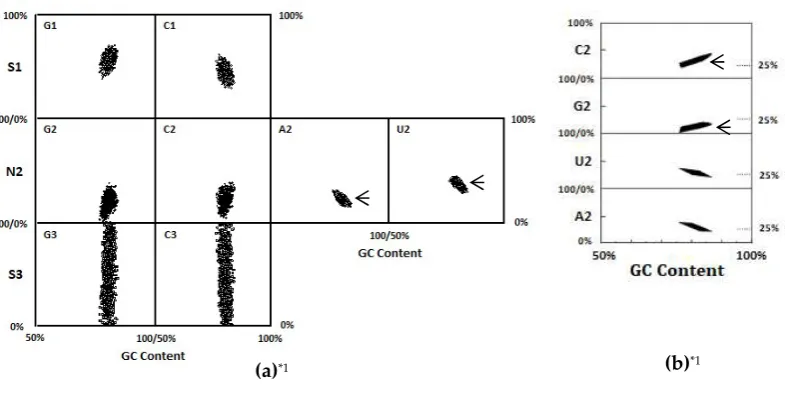
136
water-soluble globular structure, if the polypeptide chain satisfies the six protein structure indexes,
137
which were obtained by calculation with amino acid composition of water-soluble globular proteins,
138
(see also Section 2.1) [7]. Small colored circles represent [GADV]-amino acids and blue wavy lines
139
on the circle symbolize flexible structure of the protein. (b) Dependencies of base compositions at
140
second codon position, which were obtained with genomic data of the seven microorganisms
141
(Section 2.1) [4]. Hydrophobicity of imaginary protein encoded by GC-NSF(a) becomes smaller in
142
GC-rich region (more than 60% GC content), because thymine content at the second codon position
143
(T2) becomes smaller than adenine content (A2) in the region. Note that T2 and A2 on sense strand are
144
replaced with A2 and T2 on antisense strands, respectively. (c) Mechanism for creationof EntNew
145
gene from codon sequence on GC-NSF(a). EntNew gene/protein could be created from GC-NSF(a) 1,
146
(a) (b)*1
A pool containing [GADV]-amino acids
at roughly equal amounts
GC-rich gene 1 GC-rich gene 1
Weak catalytic
Mature protein
Immature protein
Active site
Maturation of gene/protein
GC-NSF(a) 1 GC-NSF(a) 1
GC-NSF(a) 2
GC-rich gene 2
Maintenance of original
genetic function
Expression Expression
Gene duplication
(c)
Random
polymerization
if a low but necessary catalytic activity (thin blue arrow) could be found on a surface of the immature
147
flexible protein produced by gene expression of GC-NSF(a) 1. The reason is because the immature
148
protein could be matured to a protein with a high catalytic activity through accumulation of base
149
substitutions on the GC-NSF(a) necessary to maturation of the protein (bold reddish violet arrow).
150
The creation mechanism of EntNew gene/protein in SNS code era or GNC code era can be similarly
151
understood by replacing GC-rich gene and GC-NSF(a) with (SNS)n gene or (GNC)n gene and
152
(SNS)n(a) or (GNC)n(a), respectively.
153
(4) Next, consider what kind of situation arises, if creation of mature protein starts from a
154
protein with extremely high rigidity. Even a clue for creation of the mature protein cannot be found
155
on any sites on such a too rigid protein, because a possibility, that structure of an organic compound
156
exactly matches the surface structure of the rigid protein, would be zero. Therefore, any organic
157
compound cannot be accepted by the rigid protein to express even a low catalytic activity. This
158
could be easily understood by considering a following example: A key roughly made with metal,
159
never match a keyhole, which was also roughly made with metal.
160
(5) The substance enabling to produce a mature protein from such an immature protein is to
161
start from a water-soluble globular structure with some flexibility, which is produced by random
162
joining of amino acids in protein 0th-order structure (Figure 2c).
163
Then, I describe three processes generating an EntNew mature gene/protein under three genetic
164
codes (the universal or standard genetic code, SNS primitive code and GNC primeval code),
165
corresponding to three protein 0th-order structures, so that significance of the protein 0th-order
166
structure could be more deeply understood.
167
2.3. GC-NSF(a) hypothesis on EntNew gene/protein creation
168
2.3.1. The reason why GC-NSF(a) can encode water-soluble globular protein with some flexibility
169
The reasons, why EntNew gene/protein is effectively generated from GC-NSF(a), are as follows
170
[11].
171
(1) Nonstop frame appears on antisense strand of GC-rich gene or GC-NSF(a) at a high
172
probability, because three termination codons, UAA, UAG and UGA, are AU-rich.
173
(2) Two amino acid sequences of proteins encoded by GC-rich gene and its GC-NSF(a) are quite
174
different from each other (Figure 3), because two strands of DNA are antiparallel and the universal
175
genetic code is triplet and asymmetric. Nevertheless, both amino acid compositions encoded by
176
GC-rich gene and its GC-NSF(a) are similar to (SNS)n and polypeptide chains produced under the
177
SNS code are folded into water-soluble globular structure at a high probability [4,10].
178
(3) Structure formabilities of all proteins with the same amino acid composition are the same,
179
because the structure formabilities were obtained by calculation using amino acid composition and
180
structure indexes of the respective amino acids [1,10]. Therefore, all proteins synthesized by random
181
joining of amino acids in a pool should have the same protein structure formabilities. This lead to the
182
idea, protein 0th-order structure (Figure 2a) [4-9].
183
184
185
A Q P E T G KGCNCAYCCNGARACNGGNAAR
CGNGURGGNCUYUGNCCNUUY
Y M W F C S F
R V R L R P L 5’
5’ 3’
3’
A part of a GC-rich gene Amino acid sequence
A part of a GC-NSF(a)
Amino acid sequences of
186
187
188
Figure 3. Amino acid sequences encoded by GC-rich gene and the corresponding codon sequence
189
on GC-NSF(a). The two amino acid sequences are quite different from each other. Possible amino
190
acid sequences of imaginary protein encoded by GC-NSF(a) are also shown, which are generated by
191
base substitutions upon degeneracy at third codon position of the GC-rich gene [12].
192
(4) Amino acid composition (actually, amino acid sequence) encoded by GC-NSF(a) satisfies the
193
six conditions for water-soluble globular protein formation (see Section 2.1) [6,10]. Therefore, the
194
polypeptide chain produced from GC-NSF(a) could be folded into water-soluble globular structure,
195
which is similar to extant water-soluble globular protein, at a high probability.
196
(5) Mature protein encoded by extant gene is generally rigid [1]. On the contrary, immature
197
protein produced from GC-NSF(a) should be more flexible than mature protein encoded by GC-rich
198
gene, because of a small hydrophobicity (Figure 2b) and a high Gly content of the protein [11]. The
199
high flexibility makes it possible to adapt surface residues to even never encountered organic
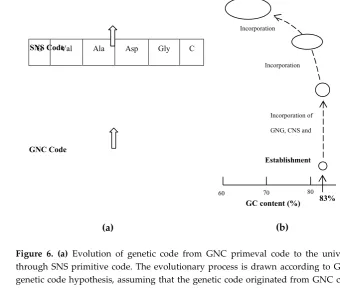
200
compound and to give a clue for the immature protein to evolve to mature protein (Figure 2c).
201
(6) Taking the number of combination of several tens of surface amino acids into consideration,
202
it is expected that many catalytic sites, probably from several hundreds, should appear on surface of
203
an immature protein. The number of possible catalytic sites should increase much more, owing to
204
flexible structure of the immature protein synthesized by random polymerization of amino acids in
205
protein 0th-order structure, although the catalytic activities would be considerably low. However, the
206
low catalytic activity would be out of question, because the catalytic activity expected must be
207
absent at the time point when the EntNew protein was required. Therefore, mature EntNew protein
208
could be produced by raising the low activity on the surface of the immature protein, if the weak but
209
sufficiently high activity could be found out among many candidates of the catalytic activity on the
210
protein surface (Figure 2c).
211
(7) Furthermore, degeneracy at the third codon position of GC-NSF(a) could also contribute to
212
generate diverse amino acid sequences without replacing amino acid sequence of a protein encoded
213
by the gene on sense strand. Thus, the degeneracy could also assist the creation of EntNew
214
gene/protein (Figure 3) [12].
215
Based on the properties of GC-NSF(a) as described above, it can be concluded that GC-NSF(a)
216
effectively encodes one of amino acid sequences, which are produced by random joining of amino
217
acids in the protein 0th-order structure (Figure 2c), and, therefore, mature water-soluble globular
218
protein could be produced from the GC-NSF(a) at a high probability. Direct evidence for the
219
GC-NSF(a) hypothesis has been obtained through homology search between amino acid sequences
220
of modern proteins encoded by GC-rich genes and imaginary proteins encoded by GC-NSF(a)s on
221
the genome of Pseudomonas aeruginosa PAO1 [13].
222
Here, discuss the formation process from immature gene/protein to mature gene/protein
224
under the universal (standard) genetic code (Figure 2c) [9].
225
(1) First, a GC-rich gene 1 is duplicated into two genes.
226
(2) Original genetic function is conserved by one of the duplicated genes.
227
(3)An immature protein is produced by expression of the GC-NSF(a) 1 on antisense strand of
228
the other GC-rich gene 1 (Figure 2c).
229
(4) Many possible catalytic sites would appear on surface of the immature flexible protein,
230
because the number of combination should reach to several hundreds. Swinging of the surface
231
residues on the protein further increases the effective number.
232
(5) If one catalytic function can be detected from many candidates for a catalytic activity on the
233
immature protein 1, the catalytic activity could be elevated to a level of sufficiently high activity by
234
receiving multiple base substitutions necessary to raise the activity (Figure 2c).
235
(6) In parallel, structure of the immature protein gradually increases rigidity to refine the
236
catalytic activity and to be able to reject any other organic compounds.
237
(7) Simultaneously, original mature gene 1 on sense strand and immature GC-NSF(a) gene 1 on
238
antisense strand become immature GC-NSF(a) gene 2 and mature gene 2, respectively (Figure 2c).
239
It is important to understand that all catalytic activities, which are necessary for extant
240
organisms to live, could be found somewhere on surfaces of a number of immature globular proteins,
241
which are produced from many GC-NSF(a)s, although the activities at initial evolutionary stage
242
might be, of course, extremely low. All extant organisms are living on this planet using EntNew
243
genes/proteins and their homologous progeny genes/proteins, which were derived from the first
244
family gene/protein. Inversely stating that, any creature could not evolve to modern organisms on
245
the present Earth, if the mechanism were not acquired, because both the first EntNew family
246
gene/protein and homologous genes/proteins in the family could not be acquired.
247
2.4. Creation of EntNew gene/protein under SNS primitive genetic code
248
Mechanism generating EntNew gene/protein under SNS genetic code encoding 10 amino acids
249
is quite similar to that under the universal genetic code (Figure 2c) [10,14]. Therefore, the mechanism
250
used in the SNS code era is described in this section, focusing on only main points, because their
251
details are described in the previous Section 2.3.
252
It is naturally considered that gene used in the SNS code era was SNS repeating sequence or
253
(SNS)n. Under the SNS genetic code, EntNew gene/protein could be generated from nonstop frame
254
on antisense strand of (SNS)n gene ((SNS)n(a)), because (SNS)n(a) could code for a random amino
255
acid sequence and immature water-soluble globular protein with some flexibility could be produced
256
from the (SNS)n(a), as similarly as the case of modern GC-NSF(a) (Figure 2c). Many possible catalytic
257
sites should appear on the surface of the immature protein, which was synthesized by expression of
258
(SNS)n(a). The reasons, why (SNS)n(a) effectively can encode one of random amino acid sequences
259
synthesized in a protein 0th-order structure or 10 amino acids encoded by SNS code, are as follows.
Amino acid composition (actually amino acid sequence) encoded by a (SNS)n gene satisfies the
261
six conditions for water-soluble globular protein formation (Figure 4a). Two amino acid sequences
262
encoded by (SNS)n gene and by (SNS)n(a), are quite different from each other, similarly to the case of
263
GC-rich gene and GC-NSF(a). Therefore, it can be concluded that (SNS)n(a) effectively encodes one
264
of amino acid sequences, which were produced by random joining of 10 amino acids. In addition,
265
immature protein, which is produced from (SNS)n(a), should have a small hydrophobicity causing
266
some flexibility necessary to adjust amino acid residues on the protein to a new organic compound
267
(Figure 2c), although the catalytic activity would be quite low. In addition, degeneracy, G or C, at the
268
third codon position enlarged the range of choice of amino acid sequence to create EntNew
269
gene/protein. Those are also similar to the cases of GC-NSF(a) of extant GC-rich gene.
270
Therefore, formation process of EntNew gene/protein can be explained by replacing GC-rich
271
gene and GC-NSF(a) with (SNS)n gene and (SNS)n(a), respectively (Figure 2c).
272
(1) First, one (SNS)n gene 1 was duplicated into two. Original genetic function was conserved in
273
one of the duplicated genes. Therefore, multiple mutations could be accepted on the other
274
duplicated (SNS)n(a) 1 to create EntNew gene (see also Figure 2c).
275
(2) An immature protein 1 could be produced by expression of the (SNS)n(a) 1 (Figure 2c).
276
277
278
279
Figure 4.(a) Dot plot of base compositions at three codon positions of mature proteins encoded by
280
SNS code which satisfies the six conditions for protein structure formation, which were obtained as
281
average properties of extant proteins encoded by genomes of seven micro-organisms [10]. (b) Dot
282
plot of base compositions at the second codon position of mature proteins which satisfies the four
283
conditions, which were obtained by excluding two conditions, Acidic-AA content and Basic-AA
284
content from the six conditions for protein structure formation [10]. Small arrows indicate that base
285
contents at the respective base positions are less or more than the corresponding base contents.
286
287
(3)If one catalytic function was found on the surface of the immature protein, the catalytic
288
activity could be elevated as receiving multiple base substitutions (see also Figure 2c). In parallel,
289
structure of the immature protein gradually became rigid and compact to grow to mature protein.
290
Simultaneously, the original mature gene 1 and the immature (SNS)n(a) 1 became immature
291
(SNS)n(a) 2 and mature (SNS)n gene 2, respectively (Figure 2c).
292
2.5. Creation of EntNew gene/protein under GNC primitive genetic code
293
It is explained in more detail in this section, how EntNew (GNC)n gene encoding
294
[GADV]-protein was generated from GNC codon sequence on its antisense strand, (GNC)n(a),
295
because it should be easier to understand the evolutionary process from (GNC)n(a) than the above
296
cases, as GNC primeval genetic code encodes only four [GADV]-amino acids [10,15].
297
One of protein 0th-order structures is the amino acid composition, in which [GADV]-amino
298
acids are contained at roughly equal amounts, because protein with the amino acid composition well
299
satisfies the four conditions, which are obtained by exclusion of both Acidic-AA content and
300
Basic-AA content from the six conditions (Figure 4b). The reason, why Acidic-AA content and
301
Basic-AA content can be excluded from the six conditions, is because Acidic-AA and Basic-AA could
302
be replaced by divalent anions, as CO32-, SO42-, and divalent cations, as Mg2+, Mn2+, respectively. As a
303
mature protein like a precision molecular machine never be directly produced by random joining of
304
[GADV]-amino acids in the absence of genetic function, such a mature protein must be generated
305
from an immature flexible water-soluble globular protein encoded by premature gene carrying
306
random GNC codon sequence, followed by evolutionary process [9].
307
[GADV]-protein produced from (GNC)n gene satisfies the four conditions, when Ala encoded
308
by GCC codon was used more frequently than Gly encoded by GGC codon in the protein (Figure 4b).
309
In other words, the protein could take the structure similar to extant proteins, when -helix forming
310
amino acid, Ala, was used considerably more than turn/coil forming amino acid, Gly. This indicates
311
that immature [GADV]-protein synthesized from (GNC)n(a) must be more flexible than mature
312
[GADV]-protein, because GCC codons for Ala on sense strand are replaced by GGC codons for Gly
313
on antisense strand. Therefore, contents of Ala and Gly in mature protein encoded by a gene on
314
sense strand, are equal to Gly and Ala contents in the corresponding immature protein encoded by
315
(GNC)n(a), respectively (Figure 5). It means that Gly was used at a higher frequency than Ala in the
316
immature protein produced from (GNC)n(a) and, therefore, the structure of the imaginary protein
317
became flexible (Figure 5). The flexible structure enabled a premature catalytic site of the protein to
318
easily adjust to a newly encountered organic compound.
319
320
321
322
323
324
325
326
327
328
V
D
A
G
A
V
D
V
A
D
V
D
V
A
A
G
V
A
D
V
G
A
G
D
V
D
G
V
D
V
D
G
G
A
D
G
GUCGACGCCGGCGCCGUCGACGUCGCCGACGUCGACGUCGCCGCCGGCGUCGCCGACGAC GACGUCGGCGCCGGCGACGUCGACGGCGUCGACGUCGACGGCGGCGCCGACGGCGUCGUC
Amino sequence of mature protein encoded by (GNC)n gene
Amino sequence of immature protein encoded by (GNC)n(a)
turn/coil region turn/coil region
329
330
Figure 5. Amino acid sequences of mature protein encoded by (GNC)n gene (upper base sequence)
331
and of immature protein encoded by (GNC)n(a) (lower base sequence). Letters written with colored
332
alphabets indicate four bases, green bold G: guanine, red bold C: cytosine, blue A: adenine, and
333
brown U: uracil. Six Cs (30%), As (30%), Us (30%) and two Gs (10%) are randomly arranged at the
334
second codon position of an (GNC)n gene, taking the results of computer analysis (C2 (31%), G2
335
(11%), U2 (29%) and A2 (29%)) shown in Figure 4b into consideration [10]. It can be seen that two
336
amino acid sequences encoded by (GNC)n gene and (GNC)n(a) are quite different from each other.
337
The difference is caused by anti-parallel double-stranded RNA structure and asymmetric GNC code.
338
Consequently, polypeptide chain encoded by codon sequence on antisense strand is folded into
339
turn/coil conformation more frequently than that encoded by sense codon sequence.
340
Formation process of EntNew gene/protein in GNC code era is explained as follows (see also
341
Figure 2c), as the process is basically the same under the three genetic codes, GNC code, SNS code
342
and the universal genetic code.
343
(1) Multiple mutations could be introduced on (GNC)n(a) sequence to create EntNew (GNC)n
344
gene, because original genetic function could be conserved in surplus one of the duplicated (GNC)n
345
genes, after gene duplication (Figure 2c). If a catalytic activity, which was required to live, could be
346
found at one site on the surface of the immature protein 1, the catalytic activity could evolve to a
347
sufficiently high level upon amino acid replacements necessary to raise the activity (Figure 2c).
348
(2) Upon the evolution of the gene/protein, the immature protein became rigid to be able to
349
refine the protein structure and reject any other organic compound. Simultaneously, the original
350
mature (GNC)n gene 1 and the immature (GNC)n(a) gene 1 became immature (GNC)n gene 2 and
351
mature (GNC)n gene 2, respectively (see also Figure 2c).
352
Thus, the excellent assignment of four [GADV]-amino acids into four GNC codons made it
353
possible to create EntNew (GNC)n gene/[GADV]-protein efficiently.
354
3. Discussion
355
One of the important problems in the field of biological sciences, how and from where EntNew
356
gene/protein has been created, remains unsolved still now (Figure 1). The reason is because there are
357
several matters, which make it difficult to solve, as described below.
358
(1) Genetic information for protein synthesis is written as one-dimensional base sequence. On
359
the contrary, catalytic function is expressed on a surface of a water-soluble globular protein with
360
three-dimensional structure.
361
(2) As a matter of course, it is impossible to design in advance the first family gene/protein,
362
which is totally different from any previously existing genes/proteins, and, therefore, does not show
363
any meaningful sequence homology with them.
364
(3) Therefore, such an EntNew gene/protein must be created through random process.
365
random processes, because of a quite high wall of extraordinary sequence diversities for creation of
367
EntNew gene/protein.
368
(4) On the other hand, it would be also impossible to create EntNew gene independently of
369
protein, because gene codes for amino acid sequence of protein. Of course, any mature protein with
370
a specific amino acid sequence also cannot be created independently of gene, because the gene is
371
directly connected with amino acid sequence of the protein.
372
Taking the contradictory request for creation of mature EntNew gene/protein into
373
consideration, only one possible way would be to start from immature protein produced by random
374
polymerization of amino acids in a specific amino acid composition or protein 0th-order structure,
375
which is encoded by one of three GC-rich codon sequences, GC-NSF(a), (SNS)n(a) or (GNC)n(a),
376
because the immature water-soluble globular protein could be evolved to mature protein through
377
base replacements of the antisense sequence, using memory capacity of double-stranded RNA or
378
DNA.
379
(GNC)n(a) could overcome the quite difficulties by introduction of protein 0th-order structure
380
holding the key solving the problem for the first time (Section 2.5). (SNS)n(a) under SNS primitive
381
genetic code and GC-NSF(a) under the universal genetic code succeeded the excellent properties
382
acquired by (GNC)n(a) (Figure 6).
383
That is supported by the facts described below.
384
(1) Base compositions at three codon positions of GC-NSF(a) is comparatively similar to SNS,
385
which encodes water-soluble globular protein at a high probability (Figure 5a) [4,10].
386
(2) Frequency using G-start codons is sufficiently higher than those of C-, A- and U-start codons,
387
in the cases of not only GC-rich genes but also AT-rich genes, indicating that [GADV+E]-amino acids
388
form the basis of protein and, therefore, are used in protein at a high frequency, irrespective of GC
389
content of the gene [4,11]. This also supports that modern genes are successors of the most ancestral
390
(GNC)n gene (Figure 6).
391
392
393
394
The Universal Genetic Code
C
Leu Pro His Arg C
Leu Pro Gln Arg G
G
Val Ala Asp Gly C
Val Ala Glu Gly G
Completion of
395
396
397
398
399
400
401
402
403
404
405
406
407
408
409
410
411
412
Figure 6. (a) Evolution of genetic code from GNC primeval code to the universal genetic code
413
through SNS primitive code. The evolutionary process is drawn according to GNC-SNS primitive
414
genetic code hypothesis, assuming that the genetic code originated from GNC code encoding four
415
[GADV]-amino acids [10]. (b) Change of the field for EntNew gene creation, accompanied by the
416
genetic code evolution. After establishment of GNC primeval genetic code, codons were
417
incorporated into the GNC code in order of GNG, CNS, GNW, CNW, A-start and U-start codons [16].
418
Upon the evolution of the genetic code, the field for EntNew gene creation shifted from extremely
419
GC-rich (around 83%) to ordinary GC-rich region around 60 to 70%. Circles and ellipsoids indicate
420
the supposed fields of EntNew gene creation.
421
(3) As shown in Figure 6b, average GC content of (GNC)n genes used under the GNC primeval
422
genetic code, was quite high as about 83%. GC content of (SNS)n genes derived from the GC-rich
423
(GNC)n genes was also high as about 83%. After establishment of SNN primitive code through
424
degeneracy at the third codon position, new codons were further incorporated into SNN code in
425
order of A-start and U-start codons (Figure 6a) [16]. Consequently, GC content of genes used under
426
the universal genetic code has expanded from about 25% to 75%. However, codon sequence on
427
antisense strand expanding from about 60% to 70% GC content remains remnants of extremely
428
GC-rich (SNS)n (~83%) and (GNC)n (~83%) genes and has been used as the field for EntNew gene
429
creation still now (Figure 6b) [11].
430
(4) In GNC primeval genetic code era, maturation of EntNew gene from immature gene was
431
adjusted by exchanging Gly for Ala encoded by GGC and GCC, respectively (Figure 4b). On the
432
contrary, in SNS code era, hydrophilic amino acids encoded by SAS codons were predominantly
433
exchanged for hydrophobic amino acids encoded by SUS codons on evolutionary process from
434
immature to mature protein (Figure 4a).
435
(5) On the other hand, shift from immature to mature protein under the universal genetic code
436
has been controlled by the two adjustments, one is the exchange of Gly for Ala and the other is
437
replacement of hydrophilic amino acids with hydrophobic amino acids. These also indicate that
438
G Val Ala Asp Gly C
SNS Code
GNC Code
GC content (%)
60 70 80
83% Incorporation of GNG, CNS and
Establishment
of GNC Code Incorporation Incorporation
modern GC-rich genes and GC-NSF(a)s have been propagated from the most ancestral (GNC)n gene
439
through (SNS)n gene.
440
On the contrary, EntNew gene/protein cannot be produced from antisense sequence of AT-rich
441
gene. The reason is easily explained as follows.
442
(1) Stop codons appear on the antisense strand of AT-rich gene at a high frequency, because all
443
the three termination codons, UAA, UAG and UGA, are AU- or AT-rich. This means that only short
444
peptides should be synthesized from antisense codon sequence of AT-rich gene.
445
(2)Imaginary protein encoded by codon sequence on antisense strand of AT-rich gene should
446
be highly hydrophobic, making the protein insoluble in water.
447
(3) The imaginary proteins have excess -sheet and extremely low turn/coil formabilities and
448
too low Acidic-AA composition [4]. This indicates that imaginary protein, which is produced from
449
codon sequence on antisense strand of AT-rich gene, does not satisfy the six conditions, indicating
450
that the protein encoded by the AT-rich codon sequence cannot form water-soluble globular
451
structure as a prerequisite for proteinous catalyst.
452
As described so far, EntNew genes/proteins were and have been created from GC-rich codon
453
sequence on antisense strand, irrespective of any genetic code era, GNC code, SNS code and the
454
universal genetic code. The following properties of the genetic code enabled the efficient creation of
455
EntNew gene/protein.
456
(1) Hydrophobic amino acids and hydrophilic amino acids are arranged in U2 and A2 columns
457
of the universal genetic code, respectively.
458
(2) In U2 column, -sheet (Val, Ile, Phe) and -helix (Leu, Met) forming hydrophobic amino
459
acids are arranged. On the other hand, turn/coil (Asn, Asp) and -helix (Glu, Gln, Lys) forming
460
hydrophilic amino acids are arranged in A2 column. The arrangements of amino acids in the
461
universal genetic code table enable secondary structure formabilities not to be biased in modern
462
proteins, irrespective of GC content of gene.
463
(3) Protein 0th-order structures, amino acids encoded by GNC code and SNS code, have written
464
in one and four columns of the universal genetic code table, respectively, although it is natural
465
because creation of EntNew gene/protein and protein synthesis were and have been carried out
466
based on the genetic codes.
467
Such a stunning arrangement of amino acids in the universal genetic code table would be the
468
results, that appropriate amino acids were introduced and captured during evolution of the genetic
469
code. The universal genetic code, which has been formed through evolution from the first GNC
470
genetic code through SNS code [10], made it possible to efficiently create EntNew genes/proteins
471
and for diverse organisms to prosper on the present Earth. I marvel at the beautiful life system,
472
which has been acquired during the evolution.
473
Funding: This research received no external funding.
474
Acknowledgments: I am very grateful to Dr. Tadashi Oishi (G&L Kyosei Institute, Emeritus professor of Nara
475
Women’s University) for encouragement throughout my research on the origin and evolution of the
476
Conflicts of Interest: The authors declare no conflict of interest.
478
References
479
1. Berg, J.M.; Tymoczko, J.L.; Stryer, L. Biochemistry, 5th ed.; W.H. Freeman Comp., New York, U.S.A. 2002.
480
2. Ohno, S. Evolution by gene duplication, Springer, Heiderberg, Germany, 1970.
481
3. Dill, K.A. Dominant forces in protein folding. Biochemistry1990, 29, 7133–7155.
482
4. Ikehara, K. Origins of gene, genetic code, protein and life: comprehensive view of life systems from a
483
GNC-SNS primitive genetic code hypothesis (a modified English version of the paper appeared in Viva
484
Origino, Vol. 29, 66-85 (2001)). J. Biosci., 2002, 27, 165-186.
485
5. Ikehara, K. Possible Steps to the Emergence of Life: The [GADV]-Protein World Hypothesis. The Chemical
486
Record, 2005, 5, 107-118.
487
6. Ikehara, K. [GADV]-Protein World Hypothesis on the Origin of Life. “Genesis: In the beginning:
488
precursors of life, Chemical Models and Early Biological Evolution”. Seckbach, J. (ed.) Springer, pp.
489
107-122, 2012.
490
7. Ikehara, K. Pseudo-replication of [GADV]-proteins and origin of life. Int. J. Mol. Sci.2009, 10, 1525-1537.
491
8. Ikehara, K. [GADV]-protein world hypothesis on the origin of life. Orig. Life Evol. Biosph., 2014, 44, 299–302.
492
9. Ikehara, K. Protein ordered sequences are formed by random joining of amino acids in protein 0th-order
493
structure, followed by evolutionary process. Orig. Life Evol. Biosph.2014, 44, 279–281.
494
10. Ikehara, K.; Omori, Y.; Arai, R.; Hirose, A. A Novel Theory on the origin of the genetic code: A GNC-SNS
495
hypothesis. J. Mol. Evol. 2002, 54, 530-538.
496
11.Ikehara, K.; Amada, F.; Yoshida, S.; Mikata, Y.; Tanaka, A. A possible origin of newly-born bacterial genes:
497
significance of GC-rich nonstop frame on antisense strand. Nucl. Acids Res.1996, 24, 4249-4255.
498
12.Ikehara, K. Degeneracy of the genetic code has played an important role in evolution of organisms. SOJ
499
Genet. Sci., 2016, 3,1-3.
500
13.Oi, R.; Ikehara, K. Direct evidence for GC-NSF(a) hypothesis on creation of entirely new gene/protein.
501
Curr. Proteom., 2018, 3, 13-23.
502
14. Ikehara, K.; Yoshida, S. SNS hypothesis on the origin of the genetic code. Viva Origino, 1998, 26, 301-310.
503
15. Ikehara, K. Mechanism for creation of “original ancestor genes”. J. Biol. Macromol., 2005, 5, 21-30.
504
16. Ikehara, K. The Origin of tRNA deduced from Pseudomonas aeruginosa 5’anticodon-stem sequence
505
-anticodon-stem loop hypothesis-. Orig. Life Evol. Biosph. 2019, 49, 61-75.