Study for s-process using neutron beam provided from
ANNRI of J-PARC
Takehioto Hayakawa12, Yosuke Toh1, Akira Kimura1, Shoji Nakamura1, Toshiyuki Shizuma1 and Hideo Harada1
1Japan Atomic Energy Agency, Tokai, Ibaraki, Japan
2 Natonal Astronomical Observatory of Japan, Mitaka, Tokyo, Japan
Abstract. Most isotopes heavier than iron are synthesized by the slow neutron capture reaction process (s-process) in stars. Isomers in stable isotopes have sometimes an important role as a branching point in nucleosynthesis flow in the s-process. An isomer with a half-life of 14.1 y in 113
Cd is a branching point from which a nucleosynthesis flow reaches to a rare isotope 115Sn. The astrophysical origin of 115Sn has remained still an open question. The s-process abundance of 115Sn depends on the ratio of the 112Cd(n, γ)113Cdm reaction cross section to the 112Cd(n, γ)113Cdgs reaction cross section. However, the isomer production ratio following the neutron capture reaction has not been measured in the energy region higher than the thermal energy. An intense neutron beam experimental system, ANNRI, in J-PARC has a high purity germanium (HPGe) detector system consisting of two cluster detectors. We have measured γ-rays decaying to the ground state and the isomer using the HPGe detectors in conjunction with a time-of-flight method at ANNRI.
1 Introduction
Nuclides heavier than iron were predominantly synthesized by two stellar neutron induced reactions of slow neutron capture reactions (s-process) and rapid neutron capture reaction process (r-process). The astrophysical origin of rare isotopes in Cd-In-Sn region, 113In, 114Sn and 115Sn, have been a long-standing problem [1-3]. These isotopes are classified to "p-nuclei" which have following features. Their isotopic fractions are typically lower than 1%. They are neutron-deficient isotopes. They are located on the outside of the main path of the s-process and shielded against the β-decay after the freezeout of the r-process by stable isobars. Hayakawa et al. [4] found an empirical relationship between a p-nucleus and an s-nucleus with the same atomic number in the solar abundances. This relationship is evidence that the most probable origin of 27 p-nuclei is photodisintegration reactions in supernova explosions (γ-process). However, the origin of odd-N isotope, 115Sn, has remained still an open question, since the relationship cover only the even-N nuclei.
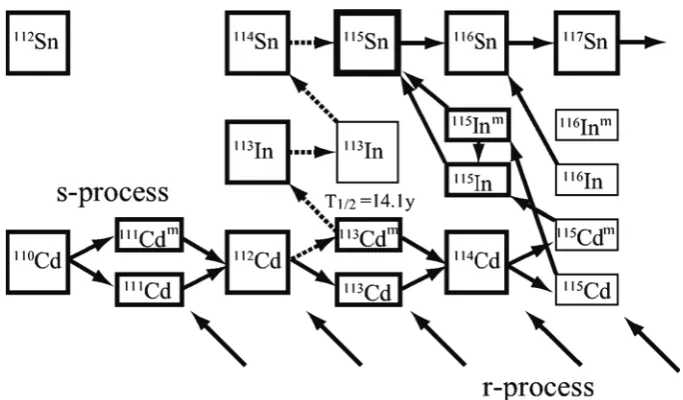
Isomers in stable isotopes have sometimes an important role as a branching point in nucleosynthesis flow in the s-process (for examples, see refs. [3,5]). As shown in Fig. 1, β-unstable isomers in stable isotopes have important role to synthesis these three p-nuclei. The p-nuclei, 113In and
115
systematically measured and the resonance parameters were also evaluated [6]. However, the partial neutron capture cross section to 113Cdm has not been measured except thermal energy. The abundance of 115Sn depends on the population ratio of 113Cdm to 113Cdgs following neutron capture reactions on 112
Cd. It was suggested that the population of the isomer in 113Cd should follow by
thermal-equilibrium conditions in s-process environments of kT=8-30 keV. In such cases, the population ratio, m/(m+gs), depend only on the temperature of the environment where the s-process occurs.
Hayakawa et al. [3] measured the neutron capture cross-section to 113Cdm using thermal neutrons provided by a nuclear research reactor JRR-3. To estimate the ratio of 112Cd(n, γ)112Cdm to 112Cd(n,
γ)112Cdm + 112Cd(n, γ)112Cdgs at the s-process energies of 5-50 keV the ratio as a function of the neutron incident energy was calculated by using a statistical model. It was found that the m/(m+gs) ratio depends strongly on branching ratios of γ-decay of excited states. The calculated ratios are
almost constant over a wide range of E < 100 keV. The s-process contribution to 115Sn using a
classical "steady flow" model with the evaluated ratio at stellar temperatures was evaluated. It was
obtained that 3-4% of the 115Sn solar abundance may originate from the s-process. However, the
m/(m+gs) ratios depend on the detailed nuclear structure and thus m/(m+gs) ratios in an energy region
of 5-50 keV should be experimentally measured. Thus, we have measured γ-rays using the HPGe
detectors in conjunction with a time-of-flight method at an intense neutron beam experimental system, ANNRI, in J-PARC.
Figure 1. Partial nuclear chart around 115Sn and nucleosynthesis flows.
2 Experimental producers
A lead absorber with a thickness of 37.5 mm was located downstream from the neutron source to absorb prompt γ-rays generated by the spallation reaction.
The ANNRI has a large highly pure germanium (HPGe) detector array, 4π Ge spectrometer, which consists of two cluster HPGe detectors, eight coaxial HPGe detectors, and BGO Compton-suppression detectors. In the present experiment, the two cluster HPGe detectors were used. This detector system was located 21.5 m downstream from the neutron source in the MLF. The γ-rays were recorded when at least two HPGe crystals detected photons. The energy of a neutron was measured using a Time-of-Flight (TOF) method by recording the time when a detector is fired. The energies of the γ-rays and a neutron were recorded in event by event as the list mode. A 112
Cd foil enriched to 98.27% was used as the target.
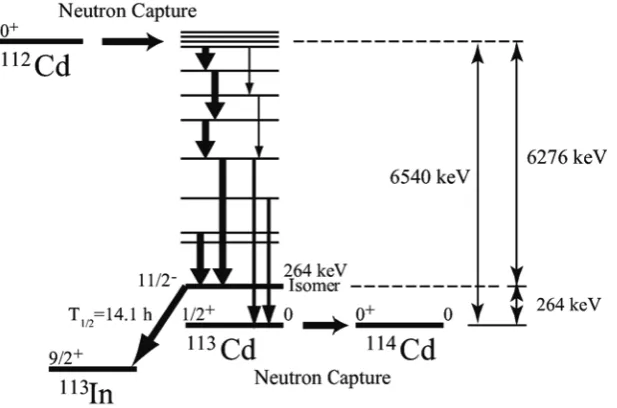
The energy difference between the ground state and the isomer is only 264 keV and thus it is difficult to distinguish two decays to the ground state or the isomer following neutron capture reactions using standard large volume scintillation detectors such as NaI(Tl). Thus, in the present experiment, we measured relative ratios of γ-rays decaying to the ground state to that to the isomer using the HPGe detectors.
Figure 2. Partial level scheme of 115Sn.
Results and Discussion
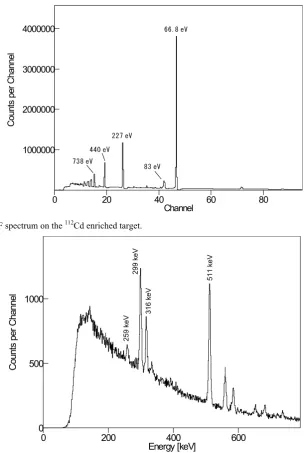
Figure 3 shows a TOF spectrum higher than the thermal energy. In the thermal energy region, the large peak originated from 113
Cd is observed. This 113
Cd is inferred to originate from the contamination to the 112Cd enriched target. The fraction of 113Cd is only 0.6%. The thermal neutron capture cross-section of 113
Cd is 20650 barn, whereas that of 112
Cd is considered to be lower than 2 barn. As discussed in the previous paper [3], the thermal neutron capture cross section of 112
Cd has not been measured yet. As shown in Fig. 3, the relatively strong resonances like 66.8 eV, 227 eV, and 440 eV, are observed. This suggests that γ-rays of 112
Cd is dominant in the energy region higher than eV.
suggests that it is possible to evaluate the isomer production ratio to the ground state as a function of neutron energy with high statics.
0 20 40 60 80 1000000
2000000 3000000 4000000
Count
s
p
er
Channel
Channel
Figure 3. TOF spectrum on the 112Cd enriched target.
0 200 400 600
0 500 1000
Count
s
per
Channel
Energy [keV]
299 keV
259 keV
316 keV
511 keV
Figure 4. Partial nuclear chart around 115Sn and nucleosynthesis flows.
4 Summary
The astrophysical origin of 115
Sn has remained still an open question. An isomer with a half-life of 14.1 y in 113
Cd is a branching point from which a nucleosynthesis flow reaches to a rare isotope 115
Sn.
The s-process abundance of 115
Sn depends on the ratio of the 112
Cd(n, γ)113
Cdm
reaction cross section to the 112
Cd(n, γ)113
Cdgs
We have measured γ-rays following neutron capture reactions on 112
Cd using the HPGe detectors in conjunction with a time-of-flight method at ANNRI. In the neutron energy region higher than eV, we
observed decay γ-rays to the ground state and the isomer. The present result suggests that it is possible
to evaluate the isomer production ratio to the ground state as a function of neutron energy higher than eV with high statics.
References
1. R. A. Ward and H. Beer, Astrophy. Astron. 103, 189A (1981). 2. Ch. Theis, et al., Astrophy. J. 500, 1039M (1998).
3. T. Hayakawa et al., Astrophy. J. 707, 859 (2009). 4. T. Hayakawa et al., Phys. Rev. Lett. 93, 161102 (2004). 5. T. Hayakawa et al., Astrophy. J. 628, 533 (2005).