Volume 2006, Article ID 65716, Pages1–13 DOI 10.1155/ASP/2006/65716
Fine-Granularity Loading Schemes Using Adaptive
Reed-Solomon Coding for xDSL-DMT Systems
Saswat Panigrahi and Tho Le-Ngoc
Department of Electrical and Computer Engineering, McGill University, 3480 University Street, Montr´eal, QC, Canada H3A 2A7
Received 29 November 2004; Revised 9 May 2005; Accepted 22 July 2005
While most existing loading algorithms for xDSL-DMT systems strive for the optimal energy distribution to maximize their rate, the amounts of bits loaded to subcarriers are constrained to be integers and the associated granularity losses can represent a significant percentage of the achievable data rate, especially in the presence of the peak-power constraint. To recover these losses, we propose afine-granularity loading scheme using joint optimization of adaptive modulation and flexible coding parameters based on programmable Reed-Solomon (RS) codes and bit-error probability criterion. Illustrative examples of applications to VDSL-DMT systems indicate that the proposed scheme can offer a rate increase of about 20% in most cases as compared to various existing integer-bit-loading algorithms. This improvement is in good agreement with the theoretical estimates developed to quantify the granularity loss.
Copyright © 2006 Hindawi Publishing Corporation. All rights reserved.
1. INTRODUCTION
Discrete multitone (DMT) modulation [1] has been widely used in xDSL applications such as asymmetric DSL (ADSL) [2] by the American National Standards Institute (ANSI) and the European Telecommunications Standard Institute (ETSI) and more recently for VDSL [3] by ANSI. Loading strat-egy is used for dynamic subcarrier rate and power allocation for given channel conditions, system constraints, and perfor-mance requirements.
For a multichannel total-power constrained problem, the optimal power distribution has long been known to be the “water-filling” distribution [4]. However the derivation tac-itly assumes infinite granularity while most of the known modulation schemes support the integer number of bits per symbol. It was initially observed in [5,6] that most of the granularity losses due to the integer number of bits per sym-bol could be recovered byroundingoffrates to integers and scaling energies accordingly after starting with a water-filling [6] or flat on/off[5] energy distribution. However the free-dom for such rescaling is considerably reduced in the pres-ence of peak-power constraint.
Peak-power constraint [7,8] arises from spectrum com-patibility requirements to enable coexistence among multiple users and diverse services. When the peak-power constraint is far stricter than the total-power constraint, as is often the case in VDSL-DMT, there is hardly any room left for ma-neuverability (or rescaling) in the energy domain (to recover
lapses in the bit-domain) and significant losses in achievable data rates of integer-bit algorithms are observed.
These losses accounting to be a significant percentage of the supported information rate compel us to tackle the integer-bit granularity problem through bit-error-rate-based joint optimization of adaptive modulation and flexible RS(n,k) coding on each subcarrier that can provide a wide range offinechoices in code rate and error-correction capa-bility.
The remainder of the paper is organized as follows.
Section 2presents the overall optimization problem formu-lation and inferences from related literature about gran-ularity. Section 3 develops a quantification of granularity loss based on relative strictness of peak-power and total-power constraints. Section 4describes the proposed adap-tive Reed-Solomon-based fine-granularity loading (ARS-FGL) scheme. Section 5presents the illustrative results for various VDSL-DMT scenarios and concluding remarks are made inSection 6.
2. POWER, INTEGER-BIT CONSTRAINTS, AND GRANULARITY LOSS
jth subcarrier. The noise includes both crosstalk and ther-mal additive white Gaussian noise (AWGN). The intercarrier spacingΔf is assumed to be small enough for all the afore-mentioned PSDs to be nearly flat over each subcarrier.
The subcarrier rate functionb(σj) is defined as the max-imum information rate in bits per symbol that can be sup-ported at thereceivedSNR ofσj=ρjεjto maintain the
con-ceded error probability not exceeding a specified target value. The object function of the overall rate maximization problem is the total supported rate:
R=
N
j=1
bρjεj. (1)
The traditional total-power constraint for the nontrivial power distribution can be expressed as
Δf ·N
j=1
εj≤Ebudget forεj≥0, 1≤ j≤N. (2)
In addition, many practical systems have limitation on the maximum transmit PSD. This implies the peak-power con-straints:
εj≤εmaxj , 1≤j≤N, (3)
where{εmax
j }Nj=1is specified by the admissible transmit PSD mask, for example, SMClass3 in [8] or M1FTTCab in [3].
The subcarrier specific rate function can be expressed as
bσj=rj
log2
1 +σj
Γj
, (4)
whererjis the coding rate andΓjis the SNR gap determined by the performance of the modulation and coding schemes in use. The floor operation (i.e., x = mfor the largest integerm ≤ x) arises from the integer-bit constraint, since we try to find the largest integer number of bits per symbol that would satisfy the error rate target at SNR ofσj. When the same FEC coding is applied for all subcarriers, that is, rj = r, this floor operation restricts the subcarrier rate to
have steps ofnrwherenis integer (i.e., integer-bit constraint) andR=r Nj=1log2(1 + (σj/Γj)).
Loading algorithms with objective to maximize rate (1) are called rate-adaptive (RA) loading algorithms. The total-power only (TPO) constrained problem specified by (1) and (2) leads to the classical water-filling solution. Most RA al-gorithms [5, 6, 9, 10] addressed the TPO problem with integer-bit constraint. The more practical total and peak-power (TPP) constrained problem, that is, (1), (2), and (3), with integer-bit constraint was considered in [5,7,11].
Both the greedy method in [9] and the Lagrangean method in [10] lead to the optimal solution for the integer-bit TPO problem, the latter being much more computation-ally effective than the former. In [5,6], a SNR-gap function-[1] based method is proposed, which, in the initial stage, gives a continuous bit distribution resulting from a flat on/off and water-filling energy distribution, respectively. The differ-ence between the rates resulting from these two energy distri-butions was seen to be only 2%. To achieve negligible degra-dation due to the integer-bit constraint, both methods use
bit-roundingand proper energy adjustment only for the TPO case.
In [5, Section 4.3.4], an Ad hoc extension for the TPP problem is presented by capping the bit round-offand the final energy rescaling with a maximal bit distribution and the peak energy constraint, respectively. A more formal treat-ment of the problem is presented in [7]. At first, the problem is solved without the integer-bit constraint for the general case of a continuously differentiable, strictly increasing, and strictly concave rate function. This solution is reproduced be-low with minor notational changes for easy reference,
ifΔf ·
N
i=1
εmax
i ≤Ebudget, thenεj=εmaxj . (5)
IfΔf ·
N
i=1
εmax
i > Ebudget,
thenεj=εj(λ)
=εmax
j , ifλ≤ρjbσρjεmaxj
=ρ1
jb
−1 σ
λ ρj
, ifρjbσρjεmax
j
≤λ≤ρjbσ(0)
=0, ifλ≤ρjbσ(0),
(6)
wherebσ(σ)=∂b(σ)/∂σandb−1
σ (·) is the inverse ofbσ(·).
The parameterλis the solution to
Δf ·N
j=1
εj(λ)=Ebudget. (7)
When (5) is satisfied, the energy distribution is indepen-dent of the rate function. Consequently, the peak-power con-straint completely dominates and total-power concon-straint is trivially satisfied. In the rest of this paper, we will refer to this case as the peak-power only (PPO) case and by TPP we will mean the case when the inequality in (6) is satisfied, that is, both total-power and peak-power constraints play a role. A suboptimal algorithm for the TPP case with integer-bit con-straint is presented in [7, Table IV]. The optimal algorithm (in terms of rate achieved) for the TPP case with integer-bit constraint is presented in [11].
3. QUANTIFICATION OF GRANULARITY LOSS
Let Ω {j∈ {1, 2,. . .,N}:εj>0} = Ω1 ∪Ω2 where Ω1 ∩Ω2 = ∅, Ω1 {j∈Ω:b−1(b(ρ
jεj))> ρjεmaxj }, Ω2 {j∈Ω:b−1(b(ρ
jεj))≤ρjεmaxj }, andxrepresents
theceilingoperation (i.e.,x =nwherenis the smallest in-teger such thatx≤n). It follows thatNΩ=NΩ1+NΩ2where NΩ,NΩ1, andNΩ2are the cardinality of the setsΩ,Ω1, and Ω2, respectively.Ωrepresents the set of nontrivially loaded subcarriers and Ω1 is the set of subcarriers in which ceil-ingthe noninteger-bitb(ρjεj) would cause the correspond-ing energy allocation to violate the peak-power constraint, that is,εj> εmaxj . Thus the only possibility to satisfy both the
integer-bit and peak-power constraints in such a scenario is using theflooroperationb(σj). Hence the granularity loss
for thejth subcarrier is,
∂bG
j =bσj−bσj, ∀j∈Ω1. (8)
For subcarriers, whereroundingis possible without violation of peak-power constraint:
∂bG
j =b
σj−roundbσj, ∀j∈Ω2. (9)
In both cases∂bGj can be treated as a quantization error with a quantization step of 1. Since the variable to be quantized, b(σj), has a much larger range (up to 15 bits/symbol) than the quantization step, the granularity loss∂bGj can be con-sidered as a uniformly distributed random variable (see [14, page 194]),
∂bG
j ∼U[0, 1), ∀j∈Ω1;
∂bG
j ∼U
−1 2, 1 2
, ∀j∈Ω2. (10)
The random variable representing the total granularity loss is∂bG= i∈Ω∂bGiwith its average
∂bG=E∂bG=
i∈Ω1
E∂bG
i+
i∈Ω2
E∂bG
i
=NΩ1·1
2+NΩ2·0= NΩ1
2
=ηNΩ
2 , where 0≤η= NΩ1
NΩ ≤1,
(11)
whereE(·) in (11) represents the stochastic expectation op-erator. The ratioηcan be estimated as follows.
(i) TPO Case: In this case, by definition, there is no peak-power constraint orεmaxj = ∞; for allj, that is,Ω1= ∅
andNΩ1 = 0,η = 0. Also, due to the denominator being∞,Ebudget/Δf · Ni=1εmaxi =0. Thus the average granularity loss is nearly zero, as observed in [5,6,13]. (ii)PPO Case: In this case,εj =εmaxj ; for allj∈Ω, that is, Ω1 =ΩandΩ2 = ∅. ThusNΩ1 =NΩand∂bPPOG =
NΩ/2,η = 1.NΩ is fairly large in xDSL applications (e.g., more than 1000 in VDSL-DMT). Also from (5), Ebudget/Δf · Ni=1εmaxi ≤1.
(iii) TPP Case: For the TPP case, the analysis ofηis more involved and depends on the specific scenario. How-ever, observing the values ofηin TPO and PPO cases, which act as the boundaries of the TPP case and its monotonic nature, we can consider the following ap-proximation:
η≈
E
budget Δf · i∈Ωεmaxi
1
, xl ⎧ ⎨ ⎩l
, x > l, x, x≤l. (12)
ηrepresents the relative strictness of the total-to-peak-power constraint and we can expect that as η increases due to stricter peak-power constraint, granularity losses will be higher. It is worthwhile to note that for a general TPP case, as channel conditions worsen,Ωshrinks, thereby reducing the denominator ofη. Eventuallyηwill increase to 1 and the TPP case will reduce to a PPO case and all previous inferences will apply. In VDSL-DMT application,ηis seen too fairly close to 1 in most cases andNΩis large, thus the granularity loss is ex-pected to be a fairly significant percentage of the supported rate.
4. ADAPTIVE REED-SOLOMON-BASED FINE-GRANULARITY LOADING SCHEME
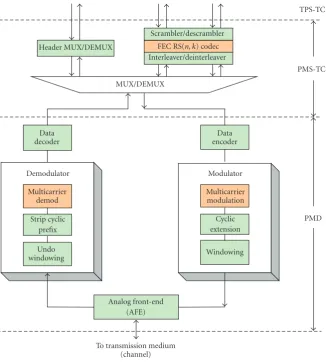
In the current VDSL1system [3], as shown inFigure 1, there is only one fixed-rate RS(n,k) encoder withn=255 andk= 239 in the PMS-TC layer and the bit and energy allocation are carried out only in the PMD layer.
The RS(255, 239) coding is applied to bits that can be transmitted in various subcarriers. The coding channel is assumed to be a binary symmetric channel (BSC) with the crossover bit-error probability,Pe,ch andPe,ch represents the BER averaged over allN subcarrier DMT modems. The fi-nal system performance is represented by the post-decoding bit-error probability of the RS(n,k) code over GF(2m) [15, Equations 4.23, 4.24]:
Pe,dec
Pe,ch,n,k
≤ 2m−1
2m−1
n
i=t+1
i+t n
n
i
Pi(1−P)n−i,
whereP=1−1−Pe,ch m
, t=
n−k 2
.
(13)
The above upper bound is less than 0.1dB away from the ex-act BER [16].
For RS(255, 239) withm=8,n=255,k=239, andt=
8, to achievePe,dec≤10−7, we needPe,ch<10−3(5.65×10⁻⁴ to be precise). This is ensured indirectly and approximately using the SNR gap method. Since onlyM-QAM is used, the uncoded SNR gap forPe,dec ≤ 10−7 is nearly 9.75 dB for a large range ofMand also the RS(255, 239) code is assumed to provide a uniform coding gainγc=3.75 dB. ThusΓj=Γ=
9.75−γc[17] and the code raterj=r=239/255 in (4).
Scrambler/descrambler FEC RS(n, k) codec Interleaver/deinterleaver
Analog front-end (AFE) Header MUX/DEMUX
MUX/DEMUX
Data decoder
Demodulator Multicarrier
demod Strip cyclic
prefix Undo windowing
Modulator Data encoder
Multicarrier modulation
Cyclic extension Windowing
To transmission medium (channel)
TPS-TC
PMS-TC
PMD
PMD: physical medium-dependant
PMS-TC: physical media specific transmission convergence TPS-TC: transport protocol specific transmission convergence FEC: forward error correction-RS(255,239)
Figure1: Functional diagram of PMD and PMS-TC sublayers in current VDSL-DMT system.
Variable RS(255, k)
encoder
Adaptive M-QAM modulator
Input energy scaling
Channel gain Input
bit stream
Transmitter Channel AWGN
Figure2: Subcarrier transmission model.
In the proposed adaptive RS-based fine-granularity load-ing (ARSFGL) scheme, instead of usload-ing a fixed-rate RS(n, k) code for all subcarriers, we assume a variable rate RS(n, ki) code for each subcarrier #i. This can be implemented
by replacing the fixed-rate RS codec in Figure 1 with a single programmable RS(255,k) codec [18, 19], which operates on a per-subcarrier basis. Framing and buffer-ing in MUX/DEMUX (Figure 1) will be modified accord-ingly to support this per-subcarrier RS codec operation and
interleaving may not be required since independence of er-ror patterns is maintained before decoding unlike in [3]. The loading algorithm provides the allocatedrates(i.e.,ki, and the number of bits/symbol) andpoweras follows.
4.1. Rate allocation
output of the M-QAM modulator is scaled to an in-put PSD level of εj to achieve the overall received SNR, σj = εjρj, corresponding to the Mj-QAM demodulator
and RS(n,kj) decoder bit-error probabilities ofPe,ch(Mj,σj) andPe,dec[Pe,ch(Mj,σj),n,kj], respectively. Our optimization problem is formulated as follows:
maximize
kj,Mj b
σj=knj ×log2Mj, (14)
constraints :k=1, 3, 5,. . .,n, log2Mj=1, 2, 3,. . . Pe,dec
Pe,ch
Mj,σj,n,kj≤10−7.
(15)
Pe,dec[Pe,ch(Mj,σj),n,kj] is obtained from (13) withk =
kjandPe,ch=Pe,ch(Mj,σj).
Pe,ch(Mj,σj) is the BER ofMj-QAM in AWGN channels, that is, for log2Mj: odd with cross-QAM using impure Gray encoding [20],
Pe,ch(M,σ)≈
Gp,MNM log2M ·Q
2σ Cp,M
, (16)
where Gp,M, NM, and Cp,M, represent the Gray penalty,
number of nearest neighbors and packing coefficients, re-spectively. For validation purposes, we simulated cross-constellations constructed from the above scheme and we observe that (16) gives an accurate estimate of BER for all cross-constellations from 25, 27,. . ., 215for BERs below 0.07, For even log2Mj with square-QAM using perfect Gray encoding [21],
for square-QAM [21]:Pe,ch(M,σ)= 2 log2M
log2 √
M
s=1
P(s,σ),
(17)
where
P(s,σ)=√1
M
×
(1−2−s)√M−1
i=1
(−1)i·2s−1/√M
2s−1−
2s−1i
√
M + 1 2
×erfc
(2i+ 1)
3σ 2(M−1)
.
(18)
Note thatb(σj) is a monotonously increasing withkjand Mj, Pe,ch(Mj,σj) and Pe,dec[Pe,ch(Mj,σj),n,kj] are
mono-tonously increasing withMj andkj, respectively. Thus we can search for Mj andkj in a sequential manner. At first, Mj is found to be within the limits specified by theuncoded
case and the ideal Shannon limit, that is,log2(1 +σj/Γ) ≤
log2Mj ≤ log2(1 +σj). We then search for kj in de-scending order, that is, fromnto (n−2), (n−5),. . ., until Pe,dec[Pe,ch(Mj,σj),n,kj]≤10−7. The optimum values forkj andMjfor givenσjcan also be precalculated and stored in a table such asTable 1so that the search forkjandMjcan be done by the table lookup technique.
Table1: Example of rate lookup table.
σ(dB) Optimumkj(1–255) Optimum log2(Mj)
30.0 245 8
30.5 247 8
31.0 249 8
31.5 251 8
32.0 229 9
32.5 235 9
33.0 239 9
33.5 223 10
34.0 229 10
34.5 235 10
35.0 239 10
The optimized rate function (14) of the proposed AR-SFGL is plotted along with that of the integer-bit-loading for VDSL in Figure 3. The finer granularity and inherent gains2 in rate can be clearly seen. The gains stem from the fact that while k, and hence Pe,ch, are fixed in the exist-ing VDSL schemes, the proposed ARSFGL scheme varies Pe,ch(Mj,σj), jointly optimizing the adaptive coding and
modulation schemes to achieve the maximum information rate. The gain in rate offered by the proposed ARSFGL is larger at higher SNR due to the fact that the proposed AR-SFGL uses the bit-error probability (BER) criterion while the existing VDSL loading scheme is based on symbol-error probability (SER) [1]. As SNR increases, higherM can be used and the difference between BER and SER becomes sig-nificant. Hence the BER-based ARSFGL is closer to the con-straintPe,dec≤10−7. Another reason for choosing the BER-based scheme is that for the choice of RS(255,kj) on each subcarrier, the input BERPe,ch(Mj,σj) is a more meaningful
quantity than theMj-ary SER(see (13)).
4.2. Energy allocation
As can be seen fromFigure 3, the ARSFGL rate function is nondecreasing and can provide near-continuous rate adap-tation. These conditions are sufficient for (5) to be satisfied3. Thus, for the PPO case, the optimal power allocation will be the PSD constraint. For the TPP case, however, the energy allocation depends on the rate function. Note that the solu-tion for a continuously differentiable, strictly increasing, and strictly concave ratefunction is already available in (6) and (7). Furthermore, the ARSFGL rate function is close to the above properties. Therefore, we consider the rate function
2Based on [3], no other code than RS is assumed inFigure 3. When
addi-tional or higher-performance coding is used, the gap between the Shan-non limit and both curves inFigure 3would be reduced by the same amount due to the additional coding gain. However, the granularity loss would remain the same.
3It is straightforward to verify (5) to hold for a continuous and
0 5 10 15 20 25 30 35 40 45 50 SNR (dB)
0 2 4 6 8 10 12 14 16 18
Rat
e
(bits)
Shannon capacity ARSFGL rate Int. bit VDSL rate log2(1 +σ)
Unachievable region
Figure3: ARSFGL performance: rate versus SNR.
approximated by
be(σ)=αlog2(βσ+γ
. (19)
The approximation4is achieved by curve-fitting and the values ofα = 0.9597,β = 0.2736, andγ = 0.8232 yield a mean-squared error of less than 0.0076 bits.
From (6) and (7) withbe(σ) as the rate function, the final solution to the TPP energy allocation problem is
εj=
B−γ
βρj
εmax
j
0
, (20)
where
[x]m
l
⎧ ⎪ ⎪ ⎨ ⎪ ⎪ ⎩
m, x≥m, x, 0< x < m, l, x≤l,
(21)
andBis the solution to
Δf ·N
j=1
B−γ
βρj
εmax
j
0
=Ebudget. (22)
HereBrelates toλin (6) and (7) asB = α/λln 2. Thus the energy allocation problem reduces to the evaluation of B. This is done by using the low cost secant-based search
4The approximation is done only for the purpose of energy allocation so
that (5)–(7) can be directly used. However, the rate allocation following this energy allocation is done using the lookup table.
method proposed in [7] with the following minor changes to suit our notation and special usage of (19), f(B)=Δf ·
N
j=1[B−γ/βρj]
εmax
j
0 −Ebudget,b0 ≡ min1≤i≤N{γ/βρj}, and
b1≡max1≤i≤N{εmaxj +γ/βρj}.b0andb1are the limits of the secant-based search. After incorporating these changes, the pseudocode in [7, Table I] can be directly used. It is worth-while to note that by virtue of providing near-continuous rate adaptation, a secondary iterative procedure characteris-tic to integer-bit algorithms (e.g., bit-rounding and energy-adjustment in [5,6] or bisection search in [7]) is not neces-sary. Thus the energy allocation for ARSFGL is simpler.
5. ILLUSTRATIVE EXAMPLES FOR APPLICATION TO VDSL-DMT SYSTEMS
We consider the 4 transmit PSDs specified for VDSL-DMT [3, Section 7.1.2] in both upstream (US) and downstream (DS) and total-power budget over the same band [3, Table 7.1], to evaluate if the inequality in (5) holds and thereby classify the case as PPO or TPP. As shown inTable 2, all 5 shaded sections (including all US cases and the M1 FTTCab DS case) are under PPO constraint and the remaining 3 cases under TPP constraint. The TPO case does not occur in prac-tice because admissible spectral masks for virtually every ap-plication have been specified [3,8], but has been presented here for the sake of completeness.
5.1. Evaluation of PPO case
Table2: Occurrence of PPO and TPP cases in VDSL-DMT.
PSD Upstream Downstream
Δf· iεmaxi (dBm) Ebudget(dBm) Δf· iεmaxi (dBm) Ebudget(dBm)
M1 FTT Cab 6.94 14.5 8.39 11.5
M2 FTT Cab 13.26 14.5 14.47 11.5
M1 FTT Ex 6.94 14.5 20.54 14.5
M2 FTT Ex 13.26 14.5 21.52 14.5
Table3: Simulation parameters.
Number of subcarriers: 4096 Cyclic prefix length: 640 samples
US carriers: U1: 870–1205, U2: 1972–2782 DS carriers: D1: 33–869, D2: 1206–1972
Loop and basic noise: Loop 1 with AWGN(−140 dBm/Hz) + 20 VDSL xTalkers
PPO TPP
Direction: Upstream Downstream
Total-power constraint: 14.5 dBm 11.5 dBm
Tx PSD constraint: M1 FTTCab M2 FTTCab
Additional noise: + Alien noise A + Alien noise F
strive for optimization in the energy domain and in this case the energy distribution is completely decided by the peak-power constraint. The received the SNR profile as a result of any loading algorithm would beσj=εmax
j ρj.
The general simulation parameters and those specific to the PPO case are presented in Table 3. This configuration resembles Test case-1 in [22] except that we do not fix the data rate at 10 Mbps, and study its variation over a wide range of loop lengths. The received SNR profile{σi}Ni=1and rate allocation over the subcarriers for this configuration at 2400 ft are presented in Figures4(a)and4(b), respectively. The resulting data rates offered by the integer-bit-loading algorithm and proposed ARSFGL schemes are 10.94 Mbps and 13.41 Mbps5, respectively. In other words, the proposed ARSFGL scheme provides an increase in rate of 22.6% (=
13.41/10.94-1). The rate-reach curves for different schemes are presented in Figure 4(c). Any integer-bit-loading algo-rithm would result in this same distribution as shown for the coded and uncoded cases. The proposed ARSFGL offers a much better reach-rate curve than the integer-bit-loading algorithm. The “theoretical expectation” curve is generated by adding ∂bPPOG , that is, (11) with η = 1, to the reach-rate curve of the integer-bit-loading algorithm for the coded case at each reach value. The ARSFGL curve closely fol-lows the “theoretical expectation” for distances longer than 1800 ft. However, for distances shorter than 1800 ft, it is no-ticeable that the ARSFGL curve is better due to the im-provements arising from a BER-based loading. Shorter dis-tances allow higher SNR and hence higherMj. Therefore, the BER-based improvement is more pronounced as pre-viously discussed (Figure 3). The improvements offered by
5It is worth noting that to achieve this increased rate with the
integer-bit-loading algorithm, a coding gain of 8.6 dB would be required, assuming 1 bit redundancy per-subcarrier characteristic of TTCM schemes [23].
the proposed ARSFGL are 23.6%, 27.5%, and 70% at loop lengths of 2500 ft, 3600 ft and 4000 ft, respectively.
5.2. Evaluation of TPP cases
In TPP cases, the peak-power constraint is less stringent than the PPO case, and hence there is some room for maneuverability in the energy domain to recover some of the granularity losses.
The simulation parameters specific to the TPP case are presented inTable 3. This configuration resembles test case-25 in [22] except that we do not fix the data rate at 22 Mbps, and study its variation over a wide range of loop lengths. The channel SNRρjfor the above configuration and a loop length of 2100 ft is shown inFigure 5(a). InFigure 5(b), the PSD-constraint in the form of M2FTTCab mask is presented along with the transmit PSD allocated by the ARSFGL scheme and integer-bit scheme by Baccarelli [7]. The integer-bit scheme leads to a sawtooth distribution, which deviates on both sides of the smooth distribution of the ARSFGL scheme. In
Figure 5(c), the resulting bit distributions are presented. Un-like in the PPO case (whereΩ2= ∅), here we observe sets of subcarriers (belonging toΩ2) where the integer-bit scheme is able to allocate more bits than the ARSFGL scheme due to the sawtooth nature of the energy distribution. This is what we have referred to as recovery of granularity loss through en-ergy readjustment in earlier parts of the paper. It can be seen that, in the subcarrier 33-300 where the M2 mask is particu-larly stringent at−60 dBm/Hz, the ARSFGL scheme is always able to allocate more bits just like in PPO cases. These sub-carriers form a part of setΩ1.
800 1000 1200 1400 1600 1800 2000 2200 2400 2600 2800 Subcarrier number
0 5 10 15 20 25 30
RSNR
(dB)
(a)
800 1000 1200 1400 1600 1800 2000 2200 2400 2600 2800 Subcarrier number
1 2 3 4 5 6 7
Rat
e
(bits)
ARSFGL Int. bit
(b)
1000 1500 2000 2500 3000 3500 4000 Reach (feet)
0 5 10 15 20 25 30
Rat
e
(Mbps)
ARSFGL VDSL int. bit
Uncoded int. bit ARSFGL theory (c)
Figure4: ARSFGL performance for PPO case. (a)Channelsignal-to-noise ratio,ρ, at 2400 ft, (b) sample rate allocation,b(σj), at 2400 ft,
0 200 400 600 800 1000 1200 1400 1600 1800 2000 100
110 120 130
CSNR
(dB)
(a)
0 200 400 600 800 1000 1200 1400 1600 1800 2000 −64
−62 −60 −58 −56 −54 −52 −50
PSD
(dBm/Hz)
ARSFGL M2 FTTCab mask
Baccarelli int. bit
300 400 500 600 700 800 −56.5
−56.45 −56.4
(b)
0 200 400 600 800 1000 1200 1400 1600 1800 2000 3
4 5 6 7 8 9
Rat
e
(bits)
ARSFGL Int. bit. (bac.)
(c)
Figure5: ARSFGL performance for TPP case. (a)Channelsignal-to-noise ratio,ρ, at different subcarriers for 2100 ft, (b) transmit PSDεjat
different subcarriers for 2100 ft, and (c) bit distributionb(ρjεj) at different subcarriers for 2100 ft.
algorithm, and the matroid optimal integer-bit algorithm6 [11]. For easier comparison of schemes, the percentage improvements over Chow’s algorithm have been presented
6In [11], an optimal solution to the integer-bit TPP problem was proposed.
The optimality was proven using the matroid structure of the underly-ing combinatorial optimization problem. The optimality of the algorithm makes it valuable for benchmarking (in the context of our paper for the ARSFGL scheme), because this is the best any integer-bit scheme (simple or complicated) can do. However, we must also note that the rate achieved by the algorithm in [7], though suboptimal is very close to the optimal rate achieved by [11]. This is observed inFigure 6for VDSL cases and was also seen in [11, Table 4].
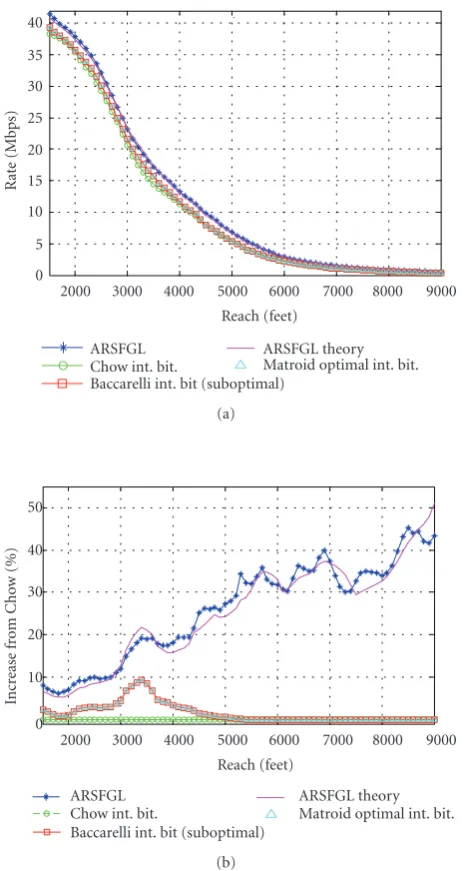
inFigure 6(b). FromFigure 6(a), we can see that on average, the ARSFGL scheme provides about 2 Mbps improvement over the integer-bit schemes for loops shorter than 5500 ft. As expected from (12), for loops longer than 4700 ft,η be-comes 1 and this case reduces to a PPO case as shown in
2000 3000 4000 5000 6000 7000 8000 9000 Reach (feet)
0 5 10 15 20 25 30 35 40
Rat
e
(Mbps)
ARSFGL Chow int. bit.
Baccarelli int. bit (suboptimal)
ARSFGL theory Matroid optimal int. bit. (a)
2000 3000 4000 5000 6000 7000 8000 9000 Reach (feet)
0 10 20 30 40 50
In
cr
ease
fr
om
Cho
w
(%)
Baccarelli int. bit (suboptimal) ARSFGL
Chow int. bit.
ARSFGL theory Matroid optimal int. bit. (b)
Figure6: Performance of various schemes for TPP. (a) Rate-reach curves and (b) percent increase in data rate as compared to Chow’s algorithm.
The theoretical curves are generated by adding∂bGfrom (12) to the rate provided by the matroid optimal integer-bit algo-rithm at different reach values. It is observed that the rate-reach curve of the ARSFGL closely follows the theoretical ex-pectations and thereby the assumption onηinSection 3is validated.
5.3. Evaluation of TPO case
Though the TPO case does not occur in practice, it has been presented here for the sake of completeness. The hypothetical TPO scenario is constructed by removing the PSD constraint from the TPP configuration shown inTable 3.
Thepowerandrateallocation results of the Leke’s algo-rithm [6] and proposed ARSFGL scheme are shown in Fig-ures7(a)and7(b), respectively, for a 2400 ft loop.
Figure 8shows the percentage increase in rate as com-pared to Chow’s algorithm [5] versus loop lengths offered by
0 200 400 600 800 1000 1200 1400 1600 1800 2000 Subcarrier number
−59 −58 −57 −56
Tx
PSD
(dBm/Hz)
ARSFGL Leke int. bit
(a)
0 200 400 600 800 1000 1200 1400 1600 1800 2000 Subcarrier number
2 4 6 8 10
Rat
e
(bits)
ARSFGL Leke int. bit
(b)
Figure7: Power and rate allocation for TPO case and 2400 ft loop. (a) Transmit PSDεj at different subcarriers, and (b) bit distribution b(ρjεj) at different subcarriers.
2000 3000 4000 5000 6000 7000 8000 9000 Reach (feet)
−4 −2 0 2 4 6
P
er
cent
incr
ease
in
rat
e
fr
o
m
C
ho
w
(Mbps)
HH[7] Chow[8] Leke[9]
Baccarelli[11] ARSFGL
Figure8: Performance of various schemes for TPO case.
for simplifying the analysis,rounding up a bit always costs more in terms of energy thanrounding down for the same
difference due to the logarithmic (concave) nature of the rate function. This bias leads to the granularity loss being positive even for the TPO case due toΩ2set of subcarriers. However in PPO and TPP case, as we observed, this effect is strongly dominated by loss due toΩ1.
5.4. Applicability to dynamic spectrum management
continuous bit-loading, respectively. When optimum spec-trum management (OSM) is used in the same scenario, the 600 m loops achieve 13 Mbps and 15 Mbps with integer-bit-loading and ideal continuous bit-integer-bit-loading, respectively. With its near-continuous bit-loading nature, the proposed ARS-FGL scheme could be used to recover most of such large granularity losses, that is, to approach the rates offered by ideal continuous bit-loading. Furthermore, given the saw-tooth and discrete nature of integer-bit distribution, multiple Nash equilibriums might exist and oscillations around these also seem likely when IWF is used with integer-bit-loading algorithm. This problem could be also mitigated to a large extent by using the ARSFGL scheme.
6. CONCLUSIONS
We examined the granularity loss due to the integer-bit re-striction that can contribute in a significant percentage in reducing the achievable data rates, especially in peak-power constrained cases, and developed a fine-granularity BER-based loading scheme to recover these losses. This is done by jointly optimizing the coding rate of a programmable RS(n,k) code and the bit and energy allocation on each sub-carrier. Illustrative examples of applications to VDSL-DMT systems indicate that the proposed scheme outperforms var-ious existing integer-bit-loading algorithms with an increase in rate of about 20% in most cases. This is a large rate increase as compared to the variation in achievable rates of less than 4% between various existing integer-bit-loading algorithms. This improvement is in good agreement with the theoretical estimates developed to quantify the granularity loss. The the-oretical estimates also present an insight into how the granu-larity losses increase with rising strictness in the peak-power constraint, in comparison to the total-power constraint and with the number of subcarriers in use. Although the illustra-tive results are for the currently standardized static spectrum management, it is expected that, with its near-continuous bit-loading nature, the proposed scheme can also be used to recover potential granularity losses that exist in dynamic spectrum management (DSM) cases.
ACKNOWLEDGMENTS
This work is partially supported by a National Sciences and Engineering Research Council Collaborative Research and Development Grant with Laboratoires universitaires Bell. The authors wish to thank Mr. Martino Freda and Mr. Nestor Couras, Electrical and Computer Engineering Department, McGill University, Montreal, Canada, for their indispens-able help in channel model construction; and Dr. Ioannis Psaromiligkos, Dr. Jan Bajcsy, and Dr. Harry Leib, all from Electrical and Computer Engineering Department, McGill University, Montreal, Canada, for their insightful discus-sions. The authors also acknowledge the comments by an anonymous reviewer, who helped to better highlight the im-provements of the proposed scheme.
REFERENCES
[1] J. M. Cioffi, “A Multicarrier Primer,”ANSI T1E1.4 Committee Contribution, pp. 91–157, November, 1991.
[2] “Asymmetric Digital Subscriber Line (ADSL) Metallic Inter-face,”ANSI Std. T1.413-1998, 1998.
[3] “Very-high Speed Digital Subscriber Lines (VDSL) Metallic Interface,”ANSI Std. T1E1.4/2003-210R5, 2003.
[4] R. G. Gallager,Information Theory and Reliable Communica-tion, John Wiley & Sons, New York, NY, USA, 1968.
[5] P. S. Chow, “Bandwidth optimized digital transmission tech-niques for spectrally shaped channels with impulse noise,” Ph.D. dissertation, Stanford University, Stanford, Calif, USA, 1993.
[6] A. Leke and J. M. Cioffi, “A maximum rate loading algo-rithm for discrete multitone modulation systems,” in Proceed-ings of IEEE Global Telecommunications Conference (GLOBE-COM ’97), vol. 3, pp. 1514–1518, Phoenix, Ariz, USA, Novem-ber 1997.
[7] E. Baccarelli, A. Fasano, and M. Biagi, “Novel efficient bit-loading algorithms for peak-energy-limited ADSL-type mul-ticarrier systems,” IEEE Transactions on Signal Processing, vol. 50, no. 5, pp. 1237–1247, 2002.
[8] “Spectrum Management for Loop Transmission Systems,” ANSI Std. T1.417-2001, January 2001.
[9] D. Hughes-Hartogs, “Ensemble modem structure for imper-fect transmission media,” U.S. Patents nos. 4,679,227 (July 1987), 4,731,816 (March 1988) and 4,833,706 (May 1989). [10] B. S. Krongold, K. Ramchandran, and D. L. Jones,
“Computa-tionally efficient optimal power allocation algorithms for mul-ticarrier communication systems,”IEEE Transactions on Com-munications, vol. 48, no. 1, pp. 23–27, 2000.
[11] E. Baccarelli and M. Biagi, “Optimal integer bit-loading for multicarrier ADSL systems subject to spectral-compatibility limits,”Signal Processing, vol. 84, no. 4, pp. 729–741, 2004. [12] J. Jang, K. B. Lee, and Y.-H. Lee, “Transmit power and bit
allo-cations for OFDM systems in a fading channel,” inProceedings of IEEE Global Telecommunications Conference (GLOBECOM ’03), vol. 2, pp. 858–862, San Francisco, Calif, USA, December 2003.
[13] P. S. Chow, J. M. Cioffi, and J. A. C. Bingham, “A practical dis-crete multitone transceiver loading algorithm for data trans-mission over spectrally shaped channels,”IEEE Transactions on Communications, vol. 43, no. 234, pp. 773–775, 1995. [14] A. V. Oppenheim, R. W. Schafer, and J. R. Buck,Discrete-Time
Signal Processing, Prentice-Hall, Englewood Cliffs, NJ, USA, 2nd edition, 1998, (Sec. 4.8.3. Analysis of Quantization Er-rors).
[15] R. H. Moroles-Zaragoza,The Art of Error Control Coding, John Wiley & Sons, New York, NY, USA, 2000.
[16] L. Zhang, C. Gao, and Z. Cao, “Exact analysis of bit er-ror rate of maximum-distance-separable codes,” in Proceed-ings of IEEE Global Telecommunications Conference (GLOBE-COM ’00), vol. 2, pp. 816–819, San Francisco, Calif, USA, November–December 2000.
[17] Telcordia Technologies, “Proposed Bit Rates for Spectral Com-patibility with VDSL,”ANSI T1E1.4 Committee Contribution, T1E1.4/2002-159R2, August 2002.
[19] Y. R. Shayan and T. Le-Ngoc, “A cellular structure for a versa-tile Reed-Solomon decoder,”IEEE Transactions on Computers, vol. 46, no. 1, pp. 80–85, 1997.
[20] J. G. Smith, “Odd-bit quadrature amplitude-shift keying,” IEEE Transactions on Communications, vol. 23, no. 3, pp. 385– 389, 1975.
[21] K. Cho and D. Yoon, “On the general BER expression of one-and two-dimensional amplitude modulations,”IEEE Transac-tions on CommunicaTransac-tions, vol. 50, no. 7, pp. 1074–1080, 2002. [22] “VDSL Test Specification for VDSL Olympics,”ANSI T1E1.4
Contribution, T1E1.4/2003-036R4, February 2003.
[23] J. P. Lauer and J. M. Cioffi, “A turbo trellis coded discrete multitone transmission system,” inProceedings of IEEE Global Telecommunications Conference (GLOBECOM ’99), vol. 5, pp. 2581–2585, Rio de Janeireo, Brazil, December 1999.
[24] K. J. Kerpez, D. L. Waring, S. Galli, J. Dixon, and P. Madon, “Advanced DSL management,”IEEE Communications Maga-zine, vol. 41, no. 9, pp. 116–123, 2003.
[25] K. B. Song, S. T. Chung, G. Ginis, and J. M. Cioffi, “Dy-namic spectrum management for next-generation DSL sys-tems,”IEEE Communications Magazine, vol. 40, no. 10, pp. 101–109, 2002.
[26] R. Cendrillon, W. Yu, M. Moonen, J. Verlinden, and T. Bostoen, “Optimal multi-user spectrum management for digital subscriber lines,” to appear in IEEE Transactions on Communications,http://www.comm.toronto.edu/∼weiyu/ osm.pdf.
[27] W. Yu, G. Ginis, and J. M. Cioffi, “Distributed multiuser power control for digital subscriber lines,”IEEE Journal on Selected Areas in Communications, vol. 20, no. 5, pp. 1105–1115, 2002.
Saswat Panigrahireceived the B.Tech. de-gree in electrical engineering from the In-dian Institute of Technology (IIT), Kanpur, India in 2003. He is currently finishing his M.Eng. degree in electrical engineering at McGill University, Montr´eal, QC, Canada. His current research interests include mul-ticarrier systems, coding theory, and opti-mization.
Tho Le-Ngoc obtained his B.Eng. degree (with distinction) in electrical engineering in 1976, his M.Eng. degree in microproces-sor applications in 1978 from McGill Uni-versity, Montreal, and his Ph.D. degree in digital communications in 1983 from the University of Ottawa, Canada. From 1977 to 1982, he was with Spar Aerospace Lim-ited and was involved in the development and design of satellite communications
sys-tems. From 1982 to 1985, he was an Engineering Manager of the Radio Group in the Department of Development Engineering of SR Telecom Inc. and developed the new point-to-multipoint DA-TDMA/TDM subscriber radio system SR500. From 1985 to 2000, he was a Professor at the Department of Electrical and Computer Engineering of Concordia University. Since 2000, he has been with the Department of Electrical and Computer Engineering of McGill University. His research interest is in the area of broadband digital communications with a special emphasis on modulation, coding, and multiple-access techniques. He is a Senior Member of the Or-dre des ing´enieur du Quebec, a Fellow of the Institute of Electri-cal and Electronics Engineers (IEEE), a Fellow of the Engineering