Service-dominant logic as a framework for exploring research
utilization
Tim Hughes
Professor of Applied Marketing
Faculty of Business and Law
University of the West of England
Mario Vafeas
Senior Lecturer
Faculty of Business and Law
University of the West of England
Abstract
This article links S-D logic to the call for better theoretical frameworks to understand
research utilization in business and management. It contributes to explaining what happens in cocreating knowledge between researchers and research users and also contributes to the development of midrange theory on S-D logic. A framework is utilised, based on Vargo and Lusch’s (2016) update on S-D logic. To demonstrate application, the framework is applied to an example of the authors’ research on marketing agencies and their clients. Implications for theory and academic practice and policy are put forward. The S-D logic framework is not tied to any particular research method or way of working and has benefits in being applicable to marketing research and across the wider field of business and management. The idea of resource enhancement is put forward as a learning process in explaining what happens to the actors’ resources in the course of resource integration.
Introduction
The call for academic research to be seen to create social and economic impact is a global issue. It is apparent in the 2020 strategy in Europe and the Star Metrics initiative in the US (LERU, May 2012). In the UK it was stressed in the 2014 Research Excellence
(Watermeyer, 2014). In Marketing and the wider field of Business and Management the impact agenda connects to the debate about the utilization of academic research. The
contention of this article is that research utilization is a cocreative activity. An academic requires a third party to take some action or change their views as a result of the academic’s research in order for utilization to take place. Therefore it always involves some element of
cocreation. The purpose of the article is to take a framework from service-dominant logic (S-D logic) (Vargo and Lusch, 2004, 2008, 2011, 2014, 2016) and apply it to the cocreation of
value from academic research, responding to the call for rigorous investigation of how the results of scientific research are utilized in management practice (Kieser, Nicolai and Seidl, 2015). Thus the aim is to contribute to theory on research utilization, as well as to the
development of midrange theory on S-D logic (Vargo and Lusch, 2017).
The article begins with a discussion of the impact policy agenda across the world and
its relationship with research utilization within management and marketing research. There follows a review of the limitations of the extant literature on knowledge generation and utilization in management, concluding with Kieser, Nicolai and Seidl’s, (2015, p213) call for
theoretical frameworks to fill a gap between“the utilization of management research and the social dynamics between academic and experiential knowledge”. The argument, in this
article, is that S-D logic has great potential to contribute to this gap in the way it
conceptualises value in use from multiple points of view. As such, S-D logic is appropriate in incorporating the different perceptions of value of academics and practitioners dealing with
the complexity and paradoxes of engaging with each other. A framework for utilization, utilising the core ideas of S-D logic, as restated by Vargo and Lusch (2016), is then discussed
agencies and their clients. The subsequent Discussion section considers the insights that might be gained and the practical implications for academic researchers.
The wider impact agenda and the policy context
The pressure on the higher education sector to demonstrate wider impact from
research is apparent across the globe (Watson et al. 2011).The European 2020 Strategy includes wider impact, as a one of the key criteria, in allocating research funding and the US
Star Metrics initiative is designed to measure the impact of scientific investment (LERU, May 2012). In the UK, the perceived importance of university-business collaboration has been reinforced by a series of government reports (Wilson Report, 2012; Witty Report, 2013;
Dowling Review, 2015). Thus impact is a political agenda with a widespread reach. The achievement of wider social and economic impact requires academics to go
beyond simply communicating their findings. The UK REF 2014 guidelines made it clear that dissemination activity on its own, without evidence of its benefits, would not be considered to be a demonstration of impact (REF 2014 report). This requirement suggests that academics
need to collaborate with research users in demonstrating how the research findings have been utilized. In management research, research usage can be seen to be about both knowledge
dissemination and knowledge production (Shapiro, Kirkman and Courtney, 2007). That is to say, it is not purely about disseminating and translating research from academics to
practitioner audiences, but also requires both sides to engage together to cocreate new useable
knowledge. This is a key point, achieving impact requires a third party to think or act in a way that is influenced by the research. This poses many challenges for academics researching
Utilization in management and marketing research
Utilization in marketing research is usefully seen in the context of the wider
disciplinary debate over the practitioner relevance of management research. A gap between academia and practice is said to have opened up (Pfeffer and Fong, 2002; Rynes, 2007) and much of the teaching and research carried out in universities is said to be irrelevant to the
needs to business (Huff, 2000; Bennis and O’Toole, 2005; Bartunek and Rynes, 2014). In other words, the outputs of management research are criticized for not having impact on the
practice of management. Marketing, has been specifically criticized in this respect (Baker and Holt, 2004; Mentzer and Schumann, 2006; Reibstein, Day and Wind, 2009; Storbacka, 2014; Mason, Kjellberg and Hagberg, 2015).
The argument goes that the divergence is detrimental to the development of the marketing field (Reibstein, Day and Wind, 2009). Fendt et al.’s (2008) analysis of the
theory-praxis gap suggests that usefulness, as embodied in pragmatism, should be an important criterion in designing research. Good theory needs to be based on both originality and practical utility (Corley and Gioia, 2011) and therefore needs to be based in the reality of the
human experience of practice (Knights and Scarborough, 2010; Mason, Kjellberg and Hagberg, 2015). Collaboration with practitioners, customers and stakeholders is often an
important element in theory development (Brodie, 2017) and in marketing management this requires an understanding of how research is relevant to the role of the practitioner in relation to the organization in which they work (Jaworski, 2011).
However, despite the longevity of the debate and the many solutions put forward in the literature, little progress has been made in increasing relevance (Bartunek and Rynes,
2014). It can be very difficult for researchers to move between the different communities of practice of academia and business (Shrivastava and Mitroff, 1984) because of the
incentives, objectives and world view between the communities (Bartunek and Rynes, 2014). Moreover, the pressure to produce high quality academic outputs may make it very difficult
for an academic to spend the time and effort necessary to become a provider of ideas to the business world (Martin, 2012). There is also the question of motivation. As Jaworski (2011) observes, the academic marketing community is split on the desirability of collaboration with
practice.
In summary, the utilization of management research in general and marketing
research, in particular, has largely been discussed in relation to relevance to practice and to the significant challenges of engaging with practice. The next section takes a broader perspective in reviewing the existing literature conceptualising the ways knowledge is
developed and shared with research users.
Knowledge creation and utilization
Gibbons et al.’s (1994) concept of Mode 1 and 2 knowledge creation can be seen to have been influential in the management literature on research utilization. Mode 1 (M1)
means research that is conducted by academics without any involvement from practitioners. In M1 research, problems are set and solved within the academic community and the process
of utilization is sequential, with discovery of new knowledge preceding its application. In contrast, Mode 2 (M2) research is conducted in the context of application and discovery and application are inseparable. An imperative of M2 is that the exploitation of knowledge
requires participation from practitioners in its generation.
The M2 approach has been widely advocated in the management literature. Van De
Ven and Johnson’s (2006) model involves the engagement of practice in problem
related to field problems is favoured over the explanatory approach of the social scientists. Rather than aiming to find universal ‘truths’ the design scientist develops heuristic rules that
managers adapt and redesign in implementation. Another way of sharing with practice is put forward in Evidence Based Management (Rousseau, 2007) which is about translating
management principles into organizational practices (Rynes, Giluk and Brown, 2007). These
approaches can be critiqued from a number of viewpoints. Action research develops solutions that come out of trying to serve the interest of the client, design science is over mechanistic
and evidence based management suffers from lack of quality of evidence (Kieser, Nicolai and Seidl, 2015). Most importantly, all these approaches require a high level of proactive
involvement by practitioners and therefore, in turn, require a degree of consensus on the
subject matter and a willingness to be fully committed by all the stakeholders. In a recent paper, Nenonen et al. (2017) reflect on how collaborative theorizing with managers can
happen, drawing from examples of four case studies. In all the case studies a significant proportion of the managers involved had bought into the programme and were involved in commenting on and critiquing theoretical frameworks. Nenonen et al. (2017) call for more
research into this type of collaborative theorizing, but also call for research into situations where other approaches for achieving academic rigour and relevance are more suitable.
This is an important point; the reality of day to day engagement between scholars and practitioners is likely to involve a number of different ways of working together
(Antonacopoulou, Dehlin and Zundel, 2011). The idea that research in management falls
neatly into M1 or M2 is said to be simplistic (Huff, 2000; Bresnan and Burrel, 2012) and normative (Hessels and Van Lente, 2008; Kieser, Nicolai and Seidl, 2015). Hessels and Van
quadrants relating to fundamental understanding versus consideration of use. Only one quadrant fulfils both criteria.
Kieser, Nicolai and Seidl, (2015, P213) recognize that research utilization needs to be defined broadly: “The concept of utilization does not restrict the ways and the context in which research is used, nor does it prescribe who can use it and what role its users play in the
process”. Kieser, Nicolai and Seidl, (2015 P213) conclude that the fundamental problem in the debate is that there is a lack of a theoretical and empirical foundation. They suggest that a
first step is to develop theoretical frameworks for research on “the utilization of management research and the social dynamics between academic and experiential knowledge”. The theoretical frameworks: “need to acknowledge that there are many different ways in which
management research can be utilized” (P216). This is where S-D logic has great potential to contribute, as will be discussed in the next section.
S-D logic as a theoretical framework for examining research utilization
The concept of research utilization connects to the idea of cocreation and value in use,
key ideas running through the work of Vargo and Lusch (2004-2017) and others on S-D logic. A central and prevailing theme of S-D logic is that value is created by
service-for-service exchange (Vargo and Lusch 2008, 2011, 2016, 2017). The creation of knowledge through research can be seen as service, in which skills and knowledge are applied to gain new insights for the benefit of others. The realization of the benefit requires a third party to
be influenced by or act on the research.
Vargo and Lusch have recently restated the core ideas of S-D logic, based on the
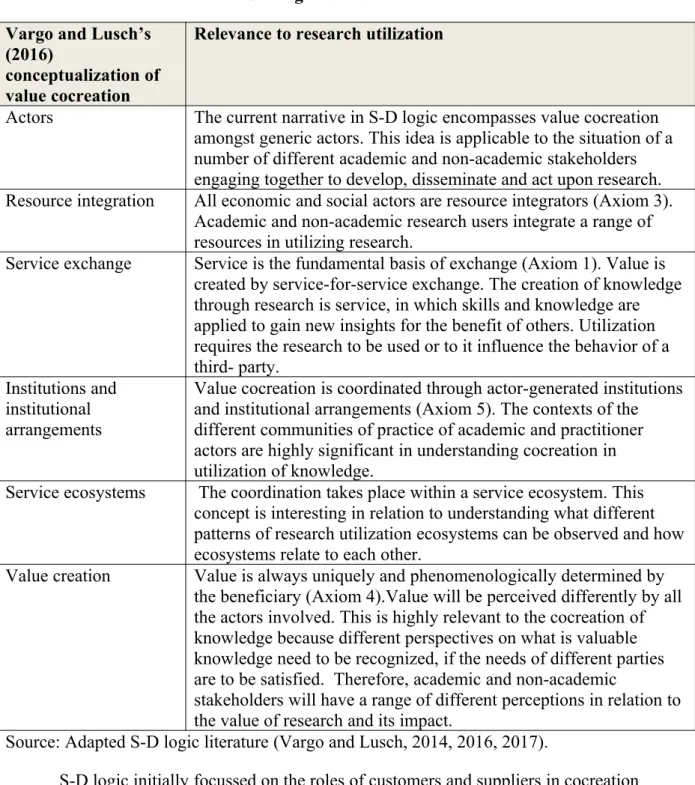
service ecosystems of value creation. Table 1 demonstrates the applicability of these ideas to research utilization.
Table 1 Relevance of themes in S-D logic to research utilization Vargo and Lusch’s
(2016)
conceptualization of value cocreation
Relevance to research utilization
Actors The current narrative in S-D logic encompasses value cocreation amongst generic actors. This idea is applicable to the situation of a number of different academic and non-academic stakeholders engaging together to develop, disseminate and act upon research. Resource integration All economic and social actors are resource integrators (Axiom 3).
Academic and non-academic research users integrate a range of resources in utilizing research.
Service exchange Service is the fundamental basis of exchange (Axiom 1). Value is created by service-for-service exchange. The creation of knowledge through research is service, in which skills and knowledge are applied to gain new insights for the benefit of others. Utilization requires the research to be used or to it influence the behavior of a third- party.
Institutions and institutional arrangements
Value cocreation is coordinated through actor-generated institutions and institutional arrangements (Axiom 5). The contexts of the different communities of practice of academic and practitioner actors are highly significant in understanding cocreation in utilization of knowledge.
Service ecosystems The coordination takes place within a service ecosystem. This concept is interesting in relation to understanding what different patterns of research utilization ecosystems can be observed and how ecosystems relate to each other.
Value creation Value is always uniquely and phenomenologically determined by the beneficiary (Axiom 4).Value will be perceived differently by all the actors involved. This is highly relevant to the cocreation of knowledge because different perspectives on what is valuable knowledge need to be recognized, if the needs of different parties are to be satisfied. Therefore, academic and non-academic
stakeholders will have a range of different perceptions in relation to the value of research and its impact.
Source: Adapted S-D logic literature (Vargo and Lusch, 2014, 2016, 2017).
S-D logic initially focussed on the roles of customers and suppliers in cocreation (Vargo and Lusch, 2004), however the perspective now taken is of cocreation taking place far
customers but among a whole host of actors.” (Vargo and Lusch, 2016, p 9). The wider conceptualisation lends itself to consideration of the range of academic and non-academic
actors that become involved in utilizing research findings.
The actors integrate operant and operand resources (Vargo and Lusch, 2011). Operant resources are the active agents in value creation, typically involving the knowledge and skills
of the actors (Vargo and Lusch 2004, 2008) and it is the integration of the operant resources, from those involved, that creates value (Löbler, 2011; Vargo and Lusch, 2011;
Kleineltankamp et al. 2012). Vargo and Lusch (2004) conceptualise that resources come into being through cocreation, leading to the idea of potential resources that are made to be useful by interacting with of other potential resources (Vargo and Lusch, 2011). When academics
engage with practitioners both parties bring in a range of operant resources. A resource integration perspective allows for an examination of the nature of the resource inputs from
the parties and a consideration of how these resources may change and develop in the process. An actor can be involved in resource integration at different levels from very active to passive (Löbler, 2013). The study of how resources become, through use, is still emerging
and subject to ontological considerations (Peters et al. 2014). The move towards cocreation as being between generic actors rather than between customer and supplier reflects a move,
identified by Löbler (2011), towards a philosophical underpinning of intersubjectivity in S-D logic. An intersubjective approach allows for the incorporation of both subjective and
objective perspectives and therefore recognises the value of considering resource integration
as both emergent [focussing on the experience of the actors] and as interaction [focussing on the relationship between interaction and resources] (Peters et al. 2014).
researcher can be seen to be providing service to the research user. Utilization only occurs when a research user is influenced by or acts on the research findings. The level of user
engagement in service exchange may vary from full involvement, in cocreating the research from the beginning, through to being a recipient who acts on newly created knowledge. In addition, the utilisation of the research may be immediate or delayed, as is the case where
further technological developments are needed to realise the benefits of theoretical research. Thus the spectrum of involvement is wide, but the fundamental principle is that service
exchange between academic and non-academic actors is necessary to achieve research utilization.
A relatively recent addition to cocreation is that of the discussion of role of
institutions and institutional logics. These are the formal and informal constraints (rules and norms) that play a major role in shaping actors’ behaviour in resource integration
(Edvardsson et al. 2014). The emphasis on the institutional context has particular significance in considering utilization of academic research in the light of the literature on the challenges of moving between different communities of practice (Shrivastava and Mitroff, 1984;
Bartunak and Rynes, 2014). Understanding the role that institutional norms play in shaping behavior and perceptions (Edvardsson et al. 2014) and in what ways institutionalized rules
need to be maintained or broken in taking on new ideas (Koskela-Huotari et al. 2016) is highly relevant.
A service ecosystem needs to be established to coordinate the cocreation of value
(Vargo and Lusch, 2014). A service ecosystem is a relatively self-contained, self-adjusting system of resource integrators, with shared institutional logics, cocreating mutual value
Lusch, 2016). Earlier work on practices in S-D logic suggests that practices exhibit
commonalties relating to understandings, procedures and engagements (Schau, Muñiz and
Arnould, 2009), that practices are spread across time and space through a process of translation (Kjellberg and Helgesson, 2007) and that it is possible to develop typologies of
cocreation practices in specific contexts (Frow, McColl-Kennedy and Payne, 2016).
Exploring research utilization within different examples of service ecosystems would provide
the opportunity to compare practice in varied contexts.
At the centre of the narrative of S-D logic is value creation. In S-D logic, value is a perception that is relative and individual, forming Axiom 4: “Value is always uniquely and
phenomenologically determined by the beneficiary”. Axiom 4 underlines the need to consider perspectives on value from different points of view. It is particularly appropriate for focusing
on understanding the differing perceptions of academics and practitioners involved in knowledge creation, where both sides are engaging with the contradictions and paradoxes inherent in the situation (Bartunek and Rynes, 2014). If the value proposition (Frow et al.,
2014) is sufficiently motivating the actors commit their operant resources, specifically
explicit and tacit knowledge (Ballantyne and Varey, 2006) to the value creation process. This
covers a wide range of patterns of involvement, from simply combining the reader of a research report’s knowledge with that of the authors, through to joint research involving a high level of interaction and resource integration. Academic and non-academic stakeholders
will have a range of different perceptions in relation to the value of research in general and specific research findings. Exploring different perspectives on what is valuable knowledge is
2010). Research may have negative as well as positive impact, depending on how it is used and the value perception of different actors.
Example: Applying the framework
To illustrate application of S-D logic to research utilization, the authors have applied it to provide a lens to view their own proactive engagement with practitioners over a four
year period in relation to their research with marketing agencies and their clients (Vafeas, Hughes and Hilton, 2016; Vafeas and Hughes, 2016). The agencies were all marketing
agencies involved specifically in the marketing communication process. This included full-service advertising agencies, design agencies, digital marketing agencies, PR agencies and promotional agencies. The authors followed up the initial research with activities designed to
engage with practitioners, disseminate the research results and encourage utilization of the research in the practioners day to day practice. An overview of the research development and
dissemination process is provided in Table 2. Table 2 Stages of research and dissemination
Stage Participants
1. Initial case studies
Nine case studies developed from dyadic depth interviews with clients and their agencies
25 client and agency practitioners
2. Agency/client workshops
Workshop a 56 agency
practitioners
Workshop b 11 client
practitioners
Workshop c 36 agency and client
practitioners 3. Presentations to practitioners
Presentation 1 84 agency
practitioners
practitioners
Presentation 3 50 agency and client
practitioners 4. Workshops with individual agencies
Nine separate workshops with individual agencies and follow-up with each agency: Agency 1 – 29 participants
Agency 2 – 22 participants Agency 3 – 4 participants Agency 4 – 13 participants Agency 5 – 12 participants Agency 6 – 13 participants Agency 7- 7 participants Agency 8 – 5 participants Agency 9 – 7 participants
112 agency practitioners
Total number of practitioners engaged across all stages
404
Stage 1-Initial case study research
Initially clients were approached and if the client agreed to take part, their agency was contacted. Sampling was purposive through the selection of individuals with the potential to provide perspectives directly related to the purpose of the research (Silverman and Marvasti,
2008). Twenty five interviews were conducted with seven clients and eighteen agency executives. Two of the clients gave access to two of their agencies and nine separate cases
were developed, each based on the relationship between a client and an agency. The clients included global, large, medium and small companies across a range of product and service sectors. The client interviewees all dealt directly with agencies and had job titles such as
top 5 London full-service agency, through medium sized agencies (some full service and others specialists in design, direct or digital marketing) to internal agencies (two cases).
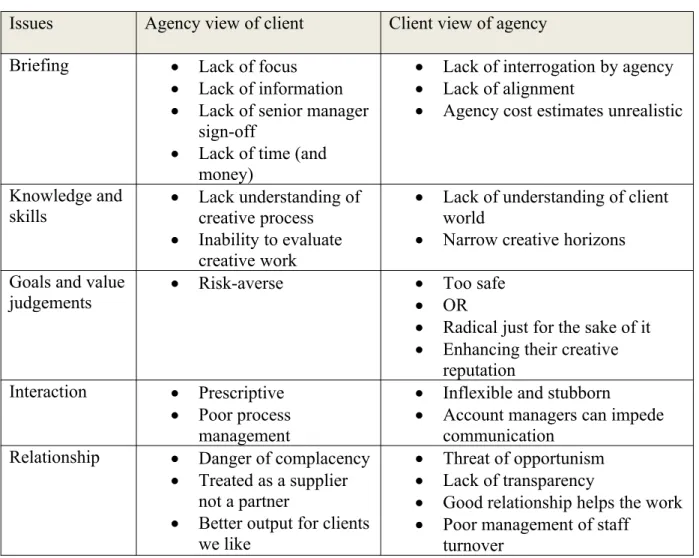
The research findings covered a number of areas of potential interests to clients and agencies, as summarised in Table 3.
Table 3 Summary of initial research findings of potential interest to practitioners
Issues Agency view of client Client view of agency
Briefing Lack of focus
Lack of information Lack of senior manager
sign-off
Lack of time (and money)
Lack of interrogation by agency Lack of alignment
Agency cost estimates unrealistic
Knowledge and
skills Lack understanding of creative process Inability to evaluate
creative work
Lack of understanding of client world
Narrow creative horizons
Goals and value
judgements Risk-averse Too safeOR
Radical just for the sake of it Enhancing their creative
reputation Interaction Prescriptive
Poor process management
Inflexible and stubborn
Account managers can impede communication
Relationship Danger of complacency Treated as a supplier
not a partner
Better output for clients we like
Threat of opportunism Lack of transparency
Good relationship helps the work Poor management of staff
turnover
Stage 2-Agency/client workshops
The next stage was designed to share the research findings and analysis more widely with practitioners. The workshops ran over a period of six months. The first workshop aimed
at agencies, the second at clients and the third intended to bring together both agencies and clients. The workshop delegates were charged for attendance and the subsequent income
presentation of the findings from the initial research; open discussion of the findings and group work. Where possible, delegate discussion and feedback was recorded and delegate
feedback was collected at the end of each workshop.
Stages 3 and 4) Presentations to practitioners and individual agency workshops
Two further presentations were made to large audiences of practitioners. The nature
of these sessions was more about straight dissemination of the research findings rather than a two-way dialogue. However in both sessions the authors offered to put on follow-up
workshops with individual agencies that wanted them. In response to this, nine individual agency workshops were set up and were subsequently run covering a total of 112 agency executives. At the end of each workshop feedback was collected from the participants and an
arrangement was made for a follow up session to take place in nine months’ time.
Application of the S-D logic framework to the example The actors
In the first place, the authors identified the actors who might be interested. In this
case, the actors were defined as marketing professionals, using marketing agencies and account executives, managers and creatives from marketing communication agencies. Setting
up a means of communication with these practitioners necessitated the involvement of other actors from professional associations, representing marketing and creative businesses in the region of the authors’ university. In attracting practitioners, the authors were greatly helped
by partnering with these professional network organisations. Actors from these networks promoted the workshops to their members, advised on the messages that would be most
this was motivating for a significant number of practitioners, who were willing to pay to come to the initial workshops and also to give up the time of a large proportion of their
employees to take part in the workshops for individual agencies (see Table 2). Other actors involved included consultants working with advertising agencies, who were interested in using the research results in the course of their work with their clients. The agency
community proved to be far more responsive than the client community. The value
proposition appeared to be weaker in relation to clients, perhaps because they feel that if the
agency relationship is not working they can change agencies. As Kieser, Nicolai and Siedl (2015) point out, other factors than scientific rigour determine practitioner adoption. The interest in the research from the agency community related to their perception of its relevance
to their current business challenges. Resource integration
S-D logic recognises the importance of integrating the operant resources (knowledge) of the actors in cocreation. Research utilization requires integration of new knowledge from the research to be integrated with the existing knowledge of the research users to create new
knowledge, which becomes a resource for the user. As discussed earlier, S-D logic allows for the incorporation of both subjective and objective perspectives (Löbler, 2011; Peters et al.
2014) and therefore resource integration can be seen as emergent, as experienced by resource integrators and interactive, as viewed through considering the relationship between
interaction and resources, this is illustrated in Table 4
Table 4 Resource integration
Stage of interaction Interaction and resource integration
Experience of the resource integrators Agency/client workshops Combination of knowledge
from interview analysis undertaken by the researchers with tacit knowledge of practitioners on day to day
issues related to overcoming some of the challenges raised.
evidenced by feedback forms (See Appendix). Researchers gained greater understanding of
contemporary contexts of agency client/working. Presentations to practitioners Low resource integration as
mainly one-way presentation of research findings.
Some value for
practitioners, as evidenced by feedback forms.
Value for researchers in generating leads for Stage 4 Agency workshops.
Workshops with individual agencies
Combination of researchers’ knowledge with different perspectives with highly contextual knowledge from practitioners across a range of functions within each agency.
Value for practitioners, as demonstrated by feedback (see examples in Table 5).
In the agency/client workshops the authors presented the findings from the initial case studies and then facilitated group discussions in a collaborative effort to extend the
participants’ understanding of the initial findings. The group discussions then moved on to discuss how some of the challenges thrown up by the research findings could be overcome.
Therefore, an interactive process of resource integration took place. The experience of the resource integrators provides triangulation through evidence collected in feedback forms relating to the knowledge gained (see Appendix for selected examples). This tacit knowledge
then enhanced the richness of the findings and was incorporated in subsequent larger scale practitioner presentations. The presentations then lead to the setting up of the individual
agency workshops; where again the authors ran groups combining knowledge from the previous stages with tacit knowledge from the narrower context of each agency. The individual agency workshops focussed on the specific implications of the research findings
at this point the resource integration was very much specific to the particular context of utilization.
A recurring theme in S-D logic is the questions of what happens to resources as a result of integration. In the context of resource integration between academics and practitioners the operant resources of the participants can be seen to have been enhanced
through resource integration. Knowledge is an operant resource and through resource
integration learning has taken place. This relates directly to research utilization. If research is
to be used the research user needs to have learnt something new from the research and then to have operationalised this learning in their subsequent practice. This can be seen as the
learning process which provides the participants with improved capabilities in dealing with
the issues raised in the research more effectively in the future. At the end of the workshops, delegates were asked to fill in feedback forms on what they learnt and what they would do
differently, as a result of the workshop (see Appendix). These feedback forms suggest that learning had taken place for most delegates and many expressed the intention to take action in their own context from what they had learnt. The individual agency workshops provided
more direct evidence of resource enhancement because the initial workshops were followed up with a second workshop at which it was possible to collect feedback on how the
participants incorporated learning from the initial workshops into their practice. Table 5 Resource enhancement/learning from individual agency workshops
Knowledge gained Example quotes from feedback sheets Recognition of common
problems for agencies “It was a good opportunity to talk openly as an agency- we all seem to have the same problems and have come up with some good solutions.” Agency understanding
of client needs
“Need to be more proactive with clients and raise issues with them.”
“I will ask my clients if they are getting what they want eg reports in a suitable format, explaining data clearly, meeting frequently; make it clear which statistics require client action”.
Agency understanding
of client limitations “Important that clients understand that they need to be fully involved in co-creative process”. “Interesting to hear the client quotes and feedback- highlights the amount of misunderstanding between client and agency……
client and team from (agency name), to ensure that everyone is clear about the background to the project and the scope of the project. As part of the kick-off, particularly on first projects, invest time to 'educate' the client into how (agency name) works so that expectations and demands are realistic from the start.” “Owner managers with no background in marketing can sometimes be the most difficult clients to deal with. This underlines the need to set expectations on both sides at the initial meeting after the appointment of the agency.”
The need for better communication
“It made me step back to think about how our clients might portray our work and maybe not understand why we do things the way we do. Key point for
communications: that everyone feels valued, which in turn will produce better work.”
“Learnt about new elements that could be introduced into marketing of the agency.” “We are going to ensure that our customers are kept better informed of the actions we are taking and why we are taking those actions. We are going to seek to streamline our monthly reporting to ensure that customers have the right information, rather than of all of the information.”
Ideas for increased
proactivity “Some good ideas for improving the process of educating clients.”“Make clients aware of instances where the agency is using knowledge gained from other sectors. Although this happens instinctively, 'flagging up' this cross-pollination will demonstrate to clients the benefit of working with an agency like (name of agency) that has a broad client portfolio.”
Relationship quality “Learning about the small elements that can improve the client agency relationship.” “Take away and implement- don’t base creative worth always on what you know the client likes- can be seen as complacency.”
“There may be a case for having more regular face-to-face reviews with clients - To get more commercial feedback from clients
- To get an honest appraisal of the process from both sides - To demonstrate enthusiasm for the client’s business”
“Need to do more inductions with brand managers on our packaging side and on how we can help SMEs.”
Service exchange
It is interesting to reflect on the nature of the service exchanged at the different stages of research. Stage 1 (the case studies) was totally initiated and led by the authors, with the interviewees providing their time and knowledge. Stages 2 and 3 (agency and client
workshops and presentations) were jointly conceived and planned between the authors and representatives of practitioner networks. The authors provided their analysis of the findings in
issues in relation to the research findings and what actions they might take. Therefore, at this stage, the service provided by the authors was exchanged and utilized in very specific
contexts. An actor can be involved in cocreation at different levels from very active to passive (Löbler, 2011). In this example, the impetus in leading the service exchange moved from being purely that of the researchers, in the first stage, to becoming more jointly owned
in the middle stages and more owned by practitioners in the individual agency workshops. This suggests patterns of service exchange that may be worth exploring in other contexts.
Institutions and institutional arrangements
Institutions and their logics are important in understanding service ecosystems (Vargo and Lusch, 2016). The practitioner actors themselves represented a range of different
institutional logics from each other. For example, clients come from many sectors and with a range of professional backgrounds. Agencies contain actors with different professional
backgrounds and affiliations. Feedback from the individual agency workshops suggests that the value of sharing the research lies in the fact that clients and agencies seldom discuss openly the state of their relationship. If clients are unhappy, they generally switch provider
without explanation (there are plenty of alternative providers). If agencies are unhappy, they generally persevere without confronting the client because they are fearful of upsetting and
losing the client. Sharing the research brought to light and shared the beliefs and attitudes of both partners in the relationship.
The fundamental difference in world views of academics and practitioners is well
documented (Shrivastava and Mitroff, 1984; Bartunek and Rynes, 2014). The authors were very aware of the need to incorporate the views and of different groups of actors in sharing
Service ecosystem
A service ecosystem is a relatively self-contained, self-adjusting system of resource
integrators, with shared institutional logics and mutual value cocreation through service exchange (Lusch and Vargo, 2014, p. 161). In working with agencies, through an existing network, over a prolonged period, the authors tapped into an existing ecosystem. Supporting,
promoting and running the workshops with members, involved social networking practices; impression management practices (the network was seen to be putting on valuable
educational events for their members) and community engagement practices, reinforcing members’ escalating engagement with the brand community (Schau, Muñiz and Arnould, 2009). In engaging with the ecosystem a process of translation of the research findings took
place (Kjellberg and Helgesson, 2007) with the dialogue in the workshops by necessity relating to the interests of the practitioners and using practitioner ‘language’.
However, the authors’ engagement with clients was far less effective and not sustained over time. The ecosystem of clients appeared to be far less developed, probably because of the wide diversity of clients and lack of common identity. Furthermore, there is a
lack of a meaningful service ecosystem that incorporates both clients and agencies. This was a major barrier to achieving utilisation of the research findings.
Value creation
As discussed earlier, value in S-D logic, is seen as an individual perception (Vargo and Lusch, 2004). Ratings were obtained from the delegates to the initial workshops using 4-
point scales in which the vast majority scored the workshops as Excellent or Good against a number of criteria. Positive value perception is also demonstrated in the case of delegates
participants in the individual agency workshops, showing potential instrumental and
conceptual use of the knowledge. The increased involvement of practitioners at the different
stages suggests that value in use may develop over time, but this aspect of operationalisation of learning is difficult to demonstrate because it requires prolonged and significant
engagement with specific practitioners. An example of this is a digital marketing agency that
the authors have maintained a relationship with over the last 2 years. A director of the company stated that the research highlighted certain key areas to focus on:
Educating clients about the process More extensive kick-off session
Being more adaptable in communication End of project sign off by clients
The authors have seen how, as a result, the agency has made changes in the processes adopted across the agency in dealing with their clients. Furthermore, one of the authors has
recently observed the agency in attending a series of meetings with a client from an early point in a project. The benefits of the approach are apparent in the openness of the dialogue with the client over a complex briefing and development process to produce a new website
for the client.
The value the authors derived from the process was very different from that perceived
by the practitioners. For the authors, the extended and time consuming stages of interaction in this case provided corroboration of the research findings and extended the initial findings, giving more insight into the context of implementation and also how the new media
environment may be changing the relationship between agencies and clients. The authors gained ideas for future research and also for new areas of marketing teaching.
Applying S-D logic to thinking about utilization of research provides a theoretical framework that goes beyond the simple M1 to M2 continuum or the classification of research
into 4 quadrants. The framework in Table 1, does not try to put different research projects on a scale. Rather, Vargo and Lusch’s (2016) elements of S-D logic identify factors that can help to explain utilization. Thus S-D logic overcomes the limitations of polarization of research
into M1 and M2 and covers the whole continuum, allowing for different levels and types of resource integration between different actors within a research/practice/user ecosystem. This
ecosystem can encompass one-to-one knowledge exchange; one-to-many knowledge exchange or many-to-many knowledge exchange.
The S-D logic framework entails a consideration of the actors involved in cocreating
value in use. Identifying user groups and stakeholders and their networks is important to understanding who is utilizing research. Closely related to this is understanding the value
proposition that will motivate different actors. Where a proactive approach is taken towards research utilization, an important first step may be to identify the actors who might be potential research users. In developing a motivating value proposition and communicating
with potential users it can be very helpful to work with network leaders. Research could useful explore and analyse different types of actor networks and their involvement in utilising
research. In recognizing that value is phenomenological, S-D logic embraces the different world views of the academic and the practitioner (Shrivastava and Mitroff, 1984; Bartunek and Rynes, 2014). The example shows how a compelling value proposition ensured
participation from different parties. The practitioners were interested and involved because the research was perceived to address some pressing business challenges.
literature review, Vargo and Lusch (2004, 2011) conceptualise that new resources come into being through cocreation. The examples in Table 5 suggest that the participating actors were
building on their existing knowledge to come up with new ideas for future actions. This suggests that not only new operant resources may be created, but also that existing operant resources can be enhanced through resource integration. The idea of resource enhancement in
this context, as being about gaining of new knowledge and combining it with existing
knowledge, connects resource integration to the existing literature on organizational learning
and the development of knowledge (Cohen, & Levinthal, 1990; Galunic and Rodan, 1998; Spender 2008). It also has links with the knowledge management literature on how
knowledge moves between communities of practice (Brown and Duguid, 1998), and the
challenges in knowledge transfer (Easterby-Smith, Lyles and Tsang, 2008). The idea of resource enhancement extends our understanding of resource integration and suggests new
avenues for further research, extending into learning and knowledge transfer. Longitudinal research designs are likely to be most effective in exploring the complexity involved in this. Identification of patterns of application can be informative in developing midrange theory.
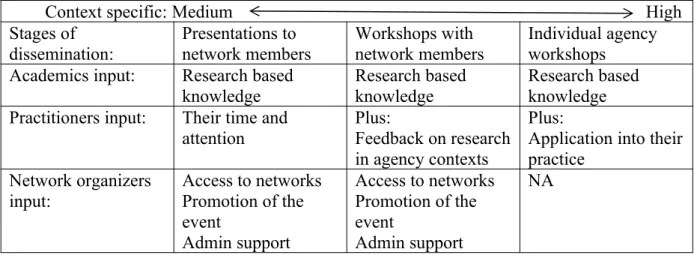
The example demonstrates how the service exchange became more context specific over time, as represented in Table 6. As the stages progressed, it became more apparent which
groups of users would be most interested in using the knowledge and by last stage (the individual agency workshops) the authors were providing their time and knowledge to the benefit of practitioners in particular organizations. The role of closeness to context in
cocreation would be worth further research because it can be seen to be relevant in different situations.
Context specific: Medium High Stages of dissemination: Presentations to network members Workshops with network members Individual agency workshops
Academics input: Research based knowledge
Research based knowledge
Research based knowledge Practitioners input: Their time and
attention
Plus:
Feedback on research in agency contexts
Plus:
Application into their practice
Network organizers input:
Access to networks Promotion of the event
Admin support
Access to networks Promotion of the event
Admin support
NA
Recent thinking on S-D logic has emphasized the different institutional logics of the actors involved in shaping their behaviors in a service ecosystem (Edvardsson et al. 2014; Vargo and Lusch, 2016) and the importance of practices that take place in ecosystems (Frow,
McColl-Kennedy and Payne, 2016). In the example, the authors engaged with an existing network for the agency actors and stakeholders, but had more difficulty in engaging with
client actors. The failure to establish an ecosystem that was inclusive of the different types of actors provides a perspective on the limitations of way the research was utilized in the
example. Further studies of ecosystems and how they are established in research user
communities would be beneficial.
If utilization is to take place, the research user will have learnt something/changed
their opinion/acted differently, as a result of exposure to new knowledge. Hence, the importance of understanding the value perceptions of research users, recognising that each actor will have their own individual perception of the process, what they have learnt and how
they intend to use the knowledge. Table 7 presents the authors’ interpretation of the motives of key players. This includes marketing consultants who requested to use the authors’
presentation with their clients.
Actors Perspective
Agency Ensuring latest knowledge for competitive advantage Improve practice
Better commercial results
Client Improve practice (but only a limited amount of clients were motivated enough to be involved)
Network Demonstrate value to members
Consultants Add value to clients
Demonstrate that they are leading edge
Researchers Publication
Demonstrate value to practice
It is envisaged that where the research users have positive perceptions, about their
involvement, this will influence their views on whether they are prepared to commit their resources to further stages of the research. More research is needed to understand what motivates different groups of practitioners to engage with research at different stages and on
how engagement in different ways and at different stages affects utilization. This would help academics to understand the value that different groups of users derive from the research in
order to improve utilization of research findings. Outside of the research utilization context there is much to learn about the motivation of different actors in different situations to cocreate. Further research could usefully explore actors’ motivations to cocreate and how
motivation develops or declines over time in the course of cocreation.
Kieser, Nicolai and Seidl, (2015) provide guidelines of the features that theoretical
frameworks for research on utilization should possess. 1) They need to take account of the context. S-D logic’s approach to value in use is highly contextual and covers the actors, their institutional logics and arrangements and the ecosystems of utilization. 2) Knowledge gets
transformed in the process. The concept of resource integration and service exchange can be applied very directly to knowledge transformation. 3) The scientific domain needs to be
social context. Again, S-D logic’s recognition of institutional logics and arrangements and the ecosystems of utilization cover this. 5) Prospective theoretical frameworks need to
acknowledge there are many different ways in which management research can be utilized. In recognizing that value is individual and phenomenological, S-D logic provides a way of considering different types of utilization under the unifying concept of value in use. That is to
say it considers utilization as something that needs to be seen from multiple user perspectives.
The contribution to theory on research utilization within S-D logic is midrange, as suggested by Vargo and Lusch (2017, p7): “At the core of S-D logic related midrange theory development is the issue of how to apply our collective skills, experiences and knowledge
(operant resources), to provide benefit to households, practitioners, policy makers and others. If there is no benefit, by definition, there is no value in use and, thus arguably, the bridge
from metatheory to application has failed.” It is particularly apt to apply S-D logic to our own context of research in marketing and the engagement of marketing scholars with research users.
Academic practice
The practical contribution of this article is to suggest a strategic approach for
researchers in disseminating ideas and cocreating knowledge. The first step is to identify the actors. Who might be interested in the research and which aspects are important to them?
Most academics engage in networks with other academics in their field, but less are likely to be engaged in practitioner networks. Management academics could adapt their networking
while not involving a full partnership, was sufficient to make the authors aware of what aspects of the research topic would be of significant interest to this audience. The main
requirement for the academic researcher in crossing the boundary is the motivation to do so and a willingness to spend the time in understanding the practitioner world. The
dissemination and subsequent further development of the findings, in the example, was
facilitated greatly by the involvement of existing networks.
In the process of engagement, the authors did not, in the main, use academic
language, but translated the findings to the practitioner context. Thus to an extent two dialogues needed to take place with a degree of translation/adaption to the context (Shapiro, Kirkman, and Courtney, 2007) and a knowledge of the managerial roles of the participants
(Jaworski, 2011). It is acknowledged that knowledge can be used conceptually and symbolically, as well as instrumentally (Cornelissen, and Lock, 2005; Age, 2014). The
authors were not trying to tell practitioners what to do, but to enrich their understanding of the decision situation (Nicolai and Seidl, 2010). This involved theory that influenced action through the practitioners selectively adapting ideas in a conceptual manner. Conceptual as
well as instrumental use is demonstrated in the feedback from the individual agency
workshops in Table 5. The idea of resource enhancement, on the academic side, can also be
applied to the authors’ learning in facilitating the ongoing dialogue with practice and in enhancing their ability to interact effectively with practitioners at all stages.
Evaluation of research utilization is challenging. The criteria for the UK REF relates
to the "reach" of the impact (how widely has the impact been felt?) and "significance"- (how much difference was made to the beneficiaries?) (Phillips and Maes, 2012). But Phillips and
Maes (2012, p12) also state: “It might be that in many cases impact can only be described qualitatively”. The authors managed to get feedback on changes made by agency
Logic underlines the need for qualitative assessment of value from different viewpoints in determining benefits within the impact agenda.
The learning from such engagement can also have great benefits in enhancing the contemporary relevance of teaching (Phillips and Maes, 2012). The authors’ own university runs large marketing programmes at undergraduate and postgraduate level. The findings from
the research are now incorporated in the syllabus at both levels to better equip students in their future roles. In addition, several of the practitioners involved volunteered to deliver
guest lectures to students on undergraduate and postgraduate courses.
Applying S-D logic to view the research user as the cocreator in knowledge utilization also has significant implications for the management of business schools and for policy. The
practitioner community should be seen as a resource that needs to be integrated with the resources of the business school if impact from research is to be realised. Consideration needs
to be given to building research centres and teams that contain the range of skills required to both conduct excellent research and engage effectively with research users. Developing academics teams that can do this has implications for business schools in the way that the
academic is trained, motivated, assessed and rewarded.
Conclusions
The example, provided for this article, demonstrates the applicability of S-D logic as a theoretical framework to view the particular empirical context of academics working with
practitioner research users to cocreate research utilization. Of course, there are many different ways and contexts in which research findings are utilised and our contention is that S-D logic
or way of working. It can apply to crossdisciplinary working between academics from different fields and practice and also across countries. From a practical point of view, the
framework highlights some imperatives for researchers seeking to make a difference to the wider society and economy.
Therefore, the main contribution of this paper is to link S-D logic to the debate about
the utilization of academic research. The link between research utilization and S-D logic has not previously been recognised. The application of S-D logic as a framework overcomes the
polarisation of thinking about knowledge creation being on M1 or M2 continuum,
encompassing all the different levels and types of interaction that may take place, without making normative assumptions about what mode is desirable.
There is much to learn within S-D logic on what happens to resources following resource integration. In the example, for this article, an important outcome from resource
integration is resource enhancement and this is directly relevant to utilization, as it applies to considering the effect that the cocreative process has had on the knowledge of the research users. This introduces a new perspective on resource integration linking the result of resource
integration to the literature on learning.
A limitation of this article is that the application of the S-D logic framework to the
engagement with research users was applied in retrospect. Utilizing the framework from the start of research projects through to utilization, on a longitudinal basis, would allow
researchers to set up ongoing analysis from the start. For example, researchers could look at
the practices of different actors at different points in the process; the change in the actors’ operant resources over time; the role of actors’ at different points; the formation of
ecosystems and changing value perceptions over time.
Åge LJ (2014) How and why managers use conceptual devices in business-to-business research. Journal of Business & Industrial Marketing 29(7/8): 633-641.
Antonacopoulou EP Dehlin E and M Zundel (2011) The Challenge of Delivering Impact: Making Waves Through the ODC Debate. The Journal of Applied Behavioral Science 47(1): 33–52.
Baker S and Holt S (2004) Making marketers accountable: a failure of marketing education? Market Intelligence and Planning 22(5): 557-567.
Ballantyne D and Varey R (2006) Creating value-in-use through marketing interaction: the exchange logic of relating communicating and knowing. Marketing Theory 6: 335.
Bartunek J and Rynes S (2014) Academics and Practitioners are Alike and Unlike: The Paradoxes of Academic-Practitioner Relationships. Journal of Management 50(5): 1181-1201.
Bennis WG and O’Toole JT (2005) How Business Schools Lost Their Way. Harvard Business Review May: 96-104.
Bresnan N and G Burrel (2012) Journals à la mode? Twenty years of living alongside Mode 2 and the new production of knowledge. Organization 20(1): 25–37.
Brodie RJ (2017)Enhancing theory development in the domain of relationship marketing: how to avoid the danger of getting stuck in the middle. Journal of Services Marketing 31(1): 20 – 23.
Brown JS and Duguid P (1998) Organizing Knowledge. California Management Review 40 (3): 90-111.
Cornelissen J P and Lock A R (2005) The uses of marketing theory: constructs, research propositions, and managerial implications. Marketing Theory 5(2): 165-184.
Cohen D M and Levinthal D A (1990) Absorptive capacity: A new perspective on learning and innovation. Administrative Science Quarterly 35:128–152.
Corley K G and Gioia D A (2011) Building theory about theory building: what constitutes a theoretical contribution? Academy of Management Review 36(1): 12-32.
Dowling Review. 2015:
https://www.gov.uk/government/uploads/system/uploads/attachment_data/file/440927/ bis_15_352_The_dowling_review_of_business-university_rearch_collaborations_2.pdf (Accessed 18/8/15).
Easterby-Smith M Lyles MA and Tsang E WK (2008) Inter-Organizational Knowledge Transfer: Current Themes Future Prospects. Journal of Management Studies 45|(4): 677-690. Edvardsson B Kleinaltenkamp M Tronvoll B McHugh P and Windahl C (2014) Institutional logics matter when coordinating resource integration. Marketing Theory 14(3): 291-309. Etzkowitz H and Leydesdorff L (2000) The dynamics of innovation: from National Systems and ‘‘Mode 2’’ to a Triple Helix of university–industry–government relations. Research Policy 29: 109–123.
Fendt J Kaminska-Labbĕ R and Sachs W (2008) Producing and socializing relevant
Frow P, McColl-Kennedy J and Payne A (2016) Co-creation practices: Their role in shaping a health care ecosystem. Industrial Marketing Management 56: 24–39
Galunic DC and Rodan S (1998) Resource Recombinations And The Potential For Schumpeterian Innovation. Strategic Management Journal 19:1193-1201.
Gibbons M, Limoges C, Nowotny H, Schwartzman S, Scott P and Trow M (1994) The new production of knowledge. The Dynamics of Science and research in Contemporary Societies. London: Sage.
Hessels L and van Lente H (2008) Re-thinking new knowledge production: A literature review and a research agenda. Research Policy 37: 740-760.
Hodgkinson GP Herriot P and Anderson N (2001) Re-aligning the Stakeholders in Management Research: Lessons from Industrial, Work and Organizational Psychology. British Journal of Management 12(Special Issue): 41-48.
Huff AS (2000) 1999 Presidential Address: Changes in Organizational Knowledge Production. Academy of Management Review 25(2): 288-293.
Jaworski B J (2011) On managerial relevance. Journal of Marketing 75(4): 211-224. Kieser A Nicolai A and Seidl D (2015) The practical relevance of management research: turning the debate on relevance into a rigorous scientific research program. The Academy of Management Annals DOI: 10.1080/19416520.2015.1011853
Kjellberg H and Helgesson CF (2007) On the nature of markets and their practices. Marketing Theory 7(2): 137–162.
Kleineltankamp K Brodie R Frow P Hughes T Peters L and Woratschek H (2012) Resource Integration. Marketing Theory 12(2): 201-205.
Knights D and Scarborough H (2010) In search of relevance: Perspectives on the contribution of academic-practitioner networks. Organization Studies 31(9 and10): 1287-1309.
Koskela-Huotari K Edvardsson B Jonas J Sörhammar Dand Witell L (2016) Innovation in service ecosystems—Breaking, making, and maintaining institutionalized rules of resource integration. Journal of Business Research (69): 2964–2971.
LERU – League of European Research Universities. 2012. Research universities and research assessment:
http://www.leru.org/files/general/LERU_PP_2012_May_Research_Assesment.pdf (accessed 20/2/2017)
Löbler H (2011) Position and potential of service-dominant logic- Evaluated in an ‘ism’ frame for further development. Marketing Theory 11(1): 51-73.
Löbler H (2013) Service-Dominant Networks: An Evolution from the Service-Dominant Logic Perspective. Journal of Service Management 24(4): 420–34.
Martin R (2012) The Price of Actionability. Academy of Management Learning & Education 11( 2): 293-299.
Mason K, Kjellberg H and Hagberg J (2015) Exploring the performativity of marketing: theories, practices and devices. Journal of Marketing Management 31(1-2): 1-15. Mentzer JT and Schumann DW (2006) The Theoretical And Practical Implications Of Marketing Scholarship. Journal of Marketing Theory and Practice 14(3): 179-190.
achieve both academic rigor and practical relevance? European Journal of Marketing 51(7/8):1130-1152.
Nicolai A and Seidl D (2010) That’s Relevant ! Different Forms of Practical Relevance in Management Science. Organization Science 31: 1257-1287.
Nowotny H Scott P and Gibbons M (2001) Re-Thinking Science: Knowledge and the Public in an Age of Uncertainty. Oxford: Blackwell.
Peters L D Löbler H Brodie R J Breidbach C F Hollebeek L D Smith S D Sörhammar D and Varey R J (2014) Theorizing about resource integration through service-dominant logic. Marketing Theory 14 (3): 249-268.
Pfeffer J and Fong CT (2002) The End Of Business Schools? Less Success Than Meets The Eye. Academy of Management Learning and Education 1(1): 78-95.
Phillips M and Maes K (2012) LERU – League of European Research Universities. Research universities and research assessment”, available at:
http://www.leru.org/files/general/LERU_PP_2012_May_Research_Assesment.pdf (accessed 15/02/2017).
Ple´ L and Chumpitaz Ca´ceres R (2010) Not always Co-creation: Introducing Interactional Co-destruction of Value in Service-dominant Logic. Journal of Services Marketing 24(6): 430–37.
REF 2014 website: http://www.ref.ac.uk/panels/assessmentcriteriaandleveldefinitions/
(accessed 20/1/2017).
Reibstein DJ Day G and Wind J (2009) Guest editorial: is marketing academia losing its way? Journal of Marketing 73:1-3.
Rousseau DM (2007) A Sticky, Leveraging, And Scalable Strategy For High-Quality Connections Between Organizational Practice And Science. Academy of Management Journal 50(5): 1037-1042.
Rynes S (2007) Editor’s Afterword. Let’s Create A Tipping Point: What Academics And Practitioners Can Do, Alone and Together. Academy of Management Journal 50(5): 1046-1054.
Rynes SL, Giluk TL and Brown KG (2007) The very Separate Worlds of Academic And Practitioner Periodicals in Human Resource Management: Implications For Evidence-Based Management. Academy of Management Journal 50(5): 987-1008.
Schau HJ Muñiz AM and Arnould EJ (2009) “How brand community practices create value. Journal of Marketing 73(5).
Shapiro D L Kirkman B L and Courtney HG (2007) Perceived Causes And Solutions Of The Translation Problem In Management Research. Academy of Management Journal 50(2): 249-266.
Shrivastava P and Mitroff II (1984) Enhancing Organizational Research Utilization: The Role of Decision Makers’ Assumptions. Academy of Management Review 9(1): 18-26.
Silverman D and. Marvasti A B (2008) Doing Qualitative Research: A Comprehensive Guide. California: Sage.
Washington, DC: Brookings Institution Press.
Storbacka K (2014) Does publish or perish lead to stylish rubbish? Journal of Business Market Management 7(1): 289-295.
Vafeas M Hughes T and Hilton T (2016) Antecedents to value diminution: A dyadic perspective. Marketing Theory 16(4): 469–491.
Vafeas M and Hughes T (2016) An examination of the dimensions and antecedents of institutionalized creativity. Industrial Marketing Management. 55: 59-69.
Van De Ven AH and Johnson P E (2006) Knowledge For Theory And Practice. Academy of Management Review 31(4): 802-821.
Vargo S L and Lusch RF (2004) Evolving to a New Dominant Logic for Marketing. The Journal of Marketing 68(1): 1-17.
Vargo S L and Lusch RF (2008) Service-dominant logic: continuing the evolution. Journal of the Academy of Marketing Science 36:1-10.
Vargo S L and Lusch RF (2011) It’s all B2B……. and beyond: Toward a systems perspective of the market. Industrial Marketing Management 40(2): 181-187.
Vargo S L and Lusch RF (2014) Inversions of service-dominant logic. Marketing Theory 14(3): 239-248.
Vargo S L and Lusch RF (2016) Institutions and axioms: an extension and update of service-dominant logic. Journal of the Academy of Marketing Science DOI 10.1007/s11747-015-0456-3
Vargo SL and Lusch RF (2017) Service-dominant logic 2025, International Journal of Research in Marketing http://dx.doi.org/10.1016/j.ijresmar.2016.11.001
Watermeyer R (2014) Issues in the articulation of ‘impact’: the responses
of UK academics to ‘impact’ as a new measure of research assessment. Studies in Higher Education 39(2): 359-377.
Watson D R Hollister SE Stroud and Babcock E (2011) The engaged university: International perspectives on civic engagement. Oxford: Routledge.
Wilson T (2012) A Review of Business-University Collaboration:
https://www.gov.uk/government/publications/business-university-collaboration-the-wilson-review (accessed 20/2/2017).
Witty A (2013) Sir Andrew Witty’s Independent Review of Universities and Growth, Preliminary findings. Department for Business Innovation and Skills:
https://www.gov.uk/government/uploads/system/uploads/attachment_data/file/249720/bis-13-1241-encouraging-a-british-invention-revolution-andrew-witty-review-R1.pdf (accessed
Appendix: Client/Agency Relationship Event.
Friday 21st November 2015
What did you learn today that you can take away and implement? (Selected quotes)
Agency: Lots of tips and thought provoking ideas about the client-agency relationship.
Agency: How important it is to collaborate and practice integrated marketing and PR
Agency: Most importantly client training/support to assist them in dealing with an agency.
Agency: Lots of things- but it’s mainly re-enforced lots of discussions I’ve had internally , both with accounts and creative teams. (following the first workshop) One key thing is the importance of putting creative in front of clients. I’ve done it myself and seen it have a massive improvement on the work we produce.
Client: I’ve got some plans for in-house training and setting up more client/agency meetings with staff across the organisation.
Client: People matter in the relationship on both sides; need to improve the understanding of a good client/agency relationship within the business; Invest in the relationship, it pays off in the long-term; discuss research and workshops with marketing team.
Client: Importance of transparency, communication and maintenance of good agency/client relations.
What impact will this workshop have on the way you do your job? (Selected quotes)
Agency: I will be giving the agency/client relationship a lot more attention. Help me think more creatively about building the relationship.
Agency: Collaborate more with complementary agencies.
Agency: Open and honest with clients. Give them the ability to feedback controversy.
Agency: It will make us reassess the cause of our frustration with client’s feedback and communication.
Agency: I’ll be feeding this back to the rest of the agency.
Agency: While I think we already have a good grasp and implementation of the values explored, there were a number of good approaches to communicating and presenting those ideas that I will adapt.
Client: I will be looking at training and induction of marketing staff and induction meetings with agencies.