FireCite: Lightweight real-time reference string extraction from webpages
Ching Hoi Andy Hong Jesse Prabawa Gozali
School of Computing National University of Singapore
{hongchin,jprabawa,kanmy}@comp.nus.edu.sg
Min-Yen Kan
Abstract
We present FireCite, a Mozilla Firefox browser extension that helps scholars as-sess and manage scholarly references on the web by automatically detecting and parsing such reference strings in real-time. FireCite has two main components: 1) a reference string recognizer that has a high recall of 96%, and 2) a reference string parser that can process HTML web pages with an overall F1of .878 and plain-text reference strings with an overall F1 of .97. In our preliminary evaluation, we presented our FireCite prototype to four academics in separate unstructured inter-views. Their positive feedback gives evi-dence to the desirability of FireCite’s cita-tion management capabilities.
1 Introduction
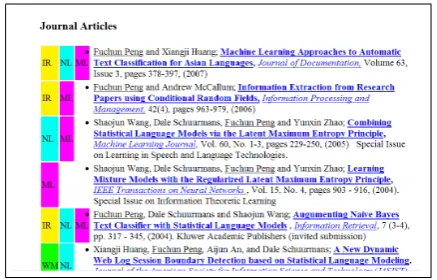
On the Web, many web pages like researchers’ or conference homepages contain references to aca-demic papers much like citations in a bibliogra-phy. These references do not always follow a spe-cific reference style. Usually, they make use of HTML formatting to differentiate fields and em-phasize keywords. For example in Figure 1, paper titles are displayed in bold.
Depending on personal preference and habit, references found on the Web may be processed in various ways. This process however, can possibly be quite a long chain of events:
1. A researcher finds a PDF copy of the paper and downloads it.
2. He reads the abstract of the paper, then de-cides to read the rest of it.
3. He prints out the paper and reads it, making annotations along the margin as he reads.
4. He produces a BibTeX entry for the paper.
Figure 1: A web page with a list of references. Paper titles are displayed inbold.
5. He cites the paper in his own work.
This process is too time-consuming for re-searchers to do for each reference, one at a time. One solution is to collect all the references of in-terest first. These references can then be processed at a later time. Bibliographic Management Appli-cations (BMAs) do exactly this by allowing the re-searcher to record interesting references for later use. Alternatively, the references can be recorded manually on paper or in a text file. The paper for each reference can also be printed and organized physically in folders or piles.
Each method has its own disadvantages. Using notebooks, text files or printouts imposes consid-erable cognitive load on the researcher especially when hundreds of references need to be managed. BMAs seek to relieve researchers from this prob-lem, but are often too complicated to use and maintain. A popular BMA, EndNote, for example, retrieves metadata from online library catalogues and databases, but experience is necessary to know which database or catalogue to search. Consider-able time can be lost searching for a computer sci-ence paper in a medical database. An automatic, yet lightweight solution is needed.
Since the references are found on the Web, the most suitable location for a BMA is within the web
browser itself. In this paper, we propose FireCite1, a Firefox browser extension which embodies this idea. FireCite 1) automatically recognizes refer-ences on web pages, 2) parses these referrefer-ences into title, authors, and date fields, 3) allows the researcher to save these references for later use, and 4) allows a local PDF copy of the paper to be saved for each reference.
At its core, FireCite consists of a reference string recognizer and a reference string parser with accuracies comparable to other systems. Unlike these systems however, as a browser extension, FireCite needs to be fast and lightweight. Bloated extensions can cause the browser’s memory foot-print to grow significantly, lowering overall per-formance. An extension must also perform its op-erations fast. Otherwise, it will detract users from their primary task with the browser. Nah (2004) suggests latencies should be kept within two sec-onds.
In the next section, we review related work. We then discuss reference string recognition, followed by parsing in Section 3. After component evalua-tions, we conclude by discussing the user interface of FireCite.
2 Related Work
Recognizing and parsing reference strings has been a task tackled by many, as it is a necessary task in modern digital libraries.
Past work has dealt primarily with clean data, where reference strings are already delimited (e.g., in the References or Bibliography section of a scholarly work). Many works consider both refer-ence string recognition and referrefer-ence string pars-ing as a spars-ingle combined problem. With regards to the task, IEPAD (Chang et al., 2003) looks for patterns among the HTML tags, while (Zhai and Liu, 2005) looks for patterns among the presenta-tion features of the web page. A machine learning approach using Conditional Random Fields is also discussed in a few works (Xin et al., 2008; Zhu et al., 2006).
CRE (Yang et al., 2008) is an automatic ref-erence string recognizer that works on publica-tion list pages. Given such a page, CRE iden-tifies individual reference strings by looking for contiguous common style patterns. The system is based on the authors’ two observations: 1)
‘refer-1The latest version of the extension is at:
https://addons.mozilla.org/en-US/firefox/addon/10766/
ence string records are usually presented in one or more contiguous regions’, and 2) ‘reference string records are usually presented by using similar tag sequences and organized under a common parent node’. Therefore, the system examines the DOM2 tree of the web page and identifies adjacent sub-trees that are similar. The system then removes subtrees that are unlikely to be reference strings, by comparing their word count against a database of reference strings’ word counts. The authors re-port an F1 of around 90% for pages where refer-ence strings make up at least 80% of the text on the page, and an F1 of at least 70% when refer-ence strings make up at least 30% of the page.
Of note is that their testing dataset consists solely of computer science researchers’ home-pages and publication list home-pages. There is no indi-cation of how their system will perform for other types of web pages. Although there are many pub-lished works on the extraction of semi-structured data from web pages, very few of them deal di-rectly with the issue of reference string extraction. Also, none of the works deal directly with the is-sue of web pages that do not contain any relevant data. In FireCite’s case, this is an important issue to consider, because false positives will be parsed, and as stated previously, almost all web pages will have elements that are not part of any reference string.
As for reference string parsing, the field of In-formation Extraction (IE) has treated this task as one of its sample applications. As such, many different IE approaches involving different super-vised classifiers have been tried.
Such classification methods require a gold stan-dard corpus to train on. The CORA Information Extraction dataset, introduced in (Seymore et al., 1999) consists of a corpus of 500 classified refer-ence strings extracted from computer scirefer-ence re-search papers, is used as training data. The CORA dataset is annotated with thirteen fields, including
author,titleanddate.
As for classification approaches, (Hetzner, 2008; Seymore et al., 1999) and AutoBib (Geng and Yang, 2004) makes use of Hidden Markov Models (HMM), while ParsCit (Councill et al., 2008) and (Peng and McCallum, 2004) make use of Conditional Random Fields (CRF).
ParsCit’s reference string parsing system makes use of CRF to learn a model that can apply
data labels to individual word tokens of a reference string. ParsCit’s labeling model consists of 7 lex-ical features (features that make use of the mean-ing/category of a word, such as whether the word is a place, a month, or a first name) and 16 local and contextual features (features that makes use of formatting information about the current and neighbouring tokens, such as whether the word is in all caps). Its lexical features require the use of an extensive dictionary of names, places, publish-ers and months. ParsCit achieves an overall field-level F1 of .94.
Another competitive method, FLUX-CiM (Cortez et al., 2007) also parses plain-text reference strings, based on a knowledge base of reference strings. Initially, labels are assigned to tokens based on the (label, token) pair’s likelihood of appearance in the knowlege base. For tokens that do not occur in the knowledge base, a binding step is used to associate them with neighbouring tokens that have already been labelled. The authors report a very high token-level accuracy in terms of F1 of 98.4% for reference strings in the Computer Science (CS) domain, and 97.4% for reference strings in the Health Sciences domain.
A key difference from other parsing methods is that tokens in FLUX-CiM are strings delimited by punctuation rather than single words (see an ex-ample in Figure 2). This comes from an observa-tion by the authors that “in general, in a reference string, every field value is bounded by a delimiter, but not all delimiters bound a field.”
Atlas , L ., and S . Shamma ,
“ Joint Acoustic and Modulation Frequency ,” EURASIP JASP , 2003 .
Figure 2: A tokenised reference string. Each box contains one token.
While both ParsCit and FLUX-CiM have high levels of performance, they are not suitable for our use for two reasons:
• Both systems are large. ParsCit’s classi-fier model plus dictionaries add up to about 10MB. FLUX-CiM requires a database of 3000 reference strings for each knowledge domain, for best performance. Databases of this size will take a significant amount of time to load and to access, negatively impacting the user experience.
• Both systems are not designed to handle web reference strings. Neither system is able to correctly parse a reference string such as the one shown in Figure 3 due to its lack of punc-tuation and the misleading tokens that resem-ble publication dates.
Doe, J. 2000 1942-1945: World War Two and its effects on economy and technology.
Generic Publisher. Generic Country.
Figure 3: A reference string that FLUX-CiM and ParsCit cannot parse correctly.
3 Methodology
FireCite performs its task of reference extraction in two logically separate stages: recognition and parsing. Reference string recognition locates and delimits the start and end of reference strings on a web page, while parsing delimits the internal fields within a recognized reference.
3.1 Recognition
Reference recognition itself can be logically seg-mented into two tasks: deciding whether refer-ences could occur on a page; and if so, delimiting the individual reference strings. We build a rough filter for the first task, and solve the second task using a three stage heuristic cascade.
Algorithm 1Reference recognition.
1: Exclude pages based on URL and absence of keywords
2: Split token stream into a set S of (non-overlapping) sequences, where each sequence contains at most one reference string, and no reference string is split across two token se-quences.
3: Select sequences likely to be reference strings, forming a setS0 which is parsed into a set of reference stringsC.
4: Remove sequences with nonsensical parse re-sults from the set of reference stringsC.
We now detail these stages.
• Is from a .edu, .org, or .ac domain. Do-mains with country identifiers, such as www.monash.edu.au, are also accepted;
• Contains one or more of the words ‘Publica-tions’, ‘Readings’, ‘Cita‘Publica-tions’, ‘Papers’, and ‘References’.
• Contains one or more of the words ‘Confer-ence’, ‘Academic’, ‘Journal’, and ‘Research’.
The included domains include web pages from academic institutions, digital libraries such as CiteseerX 3 and ACM Portal 4, and online ency-clopedias such as Wikipedia 5 – basically, web pages where reference strings are likely to be found. The keywords serve to further filter away pages unlikely to contain lists of reference strings, by requiring words that are likely to appear in the headings of such lists.
Stage 1 runs very quickly and filters most non-scholarly web pages away from the subsequent, more expensive processing. This is crucial in im-proving the extension’s efficiency, and ensuring that the extension does not incur significant la-tency for normal browsing activity.
Stage 2 splits the web page text into distinct chunks. In plain-text documents, we differentiate chunks by the use of blank lines. In HTML web pages, we use formatting tags: <p> and <br>. Other tags might also indicate a fresh chunk within ordered (<ol>) and unordered (<ul>) lists, list items are marked by the <li> tag. A horizon-tal rule (<hr>) is used to separate sections in the web page. Stage 2 makes use of all these HTML tags to split the web page text into distinct, non-overlapping sequences.
Stage 3 removes sequences that are unlikely to be reference strings, based on their length. Se-quences that are too long or short are removed (i.e., with word length 5 < wl < 64, and token lengths 4 < tl < 48). These limits are based on the maximum and minimum word and token lengths of reference strings in the CORA corpus.
The sequences that survive this stage are sent to the parsing system, discussed in the next subsec-tion to be parsed.
Stage 4 further removes sequences that are ill-formed. We require that all reference strings in-clude a title and a list of authors after being parsed.
3
hosted at http://citeseerx.ist.psu.edu
4
http://portal.acm.org
5www.wikipedia.org
Sequences that do not meet these requirements are discarded. Remaining sequences are accepted as valid reference strings.
3.2 Parsing
Between Steps 3 and 4 in the recognition pro-cess, a reference string is parsed into fields. We treat this problem as a standard classification prob-lem for which a supervised machine learning algo-rithm can be trained to perform. In implementing our parsing algorithm, recall that we have to meet the criterion of a lightweight solution, which heav-ily influenced the resulting design.
While a full-fledged reference string parser will extract all available metadata from the reference string, including fields such as publisher name, publisher address and page numbers, we con-sciously designed our parser to only extract three fields: the title, the authors, and the date of pub-lication. All other tokens are classified as Miscel-laneous. There are two reasons for this: 1) for the purposes of sorting the reference strings and sub-sequently searching for them, these three fields are most likely to be used; 2) restricting classification space to four classes also simplifies the solution, shrinking the model size.
Another simplification was to use a decision tree classifier, as 1) the trained model is easily coded in any declarative programming language (including Javascript, the programming language used by Firefox extensions), and 2) classification is computationally inexpensive, consisting of a se-ries of conditional statements.
Also, instead of the common practice of to-kenising a string into individual words, we follow FLUX-CiM’s design and use punctuation (except for hyphens and apostrophes) and HTML tags as token delimiters (as seen in the example in Fig-ure 2). This tokenization scheme often leads to phrases. There are a few advantages to this style of tokenisation: 1) considering multiple words as a token allows more complex features to be used, thus giving a better chance of making a correct classification; and 2) reducing the number of to-kens per reference string reduces the computa-tional cost of this task.
Feature Name Description
PfieldLabel (String)
The label of the previous token hasNumber
(Boolean)
Whether the token contains any num-bers
hasYear (Boolean)
Whether the token contains any 4-digit number between 1940 and 2040 fieldLength (
In-teger)
The number of characters the token has
hasMonth (Boolean)
Whether the token contains any month words (e.g. ‘January’, ‘Jan’) oneCap
(Boolean)
Whether the token consists of only one capital letter e.g. ‘B’
position (Float) A number between 0 and 1 that indi-cates the relative position of the token in the reference string.
hasAbbreviation (Boolean)
Whether the token contains any words with more than one capital letter. Examples are ‘JCDL’, and ‘ParsCit’
startPunctuation (String)
The punctuation that preceded this token. Accepted values are pe-riod, comma, hyphen, double quotes, opening brace, closing brace, colon, others,andnone
endPunctuation (String)
The punctuation that is immediately after this token. Accepted values are the same as for startPunctuation Table 1: List of classifier features
information about the token; 3) Contextual fea-tures, which are lexical or local features of a to-ken’s neighbours. Table 1 gives an exhaustive list of features used in FireCite.
We had to exclude lexical features that require a large dictionary, such as place names and first names, as such features would add significantly to the loading and execution times of FireCite.
FireCite uses its trained model to tag input phrases with their output class. Before accepting the classification results, we make one minor re-pair to them. The rere-pair stems from the observa-tion that in gold standard reference strings, both the author and title fields are contiguous. If more than one contiguous sequence of Title or Author classification labels exist, there must be a classifi-cation error. When the extension encounters such a situation, FireCite will accept the first encoun-tered sequence as correct, and change subsequent sequences’ labels to Miscellaneous (Figure 4).
The parser joins all contiguous tokens for each category into a string, and returns the set of strings as the result.
4 Evaluation
4.1 Recognition
We took faculty homepages from the domains of four universities at random, until a set of 20 home-pages with reference strings and 20 homehome-pages without reference strings were obtained. Note that these homepages were sampled from all faculties, not merely from computer science.
Tests were conducted using these 40 pages to obtain the reference string recognition algorithm’s accuracy. A reference string is considered found if there exists, in the set of confirmed reference stringsC, a parsed text segmentcthat contains the entire title as well as all the authors’ names. Each parsed text segment can only be used to identify one reference string, so if any text segments con-tain more than one reference string, only one of those reference strings will be considered found.
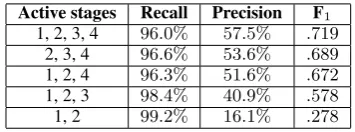
Active stages Recall Precision F1 1, 2, 3, 4 96.0% 57.5% .719
2, 3, 4 96.6% 53.6% .689 1, 2, 4 96.3% 51.6% .672 1, 2, 3 98.4% 40.9% .578 1, 2 99.2% 16.1% .278
Table 2: Results of reference string recognition over forty web pages for five variations of Fire-Cite’s reference string recognition
In order to determine the effect of each stage on overall recognition accuracy, some stages of the recognition algorithm were disabled in testing. The results are presented in Table 2. As all test pages come from university domains, all pass the first URL test. When the keyword search is deac-tivated, all 40 test pages pass Stage 1. Otherwise, 19 pages with reference strings and 6 pages with-out reference strings pass Stage 1.
The results show that disabling individual stages of the algorithm increases recall slightly, but increases the number of false positives dispro-portionately more. The fully-enabled algorithm strikes a balance between the number of reference strings found and the number of false positives.
Figure 4: An example of an incorrectly labelled (highlighted) reference string segment
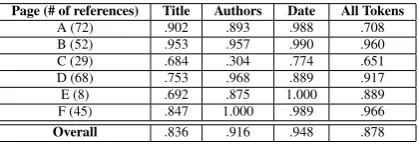
Page (# of references) Title Authors Date All Tokens
A (72) .902 .893 .988 .708 B (52) .953 .957 .990 .960 C (29) .684 .304 .774 .651 D (68) .753 .968 .889 .917 E (8) .692 .875 1.000 .889 F (45) .847 1.000 .989 .966
Overall .836 .916 .948 .878
Table 3: Results of FireCite reference string pars-ing. Performance figures given are Token F1. Overall F1 includes tokens classified as Miscella-neous, and is micro-averaged.
more important that we have a high recall rather than high precision. In that respect, this algorithm can be said to fulfill its purpose.
4.2 Parsing
To evaluate the reference string parsing algorithm, we randomly selected six staff publication pages from a computer science faculty. The presenta-tion of each page, as well as the presentapresenta-tion of reference strings on each page, were all chosen to differ from each other. There are a total of 274 reference strings in these six pages. We annotated the reference strings by hand; this set of annota-tions is used as the gold standard. The six pages are loaded using a browser with FireCite installed. FireCite processes each page and produces a out-put file with the parsed reference strings. These parsing results are then compared against the gold standard. Table 3 shows the token level results, broken down by web page.
The FireCite reference string parser is able to handle plain-text reference strings as well. A set of plain-text reference strings can be converted into a form understandable by FireCite, simply by en-closing the set of reference strings with<html> tags, and replacing line breaks with <br> tags. Table 4 shows the token F1 of the Firecite ref-erence string parser compared FLUX-CiM, while Table 5 shows the field F1of FireCite, FLUX-CiM and ParsCit. The test dataset used by all three sys-tems is the FLUX-CiM Computer Science dataset6
6available at http://www.dcc.ufam.edu.br/ ˜eccv/flux-cim/
Computer-Science/
System Title Authors Date Overall
FireCite .940 .994 .982 .979 FLUX-CiM .974 .994 .986 .984
Table 4: Token F1of FireCite and FLUX-CiM.
System Title Authors Date Overall
FireCite .92 .96 .97 .94 ParsCit .96 .99 .97 .94 FLUX-CiM .93 .95 .98 .97
Table 5: Field F1 of FireCite and other reference string parsers.
of 300 reference strings randomly selected from the ACM Digital Library. Note that in FireCite and FLUX-CiM, tokens are punctuation delimited whereas in ParsCit, tokens are word delimited.
We feel that above results show that FireCite’s reference string parser is comparable to the re-viewed systems (although statistically worse), de-spite its use of a fast and simple classifier and the lack of lexical features that require large dictio-naries. The disparity of results between handling web page reference strings and handling plain-text reference strings can generally be attributed to the differences between web page reference strings and plain-text reference strings. Specifically:
• Among the testing data used, the reference strings on one web page (Page C) all begin with the title. However, in the CORA train-ing corpus, all reference strtrain-ings begin with the authors’ names. As a result, in the trained classifier, the first token of every reference string is classified as ‘authors’. This error is then propagated through the entire reference string, because each token makes use of the previous token’s class as a classifier feature. As shown in Table 3 above, the performance for page C is much worse than the perfor-mance for the other pages.
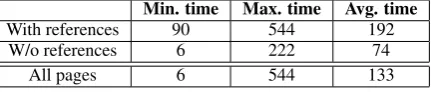
Min. time Max. time Avg. time
With references 90 544 192
W/o references 6 222 74
All pages 6 544 133
Table 6: FireCite execution time tests over 40 web pages. Times given in milliseconds.
tend to be added to the page. Because Fire-Cite treats HTML tags as token delimiters, these redundant tags increase the number of tokens in the string, thus affecting the to-ken position feature of the classifier, causing some tokens to become incorrectly classified.
Some of the inaccuracies can also be attributed to mistakes from reference string recognition. When the reference string is not correctly delim-ited, text that occurs before or after the actual ref-erence string is also sent to the refref-erence string parser. This affects the token position and previ-ous token label features.
The competitive advantage of FireCite’s refer-ence string parser is that it is very small compared to the other systems. FireCite’s reference string parser consists only of a decision tree coded into JavaScript if-then-else statements, and a couple of JavaScript functions, taking up a total of around 38KB of space. On the other hand, as mentioned above, FLUX-CiM optimally requires a database of around 3000 reference strings, while ParsCit’s classifier model and dictionaries require a total of 10MB of space. These characteristics also make the reference string parser fast. Speed tests were conducted over 40 web pages taken from the do-mains of four universities, 20 of which contain ref-erence strings and 20 of which do not. The results are summarised in Table 6. From these results we can infer with some confidence that FireCite will add no more than one second to the existing time a page takes to load.
5 Extension Front End
We thus implemented a prototype BMA as a Fire-fox extension that uses the recognizer and parser as core modules. As such an extension interacts with users directly, the extension’s front end de-sign concentrated on functionality and usability issues that go beyond the aforementioned natural language processing issues.
Browser extension based BMAs are not new.
Zotero7 as well as Mendeley8 both offer BMAs that manage reference (and other bookmark) in-formation for users. However, neither recognizes or delimits free formed reference strings found on general webpages. Both rely on predefined tem-plates to process specific scholarly websites (e.g. Google Scholar, Springer).
In developing our front end, our design hopes to complement such existing BMAs. We followed a rapid prototyping design methodology. The cur-rent user interface, shown in Figure 5, is the re-sult of three cycles of development. Up to now, feedback gathering has been done through focus groups with beginning research students and indi-vidual interviews with faculty members. Rather than concentrate on the design process, we give a quick synopsis of the major features that the Fire-Cite prototype implements.
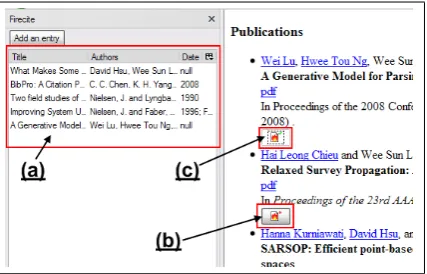
One-Click Addition of References: FireCite
appends a clickable button to each reference string it detects through the recognition and parsing modules. Clicking this button adds the reference string’s metadata to the reference library. The de-sign draws attention to the presence of a reference without disrupting the layout of the webpage.
Reference Library: The reference library
opens as a sidebar in the browser. It is a local database containing the metadata of the saved ref-erences. The library allows reference strings to be edited or deleted, and sorted according to the three extracted metadata fields.
Manual recognition and addition: The core
modules occasionally miss valid references. To remedy this, users can manually highlight a span of text, and through the right click context menu, ask FireCite to parse the span and append an “add citation” button. The user may also manually add or edit reference metadata directly in the sidebar. This feature allows the user to add entries from his existing collections of papers, or to add entries for which no reference string can be found (such as papers that have not been published).
PDF download: When a reference is added to
the local library, any Portable Document Format (PDF) file associated with the reference string is downloaded as well. Appropriate PDF files are found heuristically by finding a hyperlink lead-ing to a PDF file within the text segment. The downloaded PDF files are stored in a single folder
7
http://www.zotero.org
Figure 5: Screenshot of FireCite prototype illus-trating (a) the reference string library, (b) button appended to each reference string, and (c) button state after the reference string has been added to the list.
within Firefox’s storage location for the extension, and can be opened or deleted through the sidebar interface. With this feature, the user will not need to juggle his PDF files and reference string library separately.
As a preliminary evaluation, we presented Fire-Cite to four academics in separate unstructured interviews. All four subjects saw the potential of FireCite as a BMA, but not the usefulness of recognising reference strings on the Web. Two of them pointed out that they rarely encounter refer-ence strings while browsing the Web, while an-other only needs to search for specific, known pa-pers. When asked in detail, it was apparent that subjects do actually visit web pages that contain many reference strings. In DBLP, each entry is actually a reference string. In the ACM Digital Li-brary, in every article information page, there is a list of reference strings that have been extracted from the bibliography of the article using Optical Character Recognition (OCR).
From our study, we conclude that integration with template based recognition (a la Zotero) of sites such as DBLP, Google Scholar and ACM Portal, has better potential. As expected, since the subjects all have significant research expe-rience, they have already developed suitable re-search methods. The challenge is for FireCite to fit into their workflow.
6 Conclusion
This paper describes FireCite, a Firefox extension that can recognise and delimit metadata from ref-erence strings on freeform web pages. FireCite’s
“Liquidity-Based Model of Security Design,” with Darrell Duffie, Econometrica, 1999, 67, 65-99.
Figure 6: A reference string with one author’s name omitted.
Michael Collins and Terry Koo.
Discriminative Reranking for Natural Lan-guage Parsing.
Computational Linguistics 31(1):25-69.
Figure 7: A reference string with its year omitted. Part of a list of reference strings organised by their year of publication.
implementation demonstrates it is possible to do these tasks in real-time and with a usable level of accuracy.
We have validated the accuracy of FireCite’s embedded recognition and parsing modules by comparing against the state-of-the-art systems, both on web based reference strings that use HTML tags as well as gold-standard reference strings in plain text. FireCite achieves a usable level of reference string recognition and parsing accuracy, while remaining small in size, a criti-cal requirement in building a browser extension. This small model allows FireCite to complete its processing of reference heavy webpages in un-der one second, an acceptable level of latency for most users. Preliminary user studies show that the FireCite system should incorporate template based recognition of large scholarly sites as well for maximum effectiveness.
Future work on the parsing and recognition will focus on capturing implied contextual informa-tion. On some web pages the author may omit their own name, or place the year of publication in a section head (Figures 6 and 7). We are working towards recognizing and incorporating such con-textual information in processing.
Acknowledgements
This work was partially supported by a National Research Foundation grant ”Interactive Media Search” (grant # R 252 000 325 279).
References
semi-structured web pages by pattern discovery. Decis. Support Syst., 35(1):129–147.
Eli Cortez, Altigran S. da Silva, Marcos Andr´e Gonc¸alves, Filipe Mesquita, and Edleno S. de Moura. 2007. FLUX-CIM: flexible unsuper-vised extraction of citation metadata. InProc. JCDL ’07, pages 215–224, New York, NY, USA. ACM.
Isaac G. Councill, C. Lee Giles, and Min-Yen Kan. 2008. ParsCit: An open-source CRF reference string parsing package. In LREC ’08, Marrakesh, Morrocco, May.
Junfei Geng and Jun Yang. 2004. Autobib: automatic extraction of bibliographic information on the web. pages 193–204, July.
Erik Hetzner. 2008. A simple method for citation metadata extraction using hidden markov models. InProc. JCDL ’08, pages 280–284, New York, NY, USA. ACM.
Fiona Fui-Hoon Nah. 2004. A study on tolerable wait-ing time: how long are web users willwait-ing to wait?
Behaviour & Information Technology Special Issue on HCI in MIS, 23(3), May-June.
Fuchun Peng and Andrew McCallum. 2004. Accu-rate information extraction from research papers us-ing conditional random fields. pages 329–336. HLT-NAACL.
Kristie Seymore, Andrew McCallum, and Roni Rosen-feld. 1999. Learning hidden markov model struc-ture for information extraction. In AAAI’99 Work-shop on Machine Learning for Information Extrac-tion.
Xin Xin, Juanzi Li, Jie Tang, and Qiong Luo. 2008. Academic conference homepage understanding us-ing constrained hierarchical conditional random fields. InProc. CIKM ’08, pages 1301–1310, New York, NY, USA. ACM.
Kai-Hsiang Yang, Shui-Shi Chen, Ming-Tai Hsieh, Hahn-Ming Lee, and Jan-Ming Ho. 2008. CRE: An automatic citation record extractor for publica-tion list pages. InProc. WMWA’08 of PAKDD-2008, Osaka, Japan, May.
Yanhong Zhai and Bing Liu. 2005. Web data extrac-tion based on partial tree alignment. InProc. WWW ’05, pages 76–85, New York, NY, USA. ACM.