Using Syntactic Information to Extract Relevant Terms for Multi-Document
Summarization
Enrique Amig´o Julio Gonzalo V´ıctor Peinado Anselmo Pe ˜nas Felisa Verdejo Departamento de Lenguajes y Sistemas Inform´aticos
Universidad Nacional de Educaci´on a Distancia c/ Juan del Rosal, 16 - 28040 Madrid - Spain
http://nlp.uned.es
Abstract
The identification of the key concepts in a set of documents is a useful source of information for several information access applications. We are interested in its application to multi-document summarization, both for the automatic genera-tion of summaries and for interactive summa-rization systems.
In this paper, we study whether the syntactic po-sition of terms in the texts can be used to predict which terms are good candidates as key con-cepts. Our experiments show that a) distance to the verb is highly correlated with the proba-bility of a term being part of a key concept; b) subject modifiers are the best syntactic locations to find relevant terms; and c) in the task of auto-matically finding key terms, the combination of statistical term weights with shallow syntactic information gives better results than statistical measures alone.
1 Introduction
The fundamental question addressed in this article is: can syntactic information be used to find the key concepts of a set of documents? We will pro-vide empirical answers to this question in a multi-document summarization environment.
The identification of key terms out of a set of doc-uments is a common problem in information access applications and, in particular, in text summariza-tion: a fragment containing one or more key con-cepts can be a good candidate to be part of a sum-mary.
In single-document summarization, key terms are usually obtained from the document title or head-ing (Edmundson, 1969; Preston, 1994; Kupiec et al., 1995). In multi-document summarization, how-ever, some processing is needed to identify key con-cepts (Lin and Hovy, 2002; Kraaij et al., 2002; Schlesinger et al., 2002). Most approaches are based on statistical criteria.
Criteria to elaborate a manual summary depend, by and large, on the user interpretation of both the information need and the content of documents.
This is why this task has also been attempted from an interactive perspective (Boguraev et al., 1998; Buyukkokten et al., 1999; Neff and Cooper, 1999; Jones et al., 2002; Leuski et al., 2003). A standard feature of such interactive summarization assistants is that they offer a list of relevant terms (automati-cally extracted from the documents) which the user may select to decide or refine the focus of the sum-mary.
Our hypothesis is that the key concepts of a doc-ument set will tend to appear in certain syntactic functions along the sentences and clauses of the texts. To confirm this hypothesis, we have used a test bed with manually produced summaries to study:
• which are the most likely syntactic functions for the key concepts manually identified in the document sets.
• whether this information can be used to auto-matically extract the relevant terms from a set of documents, as compared to standard statis-tical term weights.
Our reference corpus is a set of 72 lists of key concepts, manually elaborated by 9 subjects on 8 different topics, with 100 documents per topic. It was built to study Information Synthesis tasks (Amigo et al., 2004) and it is, to the best of our knowledge, the multi-document summarization testbed with a largest number of documents per topic. This feature enables us to obtain reliable statistics on term occurrences and prominent syn-tactic functions.
key concepts. Finally, in Section 6 we draw some conclusions.
2 Evaluation of automatically extracted key concepts
It is necessary, in the context of an interactive sum-marization system, to measure the quality of the terms suggested by the system, i.e., to what extent they are related to the key topics of the document set.
(Lin and Hovy, 1997) compared different strate-gies to generate lists of relevant terms for summa-rization using Topic Signatures. The evaluation was extrinsic, comparing the quality of the summaries generated by a system using different term lists as input. The results, however, cannot be directly ex-trapolated to interactive summarization systems, be-cause the evaluation does not consider how informa-tive terms are for a user.
From an interactive point of view, the evaluation of term extraction approaches can be done, at least, in two ways:
• Evaluating the summaries produced in the in-teractive summarization process. This option is difficult to implement (how do we evaluate a human produced summary? What is the ref-erence gold standard?) and, in any case, it is too costly: every alternative approach would require at least a few additional subjects per-forming the summarization task.
• Comparing automatically generated term lists with manually generated lists of key concepts. For instance, (Jones et al., 2002) describes a process of supervised learning of key concepts from a training corpus of manually generated lists of phrases associated to a single docu-ment.
We will, therefore, use the second approach, evaluating the quality of automatically generated term lists by comparing them to lists of key con-cepts which are generated by human subjects after a multi-document summarization process.
3 Test bed: the ISCORPUS
We have created a reference test bed, the ISCOR-PUS1(Amigo et al., 2004) which contains 72 man-ually generated reports summarizing the relevant in-formation for a given topic contained in a large doc-ument set.
For the creation of the corpus, nine subjects per-formed a complex multi-document summarization
1
Available at http://nlp.uned.es/ISCORPUS.
task for eight different topics and one hundred rele-vant documents per topic. After creating each topic-oriented summary, subjects were asked to make a list of relevant concepts for the topic, in two cate-gories: relevant entities (people, organizations, etc.) and relevant factors (such as “ethnic conflicts” as the origin of a civil war) which play a key role in the topic being summarized.
These are the relevant details of the ISCORPUS test bed:
3.1 Document collection and topic set
We have used the Spanish CLEF 2001-2003 news collection testbed (Peters et al., 2002), and selected the eight topics with the largest number of docu-ments manually judged as relevant from the CLEF assessment pools. All the selected CLEF topics have more than one hundred documents judged as relevant by the CLEF assessors; for homogeneity, we have restricted the task to the first 100 docu-ments for each topic (using a chronological order).
This set of eight CLEF topics was found to have two differentiated subsets: in six topics, it is neces-sary to study how a situation evolves in time: the importance of every event related to the topic can only be established in relation with the others. The
invasion of Haiti by UN and USA troops is an
ex-ample of such kind of topics. We refer to them as “Topic Tracking” (TT) topics, because they are suit-able for such a task. The other two questions, how-ever, resemble “Information Extraction” (IE) tasks: essentially, the user has to detect and describe in-stances of a generic event (for instance, cases of
hunger strikes and campaigns against racism in Eu-rope in this case); hence we will refer to them as IE
summaries.
3.2 Generation of manual summaries
Nine subjects between 25 and 35 years-old were re-cruited for the manual generation of summaries. All subjects were given an in-place detailed description of the task, in order to minimize divergent interpre-tations. They were told they had to generate sum-maries with a maximum of information about ev-ery topic within a 50 sentence space limit, using a maximum of 30 minutes per topic. The 50 sentence limit can be temporarily exceeded and, once the 30 minutes have expired, the user can still remove sen-tences from the summary until the sentence limit is reached back.
3.3 Manual identification of key concepts After summarizing every topic, the following ques-tionnaire was filled in by users:
• What are the main organizations participating in the topic? • What are the key factors in the topic?
Users provided free-text answers to these ques-tions, with their freshly generated summary at hand. We did not provide any suggestions or constraints at this point, except that a maximum of eight slots were available per question (i.e., a maximum of 8X3 = 24key concepts per topic, per user).
This is, for instance, the answer of one user for a topic about the invasion of Haiti by UN and USA troops:
People Organizations
Jean Bertrand Aristide ONU (UN)
Clinton EEUU (USA)
Raoul Cedras OEA (OAS)
Philippe Biambi Michel Josep Francois Factors
militares golpistas (coup attempting soldiers) golpe militar (coup attempt)
restaurar la democracia (reinstatement of democracy)
Finally, a single list of key concepts is generated for each topic, joining all the answers given by the nine subjects. These lists of key concepts constitute the gold standard for all the experiments described below.
3.4 Shallow parsing of documents
Documents are processed with a robust shallow parser based in finite automata. The parser splits sentences in chunks and assigns a label to every chunk. The set of labels is:
• [N]: noun phrases, which correspond to names or adjectives preceded by a determiner, punctuation sign, or beginning of a sentence. • [V]: verb forms.
• [Mod]: adverbial and prepositional phrases, made up of noun phrases introduced by an ad-verb or preposition. Note that this is the mech-anism to express NP modifiers in Spanish (as compared to English, where noun compound-ing is equally frequent).
• [Sub]: words introducing new subordinate clauses within a sentence (que, cuando,
mien-tras, etc.).
• [P]: Punctuation marks.
This is an example output of the chunker: Previamente[Mod],[P]el presidente Bill Clinton[N]hab´ıa di-cho[V]que[Sub]tenemos[V]la obligacion[N]de cambiar la pol´ıtica estadounidense[Mod]que[Sub]no ha funcionado[V]en Hait´ı[Mod].[P]
Although the precision of the parser is limited, the results are good enough for the statistical mea-sures used in our experiments.
4 Distribution of key concepts in syntactic structures
We have extracted empirical data to answer these questions:
• Is the probability of finding a key concept cor-related with the distance to the verb in a sen-tence or clause?
• Is the probability of finding a key concept in a noun phrase correlated with the syntactic func-tion of the phrase (subject, object, etc.)?
• Within a noun phrase, where is it more likely to find key concepts: in the noun phrase head, or in the modifiers?
We have used certain properties of Spanish syn-tax (such as being an SVO language) to decide which noun phrases play a subject function, which are the head and modifiers of a noun phrase, etc. For instance, NP modifiers usually appear after the NP head in Spanish, and the specification of a concept is usually made from left to right.
4.1 Distribution of key concepts with verb distance
Figure 1 shows, for every topic, the probability of finding a word from the manual list of key con-cepts in fixed distances from the verb of a sen-tence. Stop words are not considered for computing word distance. The broader line represents the aver-age across topics, and the horizontal dashed line is the average probability across all positions, i.e., the probability that a word chosen at random belongs to the list of key concepts.
The plot shows some clear tendencies in the data: the probability gets higher when we get close to the verb, falls abruptly after the verb, and then grows steadily again. For TT topics, the probability of finding relevant concepts immediately before the verb is 56% larger than the average (0.39before the verb, versus0.25 in any position). This is true not only as an average, but also for all individual TT topics. This can be an extremely valuable result: it shows a direct correlation between the position of a term in a sentence and the importance of the term in the topic. Of course, this direct distance to the verb should be adapted for languages with different syntactic properties, and should be validated for dif-ferent domains.
Figure 1: Probability of finding key concepts at fixed distances from verb
all cases of hunger strikes found in the collection; each case has its own relevant people and organiza-tions, for instance. Users try to make abstraction of individual cases to write key concepts, and then the number of key concepts is smaller. The tendency to have larger probabilities just before the verb and smaller probabilities just after the verb, however, can also be observed for IE topics.
Figure 2: Probability of finding key concepts in sub-ject NPs versus other NPs
4.2 Key Concepts and Noun Phrase Syntactic Function
We wanted also to confirm that it is more likely to find a key concept in a subject noun phrase than in general NPs. For this, we have split compound sentences in chunks, separating subordinate clauses ([Sub]type chunks). Then we have extracted se-quences with the pattern[N][Mod]*. We assume that the sentence subject is a sequence[N][Mod]* occurring immediately before the verb. For in-stance:
El presidente [N] en funciones [Mod] de Hait´ı [Mod] ha afirmado [V] que [Sub]...
The rest of[N] and[Mod]chunks are consid-ered as part of the sentence verb phrase. In a ma-jority of cases, these assumptions lead to a correct identification of the sentence subject. We do not capture, however, subjects of subordinate sentences or subjects appearing after the verb.
Figure 2 shows how the probability of finding a key concept is always larger in sentence subjects. This result supports the assumption in (Boguraev et al., 1998), where noun phrases receive a higher weight, as representative terms, if they are syntactic subjects.
4.3 Distribution of key concepts within noun phrases
For this analysis, we assume that, in [N][Mod]* sequences identified as subjects, [N]is the head and[Mod]*are the modifiers.
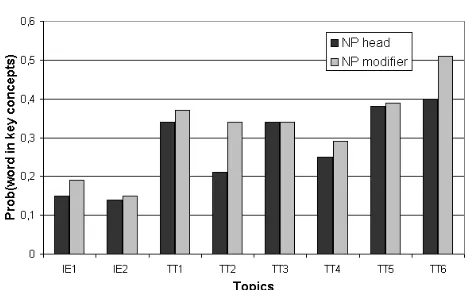
Figure 3 shows that the probability of finding a key concept in the NP modifiers is always higher than in the head (except for topic TT3, where it is equal). This is not intuitive a priori; an examination of the data reveals that the most characteristic con-cepts for a topic tend to be in the complements: for instance, in “the president of Haiti”, “Haiti” carries more domain information than “president”. This seems to be the most common case in our news collection. Of course, it cannot be guaranteed that these results will hold in other domains.
5 Automatic Selection of Key Terms
We have shown that there is indeed a correlation be-tween syntactic information and the possibility of finding a key concept. Now, we want to explore whether this syntactic information can effectively be used for the automatic extraction of key concepts. The problem of extracting key concepts for sum-marization involves two related issues: a) What kinds of terms should be considered as candidates? and b) What is the optimal weighting criteria for them?
There are several possible answers to the first question. Previous work includes using noun phrases (Boguraev et al., 1998; Jones et al., 2002), words (Buyukkokten et al., 1999), n-grams (Leuski et al., 2003; Lin and Hovy, 1997) or proper nouns, multi-word terms and abbreviations (Neff and Cooper, 1999).
Here we will focus, however, in finding appro-priate weighting schemes on the set of candidate terms. The most common approach in interactive single-document summarization is using tf.idf mea-sures (Jones et al., 2002; Buyukkokten et al., 1999; Neff and Cooper, 1999), which favour terms which are frequent in a document and infrequent across the collection. In the iNeast system (Leuski et al., 2003), the identification of relevant terms is ori-ented towards multi-document summarization, and they use a likelihood ratio (Dunning, 1993) which favours terms which are representative of the set of documents as opposed to the full collection.
Other sources of information that have been used as complementary measures consider, for instance, the number of references of a concept (Boguraev et al., 1998), its localization (Jones et al., 2002) or the distribution of the term along the document (Buyukkokten et al., 1999; Boguraev et al., 1998).
5.1 Experimental setup
A technical difficulty is that the key concepts in-troduced by the users are intellectual elaborations, which result in complex expressions which might even not be present (literally) in the documents. Hence, we will concentrate on extracting lists of terms, checking whether these terms are part of some key concept. We will assume that, once key terms are found, it is possible to generate full nomi-nal expressions using, for instance, phrase browsing strategies (Pe˜nas et al., 2002).
We will then compare different weighting criteria to select key terms, using two evaluation measures: a recall measure saying how well manually selected key concepts are covered by the automatically gen-erated term list; and a noise measure counting the number of terms which do not belong to any key concept. An optimal list will reach maximum recall with a minimum of noise. Formally:
R = |Cl|
|C| N oise=|Ln|
whereC is the set of key concepts manually se-lected by users; L is a (ranked) list of terms gen-erated by some weighting schema;Lnis the subset
of terms in Lwhich do not belong to any key con-cept; andClis the subset of key concepts which are
represented by at least one term in the ranked listL. Here is a (fictitious) example of how R and
N oiseare computed:
C={Haiti, reinstatement of democracy, UN and USA troops} L={Haiti, soldiers, UN, USA, attempt}
→ Cl={Haiti, UN and USA troops} R= 2/3
Ln={soldiers,attempt} N oise= 2
We will compare the following weighting strate-gies:
TF The frequency of a word in the set of documents is taken as a baseline measure.
Likelihood ratio This is taken from (Leuski et al., 2003) and used as a reference measure. We have implemented the procedure described in (Rayson and Garside, 2000) using unigrams only.
OKAPImod We have also considered a measure derived from Okapi and used in (Robertson et al., 1992). We have adapted the measure to consider the set of 100 documents as one single document.
as the number of times it appears preceding a verb.
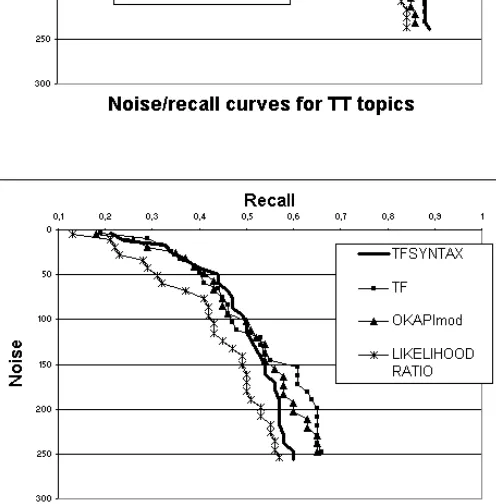
Figure 4: Comparison of weighting schemes to ex-tract relevant terms
5.2 Results
Figure 4 draws Recall/Noise curves for all weight-ing criteria. They all give similar results except our TFSYNTAX measure, which performs better than the others for TT topics. Note that the TFSYN-TAX measure only considers 10% of the vocabu-lary, which are the words immediately preceding verbs in the texts.
In order to check whether this result is consistent across topics (and not only the effect on an average) we have compared recall for term lists of size 50 for individual topics. We have selected 50 as a number which is large enough to reach a good coverage and permit additional filtering in an interactive summa-rization process, such as the iNeast terminological clustering described in (Leuski et al., 2003).
Figure 5 shows these results by topic. TFSYN-TAX performs consistently better for all topics ex-cept one of the IE topics, where the maximum like-lihood measure is slightly better.
Apart from the fact that TFSYNTAX performs better than all other methods, it is worth noticing that sophisticated weighting mechanisms, such as Okapi and the likelihood ratio, do not behave bet-ter than a simple frequency count (TF).
6 Conclusions
The automatic extraction of relevant concepts for a set of related documents is a part of many mod-els of automatic or interactive summarization. In this paper, we have analyzed the distribution of rel-evant concepts across different syntactic functions, and we have measured the usefulness of detecting key terms to extract relevant concepts.
Our results suggest that the distribution of key concepts in sentences is not uniform, having a max-imum in positions immediately preceding the sen-tence main verb, in noun phrases acting as subjects and, more specifically, in the complements (rather than the head) of noun phrases acting as subjects. This evidence has been collected using a Spanish news collection, and should be corroborated outside the news domain and also adapted to be used for non SVO languages.
We have also obtained empirical evidence that statistical weights to select key terms can be im-proved if we restrict candidate words to those which precede the verb in some sentence. The combi-nation of statistical measures and syntactic criteria overcomes pure statistical weights, at least for TT topics, where there is certain consistency in the key concepts across documents.
Acknowledgments
This research has been partially supported by a re-search grant of the Spanish Government (project Hermes) and a research grant from UNED. We are indebted to J. Cigarr´an who calculated the Okapi weights used in this work.
References
E. Amigo, J. Gonzalo, V. Peinado, A. Pe˜nas, and F. Verdejo. 2004. Information synthesis: an em-pirical study. In Proceedings of the 42th Annual
Meeting of the ACL, Barcelona, July.
Figure 5: Comparison of weighting schemes by topic
1998 Symposium on Intelligent Text Summariza-tion, Stanford, CA.
O. Buyukkokten, H. Garc´ıa-Molina, and A. Paepcke. 1999. Seeing the Whole in Parts: Text Summarization for Web Browsing on Handheld Devices. In Proceedings of 10th
International WWW Conference.
T. Dunning. 1993. Accurate Methods for the Statis-tics of Surprise and Coincidence. Computational
Linguistics, 19(1):61–74.
H. P. Edmundson. 1969. New Methods in Auto-matic Extracting. Journal of the Association for
Computing Machinery, 16(2):264–285.
S. Jones, S. Lundy, and G. W. Paynter. 2002. In-teractive Document Summarization Using Auto-matically Extracted Keyphrases. In Proceedings
of the 35th Hawaii International Conference on System Sciences, Big Island, Hawaii.
W. Kraaij, M. Spitters, and A. Hulth. 2002. Headline Extraction based on a Combination of Uni- and Multi-Document Summarization Tech-niques. In Proceedings of the DUC 2002
Work-shop on Multi-Document Summarization Evalua-tion, Philadelphia, PA, July.
J. Kupiec, J. Pedersen, and F. Chen. 1995. A train-able document summarizer. In Proceedings of
SI-GIR’95.
A. Leuski, C. Y. Lin, and S. Stubblebine. 2003. iNEATS: Interactive Multidocument Summariza-tion. In Proceedings of the 4lst Annual Meeting
of the ACL (ACL 2003), Sapporo, Japan.
C.-Y. Lin and E.H. Hovy. 1997. Identifying Top-ics by Position. In Proceedings of the 5th
Con-ference on Applied Natural Language Processing
(ANLP), Washington, DC.
C. Lin and E. Hovy. 2002. NeATS in DUC 2002. In Proceedings of the DUC 2002
Work-shop on Multi-Document Summarization Evalu-ation, Philadelphia, PA, July.
M. S. Neff and J. W. Cooper. 1999. ASHRAM: Ac-tive Summarization and Markup. In Proceedings
of HICSS-32: Understanding Digital Documents.
A. Pe˜nas, F. Verdejo, and J. Gonzalo. 2002. Ter-minology Retrieval: Towards a Synergy be-tween Thesaurus and Free Text Searching. In
IB-ERAMIA 2002, pages 684–693, Sevilla, Spain.
C. Peters, M. Braschler, J. Gonzalo, and M. Kluck, editors. 2002. Evaluation of Cross-Language
Information Retrieval Systems, volume 2406 of Lecture Notes in Computer Science.
Springer-Verlag, Berlin-Heidelberg-New York.
S. Preston, K.and Williams. 1994. Managing the Information Overload. Physics in Business, June. P. Rayson and R. Garside. 2000. Comparing Cor-pora Using Frequency Profiling. In Proceedings
of the workshop on Comparing Corpora, pages
1–6, Honk Kong.
S. E. Robertson, S. Walker, M. Hancock-Beaulieu, A. Gull, and M. Lau. 1992. Okapi at TREC. In
Text REtrieval Conference, pages 21–30.
J. D. Schlesinger, M. E. Okurowski, J. M. Conroy, D. P. O’Leary, A. Taylor, J. Hobbs, and H. Wil-son. 2002. Understanding Machine Performance in the Context of Human Performance for Multi-Document Summarization. In Proceedings of the