E-ISSN: 2321-9637
3rd National Conference on Recent Trends & Innovations In Mechanical Engineering 15th & 16th March 2019
Available online at www.ijrat.org
146
Optimization of Process Parameters in Machining of Alloy
Steel Using Vegetable oil
A.Venkata Vishnu1, V.Anvesh2, P.Karrthik3, T.Rakesh4, H.Shivaprasad5, J.Linga swamy6
1
Asst.Professor, Department of Mechanical Engineering, NNRG, Hyd, Telangana, India 2,3,4,5,6 Student, Department of Mechanical Engineering, NNRG, Hyd, Telangana, India
ABSTRACT:In machining process a lot of heat is developed due to the friction between tool and work piece, which will potentially damage the cutting tools as well as the work piece. To reduce the friction, heat transfer between tool and work piece and to remove metal particles away from the cutting zone normally lubricants/cutting fluids are employed in metal cutting industries during machining operation. The objective of the present paper is to find out the set of optimal conditions for the selected process parameters, using a vegetable oil. Taguchi method is used to determine the optimum cutting parameters viz. cutting speed, feed rate, depth of cut and type of tool at three different levels. The experiments are carried out using L9 (3
4
) orthogonal array and the work piece selected is Alloy Steel. Vegetable oil have novel properties that make them potentially useful in heat transfer medium at cutting zone.
Keyword: - Vegetable oil Taguchi Method, Alloy steel, Turning cutting speed, feed rate, depth of cut and type of tool, etc.
1. INTRODUCTION:
Application of vegetable oil lubrication in cutting has proved to be feasible alternative to cutting oils, if it can be applied properly. If the friction at the machining zone can be minimized by providing effective lubrication, the heat generated can be reduced to some extent. If a suitable lubricant can be successfully applied in the machining zone, it leads to process improvement. Several studies related to the lubrication properties of Vegetable oils are carried out over the past several decades. The growing demand for higher productivity, product quality and overall economy in manufacturing by machining, insists high material removal rate and high stability and long life of the cutting tools. But machining with high cutting velocity, feed rate and depth of cut is inherently associated with generation of large amount of heat and high cutting temperature. Such high cutting temperature not only reduces dimensional accuracy and tool life but also impairs the surface integrity of the product by inducing tensile residual stresses, surface and subsurface micro-cracks in addition to rapid oxidation and corrosion. Vegetable oil is an environmentally acceptable lubricant. Vegetable oil will yield the lowest manufacturing cost of any fluid as found by Jung Soo, et al. (2011.)
2. EXPERIMENTAL SETUP:
The Literature survey helped in proper selection of the material and suitable method [1-8]. Taguchi Robust Design Methodology is used to determine the optimum conditions
for the selected control parameters. Orthogonal Array and Signal to Noise Ratio are employed to study the performance characteristics for the selected process parameters. The turning operations (facing) are carried out on CNC lathe at Balanagar, Hyderabad and the machine used is WASINO LJ-63m CNC Turning Machine shown in fig.no.1.
2.1. Selection of Work Material:-
2.2. Selection of Insert:
The cutting inserts used for machining are VNMG, TNMG and CNMG carbide tools of
[image:2.612.321.519.213.399.2]KORLEY Company, which are Gold coated, and uncoated Carbide tools.
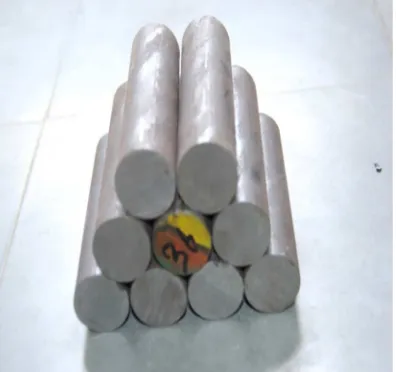
Fig. No: 1 CNC Lathe Fig. No. 2: EN353 Alloy Steel
Fig. No . 3 Rockwell hardness machine
2.3. Selection of Lubricant
Selection of cutting fluid is important in order to maintain better tool life, less cutting forces, lower power consumption, high machining accuracy and better surface integrity etc. Here vegetable oil, is used as cutting fluid under .
2.4. Preparation of Vegetable oil:
The mixture of vegetable oil ,oleic acid and triethanol amine is used as lubricant, from these three chemicals, coconut oil and oleic acid will improve machining parameters. The solvent triethanol amine is used for proper mixing of coconut oil and oleic acid. It can also control the evaporation rate of water in coolant
E-ISSN: 2321-9637
3
rdNational Conference on Recent Trends & Innovations In Mechanical Engineering
15
th& 16
thMarch 2019
Available online at www.ijrat.org
148 1 Vegetable Oil is taken 40%
2 Oleic Acid is taken 40% and 3 Triethanol Amine is 20%
40% of coconut oil is taken in a beaker and then 20% of triethanol amine is mixed in coconut oil and this mixture is stirred with mechanical stirrer for half an hour and then 40% of Oleic acid is added in the above solution slowly to dissolve or proper mixing and it is stirred for an half an hour to get a homogeneous mixture which is to be dissolve in water in all conditions.
3. EXPERIMENTAL DESIGN
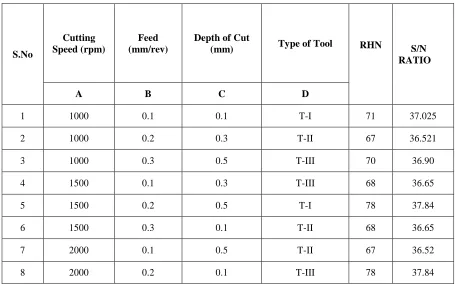
The four control factors Cutting Speed (A), Feed Rate (B) and Depth Of Cut(C) and type of tool(D) are selected with three levels and the corresponding orthogonal array L9 (34) is chosen
and are tabulated in Table No.2. Alloy Steel bars of 32mm diaX200mm length are prepared for conducting the experiment. Using different levels of the
[image:3.612.79.534.480.765.2]Process parameters as per the experimental design shown in table no.2, the specimens have been machined using conventional lathe accordingly; the Hardness of the material is measured precisely.
Table No. 1: Control Factors & Levels for Flooded
Factors Speed (A) Feed (B) Depth Of Cut (C)
Type of tools (D)
/Levels (rpm) (mm/min) (mm)
1 1000 0.1 0.1 T-I
2 1500 0.2 0.3 T-II
3 2000 0.3 0.5 T-III
Table No. 2. Experimental Design with corresponding results & S/N ratios
S.No
Cutting Speed (rpm)
Feed (mm/rev)
Depth of Cut
(mm) Type of Tool RHN S/N
RATIO
A B C D
1 1000 0.1 0.1 T-I 71 37.025
2 1000 0.2 0.3 T-II 67 36.521
3 1000 0.3 0.5 T-III 70 36.90
4 1500 0.1 0.3 T-III 68 36.65
5 1500 0.2 0.5 T-I 78 37.84
6 1500 0.3 0.1 T-II 68 36.65
7 2000 0.1 0.5 T-II 67 36.52
9 2000 0.3 0.3 T-I 70 36.90
4. RESULTS & DISCUSSIONS:
Hardness is a characteristic of a material, not a fundamental physical property. It is defined as the resistance to indentation, and it is determined by measuring the permanent depth of the indentation. More simply put, when using a fixed force (load) and a given indenter, the smaller the indentation, the harder the material.
Hardness is measured precisely with the help of a Rockwell hardness tester equipment and the results are tabulated in table no 2. For each experiment the corresponding S/N values are also
tabulated. Optimization of Hardness is carried out using Taguchi method. Confirmatory test have also been conducted to validate optimal results.
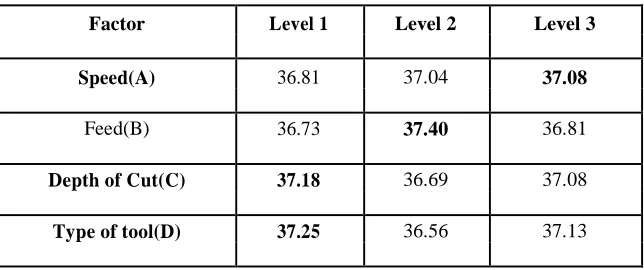
The best condition for cutting speed is level 3 (37.08), for feed is level 2 (37.40), for depth of cut is level 1 (37.18) and type of tool is level 1 (37.25). Thus, the optimum conditions chosen were: A3-B2-C1-D1. A confirmation test is performed with the obtained optimum cutting, the Hardness is measured and the S/N ratio is calculated for the flooded condition. The conformation test results are tabulated in the table no 5.
[image:4.612.146.468.368.503.2]
Table No 3: Summary of S/N Ratios for flooded
Table No 4: Optimum Set of Control Factors for flooded condition
Factors /Levels
Speed (A) Feed (B) Depth Of Cut(C)
Type of tool (D)
(rpm) (mm/min) (mm)
Optimum Value 2000 0.2 0.1 T-I
From table no. 4 the following calculations are done, for all the cases the predicted value is calculated in the same procedure.
ηpredicted= Y+ (A3-Y) + (B2-Y) + (C1-Y) + (D1-Y)
= A3+B2+12+D1-3Y
= [(37.08) + (37.40) + (37.18) + (37.25)] – [3X (36.98)] ηpredicted= 37.97
Therefore, the predicted average for optimum condition of hardness is 37.97
5. CONCLUSIONS:
A confirmation test is performed with the obtained optimum cutting parameters for cutting speed is level 3 (37.08), for feed is level 2 (37.40), for depth
of cut is level 1 (37.18) and type of tool is level 1 (37.25). The Hardness value is measured and the S/N ratio is calculated for this condition. The
Factor Level 1 Level 2 Level 3
Speed(A) 36.81 37.04 37.08
Feed(B) 36.73 37.40 36.81
Depth of Cut(C) 37.18 36.69 37.08
E-ISSN: 2321-9637
3
rdNational Conference on Recent Trends & Innovations In Mechanical Engineering
15
th& 16
thMarch 2019
Available online at www.ijrat.org
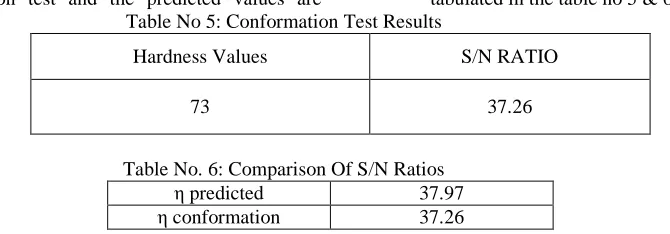
150 conformation test and the predicted values are tabulated in the table no 5 & 6.
Table No 5: Conformation Test Results
Hardness Values S/N RATIO
[image:5.612.118.453.127.244.2]73 37.26
Table No. 6: Comparison Of S/N Ratios
η predicted 37.97
η conformation 37.26
The objective of the present paper is to find out the set of optimum conditions in order to improve Hardness, using Taguchi methodology considering the turning parameters for the Alloy Steel material. Based on the results of the present experimentation the following conclusions are drawn:
In the present experimentation the optimum speed under flooded conditions is obtained using Taguchi Robust Design Methodology is 2000 rpm. Similarly the results obtained for feed and depth of cut are 0.2mm/min and 0.1mm respectively. The corresponding Type of tool is T-I.
The S/N ratio of predicted value and verification test values are valid when compared with the optimum values. It is found that S/N ratio value of verification test is within the limits of the predicted value and the objective of the work is full filled.
REFERENCES
[1]Leskover, p; Grum, J. (1986). The metallurgical aspect of machining, Annals of CIRP 35/1, 537-550
[2]A .Venkata Vishnu, K B G Tilak, Manik Reddy, “Optimization of Process Parameters for Surface Roughness in CNC Turning of EN-36 Material Using Taguchi Robust Design Methodology”, International Journal of Core
Engineering & Management (IJCEM), ICCEMT-2015, ISSN: 2348-9510, Special issue, December-2015. pp: 89-104
[3] Nirav M. Kamdar, Prof. Vipul K. Patel, “Experimental Investigation of Machining Parameters of EN36 Steel”,
International Journal of Engineering Research and Applications (IJERA) ISSN: 2248-9622. Vol. 2, Issue 3, May-Jun 2012, pp.1833-1838.
[4] Kaushal Pratap Singh and Girish Dutt Gautam:“Selection of Optimum Machining Parameters for EN36 Alloy Steel in CNC Turning Using Taguchi Method” International Journal of Scientific & Engineering Research, Volume
5, Issue 3, ISSN 2229-5518 – March 2004
[5] Manan Kulshreshtha: “Analysis of the Effect of Machining Parameters on Surface Roughness of EN 36 Nickel
Steel”, International Journal of Advanced Information Science and Technology (IJAIST) ISSN: 2319:2682 Vol.16,
No.16, August 2013.
[6] A .Venkata Vishnu, G. Guruvaiah Naidu, K B G Tilak, J.Ramakrishna, “Application of Taguchi Method in the Optimization of Turning Parameters for Material Removal Rate of En-36 Material”, International Journal of
Advance Engineering and Research Development E-ISSN (O): 2348-4470 P-E-ISSN (P): 2348-6406, Volume 2, Issue 8, August-2015.
[7] Ballal, Inamdar and Patil P.V. “Application Of Taguchi Method For Design Of Experiments In Turning Gray Cast Iron ” International Journal of Engineering Research and Applications (IJERA) Vol. 2, Issue 3, May-Jun 2012, pp.1391-1397.
[9]A.Venkata Vishnu, K B G Tilak, G. Guruvaiah Naidu, Dr.G.Janardhana Raju “Optimization of Different Process Parameters of Aluminium Alloy 6351 in CNC Milling Using Taguchi Method”, International Journal of Engineering
Research and General Science, ISSN: 2091-2730,Nepal, Vol.3 Issue 2, March-April-2015.
[10]Lathkar, G., S; Kharde, R. R; Basu, S. K. (2001). Some experiments in machining grease based solid lubricants, Journal of the Institution of Engineers, (India), vol. 82, 01- 06
[11] Edemir, A. (1991). Tribological properties of boric acid and boric acid forming surfaces, Part I. Crystal Chemistry and Mechanism of self lubrication of boric acid, Lubrication Engineering. Vol. 47, 168-178
[12]HMT "Production Technology", Tata McGraw Hill, 2004.
[13]Phillip j. Ross "Taguchi Techniques for Quality Engineering", Tata McGraw Hill, Second Edition, 2005.
[14]A.Venkata Vishnu1 G.Guruvaiah Naidu S.Sai Reddy Y.Purna Chander Rao T.Kranthi Kiran
Experimental Investigation of Turning of Steel Alloy
Under Sae40+Boric Acid
(IJSRD/Conf/RTIME/2016/009).
[15] A.Venkata Vishnu “An Investigation on Comparison of Vegetable Oil and Nano Fluids Coolants in Turning of En 19 Alloy Steel”, International Journal of Pure and Applied Research in Engineering and Technology IJPRET, 2017 (UGC Approved); Volume 6 (4): November 2017, pp: 1-15.
[16]A.Venkata Vishnu, G.Kiran Kumar, “Analysis of surface roughness in turning using nano fluids: Prediction model and cutting parameters optimization”, IJRASET (UGC Approved) Volume 5, Issue XII, December 2017,pp 340-347.
[17]A.Venkata Vishnu,