Weakly Supervised Morphology Learning for Agglutinating Languages
Using Small Training Sets
Ksenia Shalonova Computer Science, University of Bristol [email protected]
Bruno Gol´enia Computer Science, University of Bristol [email protected]
Abstract
The paper describes a weakly supervised approach for decomposing words into all morphemes: stems, prefixes and suffixes, using wordforms with marked stems as training data. As we concentrate on under-resourced languages, the amount of training data is limited and we need some amount of supervision in the form of a small number of wordforms with marked stems. In the first stage we in-troduce a new Supervised Stem Extrac-tion algorithm (SSE). Once stems have been extracted, an improved unsupervised segmentation algorithm GBUMS (Graph-Based Unsupervised Morpheme Segmen-tation) is used to segment suffix or prefix sequences into individual suffixes and pre-fixes. The approach, experimentally val-idated on Turkish and isiZulu languages, gives high performance on test data and is comparable to a fully supervised method.
1 Introduction
The major function of morphological analysis is decomposition of words into their constituents -stems and prefixes/suffixes. In recent years Ma-chine Learning approaches were used for word de-composition. There is a number of both unsuper-vised morphology learning systems that use ”raw” wordforms as training data (Creutz and Lagus, 2002; Goldsmith, 2001; Kazakov and Manand-har, 2001) and supervised morphology learning systems using segmented wordforms into stems and affixes as training data (Oflazer et al., 2001). The supervised morphology learning systems are usually based on two-level morphology (Kosken-niemmi, 1983). There is also a weakly supervised approach that uses, for example, wordpairs as
in-put, and this was applied mainly to fusional lan-guages for stem extraction (Erjavec and Dzeroski, 2004). Our project concerns developing speech technology for under-resourced languages. For this type of applications we need a relatively fast, cheap (i.e. does not require large training sets), almost knowledge-free approach that gives high performance. We have chosen to use wordforms with marked stems as training data in order to ful-fill the criteria mentioned above.
Morphological analysis is used in many prac-tical Natural Language Processing applications such as Machine Translation, Text Mining, spell-checkers etc. Our near-term goal is the integration of the morphology learning algorithms into the language-independent Text-to-Speech (TTS) sys-tem for improvement of grapheme-to-phoneme rules, stress prediction and tone assignment. In particular, the morphology learning algorithms described in this paper will be incorporated into the available isiZulu TTS system for automatic prediction of lexical tones. In the isiZulu language lexical tone assignment depends on the morpheme boundary. The current isiZulu TTS system is tone-deaf due to the lack of morphological de-composition. A number of perception tests will be carried out in order to evaluate which perfor-mance of morphology decomposition is accept-able for TTS and will improve the quality of the synthesised speech. It seems that the unsuper-vised morphology learning systems can be rela-tively easy to implement from scratch, but their performance probably cannot be regarded as high enough to improve the performance of the synthe-sized speech. In order to overcome this problem we present a novel synthesis of supervised and un-supervised induction techniques for morphology learning.
agglutinat-ing languages and the improved version of the unsupervised algorithm for segmenting affix se-quences. In (Shalonova et al., 2009) the authors presented the function learning approach called TASR (Tree of Aligned Suffix Rules) for extract-ing stems in fusional languages given wordpairs (word in grammatical form - word in basic form). While this algorithm gives good performance for Russian and English, it gives quite poor perfor-mance for agglutinating languages as shown in Section 4. A new approach for stem extraction in agglutinating languages is required for two main reasons. Firstly, suffix (or prefix) sequences in agglutinating languages can be much longer than in fusional languages and TASR does not seem to be efficient on long affix sequences as it does not generalise data in the efficient way and gen-erates too many specific rules. This leads to poor performance on unseen data. Secondly, in some agglutinating languages it could be easier for na-tive speakers to provide a stem (i.e. to provide a list of wordforms with annotated stems), whereas in highly inflective fusional languages the stem is often strongly bound with suffix sequences, and providing a proper stem requires high linguistic expertise. TASR approach is more appropriate for word-and-paradigm or realizational morphology that focuses on the whole word form rather than on word segmentation. For example, in Russian the infinitive verb govorit’(’to speak’) generates a set of grammatical forms or a paradigm - gov-orivshij,govor’aschij,govorimetc.
The second part of our approach is the im-proved version of GBUAS algorithm (Shalonova et al., 2009) that provides affix segmentation given unannotated affix sequences. Given stem bound-aries in the training set, our method splits the input word into all morphemes: stems and pre-fixes/suffixes. Our two-stage approach is tested on the under-resourced language isiZulu contain-ing both prefixes and suffixes, as well as on Turk-ish containing only suffixes. TurkTurk-ish is the most commonly spoken of the Turkic languages (over 77 million people). isiZulu is the Bantu lan-guage with about 10 million speakers and it is the most widely spoken home language in South Africa. Both Turkish and isiZulu use agglutina-tion to form new words from noun and verb stems.
In comparison to Turkish, isiZulu is a tonal lan-guage. In contrast to East Asian languages, in isiZulu there are three steps for tone assignment: lexical, morphemic and terraced. For TTS the lex-ical and morphemic tones will need to be recov-ered from the lexicon and the grammar as the or-thography has no tone marking. The terraced tone relation can in general be recovered and marked automatically from the tone sequence with a finite state model.
2 Stem Extraction Algorithm
The Stem Extraction Algorithm (SSE) is the su-pervised algorithm for stem extraction. The train-ing data for the SSE represent wordforms with the marked stem boundaries. During the train-ing stage we collect a set of all possible stem ex-traction rules from training data and assign pre-cision measures to each rule. Each rule is of the formL Rwhere ” ” is the stem boundary, L and R are the left and right graphemic contexts of a stem boundary of different lengths. We differen-tiate prefixLpre f Rstemand suffixLstem Rsu f f
stem extraction rules that correspond to the rules containing the left-hand stem boundary and the right-hand stem boundary respectively. For ex-ample, the Turkish word yer (’earth’) with the marked word boundary #ye r# generates the fol-lowingLstem Rsu f f rules: #ye r#, #ye r, ye r#, #ye , ye r, e r#, r#, ye , e r, r, and e , where the symbol ’#’ signifies the word initial and fi-nal positions. We are implementing similar fea-ture vectors used for automatic pronunciation pre-diction based on the focal grapheme (in our case it is a stem boundary) and left/right graphemic contexts of different length (Davel and Barnard, 2008). The idea of implementing expanding con-text in NLP tasks is usually applied for two-level data like grapheme-to-phoneme mapping rules (Torkkola, 1993), whereas in our case we use it for one-level data.
few negative examples). Using negative examples in contrast to using only rule frequencies (or pos-itive examples) improves the performance of the algorithm.
Definition 1. The number of positive examples for the rule Lstem Rsuff (or rule Lpref Rstem) is the number of training instances of Stem Su f f ixes (or Pre f ixes Stem) containing the substring L R.
Definition 2. The number of negative exam-ples for rule Lstem Rsuff (or Lpref Rstem) is the number of training instances Stem Su f f ixes (or Pre f ixes Stem) such that Stem+Su f f ixes (or Pre f ixes+Stem) contains substring L+R and Stem Su f f ixes (or Pre f ixes Stem) does not tain substring L R where ’+’ denotes string con-catenation.
In the above definitions ’ ’ is a stem boundary.
Example 1. Suppose we have only three isiZulu verbs: zi bek e, zi nak eke and a hlul eke. For the Lstem Rsu f f rule ’ek e’, the word zi bek e generates one positive example and the two other words zi nak eke and a hlul eke generate one negative example each.
The approach given in Algorithm 1 aims to find the unique longest rule-pair ’Lpre f Rstem and
Lstem Rsu f f’ with the highest precision that is applied to the input wordform for stem extraction. In case the language does not have prefixes like Turkish, the longest rule Lstem Rsu f f with the highest precision is applied. The decision of us-ing either a rule-pair or just a sus-ingle suffix rule is influenced by prior knowledge that a particu-lar language has got either both prefixes and suf-fixes like isiZulu or only sufsuf-fixes like Turkish. From now on we will use the term ’rulepair’ in application both to the rulepair ’Lpre f Rstemand
Lstem Rsu f f’ in case of isiZulu and to the rule-pair ’ andLstem Rsu f f’ with an empty first ele-ment in case of Turkish.
Algorithm 1Choosing rule pair for stem extrac-tion.
input W = raw wordform; P and S are sets of uniqueLpre f RstemandLstem Rsu f f rules
output result rule pair
result rule pair← /0
iMaxlength←∞
repeat
(p1,s1) ← getrulepair (P × S, W, iMaxlength)
(p2,s2)←getrulepair (P×S\(p1,s1), W,
iMaxlength)
iMaxlength←length(p1,s1)
until (p1,s1) = /0 or precision (p1,s1)
= precision(p2,s2) or length (p1,s1) =
length(p2,s2)
result rule pair←(p1,s1)
functiongetrulepair(PS, W, iMaxlength) ilength←0
r← /0
for all(p,s)∈PSdo if(p,s)matches Wthen
if length(p,s) < iMaxlength and
length(p,s)>ilengththen
ilength←length(p,s) r←(p,s)
else
if length(p,s) = ilength and
precision(p,s)>precision(r)then r←(p,s)
end if end if end if end for
returnr
end function
The search is carried out on the set of rule pairs matching an input raw wordform. The set is sorted by length first, and then by precision measure within each length category.
For example, if rulepairs have the following length-precision values:
’3-0.4’,’3-0.3’ ’2-0.3’
rulepair with the value 3-0.4 is selected.
The rulepair matches the input word if
Lpre f Rstem andLstem Rsu f f rules can be ap-plied without contradicting each other. For exam-ple, the rule pair ’#a hl’ and ’l eke’ matches the worda hlul eke, whereas the rule pair ’#a hlulek’ and ’le ke’ does not match this word. For each input wordform the set of its own rulepair candi-dates is generated. The search in the algorithm among these rulepairs starts from the longest rule-pairs, and this allows more specific rules and ex-ceptions to be applied first, whereas the more gen-eral rules are applied if no specific rules cover the input wordform.
3 Graph-Based Unsupervised Morpheme Segmentation
In this section we extend GBUMS (Graph-Based Unsupervised Morpheme Segmentation) that segments sequences of prefixes and suffixes (Gol´enia et al., 2009). We propose an exten-sion of GBUMS which uses the graph structure of GBUMS through a brute-force method. Our ex-periments showed the improved results on train-ing set and allowed GBUMS to be run on the test sets for two languages: Turkish and isiZulu.
The algorithm GBUMS was originally devel-oped in (Shalonova et al., 2009) under the name GBUSS (Graph-Based Unsupervised Suffix Seg-mentation) to extract suffix sequences efficiently and it was applied to Russian and Turkish lan-guages on training sets. We refer to prefixes and suffixes generally as morphemes. GBUMS uses a morpheme graph in a bottom-up way. Similar to Harris (Harris, 1955), the algorithm is based on letter frequencies. However, when Harris uses successor and predecessor frequencies, they use position-independent n-gram statistics to merge single letters into morphemes until a stopping cri-terion is fulfilled.
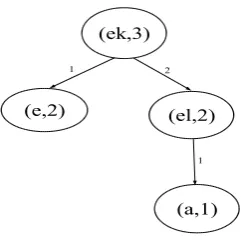
In the morpheme graph, each node represents a morpheme and each directed edge the concatena-tion of two morphemes labelled with the frequen-cies in a M-corpus (see Figure 1). M-corpus is a list of morpheme sequences
Definition 3. Let M={mi|1≤i≤ |M|}be a set
of morphemes, let fi be the frequency with which
morpheme mioccurs in a M-corpus of morpheme
sequences, let vi= (mi,fi)for 1≤i≤n, and let
fi,jdenote the number of morpheme sequences in
the corpus in which morpheme mi is followed by
morpheme mj. The morpheme graphG= (V,E)
is a directed graph with vertices or nodes V = {vi|1≤i≤ |V|}and edges E={(vi,vj)|fi,j>0}.
We treat fi,j as the label of the edge from vito vj. InG, each node is initialised with a letter ac-cording to a M-corpus, then one by one, nodes are merged to create the real morphemes. To merge nodes, an evaluation function is required. In (Gol´enia et al., 2009), Golenia et al. employed theMorph Liftevaluation function based on its re-lation to thelift of a rule for association rules in data mining (Brin et al., 1997).
Definition 4. Morph Li f t is defined for a pair of morphemes m1and m2as follows:
Morph Li f t(m1,m2) = f1,2
f1+f2 (1)
From now on, we know how to merge nodes. Now, we need to figure out the most important part of GBUMS, which is the stopping crite-rion. The stopping criterion is to prevent over-generalisation. In other words, the algorithm needs to be stopped before getting the initial M-corpus (since no merging is possible). This cri-terion is based on the Bayesian Information Cri-terion (BIC) and Jensen-Shannon divergence (Li, 2001).
BIC is used for selecting a model (set of mor-phemes) which fits a data set (M-Corpus) without being too complex. We want to point out that BIC is related to MDL. BIC is a trade-off between the maximum likelihood, the parameters of the model (probability and length of each morpheme) and the number of elements in the data set (frequency of each morpheme). A smaller value of BIC cor-responds to a better model fit. The maximum of the Jensen-Shannon divergence is used in order to analyse the increase of log-likelihood among all possible models. The Jensen-Shannon divergence is defined as follows (Dagan et al., 1997):
de-crease in entropy between the concatenated and the individual morphemes:
DJS(m1,m2) =H(m1·m2)−Lm1H(m1) +NLm2H(m2) (2)
where H(m) =−P(m)log2P(m)N=∑mFreq(m)
and Lmis the string length of m.
Stopping criterion requires that ΔBIC < 0
which translates to:
max
m1,m2DJS(m1,m2)≤2log2N (3)
Algorithm 2The GBUMS morpheme segmenta-tion algorithm
input M-Corpus = List of Strings
output M-CorpusSeg = List of Strings
M-CorpusSeg ←
SegmentInLetters(M-Corpus);
Graph←InitialiseGraph(M-CorpusSeg);
repeat
Max←0;
for all(p,q)∈Graphdo
ML Max←Morph Lift(p, q);
ifML Max>Maxthen
Max←ML Max;
pMax←p;
qMax←q;
end if end for
Graph ← MergeNodes(Graph, pMax,
qMax);
M-CorpusSeg ←
DeleteBoundaries(M-CorpusSeg, Label(pMax), Label(qMax));
Graph ← AdjustGraph(M-corpusSeg,
Graph);
untilStoppingCriterion(pMax, qMax, Max)
After several merging iterations, the output of the algorithm is the graph shown in Figure 1. The GBUMS is presented in Algorithm 2.
Note that the M-Corpus is completely segmented at the beginning of the algorithm. Then, the boundaries in the segmented M-Corpus are re-moved step by step according to a pair found in the graph with the maximum value forMorph Li f t.
When the stopping criterion is fulfilled, the seg-mented M-Corpus represents the morpheme se-quences.
At this point we present our extension of GBUMS based on a brute-force heuristic which scores every possible segmentation of an input morpheme sequence using graph values. We consider the morpheme graph as a model where each morpheme sequence can be extracted by the
MGraphfunction (eq. 4).
Definition 6. We define MGraph of a morpheme sequence without boundaries x as follows:
MGraph(x) =argmax t⊆x
1
Nt−Ctm∈t
∑
Lmlog(fm+1) (4)where
• t is a morpheme sequence with boundaries of x,
• m is a morpheme of t,
• fmis the frequency of the morpheme m,
• Nt is the number of morphemes existing in
the graph,
• Ct is the number of morphemes existing and
contiguous in the graph.
Firstly, as a post-processing procedure the
MGraph function improves the performance on training data. Secondly, it permits the identifica-tion of unseen morphemes. That is why the model generated by GBUMS can be run on test data sets.
Example 2. Let our final morpheme graph be as shown in Figure 1 where nodes represent suffixes and their frequencies.
Let x=”ekwe” be our input suffix sequence that we want to segment into individual suffixes. We split this input sequence into all possible substrings from individual characters up to size of the input string length: e-k-w-e, e-k-we, e-kw-e, ek-w-e, . . . , ekwe.
2log(4) =2.7726.
Consequently, ek-we is chosen as the correct seg-mentation for the substring ”ekwe”.
We would like to highlight that our new method can identify unseen cases with M-Graph, for in-stance, in the previous example suffix ”we” was not present in the training graph, but was correctly extracted.
Figure 1: Example of a suffix subgraph in the training phase for isiZulu.
4 Results
Our experiments were based on Turkish data con-taining 1457 verbs and 2267 nouns, and isiZulu data containing 846 nouns and 931 verbs, with one single unambiguous segmentation per word.1
Both isiZulu and Turkish data were uniquely sam-pled from the most frequent word lists.
Our first experiments compared TASR and the new SSE algorithm for stem extraction (10-fold cross validation assumes the following training and test set sizes: training sets containing 1311 wordforms for verbs and 2040 wordforms for nouns; test sets containing 146 wordforms for verbs and 227 wordforms for nouns). As can be seen from the Table 1, the performance of the SSE algorithm on Turkish data is much higher than that of TASR on the same dataset. As we mentioned in Section 1, TASR is not suitable for agglutinating languages with long suffix sequences. Although TASR algorithm gives an excellent performance on Russian, for most Turkish words it fails to ex-tract proper stems.
1In agglutinating languages some wordforms even within
one POS category can have several possible segmentations.
Test FMea
TASR Nouns 20.7±6.8
Verbs 12.6±5.9
SSE Nouns 84.3±3.2
Verbs 82.1±3.7
Table 1: Comparison of TASR and SSE for Turk-ish using 10-fold cross validation.
ap-Test FMea
Supervised Morfessor Nouns 74.6±2.3
Verbs 84.5±2.2
SSE+ GBUMS Nouns 78.8±2.4
Verbs 76.9±0.7
Unsupervised Morfessor Nouns 26.6±2.6 Verbs 28.4±2.8
Table 2: Comparison of Morfessor and
SSE+GBUMS for Turkish using 10-fold cross validation.
plied the SSE+GBUMS approach for the under-resourced agglutinating language isiZulu contain-ing both prefixes and suffixes and for Turkish con-taining only suffixes. The results show (Table 2 and Table 3) that our weakly supervised approach is comparable with the supervised Morfessor and decisively outperforms the unsupervised Morfes-sor. We think that it is useful to point out that un-supervised morphology learning systems in gen-eral require much larger training sets for better performance. F-measure is the harmonic mean of precision and recall, whereas precision is the proportion of true morpheme boundaries among the boundaries found, recall is the proportion of boundaries found among the true boundaries. In our experiments the GBUMS algorithm had no restrictions on affix length (Shalonova et al., 2009), but if there were restrictions, performance could be better. For isiZulu nouns our approach significantly outperformed supervised Morfessor, whereas for Turkish verbs SSE+GBUMS per-formed much worse. The best overall results obtained by GBUMS were based on the isiZulu nouns where about 53%of all affixes were sin-gle letter affixes, whereas the worst results our ap-proach gave for Turkish verbs where only about
12% of affixes are composed of one letter. It is important to notice that the GBUMS algorithm, which is completely unsupervised, gives better re-sults for extracting one letter affixes compared to Morfessor.
5 Conclusions
In the paper we described a weakly supervised approach for learning morphology in
agglutinat-Test FMea
Supervised Morfessor Nouns 76.7±1.6
Verbs 88.5±2.4
SSE+ GBUMS Nouns 87.9±1.9
Verbs 84.5±2.5
Unsupervised Morfessor Nouns 27.4±5.1 Verbs 26.9±5.0
Table 3: Comparison of Morfessor and
SSE+GBUMS for isiZulu using 10-fold cross validation.
ing languages. We were successful in our ulti-mate goal of synthesis of supervised and unsuvised induction techniques by achieving high per-formance on small amount of training data. Our weakly supervised approach is comparable with the supervised morphology learning system. As we are working with the languages for which lin-guistic resources are very limited (in particular words with morpheme boundaries), the developed method fulfills our goals of providing key compo-nents for speech and language products for such under-resourced languages. We speculate that the current performance might be improved by adding a small amount of completely ”raw” data to the training set.
6 Acknowledgment
We would like to thank Kemal Oflazer from Sa-banci University in Istanbul for his help and the Turkish data. We also thank Viktor Zimu and Eti-enne Barnard from CSIR in Pretoria for provid-ing us isiZulu data. We also thank Roger Tucker for his support in the project. The work was sponsored by the EPSRC Grant EP/E010857/1 ’Learning the morphology of complex synthetic languages’.
References
Brin, S., R. Motwani, J. Ullman, and S. Tsur. 1997. Dynamic itemset counting and implication rules for market basket data. InACM SIGMOD international conference on Management of data, pages 255–264. ACM.
Creutz, M. and K. Lagus. 2002. Unsupervised discov-ery of morphemes.Proceedings of the Workshop on Morphological and Phonological Learning of ACL-02, pages 21–30.
Dagan, I., L. Lee, and F. Pereira. 1997. Similarity-Based Methods for Word Sense Disambiguation.
Thirty-Fifth Annual Meeting of the ACL and Eighth Conference of the EACL, pages 56–63.
Davel, M. and E. Barnard. 2008. Pronunciation pre-diction with default refine. Computer Speech and Language, 22:374–393.
Erjavec, T. and S. Dzeroski. 2004. Machine learn-ing of morphosyntactic structure: Lemmatislearn-ing un-known Slovene words. Applied Artificial Intelli-gence, 18(1):17–40.
Goldsmith, J. 2001. Unsupervised learning of the morphology of a natural language. Computational Linguistics, 27:153–198.
Gol´enia, B., S. Spiegler, and P. Flach. 2009. UN-GRADE: UNsupervised GRAph DEcomposition. In Working Notes for the CLEF 2009 Workshop, CLEF 2009, Corfu, Greece.
Harris, Z. 1955. From Phoneme to Morpheme. Lan-guage, 31(2):190–222.
Kazakov, D. and S. Manandhar. 2001. Unsupervised learning of word segmentation rules with genetic algorithms and inductive logic programming. Ma-chine Learning, 43:121–162.
Koskenniemmi, K. 1983. Two-level Morphology: A General Computational Model for Word Form
Recognition and Production. Ph.D. thesis, Univer-sity of Helsinki.
Li, W. 2001. New stopping criteria for segment-ing DNA sequences. Physical Review Letters, 86(25):5815–5818.
Oflazer, K., M. McShane, and S. Nirenburg. 2001. Bootstrapping morphological analyzers by combin-ing human elicitation and machine learncombin-ing. Com-putational Linguistics, 27(1):59–85.
Shalonova, K., B. Golenia, and P. Flach. 2009. Towards learning morphology for under-resourced languages. IEEE Transactions on Audio, Speech and Language Procesing, 17(5):956–965.
Spiegler, S., B. Golenia, K. Shalonova, P. Flach, and R. Tucker. 2008. Learning the morphology of Zulu with different degrees of supervision. IEEE Spoken Language Technology Workshop, pages 9–12.