A Large Multilingual and Multi-domain Dataset for Recommender Systems
Giorgia Di Tommaso, Stefano Faralli
*, Paola Velardi
Department of Computer Science,*UnitelmaSapienza, University of Rome, Italy
{ditommaso,velardi}@di.uniroma1.it, [email protected]
Abstract
This paper presents a multi-domain interests dataset to train and test Recommender Systems, and the methodology to create the dataset from Twitter messages in English and Italian. The English dataset includes an average of 90 preferences per user on music, books, movies, celebrities, sport, politics and much more, for about half million users. Preferences are either extracted from messages of users who use Spotify, Goodreads and other similar content sharing platforms, or induced from their ”topical” friends, i.e., followees representing an interest rather than a social relation between peers. In addition, preferred items are matched with Wikipedia articles describing them. This unique feature of our dataset provides a mean to derive a semantic categorization of the preferred items, exploiting available semantic resources linked to Wikipedia such as the Wikipedia Category Graph, DBpedia, BabelNet and others.
Keywords:social mining, recommender systems, Twitter, users’ interest dataset
1.
Introduction
Recommender systems are widely integrated in online ser-vices to provide suggestions and personalize the on-line store for each customer. Recommenders identify preferred items for individual users based on their past behaviors or on other similar users. Popular examples are Amazon (Linden et al., 2003) and Youtube (Davidson et al., 2010). Other sites that incorporate recommendation engines in-clude Facebook, Netflix, Goodreads, Pandora and many others.
Despite the vast amount of proposed algorithms, the evalu-ation of recommender systems is very difficult (Fouss and Saerens, 2008). In particular, if the system is not opera-tional and no real users are available, the quality of recom-mendations must be evaluated on existing datasets, whose number is limited and what is more, they are focused on specific domains (i.e, music, movies, etc.). Since differ-ent algorithms may be better or worse depending on the specific purpose of the recommender, the availability of multi-domain datasets could be greatly beneficial. Unfor-tunately, real-life cross-domain datasets are quite scarce, mostly gathered by ”big players” such as Amazon and eBay, and they not available to the research community1. In this paper we present a methodology for extracting from Twitter a large dataset of user preferences in multiple do-mains and in two languages, Italian and English. To reli-ably extract preferences from users’ messages, we exploit popular services such as Spotify, Goodreads and others. Furthermore, we infer many other preferences from users’ friendship lists, identifying those followees representing an interest rather than a peer friendship relation. In this way we learn, for any user, several interests concerning books, movies, music, actors, politics, sport, etc. The other unique feature of our dataset, in addition to multiple languages and domains, is that preferred items are matched with corre-sponding Wikipedia pages, thus providing the possibility to generalize users’ interests exploiting available semantic
1
https://recsys.acm.org/wp-content/uploads/2014/10/ recsys2014-tutorial-cross_domain.pdf
resources linked to Wikipedia, such as the Wikipedia Cate-gory Graph, Babelnet, DBpedia, and others.
The paper is organized as follows: Section 2. summarizes previous research on creating datasets for recommender systems, Section 3. describes our methodology to collect data, and Section 4. presents and evaluates our results. Fi-nally, in Section 5. we draw conclusions providing some directions for future research.
2.
Related work
Most recommender systems (hereafter RS) are based on one of three basic approaches (Felfernig et al., 2014): collaborative filtering (Schafer et al., 2007) generates recommendations collecting preferences of many users, content-based filtering (Pazzani and Billsus, 2007) suggests items similar to those already chosen by the users, and knowledge-based recommendation (Trewin, 2000) identi-fies a semantic correlation between user’s preferences and existing items. Hybrid approaches are also widely adopted (Burke, 2002). All approaches share the need of sufficiently large datasets to learn preferences and to evaluate the sys-tem, a problem that is one of the main obstacles to a wider diffusion of RS (Gunawardana and Shani, 2009) since only a small number of researchers can access real users data, due to privacy issues.
To overcome the lack of datasets, challenges as RecSys have been lunched2, and dedicated web sites have been cre-ated (e.g., SNAP3 or Kaggle4), where researchers can up-load their datasets and make them available to the commu-nity. However it is still difficult to find appropriate data for novel types of recommenders, as the majority is focused on a single topic, like music (Dror et al., 2012), (Shepitsen et al., 2008), ) food ((Kamishima and Akaho, 2010), (Sawant and Pai, 2013)), travel ((Wang et al., 2010), (Mavalankar et al., 2017)) and more (C¸ ano and Morisio, 2015).
Fur-2https://recsys.acm.org/ 3http://snap.stanford.edu/data
4https://www.kaggle.com/datasets/?sortBy=
thermore, while a small number of large datasets are avail-able, such as Movielens (Harper and Konstan, 2016), Mil-lion song dataset (McFee et al., 2012) and Netflix Prize Dataset (Bennett et al., 2007), many others are quite small and based on very focused experiments.
Concerning the source of data for extracting preferences, social networks are often used, since their content is avail-able with more or less severe restrictions. For example, (Chaabane et al., 2012) use Facebook, perhaps the most ap-propriate platform for this type of study, as it provides in-centive mechanisms for sharing interests and content. How-ever, a disadvantage is the difficulty in extensively access-ing profiles due to user privacy issues. In (Chaabane et al., 2012), 104,000 public and 2000 private profiles (obtained by volunteers) have been extracted. Another study (Yan et al., 2014) presents an overview of users’ interests derived from multiple platforms to which the same user is regis-tered (e.g., Twitter, Youtube, etc.). To find the same account on multiple social networks, Google+ is used, where users are encouraged to share and link the addresses of their ac-counts. Overall 143,259 accounts were collected, of which, 11,850 provided multiple accounts. Many other studies use Twitter (eg. (Gesualdo et al., 2013), (Adamopoulos and Tuzhilin, 2014)) as a platform for extracting users’ infor-mation, although existing restrictions limit the amount of freely accessible traffic to 1%.
Data extraction from Twitter messages is expensive since it requires natural language processing techniques to an-alyze the text. To overcome this difficulty, a number of studies exploited platforms (e.g., Youtube, Spotify) that in-tegrate among their services the ability to post the user’s personal content on the most popular social network sites, such as movies that users are watching. Sharing this infor-mation is done in a simple and predefined way. Depending on the social network chosen, the content, for example a Youtube video, will be shared with a pre-formatted mes-sage formed by the video name, a link, a self-generated text and, if provided, a numerical rating (eg. ”How It’s
Made: Bread” https://youtu.be/3UjUWfwWAC4
via YouTube). The message can also be enriched and per-sonalized by the user. In (Pichl et al., 2015) this types of messages are extracted from Twitter, to detect music inter-ests. The dataset is based on 100,000,000 tweets with the #nowplaying main tag. Tweets are extracted via Twitter APIs over 3-years and next, MusicBrainz and Spotify are used to add more details. Other studies extract data about music (Schinas et al., 2013) or sport (Nichols et al., 2012) events. However, all the datasets generated in this way con-cern only one domain of interest.
To the best of our knowledge, the only really multi-domain dataset5 is presented in (Dooms et al., 2014), where pre-structured tweets about three domains - movies, books and video-clips - are extracted respectively from IMDb (Inter-net Movies Database), Youtube and Goodreads. With re-spect to this work, we collect a much wider number of inter-ests, since in addition to pre-formatted messages based on a number of available services, we reliably extract many
ad-5
Another is the ConcertTweets https://github.com/ padamop/ConcertTweets, however it is focused on music events.
ditional types of interests exploiting users’ followees lists. Furthermore, as shown in Section 4., we collected many interest typesfor each user, while the dataset released in (Dooms et al., 2014) includes only 7 users with at least 3 types of interests.
3.
Workflow and data sources
This section summarizes the data sources and workflow to create our multi-domain dataset. We extract prefer-ences from a user’s messages and from his/her friendship list, identifying those followees which represent an interest rather than a peer friendship relationship. The process is in three steps:
1. Extracting interests from users’ textual communica-tions. The first step is to extract preferences from Twit-ter messages. Using textual features extracted from users’ communications, profiles or lists seems a nat-ural way for modeling their interests. However, this information source has several drawbacks when ap-plied to large data streams, such as the set of Twitter users. First, it is computationally very demanding to process millions of daily tweets in real time; secondly, the extraction process is error prone, given the highly ungrammatical nature of micro-blogs. To reliably ex-tract preferences from users’ messages, in line with other works surveyed in Section 2., we use a number of available services, described hereafter, that allow to share activities and preferences in different domains -movies, books etc. - using pre-formatted expressions (e.g, for Spotify: #NowPlaying) followed by the url of a web site, from which we can extract information without errors. The drawback is that a relatively small number of users access these services and in addition, preferences are extracted only in few domains.
2. Extracting interests from users’ friendship lists. In (Barbieri et al., 2014) the authors argue that users’ in-terests can also be implicitly represented by the au-thoritative (topical) friends they are linked to. This information is available in users’ profiles and does not require additional textual processing. Furthermore, in-terests inferred from topical fiends are less volatile since, as shown in (Myers and Leskovec, 2014), ”com-mon” users tend to be rather stable in their relation-ships. Topical friends are therefore both relatively sta-ble and readily accessista-ble indicators of a user’s inter-est. Another advantage is that average Twitter users have hundreds of followees, many of which, rather than genuine friends, are indicators of a variety of interests in different domains, such as entertainment, sport, art and culture, politics, etc.
is possible in a large number of cases, since Wikipedia articles are created almost in real-time in correspon-dence with virtually any popular entity, either book, or song, actor, event, etc.
We applied this workflow to two Twitter streams in two lan-guages, English and Italian, as detailed in what follows.
3.1.
Extracting preferences from messages
Everyday a huge number of people uses on-line platforms (eg. Yelp, Foursquare, Spotify, etc.) that allow to share activities and preferences on different domains on a social network in a standard way. Among the most popular ser-vices accessed by Twitter users, we selected those provid-ing pre-formatted messages, as detailed hereafter.
• Spotify: Spotify is a music service offering on-demand streaming of music, both desktop and mobile. Users can also create playlists, share and edit them in collaboration with other users. In addition to accessing the Spotify web site, users can retrieve additional in-formation such as the record label, song releases, date of release etc.. Since 2014, Spotify is widely used in America, Europe and Australia. Spotify is among the services allowing to generate self-generated con-tent shares in Twitter. An example of these tweets is: ”#NowPlaying The Sound Of Silence by Dis-turbedhttps://t.co/d8Sib5EDVf”. The stan-dard form of these tweets is:
#NowPlaying <title> by <artist > <URL> By filtering the tweets stream and using Twitter APIs for hashtag detection, we generated a stream of all the users who listened music using Spotify.
• Goodreads and aNobii:Similarly to Spotify, a num-ber of platforms allows to share opinions and reviews on books. In these platforms, users can share both ti-tles and ratings. Similarly to Spotify, generated tweets have a predefined structure and point to an URL. In the book domain, we use Goodreads (10 million users and 300 million books in the database) and for Italian, the more popular aNobii service.
• IMDb and TVShowTime: In the domain of movies, currently there are no dominant services. Popular platforms in this area are Flixter, themoviedb.org and iCheckMovies. However, many of these platforms use the IMDb database, owned by Amazon, which han-dles information about movies, actors, directors, TV shows, and video games. We also use the TvShow-Time service for Italian tweets.
First, we collect in a Twitter stream all messages includ-ing a hashtag related to one of the above mentioned ser-vices (#NowPlaying, #IMDb ..). Next, we extract from tweets the music, movie and book preferences for a set of users U who accessed these services. Unlike (Dooms et al., 2014), we avoid parsing tweets using specific regular expressions, since users are free to insert additional text in the pre-formatted message. Rather, we exploit an element that all these pre-formatted tweets have: the URL, as in
(Pichl et al., 2014). Every URL points to the website con-taining all the information, such as, e.g., title, author and publisher for books. Since the URL in the tweets is a short URL, we first extend the original URL so that all URLs be-longing to a given platform can be identified (for example, all Goodreads URLs contain the ”goodreads.com” string). Next, we access the web site and scrape its content. The reason for extracting the information from the URL (which is computationally more demanding) rather than from the tweet itself is twofold:
1. Tweets can be ambiguous or malformed, and fur-thermore, users can insert additional text in the pre-formatted message, e.g, ”#NowPlaying Marty. This guy is amazing.http://t.co/jwxvLiNenW”. Scraping the html page at the URL address ensures that we extract datawithout errors, even for complex items such as book and movie titles;
2. The URL includes additional information (e.g., not only the title of a song, but also the singer and the record label), which provide us a context to reliably match the extracted entity (song, book, movie) with a Wikipedia article, as detailed in Section 3.3..
3.2.
Extracting preferences from users’
”topical” friends
We denote as topical friendsthose Twitter accounts in a user’s followees list representing popular entities (celebri-ties, products, locations, events . . . ). For example, if a user follows @David Lynch, this means that he/she likes his movies, rather than being a genuine friend of the director. There are several clues to identify topical friends in a friendship list: first, topical relationships are mostlynot re-ciprocated, second, popular users have a high in-degree. However, these two clues alone do not allow to distinguish e.g., bloggers or very social users from truly popular enti-ties.
To lean a model of topical friends we first collected a net-work of Verified Twitter Accounts. Verified accounts6are authentic accounts of public interest. We started from a set of seed verified contemporary accounts in 2016, and we then crawled the network following only verified friends, until no more verified accounts could be found. This left us with a network of 107,018 accounts of verified con-temporary users (V), representing a ”model” of authorita-tive users’ profiles. Next, from the set U of users in our datasets (separately for the English and Italian streams), we collected the set F of Twitter accounts such that, for any f ∈F there is at least oneu∈U such thatufollowsf. In order to identify candidate topical friendsFt ⊂ F, we
learned a model of popularity, using the setV and a ran-dom balanced set of ¬V users. For each account, we ex-tracted three structural features (in degree, out degree and their ratio) and one binary textual feature (presence in the user’s account profile of role words such as singer, artist, musicians, writer..). Then, we used 80% of these accounts to train a SVM classifier with Laplacian kernel and the re-maining 20% for testing with cross-validation, obtaining a
6 https://developer.twitter.com/en/docs/
total accuracy of 0.88 (true positive rate 0.95 and true neg-ative rate 0.82). Finally, the classifier was used to select a subsetFt ⊆F ofauthoritativeusers representing
”can-didate” topical friends. The last filtering step to identify ”true” topical friends inFt, i.e., genuine users’ interests,
consists in determining which members of the setFthave
a matching Wikipedia page. The intuition is that, if one such match exists, the entity to which the Twitter account belongs is indeed ”topical”.
3.3.
Mapping to Wikipages
Mapping interests extracted from users’ messages to Wikipedia pages is a very reliable process, given the addi-tional contextual information extracted from the URL (see Section 3.1.). For a complete example, see Section 3.4.. On the contrary, matching interests extracted from a user’s friendship list with corresponding Wikipedia pages is far more complex, because of synonymy, polysemy and am-biguity, as argued in (Faralli et al., 2017). Furthermore, the information included in a user’s Twitter profile is very sketchy and in some case misleading, therefore it may not provide sufficient context to detect a similarity with the cor-respondent Wikipedia article. For example, Bill Gate’s de-scription field7 in his Twitter profile is: ”Sharing things I’m learning through my foundation work and other in-terests...” which has little in common with his Wikipedia page: ”William Henry Gates III (born October 28, 1955) is an American business magnate, investor, author, phi-lanthropist, humanitarian and co-founder of the Microsoft Corporation along with Paul Allen.”
To find the Wikipedia page, if any, associated to a topical friend we used the methodology that was first presented in (Faralli et al., 2015) and improved in (Faralli et al., 2017), summarized in what follows:
1. Selection of candidate senses: For anyf inFt, find
a (possibly empty) list ofcandidate wikipages, using BabelNet synonym sets (in BabelNet, each ”Babel-Synset” points to a unique Wikipedia entry (Navigli and Ponzetto, 2012));
2. BoW Disambiguation: Compute the bag-of-words (BoW) similarity between the user description inf’s Twitter account and each candidate wikipage. The BoW representation for each wikipage is obtained from its associated BabelNet relations (Delli Bovi et al., 2015);
3. Structural Similarity: If no wikipages can be found with a sufficient level of similarity (as for the previous example of Bill Gates), select fromf’s friendship list those friends already mapped to a wikipage (if any), and compute the similarity between those wikipages and candidate wikipages.
3.4.
Anecdotic examples and evaluation
We provide hereafter examples of the process outlined in previous Sections. For the sake of space, we consider only examples of interests extracted from users’ messages.
7
as retrieved on January 2018
1. detection of ”interesting” tweets
We collect all tweets containing the selected hashtags and discard those which do not include an url. accepted #NowPlaying High by James Blunt https://t.co/7EiepE2Bvz
discarded#NowPlaying CaSh Out - Cashin’ Out
2. extraction of the url
Next, we retrieve the original url from short url. If the url does not contain the platform domain (eg. spoti.fi), we discard it.
accepted: https://t.co/oShYDc6DeL → http://spoti.fi/2cTPn0U
discarded: https://tunein.com/radio/ Pratt-Radio-s50434/
Then, we extract information about an item (movie, book or music) from the platform site through APIs, (when available) or web-scraping. For each platform we obtain the following data:
(a) Music:<Title, Author (eg. singer, band)>
(b) Books:<Title, Author>
(c) Movie: <Title, Year of production, Type (eg. movie, tv series)>
3. mapping to Wikipedia
Wikipedia mapping is obtained by a cascade of weighted boolean query on a Lucene Index.The index is based on a tdf-idf with vector space model.
(a) Searching the Wikipage of an item < T IT LE∈W ikiT itle >w1 ∧< AU T HOR∈W ikiGloss >w2 ∧ < W ORDS∈W ikiT itle >w3 ∨< AU T HOR∈W ikiT itle >w4 ∨< W ORDS∈W ikiT ext >w5
∨¬ < W ORDS∈W ikiT itle >w3 ∨< AU T HOR∈W ikiT itle >w4 ∨< W ORDS∈W ikiT ext >w5
Where
wiis a weigth assigned to a query
< W ORDS >for music ={”song”}
< W ORDS > for books = {”books”, ”novel”, ”saga”
< W ORDS >for movie ={”film”, ”series”, ”TV series”, ”episode”}
When the page doesn’t exist or is not available we search the page of the item’s author.
(b) Searching the wikipage of the item’s author < AU T HOR∈W ikiT itle >w1
∧ < W ORDS∈W ikiT itle >w2 ∨< T IT LE∈W ikiT ext >w3 ∨< W ORDS∈W ikiT ext >w4
∨¬ < W ORDS∈W ikiT itle >w2 ∨< T IT LE∈W ikiT ext >w3 ∨< W ORDS∈W ikiT ext >w4
USER ID:787930***
Source Interest Wikipage
IMDb
Eyes Wide Open - 2009 - movie WIKI:EN:Eyes Wide Open (2009 film)
Okja - 2017 - movie WIKI:EN:Okja
Goodreads
The Beautifull Cassandra - Jane Austen WIKI:EN:Jane Austen The Beach - Alex Garland WIKI:EN:The Beach (novel)
Spotify
I Don’t Know What I Can Save You From - Kings of Convenience WIKI:EN:Kings of Convenience! Nothing Matters When We’re Dancing -The Magnetic Fields WIKI:EN:The Magnetic Fields
Topical friends
@IMDb WIKI:EN:IMDb
@UNICEF uk WIKI:EN:UNICEF UK
@TheMagFields WIKI:EN:The Magnetic Fields
@BarackObama WIKI:EN:Barack Obama
@Spotify WIKI:EN:Spotify
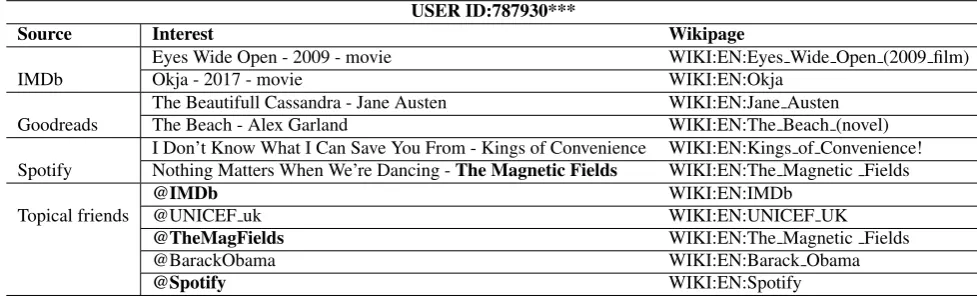
Table 1: Excerpt of a Twitter user’s interests
wiis a weigth assigned to a query
< W ORDS > for music = {”singer”, ”band”, ”artist”, ”songwriter”, ”composer”, ”musician”, ”record producer”}
< W ORDS > for books ={”writer”, ”novelist”, ”cartoonist”, ”journalist”, ”orator”, ”poet”, ”Japanese manga author”}
Examples of positive results when searching an item’s title: Tweet: I rated Arrow: Disbanded (S5.E18) 9/10 #IMDb https://t.co/Oo4qu6tHl7
Original url: http://www.imdb.com/title/ tt5607516/
WikiPage:WIKI:EN:Arrow (TV series)
Note that WikiTitle contains the term ”TV series” in WORDS.
Examples with positive results when searching an item’s author:
Tweet: 4 of 5 stars to Silken Prey by John Sandford https://t.co/AyF5Iuyc9s
Original url: https://www.goodreads.com/ review/show/2105147499
WikiPage:WIKI:EN:John Sandford (novelist)
Note that WikiTitle contains the term ”novelist” in WORDS.
Examples with incorrect results:
The system returns no results or incorrect results in 3 cases:
1. the title page of the item or item’s author page doesn’t exist:
Tweet: #NowPlaying Cherry Garcia by Dingus https://t.co/t7g4EQ3ucp
Original url: https://open.spotify.com/ track/2vfZpWZGUtfM2VYVomh7MZ
WikiPage:WIKI:EN:Eric Dingus
The wikipage of the correct singer (which is not Eric Dignus) doesn’t exist.
2. the extracted data is wrong because information ex-traction fails for various reasons (eg. missing or poorly structured information in the platform):
Tweet: 4 of 5 stars to Love, Rosie by Cecelia Ahern https://t.co/EtS1RoCarK
Original url: https://www.goodreads.com/ review/show/1965312746
WikiPage:WIKI:EN:Love, Rosie (film)
In this case Wikipedia shows the title
page with the initial name of the book
”WIKI:EN:Where Rainbows End”, but the origi-nal name of the book was modified in the reprint.
3. the searched Wikipedia page does not contain enough context to match the query.
Overall, the methodology to extract and map preferences from messages proved to be very reliable. We evaluated the precision (with adjudication) on a randomly selected bal-anced sample of 1200 songs, books, and movies in English, obtaining a precision of 96%. For the Italian dataset, we evaluated 750 songs, books, and movies, obtaining a preci-sion of 98%.
As far as the topical interests mapping performance is con-cerned, in (Faralli et al., 2017) the authors mention that in-ducing interests from topical friends and subsequent map-ping to Wikipedia has an accuracy of 84%. Since our aim in this work is to generate a highly accurate dataset, we considered only the subsetF0
tinFtwith indegree (with
re-spect to our populationU) higher than 40. In fact, we noted that less popular topical friends may still include blog-gers or Twitter users for which, despite some popularity, a Wikipage does not exists. In these cases, our methodology may suggest false positives. When applying the indegree filter, the precision -manually evaluated with adjudication on 1250 accounts randomly chosen in this restricted popu-lationFt0- is as high as 90%.
message-based interests(|U|=444,744 English speaking users) Music Books Movie Total
platform Spotify Goodreads IMDb All
#crawled tweets (tweets with selected hashtags) 19,941,046 693,975 97,772 20,732,793
#cleaned tweets (tweets for which an URL was extracted) 2,519,166 139,882 88,355 2,747,403
# of unique interests with a mapping to a Wikipage 253,311 20,710 8,282 282,303
average #interests per user 6 8 6 6
average #users per interest 7 3 7 6
precision of Wikipedia mapping (on 3 samples of 400 items each) 94% 96% 97% 96%
Table 2: 6-months (April-September 2017) statistics onmessage-basedinterests extracted from English-speaking users
Figure 1: Venn Diagram of message-based interesttypesfor our English dataset (left) and the dataset in Dooms et al.(2014)
message-based interests(|U|= 25,135 Italian speaking users) Music Books Movie Total
platform Spotify ANobii IMDb & TVShowTime All
#crawled tweets (tweets with selected hashtags) 273,256 12,198 2,229 287,683 #cleaned tweets (tweets fro which an URL was extracted) 70,330 12,193 2,119 84,642 # of unique interests with a mapping to a Wikipage 9,926 4,690 279 14,895
average #interests per user 3 9 7 6
average #users per interest 5 2 5 4
precision of Wikipedia mapping (on 3 samples of 250 items each) 96% 98% 100% 98%
Table 3: 6-months (April-September 2017) statistics onmessage-basedinterests extracted from Italian-speaking users
Interests induced from topical friends(|U|=444,744 English speaking users)
# of topical friendsFt0with indegree≥40inU 409,743
# of unique interests with a mapping to a Wikipage 58,789
average #interests per user 82
precision of Wikipedia mapping (tested on a sample of 1,250 items inFt0) 90%
Table 4: 6-months (April-September 2017) statistics on interests induced fromtopical friendsof English-speaking users
4.
Description of the Dataset
The outlined process has been applied to two streams of Twitter data, in English and Italian, extracted during 6 months (April-September 2017) using Twitter APIs. We collected the maximum allowed Twitter traffic of English users mentioning service-related hashtags (e.g., #NowPlay-ing for Spotify), and the full stream of messages in Ital-ian, since they do not exceed the maximum. As a final re-sult, we obtained for a large number of users a variety of interests along with their corresponding Wikipedia pages. An excerpt of a Twitter user’s interests is shown in Figure 1. In the example, we selected two interests from each of the four sources from which they have been induced:IMDb (movies), Goodreads (books), Spotify (music) and four in-terests from the user’s topical friends. Although a detailed analytics of interest categories is deferred to further studies, the example shows the common trend that a user’s inter-ests, either extracted from his/her messages or from topical friends, are strongly related, and in same case identical. For example, the user in Table 1 frequently accesses the IMDb and Spotify services, and he/she is also a follower of the IMDb and Spotify Twitter account. Furthermore, his/her interest in the band The Magnetic Field emerges from both source types.
Overall, we followed 444,744 English-speaking and 25,135 italian-speaking users (the set U) who accessed at least one of the services mentioned in Section 3.1.. The gen-eral statistics of interests extracted from users’ messages are shown in Tables 2 and 3.
In the English dataset we crawled more than 20M tweets from these users, of which, about 2.7M could be associ-ated to the URL of a corresponding book, movie or mu-sic. On average, we collected 6 interests per user. What is more, several users have interests in at least two of the three domains. Figure 1 compares the Venn diagram of inter-est types in our dataset (left) with that reported in (Dooms et al., 2014) (right), to demonstrate the superior coverage of our dataset, even when considering only preferences ex-tracted from users’ messages.
The number and variety of extracted preferences is how-ever mostly determined by the interests induced from users’ topical friends, as shown in Table 4 (English dataset). Al-though, to ensure a high precision of the Wikipedia map-ping step, we mapped only topical friends inFt0⊂Ftwith
a high in-degree from users inU (see Section 3.4.), the av-erage number of interests induced for each user is as high as 82, and the distribution is shown in Figure 2. The Figure shows, e.g., that there are 100,000 users inU with≥100 interests induced from their topical friends.
When merging the two sources of information, our dataset
includes an average of 90 interests per user for about 450k users, in a large variety of domains. To the best of our knowledge, this is the largest multi-domain interest dataset reported in literature, and furthermore, we provide the unique feature of a reliable mapping to Wikipedia. We release under creative commons license the dataset of English-speaking users along with their
prefer-ences. (http://lmm.tweets.di.uniroma1.it/
lmm/). The dataset is in five files. Details are provided in the readmefile. Further note, as we explained in Sec-tion 3., that the process of extracting interests from mes-sages is almost free of errors (96% precision), while induc-ing interests from topical friends and subsequent mappinduc-ing to Wikipedia has an estimated 10% error rate. However, as mentioned in Section 1., semantic techniques can be ap-plied to reliably identify the maincategoriesof interest for each user, an enhancement that we leave to future work.
5.
Concluding Remarks
In this paper we presented a new dataset that captures, from Twitter messages and friendship lists, users’ interests in multiple domains. We described the methodology to create the interests dataset and released a dataset extracted from an English Twitter stream collected during April-September 2017. The interests dataset can be extended to more lan-guages and domains through the same methodology. Thus, the dataset and its extensions can be used in a number of applications in the domain of Recommender Systems, but not only. Although the dataset possibly includes extraction errors (which is a common problem in large, automatically extracted resources), the unique feature of mapping inter-ests to Wikipedia articles and the large number of interinter-ests associated to each user, offer the possibility to identify for each user the ”dominant” interestcategories, on which Rec-ommender Systems could rely when suggesting new items.
6.
Acknowledgements
We greatly thank Dr.Giovanni Stilo, who developed the framework for extracting real-time data from Twitter streams, under the restrictions specified by Twitter. This work has been in part supported by the IBM Faculty Award #2305895190 (2017).
7.
Bibliography
Adamopoulos, P. and Tuzhilin, A. (2014). Estimating the value of multi-dimensional data sets in context-based recommender systems. InRecSys Posters.
Bennett, J., Lanning, S., et al. (2007). The netflix prize. In Proceedings of KDD cup and workshop, volume 2007, page 35. New York, NY, USA.
Burke, R. (2002). Hybrid recommender systems: Survey and experiments. User modeling and user-adapted in-teraction, 12(4):331–370.
C¸ ano, E. and Morisio, M. (2015). Characterization of pub-lic datasets for recommender systems. InResearch and Technologies for Society and Industry Leveraging a bet-ter tomorrow (RTSI), 2015 IEEE 1st Inbet-ternational Forum on, pages 249–257. IEEE.
Chaabane, A., Acs, G., Kaafar, M. A., et al. (2012). You are what you like! information leakage through users? interests. In19th (NDSS).
Davidson, J., Liebald, B., Liu, J., Nandy, P., Van Vleet, T., Gargi, U., Gupta, S., He, Y., Lambert, M., Livingston, B., et al. (2010). The youtube video recommendation system. In 4th ACM conference on Recommender sys-tems, pages 293–296. ACM.
Delli Bovi, L., Telesca, L., and Navigli, R. (2015). Large-scale information extraction from textual definitions through deep syntactic and semantic analysis. TACL, 3:529–543.
Dooms, S., De Pessemier, T., and Martens, L. (2014). Min-ing cross-domain ratMin-ing datasets from structured data on twitter. In23rd International Conference on World Wide Web, pages 621–624. ACM.
Dror, G., Koenigstein, N., Koren, Y., and Weimer, M. (2012). The yahoo! music dataset and kdd-cup?11. In KDD Cup 2011, pages 3–18.
Faralli, S., Stilo, G., and Velardi, P. (2015). Large scale ho-mophily analysis in twitter using a twixonomy. In24th, IJCAI, Buenos Aires, July 25-31, 2015, pages 2334– 2340.
Faralli, S., Stilo, G., and Velardi, P. (2017). Automatic acquisition of a taxonomy of microblogs users’ inter-ests. Web Semantics: Science, Services and Agents on the World Wide Web, 45:23–40.
Felfernig, A., Jeran, M., Ninaus, G., Reinfrank, F., Reit-erer, S., and Stettinger, M. (2014). Basic approaches in recommendation systems. InRecommendation Systems in Software Engineering, pages 15–37. Springer. Fouss, F. and Saerens, M. (2008). Evaluating performance
of recommender systems: An experimental compari-son. In Proceedings of the 2008 IEEE/WIC/ACM In-ternational Conference on Web Intelligence and Intelli-gent AIntelli-gent Technology-Volume 01, pages 735–738. IEEE Computer Society.
Gesualdo, F., Stilo, G., Gonfiantini, M. V., Pandolfi, E., Ve-lardi, P., Tozzi, A. E., et al. (2013). Influenza-like ill-ness surveillance on twitter through automated learning of na¨ıve language.PLoS One, 8(12):e82489.
Gunawardana, A. and Shani, G. (2009). A survey of accu-racy evaluation metrics of recommendation tasks. Jour-nal of Machine Learning Research, 10(Dec):2935–2962. Harper, F. M. and Konstan, J. A. (2016). The movielens datasets: History and context. ACM Transactions on In-teractive Intelligent Systems (TiiS), 5(4):19.
Kamishima, T. and Akaho, S. (2010). Nantonac
collabo-rative filtering: A model-based approach. In 4th ACM conference on Recommender systems, pages 273–276. ACM.
Linden, G., Smith, B., and York, J. (2003). Amazon. com recommendations: Item-to-item collaborative filtering. IEEE Internet computing, 7(1):76–80.
Mavalankar, A. A., Gupta, A., Gandotra, C., and Misra, R. (2017). Hotel recommendation system. Internal Report. McFee, B., Bertin-Mahieux, T., Ellis, D. P., and Lanckriet, G. R. (2012). The million song dataset challenge. In 21st International Conference on World Wide Web, pages 909–916. ACM.
Myers, S. A. and Leskovec, J. (2014). The bursty dynam-ics of the twitter information network. In23rd interna-tional conference on World wide web, pages 913–924. ACM.
Navigli, R. and Ponzetto, S. P. (2012). BabelNet: The automatic construction, evaluation and application of a wide-coverage multilingual semantic network. Artificial Intelligence, 193:217–250.
Nichols, J., Mahmud, J., and Drews, C. (2012). Summariz-ing sportSummariz-ing events usSummariz-ing twitter. InProceedings of the 2012 ACM international conference on Intelligent User Interfaces, pages 189–198. ACM.
Pazzani, M. J. and Billsus, D. (2007). Content-based rec-ommendation systems. InThe adaptive web, pages 325– 341. Springer.
Pichl, M., Zangerle, E., and Specht, G. (2014). Combining spotify and twitter data for generating a recent and public dataset for music recommendation. InGrundlagen von Datenbanken, pages 35–40.
Pichl, M., Zangerle, E., and Specht, G. (2015). # now-playing on# spotify: Leveraging spotify information on twitter for artist recommendations. InInternational Con-ference on Web Engineering, pages 163–174. Springer. Sawant, S. and Pai, G. (2013). Yelp food recommendation
system.
Schafer, J. B., Frankowski, D., Herlocker, J., and Sen, S. (2007). Collaborative filtering recommender systems. In The adaptive web, pages 291–324. Springer.
Schinas, E., Papadopoulos, S., Diplaris, S., Kompatsiaris, Y., Mass, Y., Herzig, J., and Boudakidis, L. (2013). Eventsense: Capturing the pulse of large-scale events by mining social media streams. In17th Panhellenic Con-ference on Informatics, pages 17–24. ACM.
Shepitsen, A., Gemmell, J., Mobasher, B., and Burke, R. (2008). Personalized recommendation in social tagging systems using hierarchical clustering. In2008 ACM Rec-Sys, pages 259–266. ACM.
Trewin, S. (2000). Knowledge-based recommender sys-tems. Encyclopedia of library and information science, 69(Supplement 32):180.