1
Determination of Importance Weights in QFD Using
Fuzzy Analytical Hierarchical Process: Case Study
Rahul Kshetri
1, Rachna
2, K.S. Rawat
3, Dr. Ajay
4Department of Industrial & Production Engineering1,2,4, G.B.P.U.A.T., Pantnagar-2631451,2,4 Department of Mechanical Engineering3, G.B.P.U.A.T., Pantnagar-2631453
Abstract-In the present work customer requirement is an important aspect for implementation of Quality
Function Deployment (QFD) process, with the help of QFD importance weights for the customer requirements can be find out easily. For determine importance weight Analytic Hierarchy Process (AHP) has been used, For this approach customer requirement plays a vital role for forecast towards AHP .To determine the importance weights for the customer requirements fuzzy AHP approach with an extent analysis is proposed. Triangular fuzzy number used for comparison of a fuzzy AHP. For drive weight vector using the extent analysis method and their principles for comparison of fuzzy numbers. The new approach can improve the imprecise ranking of customer requirements. prioritize customer requirements in the QFD process The fuzzy AHP with extent analysis is simple and easy to implement. For the application part the example of college to illustrate the proposed approach.
Index Terms- QFD - Quality Function Deployment, AHP- Analytic Hierarchy Process, HOQ-house of quality,
NPD- New product development FAHP-fuzzy Analytic Hierarchy Process
1. INTRODUCTION
Corporation’s competitiveness is directly proportional to new product development (NPD). Customer requirements would be requires for consideration for Managing NPD, competing products and technical issues. The more closely the product fits the customer’s expectations. For identifying customer needs Quality function deployment (QFD) is a well-known tool for translating customer requirements into a technical response.
For each stage of product development QFD translates customer requirements into technical specifications and production. QFD considers customer requirements by examining development space as well as product differentiation, position, and characteristics. QFD approach is appropriate for inhancement of business, R&D skills manufacturing, and management when drafting a marketing policy. QFD is based on transformation of customer needs into technical specifications.
The evaluation of (HOQ) house of quality for competitive point of view each customer requirement to combine the data of each competing product. Corporations can then employ the combined data for product differentiation and positioning. Importance ratings represent the relative importance of each customer requirement, although assigning ratings to customer requirements is sometimes made difficult by issues of objectivity and significance.
1.1. Quality Function Deployment
Quality Function Deployment (QFD) is a set of powerful product development tools that were developed in Japan to transfer the concepts of quality control from the manufacturing process into the new
product development process. It is a well established, comprehensive quality system, which targets satisfaction of customer needs as a means of improving product quality. The technique identifies customer needs and translates these into technical requirements. The main features of QFD are a focus on meeting market needs by using actual customer statements (referred to as the "Voice of the Customer"), its effective application of multidisciplinary teamwork and the use of a comprehensive matrix (called the "House of Quality") for documenting information, perceptions and decisions. Some of the benefits of adopting QFD have been documented as.[1]
• Reduced time to market
• Reduction in design changes
• Decreased design and manufacturing costs
• Improved quality
• Increased customer satisfaction.
QFD utilizes "Seven Management and Planning Tools” which are used in many of its procedures:
1. Affinity diagrams.
2. Relations diagrams.
3. Hierarchy trees.
4. Matrices and tables.
5. Process Decision Program Diagrams (PDPC)
6. The Analytic Hierarchy Process (AHP)
2
2. METHODOLOGY FOR RANKING
IMPORTANCE OF CUSTOMER REQUIREMENT
Determining the correct importance weights for the customer requirements is essential since they significantly affect the target values set for the engineering characteristics. Various methods have been attempted to determine the importance weights. The simplest method to prioritize customer requirements is based on a point scoring scale, such as one to five or 1 to 10 (Griffin and Hauser, 1993)[13]. However, this method cannot effectively capture human perception. In order to cope with the situation in which it is difficult to isolate a set of criteria agreeable to al individuals. Ho et al. (1999)[12] developed a group decision-making technique to obtain the importance weights for the customer requirements. Gustafsson and Gustafsson (1994)[14] used a conjoint analysis method to determine the relative importance of the customer requirements. The methodology employs pairwise comparisons of the customer requirements to determine their relative importance. Yu-Chung et al.(2013)[17] introduced artificial neural networks to determine the importance weights for the customer requirements. However, the method has a strict requirement on the input variables of the neural network. With reference to the effect that the vagueness and imprecision of the importance assessment has on the customer requirements, Yu-Chung et al.(2013)[17] converted the importance assessment of the customer requirements into fuzzy numbers and then calculated the importance weights for the customer requirements using an entropy method. Vanegas and Labib (2001)[11] proposed a method to determine the weights for the customer requirements by converting the weights from the Analytic Hierarchy Process (AHP) into fuzzy numbers using the concept of a “fuzzy line segment”.
Prioritizing customer requirements can be viewed as a complex multi-criteria decision-making problem. The AHP, a multi-criteria decision-making method, has been used in weighing customer requirements [16]. The integration of the AHP into the determination of trade-off weights for the customer requirements has been proposed by Aswad (1989) and Akao (1990)[1]. Armacost et al. (1994)[15] applied the AHP to generate importance ratings for the customer requirements in a case study on industrialized housing. In the above application of the AHP to the prioritizing of customer requirements, the pairwise comparisons for each level, with respect to the goal of customer satisfaction, are conducted using a nine-point scale. The nine point scale developed by Saaty (1980)[10], expresses the preferences between the options as being either: equally, moderately, strongly, very strongly, or extremely preferred. These preferences are translated into pairwise weights of one, three, five, seven or nine, respectively, with two, four, six, eight as the intermediate values.
However, the AHP technique may suffer problems such as excessively subjective judgments, complex procedures, and being too time-consuming. Owing to the deficiencies of past techniques, this study integrates fuzzy logic into importance ranking to rank the relative importance of customer requirement and calculate the evaluating data for product positioning.[5]
2 .1. AHP steps
The AHP approach, as applied to the supplier selection problem, consists of the following five steps. 1. Specify the set of criteria for evaluating the supplier’s proposals, then construct a decision hierarchy by breaking down the decision problem into a hierarchy of its elements.
2. Obtain the pair-wise comparisons of the relative importance of the criteria in achieving the goal, and compute the priorities or weights of the criteria based on this information.
3. Obtain measures that describe the extent to which each supplier achieves the criteria, then determine whether the input data satisfy a consistency test; if not, redo the pair-wise comparisons.
4. Using the information in step 3, obtain the pair-wise comparisons of the relative importance of the suppliers with respect to the criteria, and compute the corresponding priorities.
5. Using the results of steps 2 and 4, a final priority vector of each supplier is obtained by synthesizing all the priority vectors to achieve the goal of the hierarchy.
3. FUZZY AHP
There is an extensive literature that addresses the situation where the comparison ratios are imprecise judgments (Leung ve Chao, 2000). In most of the real-world problems, some of the decision data can be precisely assessed while others cannot. Humans are unsuccessful in making quantitative predictions, whereas they are comparatively efficient in qualitative forecasting (Kulak ve Kahraman, 2005).
Essentially, the uncertainty in the preference judgments give rise to uncertainty in the ranking of alternatives as well as difficulty in determining consistency of preferences (Leung ve Chao, 2000). These applications are performed with many different perspectives and proposed methods for fuzzy AHP.[18]
Fuzzy AHP steps
Some calculation steps are essential and explained as follows:
3 and all pair-wise comparisons are obtained from each
n decision-maker(s).
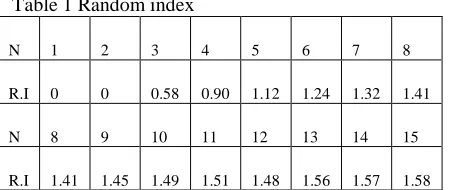
2. Calculating the consistency to ensure that the priority of elements is consistent, the maximum eigenvector or relative weights and max λ is calculated. Then, the consistency index (CI) for each matrix order n is computed by using Eq. (1).
Based on the CI and random index (RI), the consistency ratio (CR) is calculated using Eq. (2). The CI and CR are defined as follows (Saaty, 1980):
C.I = ( λmax –n)/(n-1) ... (1)
C.R = C.I/R.I ... (2)
where, n is the number of items being compared in the matrix, max λ is the largest eigenvalue and RI is a maker transforms the score of pair-wise comparison into linguistic variables via the positive triangular fuzzy number (PTFN). The fuzzy positive reciprocal
between i and j of decision elements[19]
Calculating fuzzy weights value
According to the Lambda-Max method proposed by Csutora and Buckley (2001), the fuzzy weights of the hierarchy can be calculated. This process is described as follows:
AHP to calculate the weight matrix: and
• To ensure the fuzziness of weight, two constants, i.e
Slk and Suk. , are calculated as follows: Slk = min { wimk/Wilk I 1≤i≤n }
Suk = min { wimk/ Wiuk I 1≤i≤n }
The lower bound Wlk* and upper bound Wuk* of the
weight matrix are defined as:
Wl for decision-maker k can be acquired as follows:
....(5)
Where,
i = 1,2,3,...,n
• Applying the geometric average to incorporate the opinions of decision-makers is defined as follows:
k : number of decision-makers.
4. THE PRINCIPLES FOR COMPARISON
OF MATRIX
The principles for the comparison of fuzzy numbers were introduced to derive the weight vectors of all elements for each level of the hierarchy with the use of fuzzy synthetic values. We now discuss these principles that allow the comparison of fuzzy numbers [6] [7] [8] numbers that are denoted by (l1,m1,u1) and (l2,m2,u2) respectively, then:
1. The necessary and sufficient condition of V(M1 ≥ M2)=1 is m1≥m2.
2. If m1≤m2, then
4 = 0 ,
otherwise
Definition 2. The degree of possibility for a fuzzy
number to be greater than k fuzzy numbers Mi (i=1,2,….,k) can be defined by
V(M ≥ M1,M2,….,Mk)=min V (M ≥ Mi)
Let d (p ) = min V (S ≥ S ), where, p is the ith
element of the kth level, j = 1, 2, ….., n. The number of elements in the kth level is n. Then the weight vector of kth level is obtained as:
= ( d( ) . d( ) ... d( ))T
After normalization, the normalized weight vector, W , is:
). )... T
5. WORK IMPLEMENTATION
Present work has been considering the case of college as case study. The objective of this case study using Fuzzy AHP for prioritizing the student’s requirements is the progress of the college. Now we are applying the Fuzzy AHP step by step to evaluate the student’s requirements and achieving the goal of progress of the college.
5.1. Hierarchical Structure
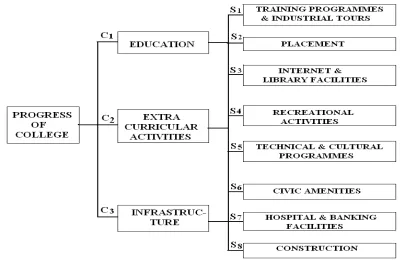
Fig. 1. Hierarchical structure for the case of college
To obtain the students requirements for the progress of college, two different types are considered: girls and boys. Discussions with these two groups reveal a total of 8 requirements for the progress of college. All the requirements are categorized with use of an affinity diagram. Figure.1 shows a three level hierarchy for the students requirements for progress of college. In fig 1. the goal is “progress of college”.
5.2. Construction of fuzzy judgment matrix
The participants in the focus group use the Fuzzy AHP scale to express their preferences between options. Then pair wise comparison matrix is obtained for each hierarchical level as follows:
Table 2 .FAHP Scales
DEFINITION INTENSITY
OF PERFORMANCE
EQUAL (1,1,1)
WEAK (2/3,1,3/2)
FAIRLY STRONG
(3/2,2,5/2)
VERY STRONG (5/2,3,7/2)
ABSOLUTE (7/2,4,9/2)
6 Consistency index & consistency ratio
CI = (λmax – n)/(n-1), CR= (CI / RI(n))100%,
Acceptable consistency of a pairwise judgment: if calculated CR<10%
5.3. Determination Of Fuzzy Synthetic Degree Values
The fuzzy synthetic degree values of all elements for the category and sub-category level of the hierarchy can be calculated as shown below:
∑∑ aij = (1, 1, 1) + (2, 2.5, 3) + ……….. + (1,
Hence, the fuzzy synthetic degree values of the element C1, DC1, can be calculated as follows:
DC1 = ∑ a1j X ( ∑∑ aij )
= (5.5, 6.5, 7.5) x (0.075, 0.089, 0.106)
= (0.41, 0.58, 0.79)
Following a similar calculation, the fuzzy synthetic degree values of the all elements of the hierarchy level can be obtained as shown below:
DC1 = (0.41, 0.58, 0.79), DC2 = (0.15, 0.21,
5.4 Calculation of weight vectors
Fuzzy numbers are compared, on the basis of principals discussed earlier, to derive the weight vectors of all elements for each level of the
Normalized wt. vectors= (0.00, 1.00, 0.00) V (DS4 ≥DS5) = 0
V (DS5 ≥DS4) = 1 d(S4) = 0, d(S5) = 1
Normalized wt. vectors = (0.00, 1.00) V (DS6 ≥DS7) = 1
Normalized wt. vectors= (0.67, 0.33, 0.00)
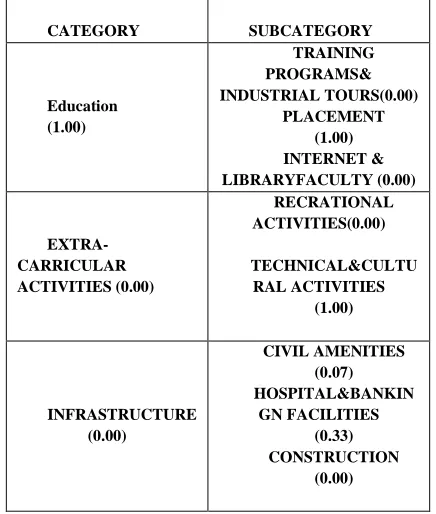
TABLE 3: Importance weights for the students requirements for the progress of the college
7
6. CONCLUSION
For product planning Determining the relative importance of customer requirements is a fundamental problem in QFD .So address this problem The AHP has been widely used. However, the use of a discrete scale of one to nine in the conventional AHP has the disadvantage that it cannot take into account the uncertainty and ambiguity inherent in the assessment of customer requirements. In fact, for the customer requirements determining the relative importance involves a high degree of subjective judgment and individual preference. In this work, a Fuzzy AHP with extent analysis has been described to determine the importance weights for the customer requirements for QFD. To calculate the importance weights for extent analysis .So it is analysed that calculation of eigenvectors required by the conventional AHP is no longer necessary. A example of college is used to illustrate the application of the approach. According to this study the normalized vector (0.67, 0.33, 0.00) have been lies in between 0 to 1 that is the requirement for the progress of college .so it has been clear that the condition having followed by the normalized vector so the direction towards progress of college is appropriate.
REFERENCES
[1] Aswad, A. (1989) Quality function deployment: a systems approach, in Proceedings of the 1989 IIE Integrated System Conference, Institute of Industrial Engineers, Norcross, GA, pp 27-32.
[2] Chan, L.K., Kao, H.P., Ng A. and Wu. M.L. (1999) Rating the importance of customer needs in quality function deployment by fuzzy and entropy methods, International Journal of Production Research, 37 (11), 2499-2518. [3] Chang, D.Y. (1996) Application of the extent
analysis method on fuzzy AHP, European Journal of Operational Research, 95, 649-655. [4] Gustafsson, A. and Gustafsson, N. (1994)
Exceeding customer expectations, in Proceedings of the Sixth Symposium on Quality Function Deployment, Novi, MI, pp, 52-57. [5] Khoo, L.P. and Ho, N.C. (1996) Framework of
a fuzzy quality function deployment system, International Journal of Production Research, 34, 299-311.
[6] Vanegas, L.V. and Labib, A.W. (2001) A fuzzy quality function deployment (FQFD) model for
driving optimum targets, International Journal of Production Research, 39(1), 99-120.
[7] Zhu, K.J., Jing, Y. and Chang, D.Y. (1999) A discussion on extent analysis method and applications of fuzzy AHP, European Journal of Operational Research, 116, 450-456. [8] Ansari, A. and Modarress, B., 1994, “Quality
Function Deployment: The Role of Suppliers,” Int. J. of Purchasing and Materials Management, vol. 30, no. 4, pp. 28-35.
[9] Armacost, R. L., Componation, P. J., Mullens, M. A., and Swart, W. W., 1994, “An AHP Framework for Prioritizing Customer Requirements in QFD: An Industrialized Housing Application,” IIE Transactions, vol. 26, no. 4, pp. 72-79.
[10] Saaty T. L,2008, Decision making with the analytic hierarchy process,” Int. J. Services Sciences, Vol. 1, No. 1.
[11] Fung et al., 1999; Wang, 1999; Vanegas and Labib, 2001
[12] Ho et al,1999, distribution and contamination status of heavy metals inestuarine sediments near cua ong harbor, ha long bay,Vietnam, geologica belgica (2010) 13/1-2: 37-47. [13] Griffin et al., voice of the customer,
wiem05-020 elements supplied: 1,2,3,4,5,6,8,10
[14] Gustafsson et al., 1989; Gustafsson & Wigstrom
[15] Armacost et al., 1994; Quality Strategy for Research and Development,Andrew P Sage [16] Fuzzy Multicriteria Decision-Making: Models,
Methods and Applications By Witold Pedrycz, Petr Ekel, Roberta Parreiras
[17] Yu-Chung et al., 2013 Proceedings of the Institute of Industrial Engineers Asian Conference.
[18] Aşkın et al.,2007 comparison of ahp and fuzzy ahp for the multicriteria decision making processes with linguistic evaluations, Đstanbul Ticaret Üniversitesi Fen Bilimleri Dergisi Yıl: 6 Sayı:11Bahar 2007/1 s.65-85