A Survey And Learning Techniques On Access Controls
In Cloud Computing
M.Arvindhan
1, Dr.Abineet Anand
2, Dr.Viswanathan
3Research Scholar1, Professor2,3
School Of Computing Science and Engineering, Golgotias University1,2,3
Abstract – Cloud computing is a technique for conveyingInformation Technology (IT) benefits in which assets are
recovered from the Internet through online tools and applications. Instead of keeping documents on a restrictive hard drive or nearby storage device, cloud-based capacity makes it conceivable to spare them to a remote database. For whatever length of time that an electronic device approaches the web, it approaches the data and the software programs to run it. Cloud computing opens up another universe of chances, however blended in with these opportunities are various information get to control security challenges that should be considered and tended to preceding focusing on a Cloud computing procedure. Cloud computing security challenges fall into three general classifications are Data Protection, User Authentication and Disaster and Data Breach. In this paper we examined different existing security solution accessible for access control mechanism like Key-Policy based Encryption, Attribute based Encryption, Multi-specialist, and Identity based encryption.
Key Words: Cloud computing, Access Control, Encryption, Authentication.
1. INTRODUCTION
Cloud is basically a pack of ware computers networked together in same or distinctive geological areas, working together to serve various clients with various need and remaining burden on demand basis with the assistance of virtualization. Cloud computing is a viable way to deal with experience direct cost advantages and it can possibly change a data center from a capital-concentrated set up to a variable evaluated environment. Cloud registering depends on an extremely central key of reusability of IT abilities [3].The greatest worry about Cloud computing. Since data administration and infrastructure management in cloud is given by third-party, it is dependably a hazard to handover the sensitive data to such providers. In spite of the fact that the Cloud computing merchants guarantee more secure password protected ensured accounts, any indication of security rupture would result in loss of customers and organizations.
Cloud Computing Associated Problems [14]:
A. Data Security concern
When we discuss the security worry of the cloud innovation, at that point a considerable measure of questions stay unanswered. Various genuine threats like virus attack and hacking of the customer's site are
the greatest Cloud computing information security issues.
B. Authenticity (Integrity and Completeness) Integrity is keeping the inappropriate change of data. Protecting Integrity, similar to confidentiality is another real issue faced by cloud frameworks that should be taken care of, and is likewise essentially done by the utilization of data encryption.
C. Data Breaches
IT experts have had awesome control over the system infrastructure and physical equipment anchoring restrictive data. In the cloud (in private, public and hybrid scenarios), a portion of those controls are surrendered to a confided in partner. Picking the correct vendor, with a tough record of security, is crucial to conquering this test.
D. Notifications And Alerts
Awareness and legitimate correspondence of security threats is a foundation of system security and the equivalent goes for cloud security. Alarming the suitable site or application managers when a danger is recognized ought to be a piece of an exhaustive security plan
33 there are similarly the same numbers of if not greater
security challenges that keep clients from focusing on a cloud computing system. Guaranteeing that your data is safely ensured both very still and in transit, limiting and checking access to that information by means of client confirmation and access logging, and sufficiently anticipating the genuine potential outcomes of compromised or difficult to reach information because of information breaks or natural disasters are on the all key security challenges that an organization must address while considering cloud computing suppliers.
2. EXISTING SECURITY SOLUTIONS
Presently we will examine about existing security solutions accessible for access control mechanism.
A. Attribute Based Encryption
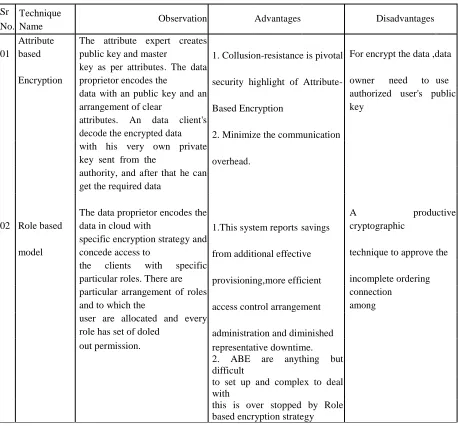
Attribute Based encryption (ABE) conspire accepts attributes as general public key and partners the cipher text and client's secret key with characteristics, so it can bolster expressive access control policies. This drastically decreases the expense of network bandwidth and sending nodes activity in fine-grained access control of information sharing [4]. The diminish correspondence overhead in the web 2) Give fine grained access control. Issue behind in this method, the information owner need to utilize the authorized client public key for encryption [5].According to attribute based encryption the access strategy is arranged into two sorts key policy attributes based encryption and cipher text- policy attributes based encryption.
B. Role Based Model
Data owner before putting away the data in cloud, first they encode the information in local system and afterward store the encrypted data in the cloud. Data users can't straightforwardly get to the information from cloud. Every user are allocated with roles and responsibility. The roles are doled out dependent on the responsibilities and qualification. The validate users have benefits to get to the information with particular role. The users are doled out with various
roles and every one of them are having an set of permissions. A role manager duty is to dole out a role to the client, and if the client is going out, at that point revoke a role from the client. Cloud Provider, users and others are not ready to see the information on the off chance that they are not relegated with appropriate roles. Data owner can repudiate the role in the event that they found as unapproved user [2].
C. Identity Based Authentication
Identity based encryption is an public key strategies, where Private Key generator produces master public key and master private key, where master public key is made by client one of a kind data. The client can decrypt the document by getting the private key with his personality from private key generator, by utilizing that he can decrypt the file[1]. Private Key generator not just produces the private keys yet additionally check the user identities. The fundamental disadvantage in Identity based encryption is need to confide in the private key generator since it holds all private key and should stay on the web.
D. Block Chain Based Access Control
The access control mechanism is cipher text-policy attribute based encryption conspire with dynamic attributes. Utilizing a block chain based decentralized record, the framework gives unchanging log of all significant security events, for example, key generation, access policy assignment, change or revocation, access request. An arrangement of cryptographic protocols guaranteeing protection of cryptographic tasks requiring secret or private keys. Just cipher texts of hash codes are exchanged through the block chain record. The model of the framework is actualized utilizing brilliant contracts and tried on Ethereum block chain platform[12].
E.Key-Policy based Encryption
attributes [7]. The disadvantage in KP-ABE conspire is that data owner don't know who can decrypt the data. The data owner need to confide in the key issuer, so its not appropriate for some application. Another disservice is absence of adaptability managing levels of attribute authority. To defeat this issue we are moving to cipher text policy – attribute based encryption
F.Fine-grained Access Control
The system is an access control system based on CP-ABE, and advances a high efficient capacity plot dependent on data sharing and secret sharing, while as it were keeping a duplicate of the data. This plan can essentially diminish the remaining task at hand of Data Owner and the storage room overhead of CSP, which can viably advance the utilization of Cryptography in the cloud storage framework. The fundamental procedure of the framework can be partitioned into three phases data publishing, data retrieval and user revocation [13].
G.Hierarchical Attribute Based Encryption
Hierarchical attribute quality based encryption is blend of hierarchical Identity Based Encryption (HIBE) and cipher text policy attribute based encryption (CP-ABE). It bolster full appointment and fine grained access command over attributes.it bolster one-to-numerous encryption. Encoded file can be decrypted by a user and all his relatives, utilizing their own secret keys. HABE hold the property of hierarchical age of keys in the HIBE framework, and the property of adaptable access control in the CP-ABE system[10].
H. Multiauthority
Multi- authority CP-ABE is more appropriate for data access control, different experts issued the attributes to
35
Table 1. Different Techniques and its Advantage & Disadvantages
Sr Technique
Name Observation Advantages Disadvantages No.
01
Attribute based
The attribute expert creates
public key and master 1. Collusion-resistance is pivotal For encrypt the data ,data
Encryption
key as per attributes. The data
proprietor encodes the security highlight of Attribute- owner need to use
data with an public key and an
arrangement of clear Based Encryption
authorized user's public key
attributes. An data client's
decode the encrypted data 2. Minimize the communication
with his very own private
key sent from the overhead.
authority, and after that he can
get the required data
02 Role based
The data proprietor encodes the
data in cloud with 1.This system reports savings
A productive cryptographic
model
specific encryption strategy and
concede access to from additional effective technique to approve the
the clients with specific
particular roles. There are provisioning,more efficient incomplete ordering
particular arrangement of roles
and to which the access control arrangement
connection
among
user are allocated and every
role has set of doled administration and diminished out permission. representative downtime.
2. ABE are anything but
difficult
to set up and complex to deal
with
this is over stopped by Role
03 Identity based
Identity based framework
creates any party public 1.Complexity of the encoding 1.A safe channel between
authentication
key with their identity.
Thrusted process can reduce user and private key
outsider creates the private key.
People in public 2.Certificates are not required generator
key generator distributes the master public key and
3. Pre-enrollment is not required.
is
required.
any party can process the
private key joining the 4. No need to revoked the key
master public key and character
approach with because key expire 2.Encrypted data is
which client can decypt the
message. This method . decoded
is helpful where pre
appropriation of verified just by one known user so
secret key is infeasible and
there is no need of this
distribution of keys between
users.
needs advance information
sharing.
04 Block chain
The access control system is cipher text-policy
1.The capacity to alter the
access A secure channel among
Based access
attribute- based encryption plot
with dynamic policy for the encrypted
user and Attribute
control
attributes. Utilizing a block
chain based information without copying authority is required for
decentralized record, the
system gives unchanging them to an large number of sharing Attribute secret
key generation, access policy assignment, change or
37
3. CONCLUSION
Security issues in the area of cloud computing are dynamic region of research and experimentation. Different issues are distinguished one of which is the security. Access control security is one of the vital issues in cloud. Cloud services are accessible to accomplish security with the differing
strategies and techniques. In this paper we examined about the overview on access controls in cloud computing. The current solutions are Attribute based Encryption, Block chain Based access control, Identity based confirmation and so on. As yet existing solution are not adequate to confide in 05 Key-Policy
Files are encrypted and stacked
utilizing some 1.Simple to manageuser The data proprietor can't
arrangement of clear attributes, while trusted in
3. More adaptable to control
users application since data
quality authority issues private
key to client which than ABE conspire.
proprietor needs to confide
catches a strategy that indicates
which sort of in the key issuer
system dependent on CP- 1.This scheme can significantly Complexity is little bit Access
plan can essentially decrease
the outstanding task 2.This can make an optimal
Data proprietor encrypt the data
and send the 1.Less introductory capital
the information documents can
be changed by the 2. Lower maintenance cost and
proprietor by refreshing the
expiration time. task costs
Domain expert gives the
benefits and data 3.Easier disaster recovery.
proprietors are controlled by
the cloud. The future plan is to implement Authorized authentication based access control scheme in cloud.
REFERENCES
[1] Hongwei Li, Yuanshun Dai1, Ling Tian, “Identity based authentication for cloud computing”, Springer-Verlag Berlin Heidelberg, pp 157- 166, 2009.
[2] Lan Zhou, Vijay Varadharajan, Michael Hitchens,
"Achieving Secure Role-Based Access Control on
Encrypted Data in Cloud Storage", IEEE
TRANSACTIONS ON INFORMATION FORENSICS
AND SECURITY, VOL. 8, NO. 12, DECEMBER
2013,” Magnified Cloud Security through Access Control” IEEE Transactions Conference on Advanced
Computing and Communication Systems, Jan. 05 – 07,
2015, Coimbatore, INDIA.
[3] Cheng-Chi Lee1, Pei-Shan Chung2, and Min-Shiang H
[4] K.Ganagavalli, P.Saravanan, V.Krishnamoorthy wang “A Survey on Attribute-based Encryption Schemes of
Access Control in Cloud Environments Attribute-based encryption”, International Journal of Network Security,
Vol.15, No.4, PP.231-240, July 2013.
[5] Junbeom Hur”Improving Security and Efficiency in
Attribute-Based Data Sharing”, IEEE Transactions on
Knowledge And Data Engineering, Vol. 25, No 10,
October 2013.
[6] Bo Lang, Jinmiao Wang,Yanxi Liu, "Achieving
Flexible and Self-contained Data Protection in Cloud
Computing", IEEE TRANSACTIONS, DOI 10.1109,
2017.
[7] Changji Wang, Yang liu”A secure and Efficient
Key-Policy attribute based Encryption Scheme”,International Conference on information
science and Engineering.2009.
[8] Changji wang, Xuan Liu,Wentao Li,”Implementing a -Policy Attribute Based Encryption”,International
Confercne on Intelleigent Networking and
Collaborative Systems,2012.
[9] Frederic Nzanywayingoma,Qiming Huang,”
Securable Personal Health Records using ciphertext Policy Attribute Based Encryption”Inter national
Conference on E -Health Netwoking,Apllications and Services”,IEEE 14th International conference on
e-health networking, applications and services, ISBN
978-1-4577-2039-0, pp 502-505,2012.
[10] Zhihua Xia,Liangao Zhang ,Dandan Liu
“Attribute-Based Access Control Scheme with Efficient Revocation in Cloud Computing,” in China
Communications ,July 2016.
[11] Kan Yang, Xiaohua Jia, Expressive, Efficient, and
Revocable Data Access Control for Multi-Authority cloud Storage” IEEE Transactions on Parallel and
Distributed Systems,Vol,25,No 7, July 2014.
[12] Ilya Sukhodolskiy, Sergey Zapechnikov, “A
Blockchain-Based Access Control System for Cloud Storage,” in IEEE TRANSACTION 2018.
[13] Xiaojie Niu, “Fine-grained Access Control Scheme Based on Cloud Storage,” in IEEE Conference on
Computer Network, Electronic and Automation, DOI
10.1109/ICCNEA.2017.48,2017.
[14] Amazon Web Services (AWS), Online at
http://aws. amazon.com.
[15] Jian Shen, Dengzhi Liu, Qi Liu, Baowei Wang, Zhangjie Fu,” An Authorized Identity Authentication-based Data Access Control Scheme in Cloud” in
ICACT ISBN 978-89-968650-6-3, 2016
[16] C. Yanli, S. Lingling, and Y. Geng, “Attribute- based
access control for multi-authority systems with constant size ciphertext in cloud computing,” China
Communications, vol. 13, no.2, pp. 146-162, 2016.
[17] X. Xie, H. Ma, J. Li et al., “An Efficient Cipher text-
Policy Attribute-Based Access Control towards
Revocation in Cloud Computing,” J. UCS, vol. 19, no.
39 [18] M. V. Thomas and K. C. Sekaran, “An Access
Control Model for Cloud Computing Environments”,
International Conference on Advanced Computing,
Networking and Security (ADCONS), 2013, pp.