ABSTRACT
ERDOGAN, SAADET AYCA. Optimization of Appointment Based Scheduling Systems. (Under the direction of Brian T. Denton.)
Appointment based service systems have been studied widely in the operations research and medical literature over the past three decades. However, the current literature ignores some important aspects of appointment scheduling. In this thesis, we begin by reviewing the existing literature on appointment scheduling with an emphasis on health care applications such as primary and specialty care clinical scheduling, and surgery scheduling. We point out areas in need of further research, particularly focusing on the uncertain nature of customer demand on service systems. We also provide a review of the stochastic programming literature which is relevant to the methodological aspect of this thesis.
We present new stochastic programming models of single server appointment scheduling systems which combine two important aspects of uncertainty: uncertainty in service durations and uncertainty in customer demand. The first model is a static scheduling model with a known number of customers each of which may no-show for their appointment. This problem is mod-eled as a two-stage stochastic linear program with allowances between customer appointments being the first stage decisions, and customer waiting times and server overtime being the second stage decisions. We provide theoretical properties that give insights into the structure of the optimal appointment schedules, and we present numerical results to demonstrate the effects of cost coefficients and no-show probabilities on the optimal schedule.
The second model considers a dynamic appointment scheduling problem in which an un-certain number of customers request appointments sequentially. The customers are assumed to be scheduled in a sequence that is fixed a priori. This problem is modeled as a multi-stage stochastic linear program in which each stage represents the sequential appointment request of a customer. At each stage, a single appointment decision is made for the appointment time of the new customer. The objective is to minimize expected customer waiting times and over-time. We present a number of methods to improve the efficiency of a decomposition based solution method for this model. Based on the structure of the linear problems at each stage, we adapted an efficient solution method for two variable linear programs. We developed sev-eral valid inequalities at each stage to improve bounds and the convergence of the algorithm. We also compared the standard application of nested decomposition method with a special multi-cut implementation of the algorithm. We present numerical results to demonstrate the performances of the different methods and the optimal structure of the resulting appointment schedules.
c
⃝ Copyright 2010 by Saadet Ayca Erdogan
Optimization of Appointment Based Scheduling Systems
by
Saadet Ayca Erdogan
A dissertation submitted to the Graduate Faculty of North Carolina State University
in partial fulfillment of the requirements for the Degree of
Doctor of Philosophy
Operations Research
Raleigh, North Carolina
2010
APPROVED BY:
Thom Hodgson Yahya Fathi
Reha Uzsoy Brian T. Denton
DEDICATION
BIOGRAPHY
ACKNOWLEDGEMENTS
This thesis would not have been possible without the invaluable support and guidance of my advisor Dr. Brian Denton, who always believed in me and encouraged me to succeed during this challenging process. I am very thankful to him for his endless support. I would also like to acknowledge the support for this research which was provided in part by grant CMMI-0620573 from the National Science Foundation.
I would like to thank my committee members, Dr. Thom Hodgson, Dr. Reha Uzsoy and Yahya Fathi, without whose encouragements I would not be in this Operations Research program, for agreeing to be in my committee and providing feedback on my work.
I would also like to thank my friends Alex Gose, Bjorn Berg and Daniel Underwood for their collaboration, insightful comments and technical assistance in this work. Special thanks go to my dear friends Natalia, Sebnem, Jennifer and Emine for always being there when I needed and for cheering me up.
TABLE OF CONTENTS
List of Tables . . . vii
List of Figures . . . ix
Chapter 1 Introduction . . . 1
1.1 Research Objective . . . 2
1.2 Summary of Research Contributions . . . 3
1.3 Organization of the Document . . . 3
Chapter 2 Literature Review . . . 5
2.1 Appointment Based Scheduling Systems . . . 5
2.1.1 Queuing Models . . . 7
2.1.2 Simulation . . . 8
2.1.3 Optimization . . . 10
2.1.4 Heuristics . . . 12
2.2 Literature Review on Stochastic Programming . . . 14
2.2.1 Stochastic Linear Programs and Solution Methods . . . 15
2.2.2 Multi-stage Stochastic Linear Programs . . . 17
2.2.3 Methods to Accelerate Convergence . . . 19
2.3 Specific Contributions to the Literature . . . 20
Chapter 3 Appointment Scheduling in the Presence of No-Shows . . . 23
3.1 Model Formulation . . . 25
3.2 Structural Properties and Solution Methodology . . . 27
3.2.1 No-Shows and Double-Booking . . . 27
3.2.2 Subproblem Structure . . . 29
3.2.3 L-Shaped Method . . . 30
3.3 Results . . . 31
3.4 Conclusions . . . 33
Chapter 4 Dynamic Appointment Scheduling with Uncertain Demand . . . 35
4.1 Dynamic Appointment Scheduling . . . 36
4.1.1 Simple Examples . . . 37
4.1.2 Model Formulation . . . 38
4.2 Structural Properties and Solution Methodology . . . 41
4.2.1 Subproblem Structure . . . 41
4.2.2 Valid Inequalities . . . 42
4.2.3 Multi-Cut Outer Linearization: . . . 45
4.2.4 Nested Decomposition . . . 46
4.3 Results . . . 47
4.3.1 Structure of the Optimal solution . . . 48
4.3.3 Convergence of the Lower Bound . . . 52
4.3.4 Value of the Stochastic Solution . . . 54
4.4 Conclusions . . . 54
Chapter 5 Dynamic Appointment Sequencing and Scheduling . . . 56
5.1 Motivation for Dynamic Appointment Sequencing and Scheduling . . . 59
5.1.1 Dynamic Appointment Scheduling Model with AOFS . . . 60
5.1.2 Counter-Example: FCFS vs. AOFS . . . 64
5.2 Dynamic Appointment Sequencing and Scheduling Model . . . 65
5.3 Structural Properties and Solution Methodology . . . 71
5.3.1 Alternative Formulation . . . 72
5.3.2 Solution to Scenario Subproblems . . . 72
5.3.3 Big M Values . . . 73
5.3.4 Valid Inequalities . . . 74
5.3.5 Integer L-Shaped Method . . . 75
5.4 Results . . . 77
5.4.1 Structure of the Optimal Solution . . . 77
5.4.2 Computational Performance of Proposed Methods . . . 81
5.5 Conclusions . . . 86
Chapter 6 Conclusions. . . 89
6.1 Thesis Contributions . . . 90
6.2 Future Directions . . . 92
References. . . 94
Appendices . . . .101
LIST OF TABLES
Table 4.1 Optimal solution of scheduling problem with 5 routine and 3 add-on customers with different cost ratioα=cℓ/cw,Zi ∼U[20,40], d= 190. . . . 48 Table 4.2 Optimal time allowances for varying cost ratios for 5 routine and 3 add-on
patients with LogNormal service times. . . 50 Table 4.3 Computational performance of standard ND, multi-cut version of ND,
and the two-variable algorithm implemented within ND. . . 52 Table 4.4 Computational performance of Standard ND and Standard ND with
(VI-1), (VI-2) and (VI-3) (Zi∼U(20,40)). . . 52 Table 4.5 Computational performances of ND and ND with (VI-1), (VI-2) and
(VI-3) (d= 0,Zi ∼U(20,40)). . . 53 Table 4.6 Value of the Stochastic Solution for several test instances with Zi ∼
U[20,40] andqi = 0.5 for add-on requests. . . 54
Table 5.1 Optimal Appointment Schedules with FCFS and AOFS for a 9 routine + 3 add-on customers problem with Zi ∼3+ Lognormal(23.55,11.89). . . . 65 Table 5.2 Second stage variables for a 3 customer problem given a first stage solution
for sequencing decisions is known . . . 73 Table 5.3 Optimal solution of a 5 customer problem instance with identical patient
characteristics, cwi = 4, cai = 2, pi = 0.5, ∀i, cℓ = 10 , cs = 5, Zi ∼
U(20,40),∀i . . . 78 Table 5.4 Alternative optimal solution of a 5 customer problem instance with
iden-tical patient characteristics,cwi = 4, cai = 2, pi = 0.5, ∀i, cℓ = 10 ,cs = 5,
Zi ∼U(20,40),∀i . . . 78 Table 5.5 Optimal solution of a 3 Routine + 2 Add-on customer problem instance,
cwi = 4 ∀i = 1,2,3, cwi = 8 ∀i = 4,5, cai = 2 ∀i = 1,2,3, cai = 6 ∀i = 4,5,cℓ = 10 ,cs= 5,p
i= 0.5,Zi∼U(20,40),∀i . . . 79 Table 5.6 Optimal solution of a 3 Routine + 2 Add-on customer problem instance,
cwi = 4 ∀i = 1,2,3, cwi = 8 ∀i = 4,5, cai = 2 ∀i = 1,2,3, cai = 4 ∀i = 4,5,cℓ = 10 ,cs= 5,p
i= 0.5∀i= 1,2,3,4,p5= 0.3, Zi∼U(20,40),∀i . . . 80 Table 5.7 Optimal sequencing rules with respect to different cost parameters and
conditional probabilitiespin the presence of customers with different vari-ances . . . 81 Table 5.8 Computational performances of solution methods with uniformly distributed
Table 5.9 Computational performances of solution methods with Lognormally dis-tributed service times (Zi ∼ Lognormal(3.2,0.5)). Problems were solved to a tolerance of 1% with a maximum time of 15000 seconds. An asterisk (*) indicates cases in which no model instance were solved to the specific tolerance. Times are reported in seconds . . . 85 Table 5.10 L-shaped gap at the time of termination for the instances that are not
solved to optimality . . . 86 Table 5.11 Results for the problem instances that are solved to optimality. (cℓ =
LIST OF FIGURES
Figure 2.1 Single server scheduling problem. The scheduler selects start times. The solid line depicts one possible scenario which includes some waiting, idling, and overtime. . . 6 Figure 2.2 Example of a scenario tree with 10 scenarios over four stages. . . 18
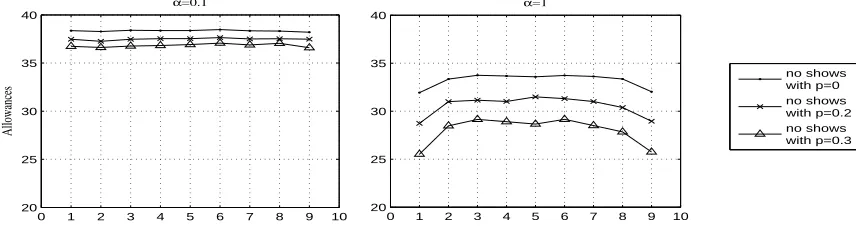
Figure 3.1 Effects of cost ratio α = cℓ/cw and no-show probability p on optimal schedule for 10 customer problem compared to the case in which all cus-tomers arrive (p= 0), (Zi ∼U(20,40), d= 200) . . . 32 Figure 3.2 Effects of cost ratio α = cℓ/cw and no-show probability p on optimal
schedule for 10 customer problem compared to the case in which all cus-tomers arrive (p= 0), (Zi ∼U(20,40), d= 200) . . . 32 Figure 3.3 Total waiting time and overtime costs with respect to the number of
customers scheduled with different no-show environments,Zi∼U[20,40],
d= 200,α= 10. . . 33
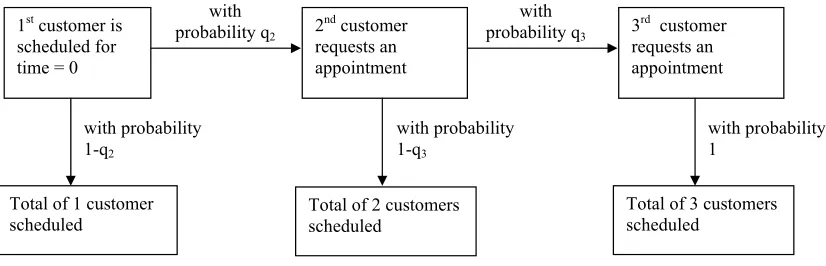
Figure 4.1 Illustration of the scheduling problem with probabilistic arrival of cus-tomers given nU = 3. . . 37 Figure 4.2 Tree of scenarios for M-SLP problem withnU customers. Solid nodes
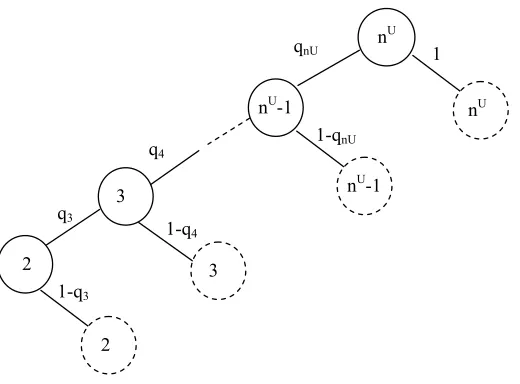
de-note stages in which additional customer appointment requests are pend-ing, and dashed nodes define the day of service given a certain number of customer arrivals. . . 39 Figure 4.3 Structure of the optimal solution of 5 routine and 3 add-on customers
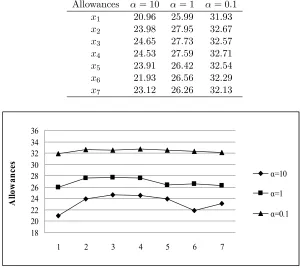
with different cost ratio α=cℓ/cw,Zi ∼U[20,40], d= 190. . . 49 Figure 4.4 Structure of the optimal solution of 5 routine and 3 add-on patients with
different cost ratio α=cℓ/cw,Zi ∼3 + Lognormal(23.55, 11.89), d= 150. 50 Figure 4.5 Effects of number of add-on customers on the optimal schedule, Zi ∼
U[20,40], d= 250,α= 10. . . 51 Figure 4.6 Comparison of convergence for ND, and ND with added (VI-3) (nU = 40,
Zi∼U[20,40], d= 450,qi= 0.5). . . 53 Figure 5.1 Illustration of the online scheduling problem for scheduling of up to 5
customers. Figure (A) illustrates the case in which the sequence of ap-pointments is FCFS; Figure (B) illustrates the general case in which the FCFS sequence is relaxed. . . 57 Figure 5.2 Illustration of the sequencing and scheduling problem with probabilistic
arrival of 3 customers given AOFS sequence. . . 61 Figure 5.3 Scenario tree for M-SLP problem with 3 customers given that customer
3 one has higher priority. . . 62 Figure 5.4 Appointment times with varying waiting cost ratios for routine and
Chapter 1
Introduction
In many service industries appointment scheduling systems provide the interface between cus-tomer demand and service provider availability. Therefore appointment scheduling systems must balance the needs of these two stakeholders. Customers seek to minimize the time they spend waiting for the service, while service providers seek to minimize the amount of time re-sources are left idle, and the amount of overtime to complete the scheduled services. Whether the scheduling is done for accounting services, consultants, legal services, barber shops/beauty salons, visa services or health care providers, the aim of balancing these conflicting criteria is a common goal.
In this thesis we develop new appointment scheduling models which can be adapted to many of the service systems mentioned above. The research is motivated in part by problems faced by health care systems due to the emerging need for improvement in this industry. In health care delivery systems, achieving a balance between conflicting criteria is particularly important because of the high cost of resources, including human and physical resources. Total health care spending in the U.S. is in 2009 was estimated to reach $2.5 trillion, and it continues to rise at the fastest rate in U.S. history [72]. According to a recent report from the National Academy of Engineering and the Institute of Medicine [71], the health care system is suffering a serious crisis related to high costs and poor access to health care services. The report identifies the design and implementation of better planning and scheduling systems as an important area to study.
number outpatients that will actually arrive. Scheduling systems that account for uncertain customer demand can help reduce waiting time for patients and lower costs to the providers. Reduced waiting time also improves patient satisfaction. In this thesis we present several new models and new methods to improve efficiency of appointment scheduling systems.
1.1
Research Objective
Scheduling appointments is challenging due to a number of complicating elements. First of all, the service durations can be affected by various factors depending on the industry and the nature of the service being provided. Service durations are often highly uncertain, depending on the requirements of each customer, as well as the differences between each service provider. In the context of appointment scheduling for surgeries, for instance, the service durations can be highly uncertain due to varying experience levels of surgeons and operating room (OR) teams, the presence of residents or surgical fellows in academic medical centers, or patient characteristics like age, weight, or other unobservable physiological factors that only become known at the time of the surgery. As a result, simplifying assumptions, such as exponential service durations, are typically not appropriate.
Another complicating factor in appointment scheduling is the uncertainty associated with customer arrivals. The exact number of customers to be served on a given day is often not known at the time of assigning appointments. This arises due to arrivals of additional unanticipated customers (often called add-ons) or due to no-shows of scheduled customers. No-shows refer to customers who are assigned to an appointment time but without warning fail to keep their scheduled appointments on the day of service. Urgent add-on cases, on the other hand, may result from a sudden and unpredictable need for access to a health service. For instance, in the surgery scheduling context, urgent add-on cases often arise on short notice. In the outpatient setting this type of uncertainty occurs due to unexpected arrivals of urgent care patients in primary and specialty care clinics. Compounding the problem is the fact that appointment scheduling systems must allocate capacity (time with a provider) dynamically before having complete knowledge of the number of patients to be scheduled. Reserving capacity for short notice add-on cases, or compensating for no-shows through overbooking, carries the risk of over or underutilizing perishable resources with high fixed costs. This combination of dynamic appointment scheduling, and uncertainty in the load on resources, gives rise to challenging optimization problems that have not yet been well studied.
customer types with varying priorities, service duration distributions, and arrival patterns.
1.2
Summary of Research Contributions
Appointment scheduling systems have been widely studied in the past. Many previous studies focus on applying queuing theory principles assuming Markovian behavior and exponential ser-vice times. However these assumptions are not representative of most scheduling environments. Furthermore, such studies assume a stationary and steady state behavior which is unrealistic in most service environments (e.g. hospitals and outpatient clinics operate largely on an 8−12 hour day). Our research makes a number of contributions to the existing literature including the following:
• New stochastic programming models that consider two prominent types of arrival uncer-tainty: no-shows and urgent add-on customers
• A study of the dynamic nature of the appointment scheduling by using a multi-stage stochastic programming formulation
• The first dynamic sequencing and scheduling optimization models for on-line appointment scheduling
• Novel solution methods based on adaptations of several decomposition methods that take advantage of the structure of the proposed models
• Theoretical insights about the optimal appointment schedule based on special cases
To our knowledge, our research is the first attempt to determine the optimal appointment schedules in the presence of uncertain duration and customer demand in a dynamic scheduling environment.
1.3
Organization of the Document
Chapter 2
Literature Review
In this chapter, we begin by reviewing the extensive literature on appointment based scheduling systems that has appeared in both the operations research and the health care literature. We particularly emphasize recent studies that consider new and important aspects of these scheduling systems. We provide a taxonomy of the literature based on the type of operations research methodology used. Finally, we briefly discuss some open challenges and opportunities that exist for future research.
The second part of this chapter is a review of two-stage and multi-stage stochastic pro-gramming methods. This is the primary solution methodology used to solve the dynamic appointment scheduling problem described in the following chapters. We discuss some basic concepts about multi-stage stochastic programs, and summarize the main ideas that have been previously proposed to improve the performance of solution methods.
2.1
Appointment Based Scheduling Systems
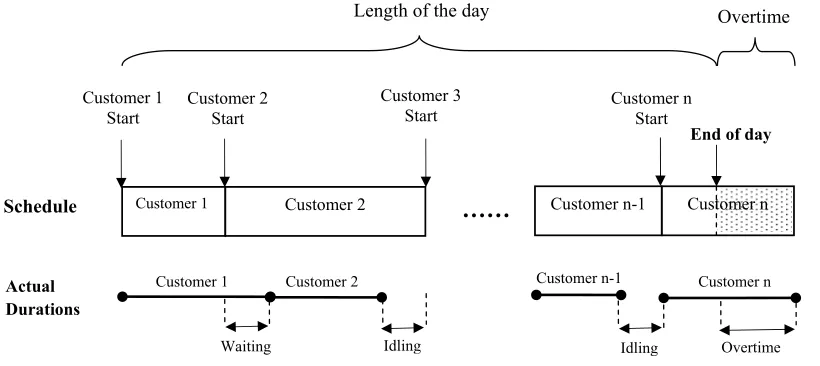
Appointment scheduling systems arise in the context of many types of service systems. Much of the appointment scheduling literature has focused on a single stochastic server with the objective of finding scheduled start times for the service of each customer. This problem is well known and widely studied in the literature [90] [65] [42] [43]. The aim of the single server scheduling problem is to assign start times for customers to be scheduled for that server on a given day. The scheduler must consider the variability in service durations. Depending on the choice of start times there may be more or less waiting or idling that occurs between customers. Also, depending on the length of time the server is planned to be available, some overtime may occur at the end of the day. Figure 2.1 demonstrates the situations when these conditions occur.
Customer n Length of the day
Customer 1 Customer 2
……
Customer n-1Overtime
Customer 1 Start
Customer 2 Start
Customer n Start
Schedule
Actual Durations
Customer 1
Waiting Idling
Customer 3 Start
Idling Overtime
Customer 2 Customer n-1
End of day
Customer n
Figure 2.1: Single server scheduling problem. The scheduler selects start times. The solid line depicts one possible scenario which includes some waiting, idling, and overtime.
appointment times is selected to optimize competing performance criteria including expected customer waiting time, server idle time and/or overtime. Customers are assumed to be punctual and no recourse is available to the scheduler once customers start to arrive on the day of service (e.g. customers cannot be rescheduled). This problem differs from typical single server queuing models in two important ways. First, the scheduling horizon is assumed to be finite, typically limited by the number of customers seen on a particular day. Second, customers are assumed to arrive deterministically according to a defined schedule of appointment times. Thus, the focus is on the transient behavior under deterministic arrivals, as opposed to steady state and stochastic arrival assumptions that are common in the queuing literature.
There are a number of literature review papers related to appointment scheduling. Cayirli and Veral [15] provide a comprehensive literature survey on appointment scheduling in the context of outpatient services. They present the problem along with the complicating environ-mental factors such as the number of different services and physicians, uncertainty in service durations, punctuality of patients, no-shows, walk-ins etc. They also present the various perfor-mance criteria including mean total cost of waiting time of patients and overtime and idle time of service providers, as well as various time-based, congestion based, productivity based perfor-mance criteria used in previous appointment scheduling literature. The authors also provide a detailed taxonomy of the methodologies used in the literature.
the waiting time between the appointment request and the actual appointment date, should be considered in addition to patient waiting time on the day of the service. They also point out a number of open research questions in need of further analysis including the effect of late cancelations and no-shows, patient preferences, and resource allocation depending on different patient types.
A large portion of the appointment scheduling literature has developed around applications to surgery scheduling. This is in part due to the extremely high cost associated with surgery. Early reviews [75] [61] [10] on surgery scheduling focus on classifying the previous research based on various stages of decision making, performance measures such as OR utilization and costs, and the scheduling process. More recent review papers provide detailed classifications based on surgery durations (deterministic or stochastic), patient arrivals (elective and non-elective), and operations research methodology [38] [14] [30].
In the remainder of this section we provide a literature review emphasizing recent stud-ies that consider new and important aspects of appointment based scheduling systems. We categorize the literature based on the type of operations research methodology used.
2.1.1 Queuing Models
There have been numerous queuing based studies presented over the past several decades on the problem of scheduling patients for surgeries and outpatient clinic appointments [90] [89] [65] [46] [82] [66]. Queuing research has focused on single server problems for which appointment decisions are economically significant. Scheduling problem contexts include manufacturing lines, transportation, and numerous health service systems. For instance, in [78], the authors consider scheduling the arrival of cargo ships at a seaport. They consider a single server queue with general service distribution and deterministic arrivals (D/G/1 queue). In their treatment of the problem the costs of underutilization of a seaport (server) are traded off against the cost of cargo ship (customer) waiting.
for each customer.
Vanden Bosch and Dietz [11] present a queuing model with phase-type service durations and deterministic arrivals where patient no-shows are also considered. In their study, patients are classified into different groups depending on their service durations. Analyzing the special structure of the model, they propose an algorithm which guarantees to find the optimal schedule along with the optimal sequence efficiently. More recently, Hassin and Mendel [41] develop a queuing model for a single Markovian server to analyze the effects of patient no-shows on customer waiting times, server idle time and overall waiting and idle time costs per customer. Recently, Zeng et al. [94] presented a study on overbooking of clinical appointment schedules to reduce the negative impact of no-shows. The authors developed and studied a queuing model with patients having heterogenous no-show probabilities. They propose that overbooking is beneficial for open access scheduling systems which allow patients to request appointments on the same day of service.
Queuing models can offer valuable general insights about the effect of uncertainty on schedul-ing decisions. However, they also have several shortcomschedul-ings, particularly in the context of ap-pointment scheduling in health care systems. For instance, many of the queuing papers cited above assume that the system reaches steady state. However, appointment based service sys-tems typically operate for some specific period of time during the day (e.g. 8-12 hours). Thus, the system terminates service at regular intervals and the steady state assumption is a signifi-cant approximation that has not been carefully validated as an approximation. Queuing models also often require strong assumptions such as exponentially distributed service durations, which is not reasonable for most types of service systems, such as surgical operations which tend to better fit a lognormal distribution [83] [64].
2.1.2 Simulation
Simulation models have found considerable application to appointment based scheduling sys-tems. Although they do not provide closed form solutions like queuing models, simulation models are more flexible in terms of assumptions about the probability distributions of service times. However, they are also more computationally intensive than queuing models and may require considerable computation time.
and the costs of two types of idle time, idle time of the surgeon and idle time of the personnel and facilities. He considers a single operation room (OR) where patient arrivals are assumed to be deterministic but surgery durations are random.
Ho and Lau [42] [43] used simulation in their studies to compare the performance of simple scheduling rules in a single server system. They propose that the performance of the scheduling rules are affected byenvironmental conditions of the operating environment such as the prob-ability of no-shows, number of patients to schedule, and the service distribution. To account for no-shows they consider simple rules such as scheduling 2,3 or more patients simultaneously at the beginning of the session, and scheduling the later patients with intervals equal to the mean of the service distribution. They also explore modifications of these rules by changing the interval time between patients. In total they evaluated more than 50 different rules with several different combinations of the three environmental conditions. They present the Pareto set of scheduling rules with respect to expected idle time of the server and expected patient waiting time.
Many researchers have used simulation to analyze more complex systems that go beyond the single server assumption such as multi-OR surgical environments with recovery areas. Scmitz and Kwak [79], for example, used simulation to analyze a multi-OR surgical suite with recovery rooms to determine the number of ORs to open on a day given that the number of surgeries to perform is known. They also study the impact of an increase in the number of ORs on recovery room usage and determine the need for recovery room capacity given that some of the surgeries are done in outpatient setting. Lowery [58] simulates patient flow through a hospital’s critical care units including ORs, ICU and PACU beds to determine the bed requirements for these recovery units. Lowery and Davis [59] developed a simulation tool to analyze the effects of changes in surgery durations and the surgery schedule on the number of ORs needed.
Simulation methods have been widely used for testing the performance of scheduling heuris-tics. Huschka et al. [45] developed a discrete event simulation model for a newly designed outpa-tient surgical suite to study the impact of scheduling and start time heuristics and daily surgical mix on the expected patient waiting time and overtime. The authors tested the performance of seven combinations of OR allocation heuristics and sequencing rules such as scheduling surgeries according to longest processing time first (LPT), shortest processing time first (SPT), increasing variance (VAR) and increasing covariance (COV) and found that in general LPT and combi-nation of LPT and VAR rules (LPT-VAR) perform better than other rules. The authors also found that arrival time schedules and daily surgery mix have significant effects while scheduling rules have smaller effect on the performance measures. Recently Gul et al. [37] develop a dis-crete event simulation model to compare the performances of the heuristics considered in [45] with a bi-criteria genetic algorithm which finds near optimal solutions.
long range decisions. For example, Testi et al. [84] used simulation in a three-phase surgical suite planning approach. The authors used optimization in the first two phases to assign the available OR time to specialties and to create the Master Surgical Schedule which determines the OR to surgical specialty assignments. In the third step they evaluate different surgery sequences depending on the longest time spent in the waiting list (LWT), LPT and SPT using simulation. They found that the SPT rule performs better in minimizing the overtime and number of the surgeries needs to be postponed to the next day.
2.1.3 Optimization
Optimization techniques have been widely applied to appointment scheduling problems. Most researchers have used deterministic models under the assumption of known service durations and customer demand for scheduling appointments. Some have also used stochastic optimization models in order to incorporate uncertainties related to service durations and customer arrivals. We begin by describing deterministic models and then move on to stochastic optimization models.
In a multi-server scheduling context, Ozkarahan [73] proposed a goal programming model for scheduling surgeries in a surgical suite with multiple operating rooms including multiple objectives such as OR utilization (considering OR idle time and overtime), OR and surgeon preferences, and intensive care capacity. For each of these objectives a goal is specified and the objective is to minimize the deviations from these goals. Surgeon specific operation durations are assumed to be accurately estimated thus considered to be deterministic for this study.
Jebali et al. [47] developed a two-step mixed integer programming (MIP) formulation for surgery scheduling. In their 2-step model, the first step consists of assigning surgeries to ORs. They consider a number of constraints including the OR, surgeon, equipment, and Intensive Care Unit(ICU) bed availability, as well as thedue datesof the surgeries for patient satisfaction with the objective of minimizing total cost of overtime and idle time of ORs and patient waiting time. The second step deals with finding the surgery sequences which minimizes the overtime in each OR assuming all surgery-to-OR assignment decisions have been made.
ORs. The objective is to minimize the weighted sum of overutilization and underutilization of ORs. They solve instances optimally with branch-and-price algorithm.
There are also a number of stochastic optimization models for appointment scheduling. The majority assume a single server, and determine optimal start times for each customer’s service (see Figure 2.1 in section 2.1.1). Weiss [88] provides the optimal start times for a simple two surgery problem with uncertain surgery durations in a single OR. Balancing surgeon’s idle time and waiting time, the author shows that the problem is equivalent to the well known newsvendor problem from inventory theory, for which the optimal solution is known in closed form. Weiss also examined the optimal sequence of two cases by looking at the expected cost resulting from the sequences. He showed that sequencing decisions are related to the dispersion of the density function of surgery durations. He proposes that scheduling surgeries that have distributions with “fatter” tails first results in higher total expected costs of waiting and idling due to the impact on the following surgery. Wang [87] usedphase-typedistributions to obtain close form expressions for expected customer waiting time and server idling. Using these closed form expressions he solves a nonlinear program to compute schedules that minimize a weighted sum of expected waiting and idling.
Denton and Gupta [21] study a general two-stage stochastic linear programming formulation of the single server appointment scheduling problem. They determine the optimal start times considering expected patient waiting time, expected OR idle time, and expected overtime with respect to a defined length of day as the performance criteria. They develop an iterative approximate method based on upper and lower bounds on the optimal solution to the problem with continuously distributed surgery durations. The authors propose that the appointment schedule with random service durations should follow a dome shape indicating that the start times for earlier and later customers need to be closer to each other than the start times in the middle of the schedule. Robinson and Chen [76] studied the same problem using Monte Carlo integration which is based on replacing the true service time distribution with an approximate discrete distribution composed of randomly generated points. The authors also proposed a simple heuristic method which follows the dome shaped optimal structure of the schedule.
samples are used to estimate deterministic capacity requirements for a MIP model that min-imizes total overtime costs and other costs associated with hospitalization, and penalties for waiting time of the patients, violating patient’s and surgeon’s preferences and deadlines. Their model is solved via branch-and-bound and then compared to the solution of a simulation op-timization approach. The authors conclude that simulation opop-timization offers improvements even for small sample sizes.
Denton et al. [24] proposed a two-stage stochastic mixed integer programming formulation to find optimal allocation of surgery blocks to ORs. They also develop a robust formulation which aims to minimize the maximum cost (worst-case outcome) that may result from the set of uncertain surgery durations. The robust formulation is advantageous when limited data is available for surgery durations. It is also much less computationally intensive than their stochastic programming model. Batun et al. [1] model a multi-OR scheduling problem as a stochastic MIP to determine the number of ORs to open on a given day, allocation of surgeries to ORs, sequence of surgeries within each OR, and start times for each surgeon. The focus of their study is on parallel scheduling of surgeries in which a surgeon may be allocated two or more ORs on the day of surgery.
Recently, Lamiri et al. [51] and Fei et al. [31] used column generation for scheduling of elective surgeries. In [31], the problem is formulated as a deterministic integer program, while in [51], a random capacity for emergency surgeries is reserved and the problem is formulated as a stochastic integer program. In both cases, the models aim to find the assignments of the surgeries into ORs on a given day in the planning horizon. Column generation is used as a solution technique in which columns represent possible surgery-to-OR assignments in a given planning horizon. The authors then use heuristic methods to find a feasible solution to the integer program and to improve the solution.
Despite the wide literature on optimization methods in appointment based scheduling prob-lems, there is still a lack of literature in optimization of multi-server appointment scheduling. The current literature suggests that considering the stochastic aspects of the surgical envi-ronment is essential for solving realistic problems. Developing efficient stochastic optimization methods to solve larger and more realistic problems which consider multiple servers still remains as an open challenge for researchers.
2.1.4 Heuristics
a MIP model and propose a primal-dual heuristic to find assignment of patients on a weekly basis. They also propose to revise the schedule (reschedule) daily to accommodate changes in recovery room availability and cleaning operations during the day. In their model they minimize the total cost which includes overtime costs due to late closure of ORs, and patient waiting costs. They consider constraints on OR availability, overtime and surgeons’ capacity. They also include constraints based on surgeon and equipment unavailability.
Denton et al. [23] developed a two-stage stochastic mixed integer programming model of the single OR scheduling problem with the addition of surgery sequencing. Decisions in their model are the optimal start times for surgeries and the optimal sequence of surgeries. An interchange heuristic is used to find near optimal sequences, and start time decisions are computed to optimality for each sequence generated by the interchange heuristic. They also prove for a two-surgery example conditions under which a stochastic ordering defines the optimal sequence, and use numerical experiments to demonstrate that sequencing in order of increasing variance of surgery duration is typically optimal or near optimal. Intuitively this is because delaying highly uncertain surgeries to the end of the day limits their impact on other surgeries in the schedule. Vanden Bosch and Dietz [12] propose a local heuristic method to sequence the customers in a first-come-first-serve appointment system when customers differ by waiting cost, no-show probability and service time distributions. The authors also propose a solution method to find the optimal schedule given the sequence is fixed.
Sier et al. [80] used simulated annealing to compute near optimal solutions to a mixed integer nonlinear programming model. In their model, they schedule surgeries depending on the patient age (younger patients earlier in the day), surgery type and duration by applying the LPT rule and equipment availability by checking conflicts and rescheduling surgeries if necessary. They study a system with four ORs and find schedules that satisfy all of the resource constraints. More recently, Denton et al. [22] combined simulation with a simple simulated annealing heuristic to study the impact of uncertainty in a multi-OR outpatient surgical environment. Beli¨en and Demeulemeester [2] also propose a simulated annealing approach as well as several different MIP heuristics to create a master surgery schedule for a block-booking system with the objective of minimizing the expected shortage of beds. Their MIP heuristics involve solving a number of MIPs which aim to minimize the maximum expected duration, maximum expected bed occupancy and maximum weighted sum of mean and variance of the daily bed occupancy respectively. Their simulated annealing approach, on the other hand, starts with a random surgery block and does pairwise exchanges of blocks to find an improved schedule with respect to bed shortage.
to be packed in the bins. There are two types of bin packing problems that have been studied: on-line and off-line. In the on-line bin packing problem customers are scheduled sequentially one at a time. Many heuristics have been proposed for this problem. One well known heuristic, calledbest fit, schedules customers to the servers which has the least amount of remaining time that is sufficient to fit the case. Another heuristic, calledworst fit, schedules the customers into the emptiest server which has enough time to fit the case.
In the off-line version of the bin-packing problem customers are batched and simultaneously assigned to servers. LPT is a well known heuristic for off-line bin packing. To apply LPT, service durations for customers are sorted based on their mean durations and then assigned sequentially to the servers. Many variants of LPT exist includingbest fit descending in which cases are assigned sequentially to the fullest server after being sorted by LPT rule and worst fit descending in which they are assigned to the emptiest server. Dexter et al. [26] compare several of these heuristics for scheduling add-on surgeries into remaining open OR times. They found that off-line algorithms are able to fit more add-on surgeries and in particular best fit descending with special constraints is more likely to maximize OR utilization.
Houdenhouven et al. [44] leverage the portfolio effect which is a risk management technique used in finance. Portfolio management is used to reduce the risk (minimize variance) or increase the profitability (maximize expected return) by distributing the investments into various dif-ferent projects instead of investing in a single project [63]. The authors use the portfolio effect with bin packing heuristics to consider uncertainty in surgery durations. They propose to use planned slack time between surgeries depending on the variances of different surgery durations. They conclude that scheduling surgeries with similar duration variability together will reduce the total slack time to allow between surgeries and thus increase available OR time. Hans et al. [40] propose both constructive and local search heuristics to minimize the total planned slack. They found that, as a result of the portfolio effect, surgeries with similar duration variability are often scheduled on the same day for each specialty.
2.2
Literature Review on Stochastic Programming
A shortcoming of stochastic programming is that the problem size tends to grow in propor-tion to the number of possible realizapropor-tions (scenarios) of uncertain parameters. The large-scale nature of the stochastic programs therefore creates the need for solution methods that exploit the special structure of these problems. Commonly employed methods include Dantzig-Wolfe decomposition (inner linearization) and Bender’s decomposition (outer linearization) which decompose the large-scale problem into a master problem and several independent subprob-lems. Dantzig-Wolfe decomposition proceeds by adding new columns to the master problem based on solutions of the subproblems [20]. Benders decomposition proceeds by adding new constraints (supporting hyperplanes known as optimality cuts) that are computed using dual solutions to the subproblems [3]. The remainder of this chapter presents the general formula-tion of stochastic linear programs with an emphasis on methods that are most relevant to this thesis. We review two-stage and multi-stage stochastic programs and related solution method-ology. We also review research on techniques developed to accelerate the performance of the decomposition-based methods.
2.2.1 Stochastic Linear Programs and Solution Methods
The classical stochastic program is the two-stage stochastic linear program (2-SLP) which has first stage and second stage decisions. First stage decisions,x∈ ℜn, are made without complete information on the collective outcome of a vector of random variables, ξ∈Ξ, where Ξ defines the set of all possible outcomes. Second-stage decisions,y∈ ℜm2, also called recourse decisions,
are taken in response. The mathematical formulation of 2-SLP is:
zSP = min cTx+Eω[Q(x, ω)]
s.t Ax=b
x≥0 (2.1)
where
Q(x, ω) = min{q(ω)Ty(ω)|W(ω)y(ω) =h(ω)−T(ω)x,y(ω)≥0} (2.2)
denotes the recourse function [8]. The matrix A ∈ ℜm1×n1 and vector b ∈ ℜm1 define first
stage constraints which are known with certainty. The matrices W ∈ ℜm2×n2, T ∈ ℜm2×n1,
and the vectors q∈ ℜn2, and h∈ ℜm2 depend on random outcome indexed byω∈Ω where Ω
of solving a stochastic program. One common approach, called wait and see (WS), assumes that the uncertainty is resolved (the outcome ω is observed) and then the optimal first stage decision, x, is made. This is not realistic since it assumes that the decision maker has perfect information about the random events before the time of the first stage decision. However, the WS solution can be compared to the optimal solution of (2.1) (referred to as SP below) to determine the expected value of perfect information (EVPI). For a minimization problem, the optimal objective value of the WS solution, zW S is less than the stochastic programming solution, i.e. zW S ≤zSP. The difference between the WS solution and the SP solution is
EV P I =zSP −zW S. (2.3)
EVPI represents the benefit to the decision maker from perfect information about future out-comes.
In the mean value orexpected value (EV) problem, the random variables are replaced with their expected values, and the SP becomes a deterministic linear program. The optimal solution of the mean value problem,x¯( ¯ξ), is then used to solve the stochastic program for each scenario to obtain objective function values of each scenario problems,z(x¯( ¯ξ), ξ), to see how this mean value solution performs over all different scenarios of the stochastic program. This value, called the expected result (EEV) uses the mean value solution as follows:
zEEV =Eξ[z(x¯( ¯ξ), ξ)]]. (2.4)
Thevalue of the stochastic solution(VSS) represents the cost of ignoring uncertainty in making a decision. It is frequently used as an estimate of the benefit of solving a stochastic program. The VSS is defined as follows:
V SS =zEEV −zSP (2.5)
In general, the larger the VSS, the more important it becomes to solve the SP relative to the solution to the mean value problem.
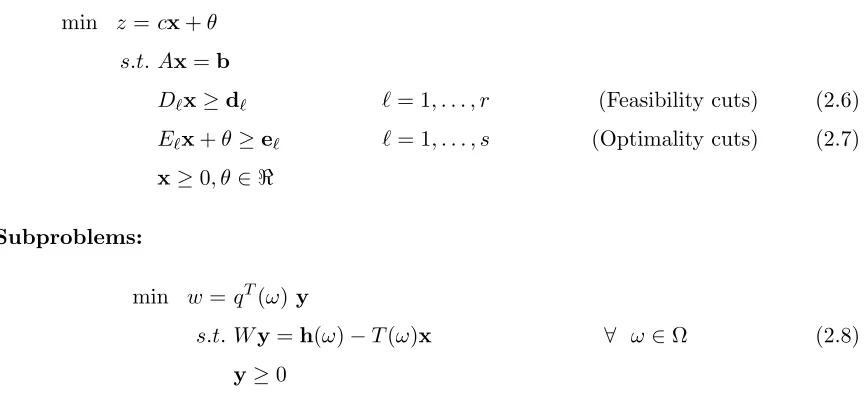
the optimality cuts form an outer linearization of (2.1). The corresponding master problem and subproblems are as follows:
Master Problem:
min z=cx+θ
s.t. Ax=b
Dℓx≥dℓ ℓ= 1, . . . , r (Feasibility cuts) (2.6)
Eℓx+θ≥eℓ ℓ= 1, . . . , s (Optimality cuts) (2.7)
x≥0, θ∈ ℜ
Subproblems:
min w=qT(ω) y
s.t. Wy=h(ω)−T(ω)x ∀ ω∈Ω (2.8)
y≥0
Initially, solving the the master problem without any feasibility and optimality cuts, generates an initial solution x0. Using this solution all subproblems are solved individually, and the corresponding dual solutions are used to generate the feasibility and optimality cuts iteratively. Feasibility cuts address the occurrence of infeasible subproblems for a given trial solution xν at iteration ν of the L-shaped method. For some problems, every feasible fist stage solutionx
has a feasible completion in the second stage. These kind of problems are said to havecomplete recourseand they do not require feasibility cuts. Optimality cuts are supporting hyperplanes of
Q(x). As optimality cuts are sequentially added to the master problem new trial solutions are obtained. The new trial solutions are passed to the second-stage subproblems. The algorithm iterates until an optimality criterion is met. Convergence to the optimal solution is guaranteed for relatively weak assumptions, given a finite number of scenarios.
2.2.2 Multi-stage Stochastic Linear Programs
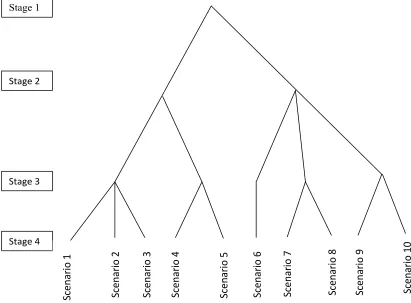
Stage 1 Stage 2 Stage 3 Stage 4 S ce n a ri o 1 S ce n a ri o 7 S ce n a ri o 8 S ce n a ri o 9 S ce n a ri o 1 0 S ce n a ri o 3 S ce n a ri o 4 S ce n a ri o 5 S ce n a ri o 6 S ce n a ri o 2
Figure 2.2: Example of a scenario tree with 10 scenarios over four stages.
Multi-stage stochastic programming has been widely used in modeling multi-period financial planning problems to develop a hedging strategy with the optimum set of investments. There have also been applications to energy, transportation, telecommunications and various other industries [6]. The general formulation of M-SLP with fixed recourse is as follows:
min z= c1x1+Eξ2[min{c2(ω2)x2(ω2) +. . .+EξH[min{cH(ωH)xH(ωH)}]. . .}] (2.9)
s.t. W1x1 =h1 (2.10)
T1(ω1)x1+W2x2(ω2) =h2(ω2) (2.11) ..
.
TH−1(ωH−1)xH−1(ωH−1) +WHxH(ωH) =hH(ωH) (2.12)
x1≥0,xt(ωt)≥0, t= 2, . . . H
ht(ωt), T1t−1(ωt−1) are scenario dependent in the future stages.
A common method for solving problems in the form of (2.9)-(2.12) is nested decomposition. It is a generalization of the L-shaped method to more than two stages. The nested decom-position method has its roots in deterministic linear programming for problems with a nested constraint structure which is often observed in problems involving dynamic decision making. In the stochastic programming context it was first proposed by Louveaux [57] for multi-stage quadratic programs and by Birge [5] for multi-stage linear programs. The algorithm generates cuts for the ancestor scenario problem for decision xt which has feasible completion in all de-scendant scenarios. Similar to the L-Shaped method, the nested decomposition achieves outer linearization by iterating backward and forward, passing information between the ancestor mas-ter problems and descendant scenario problems imas-teratively generating feasibility and optimality cuts until it converges to an optimal solution.
A number of different strategies have developed to select the next subproblem to solve during iterations of the nested decomposition method. One such approach was proposed by Wittrock [92] for deterministic problems. In his strategy, the algorithm moves from the first stage problem to the last stage sequentially (provided no infeasibility is detected) and then moves backwards, adding optimality cuts to ancestor stages sequentially until it reaches the the first stage. This strategy is called fast-forward-fast-back. Other strategies that have been tested are fast-back, which forces the algorithm to move from stage tto t−1 whenever possible, and fast-forward, which forces the algorithm to move from stage t to t+ 1 whenever possible. Gassmann [33] conducted a series of numerical experiments and concluded that fast-forward-fast-back typically performs better than other strategies.
2.2.3 Methods to Accelerate Convergence
performed with different values of ∆ to get a better solution in the next stage, xν+1.
Birge and Louveaux [9] propose a different approach to improve the solution performace of the 2-SLPs. The authors present the multicut L-shaped algorithm which generates several optimality cuts at each iteration. Instead of aggregating the dual multipliers from each real-ization into one single cut, one cut per scenario is added to the master problem. Thus more information is provided to the master problem with the goal of decreasing the total number of iterations. However, this is done at the expense of a larger first stage problem.
Another factor which may cause inefficiency in decomposition procedures is the complexity of the subproblems that need to be solved repeatedly at each iteration. Several authors propose methods that exploit the special structure of the subproblems and efficient ways to solve them. Magnanti and Wong [62] consider improving the performance of Bender’s decomposition for solving MIPs by selecting stronger optimality cuts. They point out that the method is a tradeoff between decreasing the number of iterations and adding more optimality cuts which makes the master problem more difficult to solve. The authors propose to use Pareto optimal cuts which are not dominated by other cuts. In addition, they propose that the special structure of the master problem can be taken into consideration to generate better optimality cuts. For example, if the master problem has a network, or a traveling sales person problem (TSP) structure, valid inequalities that are known to be efficient for these special problem structure can be added at the beginning of the solution procedure to minimize the number of iterations. Wentges [91] provides an example of this. He applied Bender’s decomposition for the capacitated facility location problem (CFLP) which has location decisions in the first stage and demand allocation decisions in the second stage. The subproblems in the second stage are defined as transportation problems. The highly degenerate subproblems result in multiple dual optimal solutions thus creating a series of potential optimality cuts. The author suggests that choosing the right dual solutions will produce stronger cuts, and improve convergence.
Laporte et. al. developed new valid inequalities for the stochastic vehicle routing problem (SVRP) and the probabilistic traveling salesman problem (PTSP)[52], [53]. For the SVRP, a new constraint set is developed to limit the excess duration of the route by using expectations of the stochastic routing and service times. For the PTSP, the master problem is relaxed by eliminating the integrality constraints and subtour elimination constraints. Valid inequality and lower bounding functionals on expected tour length are added to the master problem. The authors show that adding these constraints and valid inequalities improves overall convergence.
2.3
Specific Contributions to the Literature
uncertainty. Recent research focuses on problems with uncertain service duration but with little or no emphasis on uncertain customer demand. Furthermore, most work on appointment scheduling is on static scheduling, which assumes that the number of customers to be scheduled is known in advance. In reality scheduling is often dynamic because the number of customers to be scheduled is unknown at the beginning of the scheduling process. Developing efficient stochastic optimization methods to solve these larger and more realistic problems still remains as an open challenge.
The majority of the research to improve the efficiency of the multi-stage stochastic programs (M-SLP) is on parallel processing which is based on solving subproblems in parallel [77] [55] [7]. However, there is a sparse literature on other efficiency improvement techniques for M-SLP. Furthermore, there has been less work on modeling applications with M-SLPs which often provides a more realistic representation of dynamic decision making processes. Most published research considers models with a small number of stages (e.g 3−5 stages). In contrast we study problems with as many as 30 stages.
In Chapter 3 we present a new 2-SLP model for the appointment scheduling problem in the presence of customer no-shows. No-shows have significant negative effects on the performance of health care systems. Thus, we consider this aspect of uncertain customer arrivals and investigate the structure of the optimal appointment schedule. Our results indicate that, in the presence of no-shows, the optimal appointment schedule includes double-booking of customers. We also derive a sufficient condition for double-booking to be optimal.
In Chapter 4 we present our implementation of nested decomposition to solve a dynamic ap-pointment scheduling problem that we formulate as an M-SLP. A fast algorithm is employed to solve the resulting master problems at each stage. We also extend the multicut implementation of the L-shaped decomposition method proposed by Birge and Louveaux [9] to nested decom-position. Several new valid inequalities are also developed and added to the master problems to improve the convergence of the nested decomposition. A series of computational experiments are performed to evaluate the alternative methods, and to derive insights into the structure of the optimal appointment schedules.
Chapter 3
Appointment Scheduling in the
Presence of No-Shows
In this chapter we propose a new model for appointment scheduling under uncertainty. In this model, we assume customers may fail to show up (no-show) at their assigned appointment time, with some known probability. This is motivated by the common occurrence of no-shows in outpatient health care environments [54]. In outpatient clinics no-shows have been reported to range from 12% to 42%, making efficient management of resources in outpatient clinics difficult [28] [67].
No-shows not only cause loss of revenue for health care organizations, they also increase uncertainty and bring unforseen costs due to the time reserved but left unused. It is one of the most common problems in scheduling clinic appointments. Health care providers may try to overcome this problem by adapting their scheduling policies. One common approach is to allocate the same appointment time to two or more patients which is often referred as double-booking. Double-booking is commonly used by health care providers to compensate for the idle time caused by no-shows, but at the expense of higher waiting times for the customers that show up.
no-shows on the financial performance of a family medicine clinic. They found that even though 61% of no-show appointment slots were replaced by walk-in patients, the revenue loss due to broken appointments may range from 3% to 14% over a year.
More recently Muthuraman et al. [70] and Zeng et al. [94] proposed overbooking of patients in order to compensate for the no-shows. The authors state that overbooking might cause overloading of the clinic and increase the patient waiting time and provider overtime if too many patients show-up. Higher patient waiting times might then increase patient no-show rates. Thus, they provide insights into the use of overbooking policies under different no-show rates and for different patient types. In both of these studies, service times are considered to be exponentially distributed. Later Chakraborty et al. [18] extended their work by considering general service distributions.
In another study by Liu et al. [56], no-shows are considered in a dynamic multi-day appoint-ment scheduling problem. In this study, the authors proposed solutions to the appointappoint-ment scheduling problem by assigning the appointment of a patient to a future date depending on the clinic’s schedule at the time of the appointment request by the patient. In other words, the aim is to find the appointment day of the patient as opposed to finding the appointment slot in the studies mentioned above. In this study, the problem is modeled as a Markov deci-sion process. Due to the large state space, instead of determining the optimal policy, several alternative heuristic policies are developed and compared using a simulation study.
Our work differs from the previous research in several ways. Unlike previous research, we are interested in determining the effects of no-shows on the daily optimal appointment schedule. Our focus is on exact methods to determine optimal schedules, rather than heuristics. We formulate a two-stage stochastic linear program (2-SLP) for the appointment scheduling problem with a fixed number of customers with a certain probability of no-show. Unlike previous research which applies queuing principles, our model is not limited to exponentially distributed service durations. We discuss the structural properties of our model and we use L-shaped method described in Chapter 2 to to compute the optimal appointment schedules. We present numerical results to get insights about the structure of the optimal appointment schedule in the presence of no-shows. We provide theoretical insights into the optimality of double-booking decisions. Finally, we investigate the changes in the optimal appointment schedule with varying no-show rates and cost parameters.
3.1
Model Formulation
The problem addressed here is that of finding the optimal arrival times for n customers to visit a stochastic server. Service times are assumed to be random variables and the objective is to minimize a weighted sum of expected customer waiting time and expected overtime with respect to an established session length,d. Customers,i= 1, . . . , n, have no-show probabilities,
pi. We use the following additional notation, where upper case indicates random variables and bold face is used to denote vectors:
Model Parameters:
n: number of customers to be scheduled
ω: index for service duration and no-show scenarios
A(ω) : random vector of indicators for customer arrival (1) or no-show (0)
Z(ω) : vector of random service durations for n customers
d: session length to complete all customers before overtime is occurred
cw: vector of waiting time cost coefficients for n customers
cℓ : cost coefficient for overtime
Decision variables:
x: vector of time allowances (inter-arrival times) for the first ncustomers
w(ω) : vector of customer waiting times
s(ω) : vector of server idle times between consecutive customers
ℓ(ω) : overtime with respect to session length d
The vector of time allowances x ∈ ℜn−1, denotes first stage decisions made in advance of the
observation of random service durations and no-shows (note that xis n−1 dimensional since
second stage (recourse) decisions made after the observation ω of random service durations. The parameters cw,cs∈ ℜn and cℓ ∈ ℜ denote the cost per unit time for waiting, idling, and overtime, respectively.
Commonly considered criteria for determining optimal time allowances include customer waiting time, server idle time, and overtime, which can be written as follows:
wi(ω)=(wi−1(ω) +Zi−1(ω)−xi−1)+, i= 2, ..., n, (3.1)
si(ω)=(−wi−1(ω)−Zi−1(ω) +xi−1)+, i= 2, ..., n, (3.2)
ℓ(ω)=(wn(ω) +Zn(ω) + n∑−1
i=1
xi−d)+ (3.3)
where (·)+ indicatesmax(·,0). The waiting time and server idle time associated with the first customer is zero (w1(ω) = s1(ω) = 0,∀ω). i.e. the first customer receives service as soon as they arrive. The optimal appointment schedule is defined by the following unconstrained minimization problem: min x { n ∑ i=1
cwi Eω[wi(ω)] +cℓEω[ℓ(ω)]
}
. (3.4)
Some authors have considered a weighted sum of expected server idle time, overtime, and customer waiting time as the objective function; for simplicity, we consider only customer waiting time and overtime as in (3.4). This is justified by the following proposition which is adapted from [21].
Proposition 1 When d = 0 expected idle time is equal to expected overtime minus expected total service time:
n
∑
i=1
E[Si] =E[L]− n
∑
i=1
µi
Proof: See [21].
By Proposition 1, our elimination of the idle time is done without loss of generality, since idle time can be considered by setting session lengthd= 0.
Formulation (3.4) can be modified to account for no-shows as follows. Define random service durations as ˆZi =Ai(ω)Zi(ω) where
Ai(ω) =
0 with probabilitypi
1 with probability 1−pi.
(3.5)
ˆ
general there is no closed form expression for the solution to (3.4). Denton and Gupta [21] discuss the properties of an equivalent 2-SLP formulation that can be used to achieve significant computational advantages. Similarly, our model can also be formulated as a 2-SLP as follows:
min Eω[ n
∑
i=2
cwi Ai(ω)wi(ω) +cℓℓ(ω)]
s.t. w2(ω) ≥Zˆ1(ω)−x1,∀ω
−w2(ω) +w3(ω) ≥Zˆ2(ω)−x2,∀ω
. .. ... ... (NS-ASP)
−wn−1(ω) +wn(ω) ≥Zˆn−1(ω)−xn−1,∀ω
−wn(ω) +ℓ(ω) ≥Zˆn(ω) + n−1 ∑
i=1
xi−d,∀ω
x≥0, w(ω), ℓ(ω)≥0,∀ω.
We refer to the above model as the no-show appointment scheduling problem (NS-ASP).
3.2
Structural Properties and Solution Methodology
Because of the potentially large size of the stochastic program we propose, taking advantage of the problem structure is important. In this section we first provide a special condition on the optimal scheduling of 2 customers in the presence of no-shows, then we present some structural properties of (NS-ASP) and the solution methodology.
3.2.1 No-Shows and Double-Booking
As mentioned in the introduction, double-booking, i.e. the scheduling of two or more customer arrivals simultaneously, is a commonly used approach in practice. In this section, we investigate a special case for which double-booking is provably an optimal policy. Specifically, we consider the special case ofn= 2 andd= 0. This instance of (NS-ASP) is equivalent to the well known newsvendor problem:
min x1 {
Eω[cw(Z(ω)−x1)++cℓ(x1−Z(ω))+]}.
derivative to 0, we get the following expression:
cℓF(Z(ω)< x1)−cwF(Z(ω)> x1) = 0 (3.6)
cℓF(Z(ω)< x1)−cw(1−F(x1 > Z(ω))) = 0, (3.7)
where F(.) is the cumulative distribution function (cdf) of Z(ω). From equations (3.6) and (3.7), it follows that
F(Z(ω)< x1) =
cw
cw+cℓ. (3.8)
There is at least onex1 satisfying (3.8), and the optimal solution is:
x∗1= min{x1 ≥0 :F(x1)≥
cw
cw+cℓ}. (3.9)
this can be expressed alternatively as follows: x∗1 =F−1(cwc+wcℓ).
In the case of no-shows, we replace the random variable for service time, Z(ω), with
ˆ
Z =A(ω)Z(ω) (3.10)
where
A(ω) =
0 with probabilityp
1 with probability 1−p.
We now prove the following sufficient condition for optimality of double-booking customers 1 and 2.
Proposition 2 The optimal schedule for n= 2,d= 0, with no-show probabilityp, will double-book customers 1 and 2 if (cwc+wcℓ)≤p.
Proof: The optimal solution is given by
x∗1 = min{x1 ≥0|F(x1)≥
cw
cw+cℓ}. (3.11)
Note that double-booking in this case corresponds tox1 = 0, i.e. customers 1 and 2 both arrive at time 0. Since ˆZi = 0 with probability p, the cumulative distribution function (cdf) of ˆZi,
FZˆi(0) = p. The optimal solution to (3.11) is x1∗ = 0 since FZˆi(0) = p and by assumption cw
cw+cℓ ≤p.
![Figure 3.3:Total waiting time and overtime costs with respect to the number of customersscheduled with different no-show environments, Zi ∼ U[20, 40], d = 200, α = 10.](https://thumb-us.123doks.com/thumbv2/123dok_us/1623857.1202009/45.612.139.485.179.396/figure-total-waiting-overtime-respect-customersscheduled-dierent-environments.webp)
![Table 4.1:Optimal solution of scheduling problem with 5 routine and 3 add-on customerswith different cost ratio α = cℓ/cw, Zi ∼ U[20, 40], d = 190.](https://thumb-us.123doks.com/thumbv2/123dok_us/1623857.1202009/60.612.220.415.392.507/table-optimal-solution-scheduling-problem-routine-customerswith-dierent.webp)
![Figure 4.3: Structure of the optimal solution of 5 routine and 3 add-on customers with differentcost ratio α = cℓ/cw, Zi ∼ U[20, 40], d = 190.](https://thumb-us.123doks.com/thumbv2/123dok_us/1623857.1202009/61.612.175.453.72.235/figure-structure-optimal-solution-routine-customers-dierentcost-ratio.webp)