Copyright to IJIRSET www.ijirset.com 12304
Analysis of restoration and protection in
optical network with simulation framework
Krishan Kumar
1, Amit Kumar Garg
2M. Tech Scholar, Department of Electronics and Communication Engineering, DCRUST, Murthal, Haryana, India1 Professor, Department of Electronics and Communication Engineering, DCRUST, Murthal, Haryana, India2
Abstract: Survivability is one of the most important requirements of optical networks. As optical networks are prone to
component failures and carry a large volume of traffic, maintaining a high level of service availability is an important issue. In this paper, existing restoration methods proposed for optical network are critically analysed. A Net2Plan tool is presented, its features and how effectively a problem can be framed and existing and modified algorithms can be implemented on resilience simulation.
Keywords:Survivability, Restoration, Optical networks.
I. INTRODUCTION
Optical fiber has become the dominant transport medium in telecommunication systems because its advantage in capacity, reliability, cost and scalability. An attractive feature of optical fiber is its extremely large capacity, on the order of few terabits per second. Optical fiber is widely deployed in backbone networks. Only a small fraction of the full capacity of the installed optical fiber has been realized thus far. Reason for this inefficiency is large mismatch between peak electronic processing and source rates, and fiber capacity [1].
Wavelength division multiplexing network are prone to failure of components such as links, nodes, and wavelength multiplexers and demultiplexers. These network carry high volume of traffic failure may have severe consequences. Therefore, it is imperative that these networks are fault tolerant. Fault tolerant is the ability of the network to reconfigure and re-establish communication upon failure. Incorporating survivability mechanism at multiple layer leads to the issue of assigning functions to each layer and coordinating the layer in effective recovery from fault. optical layer is formed between the lower physical media layer and higher circuit layer in the transport network architecture. This layer is protocol transparent, and can support different kinds of services and protocols at the higher layer such as synchronous optical network (SONET), synchronous digital hierarchy (SDH), asynchronous transfer mode (ATM), and internet protocol (IP). The higher circuit layer is known as client layer [3] because it is served by optical layer.
The outline of the paper is as follows. In section II related work and classification of restoration methods has been given. Section III concentrates on network simulator modules and its functions. Analysis of proposed and existing algorithm discussed in section IV. In section V results of modified algorithm are discussed. Finally, concluding remarks are presented in section VI.
II. RELATED WORK
A. Related work
Copyright to IJIRSET www.ijirset.com 12305
non-WDM and WDM. Gurusamy Mohan and siva Ram Murthy [9] presented a comprehensive survey related to lightpath restoration in WDM optical networks.
B. classification of restoration methods
The restoration methods can be classified as in fig.1 they can be broadly classified as reactive and proactive methods.
Fig. 1 Classification of Restoration Methods [11]
Copyright to IJIRSET www.ijirset.com 12306
This technique is known as backup multiplexing. In dynamic traffic scenario, a proactive method can employ primary backup multiplexing. To further improve resource utilization. A path based restoration method is either failure dependent or failure independent. Failure dependent method is associated with the failure of every link used by a primary lightpath. There is a backup lightpath. As when primary link fails its corresponding backup path is used. In a single link failure different backup lightpath of a primary lightpath can share a channel. In a failure independent method a backup lightpath is chosen in such a way as it is link- disjoint with the primary lightpath.
III.NET2PLAN SIMULATOR FOR PERFORMANCE ANALYSIS
Net2plan is a technology agonistic open source java tool devoted to the planning, optimization and evaluation of communication networks. Moreover, report generation and post analysis simulation tools integrated in Net2plan help one to get into the network design merit.
A. A Subset of configurable parameters in the network simulator
Net2plan different modules and channels these can be change as demand of user, technology specific information can be introduced in the network representation via user defined attributes. Configurable parameters are nodes, links, traffic demand, routes, protection segment, shared risk group
B. Different tools provided by Net2plan
Net2plan is implemented as java library along with command line and graphical user interfaces. This tool is intended for broad spectrum of users, Net2plan provides six different tools.
TABLE I
Offering of Different Tools in Net2plan
Name of tool Functionality of tool
Offline network design Targeted to evaluate the network design generated by built-in or user defined offline network design algorithm.
Traffic matrix generation Assist user in the process of generating, normalizing, and manipulating traffic matrix. Resilience simulation Simulates the network operation, where failure in links and nodes randomly appear
and evaluates performance in user defined or built in protection/restoration schemes. Time varying simulation Simulates the network operation where traffic demand volume varies with time. Connection admission
control simulation
Simulates the network operation, where traffic demands are the source of connection requests.
Reporting Permits the generation of user defined or built in reports from any network design.
IV.ESTABLISHMENT OF RESTORATION MECHANISM
Copyright to IJIRSET www.ijirset.com 12307
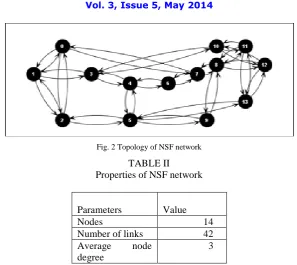
Fig. 2 Topology of NSF network
TABLE II Properties of NSF network
Parameters
Value Nodes 14 Number of links 42 Average node
degree
3
Average node degree is defined as the ratio between the number of links and the number of nodes in the network. above said topology is used to implement existing and NRSim_AA_MPLS_fastReroute restoration each route is tried to restore upon a failure at the node immediately up. This node which redirects the traffic onto the backup path is called the point of local repair and the node downstream where the backup path re-joins to the primary path is called merge point. The proposed modified algorithm NRSim_AA_MPLS_fastReroute_modified based on the principle modification as the reroute mechanism, used in this case is path based rerouting. All the modifications in the java code is done in eclipse java development tool and java run time environment is must to make modifications. Both algorithms implemented in above stated NSF topology.
V. RESULTS AND DISCUSSION
Simulation report shows availability statistics collected by the kernel and also those collected by the provisioning algorithm. Table III shows the analysis of the outcome of the proposed and existing algorithms. Average number of delay is defined as the end-to-end delay suffered by the packet chosen randomly in the network. Average number of hops represents the ratio between the in-network traffic (total sum of the carried traffic in all links) and the total carried traffic. The average network delay provided by the modified algorithm is narrowly better than the existing algorithm. It is due to approach adopted in the modification of the algorithm as the path based rerouting technique. Attribute number of hops is also somewhat better than existing algorithm.
TABLE III
Analysis of the outcome of the proposed and existing algorithm
Algorithm Attributes Value Existing
proposed
Average network delay(ms)
12.5 12.1 Existing
proposed
Average number of hops
Copyright to IJIRSET www.ijirset.com 12308
VI.CONCLUSION AND FUTURE SCOPE
It is vital to develop appropriate survivability mechanism in optical networks. In this paper classification of protection and restoration method and simulation framework based on Net2plan simulator is presented. Analysis of existing and modified rerouting algorithm is done. It is found that path based modification done in the algorithm changed few attributes and are critical for long run less time delay in networks. Still a lot needs to be done in intelligent and efficient routing and restoration.
REFERENCES
[1] Dongyun Zhou, Suresh Subramaniam, “Survivability in Optical Networks”, IEEE Network , vol. 14, no. 6, pp. 16–23, Nov./Dec2000. [2] Anu Haider, Richard Harris, “Recovery Techniques in Next Generation Networks”, IEEE Communications Survey and Tutorial. vol. 9, no.3,
pp. 2–17, Oct2007..
[3] O. Crochat and J.-Y. Le Boudec, “Design protection for WDM optical networks,” IEEE J. Select.Areas Commun., vol. 16, pp. 1158–1165, Oct. 1998.
[4] B.T Doshi, S. Dravida, P.Harsavardhana, O. Hauser, Y. Wang, “Optical Network Design and Restoration”, Bell Labs. Tech. J., pp.56-59, Jan-March. 1999.
[5] S. Ramamurthy and B. Mukherjee, “Survivable WDM Mesh Networks, Part I- Protection”, in Proc. IEEE INFOCOM, vol. 2, pp. 744-751, 1999
[6] Dexiang Wang, Madhan Sivakumar, Arvindhan Kumar, Janise MacNair, and Dwight Richards, “Multi-layer Simulation Design and Validation for a Two Tier Fault Tolerant WDM LAN Networks”, J. Opt. Communication Netw/Vol.4 , no.2 Feb 2012
[7] G. Mohan, Siva Ram Murthy, “Efficient Algorithm for Routing Dependable Connections in WDM Optical Networks”, IEEE/ACM Trans. Net. , vol. 9, pp. 533- 566, Oct. 2001
[8] Gurusamy Mohan, Siva Ram Murthy, “Lightpath Restoration in WDM Optical Networks ”, IEEE Network, Vol.14, no. 6, pp.24-32, Dec.2000
[9] Net2plan user guide manual, version 0.2.3- March 2014
[10] Demitri Bertsekas and Robert Gallenger, Data Networks, 2nd Edition
[11] Mohammad Ilyas, Hussein T. Muftah, The Handbook of Optical Communication Networks, Series editor Richard C. Dorf. University of California, Davis edited by CRC Press (2003).
[12] S. Ramamurthy, L. Sahasrabuddhe, and B. Mukherjee, “Survivable WDM Mesh Networks,” IEEE J. Lightwave Technology, vol. 21, no. 4, pp. 870–83, Apr. 2003.
[13] M. Clouqueur and W. D. Grover, “Availability Analysis of Span-Restorable Mesh Networks,” IEEE JSAC, vol. 20, pp. 810–21 May 2002. [14] Y. Xiong, D. Xu, and C. Qiao, “Achieving fast and bandwidth-efficient shared-path protection,” IEEE/OSAJ. Lightwave Technology, vol. 21, pp. 365–371, Feb 2003.
[15] O. Crochat, J.-Y. L. Boudec, and O. Gerstel, “Protection interoperability for WDM optical networks,” IEEE/ACM Trans. Networking, vol. 8, pp.384–395, June 2000.
[16] Z. Pan, C. Yu, and A. E. Willner, “Optical performance monitoring for the next generation optical communication networks,” Optical Fiber Technology, vol.16, no. 1, pp. 20 – 45, 2010.
[17] G. Li, A. Chiu, and J. Strand, “Resilience design in all-optical ultralong-haul networks,” J. Opt. Netw., vol. 5, no. 8, pp. 625–636, July 2006. [18] E. W. Zegura, K. L. Calvert, and M. J. Donahoo, “A Quantitative Comparison of Graph-Based Models for Internet Topology,” IEEE/ACM Trans. Net., vol. 5, no. 6, pp.770–83, Dec. 1997.
[19] N. Wauters et al., “Survivability in a New Pan-European Carriers Carrier Network Based on WDM and SDH Technology: Current
Implementation and Future Requirements,” IEEE Commun. Mag
., vol. 37, no. 8, pp. 63–69, Aug. 1999.[20] M. L. Shooman, Reliability of Computer Systems and Networks, John Wiley & Sons, Inc., 2002.
[21] T. M. Chen and T. H. Oh, “Reliable Services in MPLS,” IEEE Commun. Mag., vol. 37, no. 12, Dec. 1999, pp. 58–62.
[22] G. Mohan and K. Somani, “Routing Dependable Connections with Specified Failure Restoration Guarantees in WDM Networks,” 19th AnnualJoint Conf. IEEE Comp. and Commun. Soc., INFOCOM 2000, Tel Aviv, Israel, vol. 3, pp. 1761–70, Mar., 26–30 2000. [23] C. Metz, “IP Protection and Restoration,” IEEE Internet Comp., vol. 4, no. 2, pp. 97-102, Mar.-Apr. 2000.
[24] P. Demeester et al., “Resilience in Multilayer Networks,”IEEE Commun. Mag., vol. 37, no. 8, Aug. 1999.
[25] M. Alanyali and E. Ayanoglu, “Provisioning Algorithms for WDM Optical Networks,” IEEE/ACM Trans. Net., vol. 7, no. 5, pp. 767–78, Oct. 1999.
[26] Rajalakshmi P and Ashok Jhunjhunwala, “Analytical performance computation for all optical network With wavelength conversion, ” IETE Journal of Research, Vol. 54, No.1, pp 31-38, Jan-Feb 2008.
![Fig. 1 Classification of Restoration Methods [11]](https://thumb-us.123doks.com/thumbv2/123dok_us/1692209.1214017/2.595.71.511.248.604/fig-classification-of-restoration-methods.webp)