RELATION OF UNEQUAL CROSSING OVER TO THE INTER- DEPENDENCE OF Rr ELEMENTS (P) AND
(S)', 2~
L. J. STADLER4 AND M. H. EMMERLING6 University of Missouri, Columbia, Ai issouri
Received July 30, 1955
REVIOUS studies have shown that the gene Rr behaves, with respect to spon-
P
taneous mutation, as if it were composed of two independently mutating elements: (P), affecting anthocyanin pigmentation of specific plant tissues, and (S), affecting anthocyanin pigmentation of the aleurone layer of the endosperm (STADLER 1948). When seed-color is lost by mutation, the level of plant-color ex- pression remains unaltered. Similarly, the mutation of the plant-color determiner has no effect on the phenotypic expression of seed-color (STADLER 1951a).Recent experiments have shown that (P) and (S) are separable by unequal crossing over (STADLER and NUFFER 1953). It should be noted that the symbols (P) and
(S)
are not intended to imply that there is only one separable element for plant-color and one for seed-color. Both could be multiple (PPPSSSS) and give the same experi- mental results. These symbols indicate simply that all (P) determiners may be removed in a proximal segment that leave some (S), and that all (S) elements may be removed in a distal segment that will leave some (P).Thus the gene Rr may be regarded in either of two ways. The Rr effect may be produced by the action of two separate genes of independent action, one affecting the aleurone-color and the other affecting the plant-color, or alternatively, it may be thought of as a single or compound structure with dual gene action.
These possibilities may be represented in two models:
A B
Independent genes Single gene P-s
I
P--sThe experimental distinction between these two models is in the structure of the gene following mutation. According to model A, the mutation of element (P) would have no effect on the subsequent mutation frequency of element (S), since (S) This work was aided by a grant from the Atomic Energy Commission. Contract AT (11-1)-
An abstract of this paper has been published in Science 119: 585, April, 1954.
Contribution from Missouri Agricultural Experiment Station, Journal Series No. 1541. Ap- proved by the Director.
Deceased May 12, 1954. This manuscript was prepared after the death of the senior investigator, but the major part of the research was conducted prior to his death. The co-investigator assumes responsibility for the contents of this paper.
project 84.
L. J. STADLER AND M. H. EMMERLING 125 would be the same gene before and after the mutation of (P). With the model B, however, the mutation frequency of (S) cannot be predicted, since it would depend upon the mutability of the new gene designated Rps.
When several mutant Rg alleles (designated pS) were compared with their Rr alleles (designated PS), it turned out that the frequency of aleurone-color mutation in the parent R' alleles was approximately 10 times as high as that in the mutant Rg alleles (STADLER 1946 and 1951b). The results are those that would be expected with model B, a single or compound gene.
These facts taken together seem to indicate that while (P) and (S) are two distinct structural elements, they still have special inter-relationships as members of a functional complex.
The present paper is concerned with the behavior of one particular Rg Cornell allele, designated Rg-14, in subsequent mutational trials (STADLER and EMMERLING 1954). Briefly, the Rg-14 allele exhibits two peculiarities in its mutational behavior. (1) In the heterozygote Rg-14/RT the Rg gametes mutate a t a lower rate than those of the R' gametes. (2) I n the backcross progeny the Rr gametes in R g / F plants mutate a t a higher rate than those of the Rr gametes in the homozygous sibs. The latter phenomenon will be referred to as the MG effect.
Considering, then, these two characteristics of Rg-14, three alternative hypotheses can be formulated to account for the observations.
(A). The reduction in the mutation frequency of Rg-14 is due wholly to a change in the stability of (S) following either mutation or loss of (P). The MG effect is unexpected on this basis unless it can be attributed to a modifier of muta- tion rate. However, extensive trials have failed to separate the MG effect from the Rg-14 gene. Thus the effect must be either closely linked or associated with the Rg-14 allele. In this connection it might be noted that an R-linked modifier, which depresses the frequency of seed-color mutation, has been identified previously in the Rg McBain stock (STADLER 1950).
(B). The genic element (S) does not change in stability, but both effects are due entirely to unequal crossing over, yielding r' crossovers in addition to rr mutants from noncrossover mutation of R'.
(C). The stability of (S) is affected by mutation or loss of (P), and the occurrence of unequal crossing over increases the number of yr mutants from Rg-14/Rr, thus giving the MG effect.
EXPERIMENTAL EVIDENCE
Preliminary data on the compound G Rg-14 K / g Rr Cornell K support the view that unequal crossing over is involved in the production of some of the seed-color mutations.
126 UNEQUAL CROSSING OVER IN MAIZE
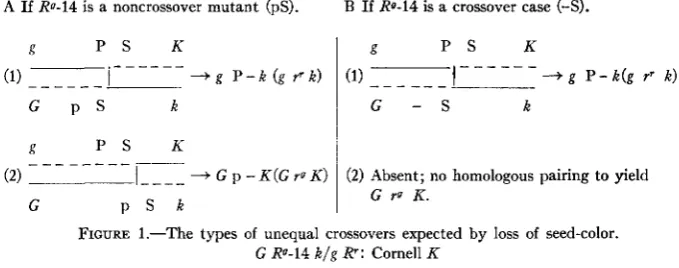
B If RO-14 is a crossover case (4).
(2) Absent; no homologous pairing to yield G rQ K .
FIGURE 1.-The types of unequal crossovers expected by loss of seed-color. G Re-14 k / g R': Cornell K
K ) is known to segregate preferentially a t megasporogenesis (RHOADES 1942). I n the progeny of females heterozygous for knob 10, individuals carrying the knob are recovered about three times as frequently as those without the knob.
The G Rg-14 k / g Rr K plants were pollinated by g rQ
k
pollen in a detasseled plot planting, and the aleurone mutations were identified by inspection of all seeds on the ears. The seed-color mutants were grown to maturity to determine the genotype and were pollinated by a recessive r stock to verify the mutation. Each mutant was sampled cytologically to determine whether unequal crossing over had occurred.The classes of unequal crossovers expected by loss of seed-color are illustrated in figure 1. The classification of unequal crossovers indicated for the RQ-14/Rr compound is derived from the assumption that the RQ-14 allele may be either (pS) or (-S) in constitution. Presumably the RQ-14 allele of the (pS) type represents a noncrossover, plant-color mutation bearing a mutant null allele of (P) which has lost its phenotypic action but has retained its pairing affinity. Thus the compound G RQ-14 k / g Rr K ,
including the (pS) allele, should yield the apparent mutants rr k and r g K , since
both distal and proximal displacement of the knob-bearing segment may occur (see fig. 1A). However, it is possible that Rg-14 is deficient for the element (P) because of the result of a plant-color, unequal crossover in the parent Rr allele. I n this case the compound G Rg-14 k / g Rr K , including the (-S) allele, should produce r' k unequal crossovers, with none of the alternative class (see fig. 1B). This is based on the assumption that unequal crossing over occurs only when there are two or more synaptically homologous elements present in the gene string. Thus the critical cross- over class, the @ K type, is expected from compounds of Rr with the RQ-14 allele of (pS) constitution and not from the (-S) type.
But the absence of the critical crossover class would not be a valid criterion for distinguishing between (-S) and (pS) alleles if phenotypically inactive elements were present either distal to (S), or proximal to (P), or between (S) and (P). These null elements (designated N ) could also be capable of pairing with (S) or (P) and thus produce unequal crossovers of the type expected only from the (pS) alleles.
Experimental detection of N elements either proximal to (P) or distal to (S)
L. J. STADLER AND M. H. EMMERLING 127 h
%
t
m
1
I
I
I
I
&2 2
z
U
t
0t
L. J. STADLER A N D M. H. EMMERLING 129
C rr K
_ _ _ _
1*
__-
The trials so far made with g
R"
K / GR'
k have given no r g crossovers (STADLER and NUFFER 1953). The five colorless seed crossovers produced by this compound were in fact of type G I' K , but the sample was too small to give any significantindication of the existence of such elements.
There is no evidence a t present which excludes the possibility of null elements between (P) and (S). I n experiments conducted with the homozygote, median
N
elements would be undetectable since the unequal crossovers would be all of the rrcrossover type (see fig. 3A). However, the subsequent behavior of plant-color cross- overs should give evidence of median N elements. The homozygous (PNS) compound is expected to produce two classes of unequal crossovers among the plant-color mutants, the (-NS) and the (- 4) types (see fig. 3B). I n the case of the Rg cross- over of (-NS) constitution, the (-NS)/(PS) compound should yield unequal cross- overs among seed-color mutants showing both proximal and distal displacement. The (- -S)/(PS) compound, which represents the other type of
RQ
crossover, should yield seed-color crossovers showing proximal but not distal displacement.Thus the critical criteria by which to detect the presence and the specific location of these null elements would be as follows: (PS), absence of ru crossovers in ho- mozygous (PS) plants; (NPS) or (PSN), presence of rg crossovers in homozygous (NPS) or (PSN) plants; and (PNS), absence of r g crossovers in the homozygote (PNS) and the presence of two types of Rg crossovers.
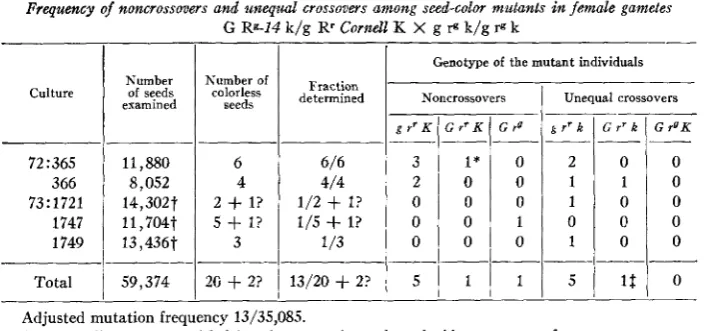
The results of the tests of the seed-color mutants produced by the compound G Rg-14 k / g Rr K are summarized in table 1. To calculate the most probable fre- quency of the noncrossover and crossover mutants the rate determined is stated in terms of the population in which analysis of the mutants was made. That is, 22 mutants were found, but only 13 of the 22 survived; thus the population of gametes tested is 13/22 X 59,374 = 35,085.
I n a population of 35,085 gametes, this compound yielded 12 rr mutants and one
TABLE 1
Frequency of noncrossovers and unequal crossovers among seed-color mutants in fdmale gametes G Rg-14 k/g Rr Cornell K X g P k/g 19 k
G r g
0 0 0 0 0 0 1 0 0 1 1 Culture 72 :365 366 73:1721 1747 1749 Total 4 2
+
l ? 5+
l?3
Number Number of
of seeds colorless
dzF$Ed
examinedI
seeds1
4/4 1/2
+
l ? 1/5+
l?1 /3 11,880
8 , 0 5 2 14,302t 11,704t 13,436t
59,374
1
2G+
2?I
13/20+
2?Genotype of the mutant individuals
Noncrossovers
1
Unequal crossoversg rr K
5
__
r ' k
2 1 1 0 1 5 __- ~
Adjusted mutation frequency 13/35,085.
*
Intermediate mutant with faint aleurone color and a coincident crossover for g.130 UNEQUAL CROSSING OVER I N MAIZE
rg mutant. Of the 12 rr mutants found, five were rr K noncrossovers, one was a non- crossover rr K with faint aleurone color, and six were rr k crossovers. The only seed- color mutant lacking plant color was a noncrossover G rg k mutant.
The evidence that these mutants are unequal crossovers comes from the fact that only 1 percent of mutants analyzed should show a coincident crossover between
Rr and the knob. The occurrence of six crossovers in this region among the 13 mutants investigated is highly significant evidence of a relation of crossing over to mutation
(P
<
0.01). The number of mutants expected by coincidence is 0.13.The critical crossover class, the rg K type, was absent in this culture, although with equal frequency of occurrence of the two crossover types,
75
percent of the crossovers detected should be of this type, since the female transmission ratio for chromosomes with and without the knob 10 was approximately 75 percentK : 2 5
percent k . This knob ratio was determined by seedling tests. The number of cross- overs identified, in comparison with numbers expected on the basis of a75
percentK:25 percent k ratio, is as follows:
Total number
of crossovers rg K crossovers rr k crossovers
Observed 6 0 6
Expected 4 . 5 1 . 5
Stevens' statistical tables (1942) can be used to determine whether the observed distribution of 0 r g K: 6 rr k crossovers deviates significantly from the expected
distribution of 4.5 rg K: 1.5 rr k crossovers. According to Stevens' table, for n = 0, 1/N = 1/6 = 0.166, the upper limit of expectation of zero mutants a t the P = 0.05
level is 2.83. Thus the difference is clearly significant. The absence of the crossover class produced by proximal displacement of the K-bearing segment can be accounted for by assuming the Rg-14 is deficient for the element (P), that is, that this mutant
is of the (-S) type.
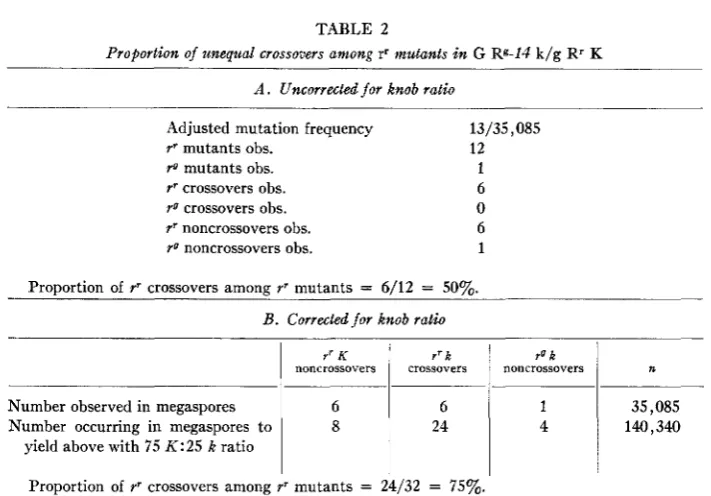
The proportion of unequal crossovers among the rr mutants in the G Rg-14 k / g RT
K
compound, uncorrected for the knob ratio, is six out of 12, or 50 percent (table 2A).The relative frequency of mutant types adjusted for the transmission advantage of the chromosome bearing K is given in table 2B. Thus the frequency in megaspores, before preferential segregation shows that the number of rr k crossovers was 24, and the number of noncrossover mutants was eight rr and four YO. The corrected pro-
portion of unequal crossovers among the rr mutants is 24 out of 32, or 75 percent. These results indicate that the excess of rr over rg mutants is due largely to un-
equal crossing over which increases the apparent rate of mutation of the opposite
Rr Cornel1 allele.
The experimental results presented above are incompatible with hypothesis A which ascribes the reduced mutation rate of (S) wholly to a change in stability of the genic element (S). The data, however, do not differentiate between hypotheses
L. J. STADLER AND M. H. EMMERLING 13 1
Number observed in megaspores Number occurring in megaspores to
yield above with 75 K:25 R ratio
TABLE 2
Proportion of unequal crosso~lers among rr mutants in G Rg-14 k/g Rr K
6 6 1
8 24 4
A . Uncorrected for knob ratio
40 : 35 1 4 351-6 351-7
Adjusted mutation frequency 13/35,085
7' mutants obs. 12
7 9 mutants obs. 1
r' crossovers obs. 6
r g crossovers obs. 0
rr noncrossovers obs. 6
7 9 noncrossovers obs. 1
RgiR' Rr/Rr rg
14/10,719 4/7,925 12/14 2
6/11,424 8/8,239 5/6 1
23/24,247 12/12,645 22/23 3
~- -
Proportion of rr crossovers among rr mutants = 6/12 = 50%.
B. Corrected f o r knob ratio
1
r T K rr k 19 knoncrossovers
1
crossovers1
noncrossovers n35,085 140,340
markers. Inefficient as these tests are, they do permit a tentative choice between hypotheses B and C.
The backcross progeny tested for the relative frequency of r7 and rg mutations, which are shown in tables 3 and 4, were produced by crossing two different Rg-14 k/Rr k F1 plants (40:351 and 69:210) by homozygous Rr Cornell. These backcross cultures were grown in a detasseled plot with rg g pollen. The genotype of each plant, as to RQ/Rr and RT/Rr, was determined by seedling tests.
These results illustrate the two peculiarities of the RQ-14 allele. The data of tables 3 and 4 show the pronounced depression of the Rg mutation frequency and the MG effect in the backcross progeny. I n table 3 the total mutation frequency in Rg/Rr plants was 39/42,075, the mutations including 33 to r' and 6 to r g . The total muta-
TABLE 3
Seed-color mutation rate of R~-14/Rr Cornell versus parent Rr Corndl/R' COrltdl in female gametes
1
Mutants fromGenotypic class R"R' fraction Rg/R' plants
determined FI Culture
Total
1
43/46,3901
24/28,8091
39/43I
610 4 19
33
132 UNEQUAL CROSSING OVER I N MAIZE
69 : 2 10-5 210-6 2 10-7
TABLE 4
Seed-color mutation rate of Rg-14/Rr Cornell versus parent allele Rr Cornell/Rr Cornell in female gametes
22/13,428 22/11,904 19/22 21/10,655 17/9,394 19/21 28/15,524 20/15,454 25/28
RO/Rr fraction determined Genotypic class
Rg/R' 1 R'/R'
FI culture
1 1 0
18 18 25
Total
1
71/39,607I
59/36,752 ~ 63/71Adjusted mutation frequency 63/35,144.
Mutants from
Ro/R' plants
2 ~ 61
tion frequency, which is reported in table 4, was 63/35,144. Of the 63 mutants tested, 61 were rT and only 2 were r g . These data probably represent extremes of
rr: r g ratio in the heterozygotes examined.
As mentioned previously, the Mc effect applies to the increased mutation rate of the R' allele in the Rg/R' class over the rate in the Rr/Rr class. Of the 42,075 gametes tested in the Rg/RT plants (table 3), about one half of the gametes were tests of the R r allele and one half were tests of the Rg allele. Thus the mutation rate for R' in plants of Rg/Rr constitution was 15.68 X lF4 (33/21,037.5); in plants of R r / P constitution was 8.33 X lW4 (24/28,809). The latter rate was calculated from the total population, since each seed tested an R r gamete. I n table 4, the ob- served mutation rate in plants of RQ/Rr constitution was 34.72 X lop4 (61/17,572), while in plants of Rr/Rr constitution the rate was 16.05 X lW4 (59/36,752). Thus the R' mutation frequency was approximately twice as frequent in Rg/Rr plants as in F I R ' plants. These data may be interpreted in terms of hypothesis B.
Hypothesis B involves the assumption that the stability of (S) is not changed, but the effects of Rg-14 are due entirely to unequal crossing over. We may assign identical noncrossover mutation rates to R T and Rg-14 and then calculate how large a proportion of the rr mutants from Rg-14/Rr plants must be unequal crossovers. The frequency of mutation of the Rg-14 gene is taken as a measure of the gene mu- tation rate, assuming that all the YO mutants observed are from mutations of the Rg allele and all are noncrossovers. If this speculation is wrong, the proportion r' mutants due to unequal crossing over is still higher.
If the assumptions from hypothesis B were valid, the data of table 3 will show an expected number of noncrossover mutations for both R r and Rg to be six, since the number of r g mutants derived from the Rg allele is six (table SA). Of the 33
mutants observed in heterozygous plants, the expected distribution of rr crossovers and rr noncrossovers will be 27 and six respectively. It is expected, therefore, that the 24 rr mutants observed in the homozygous R r plants will include 16 rr cross- overs and approximately eight r' noncrossovers. Thus the percentage of r' muta- tions ascribed to unequal crossing over will become 82 percent in the heterozygote and 67 percent in the homozygote.
L. J. STADLER AND M. H. EMMERLING 133
43/46,390 39/42,075
33 6 27 T A B L E 5
Relative frequency or unequal crossovers among r' mutants in R8-14/Rr and Rr/Rr sibs Hyjothesis B
A. Data from table 3
24/28,809 Mutation frequency
Adjusted frequency
rr mutants obs.
r g mutants obs.
rr crossovers exp.
Ra,JRr
Mutation frequency 71/39,607
Adjusted frequency 63/35,144
r' mutants obs. 61
ra mutants obs. 2
Rr/Rr
59/36,752
rr noncrossovers exp. 6 8+
I
I
ra noncrossovers exp. 6
Proportion of crossovers among rr mutants in Rg/Rr plants = 27/33 = 82%. Proportion of crossovers among 7' mutants in Rr/Rr plants = 16/24 = 67%.
rr crossovers exp.
B . Data from table 4
59
and two rT noncrossovers; in the homozygote the expected number of 7r crossovers
and noncrossovers is
55
and 4 respectively. Thus 97 percent of the rr mutants in the heterozygote and 94 percent of the 7" mutants in the homozygote may be at-tributed to the occurrence of unequal crossing over.
The same data may be interpreted in terms of hypothesis C. This hypothesis in- volves the assumption that the stability of (S) is affected by mutation or loss of
(P), and the occurrence of unequal crossing over increases the number of rr mu- tants in the heterozygote. The percentage of rT mutants that must be ascribed to unequal crossing over in the Rg/RT class may be derived from the mutation rate of
rr
mutants in the Rr/Rr plants. I n this case, the gene mutation frequency of Rrwill be identical in the heterozygote and the homozygote. This implies that the 7'
mutants from the P / R T are all noncrossovers and that there is a similar occurrence of r7 noncrossovers from Rg-14/Rr.
But the assumption of no crossing over in Rr/Rr plants is not entirely plausible, since results already a t hand indicate that crossover mutants occur in the homo- zygote (STADLER and NUPFER 1953). These were a t a rate of
7
X lW5 and con- stituted about one third of the r7 mutants. Their relative frequency among 7' mu-134 UNEQUAL CROSSING OVER I N MAIZE
Adjusted mutation frequency for rr mutants in RQ/R' Mutation frequency in RT/Rr
rr noncrossovers exp. in RQ/Rr X
_8.33 _- _ _ ~ 10,000 21,037.5
rr crossovers exp. in Rg/RP
TA4BLE 6
Relative frequency of unequal crossovers among rr mutants in R?-14/Rr and @/Rr sibs Hypothesis C
33142,075
24/28,809 = 8.33 X
17.5
15.5
A, Data from table 3
Adjusted mutation frequency for rr mutants in RQ/RT Mutation frequency in Rr/Rr
r7 noncrossovers exp. in RQ/Rr
X
~
16.05-
-_
_
10,000 17,572 rr crossovers exp. in RQ/Rr61/35,144
59/36,752 = 16.05 X
28.2
32.8
B. Data from table 4
in the heterozygote, since in the G Rr k / g RT K compound there are two chromo- somes with
R'
instead of only one. The fact that crossovers and noncrossovers are distinguishable here only by g classification badly weakens the data, since one seventh of the crossovers may be misclassified due to coincident crossing over be- tween G and R. Thus the percentage of crossovers among r' mutants, very inac- curately.estimated, is 38 percent. This is low, but the determination has practically no significance.The data of table 3 show that the mutation rate of R' Cornell in Rr/Rr plants is 8.33 X lW4 (24/28,809). If the assumptions from hypothesis C were correct, the expected number of rr noncrossovers in plants of R"R' constitution will be 17.5 (table 6A). This hypothesis implies that there is an equal mutation rate of r' non- crossovers in R r / P and Rg/Rr. O f the 33 rr mutants observed in the heterozygote, 17.5 will be noncrossovers and here, 15.5 will be crossovers. Thus the proportion of
r7 crossovers to the total number of rT mutants in the heterozygote becomes 15.5/33 (or 47 percent). The reduction in gene mutation rate of the element (S) is from 8.33 X le4 prior to mutation of (P) to 2.84 X le4 following mutation of (P).
L. J. STADLER AND M. H. EMMERLING 135 higher than that of Rg-14, even though the apparent increased rate of R r mutations in R*-14/Rr is due to crossing over.
DISCUSSION
Three hypotheses have been proposed to account for the lowered mutation rate of Rg-14 in the heterozygote Rg-14/Rr and the pronounced increase in rr mutation frequency of Rg-14/RT over R'/Rr.
The data reported on the compound G Rg-14 K/g R r K (table 1) give little sup- port to hypothesis A, which ascribes the effects of Rg-14 to a change in mutability of (S). Of the 12 r' seed-color mutants found, six were r' crossovers. This experi- ment indicates that the increased frequency of rr mutations in the heterozygote is due largely to the occurrence of unequal crossing over.
The results, however, do not differentiate between hypotheses B and C. I n order to distinguish between these two hypotheses, data are required on the relative mu- tation frequency of r' mutations in knob-marked comparisons of Rg-14/Rr and P / R T sibs. These results are not yet available, but some indication of the per- centage of r' mutations due to unequal crossing over may be obtained from back- cross progeny unmarked for the determination of unequal crossing over.
Under the hypothesis B, which assumes no change in the stability of (S) follow- ing loss of (P), but rather implies that the effects are due entirely to unequal cross- ing over, the gene mutation frequency of Rr would be as low as that found in Ra-14. This is illustrated in table 5 with data from tables 3 and 4. I n table 3 the expected percentage of crossovers among rr mutations would be 82 percent in the hetero- zygote and 67 percent in the homozygote. The proportion of unequal crossovers becomes still higher when data from table 4 are considered. I n this case the per- centage of unequal crossovers would include 97 percent of the r' mutations in the Rg-14/RT plants and 94 percent in the homozygous Rr sibs. Therefore, this hypothe- sis would seem to be questionable for the reason that it requires an unreasonably high frequency of unequal crossing over.
Hypothesis C assumes that the stability of (S) is affected both by mutation or loss of (P) and by unequal crossing over. This hypothesis implies that the frequency of unequal crossing over among mutants in the Rg/Rr class will be lower, to an ex- tent corresponding to the increased frequency of noncrossover mutation of Rr/Rr. Its minimal value may be calculated by using the mutation rate of Rr/R' deter- mined in accounting for the r7 noncrossover mutations from the Rg-14/Rr class. I n table 4 with a high rate of Rr/Rr mutation (16.05 X lop4), the proportion of rT mu- tants due to unequal crossing over need not be high (i.e. 32.8/61 or 54 percent), while the assumption of full effect would require an extremely high percentage (97 percent). Thus it appears more likely that many of the rr mutants in the R8-14/Rr plants represent gene mutations rather than unequal crossovers. A t the present time it cannot be concluded that hypothesis C is more valid than hypothesis B, since hypothesis C is based on the assumption that unequal crossing over is absent in the homozygote Rr/Rr. Data already a t hand indicate that some unequal cross- ing over occurs in the homozygote.
136 UNEQUAL CROSSING OVER I N MAIZE
(S) element may be obtained from a direct comparison of noncrossover rr mutation frequency in G Rr K/g R' k and rg noncrossover mutation frequency in G Rg-14 K / g RQ-14 k sibs. The MG effect may also be measured directly in G Rg-14 k / g R' K and
G Rr k / g Rr
K
sib comparisons. Both of these tests are now in progress.If hypothesis C were valid, the question might be asked, why should the com- pound (-S)/(PS) give more frequent crossovers than (PS)/(PS)? The high fre- quency of unequal crossing over could be due to the mode of pairing in (-S)/(PS) compound. Pairing initiated proximally would, in the RQ/R' compound, result in PS with opportunity for crossing over, while pairing initiated distally would result
S
in PS without this opportunity. Both types, in the P / R r compound, would result
in PS
.
I n the latter compound, therefore, unequal pairing would be expected only when pairing is initiated a t the (S) or (P) locus.An additional feature of considerable interest in the analysis of Rg-14 is the in- dication that the gene RQ-14 is deficient for the element (P). This type would be expected to result from a crossover mutation in the parent
R7
Cornel1 allele. It does not necessarily follow that noncrossover mutations would be all (pS), since the loss of (P) could be due to some mechanism which is independent of crossing over. If,however, Rg crossovers differ from Rg noncrossovers by the physical loss rather than by recessive mutation of element (P), it may be possible to demonstrate by the unequal crossover mutants resulting from pairing differences the presence of a n element (p) in the Rg noncrossovers and its absence in RQ crossover alleles. This would also provide a criterion for distinguishing between gene mutation and physi- cal loss in other Rg mutations, specifically those induced by irradiation. Several
Rg mutants of known crossover origin are being tested a t the present time. -
-
S
ps
SuM1\6ARY
The occurrence of unequal crossing over in the G Rg-14 k / g Rr K compound in- dicates that the RQ-14 gene is deficient for the element (P). Presumably the plant- color element was lost by the occurrence of unequal crossing over in the parent allele.
Three alternative hypotheses were proposed to account for the peculiarities of Rg-14 behavior which indicated both the lowered mutation rate of the element (S)
L. J. STADLER AND M. H. EMMERLING 137 not permit a definite choice between hypotheses
B
and C since the stocks were un- marked for the detection of unequal crossovers.ACKNOWLEDGMENTS
I wish to express appreciation to DR. J. LAUGHNAN of the University of Illinois, and to DRS. E. SEARS, E. NOVITSKI, NI. NUFFER, and MR. L. SANDLER of the Uni- versity of Missouri, for reading the manuscript and for their helpful suggestions.
LITERATURE CITED
RHOADES, M. M., 1942 Preferential segregation in maize. Genetics 27: 395-406.
STADLER, L. J., 1946 Spontaneous mutation a t the R locus in maize. I. The aleurone-color and
1948 Spontaneous mutation a t the R locus in maize. 11. Race differences in mutation rate.
1950 Spontaneous mutation a t the R locus in maize. IV. An R linked modifier of R mutation
1951a Problems of gene structure. I. The inter-dependence of the elements (S) and (P) in the
1951b Spontaneous mutation in maize. Cold Spring Harbor Symposia Quant. Biol. 16: 49-63.
STADLER, L. J., and M. G. NUFFER, 1953 Problems of gene structure. 11. Separation of Rr elements
(S) and (P) by unequal crossing over. (Abst.) Science 117: 471-472.
STADLER, L. J., and M. H. EMMERLING, 1954 Problems of gene structure. 111. Relation of unequal crossing over to the inter-dependence of Rr elements (S) and (P). (Abst.) Science 119: 585.
STEVENS, W. L., 1942 Accuracy of mutation rates. J. Genet. 43: 301-307. plant-color effects. Genetics 31: 377-394.
Am. Naturalist 82: 289-314.
rate. Portugaliae Acta. Biol. Ser. A., Goldschmidt Vol. pp. 785-797.