Optimization of Tapered Cantilever Beam
Using Genetic Algorithm: Interfacing
MATLAB and ANSYS
K R Indu
1, Airin M G
2P.G. Student, Department of Civil Engineering, SCMS School of Engineering and Technology, Kerala, India1
Assistant Professor, Department of Civil Engineering, SCMS School of Engineering and Technology, Kerala, India2
ABSTRACT: Optimization is used to obtain an effective shape of a structure. Hence it helps to obtain an economical section. Starting from the classical optimization technique, now it has reached the stage of advanced optimization techniques. These techniques are implemented using advanced software operations in which optimization can be done easily. Optimization techniques are mostly applied using a single software. In this paper an advanced optimization technique, Genetic Algorithm(GA) is implemented by coupling MATLAB and ANSYS. Thus the finite element analysis of ANSYS cab be effectively utilized in the search algorithm in MATLAB. In this paper a tapered hollow cantilever beam is optimized using the above methodology. It helps to obtain an optimum design complying with the design constraints . The volume of the cantilever beam is optimized under constraint of stress limited to the yield stress. From the optimized result it was seen that the volume of the structure got reduced considerably. The results obtained showed better optimization of the beam.
KEYWORDS: ANSYS, Cantilever, Genetic algorithm, MATLAB, Tapered
I. INTRODUCTION
Earlier, the engineers experience and their intuitions played the key role in designing a structure. But in the present stage, there are numerous techniques that helps to create an economical section, in which optimization techniques are the most efficient method. Optimization helps to achieve a feasible design, for a specified design objective. There are many optimization techniques based on mathematical programming to obtain optimum solutions. In the advanced optimization techniques, the “Genetic Algorithm” (GA) is the most popular method. It is based on the theory of natural selection and genetics.
II. OPTIMIZATION
Optimization is the process of finding one or more feasible solutions which corresponds to extreme values of one or more objectives. As the constructions are growing at a tremendous rate, the materials must be used judiciously to save for the future. Hence it is important for the structural engineers to concentrate on optimum designing of the structures. With a reference to structural problem it is always either minimizing or maximizing a certain characteristic of structure like cost, weight, or performance of the system. This is to be achieved without sacrificing any of the functional requirements like stresses, deformation, load capabilities, etc. Thus, the optimization techniques can be adopted to those problems where there is a need to create a better structure. The basic optimization terms are:
Design variables (DV): DVs are independent variables that are modified to achieve the optimal design.
State variables (SV): SVs are the dependent variables that constrain the design. They are functions of the design variables.
Objective function (F): It is the dependent variable which is to be minimized.It is always a function of the DV.
III.GENETICALGORITHM
Genetic Algorithm (GA) is a technique used to obtain solutions to optimization problems within a search space. They are evolutionary algorithms that use techniques which are inspired from evolutionary biology such as selection, mutation, and crossover. They are implemented as a software simulation. The population is an abstract representations (called chromosomes) of individuals, which are the possible solutions for an optimization problem that directs toward better solutions.
The reason to choose GA is mainly due to its simplicity and broad applicability to problems. It can easily be applied to work on various problems, when compared to traditional search methods. GA does not make any assumption nor it is constrained by the objective functions. GA works by evaluation of functions rather than its derivatives. Hence it can deal with discrete variables and easily work on complex search spaces. The Genetic Algorithm Toolbox in MATLAB helps to use the GA on a wide range of problems. The toolbox have options, like selection, mutation, crossover and migration operators, and has a inbuilt graphical interface.
IV.INTERFACEMATLABANDANSYS
The aim is to optimize the volume of the tapered hollow cantilever beam under constraint of limiting the stress to the yield stress. The analysis of beam is carried out in ANSYS. ANSYS is coupled with MATLAB. The software helps to program finite element model by using a text file to automate the optimization methodology. The coupling between MATLAB and ANSYS is done by a line-code.
A. Algorithm for size optimization
In this thesis work optimization toolbox is used to implement genetic algorithm. The following are the points summarizing the interfacing process of ANSYS and MATLAB:
1. Initially the algorithm creates a random population.
2. This initial population then becomes the scalar parameter for ANSYS .
3. ANSYS is then run in batch mode from MATLAB and produce the output files.
4. The output files from ANSYS is then read into MATLAB for checking the constraint conditions. 5. If the check is satisfied then the volume is accepted, else MATLAB returns an invalid value.
6. The algorithm then creates a new sequence of populations. In every step, the algorithm utilizes the individuals in the current generation to obtain the next population. The algorithm performs the following steps to create the new population.
a) Scores are given to each member of the current population by computing its corresponding fitness value. b) Scales the raw fitness scores, which are then converted to more usable range of values.
e) The parents so created produces the children. They are produced either by crossover or by mutation. f) The current population is then replaced with the children and thus form the next generation.
7. Finally the algorithm comes to a stops when any one of the stopping criteria is met.
B. Mathematical statement of optimization
A solution to an optimization problem specifies the values of the decision variables, and therefore also specifies the value of the objective function. The various solutions for an optimization problem are as follows:
A feasible solution that satisfies all the constraints.
An optimal solution is feasible and provides the best objective function value.
A near-optimal solution is feasible and provides a superior objective function value, but not necessarily the best.
An optimization problem can be stated as follows:
To find minimum (or maximum) of function F(s), subject to the following constraints:
gj (s) ≤ 0, j = 1,2,……m
hk (s) = 0, k = 1,2,…….n
si l
≤ si ≤ si u
, i = l,2,....n
in which, s is the vector of design variables, F(s) is the objective function to be minimized or maximized, hk (s) are
equality constraints and gj (s) are inequality constraints. Sil and Siu are lower and upper bounds.
V. THEPROBLEM
A. Initial geometry
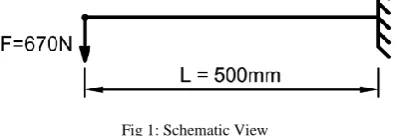
The optimization problem is the minimization of the volume of a tapered hollow cantilever beam. The objective of the optimization is to reduce total weight (or volume) under a constraint of maximum stress equal to yield strength. The element type, Beam 188 was used to model the cantilever beam.
A tapered hollow cantilever beam is modelled and meshed using beam 188 elements. The analysis and optimization is carried out in ANSYS. Later the analysis result of ANSYS is coupled with MATLAB and optimized using genetic algorithm. The tapered hollow cantilever beam is initially modelled as ID model using 2 key points.
Fig 1: Schematic View
Table I : Material Properties
Material Property Values
Material density 7850 kg/m3
Young modulus 2.1 x10⁵ N/mm2
Poisson's ratio 0.3
Yield strength 200 N/mm2
The material properties are as shown in Table I. The material used for the pipe is steel. It is having a density of 7850kg/m3. The permissible yield strength of the beam is 200 N/mm2.
B. Parameterization
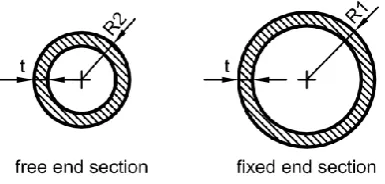
The objective of optimization problem is minimization of the mass (or volume) of the structure. The optimization is carried out under the constraint of limiting the maximum stress to the yield stress. In the optimization process the boundary conditions are considered fixed at edges and the optimization parameters are the sections of the beam at the two ends.
Fig 2: Optimization Parameters of Beam
The outer radii at the two ends (R1 and R2) and the wall thickness (t) are as shown in Fig.2. These three parameters are the design variables which can be varied to obtain the optimum design. The radius will be smaller at the free end and larger at fixed end.
Table II: Parameters and their Bounds
The three parameters are restricted to values between certain lower and upper values. These are listed in Table II . The range of radii are within 10 mm to 50 mm and of thickness is within 1mm to 5 mm.
Parameter Name Parameter Description Allowed Bounds (mm)
R1 Outer radius of the fixed end section 10 - 50
R2 Outer radius of the free end section 10- 50
VI.RESULTSANDDISCUSSIONS
The optimization was carried out under the constraint of maximum stress equal to yield stress. With this constraint the optimum results are obtained in the genetic algorithm toolbox.
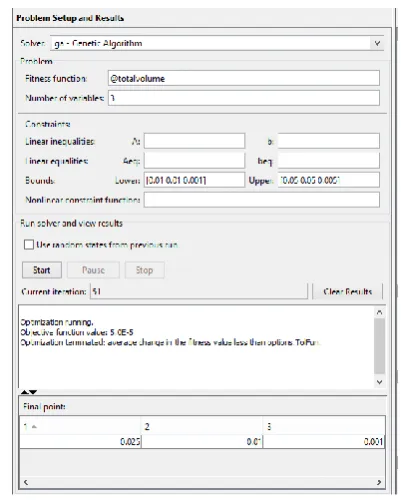
Fig 3: Optimization Parameters using Genetic Algorithm in MATLAB
The optimized values obtained by interfacing ANSYS and MATLAB using genetic algorithm is as shown in Fig. 3. In the toolbox we directly obtain the optimized values of design variables. It also displays the optimum value. The number of iterations carried out is also displayed in the toolbox.
Table III: Optimized Values
Parameter Name Initial Values Optimized values from MATLAB
R1(mm) 30 25.336
R2(mm) 15 10.000
R3(mm) 1 1.000
STRESS (N/mm2) 127.590 194.510
VOLUME (m3) 6.906x10⁵ 5.389x 10⁵
Reduction in volume 21.96%
Fig 4: Cantilever beam (a) Before optimization (b) After optimization
The initial and optimized cantilever beam is as shown in Fig. 4. It can be clearly seen than after optimization the radii are lesser than the initial radii. Hence the volume has also been reduced.
VII. CONCLUSIONS
In the present study, it can be observed that by coupling MATLAB and ANSYS advanced optimization can be done effectively. MATLAB provide an advanced optimization toolbox which can be easily done using simple scripts. The conclusions drawn from the study are as follows:
Significant reduction in the volume of tapered hollow cantilever beam. A reduction of 21.96% of original volume.
The geometry of the beam showed better structural behaviour after optimization. The constraints can be easily added or modified using simple scripts in MATLAB.
Genetic Algorithm is highly advantageous as different options of crossover and mutation can be applied. On ever changeover of options we can obtain better optimization results.
The optimization technique is flexible that any structure can be easily optimized. This methodology can be easily applied for any optimization technique.
REFERENCES
[1] CAZACU, R., and GRAMA, L. , “Comparative Study for the size optimization of a tapered pipe cantilever beam using genetic algorithm”, Fascicle of Management and Technological Engineering, Issue 1, pp. 59 -62, May 2014.
[2] Tomas, A., and Marti, P., “Shape and size optimization of concrete shells”, Engineering Structures, Vol. 32, pp. 1650- 1658, 2010 [3] ARNOUT,S., FIRL, M., and BLETZINGER, K., “Parameter free optimization of shells considering stress response”, 9th World Congress on
Structural and Multidisciplinary Optimization, pp. 1-10, June 2010.
[4] Mallika, A., and Ramana Rao, N. V., “Shape optimization of vibrating concrete shell structures”, International Journal of Earth Sciences and Engineering, Vol. 04, No. 01, pp. 178-188, February 2011.
[5] Rao, S. S., and Reddy, E.S., “Optimum design of stiffened conical shells with natural frequency constraints,” Computers and Structures, Vol. 14, No. 1-2, pp. 103-110,1981.”
[6] Bratus, A. S., “ Design of circular cylindrical shells of minimum weight with fixed natural oscillation frequencies”, PMM U.S.S.R, Vol. 47, No. 5, pp. 650-657, 1983.
[7] Lellep, J., and Puman, E., “Optimization of conical shells of piece wise constant thickness”, WSEAS TRANSACTIONS on MATHEMATICS, Vol. 1, pp. 242-251, March 2012.
[8] Levy, R., and Spillers, W. R., “Optimal design for axisymmetric cylindrical shell buckling”, Journal of Engineering Mechanics, Vol. 115, No. 8, pp. 1683-1690, November 1989.
[9] Zhou, M., “Topology optimization for shell structures with linear buckling responses”, Computational Mechanics, pp. 1-6, September 2004. [10] Prabhavati, P., Dr. Vankudre, S. B., and Melinamani, S.D., “Optimization of RCC dome using Genetic Algorithm”, International Journal
of Science and Technology, Vol. 2, pp. 54-62, July 2014.
[11] Jose, A., Ramadas, S., and Jayasree, R., "Parametric study on the structural forces and the moments of cylindrical shell roof using ANSYS”, American Journal of Engineering Research, Vol. 3, pp. 50-61, 2013.
[12] Mekjavic, I., and Piculin, S., “Structural analysis and optimization of concrete spherical and groined Shells”, Technical Gazette, Vol. 17, pp. 537-544, 2010.
[13] Rao, S. S., “Engineering optimization: Theory and practice”, 3rd edn., New Age New International, Delhi,2013.
X
Y
Z