Textual Requirement Analysis for Object
Model Designing by Using NLP
Dhanraj Deshpande
M.Tech Student, Dept. of Computer Engineering, BVCOE, Pune, Maharashtra, India
ABSTRACT: Software development is a complex process and begins with requirement gathering. Requirements are specified in their natural forms and are required to be converted into formal specifications such as object diagram for further use in any software development process. These diagrams are useful for clearly understanding the problem definition of software and other documentation purpose. This paper aims at developing specialized tool for generating class diagram and usecase diagram from requirements specified in natural language. For this purpose we present a new methodology to develop object diagram from natural language requirement specifications named RAUE. We present a new methodology for generating UML diagrams or models from natural language problem statement or requirement specification. We have named our methodology as Requirement analysis and UML diagram extraction (RAUE).
General Terms: Textual Requirement Analysis by using NLP for generation of UML Diagram.
KEYWORDS: Keywords Natural language processing (NLP), Domain Ontology, Unified Modeling Language, Requirement engineering, Software Requirement Specification
I. INTRODUCTION
In object-oriented systems, the notion of class is carried over from analysis to design, implementation, and testing. Thus, finding a set of domain classes is the most important skill in developing an object-oriented system. Auto-generation of class diagram will without doubt save the time and effort of system analyst, especially for novice. However, the automation of class generation from a written source is highly challenging due to the following three reasons (Richter, 1999; Maciaszek, 2001).
Natural language is ambiguous. Thus, rigorous and precise analysis is very difficult
The same semantics could be represented in different ways.
Concepts that were not explicitly expressed in a written source are often very difficult to model. Usually, expert domain knowledge is needed to identify the hidden classes.
As far as the best knowledge to us, the previous researchers have not offered any sound solutions to above-mentioned problems yet. Our approach proposed in this paper tries to address the problem above-mentioned but not intends to resolve all. The approach first applies natural language processing (NLP) techniques to understanding of the written requirements, and then uses domain knowledge represented by domain ontology to improve the performance of class identification. The basic notion of our approach is based upon the belief from heuristics that a class especially core class of the domain is always semantically connected with other classes and its attributes. The novice part of this approach is the use of a NLP-based RAUE model to identify core classes of the domain as starting point, for which we are usually highly confident, and further find classes that are related with the identified ones.
This methodology use NLP techniques to address the following challenging research questions: (1) How to use domain ontology but not limited to domain ontology? (2) How to find candidate concepts? (3) How to find concept pairs with strong semantic connection in the context? (4) How to distinguish attribute name from class name for each concept? (5) How to name each inter-class relationship, aggregation, generalization, or association? (6) Are there any missing classes or attributes?
In First and Second Section provides background information and describes related work. Section 4, 5 and 6 describes in detail our fully implemented NL-based RAUE tool which analyses software requirements written in English and produces first-cut class models represented in the UML. In last section, it presents conclusions and discusses future work.
II. RELATED WORKS
2001), use case descriptions (Jacobson, 1992; Richter, 1999), or CRC (Class-Responsibilities-Collaborators) cards (Wirfs-Brock, Wilkerson, & Wiener, 1990).
Also there have been several efforts for the analysis of natural language requirements [9,10, 11,16]. However, few are focused on class diagram extraction from natural language (NL) requirements. Thus, few tools exist to assist analysts in the extraction of class diagram. In this section we survey the works that use NLP or domain ontology techniques to analyze NL requirements.
Ambriola and Gervasi [5] present a Web-based environment called Circe. Circe helps in the elicitation, selection, and validation of the software requirements. It can build semi-formal models, extract information from the NL requirements, and measure the consistency of these models. It integrates a number of tools like Cico [5]. It is the main tool that is considered as a front-end and it recognizes the NL sentences and extracts some facts from them.
Zhou and Zhou [12] propose a methodology that uses NLP and domain ontology. It is based on that the core classes are always semantically connected to each other’s by one to one, one to many, or many to many relationships in the domain. This methodology finds candidate classes using NLP through a part of speech (POS) tagger, a link grammar parser, linguistic patterns and parallel structure, and then the domain ontology is used to refine the result [12].
Mich L. [13] proposes a NLP system, LOLITA to generate an object model automatically from natural language requirement. It considers nouns as objects and it uses links to find relationships between objects. LOLITA system does not distinguish between classes, attributes, and objects. This approach is limited to extract objects and cannot identify classes [1].
Taxonomic Class Modeling (TCM) methodology proposed by Song (Song et al., 2004) is the most recent and most complete work of identifying classes to our best knowledge. Starting with problem statement, it incorporates the noun analysis, class categories, English sentence structure rules, checklists, and other heuristic rules for modeling. TCM tries to identify three types of classes: noun classes, transformed classes (from verbs), and discovered classes.
Based on this survey, we recognize the TCM approach in [7] as the most successful model – for the extraction of class diagram from NL requirements.
III. A MOTIVATING SCENARIO
Provide the framework for auto-generation of class diagrams from free-text functional specification documents.
Provide a quick and reliable way to generate UML diagrams to save the time and budget of both the user and system analyst.
Allow user to visualize UML diagrams without need of installing any UML representation tool like Rational Rose.
Automatically develop a Class model along with associated attributes & operations without much need of human interaction. Generate efficient class model with all possible relationships like Generalization, Association, Composition, aggregation and dependency that does not provided in existing tools.
Provides a human-centered UI which makes user a part of the analysis process.IV. THE RAUE APPROACH
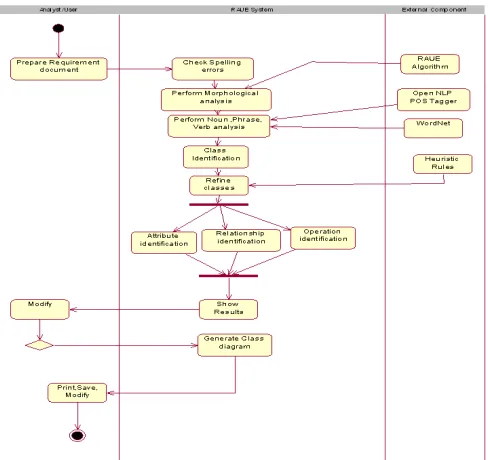
RAUE follows the Object- Oriented Analysis and Design (OOAD) [5] approach for object elicitation from requirements described in Natural Language to generate analysis and design UML models by following an approach based on NLP and domain ontology.
4.1. Theoretical Foundations
The Noun-Phrase technique of RAUE is aimed at helping in developing the analysis class model. This technique helps a requirements analyst to identify all possible objects from a given requirements document and generate analysis class model by attaching attributes and methods with the associated object. This technique categorizes a list of nouns into three classes, namely relevant classes, fuzzy classes and irrelevant classes. Fuzzy classes are further sub-divided into adjective, attribute and redundant classes.
Figure 1. The Process Model of RAUE Tool (Activity Diagram).
4.2. OpenNLP Parser:
We choose OpenNLP [8] as a parser in our system. The OpenNLP Parser library is a machine learning based toolkit for the processing of natural language text. It supports the most common NLP tasks, such as tokenization, sentence segmentation, part-of-speech tagging, named entity extraction, chunking, parsing, and coreference resolution. These tasks are usually required to build more advanced text processing services. OpenNLP is an open-source and re-usable algorithm. It provides our system with lexical and syntactic parsers. OpenNLP is an open-source and re-re-usable algorithm. It provides our system with lexical and syntactic parsers. The high accuracy and speed in OpenNLP encouraged us to choose it rather than other existing parsers. OpenNLP uses lexical and syntactic annotations to denote to the part of speech of the terms; for example, NN denotes to Proper Noun, VB denotes to Verb, and NP denotes to Noun Phrase.
4.3. WordNet
WordNet [8] is used to validate the semantic correctness of the sentences generated at the syntactic analysis. It also enables users to display all hypernyms for a selected noun. We used this feature to verify Generalization relationship where a noun phrase is supposed to be ‘a kind of’ another noun phrase [6]. WordNet can used to find semantically similar terms, and for the acquisition of synonyms [9]. We used synonyms to extract words which are semantically related to each other. We calculated the words frequency to keep the synonyms with high frequency in the document.
V. RAUE FRAMEWORK AND DESIGN
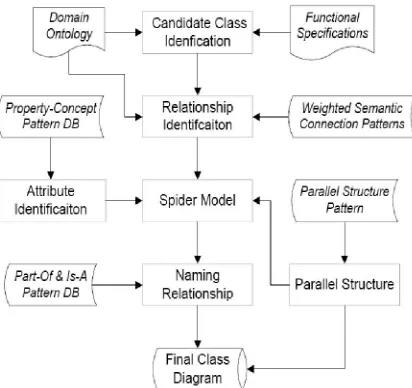
5.1. NLP-based Spider Model
In this section, we propose the algorithm for automatic generation of class diagrams. The input files include free-text functional specifications and structured domain ontology while the output is class diagram components including classes, attributes of each class, and inter-class relationships. The inter-class relationships can be classified into generalization, aggregation, and association. The association relationships can be further classified into one-to-one, one-to-many, and many-to-many. Our approach applies a NLP-based spider model to search classes of interest.
Figure 2: Framework of NLP-based Spider Model.
5.2. The RAUE stemming algorithm:
Stemming is a technique that abbreviates word by removing affixes and suffixes [9]. In RACE system, it is very important to return words back to its base form; this will reduce the redundancy and increase the efficiency of the system. To perform the stemming, we implemented a new stemming algorithm. Based on the stemming result, we find that our stemming algorithm is efficient and sufficient to be used in the morphological analysis of requirements in RACE system. Our stemming algorithm is simple and re-usable.
The algorithm is presented below.
Steps:
Step1: Use the requirements document as input.
Step2: Identify the stop words and save the result as {Stopwords_Found} list.
Step3: Calculate the total number of words in the documents without the stop words, the number of occurrences of each word, and then calculate the frequency Ƒ of each word, as in Ƒ
Step4: Use RACE stemming algorithm module to find the stemming for each word and save the result in a list.
Step5: Use OpenNLP parser in [8] to parse the whole document (including the stop words)
Step6: Use the parser output to extract Proper Nouns (NN), Noun phases (NP), verbs (VB). And save it in {Concepts-list} list.
Step7: Use Step2 and Step 6 to extract: {Noun phrases (NP)} – {Stopwords_Found} and save results to {Concepts-list}
Step8: For each concept (CT) in {Concepts-list} if {synonyms_list} contains a concept (CT2) which have a synonym (SM) which lexically equal to CT, then CT and CT2 concepts are semantically related to each other.
Step9: For each concept (CT) in {Concepts-list} if {hypernyms_list} contains a concept (CT2) which have a hypernyms (HM) which lexically equal to CT, then CT2 “is a kind of“ CT. Then save result as {Generalization-list}.
5.3. Domain Ontology:
As mentioned early in this paper, domain ontology is used to improve the performance of concepts identification. In RACE system we use a Library system Ontology as sample ontology. We gathered our ontology based on a survey we conducted on some library systems, and then we organize the ontology in such way to be easily maintained and re-used. The information in the ontology includes concepts related to classes for Library system, Attributes, and relationships. We used the XML to build the ontology.
5.4. Candidate Classes Identification
Most previous works think that sources of candidate class name are major noun phrases and minor verbs. By using part of speech (POS) tagger, we obtain a list of verbs and nouns. However, nouns are not equal to noun phrases in many cases. We further use sentence parser to get noun phrases of interest. Here we only consider nouns with pre-noun modifiers like NN+NN and JJ+NN. After POS tagging and sentence parsing, we get a set of noun phrases and verbs, namely Preliminary Candidates. Most preliminary candidates are not good classes, and are even irrelevant to the domain at all. The domain ontology offers the chance to further refine the classes for the domain model.
2. If a concept is related to design elements such as 'system', 'computer', 'data', 'application' etc then ignore it as a class.
3. If a concept is a name either of a person, location such as 'George', ‘England’,’Tommy’ etc then ignore it as a class.
4. If a concept has a hpernym in the higher level of hypernym tree then it states that the concept is general and can be replaced by a specific concept then ignore it as a class.
5. If a concept is a attribute such as 'name', 'address', 'contact_no' etc then ignore it as a class.
6. If a concept does not satisfy any of the above rules then there is a possibility that a concept is a class.
7. If a concept is noun phrase (Noun+Noun), if the second noun is an attribute then the first is a class. The second noun is an attribute of that class such as 'customer name', 'book ID' etc
5.5. Relationship Identification
Relationship identification refers to discover any semantic concept pairs within a sentence. The relationship of concept pair can be roughly classified into three categories: (1) relationship of two classes, (2) attribute of a class, and (3) value of an attribute. The relationship of two classes can be further classified into generalization, aggregation and association.
The association relationship can be either one-to-one, one-to-many, or many-to-many. However, in this step we don’t have to specify the name of the relationship, but to determine whether two concepts have relationship and how strong the relationship is if any. Because it is difficult to directly test whether two concepts are semantically connected with each other in the context, we use linkage distance to measure the semantic connection of two concepts. Linkage is a term defined in the famous parser, Link OpenNLP Parser.
5.6. Attribute Identification
When a concept is found to have strong semantic association with an existing class, it is still needed to tell whether the concept is an attribute of the associated class or another independent class. Usually, if there are more than one property associated with the concept, it is a class otherwise an attribute. For example, if only the amount of the price is necessary to remember, the price serves as an attribute, but if it is necessary to remember the amount, the discount, and the effective date range, it might well be a class. Property and concept is a special subordinate-master relationship in terms of semantics. There are strongly indicative linguistics patterns for such relationship.
5.7. Naming Relationship
In the standard of Unified Modeling Language (UML), inter-class relationship can be classified into aggregation, generalization and association. Association relationship can be either one-to-one, one-to-many or many-to-many. Aggregation is a part-whole relationship while generalization is a general-special relationship. Both two types of relationships have strong linguistic patterns associated with them. Many previous researches on this topic are well done so that we simply follow their methods (Berlan & Charniak, 1999; Hearst, 1992). However, we adopt a conservative strategy for the identification of aggregation and generalization relationship in the paper. In addition to the criterion of linguistic patterns described in previous works, they must meet two additional criterions:
(1) The parts of the composite class and the child classes of the super class must be appeared in the parallel structure. (2) At least one of the elements in the parallel structure has part-of or is-a relationship with the super class by looking up WordNet.
For examples:
A) The customer can create more than one account. The customer and account have a one to-many relationship since “more than one” modifies “account”.
B) Each customer can keep only one registered credit card in the profile. Here customer and credit card are one-to-one relationship because “only one” modifies “credit card”. If the concept A and concept B are one-to-many relationship and vice versa, the two concepts have a many-to-many relationship.
5.8. Parallel Structure.
sentence helps us find missed concepts or attributes. In detail, parallel structure can find (1) rest parts of a composite, (2) rest children of a super concept, and (3) rest attributes of a class.
VI. RAUE IMPLEMENTATION
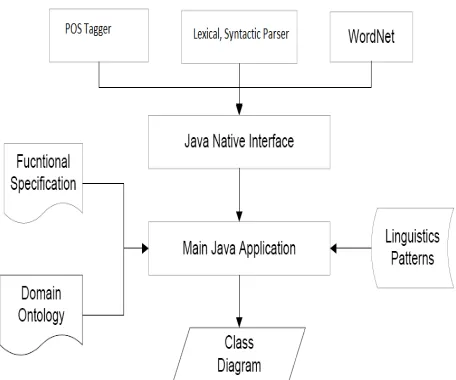
The implementation of the system involves not only complex algorithm described in section 3, but also many external programs and resources. We choose Eric Brill’s rule-based transformation tagger for part-of-speech tagging (Brill, 1994), and pick up Link Grammar as sentence parser because linkage information is very important to our approach. Meanwhile, WordNet serves as lexicon resources in our system. Though Brill’s tagger, Link Grammar Parser and WordNet are all written in native code, we find third party Java Native Interfaces (JNI) for these programs. Therefore, we can still integrate them with our main application written in Java well. Since all external programs support Windows, Linux and UNIX, and Java is platform independent, our system suppose to be able to run in different platforms though we develop and test it on Windows platform only. The architecture of the system is presented in figure 3.
Figure 3: RAUE System Architecture
Theoretically the system can accept any free-text document describing functional specifications. The version implemented here would have best performance to deal with problem statement and use case description written in natural language.
RAUE can open textual requirements from different sources including words documents (DOC), text files (TXT), rich text files (RTF), and hypertext document (HTML). The Class diagrams are visually represented. In addition, system can highlight nouns and verbs, in the document. For a good consistency, we use Threads to run different process at the same time. In the current version of RAUE, we use MsAccess to manage RAUE databases. RAUE supports two interfaces languages which are English. Our approach also needs external linguistic patterns including weighted semantic connection pattern, property-concept pattern, parallel structure pattern, part-of pattern, and is-a pattern.
VII. CASE STUDY
Input document :
Class diagram:
VIII. CONCLUSION
In this paper, we propose an enhanced approach that is based on NLP and domain ontology techniques to support the extraction of class diagram from NL requirements. We validate our approach by implementing a system called RAUE referred to as “Requirements Analysis and UML diagram Extraction”. RAUE system efficiently demonstrates the using of NLP and domain ontology techniques in the extraction of class diagram from informal requirements. The concepts extracted by our system are completely valid and recognized in the application domain. RAUE system able to finds concepts based on nouns, Noun phrases and verbs analysis. It also able to find four types of relationships: Generalization, Association, Composition, aggregation and dependency. The class diagram can be graphically represented and modified. RAUE provides a human-centered UI which makes user a part of the analysis process.
REFERENCES
[1]. Brill E., Some Advances in Transformation-Based Part of Speech Tagging. Proceedings of the Twelth national conference on Artificial intelligence, Pages: 722 – 727, 1994.
[2]. Requirements Validation via Automated Natural Language Parsing (Nanduri & Rugaber, 1995).
[3].WordNet(2.1)http://www.cogsci.princeton.eu/~wn/. Haruhiko Kaiya, Motoshi Saeki, 2005, “Ontology Based [4]. ”Static UML Model Generator from Analysis of Requirements (SUGAR) ” 2008 IEEE by Deva Kumar, Ratna Sanyal.
[5]. Ambriola, V. and Gervasi, V. “Processing natural language requirements”, Proc. 12th IEEE Intl. Conf. on Automated Software Engineering, pp. 36-45,1997.
[6]. Farid Meziane, Nikos Athanasakis, Sophia Ananiadou, 2007, Generating Natural Language specifications from UML class diagrams, Springer-Verlag London Limited 2007.
[7]. Song, Il-Yeol, et al, (2004). “A Taxonomic Class Modeling Methodology for Object-Oriented Analysis”, In Information Modeling Methods and Methodologies, Advanced Topics. In Databases Series, Ed, pp. 216-240. Idea Publishing Group. http://www.ischool.drexel.edu/ faculty/song/publications/p_TCM-ISM-2004.pdf.
[8]. OpenNLP: http://opennlp.sourceforge.net/
[9]. Tobias Karlsson, 2004, “Managing large amounts of natural language requirements through natural language processing and information retrieval support” ,Master’s Thesis, Department of Communication Systems, Lund Institute of Technology, Lund University.
[10]. WordNet(2.1)http://www.cogsci.princeton.eu/~wn/.
[11]. “On the Systematic Analysis of Natural Language Requirements with CIRCE” in 2006 Springer Science + Business Media, Inc. by VINCENZO AMBRIOLA,VINCENZO GERVASI (Dipartimento di Informatica Universit`a di Pisa, Italy).