Multiple Sink Model Which Support
Different Parameters in Wireless Sensor Field
Amol Bhadange 1, Sudipta Giri 2
P.G. Student, Department of Information Technology, MITCOE Engineering College, Pune, India1
Assistant Professor, Department of Information Technology, MITCOE Engineering College, Pune, India2
Abstract: Wireless sensor network is very essential in today’s life. The rapid growth of mobile technology is increases
in recent years. And thus this is challenging job for industry to develop an efficient network which suits in today’s technology. The users are main factor in this technology, without users the network is incomplete or rather incomplete technology without users. The main motto behind this paper is to design and implement a generalized sink model which supports users in sensor field. With the help of some parameters it is easy to evaluate sink model. Also, analysis of this model is to be done based on some evaluation criteria, which helps to make the model successful and meaningful.
The paper is divided into 5 sections. First one is introduction, second one is related work, third one is proposed design, and fourth one is experimental and results and final one is conclusion and future work.
Keywords: Remote user, Mobilecommunication, Mobile users, Wireless sensor networks, multiple static sink.
I. INTRODUCTION
Wireless mobile technology has more demand in today’s culture. Mobile network has more popular now days because of its availability and ease of use.
The proposed model depending upon mainly the sink capacity, more the sink less energy will consume at sink node. There are many existing techniques or models of wireless sensor network which supports the mobility as well as demand of users. No matter, some models also support mobile users but due to single static sink in the network create some limitations. To overcome these limitations there is need to develop some common generalized model which is compatible to both remote users as well as mobile users. So there is idea to develop such model which can increase the network life by avoiding extra congestion in the network. And here the idea came into mind to develop a generalized sink model which have a multiple sinks or base stations that creates some difference in the network. The generalized sink model helps to improve network life and also up to some extent decreases the energy consumption.
II. RELATEDWORK
While referring the paper, et. al. [6], the new concept called as hot spot problem came into picture. The paper suggested that to overcome the hot spot problem, number of sink must be in more number rather than a single sink.
Same knowledge is given by paper, et. al.[2], they proposed multistage switching network to increase the life of sink and ultimately the network life. And also up to some extent they can solve the problem of traffic by dividing the network into one or more domain and this will reduce the hot spot problem.
Other one, et. al [3], proposed distributed energy-efficient deployment algorithms which helps to improve the energy of network. To support the algorithm the technique uses cluster, this helps them to analyze the structure of network and also helps to decrees energy consumption near base station.
On the basis of sensor field development, et. al. [4] and et. al. [5] developed algorithm for how to collect sensing data from all sensor nodes, provides algorithm for multidimensional analysis for jumping sensors respectively.
III.PROPOSEDDESIGN
The proposed design of my communication protocol is as follows.
Fig 1. DFD Level 0
It is observed that from fig.1 there is need of node size to define number of users and base station is acts as a gateway to communication model. And finally will get the output with the help of some observable parameters like network size, user speed, and number of multiple static sinks. There is need to extract this DFD level 0 to DFD level 1. To understand this proposed design more in detail.
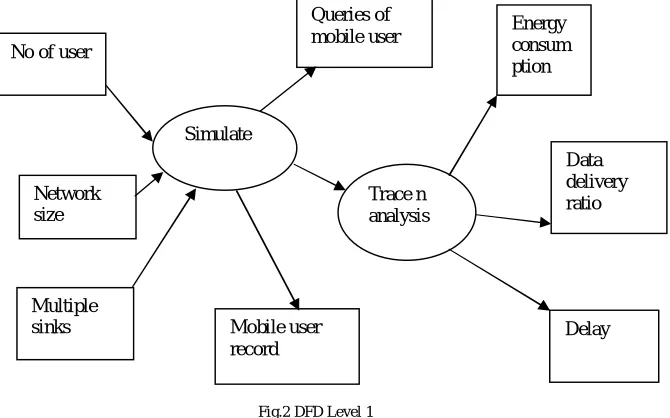
Fig.2 DFD Level 1
It is observed that from fig.2 number of users is taken to simulate with the help of speed. To decide the topology of network, network size is taken as parameter. Multiple sink is act as a gateway between users and sensor field.
During the simulation process, queries of mobile users as well as mobile user’s record are stored in mobile user Communi
cation model Node size
Base station
Analysis of process
Simulate
Trace n analysis No of user
Network size
Multiple sinks
Queries of mobile user
Mobile user record
Energy consum ption
Data delivery ratio
After simulation process will get the parameters output, with the help of trace n analysis process will plot the graph against energy consumption, data delivery ratio, delay by using xgraph. All this proposed design will be implemented in ns2 simulation tool.
The implementation results from
,
et. al. [1], shows that, the model single static sink with legacy network has more energy consumption, lower data delivery ratio, and longer delay this is because, hop count of their data gathering tree increases. Same is for single static sink model with sensor network also.To overcome the problem of energy consumption there is need to increase of number of sink. This is my first propose work, to increase the domain size. The second propose work i have decided to verify the claims of the paper which i refer by using same parameters like network speed, network size. And also there is scope of varying data packet rate like 32-128 bytes in the future. As compared with 64 bytes rate, will check what it affects on energy consumption or delay.
IV.EXPERIMENTAL RESULT
With the help of proposed design, i compare both models (single static sink model and multiple static sink models) results with respect to their parameters. Firstly i have taken 2 scenarios. In first scenario i have taken 11 nodes, out of that 3 nodes are movable and they send packets to the sink. In this scenario for understanding purpose there are 2 sink. Sinks are receiver.
Here i have compared 14 parameters for single and multiple sink scenarios. As seen from fig.3 there is slightly difference between delay of single sink with respect to delay of multiple sink, this is because of node movement is very nearer to each other. Also there is slight change in packet delivery ratio, but there is difference in energy consumption. As compared to single sink model network energy decreases in multiple sink model. Also residual energy is also decreases in multiple sink as compared with single sink. And this is a very good sign as our network consumes less energy, ultimately that will results to increase network life.
.
Parameters Single Sink Model (Actual results)
Multiple Sink Model (Actual results) No. of packets send 1478 1477
No. of packets receive 1477 1476 Packet delivery ratio 99.9323% 99.9323% Control overhead 22 22 Normalised routing overheads 0.0148951 0.0149051 Delay 0.00274533 0.00274374 Throughput 88381.1kbps 88380.8kbps Jitter 0.0133862 0.0133864 No. of packet dropped 1 1
Dropping ratio 0.067659 0.0677048 Total energy network consume 950.906w 935.231w Average n/w energy consumption 5.0906w 3.52309w Residual energy 9949.1w 9933.43w Avg. residual energy 994.91w 993.343w
Fig.3 Comparison of single and multiple sink results (Scenario1)
Nodes Single Sink Model
(Energy consumption results)
Multiple Sink Model (Energy consumption results) ‘0’ Node 983.892595w 983.915328w
‘1’ Node 983.903045w 983.904738w ‘2’ Node 999.630402w 999.630957w ‘3’ Node 999.630554w 983.904738w ‘4’ Node 983.892595w 983.915328w ‘5’ Node 999.630402w 999.630957w ‘6’ Node 999.630402w 999.630957w ‘7’ Node 999.630402w 999.630957w ‘8’ Node 999.630402w 999.630957w ‘9’ Node 999.630403w 999.631194w
Fig.4 Individual node wise energy consumption comparison (Scenario1)
In the second scenario the distance between two sinks is increased and the direction of nodes slightly changed. Some nodes are nearer to the sink and some are far away from sink. As seen from fig.5 will see the difference in delay and also our packet delivery ratio is also improved as compared with scenario1.The total energy consumption of network is reduced as compared with single sink model. In both the scenes the energy consumption of network is less as compared with single sink model. Hence it is prove that by using multiple sink, our network life is more than by using single sink.
Parameters Single Sink Model (Actual results)
Multiple Sink Model (Actual results) No. of packets send 1478 1478
No. of packets receive 1478 1477 Packet delivery ratio 100% 99.9323% Control overhead 22 22 Normalised routing overheads 0.014885 0.0148951 Delay 0.0177675 0.0425107 Throughput 88441kbps 88381.1kbps Jitter 0.0133832 0.0133897 No. of packet dropped 0 1
Dropping ratio 0 0.067659 Total energy network consume 938.834w 929.026w Average n/w energy consumption 3.88343w 2.9026w Residual energy 9937.03w 9927.22w Avg. residual energy 993.703w 992.722w
Fig.5 Comparison of single and multiple sink results (Scenario2)
Nodes Single Sink Model
(Energy consumption results)
Multiple Sink Model (Energy consumption results) ‘0’ Node 987.752577w 985.809130w
‘1’ Node 987.761264w 985.819605w ‘2’ Node 999.654924w 999.630369w ‘3’ Node 999.654924w 985.819605w ‘4’ Node 987.744871w 985.809130w ‘5’ Node 999.653386w 999.631197w ‘6’ Node 999.654924w 999.631197w ‘7’ Node 999.653387w 999.630369w ‘8’ Node 987.745237w 999.630369w ‘9’ Node 987.753143w 985.809395w
Fig.6 Individual node wise energy consumption comparison (Scenario2)
Still i am working on some more results. More and more results gives the current model is very much useful as far as sensor network point of view and also for user’s point of view.
V. CONCLUSIONANDFUTURESCOPE
The current protocol allows the multiple static sinks to perform the function as gateway for users in other networks via the legacy networks. Also in the future there is scope of try to solve mobility issue. We could try to make sink movable or dynamic instead of static.
REFERENCES
[1] Euisin Lee, Soochang Park, Fucai Yu, and Sang-Ha Kim, “Communication Model and Protocol based on Multiple Static Sinks for Supporting Mobile Users in Wireless Sensor Networks”, IEEE Transactions on Consumer Electronics, Vol.56, pp.1652-1660, 2010.
[2] GREGORY F. PFISTER, V. ALAN NORTON, ““Hot Spot" Contention and Combining in Multistage Interconnection Networks”, IEEE TRANSACTIONS ON COMPUTERS, Vol.c-34, pp.943-948, 1985.
[3] Nojeong Heo and Pramod K. Varshney, “Energy-Efficient Deployment of Intelligent Mobile Sensor Networks”, IEEE TRANSACTIONS ON SYSTEMS, MAN, AND CYBERNETICS—PART A: SYSTEMS AND HUMANS, Vol. 35, pp.78-92, 2005.
[4] Siyuan Chen, Minsu Huang, Shaojie Tang, Yu Wang, “Capacity of Data Collection in Arbitrary Wireless Sensor Networks”, IEEE TRANSACTIONS ON PARALLEL AND DISTRIBUTED SYSTEMS, Vol.23, pp.52-60, 2012.
[5] Fernando J. Cintrón, Kanthakumar Pongaliur, Matt W. Mutka, Li Xiao, Jianguo Zhao, and Ning Xi, “Leveraging Height in a Jumping Sensor Network to Extend Network Coverage”, IEEE TRANSACTIONS ON WIRELESS COMMUNICATIONS, Vol.11, pp.1840-1849, 2012. [6] Helena Rivas, Thiemo Voigt, Adam Dunkels, “A Simple and Efficient Method to Mitigate the Hot Spot Problem in Wireless Sensor
Networks”, pp.1-8.
[7] ELYES BEN HAMIDA AND GUILLAUME CHELIUS, “STRATEGIES FOR DATA DISSEMINATION TO MOBILE SINKS IN WIRELESS SENSOR NETWORKS”, IEEE Wireless communications, pp. 31-37, 2008.
[8] Emil Jovanov, Carmen C. Y. Poon, Guang-Zhong Yang, Yuan-Ting Zhang, “Guest Editorial Body Sensor Networks: From Theory to Emerging Applications”, IEEE TRANSACTIONS ON INFORMATION TECHNOLOGY IN BIOMEDICINE, Vol.13, pp.859-863, 2009. [9] Soochang Park, Euisin Lee, Min-Sook Jin, and Sang-Ha Kim, “Novel Strategy for Data Dissemination to Mobile Sink Groups in Wireless
Sensor Networks”, IEEE COMMUNICATIONS LETTERS, Vol.14, pp.202-204, 2010.