!
"
#"#
$ % %#
&
''' (
Performance Comparison of ordinary AODV and Energy Efficient AODV
V.Ramesh*
Research Scholar, Sathyabama University, Chennai, TamilNadu, India. [email protected]
N. Koteswar Rao
Associate Professor, Dept. of IT, Narayana Engg. College, Gudur, AP, India.
P.Praveen Kumar
Asst.Professor, St. Mary’s Engineering College, Nalgonda, AP, India.
S.Penchal Rao
Asst.Professor, Brahmas College of Engineering, Nellore, AP, India.
B.Mohan
Associate Professor, Dept. of IT, Narayana Engg. College, Gudur, AP, India.
Abstract: An Ad-hoc network, a self-organizing wireless network is made up of mobile nodes, each node act as relay for providing data communication, which operates on batteries. In Ad-hoc network the topology changes often and needs large and frequent exchange of data among the network nodes for efficient routing. Existing on-demand ad-hoc network routing protocols passes the information till the node energy is available and the link become breaks. Then the source reconstructs the route. During the route reconstruction after the link breaks, packets may be dropped which may cause significant throughput degradation. This paper proposed a Throughput maximization Routing (TMR) to predict the link breakage time and send a warning message to the source node of the packet and reduce the packet loss due to less energy in the node and packet loss is also reduced by providing multiple alternate routes to deliver data packets. The data packet loss due to route failure is also reduced by alternate route.
Keywords: AODV, EEAODV, Energy aware Routing, TMR.
I. INTRODUCTION
An ad-hoc (or "spontaneous") network is a local area network or other small network, especially one with wireless or temporary plug-in connections, in which some of the network devices are part of the network only for the duration of a communications session or, in the case of mobile or portable devices, while in some close proximity to the rest of the network. The term has been applied to future office or home networks in which new devices can be quickly added, using, for example, the proposed Bluetooth technology in which devices communicate with the computer and perhaps other devices using wireless transmission.
A wireless ad-hoc network is a computer network in which the communication links are wireless. The network is ad-hoc because each node is willing to forward data for other nodes, and so the determination of which nodes forward data is made dynamically based on the network connectivity. This is in contrast to older network technologies in which some designated nodes, usually with custom hardware and variously known as routers, switches, hubs, and firewalls, perform the task of forwarding the data. Minimal configuration and quick deployment make ad hoc networks suitable for emergency situations like natural or human-induced disasters, military conflicts, emergency medical situations etc.
II. AODV PROTOCOL
The Ad hoc On Demand Distance Vector (AODV) routing algorithm is a routing protocol designed for ad hoc mobile networks. AODV is capable of both unicast and multicast routing. It is an on demand algorithm, meaning that it builds routes between nodes only as desired by source nodes. It maintains these routes as long as they are needed by the sources. Additionally, AODV forms trees which connect multicast group members. The trees are composed of the group members and the nodes needed to connect the members. AODV uses sequence numbers to ensure the freshness of routes. It is loop-free, self-starting, and scales to large numbers of mobile nodes. .
the case, it unicasts a RREP back to the source. Otherwise, it rebroadcasts the RREQ. Nodes keep track of the RREQ's source IP address and broadcast ID. If they receive a RREQ which they have already processed, they discard the RREQ and do not forward it.
As the RREP propagates back to the source, nodes set up forward pointers to the destination. Once the source node receives the RREP, it may begin to forward data packets to the destination. If the source later receives a RREP containing a greater sequence number or contains the same sequence number with a smaller hop count, it may update its routing information for that destination and begin using the better route.
As long as the route remains active, it will continue to be maintained. A route is considered active as long as there are data packets periodically traveling from the source to the destination along that path. Once the source stops sending data packets, the links will time out and eventually be deleted from the intermediate node routing tables. If a link break occurs while the route is active, the node upstream of the break propagates a route error (RERR) message to the source node to inform it of the now unreachable destination(s). After receiving the RERR, if the source node still desires the route, it can reinitiate route discovery.
Multicast routes are set up in a similar manner. A node wishing to join a multicast group broadcasts a RREQ with the destination IP address set to that of the multicast group and with the 'J'(join) flag set to indicate that it would like to join the group. Any node receiving this RREQ that is a member of the multicast tree that has a fresh enough sequence number for the multicast group may send a RREP. As the RREPs propagate back to the source, the nodes forwarding the message set up pointers in their multicast route tables. As the source node receives the RREPs, it keeps track of the route with the freshest sequence number, and beyond that the smallest hop count to the next multicast group member. After the specified discovery period, the source node will unicast a Multicast Activation (MACT) message to its selected next hop. This message serves the purpose of activating the route. A node that does not receive this message that had set up a multicast route pointer will timeout and delete the pointer. If the node receiving the MACT was not already a part of the multicast tree, it will also have been keeping track of the best route from the RREPs it received. Hence it must also unicast a MACT to its next hop, and so on until a node that was previously a member of the multicast tree is reached.
III. PROBLEM STATEMENT
AODV algorithm performs routing between source and destination. In this method all the intermediate nodes are always in active state for transmitting packets. Each node can conceive large amount energy for transmitting the packets. In the existing AODV algorithm consumes more energy for transmission packets. Energy Efficient AODV algorithm reduces the energy consuming by each intermediate node.
IV. RELATED WORK
“Q. Li, J. Aslam, and D. Rus”,[1] proposed an approach called “Online power-aware routing in wireless ad-hoc networks”. Energy use is a crucial design concern in wireless ad hoc networks. The design objectives of energy-aware routing include selecting energy-efficient paths and minimizing the protocol overhead incurred in acquiring such paths. To achieve these goals altogether, the design of two energy-aware on-demand routing protocols for different network environments.
The key idea behind our design is to adaptively select the subset of nodes required to involve in a route-searching process to acquire a high residual-energy path or the degree to which nodes are required to participate in the process of searching for a low-power path for networks where in nodes can adaptively adjust their transmission power. Analytical and simulation results are given to demonstrate the high performance of the designed protocols in energy-efficient utilization and in reducing the protocol overhead incurred in acquiring energy-aware routes.
“J-H. Chang and L. Tassiulas”,[2] proposed an
approach called “Maximum lifetime routing in wireless sensor network”. In this work we study energy efficient routing strategies for wireless ad-hoc networks. In this kind of networks, energy is a scarce resource and its conservation and efficient use is a major issue. Our strategy follows the multi-cost routing approach, according to which a cost vector of various parameters is assigned to each link. The parameters of interest are the number of hop on a path, and the residual energy and the transmission power of the nodes on the path. These parameters are combined in various optimization functions, corresponding to different routing algorithms, for selecting the optimal path. We evaluate the routing algorithms it proposed in a number of scenarios, with respect to energy consumption, throughput and other performance parameters of interest. From the experiments conducted and conclude that the routing algorithms that take into account energy related parameters, increase the lifetime of the network, while achieving better performance than other approaches, such as minimum hop routing.
V. PROPOSED SYSTEM
Figure 1: System Design
A node receiving the RREQ may send a route reply (RREP) if it is either the destination or if it has a route to the destination with corresponding sequence number greater than or equal to that contained in the RREQ. If this is the case, it unicasts a RREP back to the source. Otherwise, it rebroadcasts the RREQ. Nodes keep track of the RREQ's source IP address and broadcast ID. If they receive a RREQ which they have already processed, they discard the RREQ and do not forward it.
As the RREP propagates back to the source, nodes set up forward pointers to the destination. Once the source node receives the RREP, it may begin to forward data packets to the destination. If the source later receives a RREP containing a greater sequence number or contains the same sequence number with a smaller hop count, it may update its routing information for that destination and begin using the better route. As long as the route remains active, it will continue to be maintained.
A route is considered active as long as there are data packets periodically traveling from the source to the destination along that path. Once the source stops sending data packets, the links will time out and eventually be deleted from the intermediate node routing tables. If a link break occurs while the route is active, the node upstream of the break propagates a route error (RERR) message to the source node to inform it of the now unreachable destination(s). After receiving the RERR, if the source node still desires the route, it can reinitiate route discovery.
VI. COMPONENTS OF THE SYSTEM
A. Route Discovery:
In AODV, each mobile node has no choice and must forward packets for other nodes. Each node determines whether or not to accept and forward the RREQ message depending on its remaining battery power the RREQ is dropped otherwise, the message is forwarded. The destination will receive a route request message only when all intermediate nodes along the route have enough battery levels.
B. Route Maintenance:
Route Maintenance is needed either when the connections between some nodes on the path are lost due to node mobility, or when the energy resources of some nodes on the path are depleting too quickly. In the first case, and as in AODV, a new RREQ is sent out and the entry in the route table corresponding to the node that has moved out of range is purged. In the second case, the node sends a route error RERR back to the source even when the condition is satisfied. This route error message forces the source to initiate route discovery again. This is a local decision since it is dependent only on the remaining battery capacity of the current node.
However, if this decision is made for every possible route, the source will not receive a RREP message even if there exists a route between the source and the destination. To avoid this situation, the source will resend another RREQ message with an increased sequence number. When an intermediate node receives this new request, it lowers it’s to allow the packet forwarding to continue.
When a node drops a RREQ message. The subsequent nodes closer to the destination now know that a request message was dropped and lower their threshold values. Now, the second route request message can now reach the destination. When the destination receives a RREQ, it generates a RREP. As in AODV, the RREP is routed back to the source via the reverse path. That interworks easily with AODV. By this, we mean that an ad hoc network can contain both nodes carrying out, and nodes carrying out AODV as routing protocol.
VII. ENERGY AWARE ROUTING
On-demand protocols such as AODV typically pick the shortest path route during the route discovery process, and then sticks to this route until it breaks. Continuous use of the route may drain the nodes of battery power. This is particularly true if one or more nodes are on other routes as well. Note that each message transmission and reception drain battery power. If a node runs out of battery energy and unable to forward any messages, it effectively falls out of the network. In this case, the route breaks and AODV finds an alternate route via another route discovery. However, nodes dying such as this adversely affect the operational life time of ad hoc network.
First, many applications where the dying nodes are death communication end points will fail. Second, even when the dying nodes are not the communication end points, network connectivity will become sparser and network partition becomes more likely.
The goal of our protocol is routing or re-routing around nodes low on battery power as far as possible. This will prolong the network lifetime. However, this should be done in such a way that other useful performance metrics (e.g., end-to-end delay and throughput) are not compromised in a significant way. We take a two-step approach to design the adaptive energy-aware protocol. First, the nodes are classified according to their remaining battery energy. Depending on their classification the nodes react differently to the routing protocol dynamics. Second, a new cost function is used as routing metric taking into consideration both the hop-wise distance and the battery levels of the
Energy Aware Routing
Establish Capacity between Transmit On Each Node
Conventi onal Routing Route
Discovery
Route Mainte nance Create
Trust Table
nodes. The nodes are classified according to the following energy zones.
The percentages of the initial energy reserves used in the definitions are somewhat arbitrary, and do not need to be exact. It is assumed that the initial energy of the node is the maximum energy provided by the battery when it is fully charged. The purpose of assigning zones to nodes with various battery levels is to assign different costs for routing via nodes in different zones. The cost of routing a data packet through nodes in warning (Danger) Zone is higher than the cost involved with the nodes in the Normal (Warning) Zone. This is to encourage the route discovery mechanism to explore alternate routes with higher battery power.
The above cost metric is used in AODV route discovery. Each RREQ packet flooded in the network builds up the cost for the path traversed so far by the packet. Each routing table entry also maintains the cost for that route. In regular AODV any node acts on only the very first RREQ received per route discovery flood. Duplicates of the RREQ received via alternate routes are ignored. However, use of this new cost metric requires that AODV acts on all such duplicates if they carry a lower cost metric. If a RREQ arrives with a lower cost metric (compared the metric in the routing table entry for the source indicating the cost of the reverse path), it is forwarded if the node is not the destination and does not have a route to the destination; otherwise it is replied to.
In AODV routing activity is reactive. It is possible that once a route is set, it remains active for a long period of time. In such cases, it might happen that one or more nodes on the route may move from one energy zone to another as they deplete their battery power in forwarding data packets. If this continues for a long time then some nodes may die. To ensure that the route is recalculated when the battery level depletes sufficiently to move any node on an active route into a different zone, such a node sends a route warning (RWARN) packet back to the source(s) using that route.
The warning packet is propagated much like RERR, except that the route is not erased. Thus the flow of the data
packets is not interrupted. A new route discovery process is initiated at the source on receipt. The new route discovery process does not selectively ignore the node(s) that sent. However, now such nodes incur higher cost using the method above. If a less expensive route is found, the routing tables of the appropriate nodes automatically switch to the new route. If no less expensive route is found, the old route continues to be used.
The performance of the base AODV and energy-aware AODV for various metrics. Number of traffic sources and pause times are varied to reflect various loads and mobility. Note that pause time = 0 means constant movement and pause time = 900 sec means stationary network. The initial energy for each node in this set of simulations is 1060 Joules, which represent a combined network wide initial energy of 53,000 Joules. Note that the initial energy was set at this value with some trial so that we can effectively demonstrate the difference in behavior of the base and energy aware protocols.
If the initial energy is too high, the energy-aware techniques based on battery level will not kick in and essentially only the baseline routing protocol will be
operational throughout the experiment. On the other hand, initializing with too low energy will make the nodes die too soon, and beyond this point the traditional metrics like delivery fraction and delay will be meaningless. We have found that in order to demonstrate effectively the behavior of different metrics, we need to set the initial energy and simulation run-length combination in such a way that the nodes do have a small energy remaining (about 10–20% of the initial) at the end. Initializing with higher energy does not let the rerouting techniques kick in as the nodes remain the normal zone throughout. We, however, perform some experiments with lower initial energy to demonstrate how soon the nodes die in different scenarios and protocols.
In observe that the remaining energy at the end of the simulation is much higher for energy-aware AODV than the base AODV. For the chosen parameter values, the improvement is 7-8 times for low traffic (10 and 20 sources) and up to 30 times for high traffic (30 sources). Note, however, these factors can be a little deceiving as they depend strongly on the initial energy and the simulation run length. For example, the improvements may not be this substantial if run length is lower.
Such node may fail to respond routing activities. Thus some route discovery attempts may fail and some other may obtain longer routes avoiding the sleeping nodes. This increases both packet losses and packet delay. This problem reduces with higher number of sources as a relatively lower number of nodes sleep with higher traffic diversity.
VIII. DEVELOPING ENERGY EFFICIENT AODV
In this project, designed new power-aware routing protocol to balance the traffic load inside the network so as to increase the battery lifetime of the nodes and hence the overall useful life of the ad hoc network. These protocols are based on the conventional AODV. Congested node is able to serve the flows at a higher rate, and then sources are automatically able to send packets at a higher rate. These AODV extensions increase the network survivability and lead to a longer battery life of the terminals. They achieve balanced energy consumption with minimum overhead. Simulation results show that this algorithms increase clearly network lifetime. Another important advantage of these algorithms is their simplicity and the fact that they do not affect other layers of wireless communication protocols.
A. Energy Efficient Aodv (Ee-Aodv)
The main objective is to balance energy consumption among all participating nodes. In this approach, each mobile node relies on local information about the remaining battery level to decide whether to participate in the selection process of a routing path or not. An energy-hungry node can conserve its battery power by sleeping during the idle time.
B. Route Discovery:
Figure: 2
In EEAODV algorithm, the intermediate nodes are sleeping during idle time and the only antenna of the nodes consumes power. All other parts of the nodes are in the doze mode. So whenever a packet is arrived at the intermediate node, the node awakens and it transfers the packet to the next node according to the AODV algorithm and then again goes to the sleep mode. So by this way, the energy consumed by the intermediate nodes goes much lower. [a] Initially the nodes are in doze state (sleep state) means
the expect the antenna all other parts of the node does not consume power
[b] Once the packet arrived at the node, the antenna awakens the node and forwarded the packet to the other nodes and again the node goes to the sleep mode. [c] All other intermediate nodes are also in the sleep node. [d] Except for the above mechanisms, the other things are
[image:5.612.319.556.55.602.2]similar like the AODV algorithm.
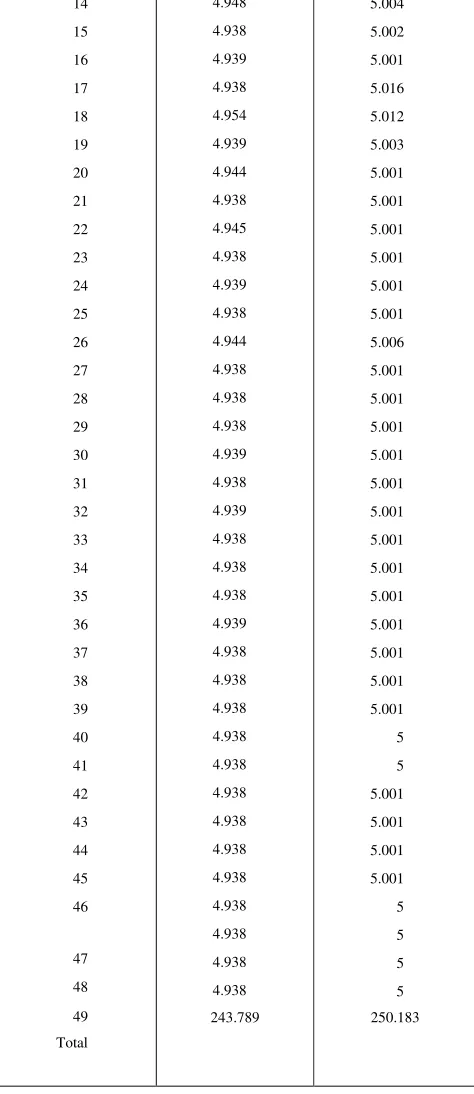
Figure 3: No of nodes Vs Energy
Nodes EE-AODV Normal AODV
0 1 2 3 4 5 6 7 8 9 10 11 12 13 4.961 4.938 4.943 4.938 4.938 4.938 4.946 4.941 4.944 4.938 4.96 4.938 4.946 4.941 5.032 5.007 5.012 5.002 5.008 5.007 5.005 5.005 5.001 5.001 5.007 5.007 5.013 5.009 14 15 16 17 18 19 20 21 22 23 24 25 26 27 28 29 30 31 32 33 34 35 36 37 38 39 40 41 42 43 44 45 46 47 48 49 Total 4.948 4.938 4.939 4.938 4.954 4.939 4.944 4.938 4.945 4.938 4.939 4.938 4.944 4.938 4.938 4.938 4.939 4.938 4.939 4.938 4.938 4.938 4.939 4.938 4.938 4.938 4.938 4.938 4.938 4.938 4.938 4.938 4.938 4.938 4.938 4.938 243.789 5.004 5.002 5.001 5.016 5.012 5.003 5.001 5.001 5.001 5.001 5.001 5.001 5.006 5.001 5.001 5.001 5.001 5.001 5.001 5.001 5.001 5.001 5.001 5.001 5.001 5.001 5 5 5.001 5.001 5.001 5.001 5 5 5 5 250.183
Figure 4: Comparison of Normal AODV and Minimized AODV
IX. RESULT AND DISCUSSION
[image:5.612.56.296.308.731.2]each node is 5 units. Each node has a radio propagation of 250 meters. EE AODV not only minimizes the energy but it also avoids collision with other nodes to a great extent.
X. CONCLUSION AND FUTURE WORK
This paper minimizes the Average power of the MANETs and it also tries to avoid collision between the nodes. This EEAODV algorithm will be helpful while making a Network mode with laptops, notebooks etc. Invariably, this paper can be extended for system level power minimization when using laptops and note books, etc.
EE-AODV algorithm which helps to minimize the power consumption is very helpful for minimizing energy or power of any mobile devices such as laptops, sensor networks, etc. This EEAODV algorithm can be extended for a lifetime of battery level which in turn it can be verified by connecting the laptop with battery source. In this project the nodes that transmitting packet information to neighboring nodes at that time the energy consumption is calculated.
XI. REFERENCES
[1] Q. Li, J. Aslam, and D. Rus, proposed an approach called “Online power-aware routing in wireless ad-hoc networks” in Proc. ACM Mobicom’01, pp. 97–107, Jul. 2001.
[2] J-H. Chang and L. Tassiulas, Maximum lifetime routing in wireless sensor networks, IEEE/ACM Trans. Netw.12 (2004), no. 4, 609–619
[3] C. E. Perkins, E. M. Belding-Royer, and S. R. Das, “Ad hoc On-Demand Distance Vector (AODV) Routing”, IETF Internet Draft, draft-ietf-manetaodv-13.txt. [4] I.F. Akyildiz, W. Su, Y. Sankarasubramaniam, E.
Cayirci, Asurvey on sensor networks, IEEE
Communication Magazine,40 (8) (2002) 102–114. [5] C. E. Perkins, E. M. Belding-Royer, and S. R. Das, “Ad
hoc On-Demand Distance Vector (AODV) Routing”, IETF Internet Draft, draft-ietf-manetaodv- 13.txt. [6] L. Ouakil, S. Senouci, and G. Pujolle, "Performance
Comparison of Ad Hoc Routing Protocols Based on Energy Consumption", Ambience Workshop 2002, Torino, Italy, September 2002.
[7] D. B. Johnson, D. A. Maltz, Y.–C. Hu, “The Dynamic Source Routing Protocol for Mobile Ad Hoc Networks (DSR)”, IETF Internet Draft, draft-ietf-manetdsr- 09.txt.
[8] K. Woo, C. Yu, D. Lee, H. Y. Youn, and Ben Lee, “Non-Blocking, Localized Routing Algorithm for Balanced Energy Consumption in Mobile Ad Hoc Networks”, MASCOTS'01, Cincinnati, Ohio, August 15-18, pp. 117-124, 2001.
[9] IEEE Standards Department. “IEEE Draft Standard - Wireless LAN”. IEEE Press, 1997.