MIKHAIL KIPNIS AND DARYA KOMISSAROVA
Received 28 January 2006; Revised 22 May 2006; Accepted 1 June 2006
We consider the stability problem for the difference systemxn=Axn−1+Bxn−k, whereA, Bare real matrixes and the delaykis a positive integer. In the caseA= −I, the equation is asymptotically stable if and only if all eigenvalues of the matrixBlie inside a special stability oval in the complex plane. Ifkis odd, then the oval is in the right half-plane, otherwise, in the left half-plane. IfA+B<1, then the equation is asymptotically stable. We derive explicit sufficient stability conditions forAIandA −I.
Copyright © 2006 M. Kipnis and D. Komissarova. This is an open access article distrib-uted under the Creative Commons Attribution License, which permits unrestricted use, distribution, and reproduction in any medium, provided the original work is properly cited.
1. Introduction
Our purpose is to investigate the stability of the system
xn=Axn−1+Bxn−k, (1.1)
whereA,B are (m×m) real matrixes,xn:N→Rm, a positive integerkis a delay. The structure of the solution of equationxn=Axn−1+Bxn−k+fnwith commutative matrixes A,Bis considered in [6]. A similar scalar equation
xn=axn−1+bxn−k, (1.2)
wherea,b are real numbers, was studied by Kuruklis [8] and Papanicolaou [15]. The following assertion describes the boundaries of the stability domain for (1.2) in the (a,b) plane (see alsoFigure 1.1).
Theorem1.1 (see [7, Theorem 2]). The zero solution of (1.2) withk >1is asymptotically stable if and only if the pair(a,b)is the internal point of the finite domain bounded by the
Hindawi Publishing Corporation Advances in Difference Equations Volume 2006, Article ID 31409, Pages1–9
1 1
1 1
a b
(a)
1
1 1
1
a b
(b)
Figure 1.1. The stability domains of (1.2). (a)kis odd,k >1. (b)kis even. The Cohn domain bound-ary|a|+|b| =1 are shown both in (a), (b).
following lines: (I)a+b=1,
(II)a= −sinkω/sin(k−1)ω,b=(−1)k+1sinω/sin(k−1)ω,
(III) (−1)kb−a=1,
(IV)a=sinkω/sin(k−1)ω,b= −sinω/sin(k−1)ω, whereωvaries between0andπ/k.
It follows from Cohn’s results [3] that (1.2) is asymptotically stable provided that
|a|+|b|<1. (1.3)
A special case of (1.2), namely, the scalar equationxn=xn−1+bxn−k, was studied by Levin and May [9]. They established that the equation is asymptotically stable if and only if 2 sin(π/2(2k−1))>−b >0. Scalar equation with two delaysxn=axn−m+bxn−k, more compound than (1.2), was investigated by Dannan [5], Kipnis and Nigmatulin [7], and Nikolaev [13,14].
The matrix equation
xn=xn−1+Bxn−k, (1.4)
whereBis an (m×m) real matrix,xn:N→Rm, a positive integerkis a delay, was inves-tigated by Levitskaya [10]. She transferred Rekhlitskii’s result [16] about the differential equation ˙x=Ax(t−τ), where a positiveτis a delay,Ais a real matrix, to the difference equations. She established that (1.4) is asymptotically stable if and only if any eigenvalue of the matrixBlies inside the oval of the complex plane bounded by a curve
Γ=
z∈C:z=2isin ϕ 2k−1e
iϕ,−π 2 ≤ϕ≤
π 2
. (1.5)
Our first problem is to obtain a characteristic equation for (1.1). Second problem is to obtain the necessary and sufficient condition in terms of the eigenvalues location of the matrixBfor the asymptotic stability of the equation
whereBis a real (m×m) matrix. Further, we give a sufficient condition for the asymptotic stability of (1.1) similar with the Cohn condition (1.3). Finally, we give explicit sufficient stability conditions for (1.1) in casesAIandA −I, that is, when (1.1) looks like (1.4) and (1.6), respectively.
2. Characteristic equation of (1.1)
The following theorem deals with the stability of the linear system:
xn=k i=1
Aixn−i, (2.1)
whereAiare (m×m) real matrixes (i=1, 2,...,k),xn:N→Rm. The equations of type (2.1) in a Banach space were investigated in [1].
Theorem2.1. Equation (2.1) is asymptotically stable if and only if all roots of the equation
det
the solution of (2.1), the following equality holds:
x(z)− lie inside the unit disk, then all roots of the denominator of (2.4) lie outside the unit disk, and consequently,x(z) may be expanded in a power series with the radius of convergence greater than 1. Hence,xn tends to 0 exponentially withn→ ∞ regardless of the initial conditions. It follows that (2.1) is asymptotically stable.
Let there exist a rootzof (2.2), such that|z| ≥1. We will seek for the solution of (2.1) in the formxn=Dzn, whereD∈Cm,D =0. Then we obtain (Izk−k
i=1Aizk−i)D=0.
stable. If, in addition,|z|>1, then the solutionxn=Dznis unbounded. At least one of the real sequencesxn=ReDznorxn=ImDznis unbounded, and (2.1) is unstable. Corollary2.2. Equation (1.1) is asymptotically stable if and only if all roots of the equation
detB+Azk−1−Izk=0 (2.5)
lie inside the unit disk. If at least one root of (2.5) lies outside the unit disk, then (1.1) is unstable.
A question arises: can we formulate a necessary and sufficient condition for the as-ymptotic stability of (1.1) in terms of restrictions on the eigenvalues of matrixesAandB? The answer is no, as indicated by the following example.
Example 2.3. Consider the equationxn=Axn−1+Bxn−3, whereB=(−00.1 0.1 0..32). In caseA=
(0.1 −0.6
−0.7 0.2 ), the equation is asymptotically stable by theCorollary 2.2. However, ifA=
(−00.5 0.2 0..65), then it is unstable, although eigenvalues of the matrixAareλ1=0.8,λ2= −0.5
in both cases.
Ifk >1 and|b|>1, then the scalar equation (1.2) is unstable (Figure 1.1). We obtain a similar result for the matrix equations (1.1) and (2.1).
Theorem2.4. If|detAk|>1, then (2.1) is unstable. Proof. The characteristic equation (2.2) has the form
det
root of the polynomialP(z) outside of the unit disk, since|a0|is the modulus of product
of all roots ofP(z).
Corollary2.5. Ifk >1and|detB|>1, then (1.1) is unstable.
3. Stability ovals for (1.6)
Theorem3.1. The system (1.6) is asymptotically stable if and only if all eigenvalues of the matrixBlie inside the region of the complex plane bounded by the curve
Γ=
Proof. We first consider the scalar equation
xn= −xn−1+λxn−k, (3.2)
whereλ∈C. The characteristic equation for (3.2) is
Writingz= −vin (3.3) gives
vk−vk−1=(−1)kλ. (3.4)
But all roots of the equation
zk−zk−1=λ (3.5)
lie inside the unit disk if and only ifλlies inside the region of the complex plane bounded by the curve (1.5). A proof of this fact had been given in [10, Theorem 1]. Therefore, all roots of (3.4), as well as (3.3), lie inside the unit disk if and only ifλlies inside the oval (3.1).
Return to the matrix equation (1.6). It follows fromCorollary 2.2that the character-istic equation for the system (1.6) is
detB−Izk+zk−1=0. (3.6)
Letλ1,λ2,...,λmbe the eigenvalues ofB. Consider the equation (cf. (3.3))
zk+zk−1=λi, i=1, 2,...,m. (3.7)
If each root of any equation (3.7) lies inside the unit disk, then each solution of (3.6) lies inside the unit disk, and conversely. The inclusion of all solutions of (3.7) in the unit disk is the condition for numberλito belong to the interior of oval (3.1). Thus, system (1.6) is asymptotically stable if and only if all eigenvalues ofBlie inside the oval bounded by
the curve (3.1).
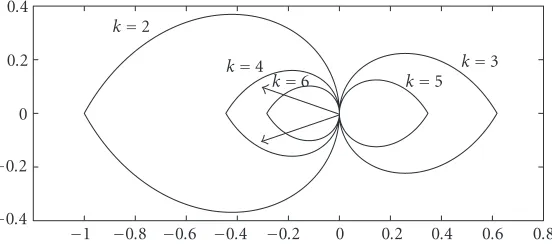
Stability ovals for (1.6) are displayed inFigure 3.1.
Projection of the results ofTheorem 3.1onto the real axis gives the following addition to the classical result of Levin and May [9], mentioned in the introduction.
Corollary3.2. The scalar equation (3.2) withλ∈Ris asymptotically stable if and only if
2 sin π
2(2k−1)>(−1)
k+1λ >0. (3.8)
Remark 3.3. Ifk=1, then the stability oval is the disk of radius 1 centered at (1 + 0i). If kis odd in (1.6), then stability oval is located in the right half-plane, ifk is even, then it is located in the left half-plane. Therefore, it is necessary for asymptotic stability of (1.6) that the condition Reλi>0 withkodd and the condition Reλi<0 withkeven hold. Hereλi(1≤i≤m) are the eigenvalues ofB. Compare it with scalar equation (1.2) and its stability domain inFigure 1.1. We see that witha= −1 in (1.2), the conditionb >0 is necessary for asymptotic stability withkodd, whileb <0 is necessary withkeven. The similarity is evident.
Corollary3.4. If there exist eigenvaluesλ1,λ2 ofB, such thatReλ1>0,Reλ2<0, then
1 0.8 0.6 0.4 0.2 0 0.2 0.4 0.6 0.8 0.4
0.2 0 0.2 0.4
k=6 k=4 k=2
k=5 k=3
Figure 3.1. Stability ovals for the system (1.6). The arrows represent the eigenvalues of a matrixBin
Example 3.6.
Now we are in a position to strengthenCorollary 2.5for (1.4) and (1.6).
Theorem3.5. If the system (1.4) (the system (1.6)) is asymptotically stable, then all eigen-values ofBlie inside the unit disk.
Proof. It is sufficient to consider the stability ovals (1.5) and (3.1) and to remark that |2 sin(π/2(2k−1))| ≤1 fork >1.
Example 3.6. Consider (1.6) withB=(−00.5.5−11.3.1). Eigenvalues of the matrixBareλ1,2=
−0.3±0.1i. Configuration of theλ1,λ2, and the stability ovals (seeFigure 3.1) indicates
that the equation is asymptotically stable fork=2, 4 and unstable fork=1, 3, and for any k >4.
4. Explicit stability conditions for (1.1)
In what follows, · is any matrix norm which satisfies the following conditions: (I)A ≥0, andA =0 if and only ifA=0,
(II) for eachc∈R,cA = |c| · A, (III)A+B ≤ A+B,
(IV)AB ≤ A · Bfor all (m×m) matricesA,B.
In addition, matrix norm should be concordant with the vector norm · ∗, that is,
Ax∗≤ A · x∗ (4.1)
for allx∈Rmand any (m×m) matrixA.
For real (m×m) matrixA, we define, as usual,A1=max1≤j≤mmi=1|aij|andA∞=
max1≤i≤mmj=1|aij|.
We will give a Cohn-type sufficient stability condition [3] for (2.1) (see also [2, Theo-rem 2.1] and [11, Theorem 2]).
Proof. Assume that max(x−1,...,x−k)=M andki=1Ai =b <1. Sequentially for
Next Corollary gives a delay-independent Cohn-type stability condition for (1.1). Corollary4.2. If
A+B<1, (4.4)
then (1.1) is asymptotically stable.
Example 4.3. Consider (1.1) withA=(−0.5 0
0.4 0.1),B=(−00.3.2 0−0.2.1). We haveA1+B1=
1.4>1, butA∞+B∞=0.9<1. ByCorollary 4.2, the equation is asymptotically
sta-ble for any delayk.
Some additional domains to the Cohn domain for scalar variant of (2.1) were de-scribed in [2, Theorem 2.3, Corollary 2.4] employing the Halanay-type inequalities. In the spirit of [2] and earlier work [4], we will give a sufficient stability condition of (1.1), additional to Cohn-type condition (4.4). The following result is convenient for applica-tion to (1.1) whenA−I 1 andB 1.
Theorem4.4. If
A+B+ (k−1)BA−I+B<1, (4.5)
then (1.1) is asymptotically stable. Proof. Let us rewrite (1.1),
Example 4.5. Consider (1.1) with A=(1.01−0.02
0 1.01 ) and B=(−00.01.2−00.2). It is easily seen
that A+B>1 for any norm · . The Cohn-type condition (4.4) cannot be ap-plied. However,A+B1+ (k−1)B1(A−I1+B1)=0.83 + (k−1)0.0504. Hence,
Theorem 4.4guarantees asymptotic stability of (1.1) fork=1, 2, 3, 4. Additional calcula-tions, based onCorollary 2.2, give instability fork >4.
A lot of explicit stability conditions for scalar equations (see, e.g., [2,11,4,12]) can be translated to the language of linear systems (1.1). However, we will indicate a new phe-nomenon. We introduce an additional stability condition for (1.1) depending on whether the delayk is odd or even. The condition is convenient for applications to (1.1) when
A+I 1 andB 1.
Theorem4.6. If
A+ (−1)k+1B+ (k−1)BA+I+B<1, (4.7)
then (1.1) is asymptotically stable.
Proof. Assumekis odd. Let us rewrite (1.1) as xn=(A+B)xn−1−Bxn−1−xn−k
=(A+B)xn−1−B
k−1
i=1
(−1)i+1(A+I)xn
−i−1+Bxn−k−i. (4.8)
The conclusion of the theorem is a consequence ofTheorem 4.1and (4.8). Now suppose thatkis even. We rewrite (1.1) as
xn=(A−B)xn−1+Bxn−1+xn−k
=(A−B)xn−1+B
k−1
i=1
(−1)i+1(A+I)xn
−i−1+Bxn−k−i.
(4.9)
The proof is completed by the same arguments as in the preceding case. Example 4.7. Consider (1.1) withA=(−1.01−0.02
0 −1.01) and B=(−00.01.2−00.2) (cf.Example 4.5).
The Cohn-type condition (4.4) cannot be applied. For odd values ofk,Theorem 4.6is useless:A+B>1 for any norm · , hence (4.7) fails whenkis odd. For even values of k, we haveA−B1+ (k−1)B1(A+I1+B1)=0.83 + (k−1)0.0504.Theorem 4.6
now implies asymptotic stability of the equation fork=2 andk=4. Additional calcula-tions of the roots of characteristic equation (2.5) give instability fork=1,k=3, and for anyk >4.
Acknowledgments
References
[1] L. Berezansky and E. Braverman,On exponential dichotomy, Bohl-Perron type theorems and sta-bility of difference equations, Journal of Mathematical Analysis and Applications304(2005), no. 2, 511–530.
[2] L. Berezansky, E. Braverman, and E. Liz,Sufficient conditions for the global stability of nonau-tonomous higher order difference equations, Journal of Difference Equations and Applications11
(2005), no. 9, 785–798.
[3] A. Cohn,Uber die Anzahl der Wurzeln einer algebraischen Gleichung in einem Kreise¨ , Mathema-tische Zeitschrift14(1922), no. 1, 110–148.
[4] K. L. Cooke and I. Gy¨ori,Numerical approximation of the solutions of delay differential equa-tions on an infinite interval using piecewise constant arguments, Computers & Mathematics with Applications28(1994), no. 1–3, 81–92.
[5] F. M. Dannan,The asymptotic stability ofx(n+k) +ax(n) +bx(n−l)=0, Journal of Difference Equations and Applications10(2004), no. 6, 589–599.
[6] J. Dibl´ık and D. Ya. Khusainov,Representation of solutions of discrete delayed systemx(k+ 1)= Ax(k) +Bx(k−m) +f(k)with commutative matrices, Journal of Mathematical Analysis and Ap-plications318(2006), no. 1, 63–76.
[7] M. Kipnis and R. M. Nigmatulin,Stability of trinomial linear difference equations with two delays, Automation and Remote Control65(2004), no. 11, 1710–1723.
[8] S. A. Kuruklis,The asymptotic stability ofxn+1−axn+bxn−k=0, Journal of Mathematical Anal-ysis and Applications188(1994), no. 3, 719–731.
[9] S. A. Levin and R. M. May,A note on difference-delay equations, Theoretical Population Biology
9(1976), no. 2, 178–187.
[10] I. S. Levitskaya,A note on the stability oval forxn+1=xn+Axn−k, Journal of Difference Equations and Applications11(2005), no. 8, 701–705.
[11] E. Liz and J. B. Ferreiro,A note on the global stability of generalized difference equations, Applied Mathematics Letters15(2002), no. 6, 655–659.
[12] E. Liz and M. Pituk,Asymptotic estimates and exponential stability for higher-order monotone difference equations, Advances in Difference Equations2005(2005), no. 1, 41–55.
[13] Yu. P. Nikolaev,The set of stable polynomials of linear discrete systems: its geometry, Automation and Remote Control63(2002), no. 7, 1080–1088.
[14] ,The geometry ofD-decomposition of a two-dimensional plane of arbitrary coefficients of the characteristic polynomial of a discrete system, Automation and Remote Control65(2004), no. 12, 1904–1914.
[15] V. G. Papanicolaou,On the asymptotic stability of a class of linear difference equations, Mathemat-ics Magazine69(1996), no. 1, 34–43.
[16] Z. I. Rekhlitskii,On the stability of solutions of certain linear differential equations with a lagging argument in the Banach space, Doklady Akademii Nauk SSSR111(1956), 770–773 (Russian).
Mikhail Kipnis: Department of Mathematics, Chelyabinsk State Pedagogical University, 69 Lenin Avenue, Chelyabinsk 454080, Russia
E-mail address:[email protected]
Darya Komissarova: Department of Mathematics, Southern Ural State University, 76 Lenin Avenue, Chelyabinsk 454080, Russia