R E S E A R C H
Open Access
Exact oscillation regions for a partial
difference equation
Chunhua Yuan
1,2, Shutang Liu
1*and Jian Liu
1,2*Correspondence: [email protected] 1School of Control Science and
Engineering, Shandong University, Jinan, Shandong 250061, P.R. China Full list of author information is available at the end of the article
Abstract
This paper is concerned with a partial difference equation with constant coefficients. By means of the theory of envelopes, we consider the regions of non-positive roots of its characteristic equation and obtain a necessary and sufficient condition for the oscillation of all solutions of the partial difference equation.
MSC: 39A21; 39A14
Keywords: partial difference equation; oscillation; envelope; characteristic equation
1 Introduction
Partial difference equations have numerous applications in image processing, material me-chanics, random walk problems, molecular orbits, finite difference schemes, as well as population dynamics [–]. In recent years, the oscillatory behavior of partial difference equations has been discussed in many papers (see [–] and the references therein).
In [–], Lin and Cheng gave explicit necessary and sufficient conditions for all so-lutions of some ordinary difference equations with constant coefficients to be oscillatory by means of the envelope theory of a family of straight lines. However, to the best of our knowledge, very little attention has been paid to the analysis of the oscillatory behavior of solutions of partial difference equations from the perspective of the envelope theory.
In this paper, we consider the partial difference equation of the form
un+,m+un,m++aun+,m+bun,m++cun,m= , () wherea,b,care real numbers andm,nare nonnegative integers. The purpose of this paper is to develop a new method for the analysis of the oscillation of () based on the theory of envelopes.
By a solution of (), we mean a nontrivial double sequence{Am,n}of real numbers which is defined form≥ andn≥ and satisfies () form≥ andn≥.
A solution {Am,n} of () is said to be eventually positive (or negative) if Am,n≥ (or Am,n≤) for largemandn. It is said to be oscillatory if it is neither eventually positive nor eventually negative.
The paper is organized as follows. Section presents several useful lemmas. In Section , we derive the oscillation criterion for partial difference equation (). Two examples are given to illustrate our oscillation criterion in Section . Finally Section is devoted to concluding remarks.
2 Some lemmas
In this section, we give some preliminaries that will be needed in the next section. From Corollary . in [], we can easily obtain the following lemma.
Lemma The following statements are equivalent:
(a) Every solution of ()is oscillatory. (b) The characteristic equation of ()
λ+μ+aλ+bμ+c=
has no positive roots.
Lemma ([]) Suppose that f(x,y),g(x,y),h(x,y)and v(x,y)are differentiable on(–∞, +∞)×(–∞, +∞).Letbe a two-parameter family of planes defined by the equation
f(λ,μ)x+g(λ,μ)y+h(λ,μ)z=v(λ,μ),
whereλandμare parameters.Letbe the envelope of the family.Then the equation
f(λ,μ)a+g(λ,μ)b+h(λ,μ)c=v(λ,μ)
has no real roots if and only if there is no tangent plane of passing through the point (a,b,c)in the Euclidean space R.
Lemma ([]) For the linear homogeneous difference equation
un+k+aun+k–+· · ·+akun= , ()
where n is a nonnegative integer,k is a positive integer and a,a, . . . ,akare real numbers, the following statements are equivalent:
(a) Every solution of ()is oscillatory. (b) The characteristic equation of ()
λk+aλk–+· · ·+ak=
has no positive roots.
3 Main results
In this section, we establish the necessary and sufficient condition for oscillations of all solutions of () by the envelope theory.
Theorem Every solution of ()oscillates if and only if a≥,b≥and c≥or a< , b< and
c>a
+b
Proof The characteristic equation of () is
λ+μ+aλ+bμ+c= .
Let
f(a,b,c,λ,μ) =λ+μ+aλ+bμ+c= . ()
Since we mainly discuss the oscillations of (), by Lemma , attention will be restricted to the case whereλ> andμ> . To this end, we will think of (a,b,c) as a point in the Eu-clidean spaceRand try to find the exact regions containing points (a,b,c) in the Euclidean
spaceRsuch that () has no positive roots. In fact,f(x,y,z,λ,μ) = can be regarded as
an equation describing a two-parameter family of planes in the Euclidean spaceR, where x,yandzare the coordinates of points of the planes in the Euclidean spaceRandλ,μ
are two parameters.
By the envelope theory, the points of the envelope of the two-parameter family of planes described by () satisfy the system of equations
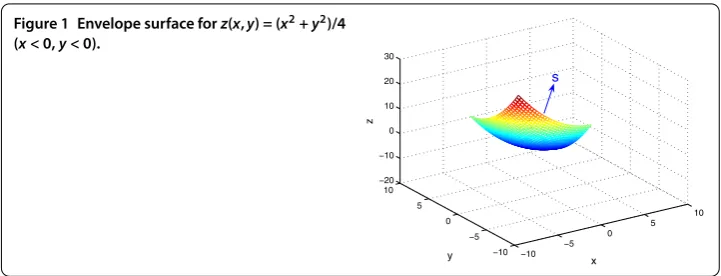
⎧ envelopeSwhich also passes through this point, and when the point (a,b,c) is vertically above the envelopeS, that is,a< ,b< andc> (a+b)/, there cannot exist any tangent
plane of the envelopeSwhich also passes through this point, while the point (a,b,c) is situated elsewhere, there always exists a tangent plane of the envelopeSwhich also passes through this point. By Lemma , the characteristic equation () does not have any positive roots if and only ifa≥,b≥ andc≥ ora< ,b< and
c>a
+b
.
Lemma implies that the statement of this theorem is true. The proof is thus completed.
Figure 1 Envelope surface forz(x,y) = (x2+y2)/4 (x< 0,y< 0).
If we letμ= in (), then () reduces to the form
λ+aλ+c= . ()
The corresponding ordinary difference equation of () takes the form
un++aun++cun= . ()
On the basis of Theorem , we can obtain the following results.
Corollary Equation()has no positive roots if and only if c≥and a≥or a< and c>a/.
Remark In fact, Corollary is just Theorem . of [].
Corollary Every solution of ()oscillates if and only if c≥and a≥or a< and c>a/.
Proof Combining the results of Corollary and Lemma yields the proof.
Remark Corollary shows that Theorem is a natural generalization for the corre-sponding result of ordinary difference equation (), and ordinary difference equation () is a special case of our study.
4 Illustrative examples
In this section, two examples are given to illustrate the applications of Theorem .
Example Consider the partial difference equation
un+,m+un,m+– .un+,m– .un,m++ .un,m= , ()
wherem,nare nonnegative integers.
From (), we havea= –. < ,b= –. < and (a+b)/ = ((–.)+ (–.))/ =
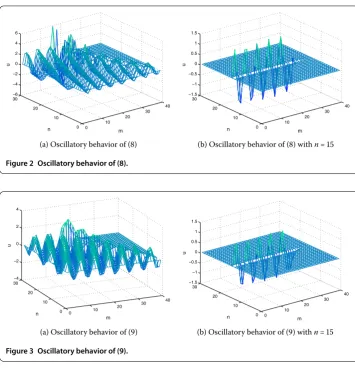
(a) Oscillatory behavior of () (b) Oscillatory behavior of () withn=
Figure 2 Oscillatory behavior of (8).
(a) Oscillatory behavior of () (b) Oscillatory behavior of () withn=
Figure 3 Oscillatory behavior of (9).
Example Consider the partial difference equation
un+,m+un,m++ .un+,m+ .un,m++ .un,m= , () wherem,nare nonnegative integers.
From (), we havea= . > ,b= . > andc= . > . It follows from Theorem that every solution of () is oscillatory. The oscillatory behavior of () is demonstrated by Figure .
5 Conclusions
In this paper, we have introduced a novel approach to problems of oscillations of a partial difference equation. Our approach is based on the envelope theory of the family of planes. We derive effective criteria to determine oscillations of a partial difference equation by this approach. Numerical examples are given to illustrate the results presented in this paper.
Competing interests
The authors declare that they have no competing interests.
Authors’ contributions
Author details
1School of Control Science and Engineering, Shandong University, Jinan, Shandong 250061, P.R. China.2School of
Mathematical Science, University of Jinan, Jinan, Shandong 250022, P.R. China.
Acknowledgements
This work is supported by the National Natural Science Foundation of P.R. China under Grant No. 61273088. The authors thank the editor and the referees for their valuable suggestions and comments.
Received: 29 October 2014 Accepted: 26 January 2015
References
1. Shi, BE, Chua, LO: Resistive grid image filtering: input/output analysis via the CNN framework. IEEE Trans. Circuits Syst. I39, 531-548 (1992)
2. Meakin, P: Models for material failure and deformation. Science252, 226-234 (1991)
3. Strikwerda, JC: Finite Difference Schemes and Partial Difference Equations. Wadsworth & Brooks, Pacific Grove (1989) 4. Li, X: Partial difference equations used in the study of molecular orbits. Acta Chim. Sin.40, 688-698 (1982) 5. Berman, G, Fryer, KD: Introduction to Combinatorics. Academic Press, New York (1972)
6. LeVeque, RJ: Numerical Methods for Conservation Laws. Birkhäuser, Berlin (1990)
7. Cheng, S: Partial Difference Equations. Advances in Discrete Mathematics and Applications, vol. 3. Taylor & Francis, London (2003)
8. Yuan, C, Liu, S: An envelope surface method for determining oscillation of a delay 2-D discrete convection system. J. Differ. Equ. (2014). doi:10.1007/s10884-014-9422-x
9. Zhang, B, Xing, Q: Oscillation of certain partial difference equations. J. Math. Anal. Appl.329, 567-580 (2007) 10. Zhang, B, Agarwal, RP: The oscillation and stability of delay partial difference equations. Comput. Math. Appl.45,
1253-1295 (2003)
11. Agarwal, RP, Zhou, Y: Oscillation of partial difference equations with continuous variables. Math. Comput. Model.31, 17-29 (2000)
12. Zhang, B, Yu, J: Linearized oscillation theorems for certain nonlinear delay partial difference equations. Comput. Math. Appl.35, 111-116 (1998)
13. Wong, PJY, Agarwal, RP: Oscillation criteria for nonlinear partial difference equations with delays. Comput. Math. Appl.
32, 57-86 (1996)
14. Zhang, B, Zhou, Y: Qualitative Analysis of Delay Partial Difference Equations. Hindawi Publishing Corporation, New York (2007)
15. Cheng, S, Lin, Y: Complete characterizations of a class of oscillatory difference equations. J. Differ. Equ. Appl.2, 301-313 (1996)
16. Cheng, S, Lin, Y: Complete characterizations of an oscillatory neutral difference equation. J. Math. Anal. Appl.221, 73-91 (1998)
17. Chen, L, Lin, Y, Cheng, S: Exact regions of oscillation for a difference equation with six parameters. J. Math. Anal. Appl.
222, 92-109 (1998)
18. Cheng, S, Lin, Y, Rassias, TM: Exact regions of oscillation for a difference equation with five parameters. J. Differ. Equ. Appl.6, 513-534 (2000)
19. Agarwal, RP, Grace, SR, O’Regan, D: Oscillation Theory for Difference and Functional Differential Equations. Kluwer Academic, Dordrecht (2000)