The pion quasiparticle in the low-temperature phase of QCD
Bastian B.Brandt1,AnthonyFrancis2,Harvey B.Meyer3,DanielRobaina4, andKaiZapp3, 1Institut für Theoretische Physik, Johann Wolfgang Goethe-Universität,
D-60438 Frankfurt am Main, Germany
2Department of Physics & Astronomy, York University, Toronto ON M3J 1P3, Canada 3PRISMA Cluster of Excellence, Institut für Kernphysik and Helmholtz-Institut Mainz, Johannes Gutenberg-Universität Mainz, D-55099 Mainz, Germany
4Institut für Kernphysik, Technische Universität Darmstadt, D-64289 Darmstadt, Germany
Abstract.We extend our previous studies [PhysRevD.90.054509, PhysRevD.92.094510] of the pion quasiparticle in the low-temperature phase of two-flavor QCD with support from chiral effective theory. This includes the analysis performed on a finite temperature ensemble of size 20×643 atT ≈ 151MeV and a lighter zero-temperature pion mass
mπ ≈185 MeV. Furthermore, we investigate the Gell-Mann–Oakes-Renner relation at finite temperature and the Dey-Eletsky-Ioffe mixing theorem at finite quark mass.
1 Introduction
The study of strongly interacting matter under extreme conditions such as finite temperature has pre-sented a theoretical and experimental challenge for many years. In experiment, heavy-ion collisions offer the possibility to study hot and dense QCD matter under laboratory conditions. One objective is
to gain insights into the deconfined phase, namely the Quark-Gluon-Plasma, where the fundamental degrees of freedom of QCD, i.e., quarks and gluons, are expected to become quasiparticles. Therefore it is important to investigate how the zero-temperature excitations get modified with increasing tem-perature. On the theory side, often the Hadron Resonance Gas Model is used in the low-temperature phase. It describes the thermodynamics by assuming the medium to consist of a non-interacting gas of hadrons and resonances up to a cut-offmass. However, its success in providing estimates for
equilibrium properties of the medium, such as quark susceptibilities, does not imply that individual excitations of the spectrum are in any sense similar to their vacuum analogues.
Here we present an extension of our study [1,2] concerning the pion quasiparticle in the low-temperature phase of two-flavor QCD. In this article, we test the modified dispersion relation of the pion quasiparticle on a new ensemble with a lighter zero-temperature pion mass. Furthermore, we investigate the Gell-Mann–Oakes–Renner relation at finite temperature as well as the Dey-Eletsky-Ioffe mixing theorem [3] at finite quark mass.
2 Dispersion relation of the pion quasiparticle
In this section we describe our analysis of the modified dispersion relation of the pion quasiparticle as it is proposed by thermal chiral perturbation theory [4,5] for anyT TC, i.e.,
ωp=u(T)
p2+m2
π. (1)
The associated chiral expansion around (T 0,mq = 0) is based on the assumption that one is sufficiently close to the chiral limit. In this limit, the ‘pion velocity’ u(T) is the group velocity of
a massless pion excitation. At finite but small quark mass and vanishing momentum it is the ratio between the quasiparticle massω0and the screening massmπ. For any temperature belowTCwe use two independent lattice estimators for the parameteru(T) [1]:
um=
−
4m2
q
m2
π
GP(x0,T,p=0)
GA(x0,T,p=0)
x
0=β/2
1/2
, (2)
uf = f
2
πmπ
2GA(β/2,T,p=0) sinh(ufmπβ/2)
. (3)
We use the definition of the quark massmq given by the PCAC relation andβdenotes the inverse temperature. The consistency of both estimators serves as an indicator for the applicability of the chiral expansion. Sinceu(T) is a renormalization group invariant quantity,umandufalso do not need any renormalization. The required time-dependent Euclidean correlators are
δabGA(x0,T,p)=
d3x eip·xAa
0(x)Ab0(0)=δab
∞
0 dω ρP(ω,p)
cosh(ω(β/2−x0))
sinh(ωβ/2) , (4)
δabGP(x0,T,p)=
d3x eip·xPa(x)Pb(0)=δab ∞
0 dω ρP(ω,p)
cosh(ω(β/2−x0))
sinh(ωβ/2) , (5) wherea,b are adjoint SU(2)isospin indices. The definition of the estimatorsuf andum further con-tains the pion screening decay constant fπand the screening pion massmπ which are defined by the asymptotic behavior of screening correlators, e.g.,
δabGs
A(x3,T,p=0)=
dx0d2x⊥
Aa
3(x)Ab3(0)
|x3|→∞
= δab f
2
πmπ
2 e−mπ|x3|. (6) The PCAC relation implies that at zero spatial momentum the spectral functions in P and/or A
chan-nels1are related by
ρAP(ω,p=0)= ω
2mρA(ω,p=0), (7)
ρP(ω,p=0)=−ω
2
4m2ρA(ω,p=0). (8)
Therefore, in order to extract the screening quantities, we formulate a simultaneous one-state fit ansatz for the corresponding correlation functions of the form
Gs
A(x3,T,p=0)= A2
1m1
2 cosh [m1(x3−L/2)], (9)
Gs
AP(x3,T,p=0)= A
2 1m21
2 sinh [m1(x3−L/2)], (10)
Gs
P(x3,T,p=0)=− A2
1m31
8m2
q cosh [m1(x3−L/2)]. (11)
2 Dispersion relation of the pion quasiparticle
In this section we describe our analysis of the modified dispersion relation of the pion quasiparticle as it is proposed by thermal chiral perturbation theory [4,5] for anyT TC, i.e.,
ωp=u(T)
p2+m2
π. (1)
The associated chiral expansion around (T 0,mq = 0) is based on the assumption that one is sufficiently close to the chiral limit. In this limit, the ‘pion velocity’ u(T) is the group velocity of
a massless pion excitation. At finite but small quark mass and vanishing momentum it is the ratio between the quasiparticle massω0and the screening massmπ. For any temperature belowTCwe use two independent lattice estimators for the parameteru(T) [1]:
um=
−
4m2
q
m2
π
GP(x0,T,p=0)
GA(x0,T,p=0)
x
0=β/2
1/2
, (2)
uf = f
2
πmπ
2GA(β/2,T,p=0) sinh(ufmπβ/2)
. (3)
We use the definition of the quark massmq given by the PCAC relation andβdenotes the inverse temperature. The consistency of both estimators serves as an indicator for the applicability of the chiral expansion. Sinceu(T) is a renormalization group invariant quantity,umanduf also do not need any renormalization. The required time-dependent Euclidean correlators are
δabGA(x0,T,p)=
d3x eip·xAa
0(x)Ab0(0)=δab
∞
0 dω ρP(ω,p)
cosh(ω(β/2−x0))
sinh(ωβ/2) , (4)
δabGP(x0,T,p)=
d3x eip·xPa(x)Pb(0)=δab ∞
0 dω ρP(ω,p)
cosh(ω(β/2−x0))
sinh(ωβ/2) , (5) wherea,b are adjoint SU(2)isospin indices. The definition of the estimatorsuf andumfurther con-tains the pion screening decay constant fπ and the screening pion massmπwhich are defined by the asymptotic behavior of screening correlators, e.g.,
δabGs
A(x3,T,p=0)=
dx0d2x⊥
Aa
3(x)Ab3(0)
|x3|→∞
= δabf
2
πmπ
2 e−mπ|x3|. (6) The PCAC relation implies that at zero spatial momentum the spectral functions in P and/or A
chan-nels1are related by
ρAP(ω,p=0)= ω
2mρA(ω,p=0), (7)
ρP(ω,p=0)=−ω
2
4m2ρA(ω,p=0). (8)
Therefore, in order to extract the screening quantities, we formulate a simultaneous one-state fit ansatz for the corresponding correlation functions of the form
Gs
A(x3,T,p=0)= A2
1m1
2 cosh [m1(x3−L/2)], (9)
Gs
AP(x3,T,p=0)= A
2 1m21
2 sinh [m1(x3−L/2)], (10)
Gs
P(x3,T,p=0)=− A2
1m31
8m2
q cosh [m1(x3−L/2)]. (11)
1See [1,2] for definitions in the ‘AP’ channel.
Here we also used thatGs
A,GsPare symmetric aroundx3 =L/2 and thatGsAPis antisymmetric around
x3 = L/2 on the lattice. We choose for the fit parameters values corresponding to a small
(uncorre-lated)χ2/d.o.f. which are stable with respect to small variations of the fit intervals for each correlator.
2.1 Lattice setup
The calculation was performed on a newly generated 20 × 643 lattice ensemble with a =
0.0658(7)(7) fm andT/Tc ≈0.91 relative toTc ≈ 165 MeV determined in the chiral limit for two dynamical degenerate light quarks [6,7]. The simulation uses the plaquette gauge action and theO(a )-improved Wilson fermion action with a non-perturbatively determinedcswcoefficient [8]. The values
of the bare parameters in the lattice action amount toβ=5.30 andκ=0.13642. The pion mass for the
corresponding zero-temperature CLS ensemble (G8) takes a value ofmπ(T =0)=ω00≈185MeV [9].
2.2 Results
The results of the analysis based on Eqs. (2,3,9-11) are shown in Table1. The new ensemble confirms the qualitative findings of our previous work. The deviation of the pion velocityu≈0.77 from unity
indicates a violation of boost invariance due to the thermal medium. Both estimatorsuf andumare in very good agreement signaling the validity of the chiral expansion. The calculated pion quasiparticle massω0 =ummπ ≈155 MeV is significantly lighter than at zero-temperature, i.e., the pole mass is shifted downward by approximately 16%. In contrast to that the pion screening massmπ ≈201 MeV is increased compared to the zero-temperature pion mass.
mπ/T 1.33(4)
fπ/T 0.502(4)
uf 0.778(30)
um 0.776(38)
ω0/T 1.03(3)
Table 1.Summary of the results of theNτ=20 thermal ensemble described in Sec.2.1. The pion quasiparticle massω0is calculated usingω0=ummπ. Forfπrenormalization factors [10] are included.
2.3 Axial-charge density correlator atp=0and p0
In order to test whether the parameterudetermined from the ratio of the quasiparticle to the screen-ing mass really does predict the dispersion relation of the quasiparticle, as in Eq.1, we analyze the time-dependent Euclidean correlatorGA(x0,T,p). In the high frequency region, a leading-order
per-turbative calculation for its spectral function, see e.g. [11], yields
ρA(ω,T,p)=θ(ω2−4m2−p2) Nc
24π2(p2+6m2), ω→ ∞. (12)
It is only at sufficiently small quark massesmand momenta p=(0,0,2πn/L), and not too smallx0,
that the correlator is parametrically dominated by the pion pole. Taking these non-pion contributions into account leads to the following fit ansatz for the spectral function
ρA(ω,Tp)=A1(p)ωsinh (ωβ/2)δ(ω−ω0)+A2(p) Nc
24π2
The corresponding fit ansatz for the spectral function reads
GA(x0,T,p)=A1(p)ω0cosh (ω0(β/2−x0))+A2(p)24Nπc2
e−cx0
x0 +
e−c(β−x0)
β−x0
. (14)
At finite momentum, leaving all four fit parameters free leads to poorly constrained fits. Therefore, the results obtained from the previous analysis of Sec.2.2were used to fixωpto the predicted value given by Eq.1. However, at zero momentum we can again use the PCAC relation to perform a simultaneous fit, including data points from time-dependent correlatorsGP andGAP. In this caseω0can be kept free. The fit parameterA1(p) is related to the residue of the pion pole via
Resωp=2A1(p)ω2psinh
ωpβ/2. (15)
To compare the fit results to the prediction from the chiral effective field theory we introduce a
param-eterb(p) which parametrizes a deviation from the expected residue
Resωp= fπ2mπ2+p2(1+b(p)). (16)
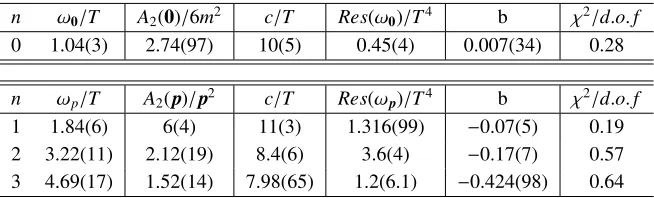
The results for vanishing and finite momentum are shown in Table2.3. The pion quasiparticle mass obtained from the simultaneous fits to the time-dependent correlators at zero momentum is consistent with the prediction from the previous analysis and the parameterbbeing compatible with zero indi-cates the validity of the chiral prediction. Figure1shows the relative pion contribution to the fits for the different channels. At the midpoint the non-pion contributions are at the sub-percent level
indicat-ing the dominance of the pion which is an essential assumption in the definition of the estimators for the pion velocityu. The results at finite momentum are qualitatively in agreement with our previous findings [2], namely at the lowest momentumb(p) is very small as expected from the effective theory.
n ω0/T A2(0)/6m2 c/T Res(ω0)/T4 b χ2/d.o.f 0 1.04(3) 2.74(97) 10(5) 0.45(4) 0.007(34) 0.28
n ωp/T A2(p)/p2 c/T Res(ωp)/T4 b χ2/d.o.f
1 1.84(6) 6(4) 11(3) 1.316(99) −0.07(5) 0.19
2 3.22(11) 2.12(19) 8.4(6) 3.6(4) −0.17(7) 0.57
3 4.69(17) 1.52(14) 7.98(65) 1.2(6.1) −0.424(98) 0.64
Table 2.Top: Results of the fits to the time-dependent correlators at vanishing momentum. Bottom: Results of fits to the axial-charge density correlator at non-vanishing momentumpn=(0,0,2πn/L). Here the quantity ωp/Tis set to the value predicted by Eq.1withu(T)=um=0.77(4). Renormalization factors are included [10].
3 Gell-Mann–Oakes–Renner relation
In this section we want to study the Gell-Mann–Oakes–Renner (GMOR) relation at finite temperature. The GMOR relation gives the pion mass in terms of the pion decay constant, the chiral condensate and the renormalized quark massm(r)
m2
π =−
ψψ
f2
π ·
The corresponding fit ansatz for the spectral function reads
GA(x0,T,p)=A1(p)ω0cosh (ω0(β/2−x0))+A2(p)24Nπc2 e−cx0
x0 +
e−c(β−x0)
β−x0
. (14)
At finite momentum, leaving all four fit parameters free leads to poorly constrained fits. Therefore, the results obtained from the previous analysis of Sec.2.2were used to fixωpto the predicted value given by Eq.1. However, at zero momentum we can again use the PCAC relation to perform a simultaneous fit, including data points from time-dependent correlatorsGP andGAP. In this caseω0 can be kept free. The fit parameterA1(p) is related to the residue of the pion pole via
Resωp=2A1(p)ω2psinhωpβ/2. (15)
To compare the fit results to the prediction from the chiral effective field theory we introduce a
param-eterb(p) which parametrizes a deviation from the expected residue
Resωp= fπ2mπ2+p2(1+b(p)). (16)
The results for vanishing and finite momentum are shown in Table2.3. The pion quasiparticle mass obtained from the simultaneous fits to the time-dependent correlators at zero momentum is consistent with the prediction from the previous analysis and the parameterbbeing compatible with zero indi-cates the validity of the chiral prediction. Figure1shows the relative pion contribution to the fits for the different channels. At the midpoint the non-pion contributions are at the sub-percent level
indicat-ing the dominance of the pion which is an essential assumption in the definition of the estimators for the pion velocityu. The results at finite momentum are qualitatively in agreement with our previous findings [2], namely at the lowest momentumb(p) is very small as expected from the effective theory.
n ω0/T A2(0)/6m2 c/T Res(ω0)/T4 b χ2/d.o.f
0 1.04(3) 2.74(97) 10(5) 0.45(4) 0.007(34) 0.28
n ωp/T A2(p)/p2 c/T Res(ωp)/T4 b χ2/d.o.f
1 1.84(6) 6(4) 11(3) 1.316(99) −0.07(5) 0.19
2 3.22(11) 2.12(19) 8.4(6) 3.6(4) −0.17(7) 0.57
3 4.69(17) 1.52(14) 7.98(65) 1.2(6.1) −0.424(98) 0.64
Table 2.Top: Results of the fits to the time-dependent correlators at vanishing momentum. Bottom: Results of fits to the axial-charge density correlator at non-vanishing momentumpn=(0,0,2πn/L). Here the quantity ωp/Tis set to the value predicted by Eq.1withu(T)=um=0.77(4). Renormalization factors are included [10].
3 Gell-Mann–Oakes–Renner relation
In this section we want to study the Gell-Mann–Oakes–Renner (GMOR) relation at finite temperature. The GMOR relation gives the pion mass in terms of the pion decay constant, the chiral condensate and the renormalized quark massm(r)
m2 π =−
ψψ f2
π ·
m(r). (17)
Figure 1.Pion contribution in percent for the different channels at zero momentum.
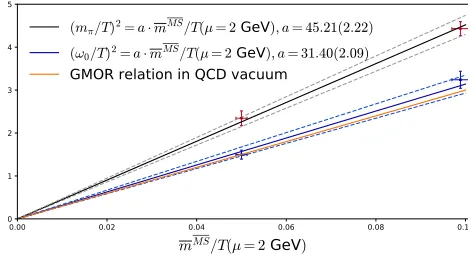
At finite temperature the pion mass splits into a pion quasiparticle mass and a screening mass. We have calculated both on two different ensembles with different quark masses at fixed inverse couplingβand temperatureT. The lattices are of size 16×483and have a lattice spacing of approximately 0.08 fm. Lattice parameters and the results based on the analysis described in Sec.2 are shown in Table3. Figure2 shows a linear dependence of both the squared pion screening mass and the squared pion quasiparticle mass on the renormalized quark mass at a fixed temperatureT ≈150 MeV. Compared to the vacuum result the slope is much steeper for the screening quantity. This is due to the decrease of the screening pion decay constantfπ. From a linear fit with zero intercept the slope can be estimated in the chiral limit, i.e.,
−
ψψ f2
πT
m=0=45.21(2.22) (18)
In case of the pion quasiparticle, we do not observe a statstically significant thermal change compared to the zero-temperature result. The determined slope is
−
ψψ
(fπ)t 2T
m=0=31.4(2.22), (19)
where ft
π ≡ fπ/u denotes the pion quasiparticle decay constant. For the heavier ensemble, within uncertainties its value does not deviate from the pion screening decay constant at zero-temperature obtained from the CLS ensemble with the same bare parameters (A5 ) [1], i.e., ft
π/fπ0 =1.010(44). This indicates that there is also no significant change of the chiral condensate, and therefore also no significant sign of chiral symmetry restoration.
4 Dey-Eletsky-Ioffe mixing theorem at finite quark mass
β 5.20
κ 0.13594
T 150 MeV
mMS/T(µ=2 GeV) 0.0989(19)
mπ/T 2.105(38)
fπ/T 0.564(8)
uf 0.870(15)
um 0.864(21)
β 5.20
κ 0.13599
T 150 MeV
mMS/T(µ=2 GeV) 0.0500(12)
mπ/T 1.53(6)
fπ/T 0.490(15)
uf 0.801(32)
um 0.799(41)
Table 3.Ensembles of size 16×483for the test of the GMOR relation. The quark mass is renormalized in the
MS scheme at a scale ofµ=2 GeV. Renormalization factors are taken from [10].
Figure 2.Test of the GMOR relation atT ≈150MeV. The vacuum result is taken from [12].
reads
ρV(ω,p,T)=(1−)ρV(ω,p,T =0)+ρA(ω,p,T =0), (20)
ρA(ω,p,T)=(1−)ρA(ω,p,T =0)+ρV(ω,p,T =0), (21)
where ≡ T2/6f2
π is a temperature dependent coefficient and fπ = 93MeV denotes the pion decay constant (atT =0). In particular, this implies that the difference of the vector and the axial spectal
function at finite-temperature is proportional to its zero-temperature equivalent:
ρV(ω,p,T)−ρA(ω,p,T)=(1−2)ρV(ω,p,T =0)−ρA(ω,p,T =0). (22)
Since this quantity is an order paramter for chiral symmetry restoration, it is instructive to investi-gate its behavior even at a finite quark mass. We consider the difference ‘V-A’ of the corresponding
correlators at zero momentum
δabGV(x0,T,p=0)−GA(x0,T,p=0)=
d3x 3
i=1
Va
i(x)Vib(0) − Aai(x)Abi(0)
β 5.20
κ 0.13594
T 150 MeV
mMS/T(µ=2 GeV) 0.0989(19)
mπ/T 2.105(38)
fπ/T 0.564(8)
uf 0.870(15)
um 0.864(21)
β 5.20
κ 0.13599
T 150 MeV
mMS/T(µ=2 GeV) 0.0500(12)
mπ/T 1.53(6)
fπ/T 0.490(15)
uf 0.801(32)
um 0.799(41)
Table 3.Ensembles of size 16×483for the test of the GMOR relation. The quark mass is renormalized in the
MS scheme at a scale ofµ=2 GeV. Renormalization factors are taken from [10].
Figure 2.Test of the GMOR relation atT ≈150MeV. The vacuum result is taken from [12].
reads
ρV(ω,p,T)=(1−)ρV(ω,p,T =0)+ρA(ω,p,T =0), (20)
ρA(ω,p,T)=(1−)ρA(ω,p,T =0)+ρV(ω,p,T =0), (21)
where ≡T2/6f2
π is a temperature dependent coefficient and fπ = 93MeV denotes the pion decay constant (atT =0). In particular, this implies that the difference of the vector and the axial spectal
function at finite-temperature is proportional to its zero-temperature equivalent:
ρV(ω,p,T)−ρA(ω,p,T)=(1−2)ρV(ω,p,T =0)−ρA(ω,p,T =0). (22)
Since this quantity is an order paramter for chiral symmetry restoration, it is instructive to investi-gate its behavior even at a finite quark mass. We consider the difference ‘V-A’ of the corresponding
correlators at zero momentum
δabGV(x0,T,p=0)−GA(x0,T,p=0)=
d3x 3
i=1
Va
i(x)Vib(0) − Aai(x)Abi(0)
. (23)
Measurements are performed on a 24×643lattice with two dynamical light quarks with a mass
ofmMS(µ =2GeV)= 12.8(1) MeV. The temperature isT = 1/24a ≈169MeV. Furthermore, we use a 128×643 corresponding quasi zero-temperature CLS ensemble (O7) to obtain a comparable
effectively zero-temperature quantity for the difference ‘V−A’2. This is achieved by calculating the
‘reconstructed’ correlator for the difference, i.e., the thermal Euclidean correlator that would be
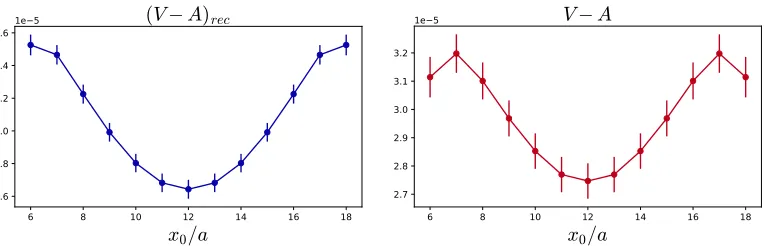
real-ized if the spectral function was unaffected by thermal effects [13]. Figure3shows the reconstructed
correlator for the difference ‘V−A’ and the same quantity for the thermal ensemble.
Figure 3. Left: The reconstructed correlator for the difference ’V−A’. Right: The difference of ‘V −A’ at T≈169 MeV. All renormalization factors are included [10,14].
Their ratio is shown in Figure4. Even for a finite quark mass of approximately 12.8 MeV it is
very flat, consistent with the prediction of Eq.22obtained in the chiral limit. The difference ‘V−A’
shows a significant reduction, by a factor of approximately 0.6 atT ≈169MeV. Therefore, chiral restoration is at an advanced stage in the spectral function. The interested reader is also referred to [7], where a rapid approach to chiral restoration in the difference of vector and axial-vector screening
masses was observed.
Figure 4.Ratio of the difference ’V−A’ and the reconstructed correlator.
5 Conclusions and outlook
We have investigated the pion quasiparticle and order parameters for chiral restoration inNf =2 QCD. The results obtained from the new ensemble with a lighter quark mass are qualitatively in agreement with our previous findings [1,2], namely that the pion mass splits in a significantly lighter pion quasi-particle mass and a heavier screening mass. Furthermore, we successfully tested that the modified dispersion relation given in Eq.1 is determined by the ‘pion velocity’u ≈ 0.77 corresponding to
a violation of boost invariance due to the thermal medium. We find no deviation from the GMOR relation up to the considered quark massmMS(µ=2GeV)≈15 MeV. In addition, two different order parameters have been investigated. The chiral condensate obtained from the GMOR relation shows no significant thermal change atT ≈150 MeV indicating no sign of chiral symmetry restoration. In contrast to that, atT ≈169 MeV, the ‘V−A’ correlator is notably reduced by a factor of approxi-mately 0.6 compared to its value at zero-temperature. Here, chiral restoration in the ‘V−A’ spectral function is at a more advanced stage.
Future considerations might include the possibility of a finite width of the pion quasiparticle. Ad-ditionally, for a more rigorous comparison of the pion screening mass it might be instructive to extract the equivalent quantity from corresponding zero-temperature spatial correlation functions. Further-more, we plan to extend our studies toNf =2+1, including a dynamical strange quark.
6 Acknowledgements
We acknowledge the use of computing time on the JUGENE and JUQUEEN computers of the Gauss Centre for Supercomputing located at Forschungszentrum Juelich, Germany under grant HMZ21. Part of the calculations were performed on the cluster ‘Clover’ of the Helmholtz-Institute Mainz. This work was supported by the DFG Grant No. ME 3622/2-2QCD at non-zero temperature with Wilson fermions on fine lattices.
References
[1] B.B. Brandt, A. Francis, H.B. Meyer, D. Robaina, Phys. Rev.D90, 054509 (2014),1406.5602 [2] B.B. Brandt, A. Francis, H.B. Meyer, D. Robaina, Phys. Rev.D92, 094510 (2015),1506.05732 [3] M. Dey, V.L. Eletsky, B.L. Ioffe, Phys. Lett.B252, 620 (1990)
[4] D.T. Son, M.A. Stephanov, Phys. Rev. Lett.88, 202302 (2002),hep-ph/0111100 [5] D.T. Son, M.A. Stephanov, Phys. Rev.D66, 076011 (2002),hep-ph/0204226
[6] B.B. Brandt, A. Francis, H.B. Meyer, O. Philipsen, H. Wittig, PoSLATTICE2013, 162 (2014), 1310.8326
[7] B.B. Brandt, A. Francis, H.B. Meyer, O. Philipsen, D. Robaina, H. Wittig, JHEP12, 158 (2016), 1608.06882
[8] K. Jansen, R. Sommer (ALPHA), Nucl. Phys. B530, 185 (1998), [Erratum: Nucl. Phys.B643,517(2002)],hep-lat/9803017
[9] M. Della Morte, A. Francis, V. Gülpers, G. Herdoíza, G. von Hippel, H. Horch, B. Jäger, H.B. Meyer, A. Nyffeler, H. Wittig, JHEP10, 020 (2017),1705.01775
[10] P. Fritzsch, F. Knechtli, B. Leder, M. Marinkovic, S. Schaefer, R. Sommer, F. Virotta, Nucl. Phys.B865, 397 (2012),1205.5380
[11] G. Aarts, J.M. Martinez Resco, Nucl. Phys.B726, 93 (2005),hep-lat/0507004
[12] G.P. Engel, L. Giusti, S. Lottini, R. Sommer, Phys. Rev. Lett.114, 112001 (2015),1406.4987 [13] H.B. Meyer, JHEP04, 099 (2010),1002.3343
[14] M. Della Morte, R. Hoffmann, F. Knechtli, R. Sommer, U. Wolff, JHEP 07, 007 (2005),