©Owned by the authors, published by EDP Sciences, 2016
Nucleon structure observables with
PANDA
María Carmen Mora Espí1,2,a, on behalf of the PANDA collaboration
1Institut für Kernphysik, Johannes Gutenberg-Universität Mainz, Johann-Joachim-Becher-Weg 45, D-55128 Mainz, Germany.
2Helmholtz-Institut Mainz, Staudingerweg 18, 55128 Mainz, Germany.
Abstract. ThePANDAdetector will be built as a part of the futureFAIRfacility in Darmstadt. The availability of an antiproton beam with beam momenta up to 15 GeV/c will make possible a broad nuclear physics program. Topics like hadron spectroscopy in the charmonium mass region, the property of hadrons inside nuclear matter, hypernuclear physics, or nucleon properties using electromagnetic processes are part of the physics program ofPANDA. The main part of this contribution concentrates on the feasibility of measurement of nucleon structure observables, such as electromagnetic form factors or transition distribution amplitudes, via experiments using electromagnetic processes in PANDA.
1 Introduction
Understanding Quantum Chromodynamics (QCD), describing the strong force, is one of the most challenging fields of physics. The interaction mechanisms between fundamental particles can be de-scribed using perturbative QCD (p-QCD) at short distances with very high precision and predictive power. However, at long distances a series of spectacular phenomena, e.g. generation of hadron masses, formation of hadronic matter and color confinement, appear, and these cannot be described by basic QCD principles. The ultimate goal for thePANDA(antiProton ANnihilations at DArm-stadt) experiment will be to explore the strong interaction at precisely the energy interval correspond-ing to the transition between the perturbative and the non-perturbative regimes of QCD. The high-intensity and high-resolution antiproton beam of the High Energy Storage Ring (HESR), ranging from
pp¯ =1.5 GeV/c topp¯ =15 GeV/c, of the future Facility for Antiproton and Ion Research (FAIR) in Darmstadt will be an excellent instrument to fulfill the ambitious physics program foreseen by the PANDAcollaboration [1]. This includes several fields of research:
• Hadron spectroscopy: The study of QCD bound states (charmonium,D-meson and baryon spec-troscopy, exotic states...) is of fundamental importance for a better, quantitative understanding of QCD. Unique precision measurements will help to distinguish between the different theory
ap-proaches used for the computation of particle spectra. The study of exotic bound states such as glueballs or hybrids will be also addressed in thePANDAcollaboration.
• Hyperon production dynamics: The measurement of reactions involving hyperons can help study-ing the creation mechanism of quark-antiquark pairs and their arrangement to hadrons. The self-analysing weak decays of most hyperons give access to spin degrees of freedom for these reactions. • Study of Hadrons in Nuclear Matter: The study of medium modifications of hadrons embedded in hadronic matter is aimed at understanding the origin of hadron masses in the context of spontaneous chiral symmetry breaking in QCD and its partial restoration in a hadronic environment.
• Hypernuclear Physics: The availability of antiproton beams atFAIRwill allow efficient production
of hypernuclei with more than one strange hadron. In particular, the production ofΞcan be used to
form doubleΛhypernuclei, which will offer a unique opportunity to study basic properties of the
potential between nucleons and hyperons in a bound state.
• Electroweak Physics: With the high intensity antiproton beam available at HESR, a large number of D-mesons can be produced. This gives the possibility to observe rare weak decays of these mesons allowing studying electroweak physics by probing predictions of the Standard Model and searching for enhancements introduced by processes beyond the Standard Model.
• Nucleon structure: PANDA will enable the investigation of the structure of the nucleon using electromagnetic processes. Nucleon structure observables,e.g. the Electromagnetic Form Factors (EMFF) or the Transition Distribution Amplitudes (TDA) will be measured withPANDA. Detailed information about these and other processes are presented later in this paper.
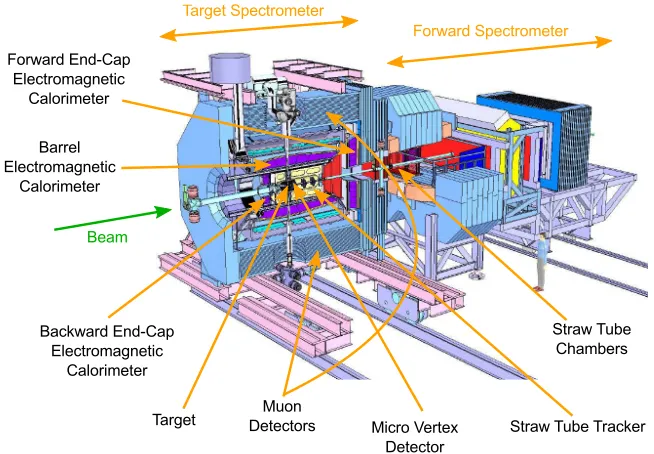
Figure 1. Sketch of thePANDAdetector, divided into the target spectrometer and the forward spectrometer. Both spectrometers contain modular detectors for tracking, particle identification, electromagnetic calorimetry and muon identification. The main detectors in the target spectrometer are signaled with arrows.
In order to successfully achieve the previously mentioned goals,PANDAneeds to be an almost 4π
• Hyperon production dynamics: The measurement of reactions involving hyperons can help study-ing the creation mechanism of quark-antiquark pairs and their arrangement to hadrons. The self-analysing weak decays of most hyperons give access to spin degrees of freedom for these reactions. • Study of Hadrons in Nuclear Matter: The study of medium modifications of hadrons embedded in hadronic matter is aimed at understanding the origin of hadron masses in the context of spontaneous chiral symmetry breaking in QCD and its partial restoration in a hadronic environment.
• Hypernuclear Physics: The availability of antiproton beams atFAIRwill allow efficient production
of hypernuclei with more than one strange hadron. In particular, the production ofΞcan be used to
form doubleΛhypernuclei, which will offer a unique opportunity to study basic properties of the
potential between nucleons and hyperons in a bound state.
• Electroweak Physics: With the high intensity antiproton beam available at HESR, a large number of D-mesons can be produced. This gives the possibility to observe rare weak decays of these mesons allowing studying electroweak physics by probing predictions of the Standard Model and searching for enhancements introduced by processes beyond the Standard Model.
• Nucleon structure: PANDA will enable the investigation of the structure of the nucleon using electromagnetic processes. Nucleon structure observables,e.g. the Electromagnetic Form Factors (EMFF) or the Transition Distribution Amplitudes (TDA) will be measured withPANDA. Detailed information about these and other processes are presented later in this paper.
Figure 1. Sketch of thePANDAdetector, divided into the target spectrometer and the forward spectrometer. Both spectrometers contain modular detectors for tracking, particle identification, electromagnetic calorimetry and muon identification. The main detectors in the target spectrometer are signaled with arrows.
In order to successfully achieve the previously mentioned goals,PANDAneeds to be an almost 4π
detector with very good energy resolution, at a few percent level, and excellent particle identification (PID) capabilities, with a fast data acquisition system (DAQ) and high radiation hardness. The basic
concept of the setup is a fixed-target experiment divided into a target spectrometer, with a 2 T solenoid around the target area to detect particles with low momenta, and a forward spectrometer based on a 2 T dipole in order to ensure particle detection below 2° for faster particles. Modular detectors for tracking, particle identification, electromagnetic calorimetry and muon identification are designed for both spectrometers. The modularity will enable an easy replacement of parts of the tracking system and the backward Electromagnetic Calorimeter (EMC) with the hypernuclear setup. The latter has dedicated targets and gamma-ray detectors that will be used in a more advanced stage of the measurement program. Figure 1 shows a sketch of thePANDAdetector depicting various subsystems foreseen to achieve the desired detection capabilities. A complete description of the different setups
can be found in various technical design reports [2–7].
2 Nucleon structure observables
2.1 Proton Electromagnetic Form Factors
The annihilation of ¯ppinto ane+e−pair (or more generally, a+−pair, with =e, µ) via a virtual
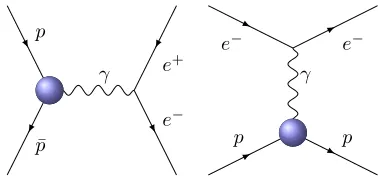
photon of massq2 = s (withs being the squared total energy available in the annihilation) gives access to the hadron-electromagnetic vertexγpp¯ . This vertex gives information about the proton EMFF,i.e.analytical functions ofq2parameterizing the hadronic current at the vertex. The kinematic region accessible byPANDA is the time-like (TL) region of momentum transfer squared,q2 > 0, also reachable by the time-reversed reactione+e− → pp¯ (in general,+− → pp¯ ). This reaction is
related by crossing symmetry to elastic electron-proton scattering (see Fig. 2), which gives access to the space-like (SL) region of momentum transfer squared,q2 <0. In the SL region, the EMFF can be interpreted as the Fourier transform of the distribution of charge and magnetization in the Breit-frame. Both regions are connected due to the analyticity and unitarity of the EMFF via the dispersion relations. A full review on EMFF can be found for example in Ref. [8].
The proton EMFF in the SL region have been studied since many years and abundant and precise data exist in this region. However, recent analyses using polarization methods show results in contra-diction with older results from Rosenbluth separation. This has given rise to a lot of discussion about the knowledge of the SL EMFF. In addition, the data collected in the TL region are still very limited. Any measurement here would contribute to expand the knowledge on these functions, not only in the TL region but also in the SL region. ThePANDAexperiment will offer an excellent opportunity to
ex-tend the, until now, scarce data bank on TL EMFF, and therefore will help disentangling the questions arisen about the EMFF in the last years (see also Refs. [9, 10]).
The current world-wide data available on the EMFF in the TL region are shown in Fig. 3. Due
e+
e− γ
p
¯
p
e− e−
γ
p p
Figure 2. Feynman diagrams of the reactions ¯pp → e+e−ande−p → e−p. The balls represent the hadron
to the small data samples, only the measurement of the ratioRor the measurement of an effective
form factor under the assumption|GE| = |GM|was possible. The results extracted by BaBar [11],
from measurements of initial state radiation (ISR) processes (e+e−→ppγ¯ ) are not in agreement with
the previous results from LEAR ( ¯pp → e+e−) [12]. More recent measurements by BESIII [13] at different energies usinge+e− → pp¯ have large uncertainties. Other measurements do not add more
relevant information [14, 15]. It is clear that the puzzle of the EMFF in the TL region is far from being understood. The high intensity and high resolution beam ofPANDAwill enable the measurement of the differential cross section of the process ¯pp→ e+e−, which will grant not only the ratio between
|GE|and|GM|, but also the chance to separate them. Feasibility studies for the measurement of the TL
EMFF withPANDAusing the reactions ¯pp → e+e−and ¯pp → µ+µ−have been performed and are
summarised in the following.
Concerning the studies for the reaction ¯pp →e+e−[16], two independent simulations were
per-formed. Method-I makes use of a dedicated event generator based on the theoretical cross section [17],
dσ dcosθ =
πα2
8EP
|GM|2(1+cos2θ)+|GE|
2
τ (1−cos
2θ), (1)
withEandPare the energy and momentum of the antiproton in the center of mass (CM) frame,αis
the fine structure constant,τ= 4qM22
p, andθis the lepton emission polar angle in the proton-antiproton
CM system. In these simulations,|GE|/|GM| =1 is assumed, and the expected amount of events is
generated at each energy. In Method-II, 106events are simulated using a flat angular distribution and the results are later scaled to the expected size of the data sample using a given model (i.e.Eq. 1 with |GE|=|GM|). In both methods an independent simulated sample with 106events is used for the study
of the efficiency. In Method-I, a fit using the cross section formula in Eq. 1 to the reconstructed,
efficiency corrected distribution, as a function of cos2θis used to extract the values of the EMFF. In
Method-II, a linear fit to
y=σ0+σ0Acos2θ , (2)
with
σ0=πα
2 2βs
|GM|2+1 τ|GE|
2 and A= τ−R2
τ+R2, (3)
is used. The main challenge of this analysis is the elimination of the huge hadronic background, due to the 106times larger cross section of the channel, ¯pp→π+π−. For the studies of the suppression of
the main background channel, an event generator based on the calculations in Ref. [18] was developed in Mainz [19]. Other channels (e.g. pp¯ →K+K−) are easily suppressed using kinematic constraints.
Both simulations arrive to the same conclusion:PANDAwill be able to measure the ratio between the electric and magnetic Form Factors (FF),R = |GE|/|GM|in a broad range of q2 values up to
q2 =14 (GeV/c)2, improving the precision of the existing results in at least one order of magnitude. In addition, the separation between the electric and magnetic FF will be possible. The measurement of the proton effective FF can be extended to higherq2 values according to the experimental efficiency.
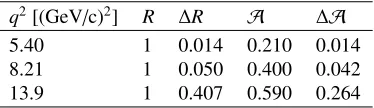
The results of these simulations are shown in Tab. 1 and Tab. 2, and also in Fig. 3 together with the results from previous experiments.
The difference between the error bars extracted with each method atq2=13.9 GeV/c2is explained
by the different size of the data samples considered in each simulation. Given an integrated
to the small data samples, only the measurement of the ratioRor the measurement of an effective
form factor under the assumption|GE| = |GM|was possible. The results extracted by BaBar [11],
from measurements of initial state radiation (ISR) processes (e+e−→ ppγ¯ ) are not in agreement with
the previous results from LEAR ( ¯pp → e+e−) [12]. More recent measurements by BESIII [13] at different energies usinge+e− → pp¯ have large uncertainties. Other measurements do not add more
relevant information [14, 15]. It is clear that the puzzle of the EMFF in the TL region is far from being understood. The high intensity and high resolution beam ofPANDAwill enable the measurement of the differential cross section of the process ¯pp→ e+e−, which will grant not only the ratio between
|GE|and|GM|, but also the chance to separate them. Feasibility studies for the measurement of the TL
EMFF withPANDAusing the reactions ¯pp → e+e−and ¯pp → µ+µ−have been performed and are
summarised in the following.
Concerning the studies for the reaction ¯pp→ e+e−[16], two independent simulations were
per-formed. Method-I makes use of a dedicated event generator based on the theoretical cross section [17],
dσ dcosθ=
πα2
8EP
|GM|2(1+cos2θ)+|GE|
2
τ (1−cos
2θ), (1)
withEandPare the energy and momentum of the antiproton in the center of mass (CM) frame,αis
the fine structure constant,τ=4qM22
p, andθis the lepton emission polar angle in the proton-antiproton
CM system. In these simulations,|GE|/|GM| = 1 is assumed, and the expected amount of events is
generated at each energy. In Method-II, 106events are simulated using a flat angular distribution and the results are later scaled to the expected size of the data sample using a given model (i.e.Eq. 1 with |GE|=|GM|). In both methods an independent simulated sample with 106events is used for the study
of the efficiency. In Method-I, a fit using the cross section formula in Eq. 1 to the reconstructed,
efficiency corrected distribution, as a function of cos2θis used to extract the values of the EMFF. In
Method-II, a linear fit to
y=σ0+σ0Acos2θ , (2)
with
σ0=πα
2 2βs
|GM|2+1 τ|GE|
2 and A= τ−R2
τ+R2, (3)
is used. The main challenge of this analysis is the elimination of the huge hadronic background, due to the 106times larger cross section of the channel, ¯pp→π+π−. For the studies of the suppression of
the main background channel, an event generator based on the calculations in Ref. [18] was developed in Mainz [19]. Other channels (e.g. pp¯ →K+K−) are easily suppressed using kinematic constraints.
Both simulations arrive to the same conclusion:PANDAwill be able to measure the ratio between the electric and magnetic Form Factors (FF), R = |GE|/|GM| in a broad range of q2 values up to
q2 =14 (GeV/c)2, improving the precision of the existing results in at least one order of magnitude. In addition, the separation between the electric and magnetic FF will be possible. The measurement of the proton effective FF can be extended to higherq2values according to the experimental efficiency.
The results of these simulations are shown in Tab. 1 and Tab. 2, and also in Fig. 3 together with the results from previous experiments.
The difference between the error bars extracted with each method atq2=13.9 GeV/c2is explained
by the different size of the data samples considered in each simulation. Given an integrated
luminos-ity of 2 fb−1, Method-I takes into account the expected number of events for the simulation at each energy, considering thus the statistical fluctuations within the data sample, whereas Method-II smears this effect by simulating higher statistics and then rescaling to the same amount of events used in the
]
2
[(GeV/c)
2
q
4 6 8 10 12 14
R 0 0.5 1 1.5 2 2.5 3 BaBar LEAR FENICE+DM2 E835 BESIII CMD-3 PANDA Method I PANDA Method II
Figure 3. Expected statistical precision on the determination of the proton FF ratio from the simulations as reported in Ref. [16] (blue squares and red circles) forR=1 as a function ofq2, compared with the existing data. Data are from references [11–15].
Table 1.Expected uncertainties for the measurement of the|GE|,|GM|and the ratioR(Method-I). For more information, we refer to Ref. [16].
q2 ∆|G
E|/|GE| ∆|GM|/|GM| ∆R/R
[(GeV/c)2] [%] [%] [%]
5.4 2.2 3.5 3.3
8.2 5.4 2.6 6.6
13.9 48 9.7 57
Table 2.Expected uncertainties for the measurement of the ratioRand the angular asymmetry on the proton FF (Method-II). For more information, we refer to Ref. [16].
q2[(GeV/c)2] R ∆R A ∆A 5.40 1 0.014 0.210 0.014 8.21 1 0.050 0.400 0.042 13.9 1 0.407 0.590 0.264
un-γ(q)
1
3 ¯ p(p2) DA
k3 k1
Mh
p(pp) π0(pπ)
T DA
Figure 4.Feynman diagram of the process ¯pp→γπ0 →e+e−π0. This process can be measured inPANDAto
access the TDA.
pN¯
¯ N DA
pN pπ
pψ
πN T DA
u
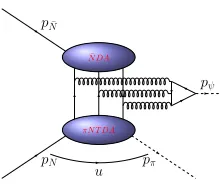
Figure 5.Feynman diagram of the process ¯pp→π0J/ψ. This process can be measured inPANDAto access the TDA.
certainty expected inPANDAis extracted, while the results of Method-I show just one possible value for the error bars.
WithPANDAit will be also possible to determine for the first time the EMFF through the reaction ¯
pp → µ+µ− [20]. For this channel the cross section and the background to signal ratio
considera-tions are the same as for the electron channel. The measurement with muons will be useful to verify the results obtained with the measurement of ¯pp → e+e−and to study the systematic effect in the
electron channel due to higher order radiative corrections from the final state. The suppression of the main background channel, ¯pp→π+π−, is more difficult in this case due to the similar masses of
pions and muons. Simulations of the signal and background channels have been performed with the same dedicated event generators described for the simulations discussed earlier. Following a similar strategy, by applying a set of cuts on kinematical variables and detector observables combined with a vertex fitting, the desired background suppression for this measurement cannot be reached. A method based on a multivariate data classification delivers a huge improvement with respect to the simple analysis based on hard cuts. A signal to background ratio of 1:4 is achieved, in comparison to the previously reached 1:30. At this level of contamination, a background subtraction based on the previ-ously measured background channel can be applied. An independently generated background sample was used to study how the background substraction has to be performed. For a beam momentum of
pp¯ =1.7 GeV/c, a statistical precision of∆|GE|/|GE| ∼8.6 %,∆|GM|/|GM| ∼4.1 % and∆R/R∼5.1 %
can be achieved.
2.2 Transition Distribution Amplitudes
γ(q)
1
3 ¯ p(p2) DA
k3 k1
Mh
p(pp) π0(pπ)
T DA
Figure 4.Feynman diagram of the process ¯pp→γπ0 →e+e−π0. This process can be measured inPANDAto
access the TDA.
pN¯
¯ N DA
pN pπ
pψ
πN T DA
u
Figure 5.Feynman diagram of the process ¯pp→π0J/ψ. This process can be measured inPANDAto access the TDA.
certainty expected inPANDAis extracted, while the results of Method-I show just one possible value for the error bars.
WithPANDAit will be also possible to determine for the first time the EMFF through the reaction ¯
pp → µ+µ− [20]. For this channel the cross section and the background to signal ratio
considera-tions are the same as for the electron channel. The measurement with muons will be useful to verify the results obtained with the measurement of ¯pp → e+e−and to study the systematic effect in the
electron channel due to higher order radiative corrections from the final state. The suppression of the main background channel, ¯pp→π+π−, is more difficult in this case due to the similar masses of
pions and muons. Simulations of the signal and background channels have been performed with the same dedicated event generators described for the simulations discussed earlier. Following a similar strategy, by applying a set of cuts on kinematical variables and detector observables combined with a vertex fitting, the desired background suppression for this measurement cannot be reached. A method based on a multivariate data classification delivers a huge improvement with respect to the simple analysis based on hard cuts. A signal to background ratio of 1:4 is achieved, in comparison to the previously reached 1:30. At this level of contamination, a background subtraction based on the previ-ously measured background channel can be applied. An independently generated background sample was used to study how the background substraction has to be performed. For a beam momentum of
pp¯ =1.7 GeV/c, a statistical precision of∆|GE|/|GE| ∼8.6 %,∆|GM|/|GM| ∼4.1 % and∆R/R∼5.1 %
can be achieved.
2.2 Transition Distribution Amplitudes
TDA are parameterizations of the hadronic matrix elements that occur in perturbative QCD calcu-lations of a certain family of reactions within the framework of collinear factorization. The cross
section of this processes can be divided into a perturbative part, calculable thanks to the high momen-tum transferred in the process, and a non-perturbative, but universal and measurable part, which is described by TDA. In particular, withPANDA, the study ofπ-NTDA will be possible via the
pro-posed mechanism reported in Ref. [21], by measuring the cross section of ¯pp → γπ0 → e+e−π0 with the emission of theπ0 in the very forward or backward limit (see Fig. 4). This constraint is
necessary in order to ensure the hard scale in which the perturbative expansion of the hard subprocess is applicable. Feasibility studies to access theπ-NTDA following the cross section calculations in Ref. [21] have been described in Ref. [22]. The study of the channel ¯pp→π0J/ψ, shown in Fig. 5, is a natural complement to the first analysis due to its higher cross section and because it can also be used to access the TDA. Therefore, it has been analysed in Ref. [23]. The measurement of these channels withPANDAwill represent a test of QCD factorization, and the validity and universality of the TDA approach. For the first channel (π0γ), simulations were performed at two values of the CM energy squared,s. The cross section can be determined with an accuracy∆σ/σbetween 12 % to 24 %. The studies for the second channel ¯pp → π0J/ψ, have been performed at three different
values ofs. The results show a background contamination lower than 1 %, coming from the channels ¯
pp→π0π+π−, ¯pp→π0π+π+π−π−, ¯pp→π0π0π+π−, ¯pp→π0π0J/ψ, and ¯pp→π0γ→e+e−, with
a signal efficiency reconstruction of about 5 % to 10 %.
2.3 Other structure functions
The physics program ofPANDAalso comprises the measurement of other structure functions ase.g.
the Generalized Distribution Amplitudes (GDA) and the Transverse Momentum Dependent Parton Distribution Functions (TMD-PDF). The GDA are the TL counterparts of the Generalized Parton Dis-tributions (GPD) which are measured in the SL region via Wide Angle Compton Scattering (WACS) in reactions likeγp→γp. WithPANDA, the reactions ¯pp→γγand ¯pp→γπ0can be used for
prob-ing the GDA. Preliminary studies [1] show that it will be possible to achieve a signal to background ratio between 1 and 2 and efficiencies ranging between 25 % and 50 %.
TMD-PDF are experimentally very well known functions in the SL region. PANDAwill shed light on of these functions in the TL region. In particular they can be measured via Drell-Yan (DY) processes. Preliminary studies [1, 24] show a production of DY processes of the order of 1.3·105DY/month with a reconstruction efficiency of ca. 33 %. More studies on the measurement of these functions are nevertheless needed to determine the real potential ofPANDAin this area.
2.4 Summary
A series of feasibility studies for the measurement of different structure functions with thePANDA
detector have been presented. The measurement of the EMFF in the TL region using the reaction ¯
pp → e+e− will represent the most precise measurement so far done of these observables. The
precision will be improved in at least one order of magnitude with respect toe.g. BaBar. In addition |GE|and|GM|, will be measured separately.PANDAwill also perform pioneering measurement of the
EMFF using the reaction ¯pp→µ+µ−, for the verification of the measurements made using electrons
and to study the asymmetries introduced by radiative corrections.
The measurement of the TDA has been studied for two different reactions ¯pp→γπ0and ¯pp→
J/ψπ0, and the results are very promising.
Other nucleon structure observables, such as GDA and TMD-PDF, are also considered to be measured withPANDAand the preliminary results are encouraging.
In conclusion, PANDAwill be an excellent experiment for the expansion of the knowledge on nuclear physics and QCD.
3 Acknowledgments
This work was supported by the Bundesministerium für Bildung und Forschung (BMBF) through grant 05P12UMFP9.
References
[1] W. Erni et al. (PANDA) (2009),arXiv:0903.3905
[2] W. Erni et al. (PANDA) (2008), FAIR TDR 4-01,arXiv:0810.1216
[3] W. Erni et al. (PANDA) (2009), FAIR TDR 4-02,arXiv:0907.0169
[4] W. Erni et al. (PANDA) (2012), FAIR TDR 4-03,arXiv:1207.6581
[5] W. Erni et al. (PANDA), Eur. Phys. J.A49, 25 (2013), FAIR TDR 4-04 [6] W. Erni et al. (PANDA) (2013), FAIR TDR 4-05
[7] W. Erni et al. (PANDA) (2014), FAIR TDR 4-06
[8] S. Pacetti, R. Baldini Ferroli, E. Tomasi-Gustafsson, Phys. Rept.550-551, 1 (2015) [9] E. Tomasi-Gustafsson, M.P. Rekalo (2008),arXiv:0810.4245
[10] E. Tomasi-Gustafsson et al., Eur. Phys. J.A24, 419 (2005) [11] J.P. Lees et al. (BaBar), Phys. Rev.D88, 072009 (2013) [12] G. Bardin et al., Nucl. Phys.B411, 3 (1994)
[13] M. Ablikim et al. (BESIII), Phys. Rev.D91, 112004 (2015) [14] R.R. Akhmetshin et al. (CMD-3), Phys. Lett.B759, 634 (2016) [15] R. Baldini et al., Eur. Phys. J.C46, 421 (2006)
[16] B. Singh et al. (PANDA), Eur. Phys. J.A52, 325 (2016) [17] A. Zichichi et al., Nuovo Cim.24, 170 (1962)
[18] J. Van de Wiele, S. Ong, Eur. Phys. J.A46, 291 (2010) [19] M. Zambrana et al. (2012), PANDA Internal Note
[20] I. Zimmermann, A. Dbeyssi, D. Khaneft (PANDA), AIP Conf. Proc.1735, 080004 (2016) [21] J.P. Lansberg, B. Pire, L. Szymanowski, Phys. Rev.D76, 111502 (2007)
[22] B.P. Singh et al. (PANDA), Eur. Phys. J.A51, 107 (2015) [23] B. Singh et al. (PANDA) (2016),arXiv:1610.02149