Analytical Processing of Applied Tasks Conceptual Models at
Design of Information-Active Systems
Olga Novoselova1,*, Anton Ruzheynikov1 and Andrey Gavrilov 1
1
Department of information technologies and computing systems, Institute of information systems and technologies, Moscow State Technological University "STANKIN", RU-127055, Moscow, Russia
Abstract. The article describes the concept of the methodology of intellectual labor automation, a formal
description of the conceptual model (CM) at the object level, and also a description of the analytical processing of CM. The conceptual model is the basis for the design of the system. The conceptual model of an applied task reflects the semantics (the system of knowledge) of the subject field in the form of static and dynamic structures and their linkage. The elements of the static structure are subject categories defined by classes: cycle, process, task, component, object, feature, value. The dynamic structure reflects the system of subject dependences which describes the process of performing a subject task. The main stage of conceptual model analytical processing is the restructuring of the dynamic component. The method and technique of descriptions restructuring of subject dependences system at the level of features are developed. The method allows to provide reduction of time and spatial expenses on performance of process of the decision of the applied task in the computing environment at early stages of information-active systems design
1 Introduction
At automation of subject tasks, it is necessary to execute modeling of task decision process and a system design - automated, information, information-active, intellectual, etc. Now there are many methods and methodologies allowing to form models of tasks and projects of systems. One of them is the methodology automation of intellectual labor (MAIL).
The methodology of intellectual labor automation [1-2] developed at the Moscow State University of Technology "STANKIN" offers an industrial method of automated systems creation and determines a necessary and sufficient set of model representations. These representations allow to present both the task performance process and the project of the automated and information-active system. The set includes the following descriptions: a) a subject task performance process (vision by an expert) - initial model representation [2, 3]; b) a knowledge system structure about subject field – conceptual model representation; c) an automated system project consisted of two model representations: infological and datalogical - invariant to the program and technical environment and implementers and one oriented to them.
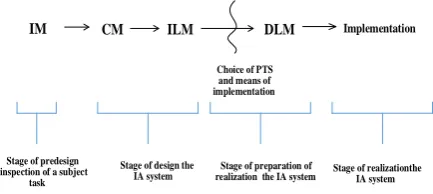
According to MAIL, the system design process includes the following stages: initial, conceptual and infological modeling. Schematically, the methodology of intellectual labor automation (MAIL) is presented in figure 1.
CM ILM DLM Implementation
Choice of PTS and means of implementation
IM
Stage of predesign inspection of a subject
task
Stage of design the IA system
Stage of preparation of
realization the IA system Stage of realization IA system the
Fig.1. Methodology of automation of intellectual work, where
IM is the initial model, CM - conceptual model, ILM - infological model, DLM - datalogical model, PTS - software and hardware environment
Each model includes the description of informational or static, functional or/and dynamic components, a model in general. Informational (or static) component describes static elements structure of model. A functional component is an algorithm of the operations performed within a subject task. A dynamic component is structure of restrictions for static structure and accesses to it. The model in general defines coordination of functional or/and dynamic and informational or static components. At the same time there are components: for an initial model – functional and informational, for a conceptual model – dynamic and static, for an infological model – functional, dynamic and static.
The description for each one of the components is formed as a special diagrams and specifications.
2 Conceptual model (CM)
The conceptual model of the applied task provides semantic unity of all subsequent models of this task [4, 5]. The static structure of the conceptual model describes the system of concepts of the subject field and consists of elements, derivative structures – schemes, also binary and ternary relations established between elements and between schemes. Conceptual structure formation is carried out at seven levels. Levels define classes of subject categories - cycle, process, task, component, object, feature, value.
The dynamic structure is a decomposition of the task into subtasks and includes descriptions of subject dependencies system of the 1st and 2nd kind. The subject dependences system of the 1st kind defines restrictions - interrelation of subject categories of the class "feature". The subject dependencies system of the 2nd kind defines restrictions on the same subject categories taking into account their "family tree" in the conceptual structure - the structure of arrangement in schemes.
The description of dynamic and static structures in the formation of the conceptual model is performed in graphical form (diagrams) and in tabular form (specifications).
Visual notation includes a set of elements (blocks and arrows); structures of these elements: sequence, iteration, alternative, cycle, switch; rules of charting and models. The composition and structure of the diagrams is fixed in the specifications. The 1st kind of subject dependencies system denotes the use of information only from the level of the conceptual structure of the type "feature" to perform actions (subject dependencies) while solving the task.
The conceptual model of the object level for the n-th applied task can be formally described as a set of structures and their linkage:
𝐾𝐾𝐾𝐾2(𝑛𝑛) =<𝑀𝑀2(𝑛𝑛),𝑇𝑇𝑇𝑇2(𝑛𝑛),������𝐹𝐹𝐹𝐹2(𝑛𝑛),𝑅𝑅2𝐾𝐾𝐾𝐾(𝑛𝑛) >. (1)
𝑀𝑀2(𝑛𝑛) – multitude of subject categories.
𝑀𝑀2(𝑛𝑛)≡ 𝐴𝐴(𝑛𝑛) = {𝑎𝑎𝑘𝑘𝑘𝑘}. (2)
Subject categories are divided into classes. They are formed in accordance with 7 semantic levels: cycle, process, task, component, object, feature, value. In this case, each feature is a property of an object.
𝑇𝑇𝑇𝑇2(𝑛𝑛) = <𝑇𝑇2(𝑛𝑛),𝑇𝑇2(𝑛𝑛),����𝑇𝑇2(𝑛𝑛),𝑇𝑇ℎ2(𝑛𝑛) >, (3)
where 𝑇𝑇2(𝑛𝑛)– multitude of binary relations,
𝑇𝑇2(𝑛𝑛) – multitude of ternary relations on subject categories,
𝑇𝑇2
����(𝑛𝑛) – multitude of schemes of subject categories, 𝑇𝑇ℎ2(𝑛𝑛) – multitude of binary relations on schemes of subject categories.
𝑇𝑇2(𝑛𝑛)⊂ 𝐴𝐴(𝑛𝑛) ×𝐴𝐴(𝑛𝑛). (4)
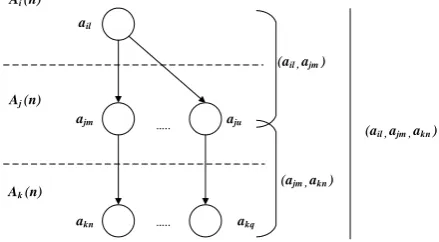
Multitude 𝑇𝑇2(𝑛𝑛) can be represented as a set of subsets of a certain kind (see fig.2).
𝑇𝑇2(𝑛𝑛) = {𝑇𝑇𝐴𝐴𝑖𝑖(𝑛𝑛) 𝐴𝐴𝑗𝑗(𝑛𝑛)𝐴𝐴𝑘𝑘(𝑛𝑛)}. (5)
Under the scheme of subject categories for subject dependencies we will understand the multitude of elementary schemes defined by:
- general (one) contextual subject category; - non-repetitive structural subject categories.
Ai (n)
Aj (n)
Ak (n)
ail
ajm
akn
aju
akq …..
…..
(ail , ajm )
(ajm , akn )
(ail , ajm , akn )
Fig. 2. Binary and ternary connections of subject categories
Formally, this is represented in the form ℎ2
𝚤𝚤𝚤𝚤
�����=�ℎ𝑖𝑖𝚤𝚤𝑗𝑗𝑘𝑘𝑘𝑘𝑖𝑖2 , … ,ℎ 𝑖𝑖𝚤𝚤𝑗𝑗𝑖𝑖𝑘𝑘𝑖𝑖
2 �, 𝑚𝑚 ≠ 𝑢𝑢. (6)
Then the multitude of schemes of subject categories or derived constructions is defined for the subject task:
𝑇𝑇2
����(𝑛𝑛) =�ℎ�����𝚤𝚤𝚤𝚤2 . (7)
Binary relations can be established on schemes of subject categories:
𝑇𝑇ℎ2(𝑛𝑛)⊂ 𝑇𝑇����2(𝑛𝑛) ×𝑇𝑇����2(𝑛𝑛). (8)
Multitude 𝑇𝑇ℎ2(𝑛𝑛) can be represented as a set of subsets of a certain kind:
𝑇𝑇ℎ2(𝑛𝑛) =
= {𝐿𝐿𝑇𝑇�2𝑖𝑖(𝑛𝑛),𝐿𝐿𝑇𝑇�2𝑖𝑖(𝑛𝑛)𝑇𝑇�2𝑘𝑘(𝑛𝑛),𝐿𝐿𝑇𝑇�2𝑘𝑘(𝑛𝑛)/𝐿𝐿𝑇𝑇�2𝑖𝑖(𝑛𝑛)}. (9) Binary relationships in category schemes reflect the connectivity of semantic complexity levels or "semantic scaling".
The dynamic relations 𝐹𝐹𝐹𝐹������2(𝑛𝑛) include two kinds of constraints - subject dependencies systems of the first 𝐹𝐹2
����(𝑛𝑛) and second ����𝐹𝐹2(𝑛𝑛) kind:
FU2
�����(n) = < F2���(n), U2����(n) >. (10)
F2
���(n) =�V2����(n), FV2�����(n)�, (11)
V2
����(n)≡ W�(n), (12)
W�(n) = �Wp
p
(n), (13)
Wp(n) =�wps�. (14)
The multitude of subject dependencies is divided into subsets of different levels decomposition:
FV2
�����(n)⊂W�(n) × W�(n), (15)
FV2
�����(n) =
= {LWp(n), LWp(n)Wt(n), LWt(n)/Wp(n)}. (16)
A submultitude 𝐿𝐿𝑊𝑊𝑝𝑝(𝑛𝑛) define binary relations as type “one after another" between subject dependencies of the 1st kind of one level.
A submultitude 𝐿𝐿𝑊𝑊𝑝𝑝(𝑛𝑛)𝑊𝑊𝑡𝑡(𝑛𝑛) define binary relations as type “composition" between the object dependencies of the 1st kind of different levels.
A submultitude 𝐿𝐿𝑊𝑊𝑡𝑡(𝑛𝑛)/𝑊𝑊𝑝𝑝(𝑛𝑛) define the binary relations as type "arrangement" between the subject dependencies of the 1st kind of the one level.
Since subject dependencies are considered at the object level, any dependency of the 1st kind is a variant of a certain type always. Since the type of dependence is fixed on a certain multitude of categories always, the subject dependence of the 1st kind is fixed on a subset of this categories multitude:
𝑤𝑤𝑝𝑝𝑝𝑝= 𝑤𝑤𝑝𝑝𝑝𝑝�𝑖𝑖,𝑡𝑡,𝑢𝑢𝑝𝑝𝑝𝑝�. (17)
The relations describing interrelations of the basic static and dynamic components of applied task model of object level can be represented in the following form:
R2KP−1(n)⊂A(n) × A(n) … × A(n) × W�(n), (18)
R2KP−1(n) =
=�rlKP2−1� rlKP2−1:�aj1, … , ajq� → wps
(19)
3 Analytical processing of the
conceptual model
For analytical processing of conceptual models it is possible to define the following complex of tasks: definition and check of information connectivity between subject dependences; analysis and restructuring of subject dependences system; fragmentation of information. [5, 6]
To analyze the system of subject dependencies on the possibility of its restructuring, it is necessary to obtain an information description (substantial features) for all subject dependencies – first elementary, then complex.
At the same time, the type of algorithmic construction should be taken into account for complex ones. The result should be a complete information description of the task on the whole (complex subject dependence of the top level), which is based on the content features description of all its constituent elementary (descendants) dependencies.
To transform the graphical descriptions, it was necessary to form a description of performing subject dependencies process in a different form. For this purpose, the "conveyor - time step" approach was proposed and the apparatus of block matrices was chosen. This apparatus allowed to present the system of dependencies in the form of a structural description [3, 5, 7]. The structural description takes into account the spatial-temporal characteristics of solving task process - the axis of the conveyors (K) is located vertically and the axis of the time steps (T) is located horizontally.
Let's present a structural description 𝑤𝑤𝑘𝑘𝑡𝑡R - complex
subject dependence in the form of a block matrix Bkt:
𝐵𝐵𝑘𝑘𝑡𝑡=�𝐵𝐵𝑘𝑘𝑡𝑡
1 𝐵𝐵
𝑘𝑘𝑡𝑡2
𝐵𝐵𝑘𝑘𝑡𝑡4 𝐵𝐵𝑘𝑘𝑡𝑡3�
, (20)
where 𝐵𝐵𝑘𝑘𝑡𝑡1 – matrix-column defines the external (input) information connection 𝑤𝑤𝑘𝑘𝑡𝑡 complex subject dependence by input subject categories of the type feature";
𝐵𝐵𝑘𝑘𝑡𝑡2 - square matrix determines the internal
information relationship between the features of the subject dependencies (k+1) of the decomposition level. These subject dependencies are part of the complex subject dependence 𝑤𝑤𝑘𝑘𝑡𝑡;
𝐵𝐵𝑘𝑘𝑡𝑡3 – matrix-string defines an external (output)
information connection 𝑤𝑤𝑘𝑘𝑡𝑡 complex subject dependence by output subject categories of the type "feature";
𝐵𝐵𝑘𝑘𝑡𝑡4 – matrix-element. It shows what type of
algorithmic construction the description belongs to: ‘1’ -sequence, ‘n’ - iteration, ‘0’ - alternative.
The dimension of the matrix Bkt is composed of sizes its constituent block matrices 𝐵𝐵𝑘𝑘𝑡𝑡1, 𝐵𝐵𝑘𝑘𝑡𝑡2, 𝐵𝐵𝑘𝑘𝑡𝑡3, 𝐵𝐵𝑘𝑘𝑡𝑡4 and dimension matrix is mkt = (m+1)×(m+1).
Next, to form a structural description for the task, structural descriptions are created for all complex subject dependencies, which are then iteratively, starting from the top level, included in the matrix describing the task as a whole. At the same time, the elements of the matrix should be specified. These elements are showing the information connectivity of subject dependencies at this level of decomposition. At each step, the dimension of the resulting matrix 𝐵𝐵𝑘𝑘𝑡𝑡∗ includes dimensions Bkt (base matrix) and B(k+1)t (embedded matrix). The result is a matrix of the complete structural description of the task, where the horizontal shows the time spent on the task - time steps, and the vertical spatial chains - conveyors.
An extended structural description 𝐵𝐵����𝑘𝑘𝑡𝑡∗ is formed on the basis of the full structural description. This matrix is obtained by transposing the elements of the matrix 𝐵𝐵𝑘𝑘𝑡𝑡2∗ relative to the main diagonal. [8]
dependencies system. To simplify the formal description, the block matrix 𝐵𝐵����𝑘𝑘𝑡𝑡∗ is copied to the block matrix 𝐶𝐶𝑘𝑘𝑡𝑡∶
B���� ≡kt∗ C
kt. (21)
Ckt=�Ckt
1 C
kt2 Ckt4 Ckt3�
= (22)
⎣ ⎢ ⎢ ⎢ ⎢ ⎢
⎡ (𝑐𝑐10𝑝𝑝)1−𝑘𝑘𝑡𝑡
⋮
(𝑐𝑐𝑝𝑝0𝑝𝑝)1−𝑘𝑘𝑡𝑡
⋮
(𝑐𝑐𝑘𝑘0𝑝𝑝 )1−𝑘𝑘𝑡𝑡
(𝑐𝑐(𝑝𝑝𝑘𝑘+1)0)4−𝑘𝑘𝑡𝑡
(𝑐𝑐11𝑝𝑝)2−𝑘𝑘𝑡𝑡
⋮
(𝑐𝑐𝑝𝑝1𝑝𝑝)2−𝑘𝑘𝑡𝑡
⋮
(𝑐𝑐𝑘𝑘1𝑝𝑝 )2−𝑘𝑘𝑡𝑡
(𝑐𝑐(𝑝𝑝𝑘𝑘+1)1)3−𝑘𝑘𝑡𝑡
⋯ ⋱ … ⋱ ⋯ ⋯
(𝑐𝑐1𝑝𝑝𝑝𝑝)2−𝑘𝑘𝑡𝑡
⋮
(𝑐𝑐𝑝𝑝𝑝𝑝𝑝𝑝)2−𝑘𝑘𝑡𝑡
⋮
(𝑐𝑐𝑘𝑘𝑝𝑝𝑝𝑝 )2−𝑘𝑘𝑡𝑡
(𝑐𝑐(𝑝𝑝𝑘𝑘+1)𝑝𝑝)3−𝑘𝑘𝑡𝑡
⋯ ⋱ … ⋱ ⋯ ⋯
(𝑐𝑐1𝑘𝑘𝑝𝑝 )2−𝑘𝑘𝑡𝑡
⋮
(𝑐𝑐𝑝𝑝𝑘𝑘𝑝𝑝 )2−𝑘𝑘𝑡𝑡
⋮
(𝑐𝑐𝑘𝑘𝑘𝑘𝑝𝑝 )2−𝑘𝑘𝑡𝑡
(𝑐𝑐(𝑝𝑝𝑘𝑘+1)(𝑘𝑘+1))3−𝑘𝑘𝑡𝑡⎦⎥
⎥ ⎥ ⎥ ⎥ ⎤
As a result of the analysis of the received structural description it is possible to carry out restructuring of subject dependences system which actually is algorithm optimization process of applied task decision on criteria of time and spatial expenses [6, 9, 10, 11]. Determining the time characteristic (number of time steps) is to find the maximum number of time step in the optimized structural description of the task. Determining the spatial characteristic (number of conveyors) is to find the maximum number of the conveyor in the optimized structural description of the task.
In order to obtain an optimal structural description over time steps, we formally described the motion of the main diagonal element in the matrix-block 𝐶𝐶𝑘𝑘𝑡𝑡2. The subject dependence (the main diagonal element) and all its associated elements moves to a time step earlier. You can move items only if there is no information connectivity between subject dependences. The absence or presence of information connectivity shows between subject dependencies the value "0" or "1" in the lower triangular matrix under the main diagonal.
The elements are moved according to the movement of the main diagonal elements in the 𝐶𝐶𝑘𝑘𝑡𝑡3Rblock. Blocks
𝐶𝐶𝑘𝑘𝑡𝑡1, 𝐶𝐶𝑘𝑘𝑡𝑡4 block matrix 𝐶𝐶𝑘𝑘𝑡𝑡Rremain unchanged.
As a result of the restructuring of subject dependences system 1st kind, we receive an optimal structural description according to the time characteristic in the form of a block matrix 𝐶𝐶𝑘𝑘𝑡𝑡, which contains a horizontally compressed structural description of the matrix 𝐵𝐵����𝑘𝑘𝑡𝑡∗ [3, 4].
The block matrix 𝐶𝐶𝑘𝑘𝑡𝑡 is copied to the block matrix Dkt to simplify the restructuring of subject dependencies system of the 1st kind by spatial characteristic:
𝐶𝐶𝑘𝑘𝑡𝑡≡ 𝐷𝐷𝑘𝑘𝑡𝑡.
To obtain the optimal structural description on the conveyors, the element of the main diagonal (the subject dependence) is moved to another conveyor located above, provided that, there is no information connectivity. Together with this element (subject dependency), all elements from this conveyor are moved. The move process is iteratively.
To move, the last element (on the main diagonal on the last conveyor (in the last row) of the Dkt2 matrix) is defined. Next, we determine the element preceding it-the
subject dependence. We need check the presence (1) / absence (0) of information connectivity between them. If there is no information connectivity, we can perform the move. The move rules are similar to the move rules when restructuring the structural description by time steps, only carry out movement from the line to the line above.
During the restructuring process, the main conveyor are formed of subject dependencies chain of the maximum length and additional conveyors to the main one. Typically, these conveyors contain subject dependencies of the type "alternative" as part of given information-related dependencies chain. Blocks Dkt3 , Dkt4 block matrix Dkt remain unchanged.
As a result of these actions, a block matrix Dkt, is obtained. This matrix contain a vertically compressed structural description of the matrix Ckt.
Fragmentation of information shows the distribution of subject dependencies of the task and their characteristics on performance time steps.
4 Conclusion
Thus, the analytical processing of subject dependencies system performs a set of tasks. The main from these tasks is the restructuring of subject dependencies system. The proposed conveyor-time steps approach and rules of formation and restructuring (optimization) of subject dependencies structural description allowed to parallelize the dynamic structure of the task taking into account the information connectivity of the dependencies. As result of restructuring (optimization) of subject dependencies system by time steps and conveyors, the task execution time is reasonably reduced, and the sequential process of solving the problem is transformed into a series-parallel one.
This research was supported by the project No. 17-29-07057 "Development of methods of restructuring and integration for semantic and syntactic representations when creating automation systems for design and management processes" of the RFBR. We also thank the Center of Collective Use of MSUT "STANKIN" for providing resources.
References
1. G.D. Volkova, Methodology automation of intellectual labor. Monograph (Мoscow: Janus-K, 2013)
2. O.V. Novoselova, G.D. Volkova and Y.M. Solomentsev, Nonlinearity: Problems, Solutions and Application 2, 223-238 (New York, NY: Nova Science Publishers, Inc., 2017)
3. G.D. Volkova, S.M. Kuryshev, Automation and control in mechanical engineering 7 (1999)
4. G.D. Volkova, Intersectoral information service 3(148), 10-23 (2009)
and scientific center of mathematical modeling of MSTU "STANKIN" - IMM RAS", 61-65 (2002) 6. O.V. Novoselova, А.A. Ruzheynikov, Information
technologies in modeling and management: approaches, methods, solutions: Collection of scientific articles of the II all-Russian scientific conference with international participation 1, 511-516 (2019)
7. F.R. Gantmakher, Theory of matrices (Moscow: Fizmatlit, 2004)
8. G.D. Volkova, N.M. Efromeev, Computer science and information technology: proceedings of the international scientific conference, 80-84 (2012) 9. O.V. Novoselova, N.V. Solodovnikova, Proceedings
of higher educational institutions. Volga region. Technical science. Scientific and practical journal 1(49), 34-40 (2019)
10. N.V. Solodovnikova, Bulletin of modern research. Electronic scientific and practical periodical 1-3(28), 207-212 (2019)