T-310: Attacking Arbitrary Boolean Functions
Nicolas T. Courtois
University College London, Gower Street, London, UK
Abstract. A major open problem in cryptanalysis of block ciphers is the discovery of round invariant properties of complex type. For some 25 years researchers found no convincing examples of such attacks. Finally some recent papers [53, 23, 17, 20] show how to construct polynomial in-variant attacks for block ciphers. However almost all such results are somewhat weak: invariants are simple and low degree and the Boolean functions tend to be very simple if not degenerate. Is there a better and more realistic attack, with invariants of higher degree and which is likely to work with stronger Boolean functions? In this paper we show that such attacks exist and can be constructed explicitly through on the one side, the study of Fundamental Equation of [23], and on the other side, a study of the space of Annihilators of any given Boolean function. The main contribution of this paper is that to show that the “product attack” where the invariant polynomial is a product of simpler polynomials is in-teresting and quite powerful. Our approach is suitable for backdooring a block cipher in presence of an arbitrarily strong Boolean function not chosen by the attacker. We also show an example showing that the same type of a product of linear polynomialsPcan be an invariant for Data Encryption Standard (DES).
Key Words: block ciphers, Boolean functions, non-linearity, ANF, Feistel ci-phers, weak keys, backdoors, history of cryptography, T-310, DES, Generalized Linear Cryptanalysis, polynomial invariants, multivariate polynomials, annihi-lator space, algebraic cryptanalysis.
1
Introduction
Only those who attempt the absurd will achieve the impossible. – Maurits Cornelis Escher
In this paper we introduce a newtypeof attack on block ciphers.
Then we discover that the attack is quite powerful and may work well beyond this specific cipher setup and even for a completely different cipher (e.g. DES).
Product attacks are not new either. This type of attack was known to us for 15 years. However only recently we have been able to find and contemplate some actual working examples of such attacks and we discover they are quite powerful and have some interesting features.
Imagine that we could break AES in a way such that the exact specification of the S-box does not really matter. Impossible? Furthermore, imagine that the S-box could be maliciously crafted by the choice of the linear wiring inside the AES S-box which makes the cipher breakable with high probability for any choice of the non-linear component, leading to a “structural” attack (cf. later Section 1.2). Then, when the non-linear component is fixed, any linear component works with a large probability. Moreover, imagine that it is extremely hard to defend against this attack, because it belongs to a vast space with the number of possible invariants growing as 22n
, and even if one attack accidentally does not work for one S-box and one cipher wiring, another similar invariant property may work for this exact cipher setup. Overall it may seem a block cipher can be broken no matter what, and nothing is potentially really a problem for the attacker. It is also useful to note that our attacks are also able to work in presence of round constants, variable S-boxes, or other properties other than the key, which make that each round is different. We don’t see any of these in AES but in many other ciphers we do, and we want our attack methodology to be extremely general so that we can (try) to apply our attack to more or less any cipher1.
In this paper we make the impossible possible, however we do not work on AES, which would be too ambitious. For the sake of scientific research we need to test our ideas on a simpler cipher. Numerous papers propose attacks on some toy ciphers [2, 40]. However it is always better (and presumably harder and more ambitious) to work on a real-life cipher. We work on an older block cipher T-310 which was extensively used in the 1980s to encrypt government communications in Eastern Europe [35, 52, 31, 51]. How can we claim that we understand the security of more recent block ciphers such as Simon or AES if we have never yet studied major attacks on some older ciphers? It is also important to note that it is not correct to believe that AES is strong and extremely secure while T-310 is some old cipher. In reality AES is a commercial cipher with only 10 rounds designed to be faster than 3DES, while T-310 is government-grade or military-grade cipher designed to be extremely robust. The hardware complexity of T-310 is thousands of times larger than for DES or AES, cf. [35]. In T-310 more than 1500 rounds are required just to encrypt just one character of the plaintext.
1
1.1 New Types of Non-Linear Attacks on Block Ciphers
Non-linear cryptanalysis was known for at least 25 years. What is new here is: 1. That such attacks may actually be found or constructed, with polynomials
of higher degree than before, e.g. (rather than quadratic or cubic cf. [53, 23, 24, 42]) and that such attacks may actually exist at all, for any block cipher. 2. Our attack works for an arbitrarily large number of rounds, which is rare
but of course, was seen before, e.g. in sliding attacks, cf. [43, 18, 34]. 3. Finally it does something which is even more unique. Namely it is able to
somewhat ignore or circumvent the non-linear component(s) of the cipher in a novel and powerful way: so that we obtain an almost purely“structural” attack on a block cipher which makes our block cipher insecure, more or less ignoring the non-linear components. An attack which is very likely to work also when they are chosen to be extremely strong and also when they are secret, unknown or key dependent [46]. This was seen before in stream cipher cryptanalysis [21, 3, 22] but it is new and unprecedented for block ciphers. In this paper we assume that attacker cannot choose the non-linear component (S-box or Boolean function) but can make some “cipher wiring” choices of the type “long-term key”. Many authors study how one to make a block cipher extremely weak on purpose cf. [23, 1, 17, 48, 4]. Our main goal is to show that a block cipher can be “backdoored” even though many components and a number of rules have already been imposed2by the designers and are assumed to be as
strong as only possible. We show that there exist extremely weak choices which are quite realistic, because they depend on a very small number of key conditions, and therefore they could occur with a relatively large probability, with a potential to work in some real-life situations. This is a realistic setting similar to what happens in symmetric cryptography at large: for example the S-boxes in Serpent have been built in order to avoid any suspicion of backdooring. For the same reason some ciphers will have no S-boxes whatsoever but may use some natural transformations such as rotations, additions etc. (ARX philosophy). In AES potentially the affine transformation inside the S-box could be manipulated, and in LFSR-based ciphers the LFSR taps could be manipulated, yet the number of “good choices” is extremely small. Then the question is can we make the cipher weak nevertheless, and with a sufficiently large probability. As a proof of concept we will show how to construct a round invariant property which - modulo a number of appropriate connections inside the cipher - works with probability of approx. 15 % over the choice of the non-linear component inside our cipher.
2
1.2 Research Goals, Structural Attacks, Generic Attacks
Block ciphers are in widespread use since the 1970s. Their iterated structure is prone to numerous round invariant attacks for example in Linear Cryptanal-ysis (LC). The next step is to look at non-linear polynomial invariants with Generalised Linear Cryptanalysis (GLC) cf. [44] (Eurocrypt’95). A major open problem in cryptanalysis is the discovery of invariant properties of complex type. Researchers have found, until 2018, extremely few such attacks with some im-possibility results [47, 7, 9]. Eventually recent papers [53, 23, 42, 20, 17] show how to construct polynomial invariant attacks for block ciphers, however in almost all such results the Boolean function is extremely weak and invariants are sim-ple and of low degree [53, 23, 42, 20]. Can we do better? What kind of better outcomes can we expect?
[Weak] Structural Invariant Attacks. Most symmetric ciphers can be di-vided into two distinct parts: a set of relatively simple [linear] transformations which mix bits together, and a set of non-linear components (Boolean functions or S-boxes). We call a “Structural Invariant Attack” an attack where 1) there is a cipher wiring and some special Boolean function such that the cipher has an invariant propertyPwhich propagates for an arbitrarily large number of rounds and 2) the propertyP does not depend a lot on the non-linear components and depends strongly on the structure3 (i.e. wiring) of the cipher. Most structural
invariant attacks found to date can be seen as quite weak. We also consider that many attacks are “weak” for another reason: because typically, the choice of the Boolean function is degenerated or pathological: it is almost always of low degree, frequently it does NOT depend on some inputs. For most of the attacks in [23, 42, 20] very clearly, the probability that a cipher with a random Boolean function would be weak in a way as to enable one of the attacks will be negligible or close to zero.
Invariants with Reduction to Zero. Recent papers [23, 20] demonstrate the existence of polynomial invariant attacks which work foranyBoolean function, based on the fact that all coefficients in a certain algebraic equation are equal to 0, cf. [23]. However this attack is not very realistic either. Previous attacks working for any Boolean function is an attack which would also work when the non-linear components are secret or unknown were not very convincing. Designing such attacks seems to impose too many strong constraints on other parts of the cipher so that it becomes too weak (e.g. Appendix of [23]) and that maybe no one would accept to use such a contrived cipher (e.g. weak ciphers in [25]). If a cipher has a backdoor, this fact should be well hidden and its components should not only look very strong, but even actually should be very strong in terms of non-linearity etc. [6].
Strong Structural Invariant Attacks. At the end, we consider a more real-istic attack scenario than in previous works. We assume that the attacker knows the non-linear components [they are public and were chosen to be very strong] and that he can now adapt his attack to these components: for example look for weak keys and weak long-term keys for one given Boolean function. This brings the question of the existence of “Strong Structural Invariant Attacks” which would work when the S-boxes or Boolean functions have not been chosen by the attacker, and are potentially random or extremely strong, or just have no4
property which would be helpful for the attacker (except properties which can hardly be avoided at all, if only we are allowed multiple attempts, e.g. multiple polynomial invariants exist).
How Does It Compare to Current Theory of Feistel Ciphers. A crucial notion in the theory of Feistel cipher is the notion of a “generic attack”, cf. for example [49, 50] which attacks work for a certain maximum number of rounds, for example for up to 7 rounds, and then the cipher is provably secure (under ideal round functions such as pseudo-random functions). Our notion of “Strong Structural Invariant Attacks” is quite close to a notion of a “generic attack”. From one point of view it is weaker or slightly weaker: our invariants work sometimes, not always, for some round functions. When they work, we have properties which are able to propagate for any number of rounds, which is rather unthinkable with traditional types of “generic attack” in [49, 50]. From another point of view our notion is substantially stronger: we obtain attacks which are able to work for an arbitrarily large number of rounds (at least in certain cases). 1.3 Long Term and Short Term Keys vs. Malicious Cipher Wiring
such as for example the P-box in DES. Older literature would not use the word backdooring, but rather use more politically correct terms such the “design” and “security analysis” of the cipher. However the final objective yesterday and today is the same. We should observe that either “backdooring” is possible OR the designers have done a good job to made it strong in all5 cases. Overall for
each cipher which has a “long term key” and for many other where we can still modify the cipher wiring without permission from the authors, the wiring can potentially be chosen maliciously. We will then say that we have a “Strong Structural Invariant Attack” if one can construct an insecure setup or wiring with a large broad applicability or/and large success probability which does not require any other (non-linear) components of the cipher to be also weak. In this paper we show how this can be done for T-310. When the modification of the long-term key is officially allowed, for example in T-310, a feasibility of a weak or malicious choice is an important and eminently practical question.
2
Non-Linear Cryptanalysis
The concept of cryptanalysis with non-linear polynomials a.k.a. Generalized Lin-ear Cryptanalysis (GLC) was introduced by Harpes, Kramer, and Massey at Eu-rocrypt’95, cf. [44]. A key question is the existence of round-invariant I/O sums: when a value of a certain polynomial is preserved after 1 round. Many researchers have in the past failed to find any such properties, cf. for example Knudsen and Robshaw at Eurocrypt’96 cf. [47]. Bi-Linear and Multi-Linear attacks were in-troduced [24, 25] for Feistel ciphers branches specifically. The number of such attacks grows as 22n, and many authors stress that systematic exploration is not
at all feasible [7]. For this reason, there are extremely few positive results on this topic [53, 23, 42, 17] and any method to approximate the solution is valuable, as one working examples for one cipher will typically allow the researchers to find or construct similar attacks also for another cipher.
In this paper and unlike in [53] we focus on invariants which work for 100 % of the keys and we focus on stronger invariants which hold with probability 1. In addition we look at a strong us case: an expensive government cipher in which the block cipher is used for encryption in an extremely low-data rate mode, a lot more costly than 3DES, AES, cf. [35]. Here most cryptanalytic attacks simply do not work (!). However all this complexity is not that useful if we are able to construct powerful non-linear invariants which work for any number of rounds. 2.1 Mathematical Theory of Invariants.
invariants w.r.tnon-lineartransformations and 36 or more variables overGF(2) and those which simultaneously hold in more than one case [required]. More de-tails about how this compares to what is done elsewhere in mathematics can be found in Section 1.5 of [23].
A well-known polynomial invariant with applications in symmetric cryptog-raphy is the cross-ratio, [25] and the “whitening paradox” cf. [25, 26].
2.2 Discovery of Advanced Non-Linear Invariant Attacks
There are two major types of invariants in recent research: linear sub-space invariants [7, 9] and proper non-linear polynomial invariants [53, 25, 23]. Several authors [7, 9, 23, 8] including here study both. Our product attack is also a linear subspace attack when all the polynomials in our product are affine which is very frequently6which also frequently the case elsewhere [19, 17].
The existence of some invariants does not imply that they can be found. Finding such properties was so far considered as extremely hard. There are two major approaches to our problem: combinatorial and algebraic. A nice algebraic approach it through solving the so called Fundamental Equation cf. [23]. Solving such equation(s), or rather several such equations simultaneously, guarantees that we obtain a Boolean function and the polynomial invariant P which prop-agates for any number of rounds. However nothing guarantees that the F E equation has any solutions. In this paper we show how to construct just one higher degree invariant which has however the property that [with or without some extra wiring adjustments] it frequently has solutions: it can work with a high probability for any non-linear component used.
2.3 On the Bootstrapping Problem in Cryptanalysis
This paper is not only about a specific attack on an important Cold War cipher, but also about cryptanalysis of symmetric ciphers at large (also inside hash functions, MACs etc). Research in block cipher cryptanalysis has suffered from a bootstrapping problem: we have hardly ever found any invariant attacks, except when the set of all possible attacks is not too large, e.g. in Linear Cryptanalysis (LC). An excessively rich space of attacks have been ignored, and we could not find many interesting attacks because we failed to see or imagine how new attacks could even look like. New examples of working attacks (to imitate in further attacks) are crucial. One cannot claim to ever have studied the security major Feistel ciphers such as 3DES, cf. Section 11 below, or SHA-256, without study of earlier Feistel ciphers, in order to realize that a new extremely large class of invariant attacks has never been studied, or almost, cf. [24]. We essentially need to re-start research on the security of block ciphers7from scratch. We also 6 A important example of attack where a polynomial is of degree 7 and is a sum of two products and where (as it seems) this works better than the best product attack in this case is given in Appendix A.2.
7
claim that it is necessaryto study the attacks on T-310 precisely, rather than say, study similar attacks on 3DES. This is because T-310 offers unprecedented flexibility and uses a limited number of key bits in each round which makes that the space of attacks is particularly rich and illuminating. Frequently attacks can be transposed from one place to another, more complex attacks can be constructed from simpler attacks by manipulating the roots of the fundamental equation cf. [23, 19, 17], and simpler attacks can then be removed, cf. Invariant Hopping method [19]. In contrast attacks on ciphers such as DES are expected to be very hard to find, and maybe can be constructed precisely by imitating specific classes of attacks earlier discovered for T-310. Or we will have some partial impossibility results [7, 9] and for 50 more years we will fail to see that there are also possibility results. Further explanations and discussion of this question can be found in Section 1.8 of [23]. Essential insights about what makes that non-linear invariant attacks are actually possible can also be found in [17]. 2.4 On Phase Transitions in Cryptanalysis
This paper provides a major example of a phase transition. A sort of “holy grail” or highly desirable property in algebraic cryptanalysis at large, which researchers have been aiming at for decades and rarely found any, cf. [16]. Phase transitions also happen with SAT solvers [14, 15, 41]. There is double phase transition ob-served in this paper as follows. When the polynomial P is of degree 1, we get linear cryptanalysis which is not excessively powerful, cf. [33] and where the complexity is very quickly degraded as the number of rounds grows. Then when the degree is 2, we already get some properties true with probability 1 working for any number of rounds, first transition. At this stage however we get attacks working only for a handful of very weak or degenerate Boolean functions, if at all, and the proportion of Boolean functions for which the attack works is neg-ligible or even somewhat double-negneg-ligible8. Then if we increase the degree to say 4, we can start “playing” with multiple solutions, for example some simple attacks of degrees say 1,2 can be “removed” yet an invariant property of degree 4 will remain, see [19] and Section 10 in [23]. Then at degree 8 a second phase transition happens: due to the structure of the ring of the Boolean functions with numerous divisors of zero, the attack becomes almost inevitable: it works for any Boolean function with some probability (this paper).
2.5 On the Future of Symmetric Cryptanalysis
time based on the widely admitted (yet problematic and perverse) assumption, that properly written quality research and funded by major governments, is necessarily good, and does not need to be relevant, or to explain correctly to the reader what the implications or practical applications of this research might be. This paper also substantially increases the amount of algebra and mathe-matics we are likely to see in future routine symmetric cryptography research. It raises very substantially the game for anyone who would like to design or influ-ence any future symmetric encryption standard. It is clear that no AES candidate from 2000 can be considered to be properly designed and properly studied, by the standards of this paper. Symmetric cipher designers must essentially start working from scratch. Even though there are highly expert researchers who has already in the recent years studied the question of resistance against invariant and partitioning attacks, cf. [7, 9], these researchers have operated so far on pure syntactic level, without a corpus of positive examples and working attacks and therefore it is hard to imagine that the right questions ranking high in practical importance has ever yet been studied. A proper “practical theory” of invariant attacks on block ciphers need yet to be constructed9and it could take many years
for the crypto community to regain confidence in their ability to design secure block ciphers. A plausible scenario is actually also that many future industrial standards for example in TLS, blockchain or 5G mobile phones are going to ban block ciphers totally, due to temporary inability to evaluate their security in any satisfactory way, and we are going to finally use some provably secure encryption such as QUAD from Eurocrypt 2005 [5].
9
3
Polynomial Invariant Attacks on Block Ciphers
We call P a polynomial invariant if the value of P is preserved after one round of encryption, i.e. ifP(Inputs) =P(Output ANF). This concept can be applied to any block cipher except that such attacks are notoriously hard to find cf. [7]. In this paper we are going to work with one specific block cipher with 36-bit10 blocks. The main point is that any block cipher round translates into
relatively simple Boolean polynomials, if we look at just one round. We follow the methodology of [23] in order to specify the exact mathematical constraint, known as the Fundamental Equation orF E, so that we could have a polynomial invariant attack on our cipher. Such an attack will propagate for any number of rounds (if independent of key and other bits). In addition it makes sense following [23] to consider that the Boolean function is an unknown, at least temporarily. We denote this function by a special variableZ. We aim at showing that our attack works if and only ifZis a solution to a certain algebraic equation [with additional variables]. An interesting feature of making Z a variable is to see that even if Z is extremely strong, key dependent or unknown, some attacks will nevertheless work. Another benefit of studying the F E in general is that our research is full of good surprises, there are numerous things which work better than expected. For example in countless interesting cases, theF E equation will not depend on F, and frequently will not depend onK, Leither, though sometimes the opposite is required, see [34]. Another major case is when the F E reduces to zero, and the attack works for any Boolean function, see Appendix of [23] and [20].
3.1 Notation and Methodology
In this paper the sign + denotes addition modulo 2, and frequently we omit the sign * in products. Let x1, . . . , x36 be the inputs of our block cipher which are
bits∈ {0,1}. For the sake of compact notation we frequently use short or single letter variable names
and we follow the backwards numbering convention of [23] witha=x36 till
z =x11 and further we use M =x10 till V = x1 which allows to avoid other
capital letters such as F, K, L or W, X, Y, Z used elsewhere. We consider that each round of encryption is identical except that they can differ only in some “public” bits calledF (and known to the attacker) and some “secret” bits called S1 =KandS2 =L. In roundmthese bits are sometimes also calledK=sm,1
and L=sm,2 and they ARE different for differentm. However we will omit to
specify the round numbermbecause at the end we are constructingone round invariants extending to any number of rounds and these variables get eliminated totally. This framework covers most block ciphers ever made except that some 10
ciphers would have more “secret” or “public” bits in one round. The capital letterZ is a placeholder for substitution of the following kind
Z(e1, e2, e3, e4, e5, e6)
wheree1. . . e6 will be some 6 of the other variables. In practice, the ei will represent a specific fixed subset of 6 variables of type a-z, or other such as L. At the end we will have four expressions of type say Z(L, c, k, l, f, h) for each Boolean function Z1-Z4 which later must be replaced by a full formula like:
Z ←Z00 +Z01∗L+Z02∗c+Z03∗Lc+. . .+Z62∗cklf h+Z63∗Lcklf h whereZ00−Z63 are the yet unknown coefficients of the ANF forZ(). Polynomial Invariants. We are looking for arbitrary polynomial invariants. For example we could have some combinations of symmetric homogenous poly-nomials like:P(a, b, . . .) =P42∗(abc+abd+acd+bcd) +. . .However in general solutions may also be complex irreducible polynomials which are far from being symmetric, cf. [23]. In this paper polynomials will be constructed primarily as products of simpler polynomials. One of the main points in discovery of innova-tive attacks on block ciphers is that most previous attacks polynomial invariants were of degree 2 [24, 23, 53]. In this paper the degree of the invariant becomes 8. 3.2 Constructive Approach Given the Cipher Wiring
Our attack methodology starts11from an arbitrary block cipher specified by its
ANFs for one round. Specific examples will be shown for T-310, an old Feistel cipher with 4 branches and undoubtedly the most important block ciphers of the Cold War with some 3,800 cipher machines in active service in 1989 [35, 52, 31, 51]. This cipher offers great flexibility in the choice of the internal wiring which will be entirely compatible with original historical hardware. The hardware encryption cost with T-310 is hundreds of times bigger than AES or 3DES, cf. [35]. Does it make this cipher very secure? Not quite, if we can construct algebraic invariants which work for any number of rounds. The block size is 36 bits and the key has 240 bits.
11
3.3 ANF Coding of One Full Round
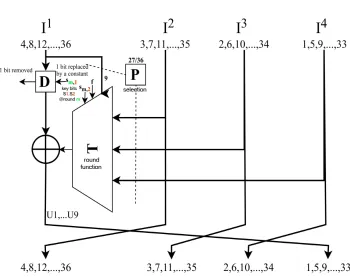
We number the cipher state bits from 1 to 36 where bits 1,5,9. . .33 are those freshly created in one round, cf. Fig 1. Let x1, . . . , x36 be the inputs and let
y1, . . . , y36 be the outputs. One round of our cipher can be described as 36
Boolean polynomials out of which only 9 are non-trivial:
y33=F+xD(9)
Z1def=Z(S2, xP(1),. . . ,xP(5))
y29=F+Z1 +xD(8)
y25=F+Z1 +xP(6)+xD(7)
Z2def= Z(xP(7), . . . , xP(12))
y21=F+Z1 +xP(6)+Z2+ xD(6)
y17=F+Z1 +xP(6)+Z2+ xP(13)+xD(5)
Z3def= Z(xP(14), . . . , xP(19))
y13=F+Z1 +xP(6)+Z2+ xP(13)+S2 +Z3 +xD(4)
y9=F+Z1 +xP(6)+Z2+ xP(13)+S2 +Z3 +xP(20)+xD(3)
Z4def= Z(xP(21), . . . , xP(26))
y5=F+Z1 +xP(6)+Z2+ xP(13)+S2 +Z3 +xP(20)+Z4+xD(2)
y1=F+Z1 +xP(6)+Z2+ xP(13)+S2 +Z3 +xP(20)+Z4+xP(27)+xD(1)
x0
def = S1
yi+1=xi for all otheri6= 4k ( with 1≤i≤36)
Two things remain unspecified: theP andDboxes or the internal wiring. In T-310 this specification is called an LZS orLangzeitschl¨usselwhich means a long-term key. We simply need to specify two functions D : {1. . .9} → {0. . .36}, P :{1. . .27} → {1. . .36}. For exampleD(5) = 36 will mean that input bit 36 is connected to the wire which becomes U5 = y17 after XOR of Fig. 1. Then
P(1) = 25 will mean that input 25 is connected as v1 or the 2nd input ofZ1. We also apply a special convention where the bit S1 is used instead of one of the D(i) by specifying thatD(i) = 0.
3.4 The Substitutions.
Fig. 1.T-310: a peculiar sort of Compressing Unbalanced Feistel scheme.
Here below is a simplified concrete example following the cipher specification step-by-step for the long-term key 551 used in [23]. More examples can be found in [23].
a←b
b←c
c←d
d←F+i [. . .] [. . .]
V ←F+Z1 +O+Z2 +q+L+Z3 +i+Z4 +k+K
4
The Fundamental Equation
In order to break our cipher we need to find a polynomial expression P say
P(a, b, c, d, e, f, g, h, . . .) =abcdijkl+ef g+ef h+egh+f gh
using any number between 1 and 36 variables such that if we substitute in P all the variables by the substitutions defined we would get exactly the same polynomial expression P, i.e. P(Inputs) = P(Output ANF) are equal as multivariate polynomials. We obtain:
Definition 4.1 (Compact Uni/Quadri-variate FE).Our “Fundamental Equa-tion (FE)” to solve is a sum of two polynomials like:
P(Inputs) +P(Output ANF) = 0 or more precisely
P(a, b, c, d, e, f, g, h, . . .) =P(b, c, d, F+i, f, g, h, F+Z1 +e, . . .)
where againZ1−Z4 are replaced byZ, Y, X, W. In the next step,Z will be replaced by an Algebraic Normal Form (ANF) with 64 binary variables which are the coefficients of the ANF of Z, and there will be several equations, and fourinstancesZ, Y, X, W of the same Boolean function:
Definition 4.2 (A Multivariate FE). At this step we will rewrite FE as follows. We will replace Z1 by:
Z←Z00 +Z01∗L+Z02∗j+Z03∗Lj+. . .+Z62∗jhf pd+Z63∗Ljhf pd Likewise we will also replaceZ2:
Y ←Z00 +Z01∗k+Z02∗l+Z03∗kl+. . .+Z62∗loent+Z63∗kloent and likewise for X =Z3 and W =Z4 and the coefficientsZ00. . . Z63 will be the same insideZ1−Z4, however the subsets of 6 variables chosen out of 36 will be different inZ1−Z4. Moreover, some coefficients ofP may also be variable. In all cases, all we need to do is to solve the equation above forZ, plus a variable amount of extra variables e.g. Z63. This formal algebraic approach, if it has a solution, still calledZ for simplicity, or (P, Z) willguaranteethat our invariant
5
Construction of An Attack
Our approach is to try to build some simple invariant attacks which initially will not work at all, but they will make us consider under which conditions they might work. The sort of result we are looking for is that a certain polynomial is an invariant if and only if a certain equation is true, the same as theF Eapproach before, except that we want to help to make it happen in several stages with some simplifications on the way. We recall that the Fundamental EquationF E is an equation such that an invariant attackP → P for 1 round holds if and only ifF Eis zero, cf. Def. 4.1 and Def. 4.2. We also consider more general transitions of type
P → Q
and for some fixed number of rounds, which should be interpreted as the value of polynomial P for the input variables should be equal to the value of polynomialQfor the output variables. In other terms the sum of these two values is zero, and informally we talk about “I/O Sums” which we already had in linear cryptanalysis [ignoring key bits] and here we do non-linear cryptanalysis (and we also try to eliminate all the key bits). It is important to see that some transitions are obvious and unconditional. For example in T-310, cf. Fig. 1, ifbcdenotes the product of variables 35 and 34 in our standard (backwards) numbering scheme, andcdis the product of variables 34 and 33, we have:
cd→bc
which is un unconditional transition true in all cases. Here the polynomial
P = cd taken and the input of the cipher is always equal to the value of the polynomial Q=bc at the output of one round of encryption. Now some other transitions are less obvious and will work if a certain I/O sum of two polynomials will be zero [which will maybe never happen with certainty]. For example in T-310 we always have the trivial transitionsd→c→b→aand at degree 2
cd→bc→ab
and we are likely to be in trouble with the next step. The problem in T-310 is actually thatais a multiple of 4, cf. Fig. 1. In generalais lost (erased) in the next round and for exampley33 =F +xD(9) is created cf. general formulas in
Section 3.3 where y33 is denoted by the letter d. Now imagine that D(9) = 36
Many further steps are needed in constructing the attack but the key point is that we are going to try to make this polynomials do something interesting and eventually construct a working invariant polynomial in several steps, while trying to make as few assumptions as possible [e.g. D(9) = 36], so that our attack will apply to a large class of keys. We will now start from scratch and we do no longer assume that D(9) = 36.
5.1 Eliminating FKL
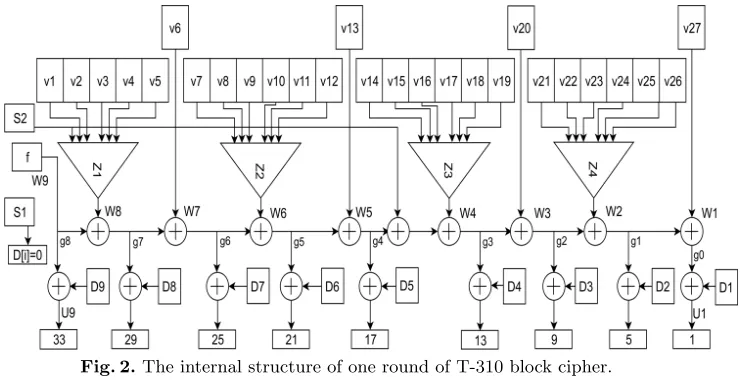
In this process there are some heuristics, for example we will try to get rid of the secret key variables K, L and the F variables corresponding to the IV or public round-dependent constant, all to be eliminated early on. This approach is suitable for a human12and we work with paper and pencil without a computer. One of key problems with T-310 is that some sums are very long, for example y9=F+Z1 +xP(6)+Z2 +xP(13)+L+Z3 +xP(20)+xD(3) and the most such
expressions contain F and many of the Z1−Z4. A potential solution is that we can eliminate many (but maybe not all) variables quite easily by XORing together consecutive freshly created outputs for example 9 and 13.
We have for example:
y9+y5=xD(3)+W(xP(21), . . . , xP(26)) +xD(2).
and similarly
y25+y21=xD(7)+Y(xP(7), . . . , xP(12)) +xD(6).
whereW is a shorter name for the function Z4 and Y is another name for Z2 which functions are identical except that the inputs are typically connected to two disjoint sets of variables.
Fig. 2.The internal structure of one round of T-310 block cipher.
5.2 Connecting Two Remote Ends
A direct inspiration for our attack are some remarkable recent attacks where two distant parts of the cipher “talk” to each other while eliminating all the other bits, however complex, involving countless state, key and IV bits, A nice example involving Z1, Z4 and key 714 is studied Section 8.2 in [23] and in more13detail
in Section 7 of [20]. This type of “complete” elimination was previously seen in stream cipher attacks cf. [21, 3] with further generalisations in [22], but was never seen before in block cipher cryptanalysis. Here we proceed in a different way from scratch and this paper is self-contained. Results in [20, 23] are a model for us except that we are aiming at something yet stronger, we want to eliminate up to 64 additional variables Z00-Z63. More precisely we wish to eliminate also the Boolean function in a certain specific way, not completely, but rather that even a very strong Boolean function not chosen by the attacker could be made to work with reasonable chances of success.
5.3 Connecting Z2 andZ4
Unlike in the very recent constructions of [23, 20], we will work on the couple of Z2 and Z4 and avoidZ1 because one of the inputs ofZ1 is the key bitL=S2 which we want to avoid. Likewise we avoidZ3 as the same key bitLis XORed to its output. Starting from our two basic equations of Section 5.1 above, we now aim at connecting togetherZ2, Z4 a.k.a.Y, W in the simplest possible way, by assuming simply that for example (order inside pairs does not matter):
(
{D(2), D(3)}={6·4,7·4} {D(6), D(7)}={2·4,3·4}
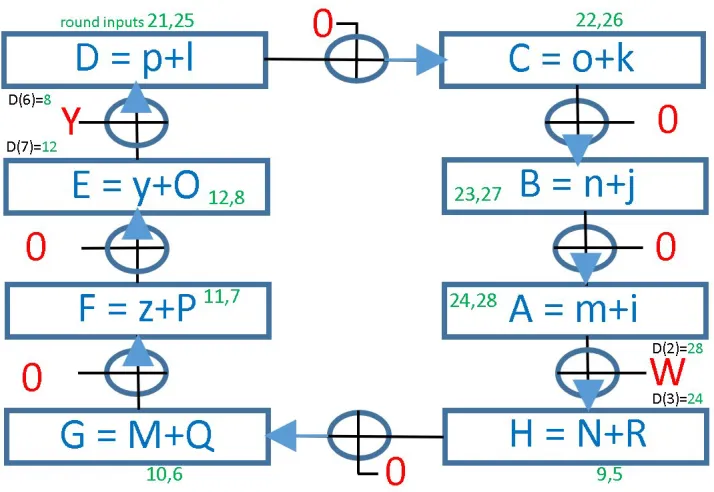
This assumption is simply meant to connect together the two equations of Section 5.1: left hand side of one become the right had side on the other after 3 steps, i.e. taking into account transitions like 25→26→27→28. At this moment it is just wishful thinking: trying to create some sort of peculiar dual-cyclic connection between our two equations. More precisely, we are aiming at a closed cycle with 8 steps as follows, hypothetically:
5,9→6,10→7,11→8,12→? 21,25→22,26→23,27→24,28→? 5,9
where the question marks relate to transitions which are not true and will actu-ally never become true. Accordingly, we define the following 8 polynomials:
13
Adef= (m+i) which is bits 24,28 B def= (n+j) which is bits 23,27 Cdef= (o+k) which is bits 22,26 Ddef= (p+l) which is bits 21,25 Edef= (O+y) which is bits 8,12 F def= (P+z) which is bits 7,11 Gdef= (Q+M) which is bits 6,10 H def= (R+N) which is bits 5,9 and then our cycle becomes
H →G→F →E→?D→C→B →A→?H
Now we are going to work on polynomials of type sayBD and it easy to see thatBD→ACafter one round, and again we are stuck because the polynomial ACcontains two multiples of 4 which are 8,12 which are erased inside this round so that we do not see an easy transition into something very simple.
Now we are ready for a big jump. As we cannot apparently achieve a lot with low degree invariants, cf. [23], we will directly consider an invariant of degree 8. 5.4 An Interesting Question
The question is given our 4 assumptions onD(2), D(3), D(6), D(7), under what conditions we could haveP =ABCDEF GHto be an invariant for 1 round, in other terms what is theF E? The answer is remarkably simple.
Theorem 5.5 (A Simple Degree 8 Non-Linear Invariant Attack).Let
P =ABCDEF GH
thenP is a non-zero polynomial14 and it is a one-round invariant if and only if theF E is equal zero for any input of the cipher and anyF, K, L and thisF E does not in fact depend on any ofF, K, L and it is actually equal to
F E=BCDF GH·((Y +E)W(.) +AY(.))
Note.Here the bits which are used as inputs toW() andY() are exactly those which would be used inside the cipher and we study them in more detail later.
Proof of Thm. 5.5: When necessary we will distinguish input and output-side polynomials (which are like different versions of the same polynomial) by an index in the exponent such asAovs.Aiwhich can be defined for any polynomial Ain the same way as in Def. 4.1: for exampleAi=A(a, b, c, d, e, f, g, h, . . .), i.e. Ai=Aand there is no change, and we will transform the output polynomial in order to eliminate all the output variables and use only input variables,
14
Ao=A(φ(Inputs)) =A(b, c, d, F +i, f, g, h, F+Z1 +e, . . .)
where φ is the transformation induced by 1 round of encryption and where φ(Inputs) denotes a sequence of 36 polynomial expressions of output-side vari-ables (ao, . . . , Vo) expressed as Boolean function of the 36 input-side variables [with some extra variables such as secret key variables]. For example the variable ais replaced by polynomialbanddbyF+i. In other words they are written as formal polynomials in B36 corresponding to the ANF expressions of one round
of encryption (and as a function of inputs of this round). Our usage of exponents is similar as in the mathematical (Hilbertian) invariant theory. Our exponents can be simply interpreted as transformations on polynomials, or more precisely as operations belonging to a certain group of transformations acting on a set of Boolean polynomialsP orA or other say (azM+b)∈B36. In this sense
expo-nentAi corresponds to the identity transformation, and our output transformed polynomial Ao would be denoted byAφ in classical invariant theory, where φ is our cipher round function φ : 0,136 → 0,136. This function φ typically de-pends also on 3 extra variables F, K, L however frequently, the final result, the polynomialAφwillnotdepend on these variablesF, K, L, or these variables get eliminated, and each time this happens, there is no ambiguity,Aφ is well defined and equal toAo.
Later this distinction will not even be needed as there will be no ambiguity: at the end theF E=P+Pφ=Pi+Pois expected to be written using input side (and maybe internal secret/public variables F KL) ONLY, and all the output-side variables will be eliminated, thus removing any ambiguity. We recall our
assumption: (
{D(2), D(3)}={6·4,7·4} {D(6), D(7)}={2·4,3·4}
and in Section 5.1 we have already established that
Ho=y9+y5=xD(3)+W(.) +xD(2) =W(.) +Ai
and
Do=y25+y21=xD(7)+Y(.) +xD(6)=Y(.) +Ei
which expressions can be reinterpreted as showing how the polynomialsD andH on the output side can be rewritten as expressions using only input-side variables and the combination of bits used here were already chosen in Section 5.1 in such a way that all bitsF KLare already eliminated. Following Def. 4.1 all we have to do is to add the polynomialABCDEF GHto itself on the output side after substitutions with input-side variables. This latter polynomial is equal to:
AoBoCoDoEoFoGoHo=BiCiDi(Y(.) +Ei)FiGiHi(W(.) +Ai) = BCDF GH(Y(.) +Ei)(W(.) +Ai) =BCDF GH(Y W+Y A+EW+EA)
ABCDEF GH+BCDF GH(Y W +Y A+EW +EA) =
BCDF GH(AE)+BCDF GH(Y W+EW+AY+AE) =BCDF GH((Y+E)W+AY) which is the exact result we need:
F E=BCDF GH·((Y(.) +E)W(.) +AY(.))
5.6 Another Proof - Exploiting a Cycle of Length 8
Fig. 3.Connections between the 8 linear factors used in our second attack withP=
ABCDEF GH and LZS265. We multiply all the 8 polynomials.
5.7 Solving the F E
Constructing non-linear invariants is sometimes a complex process which requires to manipulate complex polynomials with a computer, cf. Section 7.3. in [20] and Appendix C in [23]. In this paper the result is quite simple and was found by paper and pencil. We need to make sure thatF Eis equal to zero, or solve: 0 =BCDF GH· (O+y+Y)W(xP(21), . . . , xP(26)) + (i+m)Y(xP(7), . . . , xP(12))
Interestingly in this expression we do not enumerate the inputs of the first Y which are also Y(xP(7), . . . , xP(12)), which is because we aim at eliminating
the term (O +y +Y) completely later on by making sure that the product of other terms is always zero. We also have a polynomial where F, K, L are already eliminated. However there are many other variables. At the first sight it may seem that our equation which is polynomial of degree 18 in as many as 12 input variables plus 63 variables specifying the Boolean function is unlikely to be systematically equal to 0. What we are going to show now is simply mind-blowing: this polynomial can be made to be exactly zero in all 212 cases, even
thoughno effortwill be made whatsoever to use a particularly simple Boolean function or even to influence it. In fact we have chosen our example really well and something incredible will happen. This equation will become more easily solvable after a certain choice of which 12 bits will be connected to the 12 inputs ofY() andW() is made. Then an exponentially large space of Boolean functions will just disappear, they will be annihilated, and our equation will be partially reduced to zero in a later Section 6: not always but with a large probability.
Before we get there, the first step is to request that in our single equation which is a sum of two terms, both components are zero. For example we will aim at insuring simultaneously that:
(
CF H·W(xP(21), . . . , xP(26)) = 0
BDG·Y(xP(7), . . . , xP(12)) = 0
which will imply that ourF E is equal to 0 in all cases, i.e. our one round invariant attack works for any key and any F. At this stage it may be hard to believe but we will see that it is sufficient to put as inputs toW the 6 inputs of CF Hin a well-chosen order, not every order works but many do, and the inputs of Y needs to be the 6 inputs of BDG in another order, and that both orders must be compatible (both functionsW andY are just two instances of the same Boolean function). Moreover this actually works for any possible way to split the productBCDF GH in two products of degree 3 for example (BDG)(CF H) provided that later the inputs of W and Y are suitably aligned. Here is for example one solution which works well as we will see later:
265: P=1,20,33,34,15,13,27,6,10,23,21,25,16,14,2,4,3, 19,35,29,26,9,5,22,7,11,17 D=36,28,24,32,20,8,12,16,4
5.8 The Satisfiability Problem
Initially we want to do something quite which may seem extremely difficult. Make sure that a polynomial equation of degree 18 in as many as 12 input variables and 64 extra variablesZ00−Z63 which represent the coefficients inside the ANF of our Boolean function, cf. Def. 4.2 is systematically equal to 0 in all 212cases,
and that we will do it for an absolutely general Boolean function in 6 variables which can be random and is not chosen by the attacker, i.e. the solution should work for as many choices ofZ00−Z63 as only possible. The we made it harder be requesting that the two terms of the equation are simultaneously zero. Overall we recall that we decided to insure simultaneously that for example:
(
CF H·W(xP(21), . . . , xP(26)) = 0
BDG·Y(xP(7), . . . , xP(12)) = 0
and that the 6 inputs ofCF Hwill become inputs ofW and vice versa forY. For example with our example 265 above we haveP(24) = 22, which corresponds to the 4-th inputdofW. In fact we have already assigned the right 12 variables at some “right” 6+6 places inside LZS 265.
Now we need to see that this alone it not yet sufficient to make the attack work. We need to make sure that the polynomialCF H is an annihilator of the Boolean function W, and that simultaneously BDG is an annihilator for the second instance of the same Boolean function [two conditions]. But is this at all possible that a Boolean function chosen at randomor not chosen by the attacker would have such peculiar annihilators such asCF H? The answer will be provided in the next section. At this moment we have reduced [modulo checking that all the bits are indeed at the right positions] the problem of backdooring a block cipher to a problem of annihilating a Boolean functiontwicewith two annihilators of the form (a+b)(c+d)(e+f) for two disjoint sets of 6 variables.
6
Basic Results on Boolean Functions
LetBn be the ring of all Boolean functions inn variables with n= 6 with the usual addition and multiplication of polynomials modulo 2 with all the usual15
Boolean ring reductions such as x2 = x already built-in inside our definition
multiplication of polynomials inBn. We recall that an annihilator of a Boolean functionf ∈Bn is a function g∈Bn such that the product of these functions f·gis zero: i.e.∀x∈{0,1}n f(x)·g(x) = 0. There are countless divisors of zero in
the ringBn and annihilators exist in vast16quantities for any Boolean function. What is more surprising is that annihilators with special properties which will be exactly those which we need in our attack also exist with a large probability. First of all, is it normal that a Boolean function of degree 6 would have an annihilator of degree 3? Yes or almost, we have:
Theorem 6.1 (Algebraic Immunity Degree Bound). LetZ be a Boolean function with n= 6 variablesabcdef. Then eitherZ ofZ+ 1 has at least one annihilator of degree 3.
Proof of Thm. 6.1.Following Thm 6.0.1 in [21] there exists a functiongof degree at most 3 such that
gZ=h
wherehhas degree of at most 3. In addition following Theorem C.0.1. in the Appendix, of [21], there exists a solutions gsuch that eitherh= 0 orh=g. In the first case gZ = 0 and we found an annihilatorg of degree 3. In the second casegZ=g and sog(Z+ 1) =g+g= 0 and we found an annihilator of degree 3 for Z+1.
Remark.It is NOT true however that every functionZhas an annihilator of degree 3, a nice counter-example isabcdef+ 1 which has no annihilators at any degree less than 6. It is possible to see that such counter-examples are very few. In practice for most Boolean functions bothZ andZ+ 1, this even and also for Boolean functions generated uniformly at random, we get numerous annihilators of degree 3.
6.2 Annihilators of a Special Form
In addition to the existence of annihilators of degree 3, and in addition to the fact that his likely to very special (or that there exists annihilators g s.t. his very special) it is interesting that with large probability there exist annihilators such that g is also very special. In what follows we are going to establish some simple yet significant results on this question showing that even thoughZ is an arbitrary Boolean function, the space of annihilators is very likely to contain 15This is a standard approach and implemented in all good algebra software for ex-ample in SAGE we have the constructor BooleanFunction and the “PolyBori” im-plementation.
16
For example for every functionZ ∈Bn any multiple ofZ+ 1 is an annihilator for
some very interesting and highly symmetric polynomials. These facts are essen-tially consequences of the fact that the space of annihilators ofZ is an ideal, i.e. iff Z= 0 thenf gZ= 0, and it is also a highly structured finite partially ordered set (for divisibility) which being finite is also a lattice, i.e. every two elements have LUB/Sup and in GLB/Inf and where the top element which dominates all the other is 0. This lattice contains many some special quite symmetric elements which dominate many other in the partial order. We start by an auxiliary result. Theorem 6.3 (Special Type of Annihilators). LetZ() be a Boolean func-tion withn= 6 variablesabcdef chosen uniformly at random. We consider the following multiple ofZ():T =Z(a+b)(c+d)(e+f). We do it many times and by linear algebra [or by a careful study of how different monomials imply also the presence of other monomials] we observe that this polynomial lives in a linear space of dimension only 8. Consequently if Z() is chosen at random thenT() is equal to 0 (as a polynomial) with high probability equal to 2−8.
Proof of Thm. 6.3: This result comes from numerous symmetries imposed on T() by the linear factors. The linear space of all possible polynomials of type Z(a+b)(c+d)(e+f) is finite and a quick computation with SAGE maths software shows that its dimension is only 8. This means that every polynomial in this space can be seen as being of the form
a0Z0+. . .+a7Z7
where ai ∈ {0,1} and Zi are some polynomials forming a basis. Then we need to see that the probability distribution of the 8-tuplesai must be uniform, this is because it is an image of the input spaceGn which is an Abelian group for addition, through a linear applicationZ 7→Z(a+b)(c+d)(e+f) and all pre-images for any 8-tupleai are cosets w.r.t. H defined as sub-group of annihilators of (a+b)(c+d)(e+f), which must be of equal sizes as they define a partition of B6 and in fact any polynomial∈Bn can be viewed as bijection which maps one coset into another coset. Given the uniform distribution, the probability that our polynomial is zero is exactly 2−8.
Another Alternative Proof of Thm. 6.3: two alternative methods to prove the same result are given in Appendix B.6 and Appendix B.7 - B.13.
Finally here is the main result which we need in block cipher cryptanalysis: Theorem 6.4 (Existence of Structured 2x2x2 Annihilators).LetZ be a Boolean function withn= 6 variablesabcdef chosen uniformly at random. The probability thatZ(a+b)(c+d)(e+f) = 0 or similar for at least one permutation of variablesabcdef is approximately equal to 0.05.
Proof: For any 6 variables there are 62
· 42
/3! = 15 ways to select three pairs of variables if we consider as identical all the 3! permutations of the three sets of 2. In the first approximation, each of these choices has a probability of 2−8of
being zero, cf. Thm. 6.3 above. If all these 15 choices of a polynomial of type say Q= (a+f)(c+b)(d+e) were independent we would obtain that the probability that none of the 15 choices works is about (1−2−8)15 ≈ 0.94. Therefore we
7
Putting It All Together
We recall that in order for our invariantP to be preserved after one encryption round, we need to solve [in terms of the wiring of the cipher and the choice of the Boolean function] the following two equations:
(
(a+b)(c+d)(e+f)·W(a, b, c, d, e, f) = 0 (a0+b0)(c0+d0)(e0+f0)·Y(a0, b0, c0, d0, e0, f0) = 0
In our solution we are going use the same annihilator for both W and Y, which is not even necessary or required (therefore there exist even more ways of backdooring this cipher than the simple method we present here). Following our Thm. 6.4, this works for 5% of all Boolean functions, and all we need to do is to assign in arbitrary way the 2 time 3 sets of 2 inputs inside each Boolean function. For example, in order to identifyCdef= (k+o) =x22+x26 to the sum
(a+b) forW we must insure that P(21) = 22 and P(22) = 26 or vice versa. This must be done for all 12 variablesa, b, c, d, e,assigned atP(7) toP(12) and the variablesa0, b0, c0, d0, e0, f0 are assigned atP(21) toP(26). All this is actually already done in key 265 above and there are numerous ways to do it. Actually a careful reader will see that the order of bits inside LZS265 is such that ourF E requires to mandate rather exactly that:
(
(a+d)(b+c)(e+f)·W(a, b, c, d, e, f) = 0 (a0+d0)(b0+c0)(e0+f0)·Y(a0, b0, c0, d0, e0, f0) = 0
and this is actually what we do in our proof of concept example. This version is preferred17and permuting a, b, c, d, e, f is part of the game18.
7.1 The Bijectivity Problem
A slight technical difficulty is also that we want our long-term key to be a bi-jection on 36 bits. The reason for this requirement is that if it is not bijective, the cipher is already broken by a powerful ciphertext-only attack, see [32]. To achieve this in practice is not so difficult: we have used a version of a free open source tool described in Appendix I.11 of [31] which allows to create many ran-dom bijective LZS keys keys with arbitrary specific constraints onD() andP(). It appears that this process works with probability 1, i.e. once we have specified our constraints as above (four values for the D(i) and 12 values for the P(i)) there are still 5+15 coefficients being numbers between 0 and 36 which can be adjusted to make a key which is bijective (and looks like a secure key w.r.t all 17
We could also have a version with (a+b)(c+d)(e+f), all one needs to do to search for bijective LZS with permuted constraints, see Section 7.1. It is also important to see that there are many solutions, including making arbitrary splits ofBCDF GH
as explained earlier. Now for example it is impossible to make a KT1 key work with the present attack, this is because KT1 keys require that P(15) is an input of Z3, and thatP is injective, while here 21 must be an input of eitherZ2 orZ4. 18
previously known attacks cf. [32]). The space of long-term keys is simply enor-mous and our attack does not seem to contradict the bijectivity requirement in any way. We obtained for example the following solution:
265: P=1,20,33,34,15,13,27,6,10,23,21,25,16,14,2,4,3, 19,35,29,26,9,5,22,7,11,17 D=36,28,24,32,20,8,12,16,4
and there are plenty of other possibilities: we can also assign inputsa, b of W to beD, or F etc and we are always as it seems able to adjust the missing 15+5 coefficients to form a bijective LZS.
7.2 How to Backdoor T-310
As any Boolean function works in our attack with large probability, cf. Thm. 6.4 all we have to do now is to try some super secure Boolean functions and expect that the cipher will be broken sort of accidentally. In fact, the accident will happen 5 % of the time. For example with key 265 (and with any other variant of our attack) we have for example the following solution:
Z0(a, b, c, d, e, f) =ad+bc+be+de+ef+acd+acf+ade+bcf+bdf+cef+ abcd+abce+abef+bcdf+abcde+acdef+ 1 +a+e+c
which differs from the original Boolean function by only one linear term, the last letter was changed fromf toc.
Remark 1:It is easy to verify thatZ0(a, b, c, d, e, f)(a+d)(b+c)(e+f) = 0. Remark 2: We apologize that our attack does not work for the original Boolean function but we believe that this purely accidental; not because this Boolean function was well19 chosen or it is at all a strong or secure choice20.
19
It is rather simply a mater of good versus bad luck, and the chances that the original Boolean function would work without any modification were quite high, about 0.05. 20
8
An Attack Can Hide Another
In Appendix A we show a more general theorem which essentially triples the success probability of our attack (it works in 3 cases out of 4) and in each case we get essentially the same attack. For example with same LZS 265, we can have the following invariant for one round:
P= (A+ 1)(B+ 1)(C+ 1)(D+ 1)EF GH
This invariant works in the same way as the main result in this paper and the success probability is exactly the same. An example Boolean function for which this invariant works isbc+d+abd+acd+abcd+e+ae+be+ce+bce+ abde+cde+bcde+abcde+f+bf+abf+cf+bcf+abdf+bcdf+abcdf+ef+ bef+cef+acef+bcef+def+bdef +bcdef+ 1. This example was found by simply trying about 100 different random Boolean functions with LZS 265 and the exactP above. The attack mechanism is exactly the same cf. Appendix A. 8.1 A Combined Attack with 1+2 Invariants
We expect to obtain even more invariants such that if one does not work for a cipher, another invariant may work. Overall it is easy to see that the cumulative power of the attack described in this paper is at least about 3·5 = 15% for a fixed Boolean function chosen at random. This estimation can be justified as follows. Following Thm. 6.4 we get 5 % over the choice of a random Boolean functions in B6 if adapt the 6+6 inputs of W and Y to our specific degree 8
invariant. It is easy to see that all our 1+2 results such as Thm. 5.5 and Thm. A.1 give the same result of 5 %, cf. notes in Appendix A. Furthermore we have done some testing with 1+2 different invariantsP constructed inside this paper and we have observed that the probability that any two of these attacks would occur simultaneously is not very high. This allows to add these probabilities which leads to about 15 % success rate for one fixed Boolean function.
8.2 Beyond 1R invariants
9
Cryptanalytic Relevance of Round Invariant Attacks
Many cryptanalytic attacks do not matter at all for the security of encryption systems in real-life attacks scenarios. Or so it may seem initially. The T-310 cipher actually operates in a very secure and super-paranoid low-data rate en-cryption mode which makes that many attacks even if they seem very strong, still do not seem to break it in sense of decrypting some communications or re-covering the secret key, cf. [33]. However if we dig a big deeper we will find that we can actually break T-310 and recover the key and decrypt communications. We see two major methods to achieve this:
9.1 Decryption Oracle Attacks
We refer to [34] to see one major method in which round invariant attacks such as studied and constructed in this paper affect the security of T-310 in real-life attack scenarios. Such attacks exist, but they require a lot more work. The actual attack is a certain type of long-distance21slide attack with a decryption oracle, which is far from being obvious and has additional requirements22. One example
of a relevant non-linear attack with LZS 771 is given in [34].
9.2 Higher-Order Correlation Attacks
A second major way to exploit these properties is to see that many such at-tack create partitions of the space of 236 elements into two sets of unequal
sizes which inevitably leads to powerful ciphertext-only higher-order correlation attacks. Basically we get partitions which will bias the cipher internally in a pervasive way which works for any number of rounds. This modifies very deeply the joint probability distributions for numerous sets of internal variables and is likely to introduce some biases in such distributions. Given the fact that the key bits are repeated in a periodic way in this cipher, and that the plaintext in a natural language will also be strongly biased cf. [32], such biases lead directly to ciphertext-only key recovery attacks.
This particular method to exploit polynomial invariants was first proposed in [20]. The actual exploitation requires many additional technical steps. Several examples of such biases appear in a separate paper [20]. We given here one example which comes from the Section 10 of [23]. Let
P =eg+f h+eo+f p+gm+hn+mo+np and we use LZS 55123from [23]:
551: P=17,4,33,12,10,8,5,11,9,30,22,24,20,2,21,34,1,25, 13,28,14,16,36,29,32,23,27 D=0,12,4,36,16,32,20,8,24
Fig. 4. It is possible to see our invariant attack with LZS 551 is of the form P =
AC+BDwith the interesting cycling structure shown here and also studied in [19].
and one solution is Z = 1 +d+e+f +de+cde+def. This attack is very different24compared to what we see in this paper:P is irreducible and not
at all a product of linear terms like ABC. The invariant P as above has very interesting properties: it does indeed divide the space of possible cipher states into two unequal size sets and introduces strong biased on the various tuples of internal variables (for subsets of 8 variablese−handm−pactually used inP). We have checked that already withN= 3 variables we obtain some strong biases onN-tuples of variables which can be used in higher-order correlation attacks. For example whenP = 0 there are 40 events withef g = 1 but only 16 events with ef(g+ 1) = 1. Here the main idea is that correlation attacks involving N = 1 orN = 2 variables will not work, but starting fromN= 3 we have plenty of interesting correlations which may be exploited by the attacker. This question is beyond the scope of the present paper and is not obvious in a well-designed cipher, and leads to further technical questions (different correlations need to be combined together to form an attack). Additional examples of biases induced by polynomial invariants can be found in [20].
21As opposed to the shorter-distance 1-bit correlation attacks of [34]. 22
Such as looking for invariants actually using some key bits in a very specific way rather then totally eliminating them as we do here and in [23].
23
A strong example fully compliant with all the requirements of the KT1 class of keys approved to protect government communications cf. [32, 52, 51].
24
10
Further Developments and Open Problems
We have just started to explore an incredibly rich space of new attacks and the number of possibilities is overwhelming. We list here a few questions which we would like to find answers to in the future:
Question 1.It is possible to find a modified version of the current attack which also works25 with the exact original Boolean26 function? We conjecture
that this should be possible and is just a matter of trying with a few more attacks of this type, possibly of degree higher27 than 8. If so it can be used directly to backdoor the original historical encryption hardware by inserting a printed board with a malicious LZS.
Question 2.Is it possible to find strong keys against our attacks or guarantee in any way that the attacks will not work, cf. [7, 9]? For example:
Question 2a.Are there some specific requirements in the style of KT1 or KT2 classes cf. [32] which are able to avoid polynomial invariant attacks?
Question 2b. Is it possible to find some super-strong Boolean functions which can make T-310 secure against invariants attacks such as studied in this paper? This is related to Question 1 and we conjecture that this would be im-possible.
Question 3.What about other block ciphers e.g. DES? Then what about ciphers such as AES? In theory, as in [23] our attack is applicable directly to many other ciphers. In practice, given the fact that most modern ciphers use way more key material in one round than T-310 cf. [35], at some moment they could become secure or maybe even provably secure against polynomial invariant attacks, see Section 5.6 in [23] and [7, 9]. However there is no reason to believe that this attack would not work for example for some other classical ciphers such as triple DES. We just need to try and adapt the attack to other ciphers which requires a bit of patience, see Section 11 below for DES.
25The probability it would is expected to be high very e.g. 5 % in our current attack. 26
It is important to see that a Boolean function has typically more than one special or extremely simple annihilator, see Appendix I.19 in [31].
27
11
Application to DES
In this section we will show how the same product attack construction in this paper can be applied to DES28 (or say 3DES) more or less immediately29. The
number of inputs of each Boolean function is also the same, however there is a lot more30 key bits to take into account, and different Boolean functions are
independent31. The main research questions are, with the construction of this
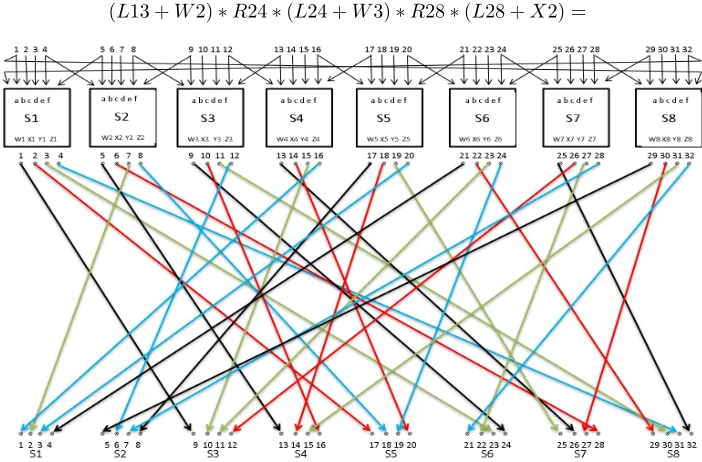
paper (essentially the same product attack) and some fixedP, what is the suc-cess probability given the P-box and when the Boolean functions are chosen at random. A second (dual) question for the same construction is, given a fixed set of S-boxes and an invariantP, what is the success probability when the P-box is selected at random. Finally, another important question is the Pbox actually used in DES a secure choice and what are weaker choices which can be attacked more easily. We consider the usual structure of DES with duplication of bits at boundaries of S-boxes:
Fig. 5.One round of DES
28In Eastern Germany a modified DES was known under the name LAMBDA1 [35] and was implemented around 1990 inside a portable electronic cipher machine T-316. 29Many thanks to Jacques Patarin and Willi Meier for suggesting this idea to me. 30
A considerable difficulty for the attacker, see early results and conclusion in [23]. 31
We are now going to adapt the product construction from Section 5 in order to build invariants for one round of DES. We first propose a basic construction which will work in some pathological cases in a very straightforward way. then we show how to make it work for the actual DES P-box and with modified S-boxes, which will be substantially harder.
11.1 Notation and Starting Point
We are going to first construct an attacks which works on 2 bits: a well-chosen pair of bits for example 4,7, corresponding to one S-box for example S2 (both bits are expected to connect to inputs of the same S-box). LetI1−32be the input of
the DES round function and letO1−32be the output of the DES round function.
In the first round we have I1 =R01 whereR01i denotes the first input on the
right side which will be sometimes denoted also byR01 if there is no ambiguity. Similarly the notation R02o denotes the second bit on the right hand side on the ouptut side of the cipher. If our encryption is performed for 1 round only we have R02o =O
2+L02i where + will always denote addition modulo 2 (when
used for binary variables). Finally for one round of the DES Feistel scheme we have L01o =R01i and the same applies for all 32 bits on the right side at the input.
We also introduce the following notation in order to simplify our polynomial expressions. We are going to denote by OPi(.) the output polynomial which is connected to output Oi. This polynomial is always one of the 4 outputs W, X, Y, Z for exactly one of the S-boxes, and has 6 input variablesa−f which are also consecutive 6 variables of typeI1−32(with wrap-around). As an example,
on our picture in Fig. 5 focuses on a pair of bits for example 4,7, showing that po-tentially they could be connected to any pair of outputs, depending on the P-box. Our Fig. 5 suggests that could be they are connected to 3rd outputY1of the 1st
S-box, which will be later called Y1, and to the last output of S2, here denoted byZ2 and later denoted by Z2. Later we will write thatOP
4(R01, . . . , R32) =
Y2(a, b, c, d, e, f) and also thatOP7(R01, . . . , R32) =Z(a, b, c, d, e, f) this
ignor-ing the key bits completely or considerignor-ing that all key bits are (for the time being) at zero. This is not quite accurate if look at the actual P-box used in DES, see later Fig. 9, where we will see that output 4 and 7 are actually equal to Boolean functionsW6 andZ7 however we do not yet assume that we use the original DES P-box, and at this stage we assume that the P-box can be modified by the attacker.
In addition we will write thatP(Z2) = 7 to explain that the last input Z of second S-box S2 is precisely the one connected to outputO7, which is the case
on our figure, and thenOP7(.) is actually a polynomial in 6 variablesa2, . . . , f2
which are also equal toI4, . . . , I9. In addition this polynomial has 6 more input
colour in our figure, and when there is no ambiguity they will be denoted simply by lettersa−f.
11.2 Basic Product Sub-Construction on 2 Bits
The goal will be at the end to obtain two polynomials which become equal i.e. if
P(Inputs) =P(Output ANF) modulo a number of assumptions. First we work on just one pair of bits for one S-box for example S2. For example we consider inputsa, dof S2 in red on our picture which are also simplyI4 andI7.
Ri4=a2
Ri7=d2 Now we define the following 2 polynomials:
(
Adef= (R4+R7) which is right bits 4,7
Bdef= (L4+L7) which is left bits 4,7
We then consider how these polynomials compare at both Input/Output sides denoted by ‘exponent’ indicesiando. We have:
Ai= (Ri
4+Ri7) =a+d
Bi= (Li4+Li7) Ao= (Li
4+Li7+OP4(.) +OP7(.))
Bo=Ai=a+d From here we have:
(
AiBi = (a+d)(Li
4+Li7)
AoBo= (a+d)(Li4+Li7+OP4(.) +OP7(.))
opportunity absolutely does NOT contain the inputsLi
4+Li7, it is a property of
the round function polynomials, and we have the following (local) Fundamental Equation for our choice of two variables (i, j) = (4,7):
F E4,7=AiBi+AoBo= (a+d)(OP4(.) +OP7(.))
11.3 Is Our Attack Feasible with Just OneF Eij
It is easy to see that unless our DES Pbox is pathologically weak, and the actual Pbox in DES is known to be extremely strong, this attack is NOT possible as such. It is easy to see that the only way to make the attack above work, i.e.AB is an invariant polynomial after any number of rounds, is to either mandate that two outputs of one S-box such asOP4(.) +OP7(.) are always at zero for all 26
inputs, or to use a Boolean function which is annihilated bya+dwhich would be possible only for certain keys and only if the 6 inputs of BOTHOPi(.) and OPj(.) come from the same S-box. All this is quite special and improbable32and so far we have not found a convincing attack on DES.
11.4 More Complex Attacks and the Original Pbox
The next question is more generally how to construct polynomials P such that they could be invariants for say 2 rounds with the original DES Pbox but with modified S-boxes. Potentially the success probability of such attacks (over the choice of the S-boxes but also over the choice of the key) is quite low HOWEVER is expected to increase as we progress with more complex polynomials and at higher degree. Moreover the number of possible polynomials is extremely large which also helps33 the attacker.
32
A probabilistic version of this attack with biased polynomial would be easier to make work, for example it is possible to see that if P box(32) = 31 and P box(29) = 28 DES can be distinguished from a random permutation using only about 28 Plain-text/Ciphertext or P/C pairs for a fraction of 2−16weak keys this using the original exact NSA-made S-boxes [27] and withA=R28+R31andB=L28+L31. 33
11.5 Closed Loop Configurations or Key Property Which Makes Ciphers Vulnerable to Non-Linear Invariant Attacks
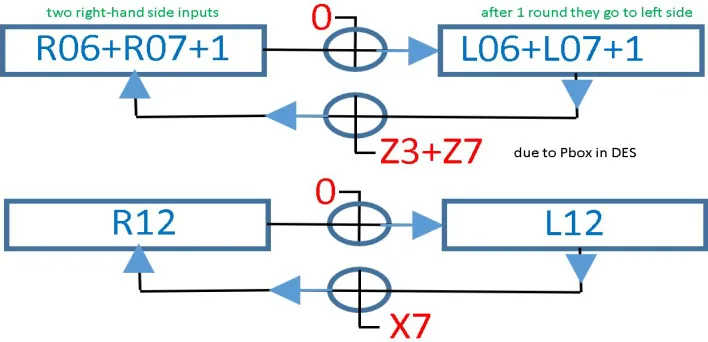
Our experience shows that the primary problem in finding “interesting” non-linear invariant attacks is to find a configuration where some set of bits and S-boxes are primarily connected to each other in closed loop, and the name of “closed-loop invariants” is used in a very recent paper [54]. This idea is not new, for T-310 it was also studied in Sections 9.1. and 9.2. and Fig. 8 and Fig. 9 in [20] and for GOST it was already studied in [29]. We reproduce here Fig. 4 from [29]:
Fig. 6.Closed-loop connection between S-boxes S3,S6,S8 in GOST cf. Fig. 4 in [29].
Fig. 7.Closed-loop connection between S-boxes S2,S3,S7 in DES.
![Fig. 4. It is possible to see our invariant attack with LZS 551 is of the formAC P = + BD with the interesting cycling structure shown here and also studied in [19].](https://thumb-us.123doks.com/thumbv2/123dok_us/7963356.1320910/29.612.142.497.97.226/possible-invariant-attack-formac-interesting-cycling-structure-studied.webp)

![Fig. 6. Closed-loop connection between S-boxes S3,S6,S8 in GOST cf. Fig. 4 in [29].](https://thumb-us.123doks.com/thumbv2/123dok_us/7963356.1320910/35.612.168.444.408.571/fig-closed-loop-connection-s-boxes-gost-fig.webp)