J . Phys. C : Solid State Phys., 15 (1982) 2709-2720. Printed in Great Britain
Impurity trapping effects in the localisation of muons in
solids
Anne M BrowneiS and A M Stonehamt
?Theoretical Physics Division, AERE Harwell, Didcot, Oxon OX11 ORA, UK $Department of Theoretical Physics, 1 Keble Road, Oxford OX1 3NP, UK
Received 4 June 1981, in final form 21 December 1981
Abstract. Muon spin rotation ( p ~ ) experiments are now regularly used to study solids and solid-state processes. The interpretation of p R data is usually based on a ‘standard’ picture in which the muons localise randomly in the solid, and then diffuse. possibly encountering impurities. There remain some important cases where no satisfactory interpretation results. For some of these anomalous systems we propose an alternative picture in which the two different factors are the importance of metastable (free muon) excited states, and the role of impurities in causing localisation. We show this allows a possible explanation of results for AI:Mn and we demonstrate that elastic strain fields of defects may be a major factor in influencing localisation. We also propose a new mechanism for delayed self-trapping.
1. Introduction
Muon spin rotation offers a special and flexible technique in the study of solids. It is a resonance method, in which the muon polarisation can be followed as a function of time. The relationship between the polarisation and physically-important quantities is dis- cussed, for example, by Stoneham (1979a); comprehensive reviews and surveys are given by Brewer and Crowe (1978), Schenck (1976) and Seeger (1978).
Despite a number of successes, there remain some important problems of interpret- ation. These concern especially muons in metals at very low temperatures, and the role of impurities in small concentrations. These problems arise within what we shall call the ‘standard picture’, which we shall define shortly. It is our aim to argue that some of these results can be understood satisfactorily within an alternative picture. In this alternative, one important component is the view that, because of the finite muon lifetime (about 2 p), the muon may not reach the thermodynamic ground state.
The ‘standard’ and ‘alternative’ pictures are most readily defined in terms of the three types of muon state in the solid. These states are ( a ) the ‘free’ state, i.e. the muon in its propogating state as when it enters the solid; ( b ) the ‘self-trapped’ state, in which the muon is effectively immobilised by the lattice distortion it causes itself, analogous to a small polaron or to hydrogen in metals; and (c) a localised state involving an impurity. It is useful to note that small-polaron theory predicts two distinct regimes in a perfect lattice, namely an incoherent hopping regime at higher temperatures, and a coherent propagation regime at lower temperatures. The coherent propagation state of state ( b ) is quite distinct from the free state ( a ) .
2710 A M Browne and A M Stoneham
The ‘standard picture’ invokes three physically-based assumptions:
(i) the ‘free’ state is never important: it lasts for a time too short to give significant consequences;
(ii) the rapid transition from the free to the self-trapped state occurs randomly in the solid;
(iii) once self-trapped, the muon diffuses through the lattice encountering impurities which affect its behaviour (see, e.g., Petzinger 1980, 1981, Kehr etal 1979).
It is probable that this picture is correct in many cases. Certainly the ideas agree with those accepted in other areas of solid-state science. One knows the muon will slow to
thermal energies rapidly. One expects self-trapping to occur within a few lattice vibra- tional periods. There is no real doubt that the self-trapped state is the ground state (Hodges and Trinkaus 1976, Leung et a1 1976). And the diffusion and trapping aspects are close to models of point defect motion following radiation damage.
The problems with this standard picture are ones which might be expected to be especially important at very low temperatures, where diffusion rates, detrapping rates, and any non-radiative transition rates may be expected to be slow. We mention four specific aspects.
( a ) The range of diffusion should be very low. Estimated diffusion constants, whether measured directly when possible or whether extrapolated from data for hydrogen, correspond to about 10+5-10+7 jumps s-’. In 2 p the muon would make 0.2 to 20 jumps, i.e. not enough to reach the nearest impurity in high-purity metals.
( b ) Impurities appear to be very important even in high-purity metals. They show especially in the distinctive differences observed from one laboratory to another. Since
so many authors mention effects of low impurity concentrations, we list a selection of the papers commenting on these effects in a separate Appendix.
(c) Quantitative fits to some of the best data fail to give an acceptable description of what is seen. Here we mean by ‘acceptable’ qualitative agreement with theoretical models and sensible quantitative values of any parameters. We shall discuss later the data on Al:Mn, where the careful analysis of Kehr etal (1981) makes just this point.
(d) For some systems, no interpretation is generally accepted, even at a qualitative level. These include the so-called anomalous metals (e.g. pure Al), where motional narrowing appears complete even at the lowest temperatures (e.g. Kehr etaZ1981), and even the so-called normal metals (e.g. pure Cu) where the mean square internal field appears to change at very low temperatures (Hartmann et a1 1981). However, the problems are not confined to metals, for the identifications of the normal and anomalous forms of muonium in diamond, silicon and germanium remain unsettled (Patterson et
af 1978, Holzschuh et a1 1979, 1981) and there are similar doubts about muon states in oxides. We shall mention all these cases in later sections.
The direct evidence for the standard picture is rather limited. In particular, properties like the Knight shift depend mainly on the spatial region within the unit cell that is sampled by the muon, and are not too sensitive to the kinetic aspects as concentrated on
here.
2. The alternative picture
We propose that, for some systems, the usual assumptions (i)-(iii) of
0
1 are replaced by these:Localisation of m u o n s by impurity trapping 2711
(ii) the direct transition from the free state to a self-trapped state can be very slow in
(iii) the impurities or defects affect the muons in three ways:
( a ) they may scatter free muons;
(6) they may catalyse the free to self-trapped muon transition, i.e. they may speed the formation of self-trapped muons relative to that in the perfect crystal. An important consequence is that m u o n s willlocalise initiallypreferentially near defects, not at random;
( c ) they may trap muons, exactly as in the conventional picture.
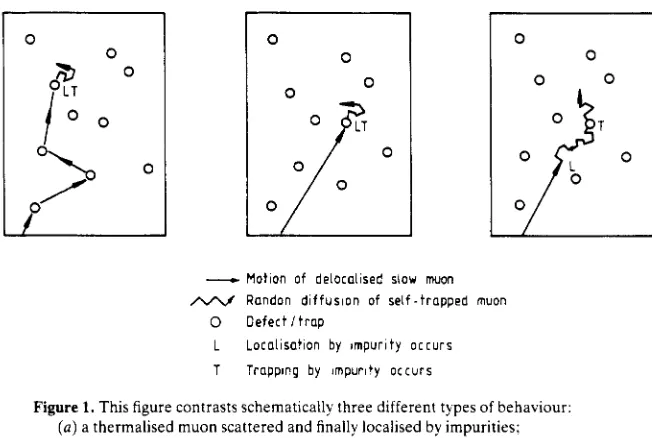
In several respects this alternative view for muons resembles the usual view of positrons in solids: positrons do not appear to have a self-trapped state in perfect metal crystals, so localisation is inevitably associated with defects or impurities. The distinc- tions are illustrated in figure 1. This model was mentioned briefly in Stoneham (1979b) and a preliminary account was given of a similar model in Browne and Stoneham (1980). a perfect (i.e. defect- and impurity-free) crystal;
0
0
0
0
0 0
-
Motion of delocalised slow mum 0 Defect I t r a pL Localisation by impurity occurs
T Trapping by impurlty occurs
M Randon d i f f u s i o n of s e l f - t r a p p e d muon
Figure 1. This figure contrasts schematically three different types of behaviour:
( a ) a thermalised muon scattered and finally localised by impurities;
( b ) here self-trapping occurs at defects without significant thermal diffusion;
( c ) the ‘standard’ picture, in which there is random self-trapping and diffusion involving traps.
2.1. Metastable excited state
The most direct evidence for metastable excited states is for muons in Fe203 and Cr203, where extra spectral lines appear at low temperatures. The most likely explanation (C Boekema and W C Mackrodt, private communication) is that the extra lines come from muons at different sites in the unit cell, where there is a local minimum in the energy. Muons at these sites are in metastable excited states. A rather similar interpretation of the two signals (‘anomalous’ and ‘normal’) in diamond, silicon and germanium has been advanced by Estle (1981). In metals, the change in mean square field seen in Cu at 0.8 K
presumably corresponds to some (as yet undetermined) excited state.
2712 A M Brorvne and A M Stoneham
amic considerations favour the lowesr energy state being populated. Kinetics aspects, since transition rates fall at low temperatures, may favour enhanced occupation of an excited state: there may not be time in the muon lifetime to achieve the ground state. This situation is, of course, also met in exciton systems. It means that, in the muon case. one cannot be sure whether the lower temperature signal corresponds to the upper or lower of the two states involved.
2.2. Other general aspects
The essence of the alternative picture is that at short timescales muons behave like positrons in solids, and that at longer timescales muons behave like hydrogen. We are specifically concerned with systems where the short-time behaviour holds for most of the muon lifetime.
The first obvious consequence of the alternative picture is that the effects of trace impurities are easily understood. The muon does not have to diffuse to the defect: instead it localises preferentially at the imperfection.
The second consequence is that, since transition probabilities involving lattice vibra- tions usually decrease rapidly with temperature, we expect the low-temperature features to be particularly sensitive to the differences between the two pictures. At high temper- atures there is rapid diffusive motion, and kinetic limits should be less important. In
particular, therefore, we expect that in metals the differences of picture will matter most in the so-called intrinsic regime of behaviour.
In the following two sections we discuss specific aspects in more detail. First. can this model give an explanation of the best-documented and most confusing of systems, Al:Mn? Secondly, are defect strain fields an important part of the catalytic process by which self-trapping is enhanced? We shall postpone any detailed analyses of kinetics to a separate report. Thirdly, we propose a new mechanism by which delayed self-trapping can occur. and one which does not appear within the standard ‘molecular crystal’ model of small-polaron theory.
3. Motion of muons in A1
In pure aluminium. no damping is seen in the ,USR signal down to about 0.1 K. Many workers have noted the dramatic effects of small impurity concentrations or of lattice defects. We shall discuss specifically the comprehensive data on A1 : Mn published recently by Kehr et a1 (1981). Their results fall into two broad regimes. Above about 2 K, a consistent and sensible interpretation emerges in terms of the trapping of muons by the strain fields of the Mn impurities. We shall not discuss this further. Below 2 K, Kehr et af discuss many explanations, and cast doubts on all of them.
In experiments, the measured quantities are counts in detectors at a particular time after the muon has entered the sample. The expression for the count in a particular detector contains a factor exp( - r ( t ) ) which describes dephasing of the muon’s spin in its motion. If the mean square variation of precession frequency o(t) is U*, then (subject
to certain general assumptions which are not too restrictive) r(t) takes the form 202r,t, where
rc
is a correlation time defined by (w(t)w(O)) =U’ exp( - t/rc). As tc becomesLocalisation of muons by impurity trapping 2713
The correlation time is determined by muon behaviour. If the muon is diffusing freely with diffusion constant D , then
$Iff = Gdd21D (1)
where d is the lattice spacing and Gd is a purely geometric factor defined by the sites
involved. Note that slower diffusion increases
r.
If, however. the depolarisation is determined by the fraction of muons captured, thenr
will increase with faster muon motion. This situation has been discussed very clearly for positrons by Hodges (1974), who notes two particular limits. If the capture event itself is rate-determining, then one has r(t)=
trypwithr:ap
= u,,cTJcr:( (2)where capture is presumed at a surface of radius r,, with lj an absorption or penetration coefficient; .zrfEis thus a cross-section, and ,tis related to the sticking probability used to describe carrier capture in semiconductors. The muon velocity is uL,; cT is the trap concentration. If diffusion to the trap is rate-determining, the expression becomes instead 4nrcDcT. Hodges' analysis suggests capture is rate-determining for positrons. and we shall assume this holds for muons too.
In comparing with observation, it is convenient to adopt specific units: 0
=
temper- ature in mK, a n d f = trap concentration in atomic parts per million. Since cT is defined per unit volume, we introduce 4nR3 as an atomic volume. From Kehr er al, using F=
2a,3tc with their quoted values, we find:rK
= (2.3 x 10⁵~-1) f U 6 9 p 5 : . ( 3 )Expression (2), with the assumption the muons have thermalised. so that
Im,vi i k T , gives us:
The two expressions are clearly broadly similar in magnitude for a reasonable cross- section
&E.
The expressions would be equal if one had:Clearly the concentration dependence is not exact, though the discrepancy may be within the limits of experiment. The temperature dependence implies a cross-section inversely proportional to temperature, a--
TI.
Hodges argues that, for positrons, capture by vacancies is inversely proportional to velocity ( a - T - 1 ' 2 ) . This is surely correct for the strong, short-range interactions of positron and vacancy. For muon- impurity systems, the position is less certain. For A1 : Mn (though less clearly for A1 : Li) there will be a longer-range elastic interaction, and it is possible that there are several excited states of muon and impurity. The parallels are then closer with some semicon- ductor systems (see e.g. Stoneham 1975, Abakumov eta1 1978) where several situations occur witha
-
TI.
2714 A M Browne and A M Stoneham
excessive. Alternatively, since equation (5) suggests trapping involves more than a strong, short-range interaction, one might hope to modify this interaction by pairing the Mn impurity with another impurity species. Hydrogen presumably binds to Mn, just as muons do, and would be a possibility. However, one would have to ensure almost all the hydrogen was paired with Mn to avoid confusing influences of isolated hydrogens.
In most of this analysis it makes no significant difference whether we assume the muon moves as a ‘free’ muon or as a large polaron, or with some intermediate character. The calculations of Hodges and Trinkaus and of Leung et a1 both strongly suggest a small polaron ground state for A1 and other ‘anomalous’ muon-metal systems, and the main feature needed is just a delay in attaining the small polaron form. We return to this point in
0
5.We see from this section that the assumptions of the alternative picture appear to give an acceptable interpretation of the A1 : Mn data, unlike the ‘standard’ picture. At this point it is convenient to comment on an earlier proposal of ours, which also proposed delayed localisation (Browne and Stoneham 1980). In the earlier model the emphasis was more on the capture event. Kehr et a1 rejected the earlier model, but on grounds which appear to confuse the self-trapping energy and the binding energy of a self-trapped muon to the impurity which catalyses localisation. Nevertheless, we agree with their conclusion that the earlier description did not offer an obvious interpretation of their data.
4. Intrinsic or extrinsic localisation?
The first component of the alternative picture concerns the importance of metastable excited states. The second essential component concerns the way in which impurities can influence behaviour, for example by encouraging transitions from ‘free’ to localised (self-trapped or impurity-trapped) states. Since the influence of impurities is apparent in quite a few systems, and since there seems no reason to associate this influence with a unique chemical or defect species, we examine here the question ‘Can the strain fields of point defects cause free muons to localise?’. We do not discount the chemical inter- actions, which may be strong, nor the influence of line defects. However, suitable chemical impurities are unlikely to be so common in nature as those with significant strain fields, so we shall ignore chemical effects in the first instance.
Localisation
of
muons by impurity trapping 2715from the earlierpapers the important idea that a critical strain is necessary for localisation to occur, and we shall look at the thermal and defect contributions to this strain. This type of picture is also used in other areas, such as electron solvation in aqueous solutions (Walker 1967). It is necessary for us to use the relatively simple idea of a critical strain principally because the treatments in small polaron theory make rather restrictive assumptions: they use one-band models, ignoring the higher-energy bands, and they concentrate on thermodynamic equilibrium, rather than on the transient states which are important in kinetics.
Here we shall quote results from our earlier report (Browne and Stoneham 1980), with some generalisation. To be specific we concentrate on a locally tetragonal critical strain, rather than simply dilatation, to avoid the well-known feature that a spherical inclusion in an elastically isotropic lattice gives only a uniform dilation. Our conclusions should be qualitatively correct for strains of any symmetry.
(i)
Thermal strain. The conditional probability that the strain exceeds a particular critical value .sC is given by:P T ( E
>
E,) = erfc(e,/ET) ( 6 ) wherealuminium, the corresponding values are 0.14 and 0.16.
probability can be written:
is a constant of the material. For copper ET is 0.05 at 0 K and 0.08 at 300 K; for
(ii) Defect-induced strain. In the absence of a thermal component the conditional
("
2
& ( E > E,) = 1
-
-tan-'n
(7)where we have written the materials-dependent factors as cuand
p;
for Cu (Y = 0.04 andp
= 0.27. The density of defects is p andA V
is the volume dilatation per defect; it is often found thatA V
is of the order of the atomic volume, and we shall use this value in making rough estimates.log Eo
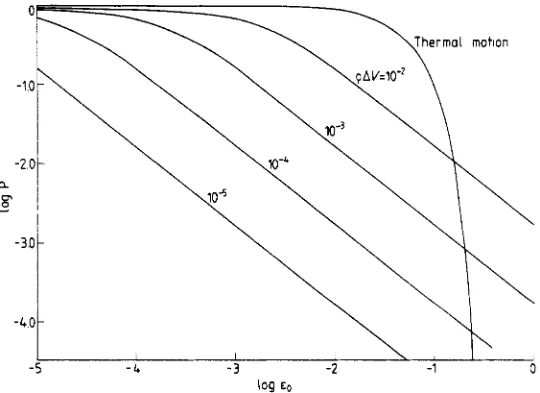
Figure 2. Probability P that the strain from a particular source E exceeds a particular value
2716 A M Browne and A M Stoneham
(iii) Defect and thermal strains simultaneously present. The distribution of strains is here a convolution of the Gaussian thermal distribution with the Lorentzian component from point defects. Such distributions have been discussed by Posener (1959). Explicit numerical evaluations confirm that the conditional probability lies above the two limiting cases of thermal broadening alone or strain broadening alone, and it interpolates smoothly between these extremes. From these calculations one finds (see figure 2) that whenever the critical strain is at all large (i.e. greater than 5-10%) the regions close to defects will dominate for point defect concentrations greater than about 100 ppm. Further, the high-strain sites are almost exclusively near to the defects: this implies preferential localisation at point defects.
5. Why is localisation delayed?
Within the usual polaron models. delayed self-trapping occurs only for restricted ranges of parameters. There is a barrier only in the so-called 'coexistence' regime in which both small and large polarons may occur. For parameters outside this range the small pola- rons, if stable at all, should relax within a few periods of lattice vibrations. In a metal- muon system, ignoring for the moment the finite muon lifetime, there are surely excited states forming large-polaron bands. Even for the lower-energy states the parameters may lie outside the restricted regimes needed for the coexistence of large and small polarons. It is hard to be convinced that there is really an effective barrier to self-trapping of the form usually discussed in any but very special circumstances.
There is, however, an alternative. Suppose one regards the muon's low-lying delo- calised states as tight-binding band states, built from local states centred on interstitial sites. Normally a single type of site will dominate completely. In some hosts there may be significant contributions from more than one interstitial site (say I and 11) to these low-lying, delocalised states. In aluminium. for example, the several calculations suggest that the octahedral site is only slightly more stable than the tetrahedral site (Popovic and Stott 1974, Popovic et a1 1976, Mainwood 1976, Jena and Singwi 1978, Prakash et a1 1979, Taylor 1980, Kahn et a1 1980). The source of delay in localisation is now apparent:
if the muon becomes (metastably) associated with sites 11, its ultimate self-trapping on sites I will be delayed.
Localisation
of
muons by impurity trapping 2717when the effect ismore dramaticstill. In thecase illustrated, QB1 = - QBII, i.e. the (large polaron) distortions from the amplitude at site I1 are opposite to those giving the ultimate localisation on site I. There will be an increased delay because the lattice has to make a very large readjustment in going from the low-lying excited states, based on sites 11, to the lowest states based on sites I. Moreover, one can note the possibility of several different coexistence regimes: two types of small polaron, one associated with each type
of site (this could correspond to the oxide systems discussed in §2.1), or site I1 large polarons coexisting with site I small polarons. In both cases there would be energy barriers between the two species.
Distortion Q favouring localisation on s i t e I
Positlon of muon In i r e a l ) space
I
Oistortlon Q favouring localisailon on s i t e I1
j b )
Figure 3. ( a ) Model system showing a mechanism for delayed localisation. Q A and QB are distortions which may give rise to localisation. x host lattice atom; 0 interstitial sites I: Cm
interstitial sites 11.
( b ) Energy contours illustrating the way a barrier can appear when there is competition between the localising distortions for different interstitial sites.
2718 A M Bro wne and A M Stoneham
6. Conclusions
We have proposed an alternative picture of muon behaviour in solids, and one which appears to cover those cases which are anomalous in the standard picture. It achieves this without any major reinterpretation of those results which fit the standard picture, apart from a possible re-identification of some of the lowest-temperature regimes (region
I in the ‘model trapping behaviour’ as described in Stoneham (1979a, b)) as extrinsic rather than intrinsic.
The main features of the alternative picture are the recognition of the importance of metastable excited states and the recognition of the role of impurities in accelerating evolution towards the expected ground state. We have shown that the results of the most detailed study of an anomalous system, Al:Mn, fit a model like ours satisfactorily. Further, we have shown that strain fields of defects can account for much of the impur- ities’ influence. What we have not discussed is the kinetic behaviour preceding and during self-trapping. This is still an area of active research where little is settled, even for model polaron systems. Apart from some general points made in our earlier report (Browne and Stoneham 1980), the extent to which these results apply to muon systems is less well defined. Nevertheless, our arguments require only simple general features, notably some feature which inhibits localisation and which loses its effect when there is a large enough local perturbation.
We have discussed the alternative picture in the context of scientific solid-state applications of Muon spin rotation. However, the implications are especially important
if muon spin rotation is to be used in materials technology. If the standard picture applies, intrinsic host behaviour is monitored in a straightforward way. When the alternative picture applies, it is the behaviour of muon excited states (possibly ill- defined) and interactions with trace impurities (possibly unintentionally present) which one monitors, a situation of more restricted practical value.
Appendix
We list here papers which describe experiments in which either trace impurity effects are mentioned or apparent. In the case of copper there are indications of metastable excited states. The list is in order of increasing atomic number.
Host Reference Be
AI
Metz H et a1 1979 Hyp. Int. 6 271
Hartmann 0, Karlsson E, Norlin L - 0 , Richter D and Niinikoski J 0 1978 Phys. Rev. Lett. 41 1055 Hartmann 0, Karlsson E, Norlin L - 0 , Niinikoski J 0, Kehr K W , Richter D, Welter J-M, Yaouanc
A and le Hericy J 1980 Phys. Rev. Lett. 44 337 Hartmann 0 et ai Solrd State Commun., to be published
Kehr K W, Richter D, WelterJ-M, Hartmann 0, Norlin L - 0 , KarlssonE, Niinikoski J 0, Chappert J and Yaouanc A 1981 Hyp. Int. 8 681
Kohn S , Brown J A, Heffner R H , Huang C Y , Kitchens J A Jr, Leon M , Olsen C E , Schillaci M E and Gauster W B 1979 Hyp. Int. 6 283
KosslerWJ.FioryAJ,Lankford W F , L i n d e m u t h J , L y n n K G , MahajanS, MinnichRP,Petzinger K G and Stronach C E 1978 Phys. Rev. Lett. 41 1558
Fiory A J , Lynn K G, Parkin D M, Kossler W J , Lankford W F and Stronach C E 1978 Phys. Reu.
Lett. 40 968
Hartmann 0, Karlsson E. Norlin L - 0 , Pernestal K , Borghini M, Niinikoski J 0 and Walker E 1978
Localisation of muons by impurity trapping 2719
Cr
Fe
c u
Nb
Ta
Heffner R H , Brown J A , Hutson R L, Leon M, Parkin D M, Schillaci M E. Gauster W B, Carlson 0 N, Rehbein D K and Fiory A J 1979 H y p . Int. 6 237
Metz H et a1 1979 H y p . Int. 6 271
Nikolskii B A 1977 Meson Chemistry and Mesomolecular Processes in Matter Conf, , Dubna. U S S R
p 246
Grebinnik V G et a1 1979 Hyp. Int. 6 103
Kossler W J , Fiory A J, Murnick D E, Stronach C E and Lankford W F 1977 Hyp. Int. 3 287 Weidinger A , Balzer G, Graf H, Moslang J , Recknagel E, Wichert Th, Bigot J and Grynszpan R I 1981 H y p . Inf. 8 543
Graf H, Kiindig W, Patterson B D, Reichart W, Roggwiller P, Camani M, Gygax F N, Riiegg W. Schenck A and Schilling H 1976 Helu. Phys. Acta. 49 730
Graf H, Balzer G , Recknagel E. Weidinger A and Grynszpan R I 1980 Phys. Reu. Lett. 44 1333 Nishida N, Hayano R S, Nagamine K, Yamazaki J , Brewer J H. Garner D M. Fleming D G . Jakeguchi J and Ishikawa Y 1977 Solid State Commun. 22 235
Yagi E, Bossy H , Doring K P, Gladisch M , Herlach D, Matsui H. Orth H. zu Pulitz G , Seeger A and Vetter J 1981 Hyp. Int. 8 553
Yaouanc A , Chappert, J , Hartmann 0, Norlin L - 0 and Karlsson E 1981 Hyp. Int. 8 667 Hartmann 0, Karlsson E , Norlin L - 0 , Niinikoski J 0, Kehr K W, Richter D, Welter J-M. Yaouanc
A and le Hericy J 1980 Phys. Reu. Lett. 44 337
Hartmann 0, Norlin L - 0 , Yaouanc A , le Hericy J , Karlsson E and Niinikoski J 0 1981 Hyp. Int.
8 533
Birnbaum H K, Camani M, Fiory A J , Gygax F N , Kossler W J , Ruegg W, Schenck A and Schilling H 1978 Phys. Reu. B 17 4143
-
1978 Phys. Lett. 65A 435Borghini M, Niinikoski J 0, Soulie J C, Hartmann 0, Karlsson E. Norlin L - 0 , Pernestal K. Kehr K W, Richter D and Walker E 1978 Phys. Reu. Lett. 40 1723
Brown J A et a1 1979 Hyp. Int. 6 233 Metz H eta1 1979 Hyp. Int. 6 271
Niinikoski J 0, Hartmann 0, Karlsson E, Norlin L - 0 , Pernestal K, Kehr K W, Richter D, Walker E and Schulze K 1979 Hyp. Int. 6 229
Borghini M, Niinikoski J 0, Soulie J C, Hartmann 0, Karlsson E. Norlin L-0. Pernestal K. Kehr K W, Richter D and Walker E 1978 Phys. Reu. Lett. 40 1723
Brown J A et a1 1979 Hyp. Int. 6 233 Metz H et a1 1979 Hyp. Int. 6 271
Niinikoski J 0, Hartmann 0. Karlsson E , Norlin L - 0 , Pernestal K, Kehr K W, Richter D , Walker E and Schulze K 1979 Hyp. Int. 6 229
Schilling H, Camani M, Cygax F N , Riiegg W and Schenck A 1978 Phys. Lett. 67A 231
References
Abakumov V N, Perel V I and Yasievich I N 1978 Sou. Phys.-Semicond. 12 1 Brewer J H and Crowe K M 1978 Ann. Reu. Nucl. Part. Sci. 28 239
Browne A M and Stoneham A M 1980AERE Report. TP.880 Emin D 1973 Adu. Phys. 22 57
-
1981 Hyp. Inc. 8 515Emin D and Holstein J 1976 Pbys. Reo. Lett. 36 323 Estle T 1981 Hyp. Int. 8 365
Hartmann 0, Norlin L 0, Yaouanc A , le Hericy J , Karlsson E and Niinikoski J 0 1981 Hyp. Inr. 8 533 Hodges C H 1974 J . Phys. F: Mer. Phys. 4 L230
Hodges C H and Trinkaus H 1976 Solid State Commun. 18 857
Holzschuh E, Graf H , Recknagel E , Weidinger A , Wichert Th and Meier P 1979 Phys. Reu. B 20 4391 Holzschuh E, Kiindig W and Patterson B D 1981 Hyp. Znt. 8 819
Jena P and Singwi K S 1978 Phys. Rev. B 17 1592
2720 A M Browne and A M Stoneham
Kehr K W , Richter D, Welter J M. Hartmann 0, Norlin L - 0 , Karlsson E. Niinikoski J 0, Chappert J and Yaouanc A 1981 Hyp. Int. 8 681
Leung C H . McMullen J and Stott M J 1976 J . Phys. F: Met. Phjs. 6 1063 Mainwood A M 1976AERE Rep. TP.684
Mott N F and Stoneham A M 1977 J . Phys. C; Solid State Phvs. 10 3391
Patterson B D, Hintermann A . Kiindig W . Meier P F. Waldner F, Graf H . Recknagel E, Weidinger A and Petzinger K 1980 Phys. Reu. Lett. 75A 225
-
Popovic Z D and Stott M J 1974 Phys. Reu. Lett. 33 1164
Popovic Z D, Stott M J. Carbotte J P and Piercy G P 1976 Phys. Reo. B 13 590 Posener D 1959Aust. J . Phys. 12 184
Prakash S, Bonnet J and Lucasson P 1979 Phys. Reo. B 19 1976 Rashba E I 1957 Opt. Spektrosk. 2 75
Schenck A 1976 Nuclear and Particle Physics at Intermediate Energies ed. J B Warren (New York: Plenum) Seeger A 1978 Topics in Applied Physics 28 e d . G Alefeld and J Vokl p 349
Stoneham A M 1975 Theory of Defects in Solids (Oxford: Oxford University Press)
- -
Sumi H 1972 J. Phys. Soc. Japan 33 327 Taylor D W 1980 Phys. Reu. B 21 5096
Toyozawa Y 1962 Scottish Uniu. Summer School: 'Polarons and Excitons' e d . C G Kuper and G D Whitfield Walker D C 1967 Q. Reu. Chem. Soc. 21 79
Wichert Th 1978 Phys. Reo. Left. 40 1347 1981 Hyp. Int. 8 647
pp 159-297
1979a Comments Solid State Phys. 9 77 1979b Hyp. lnt. 6 21 1