University of South Carolina
Scholar Commons
Theses and Dissertations
1-1-2013
Investigating Relationships Between Academic
Achievement and After School Programs in a High
School Environment
Aaron Duke Fulmer
University of South Carolina
Follow this and additional works at:https://scholarcommons.sc.edu/etd Part of theEducational Administration and Supervision Commons
This Open Access Dissertation is brought to you by Scholar Commons. It has been accepted for inclusion in Theses and Dissertations by an authorized administrator of Scholar Commons. For more information, please [email protected].
Recommended Citation
Fulmer, A. D.(2013).Investigating Relationships Between Academic Achievement and After School Programs in a High School Environment.
INVESTIGATING RELATIONSHIPS BETWEEN ACADEMIC
ACHIEVEMENT AND AFTER SCHOOL PROGRAMS IN A HIGH
SCHOOL ENVIRONMENT
by
Aaron Duke Fulmer
Bachelor of Arts Erskine College, 1996
Master of Education Clemson University, 2001
Education Specialist
South Carolina State University, 2004
Submitted in Partial Fulfillment of the Requirements
For the Degree of Doctor of Philosophy in
Education Administration
College of Education
University of South Carolina
2013
Accepted by:
Lynn Harrill, Major Professor
Christine DiStefano, Committee Member
Rhonda Jefferies, Committee Member
Zach Kelehear, Committee Member
ii
iii
DEDICATION
I dedicate this work to my beautiful wife, Julie. Thank you for the support
and freedom to pursue this goal. There are no words to express my gratitude or
admiration. Proverbs 31:10 “Who can find a virtuous woman? For her price is
far above rubies.”
I also dedicate this dissertation to my children, Grayson, Greta, and Coleman
in faith that you will come to know the God that I love at an early age and invest
iv
ACKNOWLEDGEMENTS
The process of writing a dissertation is only possible with the assistance,
encouragement, instruction, and support of many people from every part of life.
I want to acknowledge and thank the Lord Jesus Christ for the grace, mercy,
and faith he freely gives.
To my advisor, Dr. Lynn Harrill, thank you for doing more than expected and
for being committed to excellence. To the other committee members, Dr.
Kelehear, Dr. DiStefano, and Dr. Jefferies, thank you for invaluable insight and
challenging questions throughout the process.
In my professional career, there have been two people that have mentored
me and encouraged me to pursue leadership positions. Although Coach Randy
Burns and Dr. W. Rallie Liston are very different in style, they are excellent
leaders and courageous Christian gentlemen. They are both good men in a
storm.
My parents, Danny Nelson Fulmer Sr. and Nancy Barnado Fulmer, have
been foundational in the pursuit of this goal. They instilled in me a love of
learning and a dogged commitment to the Truth. Thank you for teaching me that
v
and honor of hard work. Your life story is a testament to the difference Christ
makes.
Finally, I thank and acknowledge my Great Aunt, Mildred Ingram Duke. Your
support and encouragement has been important. I had to finish this journey; I
vi
ABSTRACT
The purpose of this study was to investigate if participation in an
academically focused after school program could be linked with improved
academic achievement as measured by a standardized test. A quantitative
experimental design was utilized to explore the topic. The scale scores of
participants in an academically focused after school program were compared to
non participants to determine if there was a statistical difference between the
groups. Additionally, the attendance level of participants in the academically
focused after school program was correlated with their scale score on a
standardized test in order to the relationship.
This study is significant because after school programs have become an
important academic and social tool for both the schools and communities. After
school programs are one way that the public school systems are meeting
emerging academic and social challenges. The amount of capital and human
resources invested in after school programs must be examined and justified.
The study yielded no statistically significant findings for any of the research
questions. The scores of the participants in an academically focused after school
program and non participants were not statistically different. Furthermore, the
vii
significantly correlated. Although there were not any significant findings, it is
worthy to note that the participants had higher mean scores on the HSAP test
when compared to non participants in each of the twelve considered
disaggregate groups. Even though the results were not statistically significant,
viii
TABLE OF CONTENTS
DEDICATION ... III
ACKNOWLEDGEMENTS ...IV
ABSTRACT ...VI
LIST OF TABLES ... X
CHAPTER ONE INTRODUCTION ... 1
1.1 REVIEW OF LITTERATURE ... 4
1.2 STATEMENT OF PROBLEM ... 10
1.3 STUDY DESIGN ... 11
1.4 RESEARCH QUESTIONS ... 14
1.5 SIGNIFIGANCE ... 15
1.6 DELIMITATIONS AND LIMITATIONS ... 16
1.7 DEFINATIONS ... 18
1.8 ORGANIZATION OF RESEARCH ... 19
1.9 SUMMARY ... 20
CHAPTERTWOREVIEWOFLITTERATURE ... 21
2.1 INTRODUCTION ... 21
2.2 HISTORICAL PERSPECTIVE ... 23
2.3 HOMEWORK ASSISTANCE PROGRAMS ... 32
ix
2.5 NON-ACADEMIC PROGRAMS ... 36
2.6 ACADEMICALLY FOCUSED PROGRAMS ... 38
2.7 HALLMARKS OF SUCCESSFUL AFTER SCHOOL PROGRAMS ... 41
2.8 ACADEMIC ACHIEVMENT LINKED TO TIME ... 43
2.9 SUMMARY ... 45
CHAPTER THREE METHODOLOGY ... 47
3.1 INTRODUCTION ... 47
3.2 RESEARCH QUESTIONS ... 47
3.3 RESEARCH DESIGN ... 48
3.4 INSTRUMENTATION AND DATA COLLECTION ... 54
3.5 POPULATION AND SAMPLING ... 56
3.6 DATA ANALYSIS ... 58
3.7 DELIMITATIONS AND LIMITATIONS ... 61
3.8 SUMMARY ... 63
CHAPER FOUR RESULTS ... 64
4.1 INTRODUCTION ... 64
4.2 SAMPLE DEMOGRAPHICS ... 64
4.3 RESEARCH QUESITON ONE RESULTS ... 65
4.4 RESEARCH QUESTION TWO RESULTS ... 68
4.5 RESEARCH QUESTION THREE RESULTS ... 70
4.6 RESEARCH QUESTION FOUR RESULTS ... 73
4.7 SUMMARY ... 76
x
5.1 INTRODUCTION ... 76
5.2 SUMMARY OF STUDY ... 76
5.3 RESEARCH QUESTION ONE DISCUSSION ... 79
5.4 RESEARCH QUESTION TWO DISCUSSION ... 80
5.5 RESESARCH QUESTION THREE DISCUSSION ... 81
5.6 RESEARCH QUESTION FOUR DISCUSSION ... 83
5.7 FINDINGS RELATED TO RESEARCH ... 83
5.8 RECOMMENDATIONS FOR FURTHER RESEARCH ... 86
5.9 CONCLUSION ... 87
xi
LIST OF TABLES
Table 4.1 Sample Demographic Information ... 65
Table 4.2 Question one HSAP scale score descriptive statistics ... 66
Table 4.3 Inferential statistic results for question one sample scale scores ... 67
Table 4.4 Question two HSAP scale score descriptive statistics ... 68
Table 4.5 Inferential statistic results for male sample scale scores ... 69
Table 4.6 Question three scale score descriptive statistics ... 71
Table 4.7 Inferential statistic results for female sample scale scores... 72
Table 4.8 Summary of statistical test information ... 73
Table 4.9 Question four HSAP scale score descriptive statistics ... 74
1
CHAPTER ONE
INTRODUCTION
In the past twenty years, the number of after school programs has grown at a
steady and impressive pace (Hess and Finn, 2007). The National Center for
Education Statistics estimates that the percentage of public schools offering after
school programs tripled between 1987 and 1999 (Chapman, Kleiner and Nolin,
2004). The increased funding from federal and local sources in conjunction with
increased pressure to ensure achievement for every segment of the population
has caused a proliferation of after school programs across the nation (Zhang and
Byrd, 2006).
Although many privately funded after school programs exist, the funding for
the explosion of after school programs has come in large part from expanded
spending from the federal government. (Chapman, Kleiner and Nolin, 2004). The
21st Century Community Learning Centers (CCLC) program, the federal
government’s largest after school initiative to date, has experienced a steady
budget increase since it began in 1994 (Dynarski et al, 2004). Federally funded
after school programs operate for the purpose of fostering academic progress
(Dynarski et al, 2004). After school programs provide students academic support
in a variety of ways including homework assistance and academic enrichment
2
contextualized social problems, and build meaningful relationships between
students and adults. (Zhang and Byrd, 2006).
The pressure that has developed over the last twenty years for achievement
on standardized tests has been a significant factor in the expansion of after
school programs (Dynarski et al., 2004). Between the years 1984 and 2004,
many state and federal reforms have focused on helping students who have
historically underachieved (Dynarski et al., 2004). In 1994, the 21st CCLC
program provided stable federal funding for after school programs during
non-school hours (Zhang and Byrd, 2006). The program was revised in 1998 and
provided a mandate as well as monetary resources for academic and
recreational activities during non-school hours (Zhang and Byrd, 2006). In 2002,
the No Child Left Behind (NCLB) federal law was enacted and expanded the
federal government’s role in K-12 education. The NCLB Law is based on five
principles: “(1) stronger accountability for results, (2) increasing flexibility and
local control, (3) expanding options for parents, (4) putting reading first, and (5)
emphasizing effective teaching methods (U.S. Department of Education
[USDOE], 2005).” Furthermore, with the NCLB law enacted, the funding
mechanism for 21st CCLC was modified, giving block grants to states to spend
with greater flexibility in order to meet the specific academic and social needs
particular to each community (Zhang and Byrd, 2006).
In addition to addressing academic needs, after school programs serve the
larger community by providing structure and accountability for unsupervised
3
home from work (Fight, 2002). The Partnership for Family Involvement in
Education (2005) reports that over twenty-eight million school aged children have
either both parents, or their only parent in the workforce. Additionally, there are
between five and fifteen million school aged children left unsupervised at home
each week (Partnership, 2005). School aged children who are unsupervised
during the hours following school are more likely to receive poor grades and drop
out of school when compared to those students that are involved in structured
activities (Partnership, 2005). The social need for after school programs is further
emphasized by the fact that most juvenile crimes are committed between the
hours of 2:00 PM and 8:00 PM (Fight, 2002).
Many after school programs attempt to address both the social and
academic needs of the child (Fight, 2002). For instance, an after school program
called the Police Action League (PAL) administered by the Baltimore police
department focuses on keeping youth in high crime neighborhoods involved in
constructive activities in the hours following the dismissal of school (Fight, 2002).
Three years after the program was implemented, juvenile crime dropped over ten
percent, and the teen victimization rate dropped over fifty percent (Fight 2002). In
short, after school programs operate to fulfill two mandates: supervision and
academics (Brecher et al, 2010). Both functions are integral to understanding the
complete picture of after school programs in the United States of America.
(Brecher et al, 2010)
There are many scholarly studies investigating the effectiveness of after
4
after school programs are focused on the elementary students, there is limited
research involving secondary schools and after school programs (Chung, 2005).
This study is important because it adds to the body of scholarly work in an area
that is limited.
A second reason this study is important is because of the high stakes nature
of secondary tests. State exit exams, ACT, and End of Course/Grade tests are
just a few examples of high stakes tests given during the secondary years. If
participation in an after school program is linked to improved academic
achievement on standardized tests, then students attending the after school
program would have improved opportunity for post secondary education and a
greater probability for high school graduation. This study will explore if
participation in a particular after school program can be linked to improved
academic achievement as measured by a standardized test.
1.1Review of Literature
An after school program is any formal program that takes place following the
dismissal of school (Zhang and Byrd, 2006). However, there are no set
programmatic, curricular or personnel requirements that must be met in order for
a program to be defined as an after school program (Zhang and Byrd, 2006).
Although an academic component is not mandatory for an after school
program, most after school programs have enhanced academic achievement as
a stated goal (Carr and Weigand, 2001). The organization funding the program
5
Weigand, 2001). For example, a program may focus on academic growth,
healthy lifestyle, or the arts (Carr and Weigand, 2001). After school programs
funded by NCLB or 21st CCLC have academic achievement as one of the stated
goals (Carr and Weigand, 2001). The academic component may be focused on a
variety of educational skills including, but not limited to, homework, organization,
literacy, skill building, academic remediation, and academic enrichment (Reno
and Riley, 2000). These programs are designed to provide struggling students
with additional educational support or instruction (Carr and Weigand, 2001).
In addition to an academic component, an after school program may have
other components designed to develop the whole student (Reno and Riley,
2000). Non academic components may include: character development,
recreation activities, art, music, counseling, hobbies or mentoring (Reno and
Riley, 2000).
As of 2006 most NCLB or 21st CCLC programs were located in elementary
and middle schools (Zhang and Byrd, 2006). Secondary schools frequently have
after school programs designed for the arts, recreation, or mentoring (Zhang and
Byrd, 2006). Most after school programs in the secondary setting focus on
tutoring or homework completion (Zhang and Byrd, 2006).
Researchers have not adopted consistent criteria for classification of after
school programs into categories (Aspler, 2009). There are various typological
processes throughout literature. For example, Hofferth, Brayfield, Deich and
6
programmatic outcomes: (1) providing adult supervision and safe environments;
(2) providing a flexible, relaxed, and homelike environment; (3) providing cultural
or enrichment opportunities; (4) improving academic skills; (5) preventing
behavior problems; and (6) providing recreational activities. Another researcher,
Fashola (1998), classified after school programs by content based categories: (1)
language arts, (2) study skills, (3) academic programs in other curriculum areas,
(4) tutoring for reading, and (5) community-based programs. Based on the
research, this study classifies after school programs based on academic
components. There are four principal models for consideration: (1) homework
assistance program, (2) academic enrichment, (3) non academic and (4)
academically focused. Each type has specific characteristics and provides
differing academic assistance.
A homework assistance after school program is administered by a school or
organization and is designed to assist students in completing homework and
tutoring for the purposes of homework completion. It may or may not have a non
academic component imbedded in the program and it may have improved
academic achievement as a stated goal or outcome. One example of this type of
program is the Gevirtz Homework Project (Cosden et al, 2001). The goal of the
Gevirtz Homework Project was to provide students assistance with homework
(Cosden et al, 2001). The Gevirtz Homework Project served a broad range of
academic levels in the elementary schools of the Santa Barbra School District
(Cosden et al, 2001). Students were expected to stay in the program for three
7
minutes (Cosden et al, 2001). The program was staffed by a licensed teacher
and snacks were provided by the program (Cosden et al, 2001).
One hundred forty six students were selected for the program on a voluntary
basis and were matched with a stratified non-participant for the purpose of
comparison (Cosden et al, 2001). At the conclusion of the Gevirtz Homework
Project, the researchers found no statistical difference in academic achievement,
homework completion, school bonding and social behavior in the students that
participated in the homework assistance program and students who did not
participate in the homework assistance program (Cosden et al, 2001).
An academic enrichment after school program is administered by a school or
organization and is designed to teach new concepts, to go beyond the basics,
and support academic growth. This type program goes beyond merely assisting
with homework, but may have homework completion as a goal or component. It
seeks to support academic achievement through new instruction and
experiences. Academic enrichment programs have a non academic component
imbedded in the program. This non academic component may include mentoring,
arts, athletics, or recreation. Academic enrichment programs have improved
academic achievement as a stated goal or outcome.
For instance, a study by the State of California (2002) demonstrated the
effectiveness of an after school program with two mandates: literacy and
educational enrichment. This funding mechanism allowed for whole-child
8
high interest and retain participants (California, 2002). Upon evaluation of the
program, the data show a “positive impact on participating students’ achievement
as measured by SAT-9 reading and math scores…. and improved grade point
averages as reported by the local programs” (California 2002). Additionally this
study linked participation in the after school program to improved attendance,
improved attitude about school, and remarkably high levels of support from
participants, parents, teachers, and administrators (California, 2002).
A non-academic after school program is administered by a school or private
organization and designed to support academic growth through an array of
non-academic components. Non-non-academic programs seek to engage students in non
academic activities for the purpose of supervision, character development, and
skill development. Examples of these types of programs would be after school art
and choral programs as well as Boy/Girl Scouts. This type of program may or
may not have a stated academic goal although some studies support a link
between participation in a non academic after school program and improved
academic achievement.
In 2005, a study conducted by Chung investigated 4th graders enrolled in the
School Age Enrichment Program in Philadelphia. The after school program was
centered on activities that promote learning and growth, such as art, dance,
music, and sports (Chung, 2005). Although this non academic after school
program did not include math instruction, participants gained an average of
forty-five points on math achievement tests as compared to twenty-six points for non
9
students’ overall well-being, improved problem solving, improved interpersonal
skills, and improved communication skills (Chung, 2005).
Another non-academic after school program was sponsored by the nonprofit
organization Healthy Opportunities for Physical Activity and Nutrition and focused
on physical activity and healthy eating (Coleman et al., 2008). The participants in
this program were 4th and 5th grade students and the program had two major
components: improved physical activity and nutrition (Coleman et al, 2008). The
study utilized a survey and found a correlation among improved overall health,
improved social behavior, and enhanced academic achievement (Coleman et al,
2008).
An academically focused after school program is administered by a school or
organization and is exclusively academic, without any non-academic competing
curricular components. This type of program has increased academic
performance as a stated goal. For instance, a study conducted by Black et al.
(2009) proposed to determine if providing direct, structured academic instruction
in reading or math during after school hours improves performance in the
academic subject. The study focused on students in grades two to five (Black et
al, 2009). The study had several compelling conclusions: (1) participants in the
study demonstrated a positive and statistically significant increase in mathematic
achievement at the end of one year of instruction, (2) participants in the study
demonstrated no statistically significant increase in mathematic achievement at
the end of the second year of instruction beyond the gains made during the first
10
increase in reading achievement at the end of one year of instruction and (4)
participants in the study demonstrated a no statistically significant increase in
reading achievement at the end of the second year of instruction(Black et al,
2009).
A review of literature illustrates the different models of after school programs
and a variety of results each program yielded. Additionally, no preferred or
systematic procedure has developed regarding nomenclature topic of research.
This research has classified after school programs by academic components: (1)
homework assistance, (2) academic enrichment, (3) non-academic and (4)
academically focused.
1.2 Statement of Problem
The rise of accountability and the accompanying after school programs have
spurred research into the effectiveness of different models, programs and
methodologies of after school programs (Chung, 2005). Although there is
significant research on the general topic of after school programs, there is
minimal academic literature regarding secondary schools and after school
programs. Because most NCLB/21st CCLC programs are located in elementary
schools, there is greater opportunity for research in the younger grades (Chung,
2005). Moreover, there is a scarcity of literature involving the impact of
academically focused after school programs on academic achievement in
secondary school setting. Considering the academic effectiveness of after school
11
with academic need in the secondary schools. Studying academically focused
after school programs in the secondary setting could also help develop the
curriculum and focus the scope of future after school programs. This study will
explore if participation in an academically focused after school program can be
linked to improved academic achievement for students demonstrating academic
need. Furthermore, this study will attempt to link participation in an academically
focused after school program with improved academic achievement on the South
Carolina High School Assessment Program (HSAP) for students who score
below the fiftieth percentile on the Measure of Academic Progress (MAP).
1.3 Study Design
The researcher will explore if participation in an academically focused after
school program can be linked to an increase in academic achievement for
second year high school students in academic need. The context of this study is
a rural/small town high school in Spartanburg County, South Carolina that serves
approximately eight hundred students in a ninth to twelfth grade structure.
Sixty-eight percent of the school population qualifies for free/reduced lunch. The
population is seventy-five percent White, twenty percent African American and
five percent Hispanic.
This study will employ an experimental design with a control group, an
experimental group, and a treatment. The participants in the experimental group
are members of the above described high school and are selected by scoring
12
demonstrating academic need. The participants in the control group are fifty
randomly selected second year high school students from Spartanburg County
High Schools who score between the first and the fiftieth percentile on the South
Carolina High School Assessment Program (HSAP) test. The treatment that the
experimental group will receive is participation in an academically focused after
school program. The academically focused after school program lasts for twelve
weeks and meets one time a week per subject area for thirty minutes. At the
conclusion of the after school program, the HSAP data for the control group and
experimental group will be compared to determine if a statistical difference is
present. Moreover, the data for the males and the females in the control and
experimental groups will be compared to determine if statistical differences are
present. The final part of the study will explore if the level of participant
attendance in the after school program is correlated to the associated scale
scores on the HSAP assessment.
Data for the research will be collected ex post facto by request from the
appropriate schools with all indentifying information redacted. The researcher
will consider the appropriate data for the 2010-2011 and 2011-2012 school
13
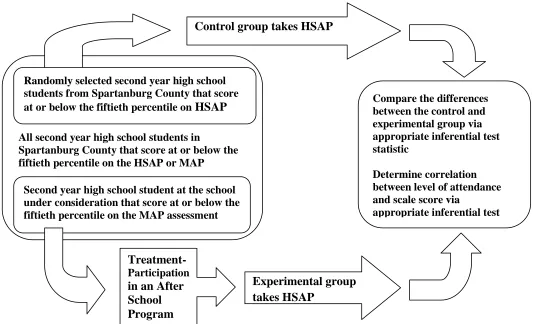
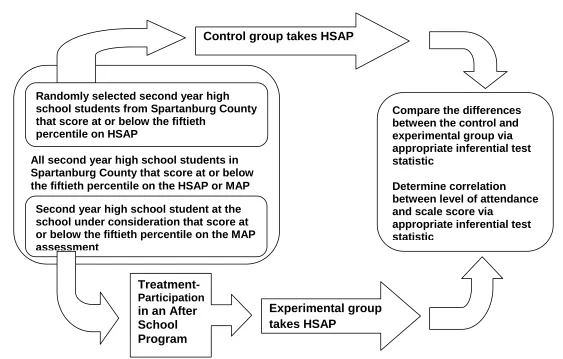
Study Diagram
Figure 1.1 Study diagram illustrates research process
Control group takes HSAP
All second year high school students in
Spartanburg County that score at or below the fiftieth percentile on the HSAP or MAP
Experimental group takes HSAP
Compare the differences between the control and experimental group via appropriate inferential test statistic
Determine correlation between level of attendance and scale score via
appropriate inferential test statistic
Treatment-
Participation
in an After School Program
14
The study diagram illustrates the described research. The total population
considered consists of all second year high school students in Spartanburg
County, South Carolina that score below the fiftieth percentile on HSAP or MAP.
The experimental and control groups are selected from this total population as
shown in the diagram. The experimental group receives the treatment and then
the data for the control and experimental groups are compared following the
culminating test, the HSAP. The correlation question does not require a control
group for consideration. The correlation question will attempt to determine if
there is a link between the number of after school sessions attended and the
scale score on the HSAP.
1.4 Research Questions
All Students
1. Is there a statistical difference between the mean scores on the HSAP test
of students who participate in an academically focused after school program and
the mean scores of the bottom fifty percent of all HSAP test takers in
Spartanburg County, South Carolina in both English Language Arts and
Mathematics?
Male Students
2. Is there a statistical difference between the mean scores on the HSAP test
of male students who participate in an academically focused after school
program and the mean scores of the bottom fifty percent of all male HSAP test
takers in Spartanburg County, South Carolina in both English Language Arts and
15
Female Students
3. Is there a statistical difference between the mean scores on the HSAP test
of female students who participate in an academically focused after school
program and the mean scores of the bottom fifty percent of all female HSAP test
takers in Spartanburg County, South Carolina in both English Language Arts and
Mathematics?
Correlation
4. Is there a correlation between the level of student participation in an
academically focused after school program and the scale scores on the HSAP for
either the English Language Arts or the Mathematics component of the HSAP
test?
Each research question is important to the overall study. Research
questions two and three consider if the effectiveness of an academically focused
after school program is gender specific. This is important to note because if the
after school program is not effective for either boys or girls, then the educator
needs to consider how to best meet the needs of each student. A great deal of
time and money goes into after school programs and if the program is not
effective, why continue the effort? The final research question considers if the
level of participation in an academically focused after school program relates to
the scale score. This question is important because it will help the administrator
consider the scope and length of a program in relation to the overall program
16
1.5 Significance
Public schools have served notable and valuable purposes since its
inception. Academically preparing the next generation of citizens has been one of
the cornerstones of the American educational system (Dynarski et al., 2004).
This study is significant because after school programs have become an
important academic and social tool for both the school and community (Dynarski
et al., 2004). The proliferation of after school programs is one way that the public
school systems of America are meeting academic and social challenges
(Dynarski et al., 2004). The amount of capital and human resources invested in
after school programs must be examined and justified (Farmer-Hinton, 2004). In
broad terms, this study will examine the relationship between an academically
focused after school program for high school students and academic
achievement as measured by a standardized test. This research will assist in
constructing the informed literature regarding the academic impact of after school
programs on the secondary level.
1.6 Delimitations and Limitations
Although this quantitative study serves to augment to the current body of
research on the relationship between participating in an academically focused
after school program and increased academic achievement, one must use
caution when making generalizations based on this research. There are several
limitations and delimitations that apply.
17
First, this study is delimited by context. The researcher only examined
students in the second year of high school attending a particular high school in
rural upstate South Carolina. The students examined were all identified as being
at the fiftieth percentile or below of all standardized test takers. The researcher
did not examine other data or contexts.
Secondly, the researcher only used the South Carolina High School
Assessment Program test in mathematics and Language Arts to collect data on
academic achievement. This research is delimited by the extent to which this test
is reliable and valid.
A third delimitation is the assumed correlation between the students in the
control and experimental groups prior to the treatment. The researcher assumes
similar populations are identified by bottom fiftieth percentiles scores on the
HSAP and the MAP. Moreover, the researcher recognizes that the research is
delimited other possible economic, social, cultural or academic differences in the
control and experimental groups.
A fourth delimitation is the differing level of expertise and vigor invested in
the after school program by each instructor. The study did not control for
differences related to the skill of the instructor.
The researcher noted the following limitations:
First, the study is limited by student motivation. Because students were
selected by MAP scores and required to attend, students may not be motivated
18
Secondly, the study is limited by attendance. Although, participation in the
program is required, attendance discrepancies could impact overall results.
Another limitation is teacher skill and motivation. Approximately twenty
teachers were utilized to provide instruction of this academically focused after
school program. The level of teacher skill and motivation are not controlled and
may cause a disparity in the result.
1.7 Definitions
There are several terms that this study will utilize. For the sake of
convenience and clarity, operational definitions are given below:
After school program - Any formalized program for children that takes place
in the hours directly after school is dismissed. There is not a particular
programmatic or curricular requirement necessary for a program to be
considered an after school program.
Homework Assistance after school program - After school programs
administered by a school or organization designed to assist students in
completing homework and tutoring for the purposes of homework completion.
Academic Enrichment after school program- After school programs
administered by a school or organization designed to teach new concepts, to go
19
Non Academic after school program- After school programs administered by
a school or private organization that supports academic growth through a
possible array of non academic components.
Academically Focused after school program - Any program for children that
takes place in the hours directly after school is dismissed that has academic
achievement as the exclusive goal.
Academic Achievement –Academic achievement is measured by the
performance of a student on the South Carolina High School Assessment
Program (HSAP) test. For this study, academic achievement on the HSAP is
defined as passing both the mathematics and English Language Arts portions of
the HSAP test.
Participant - Any student who attended ten or more of the academically
focused after school instructional sessions.
After school program attendance- Attendance is defined as a student being
present during the entire after school instructional session.
1.8 Organization of Research
The balance of this study is divided into four chapters. Chapter Two is the
review of literature involving after school programs. In Chapter Two, after school
programs will be examined from a programmatic and historical view. Each of the
four types of after school programs will be reviewed with examples. Chapter
20
contains the data, analysis and results for each research question. Chapter Five
summarizes the study, discusses the findings and then presents conclusions and
recommendations. The research concludes with references.
1.9 Summary
After school programs serve a variety of needs that are as individual as each
community. Each after school program has a focus and goal from which the
curriculum and practice flow. Most after school programs have an academic
component as a part of the overall program. Given the requirements of No Child
Left Behind and the limitations of time and space in the school day, educators
have adopted after school programs as a method of lengthening the school day
for the neediest students. Accountability and justification naturally accompanies
the increased flow of funds. Empirical data is needed to determine if after school
programs are worth the resources that the state and federal government have
invested. There is limited research involving after school programs and
secondary schools, and there is even less involving academically focused after
school programs and secondary schools. The purpose of this study is to examine
the relationship between participation in an academically focused after school
21
CHAPTER TWO
LITTERATURE REVIEW
2.1 Introduction
The term “after school program” is used to refer to any structured program
that occurs in the three to four hours directly after school is dismissed (American
Youth Forum, 2006). There are several common terms that are synonymous
with after school programs including “Out Of School Time Programs” and
“Extended Day Programs” (Black, 2004). Regardless of the chosen name, each
particular program has curricular requirements and structural constraints that are
set forth by the funding source of the program (Aspler, 2009).
The purpose of this chapter is to organize and synthesize the current body of
research regarding after school programs in relation to this research. Specifically,
scholarly literature will be reviewed in order to understand the current body of
knowledge regarding the relationship between academic achievement and after
school programs. Currently, there is no consensus on classification or
nomenclature regarding after school programs (Aspler, 2009). Each researcher
classifies after school programs based on the individual constraints and
requirements of the research (Aspler, 2009). The study will classify and analyze
22
school program. After school programs will be organized based on the following
criteria:
1. Homework Assistance Programs - After school programs administered by
a school or organization designed to assist students in completing homework and
tutoring. Homework assistance programs may or may not have a non-academic
component imbedded in the program. Homework assistance programs have
improved academic achievement as the stated goal or outcome.
2. Academic Enrichment Programs - After school programs administered by
a school or organization designed to teach new concepts, to go beyond the
basics and support academic growth. This type program goes beyond just help
with homework, but may have homework completion as a goal or component. It
seeks to support academic achievement through new instruction and
experiences. Academic enrichment programs have a non-academic component
imbedded in the program. The non-academic component may include mentoring,
arts, athletics, or recreation. Academic enrichment programs have improved
academic achievement as a stated goal or outcome.
3. Non-Academic Programs - After school programs administered by a
school or private organization that support academic growth through a possible
array of non academic components. Non-academic programs seek to engage
students in non academic activities for the purpose of supervision, character
23
after school art and choral programs as well as Boy/Girl Scouts. Non-academic
programs typically do not have an academic stated goal although they often
provide some academic benefit.
4. Academically Focused Program - After school programs that are
exclusively academic. There are no competing curricular components of the
program. Academically focused programs have increased academic performance
as a stated goal.
The literature review will begin with a historical perspective on after school
programs and continue with an analytical review of each of the above listed
classifications of after school programs. Following the discussion of each of the
types of after school programs, the literature review will focus on the link between
after school programs and academic achievement. Next, chapter two will
discuss the hallmarks of highly effective after school programs. The literature
review will conclude with a summary of the current state of research.
2.2 Historical Perspective
Halpern (2003) conducted a historical review of after school programming
since its inception. After school programs began during the last twenty-five years
of the eighteen hundreds (Halpern, 2003). During this twenty five year period,
several societal changes caused the American family to need additional
supervision for children following school (Halpern, 2003). One of the changes
was the enactment of child labor laws limiting the number of hours and the age at
24
the advent of compulsory education began taking root in several states around
the nation (Halpern, 2003). Moreover, schools were more geographically
accessible due to the increasing urbanization of America brought on by the
Industrial Revolution (Halpern, 2003). Children who lived in urban areas had
easy access to a large number of peers in a small urban neighborhood (Halpern,
2003). One unforeseen result of the newly enacted child labor and compulsory
education laws was the new phenomenon of unsupervised youth and the
accompanying anti social behavior (Halpern 2003). During these years, there
was a notable increase in crime and criminal behavior from youths in the hours
following the dismissal from school (Ascher, 2006). Criminal and delinquent
behavior in school aged children has been linked to inadequate supervision
during the hours after school (Walker and Abreton, 2005).
The first after school programs were designed to rescue boys and girls from
the dangers of industrialized life in the urban communities during the final quarter
of the eighteen hundreds (Halpern, 2003). These programs were organized by
individuals or churches and were often no more than a safe place for children to
play games and socialize (Halpern, 2003). By the turn of the century, after school
programs typically provided a wide variety of gender specific activities (Halpern,
2003). For example, a boy may have opportunities in metal working, wood
working, radio repair, debate, hiking, or photography (Halpern, 2003). Likewise,
girls who participated in after school programs may have been offered activities
25
Once the legal working age had been reached, some after school programs
of the era began to prepare urban boys and girls for various vocations (Halpern,
2003). The vocational education component grew naturally from the activities the
after school programs were already implementing (Halpern, 2003). During the
early period of after school programs, schools were largely uninvolved in student
life beyond the end of the school day. The local schools did not want to take on
the additional responsibility of after school supervision in addition to the
established educational duties (Halpern, 2003).
Early in the nineteen hundreds, government and civic leaders recognized an
existing conflict between the unsupervised urban youth and the need of society
to maintain law and order (Halpern, 2003). In the first quarter of the 1900’s,
municipal authorities began to provide outdoor playgrounds and indoor organized
recreational activities for children in order to address the growing safety and
criminal concerns (Halpern, 2003). The modern After School movement would
develop out of these foundations.
The Great Depression changed the focus and funding for after school
programs (Halpern, 2003). Children used after school programs as a refuge to
escape homes that were economically and psychologically depressed (Halpern,
2003). During this same time period, funds for after school programs diminished
and many closed or had to scale back the variety of activities (Halpern, 2003).
The election of Roosevelt, the advent of New Deal, and the onset of World
26
order to aid the war effort and to supplement a depleted work force, women
entered the work place in record numbers (Halpern, 2003). Because the nation
desperately needed the women in the work force, the federal government began
to provide limited funds to support after school programs so children would be
supervised and women could work in industrial and military production (Bodilly
and Beckett, 2005). This was the first time federal dollars supported after school
programs (Gayle, 2004). According to Gayle (2004), before World War II,
government and civic leaders thought the responsibility for supervising youth
after school was best left to community organizations, such as the YMCA and
Boy Scouts of America. After school programs helped supervise children and
provide positive support to families with both parents involved in the war effort
(Bodilly and Beckett, 2005).
The post war years can be characterized as a return to the pre-war normalcy
and traditional routines (Halpern, 2003). Likewise, after school programs
reverted back into the models popular in the pre-war years (Halpern, 2003). In
the late 1950’s and early 1960’s society again began to change in several critical
ways that prompted significant changes in how after school programs would
operate for the next thirty years (Halpern, 2003). First, Juvenile Delinquency
entered the national conscience and brought fear and concern to families across
the country (Halpern, 2003). Juvenile delinquency is behavioral disorder
characterized by despondent anti-social behavior and is especially prevalent in
males in their mid to late teens (Halpern, 2003). Juvenile delinquency became a
27
the associated negative influences (Halpern, 2003). After school programs began
initiatives to enhance the self esteem of children and give them an opportunity to
succeed in vocations, athletics and the arts (Halpern, 2003). Secondly, many
urban neighborhoods became toxic environments for the families living there
(Halpern, 2003) These low income neighborhoods were once stable, working
class, family oriented environments; now they were being assailed by
unemployment, drugs, gangs, and the disintegration of the family unit (Halpern,
2003). Street gangs and turf wars in low income urban areas became common
(Halpern, 2003). Drugs became ubiquitous on the streets for the first time during
this era and contributed to both juvenile delinquency and the breakdown of urban
neighborhoods (Halpern, 2003). Administrators of after school programs were
now struggling with management and discipline issues of the participants
(Halpern, 2003). It is also during this era when after school programs began to
experiment with providing academic assistance for struggling students (Halpern,
2003). The academic assistance offered was most often not formalized and took
the form of help with homework or tutoring on an individual basis (Halpern,
2003).
During the 1970’s and 1980’s, the number of two-income families continued
to increase, and the need for positive outlets for children in the hours after school
continued to grow (Halpern, 2003). Accordingly, the number of after school
programs continued to grow steadily and slowly during these two decades with
minimal increases in federal and state funds. During these decades, the federal
28
assist in the supervision of at risk youth during the hours after school (Halpern,
2003). During this period, after school programs continued to offer recreational,
vocational, and entertainment outlets for children (Halpern, 2003). There was
limited academic assistance for students participating in after school programs
(Halpern, 2003).
Throughout the 1990’s and 2000’s, after school programs have experienced
an increase in the number after school programs and a change in the overall
focus (Halpern, 2003). The onset of the educational accountability movement
and the accompanying federal and state dollars has given rise to greater
numbers of after school programs than ever before (Halpern, 2003). Most of the
new after school programs that were started between 1990 and 2000 were
administered by local schools (Halpern, 2003). These schools needed additional
time for academic assistance and remediation with struggling students (Halpern,
2003). Academic remediation and achievement became the primary focus of
after school programs during these decades (Halpern, 2003). Additionally,
government and civic leaders came to understand that it is more economical to
provide structure to children after school than to try to incarcerate and rehabilitate
juvenile delinquents (Gayle, 2004). Moreover, a critical mass of scholarly
research connected after school programs with providing effective help for at risk
youth (Gayle, 2004).
During the mid 1990’s, states began after school initiatives to provide
academic support and social structure during the critical hours after the dismissal
29
after school program known as the 3:00 Project. This project addressed at risk
middle school aged children and was also designed to promote safety and
academic success through tutoring and homework assistance (Gayle, 2004).
Likewise, Tom Caper, then serving as the Governor of Delaware, spearheaded a
statewide after school program designed to improve academic performance of
low-performing students in mathematics, science, English, and social studies
(Gayle, 2004). Under his leadership, Delaware invested over twenty million
dollars in extending instructional time and providing additional support to
struggling students (Gayle, 2004). Legislators in California launched a statewide
after school program known as the After-School Learning and Safe
Neighborhoods (Gayle, 2004). This particular program was designed to provide
literacy, safety, and academic support for students beginning in kindergarten and
continuing through the ninth grade (Gayle, 2004).
The federal government’s effort to regulate and fund After school programs
began with Senator James Jeffords of Vermont and Representative Steve
Gunderson of Wisconsin who introduced the 21st Century Community Learning
Centers Act (21st CCLC) (Gayle, 2004). This act was designed to provide grants
to rural and inner-city public schools for academic achievement and overall
student growth (Gayle, 2004). Officials in the Clinton administration sought this
opportunity as a means to promote their out-of-school time agenda (Gayle,
2004). In President Clinton’s first fiscal year, the 1993 budget, he proposed an
800 million dollar increase to the 21st CCLC program over a five-year period
30
after school programs and funded new services in existing after school programs
(Gayle, 2004). By fiscal year 2001, the federal budget for the 21st Century
Community Learning Centers was 845.6 million dollars (Gayle, 2004). President
Bush’s No Child Left Behind (NCLB) law continued in this movement by
mandating 250 million dollar increases to the 21stCCLC program each year for
the next six years, reaching a level of 2.5 billion dollars in fiscal year 2007
(Gayle, 2004). Gayle (2004) states that in less than one decade, the 21st CCLC
program grew from a small pilot project to an integral part of the nation’s largest
federal education reform law since 1965.
The shift in funding from private to public has changed the format, scope,
and models of after school programs (Dynarski et al, 2004). The No Child Left
Behind legislation changed the model that the federal government used to issue
funds for after school programs to the states (Zang and Byrd, 2006). Prior to
NCLB, only the after school programs that met the uniform requirements of the
federal law were funded by the federal government (Zang and Byrd, 2006).
NCLB allowed states to apply for federal block grants with broader
implementation guidelines (Zang and Byrd, 2006). The block grants gave states
greater flexibility to implement after school programs to meet the specific needs
of the students (Zang and Byrd, 2006). The federal block grants provided to
states and then in turn to local organizations had fewer federal stipulations and
allowed greater freedom to meet contextual needs (Archer, 2004).
The change from 21st CCLC to NCLB impacted the curriculum of after school
31
in order to qualify for a 21st CCLC grant a program had to provide academic
support, wide ranging enrichment opportunities in the arts and music, and offer
family literacy (Zang and Byrd, 2006). The federal block grants made academic
achievement and reaching historically underachieving groups the curricular and
fiscal mandates of NCLB After school programs (Archer, 2004). NCLB legislation
has brought an increased focus and emphasis on the individual student by
requiring states to test every student in English, math, science, and social studies
in grades three to eight (Archer, 2004). Additionally, NCLB mandated that
federally funded after school programs be used to enhance student learning and
be based on scientific research (Zang and Byrd, 2006).
Currently, there are more after school programs available than ever before
(Zang and Byrd, 2006). The models and curricula are as varied as the funding
mechanism and community needs allow (Zang and Byrd, 2006).
A survey of current research does not yield a consistent classification
methodology for after school programs. Individual research studies classify after
school programs formally and informally based on the design and purpose of the
research. This study will classify after school programs based on the academic
component in the after school program. An analysis of current research reveals
four general types of after school programs based on academic components:
1. Homework Assistance Programs
2. Academic Enrichment Programs
32
4. Academically Focused Program
Each type of program has been evaluated by the literature and will be
reviewed and analyzed individually.
2.3 Homework Assistance Programs
A homework assistance after school program is any after school program
administered by a school or organization designed to assist students in
completing homework and tutoring for the purpose of homework completion.
Homework assistance programs have been a staple of the after school program
for over twenty years (Cooper et al, 2006). This model relies on the premise that
time spent on academics is highly correlated to improved grades and academic
achievement (Cooper et al, 2006). In successful homework assistance after
school programs participants and parents of participants value the program as
positive and view the program useful in achieving the stated academic or social
goals (Gayle, 2004). Additionally, successful homework assistance programs
have a teaching staff that is vested in the school’s academic performance (Gayle,
2004). In other words, a successful homework assistance after school program
will be staffed by teaching faculty from the school (Gayle, 2004). When the
faculty in a homework assistance program is invested in the overall academic
program at the school, then they improve communication between stakeholders
and they are actively involved in recruitment and retention of participants in the
33
There is descriptive research to support the notion that student participation
in a homework assistance program has a positive impact on academic
achievement (Hollister, 2003). Hollister (2003) conducted a study that relied on a
survey completed by participants, parents of participants, and instructors. This
study established a link between participation and improved academic
achievement (Hollister, 2003). Instructors report that 40-50% of the participants
in homework assistance after school programs demonstrated an increase in the
amount of completed homework (Hollister, 2003). Parents of participants report
that 85% of participants reaped a benefit from participation in a homework
assistance program (Hollister, 2003). The surveys completed by students show
that over 50% of the students believed that participation in a homework
assistance program helped them to improve academic performance (Hollister,
2003).
An examination of experimental research into a homework assistance
programs’ efficacy for improving academic achievement has yielded mixed
results. One study conducted on elementary students in California required that
randomly selected students participate in homework activities for at least
forty-five minutes three times a week (Codsen et al, 2001). The researchers collected
data for students in both the control and experimental group regarding homework
completion, GPA, and SAT-9 scores (Codsen et al, 2001). The research showed
no significant difference (p < 0.1) between the control and treatment groups
34
In another Homework assistance program study, over 900 children in grades
three to seven were randomly assigned to a control and experimental group
(Philliber, Kaye and Herrling 2001). The experimental group was required to
participate in a homework assistance program for at least thirty minutes three
times a week (Philliber, Kaye and Herrling 2001). The control group did not
participate in a homework assistance program (Philliber, Kaye and Herrling
2001). The four hundred eighty-five participants of the treatment group had a
significant increase in the quality and completion of their homework over the four
hundred fifty-six control participants (p<.05) (Philliber, Kaye and Herrling 2001).
The homework assistance program is a widely employed model for the after
school programs. Although the homework assistance model is quite popular, the
literature is not conclusive regarding the efficacy for increased academic
performance as measured by standardized tests. There is significant evidence
to support a link between participation in a homework assistance program and
increased homework completion.
2.4 Academic Enrichment Programs
An academic enrichment program is an after school program designed to
teach new concepts, to go beyond the basics, and support academic growth.
Academic enrichment after school programs are designed to promote academic
achievement by direct academic instruction and through a non academic
35
dance, athletics, mentoring, or help with homework in conjunction with academic
instruction in order to impact the total child (Miller 2001).
After school programs utilizing the academic enrichment model appear to
have higher levels of influence on the academic achievement than after school
programs designed in the homework assistance model (Miller, 2001). In 2005,
the National Association of Elementary School Principals studied ten academic
enrichment after school programs that served at risk youth in differing contexts.
The participants demonstrated higher levels of homework completion and an
increase in academic achievement when compared to levels before participation
in the study (Miller, 2001).
Another study conducted by the University of Chicago by Whalen (2007)
analyzed a system wide effort to implement academic enrichment after school
programs in Chicago area schools (Whalen, 2007). The study included over 110
schools implementing specific programs in response to contextualized measures
(Whalen, 2007). Each site had to design and submit a specific plan to provide
direct academic enrichment and to engage the total child (Whalen, 2007). The
program duration was three years and empirical data points were measured
every year through standardized tests (Whalen, 2007). The study concluded that
“no strong relationship, positive or negative, emerged between linking the
number of days of attendance to improved math or reading course grades”
(Whalen, 2007). Furthermore, “attendance at the program correlated very
weakly, but positively with reading percentile, math percentile, and science
36
In contrast, a study in California (2002), suggests the effectiveness of an
after school programs that had only two mandates: literacy and educational
enrichment. Non academic components were also allowed by the funding
mechanism and were broadly employed (California, 2002). Upon evaluation of
the program, the data shows a “positive impact on participating students’
achievement as measured by SAT-9 reading and math scores…. and improved
grade point averages as reported by the local programs” (California, 2002).
Additionally, this study linked participation in the afterschool program and
improved attendance, improved attitude about school, and unusually high levels
of support from participants, parents, teachers, and administrators (California,
2002).
Research supports a contextualized link between academic enrichment after
school programs and increased academic achievement. The specific curriculum,
staffing, and commitment of the stakeholders all impact the overall success of the
program. An academic enrichment after school program may improve academic
achievement if the context and contributing factors work together effectively.
2.5 Non-Academic Programs
Non-academic after school programs are the oldest type of after school
programs (Halpern, 2003). These programs do not have an academic
component, but may have an academic benefit due to the other components of
the program. They have their roots in the last quarter of the 1800’s (Halpern,
37
vogue due to the abundance of public dollars that require an academic
component of some variety (Chung, 2005).
In 2002, Stephan P. Klein and Roger Bolus of Gansk and Associates
conducted a study involving fourth graders and a non academic after school
program (Chung, 2005). The after school program curriculum involved creative
outlets like art, dance, music, and sports (Chung, 2005). Even though there was
no mathematical instruction during the program, the participants in the program
gained an average of 45 points on the mathematics achievement test during the
course of the school year, as opposed to 26 points for non-participating
classmates (Chung, 2005). The researchers attribute the results to the students’
overall well-being, improved problem solving, improved interpersonal skills, and
improved communication skills (Chung, 2005). This study linked a change in the
“soft skills” to the increased academic performance as measured by a
standardized test (Chung, 2005).
Another study by Galvin (2010) highlighted the overall positive outcomes that
an academic after school program provides. The study examined an after school
program designed to teach fitness, nutrition, and personal responsibility (Galvin,
2010). The Colorado based study was a two phase approach (Gavin, 2010).
Phase one was the creation of an after school fitness club for low socioeconomic
status students (Gavin, 2010). The club met twice a week for sixty minutes
(Gavin, 2010). Each session included a thirty minute fitness lesson, and a thirty
minute lesson on either nutrition or responsibility (Galvin, 2010). The second
38
2010). The service project allowed the students a live venue to demonstrate the
newly acquired skills for responsibility and fitness that has been at the core of the
curriculum (Galvin, 2005). At the conclusion, of the study, students involved in
the non academic after school program showed greater responsibility in school
as demonstrated by attendance records and homework completion (Galvin,
2005). The students also demonstrated higher levels of personal fitness than
other low socioeconomic students (Galvin, 2005). The researchers did not
explore if participation in this non academic after school program correlated with
increased academic achievement as measured by grades or standardized tests
(Galvin, 2005)
Non academic after school programs are successful at engaging the whole
child and providing meaningful activity during the hours after school. Research
informs us that participation in non academic after school programs highly
correlates with improved academic success as measured by improved
attendance, improved homework completion and improved levels of
responsibility. In short, students who participate in non academic after school
programs may develop non academic skills that may in turn lead to greater levels
39
2.6 Academically Focused Programs
An academically focused after school program has academic achievement or
enrichment as its only goal. There are no other competing curricular or
programmatic components. Generally speaking, academically focused after
school programs have a strong record of supporting academic achievement on
standardized tests, especially in mathematics. Furthermore, academically
focused after school programs also have issues with consistent participation and
participant motivation.
One example of an academically focused after school program involved
twenty four at-risk students in grades seven to nine (Hock et al, 2001). The
students were identified as at-risk by academic record and teacher
recommendation (Hock et al, 2001). The parents or guardians had to support the
placement in the program (Hock et al, 2001). Each participant received one on
one specific tutoring from a trained researcher during the duration of the program
(Hock et al, 2001). The researcher worked with the students, teachers, and
parents to target specific weaknesses for each child (Hock et al, 2001). Each
child participated in two tutoring sessions per week for four to twelve weeks
depending on the specific needs of the student (Hock et al, 2001). At the end of
the study, participants had higher semester grades and higher grades on
classroom assessments than they had before participation in the program (Hock
40
In a study conducted by Black et al (2009), researchers sought to determine
a link between structured academic instruction in reading or math during after
school hours and increased performance in the academic subject. The
researchers identified twenty-seven after school centers across ten states in
urban, rural and suburban settings (Black et al, 2009). The study focused on
students in middle and upper elementary school that voluntarily attended one of
the selected academically focused after school programs and were between one
and two grade levels behind in both math and reading (Black et al, 2009). Each
identified participant received forty five minutes of direct academic instruction in a
small group setting either one or two times a week depending on the academic
need of the child (Black et al, 2009). The program took place over a one or two
year period (Black et al, 2009). The intervention curriculum was prescribed by the
researchers and each participating instructor in the program pledged to
implement the curricular components with fidelity (Black et al, 2009). Academic
achievement was measured by scores on the SAT 10 total math and reading
scores (Black et al, 2009). The study had several intriguing conclusions: (1)
participants in the study demonstrated a positive and statistically significant
increase in mathematics achievement at the end of one year of instruction, (2)
participants in the study demonstrated no statistically significant increase in
mathematics achievement at the end of the second year of instruction beyond
the gains made during the first year, (3) participants in the study demonstrated
no statistically significant increase in reading achievement at the end of one year